Empowering Women: A Future-Ready Workforce
- Date: Tuesday, 29 August 2023, 4:00 PM
Venue: Lavender Hall, BMICH, Colombo (livestreamed on WPAN’s and the Advocata Institute’s Facebook page and YouTube channel)
Host: Women’s Policy Action Network (WPAN)
Supported by: Kingdom of the Netherlands
Facilitated by: Advocata Institute
Keynote Speaker: Lakmini Wijesundera, Co-Founder & CEO, IronOne Technologies and BoardPac
Overview
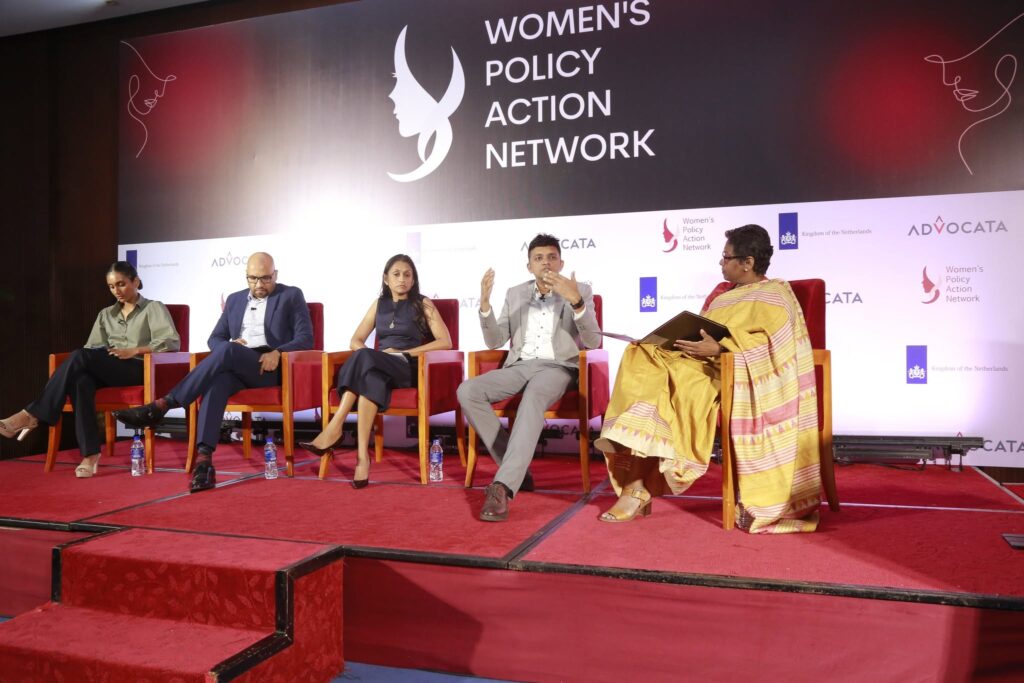
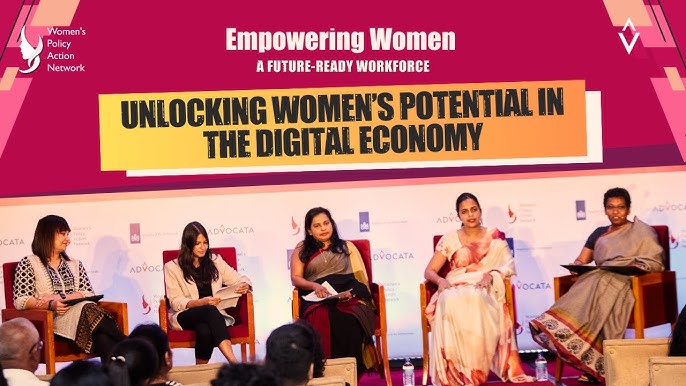
On 29 August 2023, the Women’s Policy Action Network (WPAN) convened “Empowering Women: A Future-Ready Workforce” at Lavender Hall, BMICH, bringing together policymakers, private sector leaders, researchers and civil society representatives to examine two of the most persistent structural barriers to women’s economic participation in Sri Lanka: inadequate social infrastructure and unequal access to the digital economy. The conference was held against the backdrop of Sri Lanka’s worst economic contraction since independence, a period in which the country’s ongoing IMF-supported reform agenda has made the question of how to expand and diversify the labour force more urgent than ever. With female labour force participation stagnating at around 30–35% despite comparatively high levels of female literacy and education, WPAN framed the conference around a simple premise: sustainable economic recovery is not possible without deliberately removing the barriers that keep women out of the workforce.
The event was structured around two moderated panel discussions — one on social infrastructure and one on digital infrastructure — each grounded in original research conducted by WPAN in partnership with the Advocata Institute, LIRNEasia and Verite Research, and supported by the Kingdom of the Netherlands.
Keynote Address
The conference opened with a keynote address by Lakmini Wijesundera, Co-Founder and CEO of IronOne Technologies and BoardPac. Drawing on her experience building and scaling technology businesses in Sri Lanka, the keynote set the tone for the day by connecting the country’s broader digital transformation ambitions to the specific question of who gets to participate in that transformation. The address underscored that closing gender gaps in leadership, entrepreneurship and digital access is not simply a matter of fairness, but a practical necessity for building a workforce and an economy resilient enough to weather future shocks.
Session One: Digital Infrastructure — Unlocking Women’s Potential in the Digital Economy
The first panel discussion centred on WPAN’s policy brief, Unlocking Women’s Potential in the Digital Economy, which examined how accessibility, affordability, digital literacy and the state of digital payment systems shape women’s ability to participate in digital entrepreneurship and e-commerce.
Accessibility emerged as a foundational constraint. While Sri Lanka has achieved relatively high network coverage compared to regional peers, the panel highlighted that coverage alone does not translate into meaningful access — network performance, download speeds and the availability of public Wi-Fi all lag well behind regional benchmarks. Roughly 2,000 locations across the country were identified as “dark spots” with weak or no signal, and 80% of Grama Niladhari divisions were found to lack broadband coverage altogether. Discussants pointed to Sri Lanka’s comparatively modest network of public Wi-Fi hotspots — a fraction of what countries such as Malaysia offer — as a further limitation, particularly for women who cannot afford private data plans.
Affordability was discussed as a compounding barrier. Panelists referenced survey data showing that while phone ownership among women is relatively high, smartphone ownership and internet access through smartphones remain considerably lower, particularly in rural and estate sectors. Notably, the research found that Sri Lankan women largely do not face the “permission barrier” seen in some other South Asian countries — the constraint is overwhelmingly one of cost. High telecommunications taxation was singled out as a significant driver of this affordability gap: Sri Lanka’s effective tax rate on internet services was shown to be markedly higher than in comparator countries such as Malaysia and the Maldives, pushing up the price of both connectivity and devices.
Digital literacy was the third pillar discussed. The panel drew attention to a methodological concern raised in the research: Sri Lanka’s official definition of “digital literacy” sets a low bar, counting anyone able to operate a device for even basic functions as digitally literate. As a result, official statistics may overstate genuine digital competency. Even accounting for this, the data presented showed a persistent gender gap in both computer and digital literacy, and a steep drop-off between awareness of the internet and actual, confident use of it — much of which panelists attributed to gaps in IT education and a lack of structured digital-skills training for women entrepreneurs.
Finally, the discussion turned to digital payment systems. Despite the existence of platforms such as LankaQR and JustPay, panelists noted that cash-on-delivery remains overwhelmingly the preferred payment method for e-commerce in Sri Lanka, reflecting low trust in and awareness of digital payment infrastructure. This was framed as a particular obstacle for women-led digital enterprises seeking to reach international markets, where slow and costly cross-border bank transfers discourage business altogether.
The session closed with a set of policy recommendations discussed by panelists, including expanding telecommunications infrastructure into underserved areas, simplifying and rationalising the tax structure on internet services, creating a secondary market for mobile devices, restructuring the school IT curriculum, and developing a standardised, interoperable digital payment interface alongside a national digital identity and e-KYC system modelled on approaches such as India’s India Stack.
Session Two: Social Infrastructure for Gender Equality and Empowerment
The second panel turned to WPAN’s companion brief, Social Infrastructure for Gender Equality and Empowerment, which argues that the unequal distribution of unpaid care work is a “missing link” in explaining Sri Lanka’s persistently low female labour force participation. Panelists noted that Sri Lankan women spend an estimated 54 minutes more per day than men on unpaid caregiving, and that having a child under five in the household reduces a woman’s likelihood of joining the labour force by an estimated 7.4 percentage points. The discussion organised itself around three focus areas identified in the brief: childcare, elderly care and parental leave.
On childcare, panelists discussed the scale of Sri Lanka’s preschool and daycare sector — over 19,000 centres serving close to half a million children, 80% of them privately run — alongside significant gaps in accessibility, affordability and quality assurance. Fixed operating hours that fail to accommodate informal-sector work schedules, and a wide urban-rural gap in preschool attendance, were flagged as key equity concerns. The panel called for standardised regulation of daycare centres through local government by-laws, professionalisation of the caregiving workforce, and incentives for the corporate sector to invest in workplace and public-private childcare partnerships.
The discussion on elderly care was framed around Sri Lanka’s rapidly ageing population: the old-age dependency ratio is projected to nearly double by 2050, a demographic shift occurring at a much lower level of per capita income than in other ageing economies. With only 225 registered elderly care homes nationally — the vast majority privately run and concentrated in the Western Province — panelists agreed that current infrastructure is nowhere near sufficient to meet future demand, and that the burden of elder care, like childcare, disproportionately falls on women. International examples such as Japan’s Long-Term Care Insurance scheme and Mexico’s targeted social protection programmes for older citizens were referenced as potential models for reform.
The final theme, parental leave, generated significant discussion around the asymmetry in Sri Lanka’s current legal framework: maternity leave, while granted for 84 days, is entirely funded by employers — a structure the panel noted can disincentivise the hiring of women — while there is no statutory paternity leave beyond a token three-day allowance for public officers. The John Keells Group’s move to offer 100 days of equal maternity and paternity leave was cited as a private-sector case study in what more equitable leave policy could look like. Panelists also referenced Verite Research’s analysis showing that state-funded maternity leave would cost only around 0.5% of 2021 tax revenue — considerably less than existing welfare expenditure such as the Samurdhi programme — making the case that mandating and funding more equitable parental leave is fiscally feasible.