 Research Publication
Unlocking Women’s Potential in the Digital Economy
29, August 2023
17 min read
Background
Digitalization offers enormous growth opportunities,1 particularly in digital entrepreneurship. Access to digital devices, the internet, digital literacy, and digital payment systems are vital to engage in the digital economy and digital trade activities. E-commerce and digital entrepreneurship are especially beneficial for women, offering flexible working hours, the convenience of working from home and new sources of income.
However, entry to this sector is fraught with challenges, such as lack of access to and the high cost of internet and digital devices as well as the absence of a robust digital payment system. Lack of technical knowledge and expertise further constraints engagement in this sector. While mobile phones are the most common means of internet access, a gender gap exists in mobile ownership and mobile internet usage. This gap is not unique to Sri Lanka. It is a phenomenon seen in many low-income and middle-income countries, with women being 14% less likely than men on average to own mobile phones.2
This policy brief describes how accessibility and affordability of digital devices and the internet, the lack of a robust digital payment system and low digital literacy act as barriers to women’s economic empowerment and digital entrepreneurship in Sri Lanka. Closing the digital divide in these respects can increase employment opportunities for women and stimulate overall economic growth
Accessibility
Lack of access to digital devices and the internet is a significant barrier that prevents women from entering the digital space and engaging in digital enterprises.
Digital infrastructure is defined by the UNDP as, “a set of digital building blocks which are interoperable, built on open standards and specifications providing access to public and private services at societal scale and are governed by enabling rules to drive innovation, inclusion, and competition in the digital economy”3. The availability of digital infrastructure that meets these criteria is what enables accessibility.
Sri Lanka has made some progress in developing its digital infrastructure over the past two decades.4 However, it still trails behind neighbouring countries in expanding broadband internet connectivity.5 Interviews with key stakeholders in the digital sector highlighted the missed opportunities to individuals and the country due to poor digital infrastructure.
Key informants further highlighted that even if individuals had access to the internet, there were still critical issues with internet speeds, download capacity and lack of adequate public Wi-Fi hotspots.
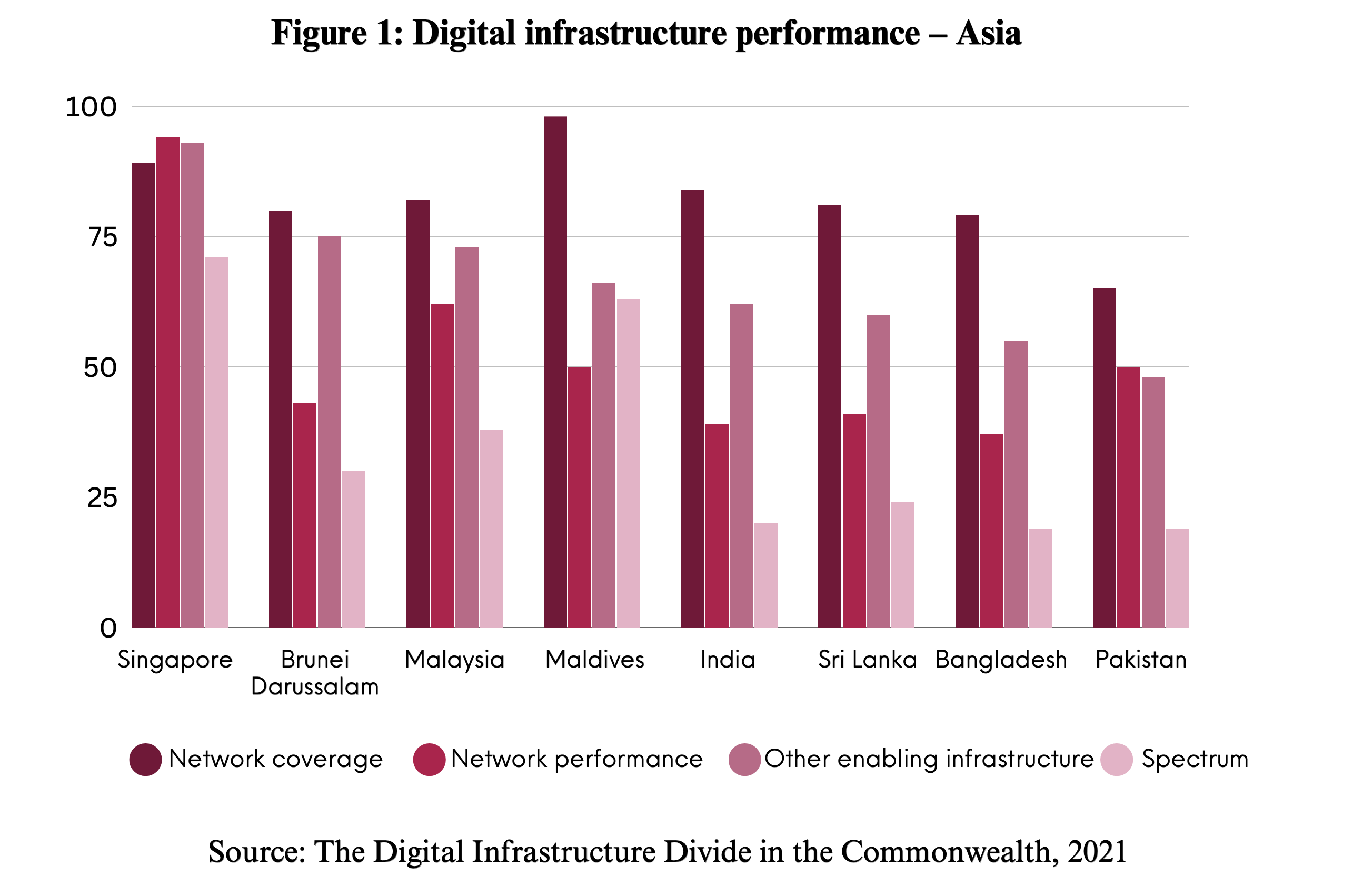
Figure 1 highlights concerns of the standard of digital infrastructure in the country. When comparing the quality of digital infrastructure with neighbouring countries such as India, Bangladesh, Malaysia and Singapore, Sri Lanka exhibits a high network coverage score (of above 80), indicating that there is high network coverage for most of the population6. However despite high network coverage, Sri Lanka lacks network performance, evident by its low average mobile broadband download, upload and latency speeds.7 Sri Lanka has a score of approximately 40 for network performance while Singapore has a score above 90.8 Sri Lanka also scores poorly on other enabling infrastructure, measured by the percentage of the population that has access to basic infrastructure such as electricity, telecommunications, internet bandwidths, secure servers and internet exchange points.9 Spectrum allocation, which is the range of frequencies or radio waves available for wireless communication, is crucial for cellular companies to send data, because different technologies have varying ranges. This allocation ensures that different technologies can effectively transmit data without interference from one another.10 Sri Lanka has a score between 20 to 30 for this component, reflecting a drawback in this area and the need for digital infrastructure improvement in Sri Lanka.
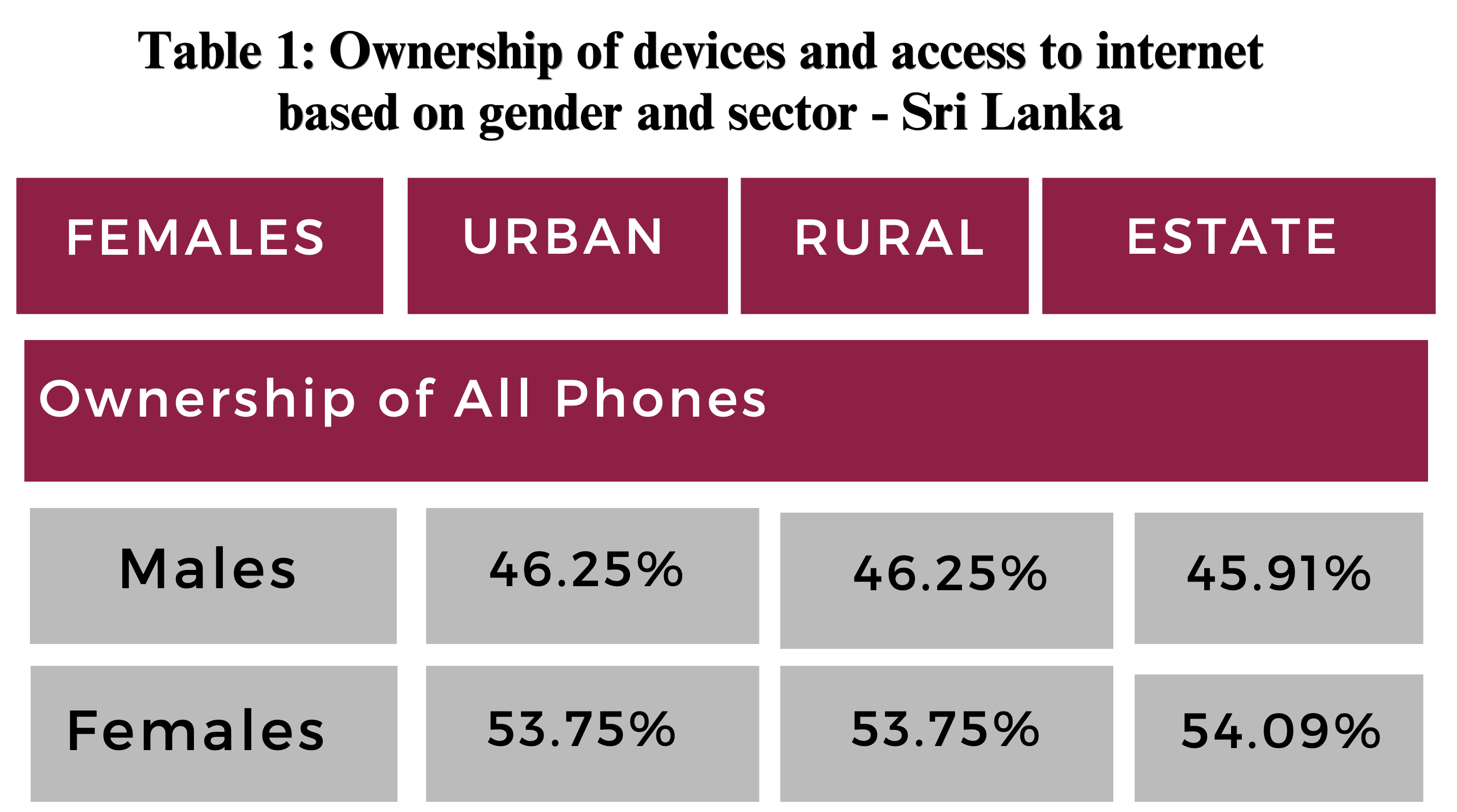
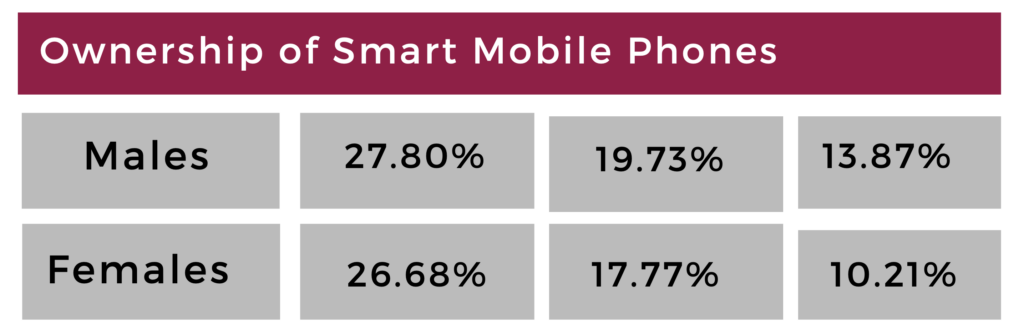
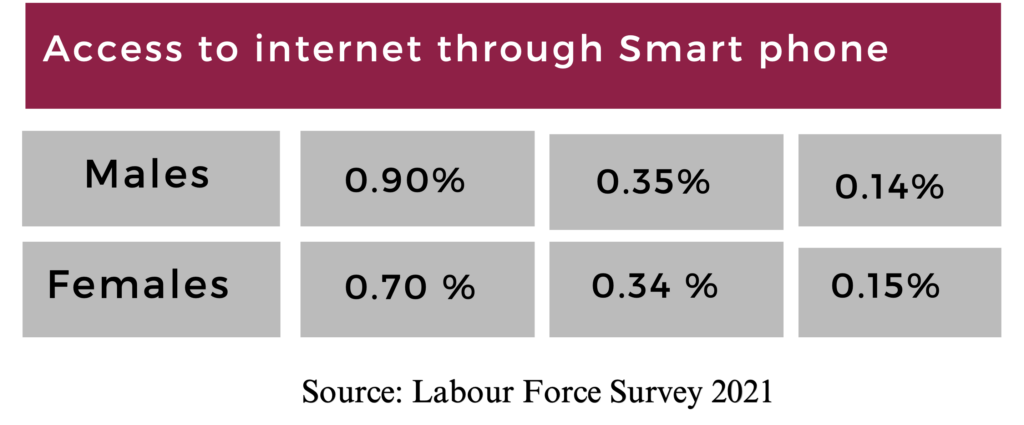
As highlighted in Table 1, while more women have access to all phones, only a small percentage of women own a smartphone and an even smaller percentage access the internet using the smartphone. LIRNEasia’s AfterAccess survey data highlights that only 47% own a smartphone while the majority of those surveyed use either a basic phone (46%) or a feature phone (7%).11 Unlike other South Asian countries, Sri Lankan women do not face the barrier of lack of permission from gatekeepers such as husbands in terms of mobile internet use, but affordability remains a key issue.12
Policy Recommendations
- Invest in expanding the existing telecommunications infrastructure to cover underserved and remote areas. In July 2020, the Director General of TRCSL, Oshada Senanayake, identified 2,000 locations with weak signals, termed “dark spots”, across the country. Furthermore, 80% of the 152 Grama Niladari Divisions lacked broadband coverage.13 Thus, the construction of new cell towers and satellite-based solutions is required. Building more cell towers, especially in remote regions can expand coverage and ensure even remote villagers have access to reliable mobile connectivity.
- According to a key informant, the average download speed for fixed broadband in Sri Lanka is about 20 Mbps. By contrast the global average is about 130.25 Mbps. On mobile devices, the average download speed in Sri Lanka is approximately 15 Mbps while the global standard is 63 Mbps. In Singapore, download speeds are approximately 200300 Mbps. Fiber optics offer much higher bandwidth and faster data transmission compared to traditional copper cables. Laying more fiber optic cables in Sri Lanka especially in underserved areas, can help bridge the digital divide and provide fast and more reliable internet services.
- Sri Lanka lacks adequate public Wi-Fi hotspots. A key informant highlighted that there are approximately 500-600 Wi-Fi hotspots in the country, mainly located in Colombo, Galle and Kandy. She also stated that in comparison, Malaysia has roughly 9,000 Wi-Fi hotspots. Hence, funds must be allocated to build a network of public Wi-Fi hotspots in strategic locations, including urban centers, transportation hubs, public parks, and rural areas. Such access encourages digital inclusion, access to online resources, job opportunities, and educational content.
Affordability
Over the past decade, there have been several revisions in the levies and taxes on telecommunication and internet services. In 2015, Sri Lanka charged the highest sectorspecific tax and fees on the mobile sector in comparison to all other South Asian countries. In 2019, the government introduced a lower tax regime and reduced the Telecommunication Levy from 15% to 11.25%.14 However in 2022, the Telecommunications Levy was raised from 11.25% to 15%.15 All three mobile service providers in Sri Lanka increased call and data tariffs by 20% due to the increase in the Value-Added Tax (VAT) to 15%. Thus, tariffs on mobile, fixed telephone, broadband plans and value-added services (prepaid and postpaid) were increased by 20%.16 The effective tax rate on internet services in Sri Lanka at present is 17.34% (including VAT of 15.3061% and CESS of 2.0408%). The effective tax rate on IDD voice, inbound roaming, Wi-Fi and data-related services (mobile and fixed broadband) is 20.36% (including VAT of 15.07%, other government levies of 2.04% and recovery in lieu of SSCL of 2.62%). High taxes on telecommunications and the internet affect affordability of digital devices and the internet.
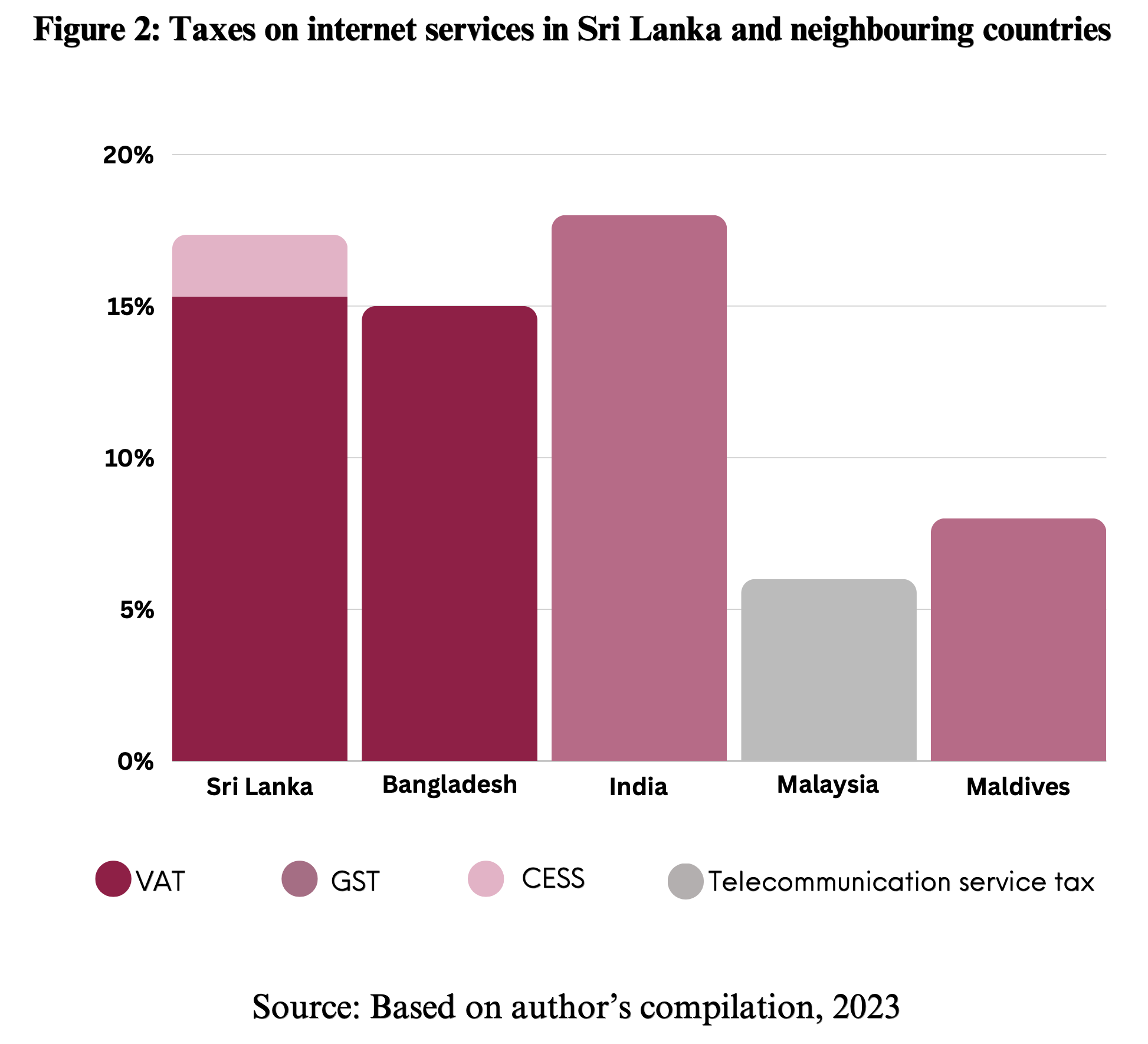
Compared to other countries like Bangladesh, Malaysia and Maldives, the internet services tax in Sri Lanka is quite high. Although the current effective tax rate on internet services in India is marginally higher than in Sri Lanka, it should be noted that, before its digital transformation, the tax in India was low, aiding its citizens to access the internet. . Furthermore, in the period leading up to the digital boom, India hugely improved its digital infrastructure. By contrast, Sri Lanka has experienced frequent fluctuations in internet service quality and telecommunications levies in the past, and it continues to grapple with inadequate digital infrastructure.
Figure 3: Barriers to internet usage
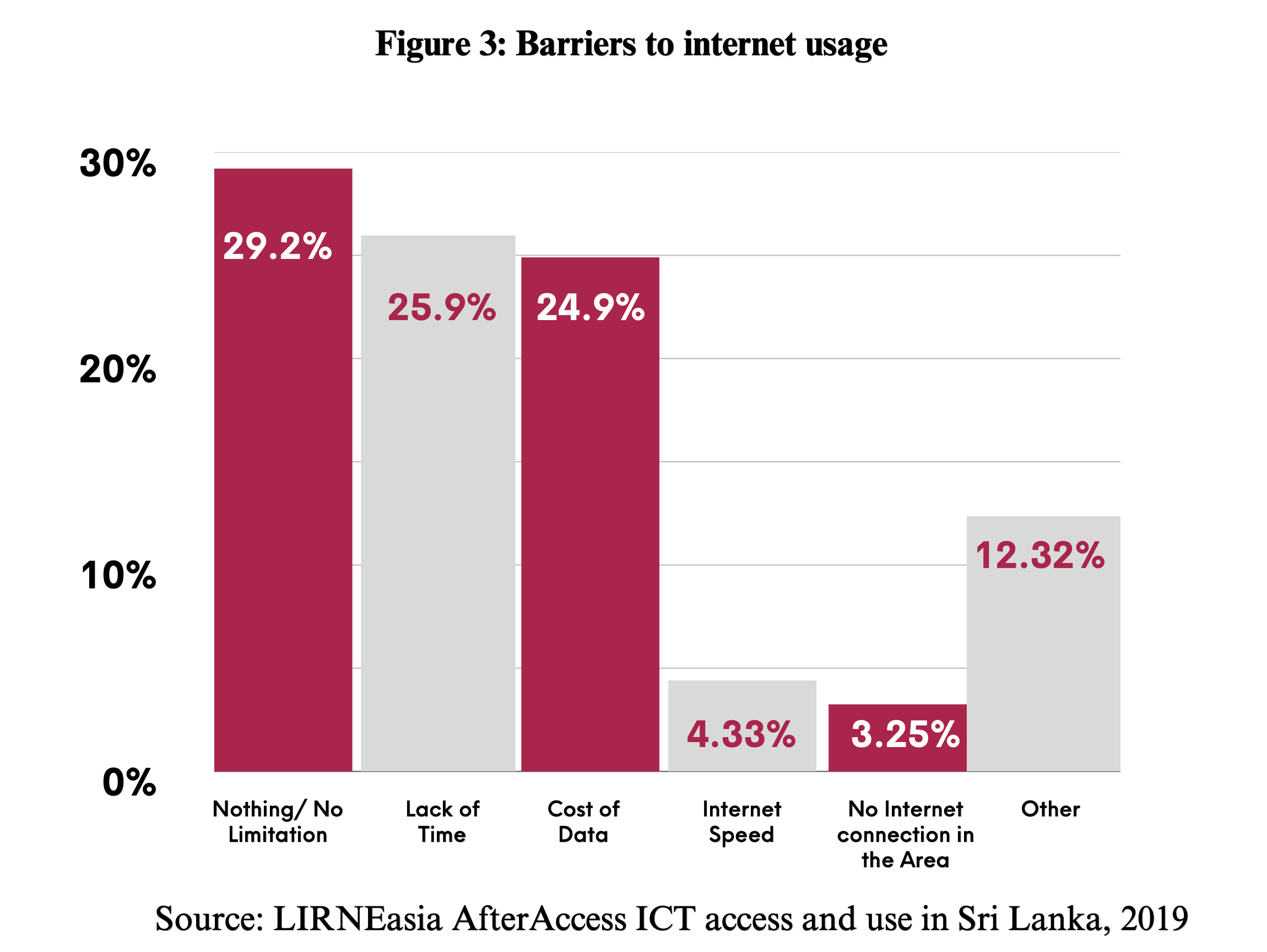
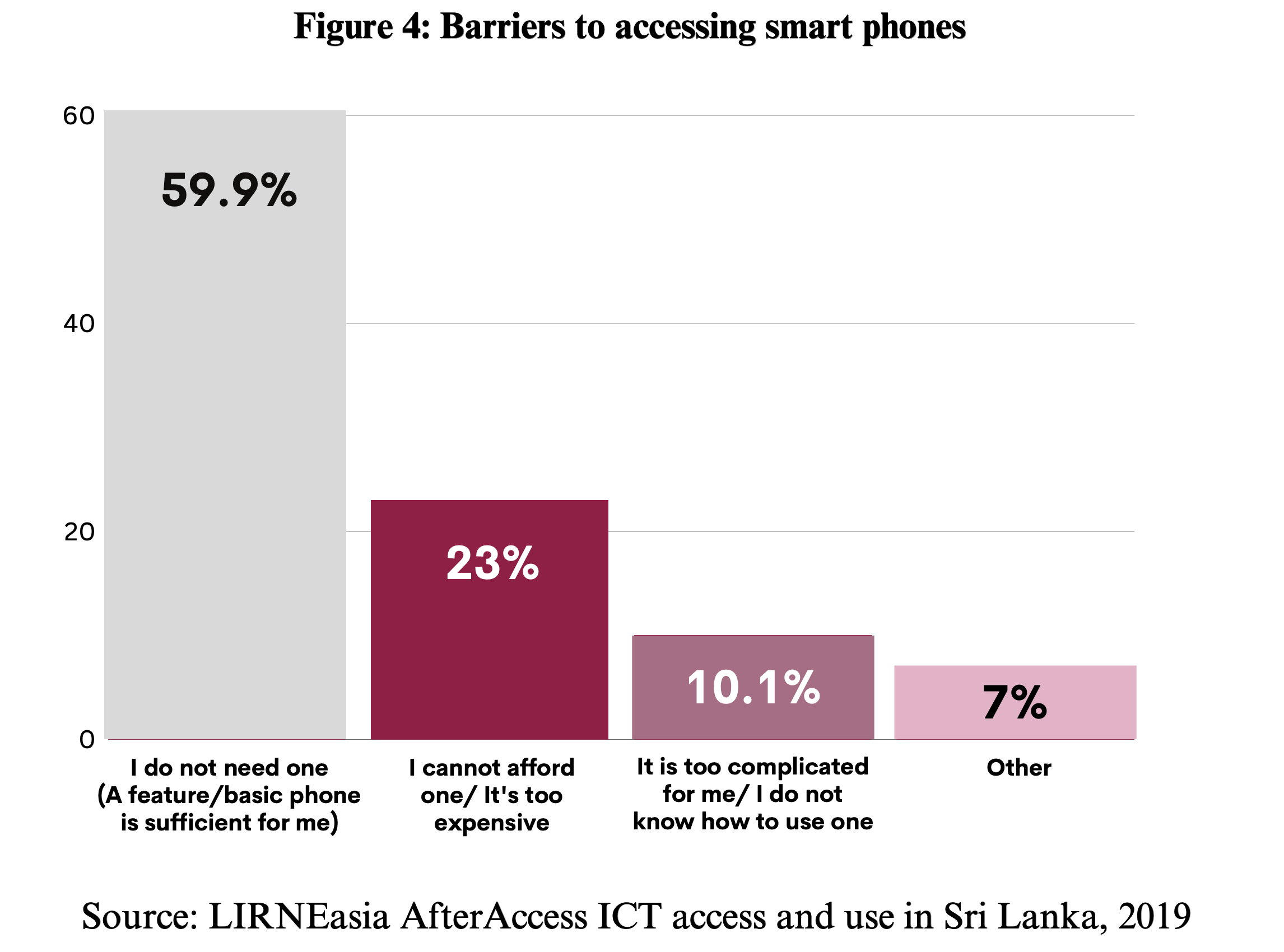
According to a study by LIRNEasia, around 24% of the population finds data costs high and to be a barrier to internet usage.17 Furthermore, 23% of those surveyed did not have smartphones as they cannot afford them or found them too expensive. The high cost of access to the internet and mobile phones disproportionately affects low-income earners who spend a large proportion of their income on essentials such as food, education and health and consequently have less discretionary income to spend on items such as smartphones. The high cost of laptops and other digital devices also hinders women’s access to the digital world.
Policy Recommendations
- Implement a transparent and simpler tax structure for internet services
- Implement transparent pricing models that charge users based on their actual data consumption.
- Exempt certain types of businesses, especially small and medium-sized enterprises (SMEs), from paying telecommunications services taxes. The reduced operational costs could encourage digital entrepreneurship and business expansion.
- Create a secondary market for mobile phones. This policy would not only extend the life cycle of devices but also contribute to a more sustainable and affordable mobile technology ecosystem, while reducing electronic waste and promoting responsible consumption. Access to mobile phones enables engaging in digital economic activities.
- Collaborate with banks and financial institutions to develop instalment payment schemes which will make the purchase of mobile devices more affordable for low income individuals.
Digital Literacy
Digital literacy is defined by UNESCO as the ability to access, manage, understand, integrate, communicate, evaluate and create information safely and appropriately through digital technologies for employment, decent jobs and entrepreneurship. It includes competencies that are variously referred to as computer literacy, ICT literacy, information literacy and media literacy18. It is important to identify the gender gap in digital and computer literacy because due to the existing inequality gap between men and women, even a small gap can have a disproportionate impact.
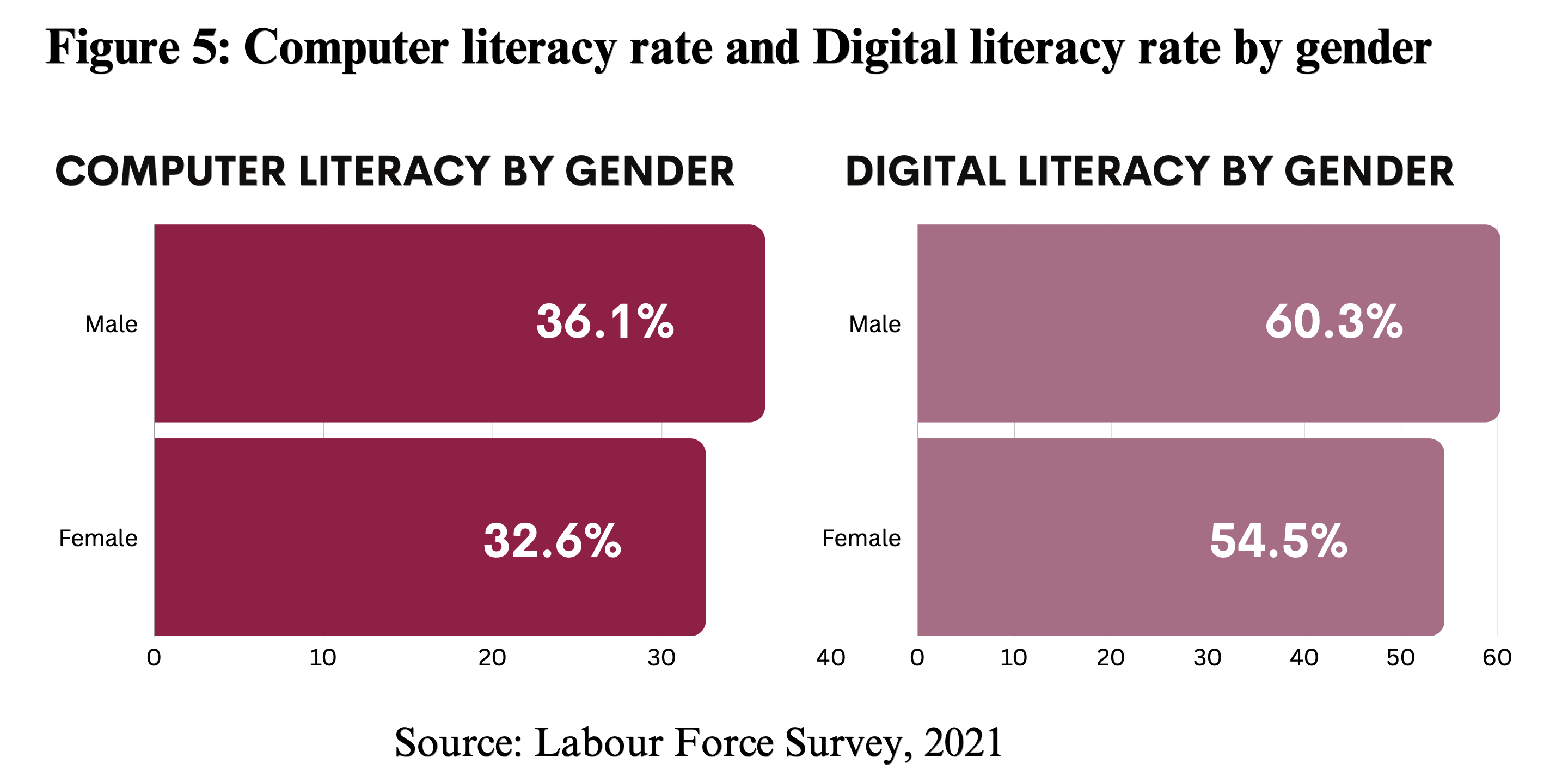
As reflected in Figure 5, although the digital and computer literacy rate for females is positive, it is less than their male counterparts.
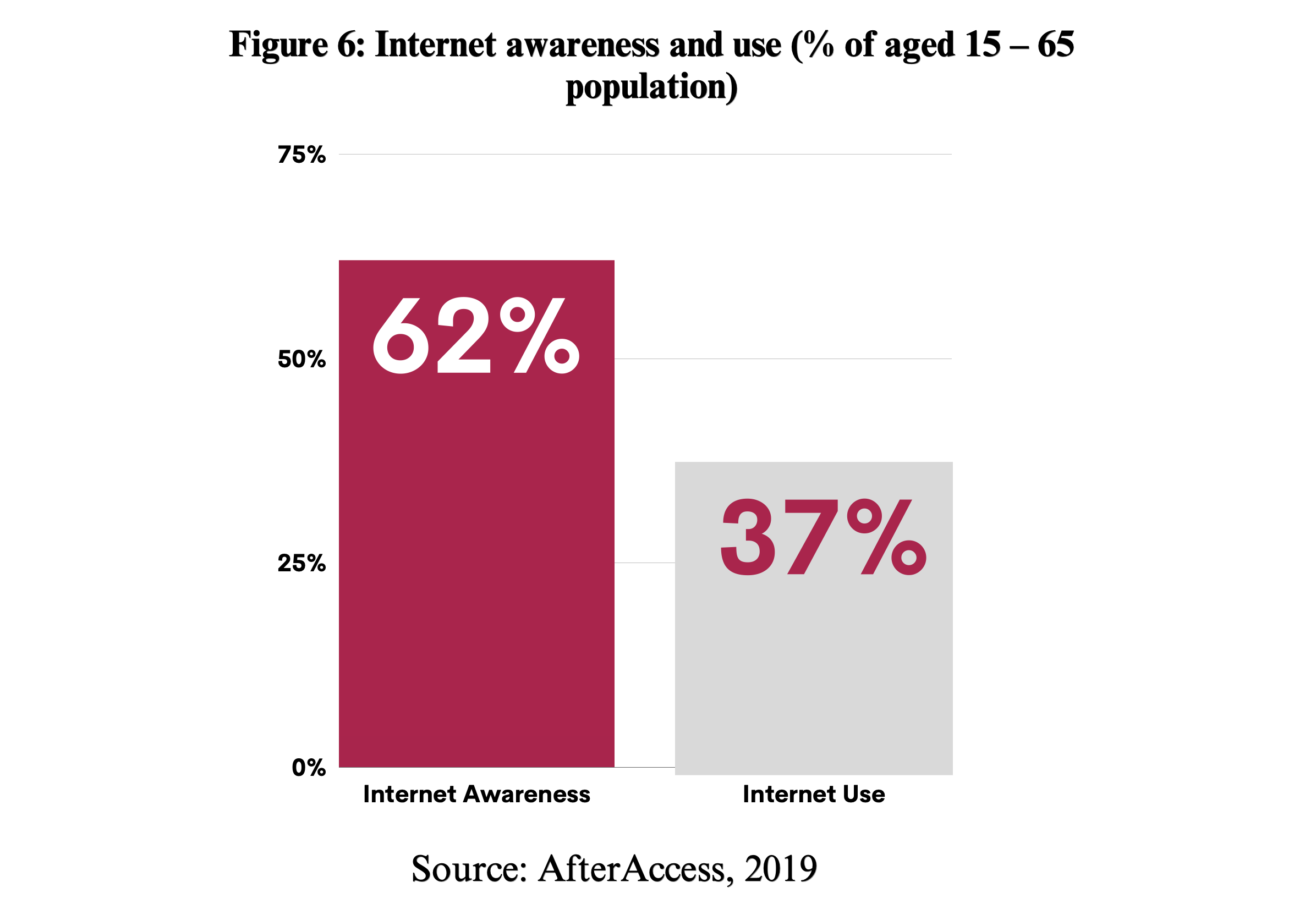
The AfterAccess survey conducted by LirneAsia is a database of mobile phone and internet access and use in the global South. Figure 6 highlights the gap in internet adoption and internet awareness among those surveyed. The lack of digital literacy hinders efficient usage of digital devices and the internet.
The technology adoption hurdle and lack of technical knowhow also persists.
Another issue that was identified as a challenge for consumers is deciding which internet data package offers the best value for money. According to a key informant, consumers often rely on the seller’s recommendation either due to a lack of information or the inability to make an informed decision before making a purchase based on the available information.
Policy Recommendations
- Despite a 57.2% digital literacy rate in Sri Lanka, only 44.5% use digital devices to search the internet and 17.8% to send emails due to the technology adoption hurdle and lack of technical knowhow.19 Hence, even with access to devices, many lack efficient usage skills. LIRNEAsia’s survey shows most time is spent on social media, while the use of devices for online shopping and internet banking is underutilized.20 An in-depth study by SLASSCOM and Daraz on the e-commerce sector in Sri Lanka found that 61% of nonusers avoid e-commerce due to a lack of knowledge.21 To address the lack of knowledge in using digital services, this brief recommends implementing programmes to teach basic IT skills and how to access digital financial services.

- The surveys conducted thus far to understand the state of digital literacy in the country do not provide an accurate picture due to limitations in their methodology. In the Labour Force Survey conducted by the Department of Census and Statistics, any person (aged 5-69) who can use a computer, laptop, tablet or smartphone on his/her own is considered a digital literate person.22 For example, if a 5-year-old child can play a computer game then he/she is considered a computer literate person. Accordingly, even if a person uses a smartphone only for voice calls and does not necessarily use any other features on a smartphone, he/she would be considered digitally literate.23 Hence this definition does not consider proficiency in software usage or internet navigation skills24 and thus does not reflect the true digital literacy of the country.25 These surveys should adhere to international standards in defining “digital literacy”,in order to provide more precise insight into the true digital literacy rate in Sri Lanka.
- According to the AfterAccess survey conducted by LIRNEAsia26, although 62% of Sri Lankans aged 15-65 have heard of the internet, only 37% use it.27 This low number may be due to the lack of quality IT education in schools. Restructuring the school IT syllabus to equip students with essential digital skills such as accessing digital financial services and the effective use of digital devices could enhance digital literacy.
- Implement programmes like “Suhuruliya”, which promotes ICT capacity development for women entrepreneurs and key stakeholders including government officials, private sector, civil society groups and media.
Digital Payment Systems
Sri Lanka lacks robust digital payment systems. Despite the presence of digital payment systems such as ‘Just Pay’ and ‘Lanka QR’ in Sri Lanka, these services are not promoted and uptake is low as consumers prefer cash payments.28 Most individuals are unaware of digital technology and therefore do not use the available services and platforms.29 As such, the Lanka QR Code payment method has not yet achieved the widespread adoption needed to serve as an interoperable payment platform for local consumers in Sri Lanka.30 The limited adoption of digital payment methods such as credit cards, debit cards, online bank transfers, and Fintech solutions can also be attributed to citizens’ lack of trust and awareness. These factors impede the growth and sustainability of digital entrepreneurship in the country.
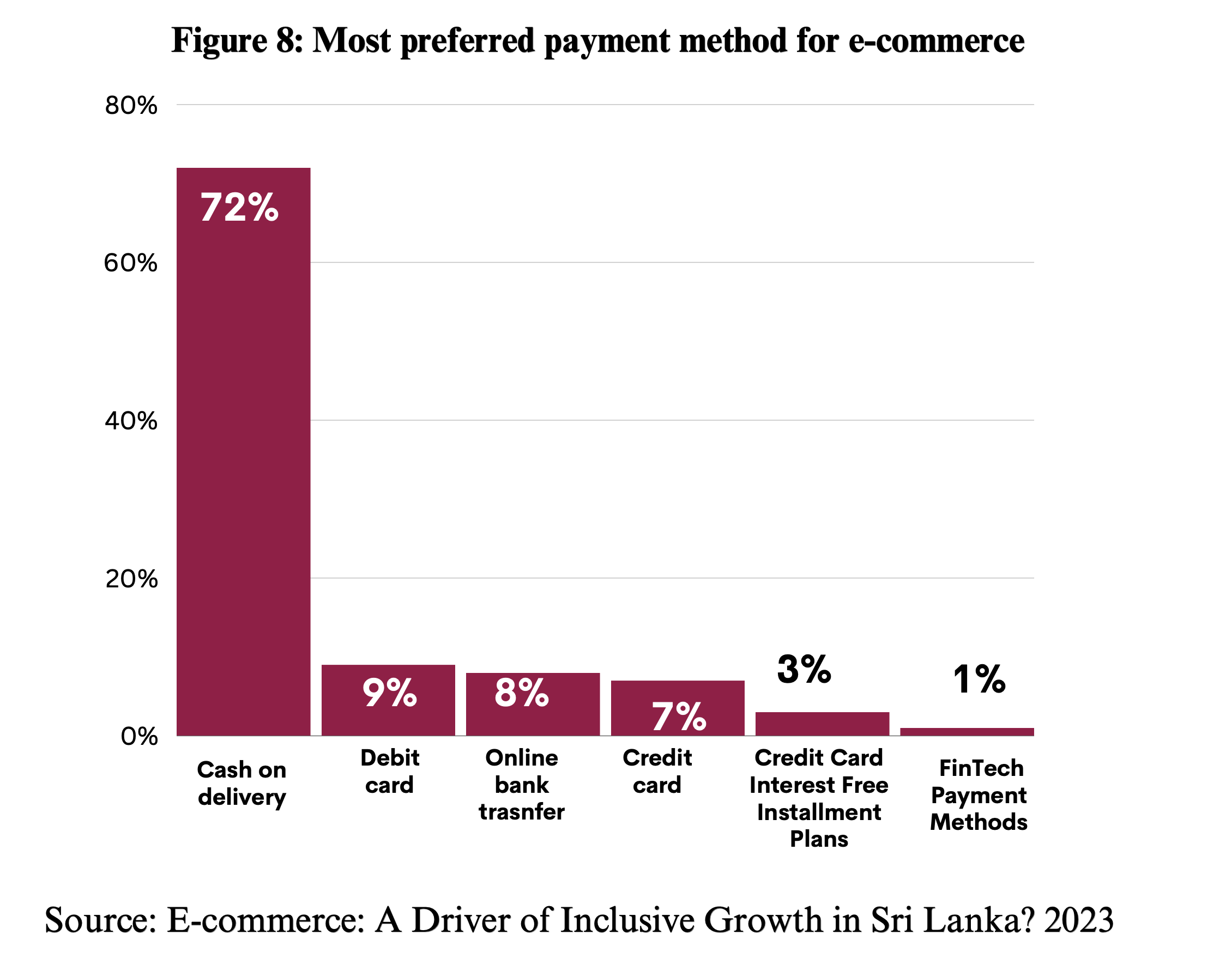
As Figure 8 shows, the study by SLASSCOM and Daraz on the e-commerce sector in Sri Lanka highlighted that the most preferred payment method for ecommerce was cash on delivery (72%) while only a small number chose to use debit cards (9%), online bank transfers (8%) and credit cards (7%).31
SLASSCOM and Daraz’s nationwide survey also highlighted the absence of robust digital payment systems and financial markets in Sri Lanka.32 The issue of lack of digital payments poses a significant hurdle for digital entrepreneurs looking to access the global market. Bank transfers are costlier and more time consuming for international clients, which discourages business transactions and hence is a less preferred alternative. This gap in the digital payment space highlights the need for applications that allow instant payment or overseas fund collection for digital entrepreneurs. To address this issue, the Central Bank should take steps to facilitate payments outside the traditional banking system.
Policy Recommendations
- Develop a standardised universal payment interface that can be used across financial institutions and is easily accessible through mobile apps, websites, and physical payment terminals. Encourage businesses and government agencies to integrate the universal payment interface into their systems, making it a convenient choice for various transactions.
- Enable digital identity systems to be used for various government services, financial transactions, and other essential activities.
- Reduce the need for physical identification documents by introducing an e-KYC system like that introduced by India Stack, which led to a significant reduction in customer onboarding cost for Indian banks.
Conclusion
The gains from digital inclusion are enormous. Although some steps have been taken to improve Sri Lanka’s digital presence, there are still many areas that require immediate attention. To seize these opportunities and bridge the gender gap in this digital era, a multifaceted approach is essential. This approach includes improving access to digital devices; addressing the challenges related to digital infrastructure and affordability to ensure that all citizens, especially women, can participate in and benefit from the digital economy; enhancing digital literacy through education reform; and promoting the adoption of robust digital payment systems. For this approach to work, a collective effort from various stakeholders is vital. The government must play a pivotal role by formulating policies that promote digital infrastructure, financial inclusion, and innovative technologies, while also creating a favourable regulatory environment for digital payment systems and open Application Programming Interfaces (APIs). Additionally, providing digital identities to citizens, driving digital literacy programs, investing in STEM education, increasing data collection, and improving the ease of doing business are essential governmental responsibilities. The corporate sector should actively contribute by driving innovation and investment in technology, fostering collaborations among financial institutions, technology companies, and startups, and developing user-friendly digital payment solutions.
On the societal front, re-skilling and up-skilling women; promoting awareness and education; advocating for digital adoption; establishing feedback mechanisms; and supporting STEM initiatives, are vital steps in realizing the full potential of digital entrepreneurship and economic empowerment in Sri Lanka. By taking these steps, Sri Lanka can empower its women economically, increase digital entrepreneurship, and foster a thriving ecosystem where innovative businesses can flourish and compete globally.
Contributors
- Dr. Roshan Perera – Senior Research Fellow
- Chantal Dassanayake – Research Associate
- Thathsarani Siriwardana – Research Assistant
References
- Fostering women entrepreneurship in the Digital Economy – UNCTAD. Available at: https://unctad.org/system/files/official-document/dtlecdc2022d3_en.pdf.
- Triggering mobile internet – GSMA. Available at: https://www.gsma.com/mobilefordevelopment/wp-content/uploads/2017/11/GSMA-Triggering-Mobile-Internet-Use_Web.pdf.
- (2023) The Human and Economic Impact of Digital Public Infrastructure. Available at: https://www.undp.org/sites/g/files/zskgke326/files/2023-07/undp-the-human-and-economic-impact-of-digital-public-infrastructure-final.pdf.
- Wattegama, C. (2021) Digital Economy of Sri Lanka: National Goals and Lessons from the South – UNCTAD. Available at: https://unctad.org/system/files/official-document/BRI-Project_RP15_en.pdf.
- Ibid.
- Kumar, R and N Strazdins (2021) ‘The Digital Infrastructure Divide in the Commonwealth’, Trade Competitiveness Briefing Paper 2021/01, Commonwealth Secretariat, London.
- Ibid.
- Ibid.
- Ibid.
- Ibid.
- (2019) AfterAccess – LIRNEasia. Available at: https://lirneasia.net/wp-content/uploads/2019/05/LIRNEasiaAfterAccess-Asia-3.0-update-28.05.2019.pdf.
- Kukreja, A. (2020) Mobile internet in Sri Lanka – the numbers do not add up, Mobile for Development. Available at: https://www.gsma.com/mobilefordevelopment/blog-2/mobile-internet-in-sri-lanka-the-numbers-do-not-add-up/#fn6.
- Lahiru, N. (2021) No, Sri Lanka’s internet penetration isn’t 20.6 million, ReadMe. Available at: https://readme.lk/sri-lanka-internet-penetration/.
- VAT and telecom tax to be increased (2022) Ada Derana. Available at: http://www.adaderana.lk/news/82789/vat-and-telecom-tax-to-be-increased.
- https://trc.gov.lk/public-notice-effective-tax-rates.html.
- Sri Lanka Telephone, data tariffs up by 20-Pct (2022) EconomyNext. Available at: https://economynext.com/sri-lanka-telephone-data-tariffs-up-by-20-pct-99415/.
- Amarasinghe, T., Galpaya, H. and Zainudeen, A. (2020) AfterAccess: ICT Access and use in Sri Lanka and the Global South (presentation), LIRNEasia. Available at: https://lirneasia.net/2019/05/afteraccess-ict-access-and-use-in-sri-lanka-and-the-global-south-presentation/.
- (2018) A Global Framework of Reference on Digital Literacy Skills for Indicator 4.4.2 – UNESCO. Available at: https://uis.unesco.org/sites/default/files/documents/ip51-global-framework-reference-digital-literacy-skills-2018-en.pdf.
- Sri Lanka Labour Force Survey Annual Report – 2021 (2021) Department of Census and Statistics. Available at: http://www.statistics.gov.lk/LabourForce/StaticalInformation/AnnualReports/2021.
- Ibid.
- Daraz and SLASSCOM (2023) E-commerce: A Driver of Inclusive Growth in Sri Lanka? Available at: https://slasscom.lk/wp-content/uploads/2023/03/Daraz-SLASSCOM-Ecommerce-Report2023_Download.pdf.
- Any person (aged 5-69) who can use a computer on his/her own is considered a computer literate person.
- Wanigasinghe, L. (2023) DigitALL: Are Sri Lankan women abandoned in digital transformation?, The Island. Available at: https://island.lk/digitall-are-sri-lankan-women-abandoned-in-digital-transformation/.
- Gunawardene, N. (ed.) (2020) INCREASING DIGITAL LITERACY. Available at: https://www.minormatters.org/storage/app/uploads/public/5f1/adb/cc3/5f1adbcc3bbe6168565162.pdf.
- Iqbal, T. (2019) Driving internet use in Sri Lanka: What needs to be done?, LIRNEasia. Available at: https://lirneasia.net/driving-internet-use-sri-lanka.
- The AfterAccess survey conducted by LirneAsia is a database of mobile phone and Internet access and use in the Global South.
- (2020) Poor digital awareness and skills are a barrier to internet use in Sri Lanka – LIRNEasia. Available at: https://lirneasia.net/wp-content/uploads/2020/03/LIRNEasia-AfterAccess-DigitalSkills-Sri-Lanka-Policy-Brief.pdf.
- Hewawasam, P.C., Khatibi, A. and Azam, S.M.F. (2023) Sri Lankan Consumers’ Recommendations of QR Code-Enabled Payment Solutions to Create a Cashless Society: Do Moderating Variables Collaborate? Available at: https://www.researchgate.net/publication/367768300_Sri_Lankan_Consumers%27_Recommendations_Of_Qr_Code_-Enabled_Payment_Solutions_To_Create_A_Cashless_Society_Do_Moderating_Variables_Collaborate.
- (2021) Payments Bulletin Third Quarter 2021. Available at: https://www.cbsl.gov.lk/sites/default/files/Payments_Bulletin_3Q2021_e.pdf.
- Ibid.
- Daraz and SLASSCOM (2023) E-commerce: A Driver of Inclusive Growth in Sri Lanka? Available at: https://slasscom.lk/wp-content/uploads/2023/03/Daraz-SLASSCOM-Ecommerce-Report2023_Download.pdf.
- Ibid.
You may also be interested in
Research Publication
 Research Publication
WPAN Policy Brief
 Event
Event