 Research Publication
Social Infrastructure for Gender Equality and Empowerment
29, August 2023
14 min read
Background
Sri Lanka’s economy suffered its worst contraction in 2022. Buffeted by various shocks over the last few years, the economy was operating below its potential. While the IMF program seeks to restore macroeconomic stability, economic growth is vital for long term sustainability. An ageing population and labour migration threaten this economic recovery.
It is imperative at this juncture that efforts are channelled to make the market more accessible to women. This increased access would mean allowing women to make a fair and rational decision in their choice of employment. Increasing female labour force participation by engaging them in work within the country is important for empowering women and giving them greater economic independence. Despite accounting for a larger share of the working age population in Sri Lanka, the number of economically active women is significantly lower than men.
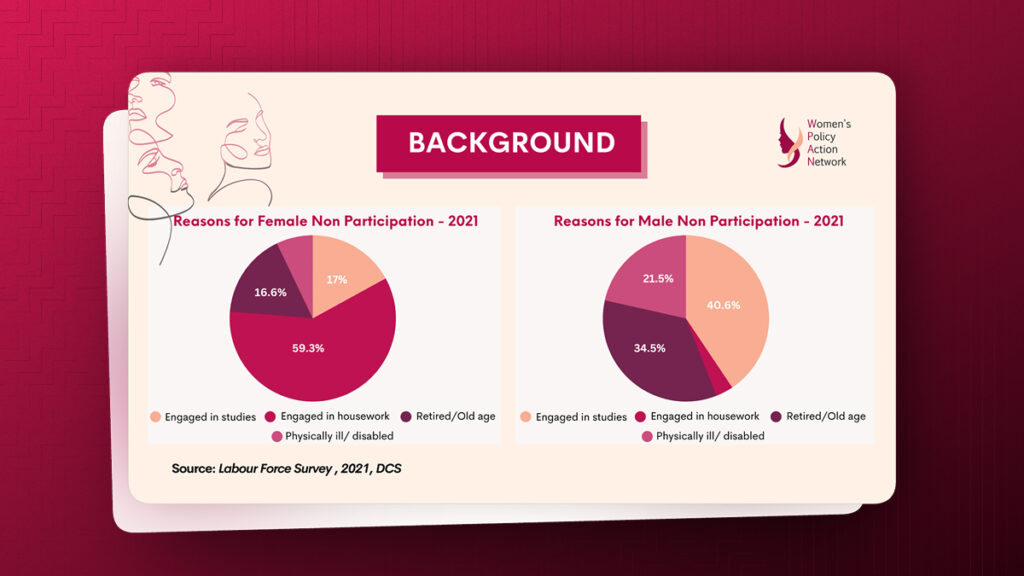
The gender gap in unpaid care work has significant implications on women’s ability to actively participate in the labour force. For every hour that a woman spends on domestic chores, she foregoes the opportunity to engage in the labour market or to invest in educational activities.1 According to the Organisation for Economic Cooperation and Development, globally, women spend two to ten times more time on unpaid care work than men.2 In Sri Lanka, women spent an estimated 54 minutes more than men on unpaid caregiving services for households per day.3
engage in care work have an explicit cost that outweighs their earnings regardless of their employment status.4
Figure 1
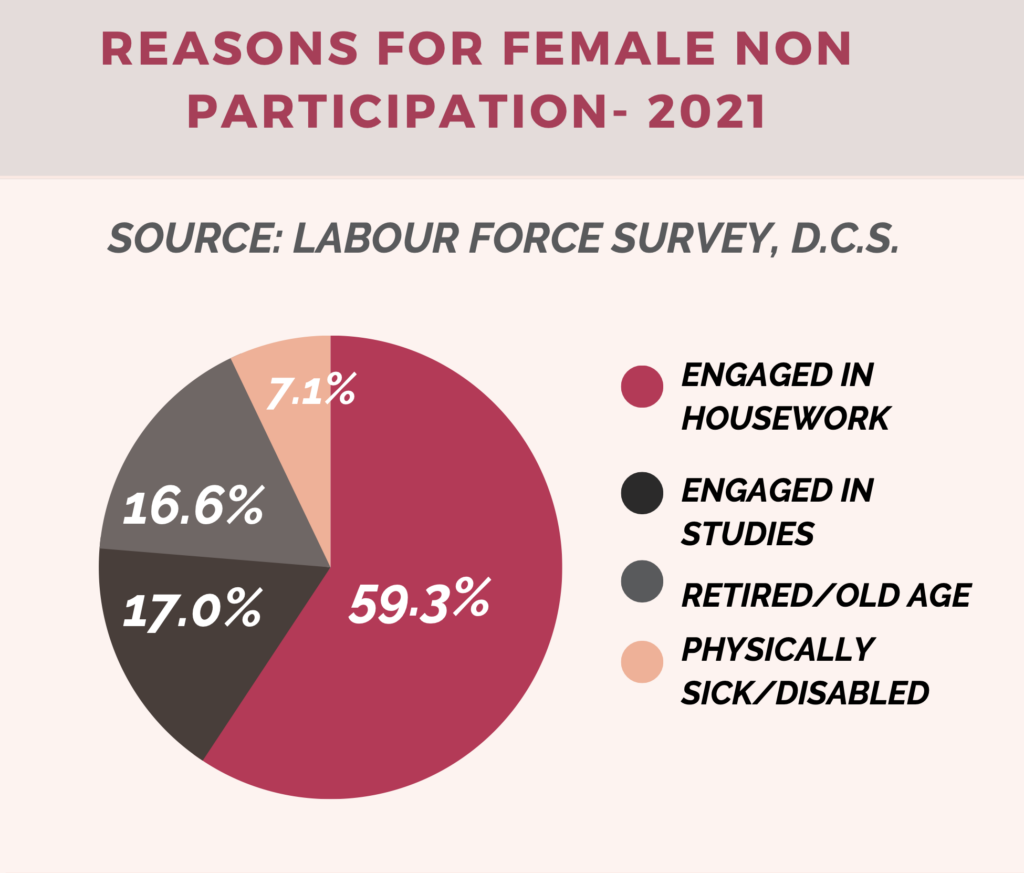

This unequal distribution of care responsibilities is linked to discriminatory social institutions and stereotypes on gender roles. Gender inequality in unpaid care work is the missing link in the analysis of gender gaps in labour outcomes, such as labour force participation, wages and job quality. Therefore, in countries like Sri Lanka, where female labour force participation has stagnated at around 30%5, redistribution of care work could help increase women’s participation in the labour force.
In the ambit of care work, this brief identifies the following three key areas as being the most important for the redistribution of care work to help increase women’s participation in the labour force.
02. Childcare
The vision of the government’s National Policy on Child Day Care Centers (2019) is to ensure ‘the availability of quality, affordable and accessible services’, ‘to protect the rights and well-being of all children that are placed in Day Care Centers,’ and also ‘to encourage parents (particularly mothers) to take up or return to employment’.
Childcare can be provided at workplace and home-based day care centres, after-school childcare centres, and after-school activity centres. Based on statistics collected by the State Ministry of Women and Child Development, there are a total of 19,216 preschools and centres across the island – catering to 474,406 children; 80% of them are privately operated. However, there are issues of accessibility as well as regulation and monitoring.
Figure 2

Accessibility
Warnasuriya (2020) notes that most private daycare centres operate from 9 am to 5 pm, making them unable to accommodate different work schedules, especially for those who work in the informal sector. Wealth inequality also disproportionately affects public access to quality and constant care; a survey by Verite Research (2022) estimated the cost of existing paid childcare to be in the range of LKR 22,400 – 27,000 per month, while the median income of women in the sample surveyed was around LKR 25,500 in 20226. In addition, the Early Childhood Development (ECD) census of 2016 found that 68% of children from wealthier households in urban areas were likely to attend preschool, whereas, in rural areas only 48% of children were able to do so.
Monitoring and Regulation
The National Policy on Child Day Care Centers (2019) highlights the lack of quality in childcare in Sri Lanka. A study by Herath et al (2013) found that overall process quality to be mediocre, with 25% of preschools being of poor quality and only 6% being of good quality. Over half the centres did not have the appropriate number of staff; 80% of child groups were larger than appropriate and only 8% of centres were led by a graduate. Of the teachers, 90% had preschool teacher training. Smaller student groups cared for by a higher number of staff had significantly higher process quality. Better quality preschools cost more7.
Not only do these disparities affect children and their quality of life, but, according to the World Bank (2020), having a child under the age of five in the household reduces a woman’s chances of joining the labour force by 7.4%8, compared to if she did not have children. This barrier contributes to Sri Lanka’s low female labour force participation rate of between 30-35% (ILO, 2016), despite the high levels of female literacy and education.9
Policy Recommendations
- Regulate and Monitor child care centers.
– Utilize local government mandates via by-laws to enact local legislation to set up standardized and regularized day care centers.
– Set up a professional care industry through public-private partnerships, including accredited qualifications to certify trained and qualified caregivers. - Incentivize the corporate sector to operate private daycare centres.
– Encourage public-private partnerships in providing care for children by utilizing existing infrastructure.
– Provide tax credits to incentivize the private sector to engage in child care development.
03. Elderly Care
Sri Lanka has a rapidly ageing population. According to the Asian Development Bank (ADB), by 2050 Sri Lanka’s old age dependency ratio will nearly double, implying that each working adult will have twice as many elderly persons to support.10 The rapid increase in the share of the elderly population is taking place at a similar rate as other developed economies but at a lower level of per capita income.11 These trends underscore the importance of having in place affordable and quality elderly care infrastructure.
Figure 3

According to the Time Use Survey conducted in 2017 by the Department of Census and Statistics, women spend approximately 4 hours more per day than men providing unpaid caregiving services and domestic services for household and family members12. It is evident that the burden of the demographic change in the population will be mostly borne by women. This implication highlights the critical importance of establishing reliable and good quality elderly care facilities, as the care burden is a major obstacle for women joining the labour force.
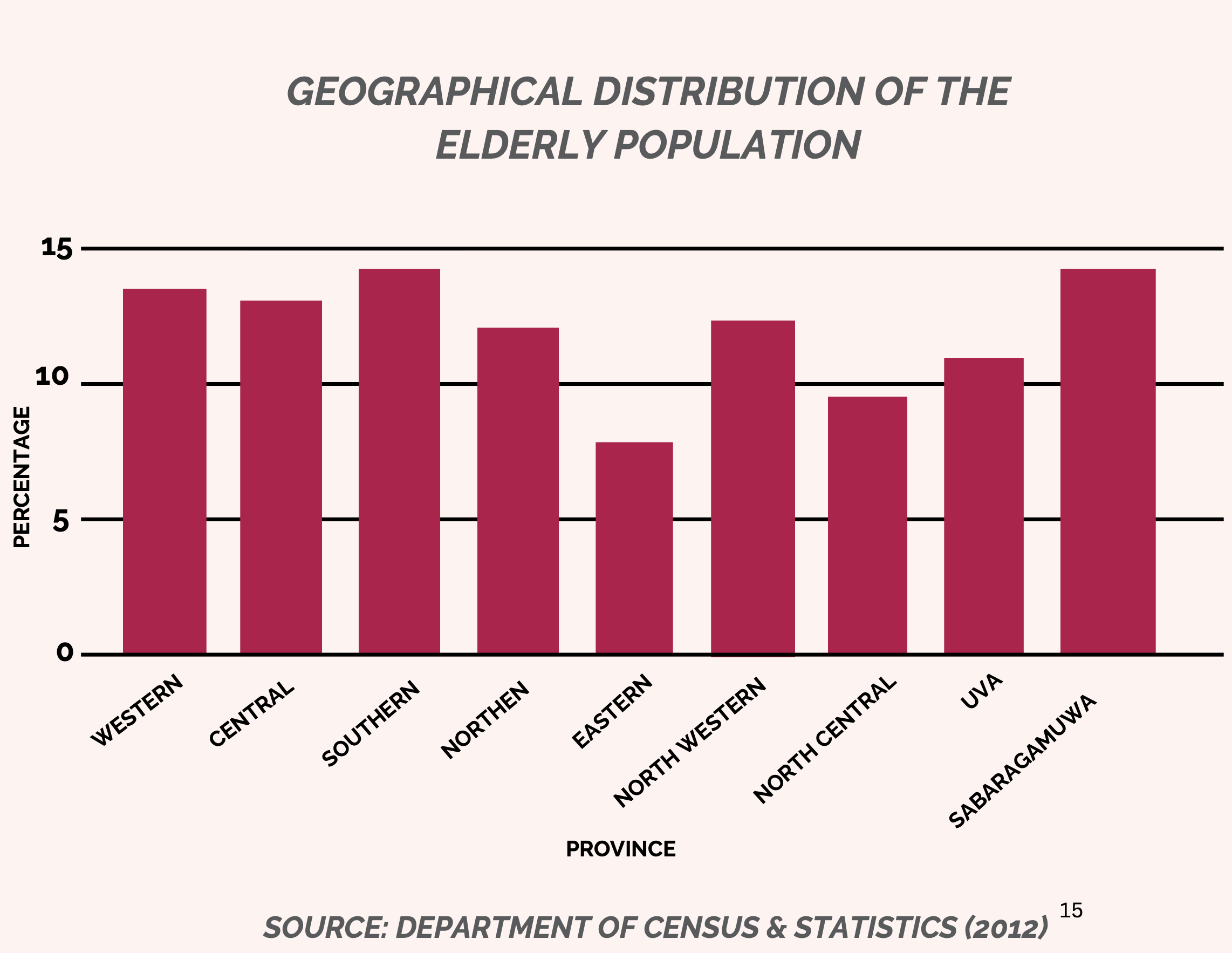
According to a study by the ADB in 201713, there were only 225 registered care homes, of which only five were state-sponsored. A geographical distribution of elderly population indicates the Central and Sabaragamuwa provinces have a high density of elderly population (Figure 4). However, over 50% of elders in care homes are located in the Western Province.14
Figure 4
The primary legislation governing elderly care in Sri Lanka is the Protection of the Rights of Elders Act No. 9 of 2000 (amended in 2011) which mainly focuses on creating a council to promote and protect the welfare and the rights of elders in Sri Lanka.16 In 2017, the government introduced the National Elderly Health Policy of Sri Lanka, reflecting its commitment towards ensuring comprehensive elderly health care services to all senior citizens of the country.17 However, the implementation and the effectiveness of these laws and regulations are weak due to the resource constraints that exists in the country.
Often, women are faced with a choice between caring for their elderly parents or pursuing a career. The exclusion of women from the labour force significantly diminishes productive engagement in both economic and social activities. When women are not participating in the labour force, a substantial opportunity cost is incurred. Their skills, talents, and potential contributions go untapped, resulting in a loss of economic productivity and growth. Women bring a unique set of skills, perspectives, and experiences to the workforce. Each individual has a comparative advantage in certain areas, and by excluding women, their expertise and contributions to various sectors are missed out on.
Compared to other countries that also have a rapidly ageing population, Sri Lanka is falling behind. Since 2000, Japan has provided benefits to over five million people over the age of 65 through their Long-Term Care Insurance. Benefits include institutional and home-based care services, and the municipalities in charge engage with both public and private providers to ensure quality care.18 In Mexico, the government has several programs such as the ‘65 and Over’Program and the PROSPERA Program, providing monetary benefits, social protection, and pathways to access healthcare and social security.19
Policy Recommendations
- Regulate and monitor elderly care centers.
– The current institutional mechanisms should be strengthened to monitor and implement the national policies and the laws effectively.
– Qualified and trained caregivers should be working in the elderly centers. This should be monitored by the state institutions. - Maximize the use of current infrastructure by renovating and repurposing it to establish additional elderly care centers. This approach enables efficient use of resources and addresses the growing need for elder care facilities.
- Develop a private – public run care industry, to drive down costs and incentivise investment.
- Introducing a comprehensive life cycle universal scheme that offers insurance coverage throughout every stage of life, rather than exclusively during old age.
04. Parental Leave
The need for paid parental leave is arguably the most crucial to women’s economic empowerment. Paid parental leave allows a woman to balance her domestic and careerbased obligations, enabling her to return to work after the birth of a child. However, if this leave is only applicable to females, employers will perceive female hires as an additional cost to the business. By providing both paternal and maternal leave, discriminatory recruitment practices can be mitigated and both parents will be able to share the responsibilities of domestic care work.
There exists no statutory provision mandating paternal leave in Sri Lanka. The Public Administration Circular 03/2006 states: “03 days special leave to a Public Officer on the occasion of the birth of a child to his wife”.20 Mandating and recognizing real paternal leave would pave the way for destigmatizing care work between the genders.
In 2018, Section 3 of the 1939 Maternity Benefits Ordinance was amended by Section 2 of the Maternity Benefits (Amendment) Act, No. 15 of 2018 and the Shop and Office Employees (Regulation of Employment and Remuneration) (Amendment) Act, No. 14 of 2018 to extend maternity leave granted to all female employees for every child.21,22 From June 2018, every birth entitles a female employee to twelve weeks (84 days) of paid maternity leave, excluding any other holiday or leave for which the female employee is entitled to under any other law or regulation.
Section 18(b) of the Shop and Office Employees Act No. 19 of 1954 was also amended in 2018 and extends maternity leave granted to female employees in shops and offices after the birth of a second child. Previously, a female employee was entitled to only forty-two working days of maternity leave for a third or subsequent child (including holidays). This provision was amended to grant women eighty-four working days for giving birth to any child. While these amendments are welcome, there are still some discrepancies between different legislation, in terms of how working days are calculated when determining the total number of days of maternity leave, still need to be addressed.
Under the existing regulations, the entire cost of maternity leave benefits is borne by the employer. This policy leads to discriminatory practices and disincentives employers from hiring women. A handful of conglomerates such as John Keells Group have initiated paid parental leave which covers both paternal and maternal leave23. However, access is limited to those who work in these organizations.
Verité Research estimated that the total cost of maternity leave benefits amounted to only 0.5% of tax revenue in 2021; by contrast, Samurdhi payments was equivalent to 4.2% of tax revenue.24 Hence, the government currently spends more on welfare schemes that it would on maternity leave benefits. Mandating state-funded maternity leave benefits is both fiscally feasible and a costeffective approach for the state.25
JKH CASE STUDY
In August 2022, the John Keells Group introduced equal days of maternity and paternity leave as parental leave. While the group already offered 100 days of maternity leave on the birth or adoption of a child, with this initiative, the 5 days of paternity leave established in 2016 was increased to 100 days, ensuring equity, and recognising the importance of both parents’ roles in early childcare. One of the key objectives of offering an equal number of maternity and paternity leave days was to eliminate discrimination associated with recruiting women. This policy is of particular significance as, in 2021, the organization set a five-year target of ensuring that women made up 40% of its workforce. The increase in paternity leave to 100 days at the birth or adoption of a child, aimed to provide support to partners of staff who worked outside of John Keells companies. This flexible arrangement enables working women to return to their respective workplaces after their maternity leave, strengthening their commitments to diversity and inclusion to the wider society. As of 2020, the group also offered employer-supported childcare facilities with 3 crèche service providers, at subsidized rates for all staff.
Policy Recommendations
- Mandate paid and substantial parental leave for both men and women. This policy could be borne entirely by the State or via tax credits provided to companies who bear these costs.
- Bring legislation covering maternity leave under one statute.
- Recognise paternity leave through statutory instruments destigmatizing gender roles.
Contributors
- Dr. Roshan Perera – Senior Research Fellow
- Akhila Randeniya – Research Asisstant
- Thathsarani Siriwardana – Research Asisstant
- Savaira Sammoon – Research Intern
References
(1)Unpaid Care Work: The Overlooked Barrier in Women’s Economic Empowerment https://www.ips.lk/talkingeconomics/2017/09/15/unpaid-care-work-the-overlooked-barrier-inwomens-economic-empowerment/
(2)Unpaid Care Work: The missing link in the analysis of gender gaps in labour outcomes https://www.oecd.org/dev/development-gender/Unpaid_care_work.pdf
(3) Sri Lanka Time Use Survey Final Report – 2017 http://www.statistics.gov.lk/PressReleases/TUS_FinalReport_2017
(4) Costs of Doing a Job for Urban Women in Sri Lanka – Verite Research 2022,https://www.veriteresearch.org/wp-content/uploads/2022/09/VR_EN_RR_May2022_Costsof-Doing-a-Job-for-Urban-Women-in-Sri-Lanka.pdf
(5) Sri Lanka Labour Force Survey Annual Report – 2021 http://www.statistics.gov.lk/LabourForce/StaticalInformation/AnnualReports/2021
(6) Costs of doing a job for urban women in Sri Lanka / Subhashini Abeysinghe…[et al.]. – Colombo : Verite Research, 2022. https://www.veriteresearch.org/wp-content/uploads/2022/09/VR_EN_RR_May2022_Costs-ofDoing-a-Job-for-Urban-Women-in-Sri-Lanka.pdf
(7) Herath, H.M.D., et al (2013), Assessment of the quality of childcare centres in the Colombo Municipal Council Area, in Sri Lanka Child Health Journal (42(4)), pp.200–204, Sri Lanka College of Pediatrists, Colombo
(8) “Solotaroff, Jennifer L.; Joseph, George; Kuriakose, Anne; Sethi, Jayati. 2020. Getting to Work: Unlocking Women’s Potential in Sri Lanka’s Labor Force. Directions in Development—Countries and Regions;. © Washington, DC: World Bank. http://hdl.handle.net/10986/28660
(9) Factors affecting women’s labour force participation in Sri Lanka / International Labour Organization ILO Country Office for Sri Lanka and the Maldives. – Colombo: ILO, 2016
(10) Growing Old Before Becoming Rich Challenges of an Aging Population in SriI Lanka : Asian Development Bank, 2019. https://www.adb.org/sites/default/files/publication/557446/agingpopulation-sri-lanka.pdf. (11) ibid
(12)http://www.statistics.gov.lk/PressReleases/TUS_FinalReport_2017
(13) https://www.adb.org/sites/default/files/publication/710721/sri-lanka-diagnostic-study-longterm-care.pdf
(14) Department of Census and Statistics – Population Census 2012
(15) Census of Population and Housing 2012
(16)The Protection of the Rights of Elders Act. No. 9 of 2000 https://www.ilo.org/dyn/natlex/natlex4.detailp_lang=en&p_isn=92341&p_country=LKA&p_count=271&p_classification=08.02&p_classcount=2#:~:text=Protection%20of%20the%20Rights%20of%20Elders%20Act%2C%20No%209%200f%202000.,-Country%3A&text=The%20principle%20role%20of%20the,self%20respect%2C%20independence%20and%20dignity.
(17)https://extranet.who.int/countryplanningcycles/sites/default/files/planning_cycle_repository/sri_lanka/srl_natioanl_elderly_health_policy.pdf (18)https://www.ncbi.nlm.nih.gov/pmc/articles/PMC7533196/
(19) https://www.gob.mx/epn/prensa/five-million-mexican-seniors-receive-support-from-the-65and-over-program-epn
(20) Paternal Leave – Chapter XII of the Establishments Code https://www.pubad.gov.lk/web/images/circulars/2006/E/03-2006(e).pdf
(21)MATERNITY BENEFITS (AMENDMENT) ACT, No. 15 OF 2018 https://eohfs.health.gov.lk/occupational/images/pdf/acts_regulations/maternity_benifit_ordinance.pdf
(22) Shop and Office Employees (Regulation of Employment and Remuneration) (SOE) Act No. 19 of 1954, Section 1
(23)JKH introduces equal 100 days of maternity and paternity leave days as parental leave https://www.ft.lk/business/JKH-introduces-equal-100-days-of-maternity-and-paternity-leavedays-as-parental-leave/34-738222
(24) International Women’s Day – Publicfinance.lk https://publicfinance.lk/en/topics/international-women-s-day1678252724#:~:text=International%20Women’s%20Day&text=In%20Sri%20Lanka%2C%20as%20shown,to%20women%20of%20other%20ages.
(25) State funding for maternity leave in Sri Lanka – a no-brainer – Verite Research https://www.veriteresearch.org/wp-content/uploads/2023/05/20230517_MLBInsight_D0
You may also be interested in
Research Publication
 Research Publication
WPAN Policy Brief
 Event
Event