 Event
Event
What Is Wrong with Sri Lankan Labour Law?
3, September 2026
Summary
Shyamali Ranaraja argues that Sri Lanka’s labour-law framework is fragmented, outdated and difficult to administer. More than 40 laws relate to employment, but only a smaller group is regularly used. In the absence of a unified labour code, statutes overlap, duplicate provisions and fail to address newer forms of work. Leave rules create anomalies, dispute resolution is slow, and employers carry most formal responsibility for social security through separate obligations such as EPF, ETF, gratuity, maternity benefits and severance pay.
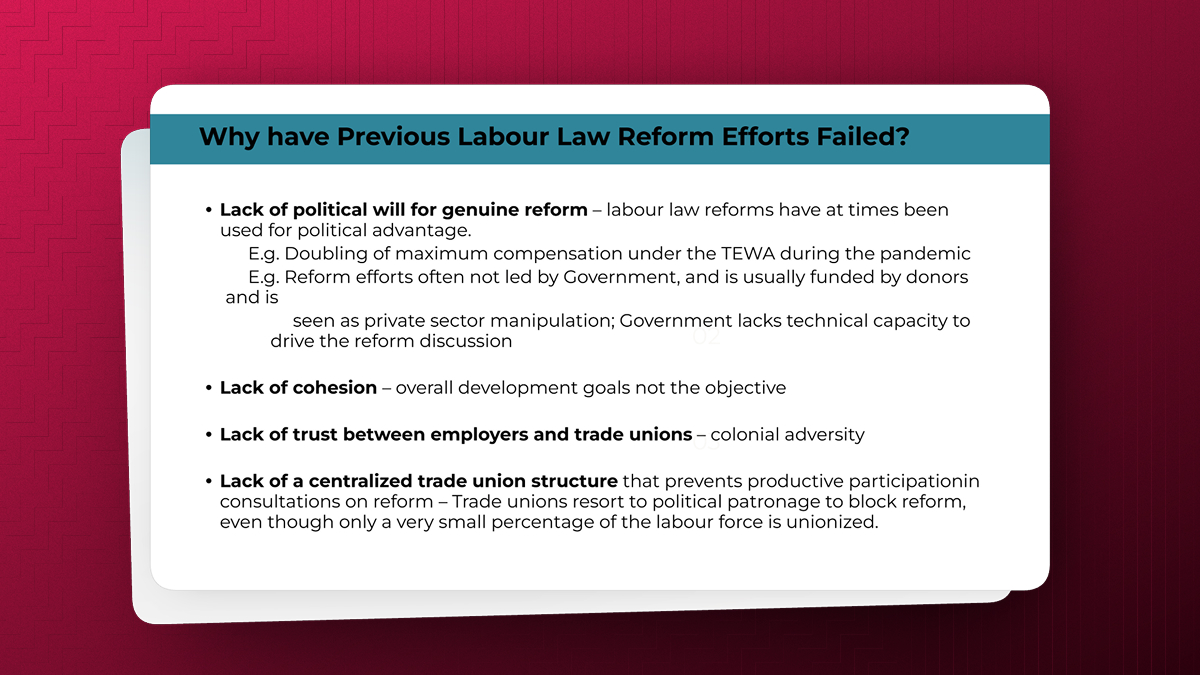
Previous reform attempts have repeatedly stalled because of weak political ownership, limited technical capacity, poor alignment with broader development goals and deep distrust between employers and trade unions. Fragmented trade-union representation and political patronage further complicate consultation. The presentation makes the case for a coherent reform process that modernises the legal framework, simplifies administration and connects worker protection with employment creation and economic development.
Key Points
- Sri Lanka has more than 40 employment-related laws but no consolidated labour code.
- Many core statutes predate independence or the early post-independence period and do not reflect modern forms of employment.
- Overlapping rules, court-made requirements and customary practices make compliance difficult to understand.
- Leave entitlements and dispute-resolution processes generate significant anomalies and delays.
- Employers bear a fragmented set of social-security obligations in the absence of a universal system.
- Sustainable reform requires political leadership, technical capacity and greater trust between employers, workers and government.