The State of State Enterprises in Sri Lanka – 2019
Systemic Misgovernance: A Discussion
Who We Are
The Advocata Institute is an independent policy think tank based in Colombo, working to promote sound public policy ideas for a free and a more prosperous country. Our mission is supported by academics, the business community, journalists as well as international figures in policy making who have joined our advisory board and work with us as fellows of the think tank. The group was started by a group of concerned citizens who believe the public debate in Sri Lanka needs a voice promoting individual liberty, free-markets and limited government.
What We Do
We conduct research, provide commentary and hold events to promote sound policy ideas compatible with a free society in Sri Lanka. We intend to add to the public debate and make available alternative ideas that lead to change of public opinion and policies.
Legal Entity
The Advocata Institute is a non-profit organisation registered as a company limited by gurantee under the Companies Act
Contributors
Ravi Ratnsabapathy, Resident Fellow, Advocata Institute
Aneetha Warusavitarana, Research Analyst, Advocata Institute
Joshua Karpinski, Research Intern, Advocata Institute
Dilshani Ranawaka, Research Assistant, Advocata Institute
Foreword
In 2016 the Advocata Institute released the ‘State of State-Owned Enterprises’, a flagship report which highlighted the losses incurred by Sri Lankan state-owned enterprises (SOEs) and stressed the importance of bringing the option of privatisation back on the table. The significance of the report was that it was one of few publications to look at the losses incurred by SOEs.
This second report on SOEs moves beyond analysing SOEs as loss making entities and understanding the extent of the problem. Focus has instead been directed to looking at the reasons for these losses to persist, and the ways in which SOEs have been used to further political or individual gain. Multiple levels of authority analysed through the lens of the principal-agent problem in this report highlights how incentives for personal gain drive the functioning of many SOEs.
Extracts from the reports of the Committee on Public Enterprise bring to light how misgovernance creates the opportunity for SOEs to be used as vehicles for corruption, with extensive losses being incurred for personal gain.
The report provides a few recommendations for reform of SOEs, starting with the need to create an authoritative list of all entities in order to have an adequate grasp of the problem. From there the recommendations focus on improving governance of SOEs, by strengthening COPE and COPA, and adopting the OECD corporate guidelines for state-owned enterprises.
Dhananath Fernando Chief Operating Officer Advocata Institute
Acknowledgments
This project would not have been possible without the gracious support of many people who contributed their time, offered advice and helped in innumerable ways.
In particular we wish to thank Amal Sanderatne and the team at Frontier Research for helping us compile the relevant data, Dr Sujata Gamage for her ongoing work on compiling a list of state entities and bodies, Mr Nathan Koblintz whose careful editorial advice brought structure and coherence to the report. We wish to thank our advisors, both the official and the unofficial, for their time, guidance and encouragement.
We are truly indebted to their kind voluntary contributions.
Executive Summary
∫ State Owned Enterprises (SOEs) play a significant role in the country’s economy and are present in key sectors including Ports, Energy, Banking, Insurance and Water. SOEs are vulnerable to mismanagement and corruption because of potential conflicts between the ownership and policy-making functions of the government, and undue political influence on their policies, appointments, and business practices.
∫ The internal control, monitoring and governance frameworks seem inadequate to deal with these problems – of the 400-odd entities regular information is only available for 55. Even obtaining a complete list of entities proved to be a challenge. Financials are routinely late and only a minority obtain ‘clean’ audit reports. Of the 55, only 11 had published an annual report for 2016 by the time the Department of Public Enterprises compiled its Performance Report for 2017.
∫ Underperformance appears common; according to the Department of Public Enterprises the 55 largest delivered a net Return on Assets (ROA) of only 0.64% in 2017. The combined losses among the loss-making entities reached Rs.87bn in 2017 compared to Rs.42bn in 2016. Some are in deep trouble. The Petroleum Corporation carries a negative equity. Sheer incompetence and corruption have pushed Sri Lankan Airlines close to financial collapse. Central budget support to SOEs amounted to Rs.41bn in 2017.
∫ The reports of COPE and the Auditor General highlight repeated instances of fraud, mismanagement, corruption and negligence. The issues no longer appear to be isolated incidents of opportunistic behaviour by individuals or occasional lapses in control but point to deeper, structural weaknesses.
∫ While internal control and accountability mechanisms are important in checking abuses, they are insufficient in themselves. A climate of integrity is necessary but judged by the available evidence, largely absent. Patronage politics and a lack of oversight seem to have spawned a culture where politicians believe SOEs are to be exploited for their own ends.
∫ A trend for SOEs to be incorporated as limited liability companies allows politicians to bypass treasury or budget restrictions and evade parliamentary accountability. Complex corporate structures provide a convenient shroud for abuse. A review of the reports of the Auditor General and the Committee on Public Enterprises paints a dismal picture of systemic failures of governance leading to gross misappropriation of public funds.
∫ The essays in this report attempt analyse the causes for the structural weaknesses and propose simple recommendations to establish basic central government control over SOEs and improve accountability.
The report presents three main recommendations.
1. Compiling a comprehensive list of all SOEs and setting basic reporting procedures
2. Strengthening COPE and COPA
3. Implementing the OECD Principles of Corporate Governance
Infographics
State-Owned Enterprises: Overview
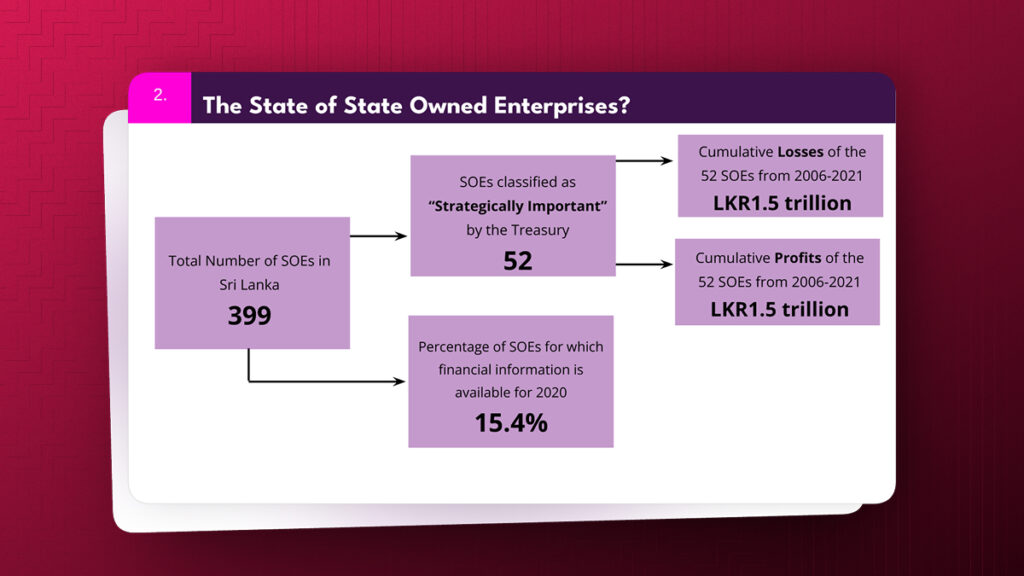
Total number of SOEs527
Percentage of SOEs where financial information is available10.4%
Number of strategically important SOEs as classified by Treasury55
Cumulative profits of the 55 SOEs, 2006–2017LKR 964 billion*
Cumulative losses of the 55 SOEs, 2006–2017LKR 795 billion*
* Source: Calculated by Advocata Institute using Appendix 3 & 4.
Cumulative Profits and Losses by Sector (2006–2017)
| Sector | Profits | Losses | Net Result |
|---|
| Ports | LKR 48,044 Mn | LKR -9,575 Mn | Net Profits: LKR 38,469 Mn |
| Energy | LKR 130,708 Mn | LKR -494,653 Mn | Net Losses: LKR -363,945 Mn |
| Water | LKR 9,279 Mn | LKR -11,787 Mn | Net Losses: LKR -2,508 Mn |
| Aviation | LKR 50,385 Mn | LKR -181,274 Mn | Net Losses: LKR -130,889 Mn |
| Transport | LKR 2,598 Mn | LKR -60,595 Mn | Net Losses: LKR -57,997 Mn |
| Construction | LKR 7,243 Mn | LKR -3,098 Mn | Net Profits: LKR 4,145 Mn |
| Livestock | LKR 2,527 Mn | LKR -1,130 Mn | Net Profits: LKR 1,397 Mn |
| Non-renewable resources | LKR 4,341 Mn | LKR -34 Mn | Net Profits: LKR 4,307 Mn |
| Health | LKR 13,277 Mn | LKR -713 Mn | Net Profits: LKR 12,564 Mn |
| Media | LKR 5,233 Mn | LKR -2,099 Mn | Net Profits: LKR 3,134 Mn |
| Plantations | LKR 3,728 Mn | LKR -3,010 Mn | Net Profits: LKR 718 Mn |
| Banking & Finance | LKR 573,631 Mn | LKR -94 Mn | Net Profits: LKR 573,537 Mn |
| Insurance | LKR 77,517 Mn | LKR -16,890 Mn | Net Profits: LKR 60,627 Mn |
| Lotteries | LKR 19,439 Mn | LKR 0 Mn | Net Profits: LKR 19,439 Mn |
| Others | LKR 16,137 Mn | LKR -10,350 Mn | Net Profits: LKR 5,787 Mn |
Source: Calculated by Advocata Institute using Appendix 4.
Public Sector Employment
| Total number of employees in the public sector, 2017 | 1,375,499 |
|---|
| Employed population in Sri Lanka, 2017 | 8,208,179 |
|---|
| Public sector employees as a percentage | 16.7% |
|---|
| Employees of SOEs, 2008 | 229,445 |
|---|
| Employees of SOEs, 2017 | 233,849 |
|---|
Source: Ministry of Finance, Annual Report (2017); Sri Lanka Labour Force Survey Annual Report (2017).
| Name of the State-Owned Enterprise | Total Losses (2006-2017) | Total Profits (2006-2017) | Net Losses (2006-2017) |
|---|
| Ceylon Petroleum Corporation | LKR -259,107 Mn | LKR 81,846 Mn | LKR -177,261 Mn |
| Ceylon Electricity Board | LKR -235,546 Mn | LKR 48,862 Mn | LKR -186,684 Mn |
| Sri Lankan Airlines | LKR -163,097 Mn | LKR 6,949 Mn | LKR -156,148 Mn |
| Sri Lanka Transport Board | LKR -60,595 Mn | LKR 2,598 Mn | LKR -57,997 Mn |
* Source: Calculated by Advocata Institute using Appendix 4
What is a State-Owned Enterprise?
The Ministry of Finance broadly treats any institution that is not a department or ministry as a state-owned enterprise (SOE). SOEs are usually incorporated by an Act of parliament, but a recent trend has been for these entities to be incorporated under the Companies Act. Thus, SOEs in Sri Lanka include statutory bodies, regulatory agencies, promotional institutions, educational institutions, public corporations and limited companies.
The variety of SOEs in Sri Lanka raises the question: how large a role does the government play in business?
The answer to this question is not easily found. When analysing the business footprint of government activity, the focus is primarily with commercial entities. Unfortunately, data on SOEs is limited, and some of the published data covers the broader definition of both commercial and non-commercial entities. This can be seen in the case of employment data, the use of which is limited unless the data can be disaggregated between commercial and non-commercial enterprises.
A working definition that covers commercial enterprises appears below. As a first step to better management, the government could adopt a similar definition and publish financial and performance data separately for commercial and non-commercial public enterprises. Working Definition of Commercial State-Owned Enterprises (SOEs)
To define SOEs we use three parameters of 1) ownership, 2) economic purpose and 3) legal form. The motives for state ownership can vary but broadly they may be classed as either pursuing economic activities or public service obligations. There are instances of overlap and many grey areas, so some classifications are arbitrary. Utilities present unique challenges so for purposes of this initial definition, they are excluded. The OECD has developed a strong and useful definition for SOEs which has been adapted below for the local context.
The OECD definition of a SOE is: “…any corporate entity recognised by national law as an enterprise, and in which the state exercises ownership, should be considered as an SOE. This includes joint stock companies, limited liability companies and partnerships limited by shares. Moreover, statutory corporations, with their legal personality established through specific legislation,
should be considered as SOEs if their purpose and activities, or parts of their activities, are of a largely economic nature”.
1. Ownership State ownership of enterprises can either be exercised by the state being the ultimate beneficiary owner of the majority of voting shares, or by exercising an equivalent degree of control. In both scenarios the risks and rewards of ownership are borne by the state, and in the event of losses, the state will be expected to bail out the enterprise. Government departments which provide commercial services such as the Department of Railways would be an example of this.
2. Economic purpose An economic activity is one that involves offering goods or services on a given market and which could, at least in principle, be carried out by a private operator in order to make profits.
The definition of SOEs excludes entities whose primary purpose is the pursuit of public service obligations or the exercise of governmental authority or a governmental function. We exclude health and education on this basis, but this does not absolve the state from seeking measures to improve efficiency and effectiveness of the services provided. The provision of purely administrative services (eg issue of motor vehicle licenses) is treated as a governmental function.
3. Legal form
The legal form taken by SOEs vary but should include:
a) Companies incorporated under the Companies Act in which the Sri Lankan state has a financial investment; either directly or indirectly through any ministry, department, provincial council, district secretariat, agency, public corporation or body.
c) Subsidiaries of the above.
Structural Problems of State-Owned Enterprises
Agency and political costs: structural inefficiency in State-Owned Enterprises in Sri Lanka
By Ravi Ratnasabapathy
The problem of agency, also known as the principal-agent problem is encountered in any enterprise, private or public, that is not directly managed by its owners. The crux of the problem is the divergence of interests between owners and managers that results in substantial costs to owners. The mitigation of agency costs is dependent on the effectiveness of the corporate governance mechanisms present.
SOEs suffer agency costs as well as political costs, therefore, ceteris paribus, for state enterprises to function effectively the regime of governance needs to be much stronger than for private entities. In Sri Lanka the governance regime is a lot weaker, leading to under performance and abuse.
Defining the problem of agency
The agency problem is a conflict of interest inherent in any relationship where one party is expected to act in another’s best interests. In business, the agency problem usually refers to a conflict of interest between a company’s management and the company’s shareholders.
The shareholders are the ultimate owners of the company, and as principals, elect the management to act and take decisions on their behalf. The managers are supposed to employ the resources of the business in a manner that will maximise shareholder wealth. However, the manager’s self-interest is to divert these resources to enhance their personal status (through prerequisites such as chauffeured vehicles, business- class travel) and maximise their own wealth (through excessive pay or corruption).
The reduction of agency costs is regarded as the essential function of company law and corporate governance.
Agency costs: a distinction between private and public
As observed above, the agency problem is present in all corporate entities, but the fundamental distinction between private shareholders and citizens is important to keep in mind.
Investors in private companies take a risk when they put money down, but the risk is of their own volition. Shareholders subscribe voluntarily to shares; they are not compelled to invest. Generally, people only invest in private companies if they know and trust the management.
If the business does not perform to expectations, they are aware that they will earn a lower return. If it fails the shareholders will lose, but it is their own money, voluntarily invested that is lost. With SOEs the important difference is that unlike in a company where willing investors are taking a conscious decision, the investment in an SOE is by citizens who contribute involuntarily and unwittingly. Taxation is compulsory and all citizens contribute to SOEs through indirect taxes.
In the most extreme case, if shareholders are disgusted and can find no remedy, they still enjoy a final option: exit. They may sell their shares. For citizens, unless they choose to migrate, there is no exit option.
Businesses must risk their own money when they go into trade but governments risk other people’s money. If a business does not earn a profit, the owner will need to keep infusing funds, and this provides a powerful incentive to improve efficiency. If the owner is incapable of improving the business and is unable to infuse more funds a mismanaged business will eventually close.
Sri Lankan SOEs enjoy implicit state guarantees and funding via state banks which undermines even the threat of bankruptcy as a source of managerial discipline. The continuous accumulation of losses is only possible because of this factor. An example is SriLankan Airlines which has accumulated losses of USD 1 billion (and carries a negative net worth) but continues to operate with funding from state banks. For context, the current IMF facility is only USD 1.5 billion.
∫ The Employees’ Trust Fund Board has paid incentives amounting to Rs.74.8 million, bonuses amounting to Rs.44.5 million contrary to the treasury circulars. However, the management stated that it was not in a position to regularize the matter as employees have been enjoying these privileges for a long period of time. 1
Examples of agency costs
Public Sector
Payment of irregular incentives at the ETF: staffbenefit at the expense of members
Excessive payments to the management of the People’s Bank and Sri Lankan Airlines.
Private Sector
Excessive remuneration and perquisites at Hunter & Co
The problem with state enterprises: political costs and agency costs
State ownership creates its own agency problems. Politicians and bureaucrats who oversee SOEs are distinct from the citizens on whose behalf the enterprises are ostensibly owned. This creates an extra level of agency.
SOEs are ultimately owned by citizens but run by managers who are controlled by politicians. Politicians determine or otherwise influence the appointment of key management and must hold the managers accountable.
Unlike shareholders, the politicians have not invested their money in the business. As they have no stake there is no specific interest in ensuring it is well run.
However, politicians do have incentives to direct SOEs to achieve political purposes that may result in economic inefficiencies, giving rise to political costs. These may be benign if policies enhance social welfare at the cost of shareholder value. However, more often than not, they are malign and favour political allies at the expense of public welfare.
The real owners the citizens have no voice, and little interest in or knowledge about how the business is run.
Political costs: The problem of agency within the political context of Sri Lanka
As citizens lack the interest or wherewithal to monitor SOEs, efficiency is entirely dependent on the system of governance. Distorted incentives and weakened mechanisms present structural challenges to efficiency.
∫ The payment of Rs.75 million to senior managers of the People’s Bank2 and allegedly excessive payments to top management of Sri Lankan Airlines.3
∫ Hunter and Company PLC, where the auditors were dismissed when they insisted that disclosure was necessary with regard to a bungalow that was being used by key management personnel.4 Later, a shareholder of the company moved to convene an EGM to call explanation from Hunters’ directors with regard to “disappearance of Rs.2.5 million cheque in favour of a Mr. Mahesh Gajanayake and about directors’ remuneration over and above the limit set out in the company’s Article 107.”5
“The salary of the chief executive of a large corporation is not a market award for achievement. It is frequently in the nature of a warm personal gesture by the individual to himself”. – John Kenneth Galbraith-
a) Patronage
Politics in Sri Lanka is based on patronage. Ministers face pressures from constituents for jobs or favours, and state sector jobs are especially prized for their status and security. The political culture is such that granting jobs is perceived to be a necessary condition for re-election. In general, lawmakers and ministers in Sri Lanka view SOEs as providing avenues to create employment. This is often true across party lines and ideological divides.
SOEs incorporated as limited liability companies enjoy greater autonomy in the management of their affairs, allowing the minister to bypass treasury or budget restrictions placed on recruitment. In the case of the state banks it is even possible for the minister to exercise patronage by directing lending on preferred terms to selected constituents. (Refer Chapter on COPE Reports)
This leads to problems of over staffing. The more staffare hired, the greater the potential votes, leading to the chronic over staffing evident in many SOEs. The allied problem is nepotism – the recruitment of people based on relationships instead of ability. Recruiting unsuitable candidates weakens the general level of competence within
the SOE which adversely impacts performance. Therefore, patronage is particularly harmful as it has a dual impact on performance; the hiring of excess staffadds to unnecessary costs, while nepotism leads to diminished efficiency.
The operating expenditure of certain institutions is unnecessarily high due to the excess number of employees. For instance, the Chairman of Sri Lanka Telecom informed COPE in 2014 that the company had a staffof nearly 8000 whereas the actual requirement at the time was around 6000. This has led to a decrease in the profitability of the institution.6
The problem is pervasive. The Secretary to the Treasury Dr. Samaratunga7 noted that recruitments to SOEs take place without the approval of the Management Services Department of the Treasury. “All SOEs across the government—public corporations, statutory board or government- owned companies—have effected recruitment without proper approval of the management services”.
The problem is illustrated below through the case of the State Engineering Corporation.8 A compilation of instances of patronage, as extracted from the COPE reports can be found in appendix 1.
| No. of staffrecruited | Commentary on recruitments during COPE period of review (May 2016 – August 2016) |
|---|
| State Engineering Corporation | 602 employees | Recruitment took place only with the approval of the Board of Directors and recruiting Marketing Development Officers. Approval of the Department of Management Services was not received. |
| 451 employees | This recruitment was for 41 positions and took place without the approval of the Department of Management Services as at 31 December 2015. |
| 179 casual and unskilled workers | This recruitment was on a daily paid basis during the period from 01 January 2016 to 30 March 2016 without the approval of the Department of Management Services. This was despite a surplus of 99 unskilled employees in the corporation as at 31 December 2015. |
| 258 employees | This recruitment was without the approval of the Department of Management Services. The recruits were for the machinery division, which had been restructured under a programme entitled ‘National Machinery and Equipment Organization’. The approved cadre for the said organization as at 31 March 2016 was 344 but that the actual cadre as of that date was 602. |
b) Corruption
Corruption is endemic in the political system of Sri Lanka, and the root of the problem lies in campaign finance.
Changes to the 1978 constitution removed limits on campaign spending and the need to disclose sources of funding. This has led to a massive increase in spending with candidates seeking to outspend each other in order to win. Those who do win an election often come into office having made major investments or incurred significant debts during their campaign. Usually it is a combination of both, creating an in-built incentive for corruption.
In the absence of strong governance mechanisms, it is hardly surprising that MPs succumb to temptation; spending a good deal of their time in office either recovering spending on the previous election or raising funds for their next re-election campaign. This explains the scramble for positions in government that allow control over resources. The greater autonomy of SOEs make them particularly tempting targets, with some appearing to have been formed largely to facilitate corruption.
Case Study: Lanka Coal Company (Private) Limited 10
The company was incorporated as a subsidiary of the CEB to handle procurement of coal. The commercial rationale to incorporate a separate legal entity, with the associated statutory and administrative to costs, to manage procurement instead of following the standard procurement process of the CEB, seems weak. A special investigation by the Auditor General details numerous weaknesses in procurement at Lanka Coal resulting in an estimated loss of Rs 4bn in the period 2009-16. (following a COPE inquiry, the company has since adopted the government tender procedure).
Conclusion
Perverse incentives and weak governance increase political and agency costs of state enterprises. It is therefore not surprising that a study by Gunaruwan9
found that “inefficiency is a common feature in all Sri Lankan SOEs, across all organisational categories”.
Greater efficiency can only be expected through better governance. To achieve this the fundamental weaknesses in our political system, need to be addressed and a comprehensive system of corporate governance for state enterprises adopted. Sri Lanka should consider adopting the principles identified by the OECD for a sound framework of corporate governance of state enterprises. The report goes into further detail on this in the recommendations section.
Failure of governance in Sri Lanka’s political system
By Ravi Ratnasabapathy
A previous essay in this book examined the problem of agency costs in state enterprises. The weaknesses in governance of SOEs stem from those within the larger political system. The problems in governance can be assessed by examining the political system, understanding the incentives of actors and the effectiveness of institutions in directing these towards the public good.
General weaknesses in the political system
a) The power of interest groups b) Campaign finance c) Weak parliament and committees d) Citizens as shareholders
a) The power of interest groups
People may commonly assume that political actors are mainly concerned with public interest and that the state exists to carry out the wishes of the public.
Unfortunately, the state is made up of people and the dominant motive in people’s actions in the marketplace – whether they are employers, employees, or consumers – is concern for themselves.
When individuals become politicians they do not suddenly abandon their personal interests and turn into public spirited individuals who make morally correct decisions in the ‘public interest’.
While most people will base some of their actions on charitable instincts only in rare cases are these likely to be primary motives. Politicians are no different, acting to please interest groups that support them, pushing policies that lead to re-election and pursuing other personal agendas.
Politicians take collective decisions. They are made by politicians on behalf of the public, and not by the public themselves. All decisions involve a trade offin costs and benefits but when an individual makes an economic choice, they experience both the costs and the benefits. Thus, they will only act if it is in their interest.
In collective decisions, whether to give jobs to graduates or build a road, the beneficiaries (e.g. graduates, road users) are not always the people who bear the costs (taxpayers or homeowners whose property is lost).
Further, in a market transaction both sides have to agree, if either disagrees, they can walk away. In political decisions those who disagree cannot walk away, they are bound to accept the decision and bear whatever costs the collective choice demands.
Therefore collective decisions, unlike individual ones, carry wide implications. Good politicians should weigh overall costs and benefits on our behalf to determine if ‘social welfare’ might be increased by the right choices. The question is do Sri Lankan politicians have the motive; or even the capacity, to do so?
When political decisions are made how do we determine what is ‘best’ for ‘the people’? Society is complex, made up of different groups with different interests. The young may be interested in education and jobs, but pensioners may be more concerned with old age security and health care. An ageing population may vote for increased pensions, but if this is achieved at the cost of lower spending on education the young may lose. Different decisions involve different stakeholders with varied interests, making it difficult to identify a single ‘public interest’.
When collective decisions are taken a choice will be made between many competing sets of interests: but only one set of interests can win. Politicians face conflicting pressures from lobbyists, businesses, family and friends. Those with the greatest leverage will win, which is not the same as saying policies that bring the greatest social benefit will win.
Small, homogeneous groups (trade unions like the GMOA or businesses) find it relatively easy to organise and have a great deal to gain or lose when collective decisions go for or against them. The opposite is true with large groups, such as consumers or taxpayers.
With large groups the impact of collective decisions on a single member is small so they have little incentive to lobby. Being so diverse, they are also difficult to organise.
The result is that concentrated interest groups have a powerful incentive to organise and campaign for policies that will specifically benefit them. By contrast, the general public, with very diverse interests, have little motivation to put effort into public debate.
The protective tax (roughly Rs.10) on a loaf of bread may not amount to much to a consumer but to the flour millers this represents a gain of around Rs.20bn a year.
When particular groups manipulate policy to win preferential tax or legal privileges this results in a substantial transfer of wealth from the public to privileged groups. In Sri Lanka the practice is widespread; witness the plethora of special tax concessions, (about 200 according to the Finance Minister)1 exclusive import licenses, permits and protective tariffs.
b) Campaign finance creates incentives for corruption and poor governance
Limits on campaign spending and the need to disclose sources were removed in the 1978 constitution opening the floodgates to spending. This excludes the majority of citizens, including the educated from politics.
There are no accurate estimates of the cost of an election campaign but a former Secretary General of Parliament recently stated that this was in the region of Rs.60-70m. Conversations with other commentators produced estimates between Rs.50-100m, rising to Rs150m for those fighting for preferential votes.
The proportional representation system has increased constituency size (campaign costs are proportional to constituency size) while the preferential voting system intensifies political competition (not only must candidates battle other parties, they must also fight within the party). The combination has sparked an arms race in campaign spending.
While costs are lower outstation they are still substantial and far beyond the lawful earnings of an MP who earns a monthly salary of Rs.54,285/- plus other allowances of around Rs.160,000/-.
Politicians turn to wealthy backers, some connected to the underworld to fund campaigns and provide labour-in return for political protection or rewards. The result is that a group selected on the basis of access to cash and a workforce – not intellect or ability enters
parliament. Moreover, the need to recover campaign spending means they come into office under obligation to their sponsors, carrying an inbuilt incentive to corruption.
This has undermined the technical capacity of the state; how can proper policy be formulated if the politicians and bureaucrats are ill-qualified to perform the necessary analysis? The bureaucracy has an important role in policymaking, providing objective assessment of policy options, drawing on experience and practical considerations. Unfortunately, decades of nepotism have sapped its capacity. The concept of independent policy analysis does not exist in Sri Lanka, leaving a vacuum vulnerable to capture by special interest groups.
c) Weak parliament and committees
Political actors will pursue their own interests, but functional governance systems can check the worst of these impulses. The most important is parliament, which works through questioning government ministers, debating and the investigative work of committees, principally the Committee on Public Expenditure (COPE) and Committee on Public Accounts (COPA) which scrutinise expenditure.
Unfortunately, serious deficiencies exist. Engineering crossovers in return for political office reduces parliament to a rubber stamp thus there is little incentive for MPs to take parliament seriously, many don’t even attend.
An analysis2 showed that less than half the MPs attended at least 75% of the sessions. Even those who attend remain in the house only for the first hour. Attending funerals, weddings is the priority; they recently voted themselves a new monthly allowance of Rs.100,000 for gifts at functions.3 Once elected, the goal is Cabinet appointment, as this presents opportunities for gain or furthering political careers. Once ensconced, the incentive is to enjoy office, not to risk the privileges by questioning authority. The multiplication of the cabinet is driven more by the need to lure opposition MPs to maintain a rubber-stamp majority than strictly functional requirements.
The committee system is also weak. Until recently they were ‘Consultative Committees’ chaired by a Minister and structured to aid the executive than hold it to account. With the major overhaul of the system4 by the Yahapalanaya government – a significant if little known reform in the last three years – these are now known as ‘Oversight Committees’5 and their function is now much better geared to scrutiny and accountability-but much more needs to be done.
COPA/COPE are under-resourced; their reports complain of a lack staff (particularly audit) and proper IT systems. Further, the government is not required to act on the recommendations of these committees (although ministers must now respond to findings) within any stipulated period of time, leaving the accountability loop open.
Despite many limitations, these committees have uncovered multiple grave malpractices that point to fundamental control weaknesses. The fact that only a minority of institutions seem able to furnish an unqualified audit report suggests much more lurks undetected.
d) Citizens as shareholders
If politicians do not hold SOEs to account can citizens, the ultimate “owners” exert any meaningful oversight? Unfortunately not because:
∫ They have no legal standing as owners;
∫ the fragmented nature of the “ownership” creates a collective action problem: no one citizen, even ones who are seriously interested, has an incentive to bear the costs required to monitor the managers.
Oversight is costly, and time and effort must be spent on monitoring performance if malpractice is to be detected. This task is made more difficult as citizens lack ready access to information. As no direct rewards accrue to a diligent citizen from such action there is little incentive to expend the effort to do so; citizens depend on politicians to do this. As discussed previously, the politician has no clear incentive, especially since they are not held accountable for poor performance.
The main mechanisms to address these two layers of agency costs are corporate laws and political and legal institutions. The weaknesses of the political institutions have been discussed above and corporate law are rarely enforced on SOEs.
To take a few simple examples; of the 55 large SOEs only ten had published an annual report for 2016, as per the 2017 report of the department of Public Enterprises. (The law requires publication within six months of the year end. Timely disclosure is essential in a robust corporate governance framework as it provide the basis for scrutiny for stakeholders.) Thirty SOEs were two or more years in arrears.
Sri Lankan Airlines has suffered a serious loss of capital,6 but the legal procedures that must follow are ignored. Even the labour laws are not enforced-the JEDB has unpaid EPF liabilities of Rs.323m but earns no sanction.
Therefore, the performance of SOEs suffers from both political costs (i.e. the costs associated with control of firms by politicians who have political goals that differ from economic efficiency) and agency costs (i.e. the costs resulting from managerial pursuit of private benefits at the expense of the firm), leading to chronic inefficiency and underperformance.
Conclusion: a dysfunctional state that serves political interests
The political process incentivises corruption. A weak governance regime means little accountability and few checks on government spending. In addition, limited technical capacity means policy is open to “capture” by special interests. The combination is deeply dysfunctional: a parasitic system that transfers wealth to the politically connected through corruption and rent-seeking.
The weaknesses in the political system are discussed here in order to place the context within which the agency and political costs of SOEs are experienced. Poor oversight magnifies these costs. In combination with the perverse incentives of politicians it gives rise to the blatant breaches of fiduciary responsibility that occur, repeatedly in the COPE reports. A summary of selected examples is available elsewhere in this report.
All political systems need to mediate the relationship between private wealth and public power. Those that fail have dysfunctional governments, captured by wealthy interests.
The ramifications of this are far-reaching. Although a full discussion is out of place here, structural weaknesses could explain why a massive expansion in state activity has yielded minimal visible benefits to citizens. Between 2005-15 total government spending quadrupled (from Rs.584bn to Rs.2,290bn) with little noticeable improvement in essential services; transport, health, education or waste disposal.
The money is swallowed up in a massive administrative machine. There is endless duplication in the 32 cabinet ministries, 3 non-cabinet ministries, 109 departments, and 24 spending units, 527 SOEs just at the centre.7 Most developed countries make do with about 20 ministries.
The problem with endemic corruption is that public officials, both bureaucrats and politicians, may redesign programmes and propose projects with few public benefits and many opportunities for private profit.
In Sri Lanka, patronage wins elections which may be why we have 166,588 peons and 25,645 drivers in public service (but only 19,612 medical officers and 32,399 nurses). The public sector workforce ballooned from 850,267 to 1.35m8 between 2005 and 2016. Salaries and pensions consume almost half of all tax revenue. Much other government expenditure has been funded by debt: but it is only now; when debt is repaid- and taxes rise, that the true cost becomes apparent to the public.
Structural problems require structural solutions; changing the identities of the people who hold public office will not suffice.
A concerted effort to improving oversight is needed, to overcome the resistance from within (as it is not in their interest). The National Audit Bill to strengthen the Auditor General’s role to increase accountability was only passed in July 2018, after being held up since 2003. Requests to open the COPE/COPA hearings to the public by the Committees’ themselves have gone unheeded.
This book contains some recommendations to improve accountability and governance within SOEs. These are important because large leakages take place through SOEs but will address only the subset of a larger problem.
Sri Lankan intellectuals have long placed great faith in government but given the quality of governance the role that the state should play in public life should be reassessed. The governance mechanisms are what ensure that state activity delivers benefits to citizens. A state that exhibits high levels of governance may be trusted to play a larger role, whereas one with weaker governance should only play a smaller role.
Keynes stated the function of government: it should do only what the people could not do at all, not what it could do better than the people.
Our objective should be a state that performs a limited and well-defined number of tasks to which it is suited and has the requisite capacity.
SOEs incorporated under the Companies Act
A veil of incorporation or a shroud of secrecy?
By Ravi Ratnasabapathy
Sri Lankan SOEs vary in type, ranging from Departments, Authorities, Boards, Corporations to Companies. The traditional practice is for SOEs to be incorporated via a special act of Parliament, which creates direct accountability of that SOE to Parliament. However, a glance at the list of SOEs highlights two unusual facts:
1. Many SOEs are incorporated as limited liability companies under the Companies Act instead of by act of Parliament.
2. The evolution of complex corporate structures within SOEs, some having multiple subsidiaries and associate companies.
Public corporations are governed by acts of parliament and subject to the financial and administrative regulations of the state, unlike entities incorporated under the Companies Act. The Auditor General reports that unless the majority of shares are owned by the government, limited companies do not fall under their purview. Our list of 527 SOEs includes 149 incorporated as limited companies, a fact that the Auditor General (AG) has drawn attention to:
“In recent years it was observed that considerable number of limited liability companies … have been incorporated under the Companies Act by certain Public Enterprises and the Universities even sometimes without the approval of the Cabinet of Ministers” 1
The proliferation of subsidiaries and associate companies within SOEs is also problematic. The list includes 84 subsidiaries and 19 sub-subsidiaries. Even within the private sector, complex corporate structures present governance challenges as risks can lie undetected within subsidiaries/associates. These risks, if left unchecked can expose the group to significant liabilities and the same is true for SOEs. Vigilance of subsidiary activity is essential for risk management and compliance but the AG notes:
“However, it was observed that most of the Public Corporations do not exercise their controlling power over the subsidiaries although their members constitute the majority of the Board of Directors”2
A classic example is the Ceylon Electricity Board which has some 22 associate companies, subsidiaries and sub-subsidiaries. Such structures are difficult to penetrate, obscure transparency and leave room for corruption. The subsidiaries may provide goods and services to other companies within the group via transfer pricing arrangements instead of open tendering. When the directors or key management of these companies are also employees or associates of the parent body it gives rise to serious conflicts of interests that are difficult to avoid; a point highlighted by the first COPE report 3.
“Arbitrary nature of the subsidiary and sub subsidiary companies operating under the Ceylon Electricity Board and their lack of responsibilities to the Board
The Committee undertook a study on the members of the Boards of Directors of 20 subsidiary companies operating under the Ceylon Electricity Board and observed that the same person represents the Boards of Directors of many of those companies. For example, the Committee observed that the Chairman of the Ceylon Electricity Board is a member of Boards of Directors of 6 subsidiary companies which enables him to take different positions in regard to the same issue thus jeopardizing the main aim of the Board which is providing electricity to the consumers at an affordable price. The following traits of the subsidiary companies operating under the Ceylon Electricity Board were identified.
∫ Taking steps to retain a majority of dividends in those companies
∫ Ceylon Electricity Board has no control over those companies. It was observed that the meetings of the Board of Directors of those companies are not represented by an official of the Ministry or the Treasury. Those institutions are informed only of matters of specific importance.
∫ Even though the Ceylon Electricity Board holds a majority of shares of these companies they are reluctant to be responsible to the Board”
The failure to disclose details of related party transactions (with subsidiaries) was one of the reasons that compelled the AG to qualify the audit opinion on the financial statements of Ceylon Electricity Board for 2013.4 In some cases, it appears that complex group structures have evolved to conceal transactions, hide assets, divert revenue streams or simply enrich connected parties; the very reason such structures are also encountered in instances of money laundering.
People’s Bank: Construction works worth 1,964 million rupees by sub-subsidiaries 5
The People’s Leasing Property Development Company, a sub-subsidiary company of People’s bank that was established through the People’s Leasing Finance Company has made 13 construction works worth Rs.1,964 million. An unusual payment of Rs.11,000 per square foot, exceeding the ordinary payment of Rs.6,000 per square feet as made in the case of these construction works. Further procurement processes have not been followed, and a Bill of Quantities has not been prepared.
The chairman has stated that a decision has been taken not to award construction contracts to this company at the moment and to carry out construction work by People’s Bank itself. (Emphasis Added)
Four private companies formed under the Road Development Authority .6
1. Maganeguma Emulsion Production Company (Pvt.) Limited 2. Maganeguma Consultancy and Project Management Services Company (Pvt.) Limited 3. Maganeguma Road Construction Equipment Company (Pvt.) Limited 4. Expressway Transport (Pvt.) Company
“It was discovered that neither the Ministry nor the Authority possessed any information regarding the methodology that had been adopted in establishing the aforesaid companies as per the decision taken by the Cabinet. It was further discovered share certificates, records of minutes were not available, and that annual general meetings had not been conducted.”
COPE requested a report from the Attorney General around all matters related to the ownership of these four companies, on the matters that should be examined at Ministry level and on the significant matters that should be examined in a criminal investigation.
Sri Lanka Telecom’s Rs.108m acquisition of a dormant company. As per the COPE report7 of August 2014:
“Even though the Sri Lanka Telecom had purchased 75% of shares of the Sky network Ltd. for Rs.108 million to obtain the frequency required for the continuation of service related to WiMax technology, the Company had been closed down after a couple of years with no adequate business activities done on the ground that the technology had become obsolete.
The transaction looks suspicious as the said company which had been formed in 2006, had carried out no business activities other than retaining a frequency until it was purchased by SLT in 2008.It was also revealed that Rs.10,468,000 had been paid as director fees during the period in which the company did not function and the person who had been paid as such had happened to be a Director in the Sky network Ltd”. (Page ix)
The third COPE reports8 highlights some suspect behaviour in the management at the Cooperative Wholesale Establishment which refused to submit the accounts of its subsidiaries to the AG:
“It was revealed that account details of C.W.E. construction and C.W.E. securities had not been submitted to the Auditor General despite reminders being sent and replies to only 13 out of the 26 audits queries had been submitted to the Auditor General.” (p7).
COPE also notes an instance of selected employees drawing two sets of salaries, from the CWE and its subsidiaries (p10).
An analysis in the COPE report of 20149 showed that of 46 institutions that were reviewed only 15% had unqualified or clean audit reports. A full 75% of reports were qualified, while 4% were disclaimers of opinion while 6% failed to submit accounts. Things were not much better in 2017. the AG notes10 that of 218 entities reviewed only 80 (36%) received ‘clean’ audit opinions. These are shocking revelations and the problems appear to be systemic.
The complex structures created under the Companies Act, provide a shroud of secrecy that hampers oversight and enables systematic corruption to take place resulting in gross misappropriation of funds. The recommendations found later in this report contain suggestions to lift this shroud: a census of entities and implementing basic regular reporting structures to establish a minimum degree of control.
The COPE, a key oversight committee, is by its own admission under-resourced. It lacks staffparticularly for audit and legal support. They also lack IT systems and apparently, even a proper office.1 Despite these limitations and the fact that the reports are not comprehensive – they have examined a limited number of issues in a few institutions, they are a devastating critique on the state of governance. This only underlines the need for a drastic re-think in the role of government.
The COPE Reports
Selected instances of misgovernance
Sri Lanka Ports Authority: Rs.5.8 billion to construct Suriyawewa Cricket Stadium
∫ As per the Auditor General’s report on the SLPA (2016):2
“The Authority had conducted the architectural and construction activities of the international cricket stadium in Suriyawewa on behalf of the Institute of Sri Lanka Cricket. According to the contract agreement entered into between the contractor and the Authority on the said construction, a sum totalling Rs.5,838mn inclusive of the interest amounting to Rs.2,881mn had remained payable to the contractor by the Authority up to 31 December 2016 in respect of the said constructions made under the variation order (emphasis added) of the contract for construction of the Hambanthota Harbour”.
“Despite the non-availability of any verification that the said sum would be borne either by the Treasury or the Institute of Sri Lanka Cricket, the sum had been accounted in the financial statements of the Authority as being receivable from a Government institution, but the receipt of that sum remained doubtful”.
∫ Separately, the third COPE report3 observes that Sri Lanka Cricket owes the State Engineering Corporation an amount of Rs.818 million on 7 projects as at 31.12.2015.
Note: A variation order is an alteration to the scope of works in a construction contract in the form of an addition, substitution or omission from the original scope of works. While these are not unusual in large projects, it is bizarre to treat work on an entirely new and unrelated project as a variation in a port construction contract.
State Pharmaceuticals Corporation: Purchase and issue of substandard drugs worth Rs.1 Billion4
∫ Substandard drugs worth Rs.1 billion had been purchased between 2011-14, of which the majority (Rs.867 million) was intended for free distribution through the public health system.
Other Findings:
1. Imported pharmaceuticals not properly tested due to lack of lack of laboratory facilities. Drugs later found to be substandard are issued to patients owing to the delays in testing samples prior to the distribution of the same.
2. Drugs worth Rs250m had been identified for destruction in 2014 & 2015 owing to quality failure, expiration etc. but only Rs.214.6m were actually destroyed.
3. Substandard drugs worth Rs.199m purchased between 1996-2014 for sale through Osu Sala outlets.
The Special Audit Report on the Rice Import Process of the Lanka Sathosa Ltd.5
During the years 2014 and 2015 presented by the Auditor General at the request of the Committee on Public Enterprises of the Parliament made at the meeting held on 20 September 2016
Background
1. Lanka Sathosa Ltd was incorporated under the Companies Act, not by act of Parliament, which is more usual for state enterprises. 2. As a company, the audit of Lanka Sathosa did not fall under the purview of the Auditor General, until the passing of the 19th Amendment.
Summary
Net Loss of Rs.15bn incurred by the Lanka Sathosa / Government on the Importation of Rice.
∫ 257,559t metric tons was imported at a cost of Rs.27bn between 2014 – 2016. 233,807 metric tons was sold realizing Rs.11.8bn resulting in a net loss of Rs.15bn.
∫ Sathosa continued to hold unsalable stock 19 month after import – at the time AG prepared the report. The stocks were estimated to be 23,751 metric tons and held in the stores and private yards, incurring rent and demurrage on containers (p176, p172, p173)
Key weaknesses in the internal controls and the accounting system highlighted by AG
1. The failure to maintain proper stock records of rice stores. Lack of a documented/ computerized system for obtaining the information on stocks at each store and at the institution. As per the AG’s report 7,947 metric tons appear to be lost or unaccounted for (p172). (This is roughly equivalent to losing about 361 containers (20ft)) (Emphasis added).
Note: Management of inventory is the most fundamental business function in retail and wholesale trade – which is essentially about holding and distributing stock.
2. The existence of “large scale weaknesses in the systems and methodologies for the maintenance of accounts and information of the institution”.
3. Majority of outlets are not linked to a central computer system. The Chairman had stated that they are unable to provide the AG with information on monthly sales of rice as the majority of shops were not linked to a system. Lanka Sathosa had 321 sales outlets, but 220 outlets were not linked. (Emphasis Added)
4. There was no approved internal procedure for procurement. In the absence of which, there was a failure to follow the Government Procurement Guidelines (NPA Circular No. 08 of 25 January 2006). In the absence of a purchase procedure, they were unable to verify if purchases made properly. For example, rice has been purchased at different prices ranging from USD 440 to USD 535 per kg (Ponni Samba), USD 385 to USD 460 per kg (nadu) in 21 instances of import between 10th April 2014 to 29th December 2014.
5. As per Government Procurement Guidelines, a formal contract should be signed for any supply of goods or services exceeding Rs.500,000. Lanka Sathosa had not entered into contracts with the 14 suppliers in the purchase of rice valued at Rs.1,199,495,609.
6. There was no evidence that the approvals of the Board of Directors had been obtained for the import of 29,262 metric tons of rice in 21 instances on DP6 terms. In all 21 instances, the Deputy General Manager (Procurement) had endorsed the Pro-forma Invoices with the phrase “the Chairman has given instructions for the import of rice”. The purchases were at varying prices, 14,739 metric tons of Ponni Samba Rice in 12 instances at prices ranging from USD 440 to USD 535 and 14,523 metric tons of Nadu Rice in 9 instances at prices ranging from USD 385 to USD 460.
7. Bad physical storage meant that a large quantity was spoilt. AG notes that “most of the rice stocks available at the Meethotamulla, Veyangoda, McCallum and Ekala Stores at the time of stores inspection
being damaged beyond inspection”. When the damaged stock was sold for animal feed, the Director of the Department of Animal Production and Health issued a report stating (p183) that:
8. Continuing to hold unsalable stock 19 month after import – at the time of the reporting AG stated 23,751 metric tons of rice still remain in the stores and private Yards, incurring rent and demurrage on containers (p176, p172, p173)
a. Stores Nos. 01, 08 and 13 are in unsatisfactory sanitary condition. b. Walls and roofs are damaged c. Water had seeped through the roofs and walls d. Existence of a considerable quantity of damaged bags of rice and perished rice
Limitations in the scope of the report
The AG lists a number of limitations, the major ones are reproduced below.
4. The obstructions that existed in carrying out an examination of the stocks of rice.
Note: Lanka Sathosa has not submitted an Annual Report between 2010-2016
People’s Bank 7
1. Non-performing loans Rs.395m–Kandy City Centre
∫ An overdraft facility of 245 million rupees and a long-term loan facility of Rs.150 mn were granted to a customer for a construction named Kandy City Centre on 30th January 2009 and 27th January 2009 respectively. However, these loans were classified as non-performing loans after 3 months. Though the customer agreed to pay the loan in instalments of Rs.1 mn per month, it was decided to offset the loan against the monthly rent to be paid on behalf the People’s Bank branch housed in Kandy City Center.
∫ However even if the customer repaid the loan in monthly instalments of 1 million rupees each the
bank would have to wait for 62 years to recover the outstanding amount. The Chairman stated that several such unsystematic transactions had been done.
Note: As per CBSL guidelines, ‘Credit facilities repayable in monthly instalments: when 3 consecutive instalments, principal and/or interest, have not been paid’ are to be classified as non-performing loans.8
The loan was granted in January 2009 and was classified as non-performing within three months of disbursement, which indicates that there was no attempt at repayment. Subsequent to COPE recommendations, Rs.20mn had been recovered. Legal action had been instituted but, the defendants did not appear in courts when the case was called on 01.12.2016.
1. The existence of a period of 2 years approximately between the subject event which commenced in the year 2014 and the date on which the Auditor General was requested to carry out an examination of the process.
2. The failure on the part of the Ministry of Industry and Commerce and the Lanka Sathosa to supply required information required for audit. (Emphasis added)
3. Inordinate delays in the supply of the information required for audit as set out by the Ministry of Industry and Commerce and the Lanka Sathosa. (Emphasis added)
I. The failure on the part of the Lanka Sathosa to carry out physical count of stock of rice. II. The failure to maintain proper stock records of rice stores. III. The failure to arrange the storage of rice methodically to facilitate easy physical examination/ computation. IV. Most of the rice stocks available at the Meethotamulla, Veyangoda, McCallum and Ekala Stores at the time of stores inspection being damaged beyond inspection. V. Lack of a documented/computerized formal methodology for obtaining the information on stocks at each store and at the institution.
Credit approval in a bank should go through multiple levels of authority, the branch manager, credit officer, credit committees, board committees and risk management committees depending on the size of the loan. A loan in excess of Rs.100 mn would typically require approval at the highest levels. The Chairman’s comment of ‘unsystematic transactions’ seems to indicate serious control weaknesses, further examples follow.
2. Non-performing loans granted by Ja-ela Branch Rs.619 mn
∫ The Ja-ela Bank branch had granted three loan facilities and three overdraft facilities to a customer, his spouse and an enterprise and subsequently these loans were categorized as non-performing loans.
I. At the date of 12.11.2013, the outstanding balance of Rs.619,867,345 of the 03 overdraft facilities to and one loan facility could not be recovered.
II.The Chairman stated that legal action has been taken to recover more than 60% of the aforesaid loans which had been granted in an unsystematic manner and discussions are being held in regard to the remaining portion of the loans.
Note: Subsequent follow up by COPE indicates that the husband and wife were directors in company engaged in property development. Loans had been obtained in the names of the individual directors and the company. The unsettled balance of the aforesaid loans was Rs.197.638 mn and the interest to be collected was Rs.503.24 mn making the sum total due to the bank Rs.700.878 mn at the date of 30.09.2016.
3. Loans that have been written off – Rs.260 mn
∫ An amount of Rs.260 mn obtained as loans (34 loan facilities of Rs.213 mn and a temporary overdraft of Rs.47 mn) by a customer has been written offin the year 2011 and the amount that was written offis 51% of the total amount of loans that was written offby the bank in that year. The non-performing loans that have been written offduring the period from the year 2011 up to
2015 are mentioned below. Note: A single customer’s irregular loan balance was Rs.263.85 mn as at 27.06.2007. The loan had been secured against property, but the People’s Bank had apparently received a third mortgage, the property being previously mortgaged to two other banks. When the property was auctioned, after claims against the primary and secondary mortgages were paid, no funds had been available to settle the People’s Bank outstanding and the loan was written offin 2011.
Airport and Aviation Services 9
1. Rs.7 mn on construction of Kataragama Holiday Resort
∫ A sum of Rs.7 mn had been paid to a private party in the year 2002 to purchase a land to construct this holiday resort. Thereafter, after being informed by the Kataragama Divisional Secretariat that it was a land belonging to the government, it had been obtained for a period of 30 years with effect from10.01.2008 for an annual lease of Rs.460,000. However, the sum of Rs.7 mn paid to a private party had not been recovered. (Emphasis added)
Note: Following the COPE report, legal action had been instituted in the Gampaha District court for recovery of the Rs.7 mn. The question as to why title was not properly ascertained prior to purchase remains unanswered.
2. Airport and Aviation Services Limited: Rs.248 mn paid on a contract signed for Rs.27 mn to develop an ERP System. The project was not completed.
∫ The contract had been awarded to a private company for Rs.27,464,632 (without VAT) on 29.06.2012 for the implementation of the relevant project within 08 months. The Company had paid a sum of Rs.248,600,000 (without VAT) to the contractor and the period of contract had been extended on four occasions. Though over four years have lapsed as of today since the awarding of the contract, the relevant contractor had failed to carry out the contract properly. The work of this institution has currently been suspended and it has submitted an appeal.
| 2011 (Rs.) | 2012 (Rs.) | 2013 (Rs.) | 2014 (Rs.) | 2015 (Rs.) |
|---|
| Non- performing loans that have been written off | 508,749,433 | 230,327,732 | 67,739,825 | 24,831,327 | 42,349,646 |
Sri Lanka Tourism Development Authority 10
1. Spent a total of Rs.113 mn on four occasions for work that was not carried out
∫ It was received that a sum of Rs.11,089,228 out of Rs.29,195,802 which had been renovating 30 rooms of holiday bungalow belonging to the Authority had been for work not done and overpaid taxes. According to the report obtained by the Authority from ICTAD on the loss revealed by the auditor, a loss of nearly Rs.5 mn has taken place. Steps had not been taken to recover that amount from the revealed contractor or the officer who approved the payment.
∫ Even though a sum of Rs.10,196,000 had been paid to the relevant supplier of stones without prove of that 1648 cubes of boulders, 368 cubes of rubble and 40 cubes of gravel earth for containing the road near Kalpitiya Tooraiadi jatty and Wanni Mundalama lagoon were accepted and used for consumptions there was no evidence to prove that they were physically accepted.
∫ A sum of Rs.3,226,950.00 had been paid to suppliers based on 3 letters which the said suppliers had produced starting that they had provided dozers to construct the Kalpitiya Mohottuwasama Jetty. However, this payment had been made without a certificate of fixing work hours according to daily meter reading by an officer of the authority.
∫ Even through the Kalpitiya integrated Tourism project, commenced in 2008 on an estimated cost of Rs.5521 mn in order to construct holiday resorts with 4,000 rooms and infrastructures facilities was to be completed within 5 years, not a single room had been constructed despite an expenditure of Rs.88,797,590 as at 31.12.2014.
2. Paid Rs.7.3 mn as part of the interest of a loan obtained by a private hotel
∫ Four hotels had been selected close to the Hambantota International Cricket Stadium (which was selected to host cricket matches for the 2011 Cricket World Cup), to develop necessary facilities for accommodation.
∫ It was revealed that this sum of Rs.7,382,305 being a portion of the 4% interest of a loan obtained by the Peacock Beach Hotel from the
Bank of Ceylon, had been paid out of the Tourism Development Fund at a number of occasions. According to the documentations furnished to this committee the approval of the minister in charge of the subject had not been obtained to make the above payments.
Note: A letter appended to the COPE report provides some explanation of the circumstances of this payment. It indicates that the four hotels had to be upgraded to four star status in order to host the 2011 World Cup matches. The hotels had apparently informed the SLTDA that there was no commercial viability to the exercise and requested that the Government subsidise the interest cost on the loans required to finance the upgrade.
The cost of upgrade for three hotels is indicated as being “Rs.414m+”- as the upgrade cost of the fourth hotel was apparently not available. The letter was written by the Director General of the SLTDA and addressed to the Secretary, Ministry of Tourism had copied to the Bank of Ceylon, People’s Bank and Hatton National Bank. The interest rates on the loans were supposed to be 12% and the SLTDA was supposed to pay 4% as a subsidy. Based on these figures the subsidy for the three hotels would amount to Rs.16.56m annually, assuming loans to the values indicated were granted. It is not known if this was the case and if further payments were made.
CEB (Ceylon Electricity Board) unauthorised payment of allowances Rs.849m11
∫ A sum of Rs.849m had been spent to pay 39 allowances of various types to employees without the approval of the Cabinet of Ministers or the Treasury.
∫ Establishing a new salary scale known as “E – scale” for engineers with effect from of 1st January 2015 and making payments in accordance with that without the recommendations of the salaries and Cadre Commission
Board of the Sri Jayewardenepura Hospital 12
1. Payment of consultant’s fees
Note: Although this is a state hospital it also runs a paying ward. These payments of fees appear to be over and above the normal remuneration to staff.
∫ 50% of the total income charged from the patients of the paying wards have been paid as professional fees to the doctors and staffof the hospital. PAYE tax has not been deducted on the payment. Unpaid PAYE tax for 2014 and 2015 amounted to Rs.74.7m
2. Purchase of anaesthetic equipment
∫ Four anaesthetic machines had been purchased at a cost of Rs. 29.9m without following a proper procurement process. The purchase of the equipment had apparently gone ahead despite an offer from the Australian Government to provide these free of charge. ∫ The purchase of the equipment had been justified on the basis of three existing machines being defective. No technical evaluation is available to support this, and no proper procedure was followed for disposal. The Committee was later informed that he disposed equipment had been given to the Negombo, Kalutara and Monaragala hospitals.
3. Expired stock
∫ Drugs and other worth Rs.5.1m had been purchased for the Neurosurgical Unit in February 2012.
∫ 80% of the stock valued at Rs.4.1m had not been used and expired.
National Secretariat for Elders 13
∫ Deducting Rs. 100/- without the concurrence of the Ministry of Finance from the elders’ allowance of Rs 2,000 paid to elders as per a budget proposal
∫ The budget for 2015 proposed a monthly payment of Rs.2000/- for elders over the age of 70. The Ministry of Social Empowerment and Welfare, the relevant line ministry, by way of circular No. 1/2016 has ordered that Rs.100/- be deducted from each payment and the money be retained at the secretariat to set up a welfare fund.
∫ The money is being deducted in spite of the opposition of the management of the secretariat and without the approval of the Ministry of Finance
Note: The Secretariat has issued ID cards for 10,978 elders, although the plan had been to issue 40,000 cards. Assuming the monthly allowance of Rs.2000 was paid only to those registered the monthly payment would amount to Rs.21m and the amount retained for the ‘welfare fund’ would be Rs.1m per month.
The National Transport Commission 14
∫ A total amount of Rs.37m has been spent to renovate a part of a building to regulate inter provincial buses, with Rs.20m spent on GPS technology and Rs.17m spent on improving the technical network. However, the control room has not been utilized.
∫ Of the 1,307 units of GPS equipment fixed on buses (at a cost of Rs.79m), there are certain units not functioning owing to irregularity in maintenance.
∫ The spending of Rs.8,009,310 for a festival organized by the National Transport Commission took place. Additionally, there was expenditure of Rs.1,891,000 to record a television documentary without proper approval.
Note: Following the COPE report officers were appointed to conduct an investigation in to the ceremony at the Shalika Ground and the television documentary.
Janatha Estate Development Board 15
∫ Contributions due to the Employees Trust Fund and the Employees Provident Fund have not been paid by the institution for a number of years, making the institution liable to pay a huge surcharge to the Treasury. The expense incurred for the surcharge during the period from year 2011 up to 2015 was Rs.323,540,632.
∫ Land leased at low rates: land belong to the JEDB in Vauxhall street had been undervalued and given on long leases of 25, 30 or 50 years upon a cabinet decision.
Annexure 07 of the first COPE report: The details of lands and properties given on lease
| No. | Name of the land | Name of the Lease | Lease amount | Date of Lease | Amount of the lease (in year) | Period of the lease (in year) | Extent of the land | Lease Agreement | No. of the Lease Agreement | Valuation report obtained before giving the land on lease |
|---|
| 1 | No. 175, Vauxhall Street Building | Ashok Glass Company | 65,137.50 | 19th July 2003 | 10.42 | 25 | 4825 Square feet and 1425 Square feet | Available | | Not Available |
| 2 | No. 55/75, Vauxhall Street | Thurusiviya Fund | 94,920.00 | 01st December 2010 | 40 | 1 | 2373 Square feet | Available | | Not Available |
| 3 | No. 55/75, Vauxhall Street | Kantale Sugar Company | 11,014.00 | 01st September 2009 | 20.24 | 544 Square feet | | Not Available | | Not Available |
| 4 | No. 55/75, Vauxhall Street | Rubber Development Department | 1,000,000.00 | 01st July 2015 | 73.84 | 1 | 13542 Square feet | Not Available | Not Available | Not Available |
| 5 | No. 175, Vauxhall Street Building | Nilona Lanka House | 105,000.00 | 10th March 2011 | 22.89 | 30 | 4586 Square feet | Available | 3066 | Not Available |
| 6 | No. 175, Vauxhall Street Building | Kandy Tyre House | 159,660.00 | 01st April 2003 | 30 | 30 | 5322 Square feet | Available | 6952 | Not Available |
| 7 | No. 175, Vauxhall Street Building | Mr. Paint Lanka Company | 150,000.00 | 01st January 2013 | 01.02 | 1 | 145952 Square feet | Available | | Not Available |
| 8 | No. 175, Vauxhall Street Building | Mr. Paint Lanka Company | 192,500.00 | 01st January 2014 | 178.40 | 1 | Square feet 1079 | Available | | Not Available |
| 9 | No. 320, Darly Road | Mag Car Care Centre | 285,000.00 | 11th October 2015 | 19.65 | 25 | Square feet 14500 | Available | 2078 | Not Available |
| 10 | No. 320, Darly Road | Newzealand College | 390,433.00 | 01st August 2012 | 13.49 | 30 | 28921 Square feet | Available | 2015 | Not Available |
| 11 | No. 320 Darly Road | Advanced Technological Institute | 690,000.00 | 04th August 2012 | 60 | 2 | 11500 Square feet | Available | 1030 | Not Available |
| 12 | No. 320 Darly road | Lakeside Property Development | 15,520,512.00 | 18th December 2007 | 93,497 (Per Perch) | 53 | 01 Acre 0 Roads 6.6 Perches | Available | 122 | Not Available |
Sri Lanka Ayurvedic Drugs Corporation 16
∫ Conducting a ceremony by the name of Isiwara Osu launch in the year 2015 incurring an expenditure of Rs.7 million as the initial step to introduce 10 new products to the market
∫ Out of the expenditure borne on this event 71% had been spent on behalf of publicity. Out of the 10 products 01 was new and the other 09 products were old products. It was also revealed that no research had been conducted with regard to the introduction of these products.
∫ The chairperson stated that the objective behind this was to enhance directing production to the private sector.
Note: Exorbitant expenditure on ceremonies and festivals seems to be a recurring theme in the COPE reports.
Elkaduwa Plantation Company LTD 17
1. Leasing out the Nellaolla estate
I. Leasing out an extent of 125hectares of the Nellaolla estate which consist of 358 hectares to Agri Squad company and the balance forcibly acquired by the residents of the area.
II. A person as a sub lessee of the Agri Squad Company possessing the estate in an unauthorized manner.
2. Leasing out a factory owned by the company ∫ Leasing out a factory owned by the company to the institution by the name of Pride Tea, the particular institution has completely defaulted paying lease rent to the company and also defaulting the payment due for tea leaves with a value of Rs.30m provided by the company
Bank of Ceylon overseas branches18
∫ The London (UK) branch is incurring losses continuously. In 2014 its post-tax net loss had increased to Rs.122,031,000.
∫ Although the Seychelles branch has earned profits, at present its business activities are at a tremendous risk due to 62% of the total deposits being liable to only 3 customers. Additionally, a great cost is borne to maintain this branch.
National Water Supply and Drainage Board19
∫ There was a cost escalation of 338% in 11 water supply projects that were funded by a bank loan of Rs.54bn. The board has received an unsolicited foreign funded project, and work has commenced without a contract. Strangely the NWSDB has been appointed as a sub-contractor on the project by the main contractor, to the value of USD 64m (it appears that the unsolicited proposal was accepted by the NWSDB and the work has later been sub-contracted to the NWSDB itself).
Lanka Mineral Sands Ltd. Spending money on tasks that are contrary to the objectives of the Company – Beach Park 20
∫ Welfare funds of the Company have been utilized for the construction of roads and buildings in various other areas in contravention to the objectives of the institution. Information pertaining to spending Rs.40m for the construction of the Hambantota Beach Park and the spending of money for making improvements to the Devinuwara Maha Devale have come to light.
State Engineering Corporation21
∫ In the years 2013 and 2014, vehicles and drivers of the Corporation had been released to the Ministry without approval and Rs.37m and Rs.42m had been paid respectively in 2013 and 2014 as rental, fuel expenses and drivers’ salaries for the vehicles.
Telecommunications Regulatory Commission22
∫ The Committee observed the printing of 500,000 Dhamma booklets at a cost of Rs.2.5m and the failure to submit a receipt for the said amount, though it had been paid to a company which was under the Ministry of Urban Development.
Recommendations
By Ravi Ratnasabapathy
1. Compiling a comprehensive list of all SOEs and setting basic reporting procedures
2. Strengthening COPE and COPA
3. Implementing the OECD Principles of Corporate Governance
Compiling a comprehensive list of all SOEs and setting basic reporting procedures
An initial challenge when attempting to address the problem of SOEs is the lack of a comprehensive list of all SOEs and their subsidiaries. As many SOEs are incorporated under the Companies Act they may not be captured within usual oversight mechanisms, allowing them to become vehicles for corruption. An immediate step is to assess the size of the problem and take steps to prevent further abuse.
1. Request that the Department of Census and Statistics (DCS) compiles a comprehensive list of all entities, their subsidiaries and sub-subsidiaries.
2. Set up a simple framework for monthly reporting based on key performance indicators for ongoing monitoring. All entities, regardless of ownership structure, would send performance reports to Finance Ministry.
The above is expanded in some detail below.
1. Compiling a comprehensive list of entities through the Department of Census and Statistics (DCS)
The DCS recently completed a comprehensive census of Government and semi government sector employment in 2016. The DCS is probably the institution best placed to compile a comprehensive list of entities. Proper control can only begin with information on the actual number of SOEs and a identifying the ministry or department they fall under. The definition of an SOE should cover the following:
(a) companies incorporated under the Companies Act in which the Sri Lankan state has a financial investment; either directly or indirectly through any ministry, department, provincial council, district secretariat, agency, public corporation or body.
(b) public companies and institution incorporated under acts of Parliament in which the Sri Lankan state has a financial investment, assets under management or another form of financial asset
belonging to the state, and the list must include all subsidiaries of the above and any sub-subsidiaries. The DCS may require a special mandate to do this. A special cabinet paper or minute from the Finance Ministry may be necessary.
2. Ongoing monitoring by setting up a simple framework for monthly reporting based on key indicators that can establish centralised control over these entities
SOEs and their subsidiaries should not be allowed to unilaterally create a liability (or contingent liabilities etc) without line ministry and Ministry of Finance approval. This would include borrowings, issue of debentures and opening of large LCs.
Detailed below is a potential framework for ongoing monitoring of SOEs.
The following to be submitted by SOEs:
There will need to be monthly meetings with SOE boards where their performance is reviewed, and boards held to account. Appointing independent directors to review and compile special audits is one way to ensure that performance reviews take place. Appointments to the boards of subsidiaries and for key management of staffmust be approved by the Department of Public Enterprises.
If possible, Finance Ministry should issue a circular prohibiting the current practice of incorporating entities under Companies Act. Any new SOEs must be incorporated by Act of Parliament and deviating from this should require Finance Ministry approval. Any SOEs that do become incorporated under the Companies Act should be incorporated as public limited companies; with Articles of Association to say that Auditor General will be responsible for audits/appointments of auditors and regular submission of financials to COPE.
Strengthening COPE and COPA
Some suggestions to strengthen the process of scrutiny and broaden the scope of the COPE and the COPA are outlined below.
These may be radical, but if the holders of office understand that they act must solely in terms of the public interest they should willingly submit themselves to whatever scrutiny is appropriate to their office.
The Commonwealth Association of Public Accounts Committees, of which Sri Lanka is a member has set out principles that should be adopted:
1. COPA/COPE should be chaired by an opposition MP.
2. Cabinet Ministers should not be members of COPA/ COPE.
3. Appoint several non-parliamentarians to COPA/ COPE.
4. COPA/COPE Meetings must be open to the public as well as the media.
5. Performance Audits (Value for money audits) or reviews to be conducted by the AG.
As a standard of good practice as well as by tradition, the COPE/COPA must be chaired by a member of the Opposition which promotes independent scrutiny. Since 2015 Sri Lanka follows this convention but it should not be restricted to a mere convention but included in the standing orders of Parliament. For the same reason Cabinet Ministers who form a part of Executive should not be appointed to the COPA/COPE.
Given the surfeit of Ministers (cabinet, deputy and state) there may be practical difficulties in finding ordinary MPs to appoint to COPA/COPE, but even if Ministers are appointed, they should be expected to recuse themselves from meetings when matters under their purview are examined, a protocol that the Chairman of COPA/COPE should strictly enforce.
It is reported that attendance at COPA meetings is poor due to the large number of committees that MPs must attend. This means that not only is its independence compromised, if the meetings are poorly attended the level of scrutiny may be inadequate.
A solution that would address both issues would be to appoint non-parliamentarians to the COPA/ COPE. According to the Commonwealth Association of Public Accounts Committees, the appointment of non-parliamentarians is not without precedent and given the importance of the committee something that should be considered seriously. Given that the work of the committee is of a technical nature it is important that people with the necessary skills are appointed. It is suggested that the main accountancy bodies; the ICASL, CIMA, ACCA, AAT and the Chartered Financial Analysts be invited to recommend a member each to be appointed to the COPA/COPE. The Bar Association could also be invited to nominate a member.
The presence of non-parliamentarians would strengthen the independence of the COPA/COPE. Having technically competent people to review finances and legal aspects would greatly enhance the degree of scrutiny possible. To enhance this still further the COPA/COPE meetings should be open to the media and the public. The media has a crucial role in reporting the work of the COPA/COPE to the public. Media scrutiny and the public interest will make the Executive more alert and likely to respond positively to COPA/COPE recommendations in a timely manner. The institutions reviewed by the committees should be also be required to comply with the final recommendations of the committee.
The typical financial audit looks at the accuracy of the records; whether revenues have been collected and properly accounted for, expenditure has been incurred in accordance with the wishes of Parliament and that accounting for financial transactions is accurate, complete and in compliance with the relevant laws and financial rules.
The COPA/COPE and the Auditor General now need to expand this scope and scrutinise the value for money – the economy, efficiency and effectiveness – of public spending.
Three criteria are to assess the value for money of government spending i.e. the optimal use of resources to achieve the intended outcomes:
1. Economy: minimising the cost of resources used or required (inputs) – spending less
2. Efficiency: the relationship between the output from goods or services and the resources to produce them – spending well
3. Effectiveness: the relationship between the intended and actual results of public spending (outcomes) – spending wisely
Public institutions may have spent money as approved by parliament and recorded the expenses correctly, but have they achieved the purpose for which the money
was allocated? If the purpose was achieved, was it done in the most efficient manner possible?
The National Audit bill passed in July 2018 empowers the AG to conduct value for money audits, but the treasury must allocate sufficient resources to enable the AG conduct these audits. New staffmay need to be recruited, personnel will require training. Techical expertise in specialised areas – the energy sector, ports etc may be required and the AG should have adequate funding to do so.
Implementing the OECD Principles of Corporate Governance
The Organisation for Economic Co-operation (OECD) has published guidelines on the corporate governance of SOEs. These guidelines are an internationally accepted standard and on how Government’s may effectively manage their responsibilities as company owners, thus helping to make state-owned enterprises more competitive, efficient and transparent.
The OECD Guide comprises seven sections :
1. Rationales for state ownership
2. The state’s role as an owner
3. State owned enterprises in the marketplace
4. Equitable treatment of shareholders and other investors
5. Stakeholder relations and responsible business
6. Disclosure and transparency
7. Responsibilities of the boards of SOEs
It is advisable that the Government adopt a comprehensive framework for SOE governance, to improve performance and maintain the confidence of the public. The most important points from guidelines that have the greatest relevance to the Sri Lankan experience are elaborated below.
1. Ensuring an Effective Legal and Regulatory Framework for State-Owned Enterprises.
The legal and regulatory framework for state-owned enterprises should ensure a level-playing field in markets where state-owned enterprises and private sector companies compete in order to avoid market distortions.
a) SOEs should not be exempt from the application of general laws and regulations. Stakeholders, including competitors, should have access to efficient redress and an even-handed ruling when they consider that their rights have been violated.
b) There should be a clear separation between the state’s ownership function and other state functions that may influence the conditions for state-owned enterprises, particularly with regard to market regulation. In simple terms there should be no preferential treatment by regulators for state-owned enterprises.
e) SOEs should face competition in funding. Their relations with state-owned banks, state-owned financial institutions and other state-owned companies should be based on purely commercial grounds. This will prevent the development of off- balance sheet black holes in public finances.
2. The State Acting as an Owner.
The state should act as an informed and active owner. A clear and ownership policy should be present, which explains the objectives of ownership against which performance can be measured.
a) The government should issue an ownership policy that defines the overall objectives of state ownership. It must explain the state’s role in the corporate governance of SOEs, and how it will implement its ownership policy.
b) The government should not be involved in the day-to-day management of SOEs and allow them full operational autonomy to achieve their defined objectives.
c) The exercise of ownership rights should be clearly identified within the state administration. Ideally all shareholding by the state should be centralised under one specialised body which will oversee the investments and be held responsible to parliament. This will ensure that proper attention is paid to the management of investments and consistent policies apply. The body should:
d) Ensure a well-structured and transparent board nomination processes and actively participating in the nomination of all SOEs’ boards. Board nomination should not be the prerogative of the minister alone.
3. Equitable Treatment of Shareholders.
The state and state-owned enterprises should recognise the rights of all shareholders and ensure their equitable treatment and equal access to corporate information. This is relevant where the state owns a partial shareholding and ensures that the concerns of minority shareholders are addressed.
An active policy of consultation with minority shareholders, transparency in dealings and facilitating minority participation at shareholders meetings is necessary.
4. Responsibility to Stakeholders.
The state ownership policy should fully recognise the state-owned enterprises’ responsibilities towards stakeholders and request that they report on their relations with stakeholder.
5. Transparency and disclosure.
State-owned enterprises should observe high standards of transparency in the conduct of their affairs. In particular:
a) The entity vested with the state shareholding should develop consistent and aggregate reporting on state-owned enterprises and publish annually an aggregate report on SOEs. In Sri Lanka’s case it may also be advisable, additionally, to list all SOEs on the stock exchange. Meeting the disclosure requirements of the CSE will go a long way to improving transparency.
b) SOEs, should be subject to an annual independent external audit based on international standards. The existence of specific state control procedures does not substitute for an independent external audit.
6. The Responsibilities of the Boards of State-Owned Enterprises.
b) SOE boards should carry out their functions of monitoring of management and strategic guidance, subject to the objectives set by the government and the ownership entity. They should have the power to appoint and remove the CEO. Note that the minister does not appoint the CEO, it is the board that appoints the CEO.
References
Auditor General’s Department (2016). The Special Audit Report on the Procurement of Coal from the year 2009 to June 2016 by the Lanka Coal Company (Private) Limited for the Lakvijaya Power Plant, Norochchole. (online) Available at: http://www.auditorgeneral.gov.lk/web/images/special_report/Coal/Lanka_Coal_Company_-_English_20-1-2017-final-1.pdf(Accessed 21 Feb.2019)
Auditor General’s Department (2016). The Special Audit Report on the Rice Import Process of the Lanka Sathosa Ltd. during the years 2014 and 2015. [online] Available at: http://www.auditorgeneral.gov.lk/web/images/special_report/Rice/Procurement-of-Rice-Import-Process—Lanka-Sathosa-English.pdf [Accessed 7 Jan. 2019].
Auditor General’s Department (2018). Annual Report 2017. [online] p.111. Available at: http://www.auditorgeneral.gov.lk/web/images/audit-reports/upload/2017/annual_report-2017/FinalAnnualReport2017English.pdf [Accessed 24 Jan. 2019].
Ceylon Today. 2018. People’s Bank GM and ex-SDGM paid Rs. 75mil as arrears salary increment. [ONLINE] Available at: http://www.ceylontoday.lk/news-more/2301. [Accessed 20 August 2018].
Daily FT (2016). Objective of Sectoral Oversight Committees is to empower Parliament: PM. [online] Available at: http://www.ft.lk/news/objective-of-sectoral-oversight-committees-is-to-empower-parliament-pm/56-525605 [Accessed 7 Jan. 2019].
Daily FT (2018). Mangala says new IR Act will double share of direct taxes by 2020. [online] Available at: http://www.ft.lk/front-page/Mangala-says-new-IR-Act-will-double-share-of-direct-taxes-by-2020/44-651642 [Accessed 8 Feb. 2019].
Daily Mirror (2016). MPs given Rs.100,000 to help constituents: PM. [online] Available at: http://www.dailymirror.lk/119842/MPs-given-Rs-to-buy-gifts-for-constituents-PM [Accessed 24 Jan. 2019].
Daily Mirror. 2018. Treasury Secy. reveals shocking state of State-owned enterprises. [ONLINE] Available at: http://www.dailymirror.lk/article/Treasury-Secy-reveals-shocking-state-of-State-owned-enterprises–152305.html. [Accessed 4 October 2018].
Described in the Foreword to the First Report (For the period from 26th of January 2016 to 08th of April 2016) From The Committee on Public Enterprises (pp xi, xiii)
Details of eight contracts to build transmission lines or otherwise strengthen infrastructure granted to LTL Project (Pvt) Ltd were not provided for audit. The value of four contracts amounted to Rs.5.9bn, the value of the others is not disclosed in the AG’s report (Report of the Auditor General, 2013)
First Report from the Committee on Public Enterprises. (2016). Parliamentary Series of the Eighth Parliament of The Democratic Socialist Republic of Sri Lanka, [online] 90. Available at: https://www.parliament.lk/uploads/comre-ports/1473324728009594.pdf [Accessed 24 Jan. 2019].
Fourth Report from the Committee on Public Enterprises. (2017). Parliamentary Series of the Eighth Parliament of The Democratic Socialist Republic of Sri Lanka, [online] 313. Available at: https://www.parliament.lk/uploads/com-reports/1508478227091402.pdf [Accessed 07 Feb. 2019].
Gunaruwan, T. (2016). Unsatisfactory Performance of Sri Lanka’s State-Owned Enterprises: Causality Diagnostics in Management Autonomy and Accountability. In: The 5th International Conference of Sri Lanka Forum of University Economists. Department of Economics Faculty of Social Sciences University of Kelaniya, Sri Lanka, pp.67-72.
Interim Report from the Committee on Public Enterprises. (2014). Parliamentary Series, 318. Available at: http://www.parliament.lk/uploads/comreports/1414745577004196.pdf
Ministers are now required to submit responses to committee findings (previously they could be ignored), COPE follows the convention of being chaired by an opposition MP and non-COPE members of Parliament may now observe its proceedings
Ministry of Finance, Sri Lanka (2017). Annual Report 2016. [online] p.187. Available at: http://www.treasury.gov.lk/documents/10181/12870/2016/c36d6610-d6e7-4b1c-ab35-238a4db56b88 [Accessed 24 Jan. 2019];
Ministry of Finance and Planning Sri Lanka (2008). Annual Report 2007. [online] p.86. Available at: http://www.trea-sury.gov.lk/documents/10181/12870/2007/ca29c184-902c-49ed-b751-229a51aef843 [Accessed 24 Jan. 2019] ;
Ministry of Finance and Planning Sri Lanka (2006). Annual Report 2005. [online] p.26. Available at: http://www.trea-sury.gov.lk/documents/10181/12870/2005/a06436fe-113d-41ae-b4c9-54bd2319786c [Accessed 24 Jan. 2019].
Minsitry of Finance and Mass Media (2018). Budget Estimates 2018 Volume II. [online] p.xii. Available at: http://treasury.gov.lk/documents/10181/490927/V_02_Approved_E.pdf/0c832f1d-73b7-4fa7-8c31-641fe6e99ff3[Ac-cessed25Jan.2019];
Cabinetoffice.gov.lk. (2019). List of Cabinet Ministries. [online] Available at: http://www.cabinetoffice.gov.lk/cab/in-dex.php?option=com_content&view=article&id=5&Itemid=3&lang=en [Accessed 25 Jan. 2019]; Annexure 1
OECD (2015), OECD Guidelines on Corporate Governance of State-Owned Enterprises, 2015 Edition, OECD Publishing, Paris.
Sri Lanka Mirror (2017). How our MPs dodge House sittings!. [online] Available at: https://srilankamirror.com/news/4731-how-our-mps-dodge-house-sittings [Accessed 22 Jan. 2019].
SriLankan’s million plus salary details out following pilots’ RTI petition. 2018. SriLankan’s million plus salary details out following pilots’ RTI petition. [ONLINE] Available at: http://www.sundaytimes.lk/180722/news/srilankans-million-plus-salary-details-out-following-pilots-rti-petition-303677.html. [Accessed 20 August 2018].
The Daily FT. 2018. SOE heads told to shape up. [ONLINE] Available at: http://www.ft.lk/top-story/SOE-heads-told-to-shape-up/26-658459. [Accessed 5 September 2018].
The Island. 2008. Probe into Hunters’ auditors resignation. [ONLINE] Available at: http://www.island.lk/2008/07/23/business4.html. [Accessed 4 September 2018].
The Sunday Times, Sri Lanka. 2008. Hunters’ directors call for EGM. [ONLINE] Available at: http://www.sundaytimes.lk/080928/FinancialTimes/ft333.html. [Accessed 4 September 2018].
Third Report from the Committee on Public Enterprises. (2017). Parliamentary Series of the Eighth Parliament of the Democratic Socialist Republic of Sri Lanka, [online] 120. Available at: https://www.parliament.lk/uploads/com-reports/1486964143098863.pdf [Accessed 24 Jan. 2019].
Appendix 1 – Patronage in Practice
First Report of the Committee on Public Enterprises (For the period from 26th of January 2016 to 08th of April 2016)| SOE | No. of Employees | Description of Issue |
|---|
| Bank of Ceylon | 200 Management Trainees | The second round of examinations were carried out by a private institution at a cost of Rs.2,098,000. The Schemes of Recruitment were violated with the intention of recruiting relatives of the officers at higher levels of management. |
| Ceylon Electricity Board | 333 employees | The recruitment was in contravention of Public Administration Circular of 15/90 of 09th March 1990 and Public Enterprises Circular of PED /12 of 2nd June 2003. Employees had been recruited through Manpower Supply Companies without an approved cadre. Employees had been recruited from outside by exceeding the approved personnel plan of the Board while the number of untrained field workers had exceeded the approved cadre. |
| Lankaputra Development Bank | 64 employees | There were weaknesses in the recruitment procedure of the institution. Emloyees did not fulfill minimum qualifications, had not submitted proper educational certificates, or had incomplete recommendation forms. Appointment letters which should be signed by the general manager, were instead signed by the Chairman. |
| National Water Supply and Drainage Board | 500 employees | 500 individuals have been recruited for polytechnical skills training based on approval from the Boad of Directors, irrespective of the poor financial status of the institution, without approval of the Management Services Department and the Treasury, and without newspaper advertisements. The 500 employees were provided an allowance of Rs.20,000 for 6 months training period from 1st June 2015, on the basis of absorption into permanent service dependent on vacancies. This is despite the fact that the institution is unable to absorb 900 temporary employees to its permanent service |
| Third Report of the Committee on Public Enterprises (For the period from 01st of May 2016 to 31st of August 2016) | | |
| SOE | No. of Employees | Description of Issue |
| Road Development Authority | 148 employees | Recruitment of 54 individuals as adivsors, and 94 individuals as project officers in 2015 as at a cost of Rs.5.86 million. This recruitment took place without the approval of the Management Services Department and without required approval for a financial allocation. |
| State Engineering Corporation | 602 employees | Recruitment took place only with the approval of the Board of Directors and recruiting Marketing Development Officers. Approval of the Department of Management Services was not received. |
| 451 employees | This recruitment was for 41 positions and took place without the approval of the Department of Management Services as at 31 December 2015. |
| 179 casual and unskilled workers | This recruitment was on a daily paid basis during the period from 01 January 2016 to 30 March 2016 without the approval of the Department of Management Services. This was despite a surplus of 99 unskilled employees in the corporation as at 31 December 2015. |
| 258 employees | This recuritment was without the approval of the Department of Management Services. The recruits were for the machinery division, which had been restructured under a programme entitled ‘National Machinery and Equipment Organization’. The approved cadre for the said organization as at 31 March 2016 was 344 but that the actual cadre as of that date was 602. |
| Telecommunications Regulatory Commission | 16 employees | This recruitment was for posts outside the cadre, and took place without the approval of the Management Services Department. This is despite there being 40 vacancies at the executive grade and 56 vacancies for Staff Assistants. |
|---|
| 5 advisors | These appointments were made without cabinet approval |
| Sri Lanka Ayurvedic Medicine Corporation | 06 project coordinators | Recruited as project coordinators under the Special Projects Office of the respective Minister. They received a monthly allowance of Rs. 20,000. The recruitment decisions were taken at the meeting of the Board of Directors, without the participation of the Treasury Representative. |
| 1 employee | Appointed as Assistant General Manager for a period of one year on a contract basis, without obtaining necessary approval from the Secretary to the Ministry. Receiving a monthly transport allowance of Rs. 50,000 based on Public Administration Circulars 05/2016 |
| 41 employees | Were recruited outside the approved cadre. These recruitments have been made without publishing public notifications, holding structured interviews and without obtaining approval of the Management Service Commission |
| 3 employees | Recruited on permanent basis to the position of Assistant Manager (Sales Promotion). This position is not in the approved cadre, and the recruitments have been made without publishing public notifications, holding structured interviews and without obtaining approval of the Management Service Commission |
| Fourth Report of the Committee on Public Enterprises (For the period from 01st of September 2016 to 28th of February 2017) | | |
| SOE | No. of Employees | Description of Issue |
| Co-operative Wholesale Establishment and Lanka Sathosa | 220 employees | This recruitment was in excess of the approved cadre. |
| Sri Lanka Ayurvedic Drugs Corporation | 57 employees | Recruitment on contract basis during the year 2015, out of which 41 positions did not belong to the approved cadre. |
| 3 employees | Recruitment on permanent basis for the position of Assistant Manager(Sales Promotion), a position which is not in the approved cadre . |
| 1 employee | In the director board meeting held on 20th May 2015,it has been decided to recruit an officer for a period of one year from 01.05.2015 to 30.04.2016 without the approval of the Department of Management services |
| Fifth Report of the Committee on Public Enterprises (For the period from 01st of March 2017 to 30th of June 2017) | | |
| SOE | No. of Employees | Description of Issue |
| University of Vocational Technology | 2 employees | Recruitment to the position of Senior Lecturer. The individuals lack the minimum qualifications, and were hired despite the advice given through a letter of the Management Services Department that no recruitment should be done on ‘Personal to Holder Basis’. In addition, their graduation certificates had not been verified by the relevant universities. |
| 1 employee | Recruitment to the post of Assistant Registrar. Even though the final selection should be made based on 60% of the marks scored at the written examination and 40% of the marks scored at the interview, the said calculation had been based on the marks scored at the interview only. |
| Sri Lanka Bureau of Foreign Employment | 7 employees | Recruitment to the position of Deputy General Manager. The Director of the Public Enterprises Department stated that the interview for the postion was carried out without due transparency, that representatives of Public Enterprises Department or Management Services Department had not been called to sit in the interview board; and that separate interviews had not been conducted for each post. |
| 109 employees | Recruitment as minor staffmembers, on contract basis, outside the approved cadre. This staffwas hired falsely citing reasons such as resolving issues of migrant workers, expanding activities of regional offices, training migrant workers going to Korean jobs, etc. Although these new recruitments were made, no new training centers have been established while some of the existing training centers have been closed down. |
|---|
| General Sir John Kotelawala Defense University | Cadre of 1,046 members released from the military service. | Without approval from management services |
| Board of Investment | 245 employees | This recruitment is outside the approved cadre. The Executive Director (Human Resources) stated that such excessive employees have been recruited on contract and temporary bases and they have been employed in the security service |
| First Report of the Committee on Public Enterprises (For the period from 01st July 2017 to 30th September 2017) | | |
| SOE | No. of Employees | Description of Issue |
| Sri Lanka Transport Board | 5638 employees | The permanent cadre was 30,524 by 30th June 2017 even though approval had been obtained for a cadre of 24,886 in March 2017. The Chairman stated that there had been a cadre of nearly 36,000 by 2015. 3,227 had left the service under the voluntary retirement scheme, with another 526 due to retire. The cadre is expected to reach the approved number only by 2021. |
| Regional Development Bank | 1 employee | A decision had been taken to increase the salary of the General Manager by 45% with effect from January 2015, increasing the salary to Rs.435,000 |
| Sri Lanka State Pharmaceutical Manufacturing Corporation | 17 employees | Although there were 38 vacancies in the cadre approved as at 31 December 2016, recruitments have been made in excess to 01 executive post, 05 non executive posts and 11 minor staffposts. Out of these appointments, one person has been recruited on permanent basis while the 16 have been recruited on contract basis. |
| 24 employees | “In years 2015 and 2016, 24 persons have been recruited for the posts of Sales Promotion Officer, Project Coordinator and Consultant which are not part of the approved cadre. In years 2015 and 2016, 24 persons have been recruited for the posts of Sales Promotion Officer, Project Coordinator and Consultant which are not part of the approved cadre. These 24 officers have not reported for duty at the Corporation. They have not been assigned duties and they have not been given job descriptions. In years 2015 2016 they have been paid a total of Rs. 9,430,398 as salaries.” |
| Sri Lankan Airlines Limited | 190 employees | It was disclosed through audit reports that there are 190 officers at the Institute who draw a monthly salary of over one million rupees as at present. Despite the recommendation that had been issued by the Committee to send information on their educational qualifications, age, and the tasks assigned to them, a report containing such information has not been submitted to the Committee so far. |
| Road Development Authority | 43 employees | The service of 43 new advisers and public relation officers have been obtained from 31.12.2016 without the approval of the Board of directors of the institution |
Appendix 2 – Summary of all Government Institutions
| Ministries 2019 | Department | SOE | | | | AGENCIES ALL |
|---|
| | Principal | Subsidiary | Sub- Subsidiary | SOEs All | |
| 1. Agriculture, Rural Economic Affairs and Animal Husbandry Development. | 7 | 25 | 3 | | 28 | 35 |
| 2. Buddha Sasana & North Western Province Development. | 1 | 2 | | | 2 | 3 |
| 3. City Planning, Water Supply and Higher Education | 1 | 43 | 3 | | 46 | 47 |
| 4. Defence | 9 | 12 | 1 | | 13 | 22 |
| 5. Development Strategies, International Trade, Science, Technology and Research | 2 | 2 | 1 | | 3 | 5 |
| 6. Education | 3 | 10 | | | 10 | 13 |
| 7. Finance and Media | 22 | 36 | 19 | 7 | 62 | 84 |
| 8. Foreign Affairs | 1 | 2 | | | 2 | 3 |
| 9. Health, Nutrition and Indigenous Medicine | 2 | 25 | | | 25 | 27 |
| 10. Highways and Road Development and Petroleum Resources Development | | 5 | 1 | | 6 | 6 |
| 11. Hill country New Villages, Infrastructure and Community Development | | 5 | | | 5 | 5 |
| 12. Housing, Construction and Cultural affairs | 6 | 16 | 5 | | 21 | 27 |
| 13. Industry and Commerce and Resettlement and Cooperative Development | 6 | 26 | 6 | | 32 | 38 |
| 14. Internal & Home Affairs, Provincial Councils and Local Government | 5 | 4 | | | 4 | 9 |
| 15. Justice and Prison Reforms | 10 | 8 | | | 8 | 18 |
| 16. Labour, Trade Union Relations and Social Empowerment | 5 | 13 | 1 | | 14 | 19 |
| 17. Lands and Parliamentary Reforms | 4 | 3 | 1 | | 4 | 8 |
| 18. Mahaweli Development & Environment | 2 | 17 | 6 | | 23 | 25 |
| 19. Megapolis and Western Development | 1 | 2 | 6 | | 8 | 9 |
| 20. National Integration, Official Languages, Social Progress and Hindu Religious Affairs | 2 | 5 | | | 5 | 7 |
| 21. National Policies and Economic Affairs, Rehabilitation and Prison reforms, Northern Development, Vocational Training, Skill Development and Youth Affairs. | 3 | 21 | 2 | | 23 | 26 |
| 22. Plantation Industries | 1 | 24 | | | 24 | 25 |
| 23. Ports, Maritime Affairs and Southern Development | | 4 | 4 | | 8 | 8 |
| 24. Postal Services and Muslim Affairs | 2 | | | | 0 | 2 |
| 25. Power and Energy and Business Development | 2 | 4 | 6 | 12 | 22 | 24 |
| 26. Public Administration and Disaster Management | 2 | 9 | | | 9 | 11 |
| 27. Public Enterprise Development, Upcountry Heritage and Kandy Development | | 40 | | | 40 | 40 |
| 28. Science, Technology & Research | 1 | 18 | 2 | | 20 | 21 |
| 29. Telecommunication, Digital Infrastructure facilities, Foreign Employment and Sports | 2 | 12 | 14 | | 26 | 28 |
| 30. Tourism Development and Christian Religious Affairs. | 4 | 4 | 3 | | 7 | 11 |
| 31. Transport and Civil Aviation | 2 | 10 | 0 | | 10 | 12 |
| 32. Women and Child Affairs and Development of Dry Zones | 1 | 4 | | | 4 | 5 |
| Not formally assigned to a ministry | 0 | 13 | 0 | 0 | 13 | 13 |
| Grand Total | 109 | 424 | 84 | 19 | 527 | 636 |
Appendix 3 – Detailed List of all SOEs
| # | Ministry | | All Agencies | # | Subsidiary |
|---|
| 1 | Agriculture, Rural Economic Affairs and Animal Husbandry Development. | 1 | Agriculture and Agrarian Insurance Board | – | – |
| – | – | 2 | Ceylon Fertilizer Company Ltd | – | – |
| – | – | 3 | Ceylon Fisheries Corporation | – | – |
| – | – | 4 | Ceylon Fishery Harbour Corporation | – | – |
| – | – | 5 | Cey-Nor Foundation Ltd | – | – |
| – | – | 6 | Colombo Commercial Fertilizer Company Ltd | – | – |
| – | – | 7 | Hector Kobbekaduwa Agrarian Research & Training Institute | – | – |
| – | – | 8 | Institute of Post Harvest Technology | – | – |
| – | – | 9 | Janadiriya Fund (Gramodaya Mandala Fund) | – | – |
| – | – | 10 | Janatha Fertillzer Enterprises Ltd | – | – |
| – | – | 11 | Lanka Phosphate Ltd | – | – |
| – | ¹ | 12 | Milk Industries Lanka Ltd (MILCO) | – | – |
| – | – | 13 | National Agricultural Diversification and Settlement Authority (Hadabima Authority) | – | – |
| – | – | 14 | National Aquaculture Development Authority | – | – |
| – | – | 15 | National Aquatic Resource Research and Development Authority | – | – |
| – | – | 16 | National Fertilizer Secretariat | – | – |
| – | – | 17 | National Food Promotion Board | – | – |
| – | – | 18 | National Livestock Development Board | 1 | Mahaweli Livestock & Agro Enterprises |
| – | – | – | – | 2 | Sri Lanka Libya Agricultural and Livestock Development Company (Pvt) Ltd |
| – | – | – | – | 3 | Sri Lanka Poultry Development Company (Pvt) Ltd |
| – | – | 19 | Paddy Marketing Board | – | – |
| – | – | 20 | Regional Economic Centres | – | – |
| – | – | 21 | Rural Economic Resuscitation Fund (Finance) | – | – |
| – | – | 22 | Rural Resuscitation Fund | – | – |
| – | – | 23 | Spices and Allied Products Marketing Board | – | – |
| – | – | 24 | Sri Lanka Council for Agrarian Research Policy | – | – |
| – | – | 25 | Water Resource Board | – | – |
| 2 | Buddha Sasana & North Western Province Development. | 1 | Buddha Sasana Fund | – | – |
| – | – | 2 | International Buddhist Centre | – | – |
| 3 | City Planning, Water Supply and Higher Education | 1 | Buddhasravaka Bhiksu University | – | – |
| – | – | 2 | Buddhist and Pali University | – | – |
| – | – | 3 | Eastern University | – | – |
| – | – | 4 | Gampaha Wickramarachchi Ayurveda University | – | – |
| – | – | 5 | Institute of Agro-Technology and Rural Sciences | – | – |
|---|
| – | – | 6 | Institute of Bio Chemicals Molecular Biology and Biotechnology | – | – |
| – | – | 7 | Institute of Human Resource Advancement | – | – |
| – | – | 8 | Institute of Indigenous Medicine | – | – |
| – | – | 9 | Institute of Technology University of Moratuwa | – | – |
| – | – | 10 | Mahapola Trust Fund | 1 | National Wealth Corporation (Pvt) Ltd |
| – | – | 11 | National Water Supply & Drainage Board | – | – |
| – | – | 12 | Postgraduate Insittute of Humanities and Social Sciences | – | – |
| – | – | 13 | Postgraduate Institute of Agriculture | – | – |
| – | – | 14 | Postgraduate Institute of Archaeology | – | – |
| – | – | 15 | Postgraduate Institute of English | – | – |
| – | – | 16 | Postgraduate Institute of Management | – | – |
| – | – | 17 | Postgraduate Institute of Medicine | – | – |
| – | – | 18 | “Postgraduate Institute of Pali and Buddhist Studies Buddhist Studies” | – | – |
| – | – | 19 | Postgraduate Institute of Science | – | – |
| – | – | 20 | Rajarata University of Sri Lanka | – | – |
| – | – | 21 | Sabaragamuwa University | – | – |
| – | – | 22 | South Eastern University | – | – |
| – | – | 23 | Sri Lanka Institute of Advanced Technological Education | – | – |
| – | – | 24 | Sri Lanka Institute of Information Technology | – | – |
| – | – | 25 | Sri Palee Campus | – | – |
| – | – | 26 | Swami Vipulananda Institute of Aesthetic Studies | – | – |
| – | – | 27 | The Open University of Sri Lanka | – | – |
| – | – | 28 | Trincomalee Campus | – | – |
| – | – | 29 | University Grants Commission | 2 | The National Center for Advanced Studies in Humanities & Social Sciences |
| – | – | 30 | University of Colombo | 3 | Colombo Science and Technology Cell |
| – | – | 31 | University of Colombo Institute of Agro Technology and Rural Sciences | – | – |
| – | – | 32 | University of Colombo School of Computing | – | – |
| – | – | 33 | University of Jaffna | – | – |
| – | – | 34 | University of Kelaniya | – | – |
| – | – | 35 | University of Moratuwa | – | – |
| – | – | 36 | University of Peradeniya | – | – |
| – | – | 37 | University of Rajarata | – | – |
| – | – | 38 | University of Ruhuna | – | – |
| – | – | 39 | University of Sri Jayewardenepura | – | – |
| – | – | 40 | University of Visual & Performing Arts | – | – |
| – | – | 41 | Uva Wellassa University | – | – |
| – | – | 42 | Vauniya Campus | – | – |
| – | – | 43 | Wayamba University | – | – |
| 4 | Defence | 1 | Defence Research and Development Centre | – | – |
| – | – | 2 | Defence Services Command & Staff College | – | – |
| – | – | 3 | Defence Services School | – | – |
|---|
| – | – | 4 | Lanka Logistics and Technologies Ltd | – | – |
| – | – | 5 | National Cadet Corps | – | – |
| – | – | 6 | National Dangerous Drugs Control Board | – | – |
| – | – | 7 | National Defence Fund | – | – |
| – | – | 8 | Rakna Arakshana Lanka Ltd | – | – |
| – | – | 9 | Ranaviru Sewa Authority | – | – |
| – | – | 10 | Sir John Kotelawala Defence University | 1 | Care Technology Lanka (Pvt) Ltd |
| – | – | 11 | Sri Lanka Institute of National Defence Studies | – | – |
| – | – | 12 | State Intelligence Service | – | – |
| 5 | Development Strategies, International Trade, Science, Technology and Research | 1 | Board of Investment of Sri Lanka | – | – |
| – | – | 2 | Sri Lanka Export Development Board | 1 | Development Holdings (Pvt) Ltd |
| 6 | Education | 1 | Colleges of Education | – | – |
| – | – | 2 | National Authority on Teachers Education | – | – |
| – | – | 3 | National Institute of Education | – | – |
| – | – | 4 | National Institute of Library and Information Science | – | – |
| – | – | 5 | National Libraries Documentation Service Board | – | – |
| – | – | 6 | Sri Lanka Carbon Fund Ltd | – | – |
| – | – | 7 | Sri Lanka Publication Development Bureau | – | – |
| – | – | 8 | State Printing Corporation | – | – |
| – | – | 9 | Teachers’ Colleges | – | – |
| – | – | 10 | UNESCO National Commission of Sri Lanka | – | – |
| 7 | Finance and Media | 1 | Academic of Financial Studies (Grt) Ltd | – | – |
| – | – | 2 | Bank of Ceylon | | |
| – | – | – | – | 1 | Bank of Ceylon (UK) Ltd |
| – | – | – | – | 2 | BOC Management & Support Services (Pvt) Ltd |
| – | – | – | – | 3 | BOC Property Development & Mgt (Pvt) Ltd |
| | | | 4 | BOC Travels (Pvt) Ltd |
| – | – | – | – | 5 | MCSL Financial Services Ltd |
| – | – | – | – | 6 | Merchant Bank of Sri Lanka PLC |
| – | – | – | – | 7 | Merchant Credit of Sri Lanka Limited |
| – | – | 3 | National Savings Bank | 8 | NSB Fund Management Company Ltd |
| – | – | 4 | People’s Bank | 9 | People’s Merchant Finance Ltd |
| – | – | – | – | 10 | Peoples Leasing & Finance PLC |
| – | – | – | – | 10.1 | MBSL Insurance Co. Ltd† |
| – | – | – | – | 10.2 | People’s Insurance Ltd † |
| – | – | – | – | 10.3 | People’s Leasing Finance PLC † |
| – | – | – | – | 10.4 | People’s Leasing Fleet Management Ltd † |
| – | – | – | – | 10.5 | People’s Leasing Havelock Property Ltd † |
| – | – | – | – | 10.6 | People’s Leasing Property Development Ltd † |
| – | – | – | – | 10.7 | People’s Micro Finance Ltd † |
| | | | 11 | MBSL Savings Bank Ltd |
| | | | 12 | Peoples Travels (Pvt) Ltd |
Note : † Denotes Sub-subsidiaries of the subsidiary
| – | – | 5 | State Mortgage and Investment Bank | – | – |
|---|
| – | – | 6 | Ceylon Agro Industries | – | – |
| – | – | 7 | Credit Information Bureau | – | – |
| – | – | 8 | Development Lotteries Board | – | – |
| – | – | 9 | Hotel Developers (Lanka ) Ltd | – | – |
| – | – | 10 | Insurance Board of Sri Lanka | – | – |
| – | – | 11 | Lady Lochore Fund | – | – |
| – | – | 12 | National Development Bank (NDB) | – | – |
| – | – | 13 | National Insurance Trust Fund | – | – |
| – | – | 14 | National Lotteries Board | – | – |
| – | – | 15 | Public Management Corporation | – | – |
| – | – | 16 | Public Service Mutual Provident Association | – | – |
| – | – | 17 | Public Utilities Commission of Sri lanka | – | – |
| – | – | 18 | Right to Information Commission | – | – |
| – | – | 19 | Securities and Exchange Commission of Sri Lanka | – | – |
| – | – | 20 | Sri Lanka Accounting and Auditing Standards Monitoring Board | – | – |
| – | – | 21 | Sri Lanka Export Credit Insurance Corporation | – | – |
| – | – | 22 | Sri Lanka Insurance Board | 13 | Sri Lanka Insurance Resort & Spas (Pvt) Ltd |
| – | – | 23 | Sri Lanka Insurance Corporation | 14 | Litro Gas Lanka Ltd |
| – | – | | – | 15 | Litro Gas Terminal Lanka (Pvt) Ltd |
| – | – | 24 | Strike, Riot and Civil Commotion and Terrorism Fund | – | – |
| – | – | 25 | Tax Appeals Commission | – | – |
| – | – | 26 | Associated Newspapers of Ceylon Ltd | 16 | Business Lanka AN (Pvt) Ltd |
| – | – | | – | 17 | Info Media (Pvt) Ltd |
| – | – | | – | 18 | Lakehouse Property Development (Pvt) Ltd |
| – | – | | – | 19 | Lanka Puwath Limited |
| – | – | 27 | Independent Television Network Ltd | – | – |
| – | – | 28 | Mahinda Rajapaksa National Telecinema Park (Ranmihithenna) | – | – |
| – | – | 29 | Selacine Rupavahini Institute | – | – |
| – | – | 30 | Sri Lanka Broadcasting Corporation | – | – |
| – | – | 31 | Sri Lanka Press Council | – | – |
| – | – | 32 | Sri Lanka Rupavahini Corporation | – | – |
| | 33 | Regional Development Bank (Pradeshiya Sanwardena Bank) | | |
| | 34 | Sri Lanka Savings Bank | | |
| | 35 | Lankaputhra Development Bank | | |
| 8 | Foreign Affairs | 1 | Lakshman Kadirgamar Institute | – | – |
| – | – | 2 | National Oceanic Affairs Committee Secretariat | – | – |
| 9 | Health, Nutrition and Indigenous Medicine | 1 | All National, Teaching and Specified Government Hospitals | | |
| – | – | 2 | Ashraff Memorial Hospital | – | – |
| – | – | 3 | Ayurveda Teaching Hospitals | – | – |
| – | – | 4 | Ayurvedic College and Hospital Board | – | – |
| – | – | 5 | Ayurvedic Medical Council | – | – |
| – | – | 6 | Homeopathy Hospital, Welisara | – | – |
|---|
| – | – | 7 | Homeopathy Medical Council | – | – |
| – | – | 8 | Medical Research Institute | – | – |
| – | – | 9 | National Authority on Tobacco and Alcohol | – | – |
| – | – | 10 | National Drugs Regulatory Authority | – | – |
| – | – | 11 | National Health Council | – | – |
| – | – | 12 | National Health Development Fund | – | – |
| – | – | 13 | National Institute of Health Science | – | – |
| – | – | 14 | National Medicines Regulatory Authority | – | – |
| – | – | 15 | National Institute of Nephrology, Dialysis and Transplantation | – | – |
| – | – | 16 | Private Medical Institute Council | – | – |
| – | – | 17 | School of Medical Laboratory Technology | – | – |
| | 18 | Sri Jayewardenepura General Hospital | | |
| – | – | 19 | Sri Lanka Ayurvedic Drugs Corporation | – | – |
| – | – | 20 | Sri Lanka Medical College Council | – | – |
| – | – | 21 | Sri Lanka Medical Council | – | – |
| – | – | 22 | Sri Lanka Thriposha Ltd | – | – |
| – | – | 23 | State Pharmaceutical Corporation | – | – |
| – | – | 24 | State Pharmaceutical Manufacturing Corporation | – | – |
| – | – | 25 | Vijaya Kumaranatunga Memorial Hospital | – | – |
| 10 | Highways and Road Development and Petroleum Resources Development | 1 | Ceylon Petroleum Corporation | 1 | Ceylon Petroleum Storage Terminals Limited |
| – | – | 2 | Petroleum Resources Development Secretariat | – | – |
| – | – | 3 | Polipto Lanka Ltd | – | – |
| – | – | 4 | Road Development Authority | – | – |
| – | – | 5 | Road Maintenance Trust Fund | – | – |
| 11 | Hill country New Villages, Infrastructure and Community Development | 1 | Estate Sector Self-Employment Revolving Fund | – | – |
| – | – | 2 | New Villages Development Authority | – | – |
| – | – | 3 | Plantation Human Development Trust | – | – |
| – | – | 4 | Rural Community Development (Youth Empowerment) Project | – | – |
| – | – | 5 | Saumyamoorthi Thondaman Memorial Foundation | – | – |
| 12 | Housing, Construction and Cultural affairs | 1 | Building Materials Corporation | – | – |
| – | – | 2 | Centre for Housing Planning and Building | 1 | Dewcoshawa Co. Ltd |
| – | – | – | – | 2 | Fugeem Co (Pvt) Ltd |
| – | – | 3 | National Equipment and Machinery Organization | – | – |
| – | – | 4 | National Housing Development Authority | 3 | Housing Development Finance Corporation |
| – | – | – | – | 4 | Ocean View Development Company (Pvt) Ltd |
| – | – | 5 | State Development and Construction Corporation | – | – |
| – | – | 6 | State Engineering Corporation of Sri Lanka | – | – |
|---|
| – | – | 7 | The Urban Settlement Development Authority | – | – |
| – | – | 8 | Condominium Management Authority | – | – |
| – | – | 9 | Ape Gama | – | – |
| – | – | 10 | Central Cultural Fund | 1 | Cultural Conservation Construction (Pvt) Ltd |
| – | – | 11 | Galle Heritage Foundation | – | – |
| – | – | 12 | Gramodaya Folk Arts Centre | – | – |
| – | – | 13 | National Arts Council | – | – |
| – | – | 14 | National Film Corporation (1) | – | – |
| – | – | 15 | Public Performance Board | – | – |
| – | – | 16 | Tower Hall Theatre Foundation | – | – |
| 13 | Industry and Commerce and Resettlement and Cooperative Development | 1 | Construction Industry Development Authority (CIDA) – ICTAD | – | – |
| – | – | 2 | Consumers Affairs Authority | – | – |
| – | – | 3 | Cooperative Wholesale Establishment – (CWE) | 1 | CWE Construction & Engeneering (Pvt) Ltd |
| – | – | – | – | 2 | CWE Economic Centers Services (Pvt) Ltd |
| – | – | – | – | 3 | Lanka General Trading Company Ltd |
| – | – | – | – | 4 | State Trading Cooporative Wholesale Co. Ltd |
| – | – | 4 | Elephant Pass Saltern | – | – |
| – | – | 5 | Industrial Development Board – (IDB) | – | – |
| – | – | 6 | Kahatagaha Graphite Lanka Ltd | – | – |
| – | – | 7 | Lanka Cement Cooperation | 5 | Lanka Cement PLC |
| – | – | 8 | Lanka Leyland (Pvt) Ltd | 6 | Lanka Ashok Leyland PLC |
| – | – | 9 | Lanka Mineral Sands Ltd | – | – |
| – | – | 10 | Lanka Salusala Ltd | – | – |
| – | – | 11 | Lanka Sathosa Ltd | – | – |
| – | – | 12 | Lanka Textile Mills Emporium Ltd | – | – |
| – | – | 13 | Manthai Salt Ltd | – | – |
| – | – | 14 | National Craft Council | – | – |
| – | – | 15 | National Design Centre | – | – |
| – | – | 16 | National Enterprises Development Authority (NEDA) | – | – |
| – | – | 17 | National Institute of Cooperative Development | – | – |
| – | – | 18 | National Paper Co. Ltd | – | – |
| – | – | 19 | Paranthan Chemical Company Ltd | – | – |
| – | – | 20 | SME Authority | – | – |
| – | – | 21 | SME Venture Capital Company | – | – |
| – | – | 22 | Sri Lanka Cement Corporation | – | – |
| – | – | 23 | Sri Lanka Handicraft Board (Laksala) | – | – |
| – | – | 24 | STC General Trading Company | – | – |
| – | – | 25 | Sri Lanka Institute of Textile and Apparel | – | – |
| | 26 | Lanka Industrial Packaging Ltd. | | |
| 14 | Internal & Home Affairs, Provincial Councils and Local Government | 1 | Local Loans and Development Fund | – | – |
| – | – | 2 | Sri Lanka Institute of Local Governance | – | – |
|---|
| – | – | 3 | National Secretariat for Disabilities | – | – |
| – | – | 4 | Sri Lanka Freedom from Hunger Campaign | – | – |
| 15 | Justice and Prison Reforms | 1 | Council of Legal Education | – | – |
| – | – | 2 | International Arbitration Centre of Sri Lanka | – | – |
| – | – | 3 | Legal Aid Commission | – | – |
| – | – | 4 | Mediation Board Commission | – | – |
| – | – | 5 | Training Schools for Youthful Offenders | – | – |
| – | – | 6 | Rehabilitation of Persons, Properties and Industries Authority | – | – |
| – | – | 7 | Sri Lanka Judges Institute | – | – |
| – | – | 8 | Superior Courts Complex Board | – | – |
| 16 | Labour, Trade Union Relations and Social Empowerment | 1 | Employee Trust Fund Board | 1 | Lanka Salt Ltd |
| – | – | 2 | Employees’ Provident Fund | – | – |
| – | – | 3 | National Council for Persons with Disabilities | – | – |
| – | – | 4 | National Institute for Occupational Safety and Health | – | – |
| – | – | 5 | National Institute of Labour Studies | – | – |
| – | – | 6 | National Institute of Social Development | – | – |
| – | – | 7 | National Secretariat for Elders & National Council for Elders | – | – |
| – | – | 8 | National Secretariat for Persons with Disabilities | – | – |
| – | – | 9 | Rural Development Training and Research Institute | – | – |
| – | – | 10 | Shrama Vasana Fund | – | – |
| – | – | 11 | Social Security Board | – | – |
| – | – | 12 | Sri Lanka Jobs Net Ltd | – | – |
| – | – | 13 | National Institute of Occupational Safety and Health | – | – |
| 17 | Lands and Parliamentary Reforms | 1 | Institute of Surveying and Mapping | – | – |
| – | – | 2 | Land Reform Commission | 1 | Colombo Land Development Company Ltd |
| – | – | 3 | Land Survey Council | – | – |
| 18 | Mahaweli Development & Environment | 1 | Central Environmental Authority | – | – |
| – | – | 2 | Central Engineering Consultancy Bureau | 1 | Central Engineering Services (Pvt) Ltd |
| – | – | 3 | Climate Resilient Integrated Water Management Project | – | – |
| – | – | 4 | Dam Safety & Water Resources Planning Project | – | – |
| – | – | 5 | Ecosystem Conservation & Management Project | – | – |
| – | – | 6 | Engineering Council Sri Lanka | 2 | Natural Resources Mgt Services (Pvt) Ltd |
| – | – | 7 | Geological Survey and Mines Bureau | 3 | GSMB Technical Services (Pvt) Ltd |
| – | – | 8 | Mahaweli Authority | 4 | Mahaweli Consultancy Bureau (Pvt) Ltd |
| – | – | 9 | Mahaweli Consolidation Project (System B Rehabilitation) | – | – |
|---|
| – | – | 10 | Mahaweli Water Security Investment Programme | – | – |
| – | – | 11 | Marine Environment Protection Authority | – | – |
| – | – | 12 | Moragahakanda and Kalu Ganga Reservoir Project | – | – |
| – | – | 13 | National Gem and Jewellery Authority | 5 | Gem & Jewellery Research |
| – | – | 14 | State Timber Corporation | 6 | Lanka Timber Plantation & Industries (Pvt) Ltd |
| – | – | 15 | Sustainable Development Council | – | – |
| – | – | 16 | The Project of Addressing Climate Change Impacts on Marginalized Agricultural Communities Living in the Mahaweli River Basin of Sri Lanka | – | – |
| – | – | 17 | Uma Oya Development Project | – | – |
| 19 | Megapolis and Western Development | 1 | Urban Development Authority | 1 | On’ally Holding Ltd |
| – | – | – | – | 2 | Peliyagoda Ware House Complex Company Limited |
| – | – | – | – | 3 | Urban Investment & Development Company (Pvt) Ltd |
| – | – | – | – | 4 | Waters Edge Limited |
| – | – | 2 | Sri Lanka Land Reclamation and Development Corporation | 5 | Land Reclamation & Development Company (Pvt) Ltd |
| – | – | – | – | 6 | Land Reclamation & Development Company Services (Pvt) Ltd |
| 20 | National Integration, Official Languages, Social Progress and Hindu Religious Affairs | 1 | National Institute of Language Education and Training | – | – |
| – | – | 2 | Office for National Unity and Reconciliation (An institution implementing the mission of the Ministry) | – | – |
| – | – | 3 | Office on Missing Persons | – | – |
| – | – | 4 | Official Language Commission | – | – |
| – | – | 5 | Secretariat for NonGovernmental Organization | – | – |
| 21 | National Policies and Economic Affairs, Rehabilitation and Prison reforms, Northern Development, Vocational Training, Skill Development and Youth Affairs. | 1 | Ceylon German Technical Training Institute | – | – |
| – | – | 2 | Institute of Policy Studies | – | – |
| – | – | 3 | National Apprentice and Industrial Training Authority | – | – |
| – | – | 4 | National Centre for Leadership Development | – | – |
| – | – | 5 | National Human Resources Development Council | – | – |
| – | – | 6 | National Institute of Business Management and Affiliated institutions | 1 | National School of Business Management |
| – | – | 7 | National Institute of Fisheries and Nautical Engineering (Ocean University) | – | – |
| – | – | 8 | National Institute of Technical Education | – | – |
|---|
| – | – | 9 | National Operations Room | – | – |
| – | – | 10 | National Youth Awards Authority | – | – |
| – | – | 11 | National Youth Corp | – | – |
| – | – | 12 | National Youth Service Council | 2 | Youth Services Ltd |
| – | – | 13 | National Youths Services Cooperative Limited | – | – |
| – | – | 14 | North Sea Ltd | – | – |
| – | – | 15 | Office for Reparations | – | – |
| – | – | 16 | Palmyrah Development Board | – | – |
| – | – | 17 | Skills Development Fund | – | – |
| – | – | 18 | Sri Lanka Institute of Printing | – | – |
| – | – | 19 | Tertiary & Vocational Education Commission | – | – |
| – | – | 20 | University of Vocational Technology | – | – |
| – | – | 21 | Vocational Training Authority of Sri Lanka | – | – |
| 22 | Plantation Industries | 1 | Ceylon Sugar (Pvt.) Ltd. | – | – |
| – | – | 2 | Chilaw Plantation Ltd | – | – |
| – | – | 3 | Coconut Cultivation Board | – | – |
| – | – | 4 | Coconut Development Authority | – | – |
| – | – | 5 | Coconut Research Institute | – | – |
| – | – | 6 | Elkaduwa Plantation Ltd | – | – |
| – | – | 7 | Galoya Plantations | – | – |
| – | – | 8 | Hingurana Sugar Industries Corporation | – | – |
| – | – | 9 | Janatha Estates Development Board | – | – |
| – | – | 10 | Kalubovitiyana Tea Factory Ltd | – | – |
| – | – | 11 | Kantale Sugar Industries | – | – |
| – | – | 12 | Kurunegala Plantation Ltd | – | – |
| – | – | 13 | National Institute of Plantation Management | – | – |
| – | – | 14 | Rubber Research Institute | – | – |
| – | – | 15 | Sri Lanka Cashew Corporation | – | – |
| – | – | 16 | Sri Lanka Rubber Manufacturing and Export Corporation | – | – |
| – | – | 17 | Sri Lanka State Plantation Corp | – | – |
| – | – | 18 | Sri Lanka Tea Board | – | – |
| – | – | 19 | Sugar Cane Research Institute | – | – |
| – | – | 20 | Tea and Rubber Estates (Control and Fragmentation) Board | – | – |
| – | – | 21 | Tea Research Institute | – | – |
| – | – | 22 | Tea Shakthi Fund | – | – |
| – | – | 23 | Tea Small Holdings Development Authority | – | – |
| – | – | 24 | Thurusaviya Fund | – | – |
| 23 | Ports, Maritime Affairs and Southern Development | 1 | Ceylon Shipping Corporation Ltd | 1 | Ceylon Shipping Agency (Pvt) Ltd |
| – | – | 2 | Merchant Shipping Secretariat | – | – |
| – | – | 3 | Shipping & Aviation Information and Research (Pvt) Ltd | – | – |
| – | – | 4 | Sri Lanka Ports Authority | 2 | Jaya Container Terminal Limited |
| – | – | – | – | 3 | Magampura Ports Management Company (Pvt) Ltd. |
|---|
| – | – | – | – | 4 | Sri Lanka Ports Management & Consultancy Services Ltd |
| 24 | Postal Servcies and Muslim Affairs | | – | | – |
| 24 | Power and Energy and Business Development | 1 | Ceylon Electricity Board | 1 | Lanka Electricity Company (Pvt) Ltd |
| – | – | – | – | 1.1 | LECO Projects (Pvt) Ltd † |
| – | – | – | – | 1.2 | Lakdhanavi Ltd. † |
| – | – | – | – | 1.3 | Bright International (Pvt) Ltd † |
| – | – | – | – | 1.4 | LTL Transformers † |
| – | – | – | – | 1.5 | LTL Energy † |
| – | – | – | – | 1.6 | Lanka Industrial Productions † |
| – | – | – | – | 1.7 | Nividu † |
| – | – | – | – | 1.8 | LTL Galvanizers † |
| – | – | – | – | 1.9 | Infra Engineering (Pvt) Ltd † |
| – | – | – | – | 1.10 | Pavan Danavi (Pvt) Ltd † |
| – | – | – | – | 1.11 | Heladanavi Ltd † |
| – | – | – | – | 2 | Lanka Coal Company (Pvt) Ltd |
| – | – | – | – | 3 | LTL Holdings (Pvt.) Ltd. |
| – | – | – | – | 3.1 | LTL Energy (Pvt) Ltd† |
| – | – | – | – | 4 | Sri Lanka Energy (Pvt) Ltd |
| – | – | – | – | 5 | Trincomalee Power (Pvt) Ltd |
| – | – | – | – | 6 | West Coast Pvt Ltd |
| – | – | 2 | Sri Lanka Atomic Energy Board | – | – |
| – | – | 3 | Sri Lanka Atomic Energy Regulatory Council | – | – |
| – | – | 4 | Sri Lanka Sustainable Energy Authority | – | – |
| 26 | Public Administration and Disaster Management | 1 | Disaster Management Centre | – | – |
| – | – | 2 | Distance Learning Centre | – | – |
| – | – | 3 | National Building Research Organization | – | – |
| – | – | 4 | National Disaster Management Council | – | – |
| – | – | 5 | National Disaster Relief Services Centre | – | – |
| – | – | 6 | Productivity Secretariat | – | – |
| – | – | 7 | Project for minimizing the adverse climate impact | – | – |
| – | – | 8 | Public Service Pensioners’ Trust Fund | – | – |
| – | – | 9 | Sri Lanka Institute of Development Administration | – | – |
| 27 | Public Enterprise Development, Upcountry Heritage and Kandy Development | 1 | BCC Lanka Ltd | | – |
| – | – | 2 | Ceylon Ceramic Corporation (Brick & Tiles Division) | | – |
| – | – | 3 | Kahagolla Engineering Services Corporation. | | – |
| – | – | 4 | Public Resources Management Corporation | | – |
| – | – | 5 | Adamjee Extractions (Private) Limited | | – |
Note : † Denotes Sub-subsidiaries of the subsidiary
| – | – | 6 | Collins Garment (Private) Limited | | – |
|---|
| – | – | 7 | Composite Tower Solutions (Private) Limited | | – |
| – | – | 8 | Continental Vanaspathi (Private) Limited | | – |
| – | – | 9 | Cosco Polymer Lanka (Private) Limited | | – |
| – | – | 10 | Cosmos Macky Industries Limited | | – |
| – | – | 11 | D. C. Apparel (Private) Limited | | – |
| – | – | 12 | Data Food (Private) Limited xxxi | | – |
| – | – | 13 | Dynamic Clothing (Private) Limited | | – |
| – | – | 14 | Former Cashew Corporation Land – Situated at Kollupitiya | | – |
| – | – | 15 | Great Wall Thread Manufacturing (Private) Limited | – | – |
| – | – | 16 | Health Food Products (Private) Limited | – | – |
| – | – | 17 | Hy Fashion Garments (Private) Limited | – | – |
| – | – | 18 | Inter Trade Lanka (Private) Limited | – | – |
| – | – | 19 | Jaqalanka Limited | – | – |
| – | – | 20 | Kabool Lace (Private) Limited | – | – |
| – | – | 21 | Macfa Apparel (Private) Limited | – | – |
| – | – | 22 | Needle Crafts (Private) Limited | – | – |
| – | – | 23 | Pelawatta Sugar Company | – | – |
| – | – | 24 | Plymouth Industries (Private) Limited | – | – |
| – | – | 25 | Polymers Exports (Pvt. Ltd) 609 | – | – |
| – | – | 26 | Properties situated at Pettah and Narahenpita Lanka Tractors Limited | – | – |
| – | – | 27 | Properties situated at Badulla – Colombo Commercial Company | – | – |
| – | – | 28 | Properties situated at Battaramulla – Suchir Neb Projects (Private) Limited | – | – |
| – | – | 29 | Properties situated at Kollupitiya – Ceylinco Leisure Properties Limited | – | – |
| | 30 | Property situated at Pettah – Chalmers Granaries | | |
| – | – | 31 | Rican Lanka (Private) Limited | – | – |
| – | – | 32 | Royale Exports (Private) Limited | – | – |
| – | – | 33 | Ruhunu Putha Apparels (Private)Limited | – | – |
| – | – | 34 | Sanjaya Garments (Private) Limited | – | – |
| – | – | 35 | Seetha Fashions (Private) Limited | – | – |
| – | – | 36 | Sevanagala Sugar Company | – | – |
| – | – | 37 | Sinotex (Lanka) Ltd | – | – |
| – | – | 38 | Sri Chirag (Private) Limited | – | – |
| – | – | 39 | Tandon Lanka(Private) Limited | – | – |
| – | – | 40 | Yoheedha Associates (Private) Limited | – | – |
| 28 | Science, Technology & Research | 1 | Arthur C Clarke Institution for Modern Technology | – | – |
| – | – | 2 | Blue Green Growth Secretariat | – | – |
| – | – | 3 | Centre of excellence for Robotic Applications | – | – |
| – | – | 4 | Co-ordinating Secretariat of Science Technology & Innovation | – | – |
| – | – | 5 | Industrial Technology Institute | – | – |
| – | – | 6 | Inventors’ Fund | – | – |
| – | – | 7 | National Engineering Research and Development Centre | – | – |
|---|
| – | – | 8 | National Institute of Fundamental Studies | – | – |
| – | – | 9 | National Intellectual Property Office of Sri Lanka | – | – |
| – | – | 10 | National Research Council | 1 | Lanka Education & Research Network |
| – | – | – | – | 2 | Slintec (Pvt) Ltd |
| – | – | 11 | National Science Foundation | – | – |
| – | – | 12 | Planetarium | – | – |
| – | – | 13 | Sri Lanka Accreditation Board for Conformity Assessment | – | – |
| – | – | 14 | Sri Lanka Institute of Nano Technology | – | – |
| – | – | 15 | Sri Lanka Inventors Commission | – | – |
| – | – | 16 | Sri Lanka Standards Institute | – | – |
| – | – | 17 | Timber-related design centre | – | – |
| – | – | 18 | Vidatha Centres | – | – |
| 29 | Telecommunication, Digital Infrastructure facilities, Foreign Employment and Sports | 1 | All Information Technology Parks | – | – |
| – | – | 2 | Information & Communication Technology Agency of Sri Lanka | 1 | Lanka Govt Information Infrastructure |
| – | – | – | – | 2 | Sri Lanka Cert (pvt) Ltd |
| – | – | 3 | Sri Lanka Computer Emergency Readiness Team (Sri Lanka CERT) | – | – |
| – | – | 4 | Sri Lanka Telecom | 3 | Mobitel (Pvt) Ltd |
| – | – | – | – | 4 | Sky Network (Pvt) Ltd |
| – | – | – | – | 5 | SLT Campus (Pvt) Ltd |
| – | – | – | – | 6 | SLT Hongkong Ltd |
| – | – | – | – | 7 | SLT Human Capital Solutions |
| – | – | – | – | 8 | SLT Manpower (Pvt) Ltd |
| – | – | – | – | 9 | SLT Property Mgt. (Pvt) Ltd |
| – | – | – | – | 10 | SLT Publication (Pvt) Ltd |
| – | – | – | – | 11 | SLT Services (Pvt) Ltd |
| – | – | – | – | 12 | SLT VisionCom (Pvt) Ltd |
| – | – | – | – | 13 | Sri Lanka Foreign Employment Agency (Pvt) Ltd |
| – | – | – | – | 14 | Sri Lanka Telecom (Services) Ltd |
| – | – | 5 | Sri Lanka Bureau of Foreign Employment | – | – |
| – | – | 6 | Asian Game (Pvt) Ltd | – | – |
| – | – | 7 | Institute of Sports Medicine | – | – |
| – | – | 8 | National Institute of Sports Science | – | – |
| – | – | 9 | National Sports Council | – | – |
| – | – | 10 | Provincial Sports Complexes | – | – |
| – | – | 11 | Sri Lanka Anti-doping Agency | – | – |
| – | – | 12 | Sugathadasa National Sports Complex Authority | – | – |
| 30 | Tourism Development and Christian Religious Affairs. | 1 | Sri Lanka Institute of Tourism and Hotel Management | | |
| – | – | 2 | Sri Lanka Tourism Development Authority | 1 | Lanka Rest Houses Limited |
|---|
| | | | 2 | Sri Lanka Exhibition and Convention Bureau |
| | | | 3 | Sri Lanka Tourism Promotion Bureau |
| – | – | 3 | Wildlife Trust | | |
| – | – | 4 | Lanka Convention Bureau | – | – |
| 31 | Transport and Civil Aviation | 1 | Airport & Aviation Services (SL) Ltd | – | – |
| – | – | 2 | Civil Aviation Authority | – | – |
| – | – | 3 | Lakdiva Engineering Co. Ltd | – | – |
| – | – | 4 | National Council on road safety | – | – |
| – | – | 5 | National Transport and Medical Institute | – | |
| – | – | 6 | National Transport Commission | – | |
| – | – | 7 | Sri Lanka Central Transport Board | – | |
| – | – | 8 | Werahara Engineering Services Ltd. (WESCO) | – | |
| – | – | 9 | Expressway Transport (Pvt) Ltd | – | |
| – | – | 10 | Sri Lanka Transport Board | – | – |
| 32 | Women and Child Affairs and Development of Dry Zones | 1 | Children’s Secretariat | – | – |
| – | – | 2 | National Committee on Women | – | – |
| – | – | 3 | National(Institute) of Child Protection Authority | – | – |
| – | – | 4 | Sri Lanka Women’s Bureau | – | – |
| 33 | Not Assigned Ministry | 1 | Canowin Hotels and Spas (Pvt) Ltd | | |
| | 2 | Canwil Holdings (Pvt) Ltd | | |
| | 3 | Ceybank Holiday Homes (Pvt) Ltd | | |
| | 4 | Ceylease Financial Services Ltd | | |
| | 5 | HDFC Real Estate Development | | |
| | 6 | Hotels Colombo (1963) Ltd | | |
| | 7 | Koladeniya Hydro Power (Pvt) Ltd | | |
| | 8 | Lanka Fabric Ltd | | |
| | 9 | Lanka Hospitals Corporation PLC | | |
| | 10 | Mihin Lanka (Pvt) Ltd. | | |
| | 11 | Sri Lankan Airlines | | |
| | 12 | Stakoon Rubber Corporation Ltd. | | |
| | 13 | Thomas De La Rue Lanka Ltd | | |
Note : † Denotes Sub-subsidiaries of the subsidiary
Appendix 4 – Profits and Losses
At present Sri Lanka possesses 245 State Owned Enterprises (SOEs), of which 55 have been identified by the General Treasury as strategically important SOBEs under the clusters of Banking & Finance, Insurance, Energy, Ports, Water, Aviation, Commuter Transport, Construction, Livestock, Plantation, Non Renewable Resources, Lotteries, Marketing & Distribution, Health and Media- Treasury Annual Repor 2014
Operating Profit/Loss Rs. Mn
| Enterprise | 2006 | 2007 | 2008 | 2009 | 2010 | 2011 | 2012 | 2013 | 2014 | 2015 | 2016 | 2017 |
|---|
| Banking and Finance |
| Bank of Ceylon | 4,137 | 4,518 | 5,231 | 4,208 | 10,053 | 16,485 | 19,794 | 15,258 | 20,777 | 23279 | 31189 | 30363 |
| People’s Bank | 4,079 | 5,002 | 5,664 | 6,076 | 8,771 | 15,600 | 15,249 | 10,304 | 17,200 | 19520 | 20814 | 23564 |
| National Savings Bank (NSB) | 3,501 | 3,301 | 3,100 | 6,944 | 9,776 | 9,255 | 6,169 | 2,279 | 10,472 | 13034 | 13303 | 14029 |
| State Mortgage & Investment Bank (SMIB) | 318 | 124 | 41 | 119 | 638 | 688 | 522 | 343 | 411 | 681 | 706 | 446 |
| HDFC Bank (HDFC) | 239 | 47 | -94 | 92 | 189 | 321 | 176 | 309 | 818 | 993 | 848 | 502 |
| Lankaputhra Development Bank Ltd | 52 | 58 | 227 | 221 | 163 | 124 | 294 | 371 | 193 | 204 | 259 | 285 |
| Pradeshiya Sanwardhana Bank (RDB) | – | – | – | – | 1,570 | 1,875 | 1,492 | 689 | 1,268 | 1562 | 2131 | 3289 |
| Sri Lanka Savings Bank Ltd | – | – | 150 | 239 | 295 | 494 | 645 | 616 | 236 | 348 | 600 | 605 |
| Employee’s Trust Fund Board | | | | | | 10,950 | 14,130 | 15,167 | 17,274 | 18109 | 16043 | 19534 |
| Insurance |
| Sri Lanka Insurance Corporation | | 800 | 1,600 | 2,800 | 15,000 | 2,132 | 4,236 | 5,012 | 4511 | 3439 | 12741 | 2675 |
| National Insurance Trust Fund | | | | | | 2,315 | 2,083 | 4,374 | 4674 | 4449 | 2840 | 758 |
| Sri Lanka Export Credit Insurance Corporation | | | | | | 113 | 163 | 207 | 190 | 224 | 181 | -183 |
| Agriculture and Agrarian Insurance Board | | | | | | -3,692 | -1,775 | -1,887 | -1941 | -256 | -3261 | -3895 |
| Energy |
| Ceylon Electricity Board | -14,176 | -22,314 | -33,870 | -7,440 | 4,962 | -19,266 | -61,447 | 22,945 | -13303 | 20955 | -14499 | -49231 |
| Ceylon Petroleum Corporation | -466 | 7,089 | -11,085 | -7,717 | -20,295 | -94,508 | -97,380 | -7,770 | 1633 | -19886 | 69620 | 3504 |
| Ports |
| Sri Lanka Ports Authority | 5,903 | 3,498 | 2,941 | 1,942 | 4,387 | 329 | 5,211 | 1,625 | 7950 | -9575 | 1036 | 13222 |
| Water |
| National Water Supply and Drainage Board | -214 | -1,278 | -2,915 | -1,425 | -5,955 | 421 | 408 | 1,193 | 1432 | 1030 | 2978 | 1817 |
| Aviation |
| Airport and Aviation Services (SL) Ltd | 2,120 | 2,469 | 1,742 | 1,441 | 1,864 | 3,421 | 2,738 | 3,554 | 4038 | 2378 | 6909 | 10762 |
| Sri Lankan Airlines Ltd | 1,149 | 5,145 | -9,738 | -5,409 | 655 | -19,675 | -21,751 | -32,358 | -16,181 | -16,433 | -12,622 | -28,930 |
| Mihin Lanka (Pvt) Ltd | -195 | -3,160 | -1,300 | -1,221 | -940 | -1,967 | -2,866 | -2,566 | -1187 | -1196 | -1579 | – |
| Transport |
| Sri Lanka Transport Board | -6,824 | -6,051 | -7,998 | -4,645 | -830 | -3,490 | -2,964 | -10,640 | -9407 | -4129 | -3617 | 2598 |
| Construction |
| State Engineering Corporation of Sri Lanka | 25 | 128 | 55 | 279 | 133 | 211 | 226 | 128 | 81 | -709 | -958 | -940 |
| Central Engineering Consultancy Bureau | 52 | 44 | 238 | 271 | 669 | 428 | 384 | 570 | 426 | 582 | 816 | 633 |
| State Development and Construction Corp. | 32 | 55 | 121 | 210 | 102 | 43 | 48 | 90 | 90 | 50 | 23 | -491 |
| Livestock |
| Milco Ltd | 21 | 109 | 352 | 339 | 103 | 111 | (267) | 160 | 185 | 4 | 340 | 114 |
| National Livestock Development Board | -23 | 43 | 20 | 24 | 187 | 250 | 29 | 2 | 87 | 38 | 9 | -840 |
| Plantation |
| Sri Lanka State Plantations Corporation | | | | | | (52) | (117) | (228) | -69 | -202 | -134 | -79 |
| Janatha Estates Development Board | | | | | | (258) | (235) | (248) | -237 | -413 | -443 | -295 |
| Kurunegala Plantations Ltd | 39 | 100 | 120 | 126 | 181 | 225 | 186 | 208 | 227 | 155 | 156 | 240 |
| Chilaw Plantations Ltd | 60 | 122 | 53 | 141 | 137 | 97 | 86 | 82 | 85 | 85 | 78 | 126 |
| Kalubovitiyana Tea Factory Ltd | 37 | 49 | 42 | 72 | 23 | 31 | 91 | 28 | 24 | 10 | 43 | 31 |
| Sri Lanka Cashew Corporation | | | | | | 20 | 44 | 1 | 2 | 17 | 32 | 16 |
| Non-renewable resources |
| Lanka Mineral Sands Ltd | | | | | | 1,107 | 1,302 | 221 | 61 | 503 | 170 | 100 |
| Lanka Phosphate Ltd | | | | | | 202 | 114 | 172 | 179 | 61 | -32 | 15 |
| Kahatagaha Graphite Lanka Ltd | | | | | | 54 | 17 | 21 | 17 | 1 | -2 | 24 |
| Lotteries |
| Development Lottery Board | | | | | | 1,742 | 1,758 | 2,126 | 2422 | 2389 | 2700 | 2320 |
| National Lottery Board | | | | | | 396 | 590 | 477 | 109 | 911 | 897 | 602 |
| Health |
| State Pharmaceuticals and Manufacturing Corp. | 9 | 77 | 121 | 152 | 292 | 245 | 116 | 328 | 270 | 414 | 441 | 322 |
| SL Ayurvedic Drugs Corporation | 56 | 15 | 109 | 83 | 87 | 64 | 54 | 42 | 47 | 49 | 48 | 56 |
| State Pharmaceuticals Corporation | 386 | 437 | 456 | 401 | 484 | 418 | 468 | 777 | 654 | 1230 | 1868 | 1560 |
| Sri Jayawardenapura General hospital | | | | | | (28) | (121) | 92 | 549 | -250 | -171 | -143 |
| Media |
| Independent Television Network Ltd | 89 | 10 | 317 | 296 | 495 | 678 | 813 | 847 | 566 | 327 | -70 | -287 |
| SL Rupavahini Corporation | 207 | 30 | 31 | 12 | 42 | 173 | 47 | 48 | -182 | -375 | -231 | -196 |
| Sri Lanka Broadcasting Corporation | (87) | (38) | (18) | 38 | 43 | (78) | (68) | (130) | -51 | -288 | 49 | 75 |
| Other |
| Sri Lanka Handicraft Board | | | | | | 50 | 73 | 24 | 15 | -40 | 7 | 33 |
| State Timber Corporation | | | | | | 603 | 202 | 382 | 427 | 425 | 86 | 565 |
| STC General Trading Company | | | | | | 62 | 97 | 78 | 46 | 19 | 61 | 71 |
| Lanka Sathosa Ltd | | 7 | 22 | 29 | 58 | 79 | 652 | 663 | 364 | 1259 | -4474 | -1980 |
| State Printing Corporation | | | | | | 134 | 140 | 78 | 71 | 3 | -75 | -229 |
| Ceylon Fisheries Corporation | | | | | | (69) | (42) | (80) | -56 | -190 | -161 | 37 |
| Ceylon Fishery Harbour Corporation | | | | | | (302) | (259) | (42) | 20 | -91 | -31 | -64 |
| Ceylon Fertilizer Company Ltd | | | | | | 96 | 107 | 241 | 288 | 411 | 937 | 128 |
| Colombo Commercial Fertilizer Company Ltd | | | | | | 165 | 216 | 209 | 366 | 436 | 253 | 70 |
| Hotel Developers Lanka PLC | | | | | | (998) | 757 | 253 | 316 | 433 | 172 | 219 |
| Lanka Sugar Company Ltd | | | | | | 93 | (155) | 1,346 | -31 | -981 | 1006 | 677 |
| Total | 526 | 436 | -44,265 | -1,302 | 33,339 | -72,083 | -107,520 | 37,991 | 58,426 | 65,003 | 150,030 | 48,204 |
| Profits | | | | | | 72,300 | 81,927 | 93,940 | 101,071 | 120017 | 192390 | 135,987 |
| Losses | | | | | | -144,383 | -189,447 | -55,949 | -42,645 | -55014 | -42360 | -87783 |
Sources: Treasury Annual Reports 2017 & 2016; Fiscal Management Report 2016.
Designed & Printed by Ceylon Printers PLC
The State of State Enterprises in Sri Lanka – 2019
Systemic Misgovernance: A Discussion
Who We Are
The Advocata Institute is an independent policy think tank based in Colombo, working to promote sound public policy ideas for a free and a more prosperous country. Our mission is supported by academics, the business community, journalists as well as international figures in policy making who have joined our advisory board and work with us as fellows of the think tank. The group was started by a group of concerned citizens who believe the public debate in Sri Lanka needs a voice promoting individual liberty, free-markets and limited government.
What We Do
We conduct research, provide commentary and hold events to promote sound policy ideas compatible with a free society in Sri Lanka. We intend to add to the public debate and make available alternative ideas that lead to change of public opinion and policies.
Legal Entity
The Advocata Institute is a non-profit organisation registered as a company limited by gurantee under the Companies Act
Contributors
Ravi Ratnsabapathy, Resident Fellow, Advocata Institute
Aneetha Warusavitarana, Research Analyst, Advocata Institute
Joshua Karpinski, Research Intern, Advocata Institute
Dilshani Ranawaka, Research Assistant, Advocata Institute
Foreword
In 2016 the Advocata Institute released the ‘State of State-Owned Enterprises’, a flagship report which highlighted the losses incurred by Sri Lankan state-owned enterprises (SOEs) and stressed the importance of bringing the option of privatisation back on the table. The significance of the report was that it was one of few publications to look at the losses incurred by SOEs.
This second report on SOEs moves beyond analysing SOEs as loss making entities and understanding the extent of the problem. Focus has instead been directed to looking at the reasons for these losses to persist, and the ways in which SOEs have been used to further political or individual gain. Multiple levels of authority analysed through the lens of the principal-agent problem in this report highlights how incentives for personal gain drive the functioning of many SOEs.
Extracts from the reports of the Committee on Public Enterprise bring to light how misgovernance creates the opportunity for SOEs to be used as vehicles for corruption, with extensive losses being incurred for personal gain.
The report provides a few recommendations for reform of SOEs, starting with the need to create an authoritative list of all entities in order to have an adequate grasp of the problem. From there the recommendations focus on improving governance of SOEs, by strengthening COPE and COPA, and adopting the OECD corporate guidelines for state-owned enterprises.
Dhananath Fernando Chief Operating Officer Advocata Institute
Acknowledgments
This project would not have been possible without the gracious support of many people who contributed their time, offered advice and helped in innumerable ways.
In particular we wish to thank Amal Sanderatne and the team at Frontier Research for helping us compile the relevant data, Dr Sujata Gamage for her ongoing work on compiling a list of state entities and bodies, Mr Nathan Koblintz whose careful editorial advice brought structure and coherence to the report. We wish to thank our advisors, both the official and the unofficial, for their time, guidance and encouragement.
We are truly indebted to their kind voluntary contributions.
Executive Summary
∫ State Owned Enterprises (SOEs) play a significant role in the country’s economy and are present in key sectors including Ports, Energy, Banking, Insurance and Water. SOEs are vulnerable to mismanagement and corruption because of potential conflicts between the ownership and policy-making functions of the government, and undue political influence on their policies, appointments, and business practices.
∫ The internal control, monitoring and governance frameworks seem inadequate to deal with these problems – of the 400-odd entities regular information is only available for 55. Even obtaining a complete list of entities proved to be a challenge. Financials are routinely late and only a minority obtain ‘clean’ audit reports. Of the 55, only 11 had published an annual report for 2016 by the time the Department of Public Enterprises compiled its Performance Report for 2017.
∫ Underperformance appears common; according to the Department of Public Enterprises the 55 largest delivered a net Return on Assets (ROA) of only 0.64% in 2017. The combined losses among the loss-making entities reached Rs.87bn in 2017 compared to Rs.42bn in 2016. Some are in deep trouble. The Petroleum Corporation carries a negative equity. Sheer incompetence and corruption have pushed Sri Lankan Airlines close to financial collapse. Central budget support to SOEs amounted to Rs.41bn in 2017.
∫ The reports of COPE and the Auditor General highlight repeated instances of fraud, mismanagement, corruption and negligence. The issues no longer appear to be isolated incidents of opportunistic behaviour by individuals or occasional lapses in control but point to deeper, structural weaknesses.
∫ While internal control and accountability mechanisms are important in checking abuses, they are insufficient in themselves. A climate of integrity is necessary but judged by the available evidence, largely absent. Patronage politics and a lack of oversight seem to have spawned a culture where politicians believe SOEs are to be exploited for their own ends.
∫ A trend for SOEs to be incorporated as limited liability companies allows politicians to bypass treasury or budget restrictions and evade parliamentary accountability. Complex corporate structures provide a convenient shroud for abuse. A review of the reports of the Auditor General and the Committee on Public Enterprises paints a dismal picture of systemic failures of governance leading to gross misappropriation of public funds.
∫ The essays in this report attempt analyse the causes for the structural weaknesses and propose simple recommendations to establish basic central government control over SOEs and improve accountability.
The report presents three main recommendations.
1. Compiling a comprehensive list of all SOEs and setting basic reporting procedures
2. Strengthening COPE and COPA
3. Implementing the OECD Principles of Corporate Governance
Infographics
State-Owned Enterprises: Overview
Total number of SOEs527
Percentage of SOEs where financial information is available10.4%
Number of strategically important SOEs as classified by Treasury55
Cumulative profits of the 55 SOEs, 2006–2017LKR 964 billion*
Cumulative losses of the 55 SOEs, 2006–2017LKR 795 billion*
* Source: Calculated by Advocata Institute using Appendix 3 & 4.
Cumulative Profits and Losses by Sector (2006–2017)
| Sector | Profits | Losses | Net Result |
|---|
| Ports | LKR 48,044 Mn | LKR -9,575 Mn | Net Profits: LKR 38,469 Mn |
| Energy | LKR 130,708 Mn | LKR -494,653 Mn | Net Losses: LKR -363,945 Mn |
| Water | LKR 9,279 Mn | LKR -11,787 Mn | Net Losses: LKR -2,508 Mn |
| Aviation | LKR 50,385 Mn | LKR -181,274 Mn | Net Losses: LKR -130,889 Mn |
| Transport | LKR 2,598 Mn | LKR -60,595 Mn | Net Losses: LKR -57,997 Mn |
| Construction | LKR 7,243 Mn | LKR -3,098 Mn | Net Profits: LKR 4,145 Mn |
| Livestock | LKR 2,527 Mn | LKR -1,130 Mn | Net Profits: LKR 1,397 Mn |
| Non-renewable resources | LKR 4,341 Mn | LKR -34 Mn | Net Profits: LKR 4,307 Mn |
| Health | LKR 13,277 Mn | LKR -713 Mn | Net Profits: LKR 12,564 Mn |
| Media | LKR 5,233 Mn | LKR -2,099 Mn | Net Profits: LKR 3,134 Mn |
| Plantations | LKR 3,728 Mn | LKR -3,010 Mn | Net Profits: LKR 718 Mn |
| Banking & Finance | LKR 573,631 Mn | LKR -94 Mn | Net Profits: LKR 573,537 Mn |
| Insurance | LKR 77,517 Mn | LKR -16,890 Mn | Net Profits: LKR 60,627 Mn |
| Lotteries | LKR 19,439 Mn | LKR 0 Mn | Net Profits: LKR 19,439 Mn |
| Others | LKR 16,137 Mn | LKR -10,350 Mn | Net Profits: LKR 5,787 Mn |
Source: Calculated by Advocata Institute using Appendix 4.
Public Sector Employment
| Total number of employees in the public sector, 2017 | 1,375,499 |
|---|
| Employed population in Sri Lanka, 2017 | 8,208,179 |
|---|
| Public sector employees as a percentage | 16.7% |
|---|
| Employees of SOEs, 2008 | 229,445 |
|---|
| Employees of SOEs, 2017 | 233,849 |
|---|
Source: Ministry of Finance, Annual Report (2017); Sri Lanka Labour Force Survey Annual Report (2017).
| Name of the State-Owned Enterprise | Total Losses (2006-2017) | Total Profits (2006-2017) | Net Losses (2006-2017) |
|---|
| Ceylon Petroleum Corporation | LKR -259,107 Mn | LKR 81,846 Mn | LKR -177,261 Mn |
| Ceylon Electricity Board | LKR -235,546 Mn | LKR 48,862 Mn | LKR -186,684 Mn |
| Sri Lankan Airlines | LKR -163,097 Mn | LKR 6,949 Mn | LKR -156,148 Mn |
| Sri Lanka Transport Board | LKR -60,595 Mn | LKR 2,598 Mn | LKR -57,997 Mn |
* Source: Calculated by Advocata Institute using Appendix 4
What is a State-Owned Enterprise?
The Ministry of Finance broadly treats any institution that is not a department or ministry as a state-owned enterprise (SOE). SOEs are usually incorporated by an Act of parliament, but a recent trend has been for these entities to be incorporated under the Companies Act. Thus, SOEs in Sri Lanka include statutory bodies, regulatory agencies, promotional institutions, educational institutions, public corporations and limited companies.
The variety of SOEs in Sri Lanka raises the question: how large a role does the government play in business?
The answer to this question is not easily found. When analysing the business footprint of government activity, the focus is primarily with commercial entities. Unfortunately, data on SOEs is limited, and some of the published data covers the broader definition of both commercial and non-commercial entities. This can be seen in the case of employment data, the use of which is limited unless the data can be disaggregated between commercial and non-commercial enterprises.
A working definition that covers commercial enterprises appears below. As a first step to better management, the government could adopt a similar definition and publish financial and performance data separately for commercial and non-commercial public enterprises. Working Definition of Commercial State-Owned Enterprises (SOEs)
To define SOEs we use three parameters of 1) ownership, 2) economic purpose and 3) legal form. The motives for state ownership can vary but broadly they may be classed as either pursuing economic activities or public service obligations. There are instances of overlap and many grey areas, so some classifications are arbitrary. Utilities present unique challenges so for purposes of this initial definition, they are excluded. The OECD has developed a strong and useful definition for SOEs which has been adapted below for the local context.
The OECD definition of a SOE is: “…any corporate entity recognised by national law as an enterprise, and in which the state exercises ownership, should be considered as an SOE. This includes joint stock companies, limited liability companies and partnerships limited by shares. Moreover, statutory corporations, with their legal personality established through specific legislation,
should be considered as SOEs if their purpose and activities, or parts of their activities, are of a largely economic nature”.
1. Ownership State ownership of enterprises can either be exercised by the state being the ultimate beneficiary owner of the majority of voting shares, or by exercising an equivalent degree of control. In both scenarios the risks and rewards of ownership are borne by the state, and in the event of losses, the state will be expected to bail out the enterprise. Government departments which provide commercial services such as the Department of Railways would be an example of this.
2. Economic purpose An economic activity is one that involves offering goods or services on a given market and which could, at least in principle, be carried out by a private operator in order to make profits.
The definition of SOEs excludes entities whose primary purpose is the pursuit of public service obligations or the exercise of governmental authority or a governmental function. We exclude health and education on this basis, but this does not absolve the state from seeking measures to improve efficiency and effectiveness of the services provided. The provision of purely administrative services (eg issue of motor vehicle licenses) is treated as a governmental function.
3. Legal form
The legal form taken by SOEs vary but should include:
a) Companies incorporated under the Companies Act in which the Sri Lankan state has a financial investment; either directly or indirectly through any ministry, department, provincial council, district secretariat, agency, public corporation or body.
c) Subsidiaries of the above.
Structural Problems of State-Owned Enterprises
Agency and political costs: structural inefficiency in State-Owned Enterprises in Sri Lanka
By Ravi Ratnasabapathy
The problem of agency, also known as the principal-agent problem is encountered in any enterprise, private or public, that is not directly managed by its owners. The crux of the problem is the divergence of interests between owners and managers that results in substantial costs to owners. The mitigation of agency costs is dependent on the effectiveness of the corporate governance mechanisms present.
SOEs suffer agency costs as well as political costs, therefore, ceteris paribus, for state enterprises to function effectively the regime of governance needs to be much stronger than for private entities. In Sri Lanka the governance regime is a lot weaker, leading to under performance and abuse.
Defining the problem of agency
The agency problem is a conflict of interest inherent in any relationship where one party is expected to act in another’s best interests. In business, the agency problem usually refers to a conflict of interest between a company’s management and the company’s shareholders.
The shareholders are the ultimate owners of the company, and as principals, elect the management to act and take decisions on their behalf. The managers are supposed to employ the resources of the business in a manner that will maximise shareholder wealth. However, the manager’s self-interest is to divert these resources to enhance their personal status (through prerequisites such as chauffeured vehicles, business- class travel) and maximise their own wealth (through excessive pay or corruption).
The reduction of agency costs is regarded as the essential function of company law and corporate governance.
Agency costs: a distinction between private and public
As observed above, the agency problem is present in all corporate entities, but the fundamental distinction between private shareholders and citizens is important to keep in mind.
Investors in private companies take a risk when they put money down, but the risk is of their own volition. Shareholders subscribe voluntarily to shares; they are not compelled to invest. Generally, people only invest in private companies if they know and trust the management.
If the business does not perform to expectations, they are aware that they will earn a lower return. If it fails the shareholders will lose, but it is their own money, voluntarily invested that is lost. With SOEs the important difference is that unlike in a company where willing investors are taking a conscious decision, the investment in an SOE is by citizens who contribute involuntarily and unwittingly. Taxation is compulsory and all citizens contribute to SOEs through indirect taxes.
In the most extreme case, if shareholders are disgusted and can find no remedy, they still enjoy a final option: exit. They may sell their shares. For citizens, unless they choose to migrate, there is no exit option.
Businesses must risk their own money when they go into trade but governments risk other people’s money. If a business does not earn a profit, the owner will need to keep infusing funds, and this provides a powerful incentive to improve efficiency. If the owner is incapable of improving the business and is unable to infuse more funds a mismanaged business will eventually close.
Sri Lankan SOEs enjoy implicit state guarantees and funding via state banks which undermines even the threat of bankruptcy as a source of managerial discipline. The continuous accumulation of losses is only possible because of this factor. An example is SriLankan Airlines which has accumulated losses of USD 1 billion (and carries a negative net worth) but continues to operate with funding from state banks. For context, the current IMF facility is only USD 1.5 billion.
∫ The Employees’ Trust Fund Board has paid incentives amounting to Rs.74.8 million, bonuses amounting to Rs.44.5 million contrary to the treasury circulars. However, the management stated that it was not in a position to regularize the matter as employees have been enjoying these privileges for a long period of time. 1
Examples of agency costs
Public Sector
Payment of irregular incentives at the ETF: staffbenefit at the expense of members
Excessive payments to the management of the People’s Bank and Sri Lankan Airlines.
Private Sector
Excessive remuneration and perquisites at Hunter & Co
The problem with state enterprises: political costs and agency costs
State ownership creates its own agency problems. Politicians and bureaucrats who oversee SOEs are distinct from the citizens on whose behalf the enterprises are ostensibly owned. This creates an extra level of agency.
SOEs are ultimately owned by citizens but run by managers who are controlled by politicians. Politicians determine or otherwise influence the appointment of key management and must hold the managers accountable.
Unlike shareholders, the politicians have not invested their money in the business. As they have no stake there is no specific interest in ensuring it is well run.
However, politicians do have incentives to direct SOEs to achieve political purposes that may result in economic inefficiencies, giving rise to political costs. These may be benign if policies enhance social welfare at the cost of shareholder value. However, more often than not, they are malign and favour political allies at the expense of public welfare.
The real owners the citizens have no voice, and little interest in or knowledge about how the business is run.
Political costs: The problem of agency within the political context of Sri Lanka
As citizens lack the interest or wherewithal to monitor SOEs, efficiency is entirely dependent on the system of governance. Distorted incentives and weakened mechanisms present structural challenges to efficiency.
∫ The payment of Rs.75 million to senior managers of the People’s Bank2 and allegedly excessive payments to top management of Sri Lankan Airlines.3
∫ Hunter and Company PLC, where the auditors were dismissed when they insisted that disclosure was necessary with regard to a bungalow that was being used by key management personnel.4 Later, a shareholder of the company moved to convene an EGM to call explanation from Hunters’ directors with regard to “disappearance of Rs.2.5 million cheque in favour of a Mr. Mahesh Gajanayake and about directors’ remuneration over and above the limit set out in the company’s Article 107.”5
“The salary of the chief executive of a large corporation is not a market award for achievement. It is frequently in the nature of a warm personal gesture by the individual to himself”. – John Kenneth Galbraith-
a) Patronage
Politics in Sri Lanka is based on patronage. Ministers face pressures from constituents for jobs or favours, and state sector jobs are especially prized for their status and security. The political culture is such that granting jobs is perceived to be a necessary condition for re-election. In general, lawmakers and ministers in Sri Lanka view SOEs as providing avenues to create employment. This is often true across party lines and ideological divides.
SOEs incorporated as limited liability companies enjoy greater autonomy in the management of their affairs, allowing the minister to bypass treasury or budget restrictions placed on recruitment. In the case of the state banks it is even possible for the minister to exercise patronage by directing lending on preferred terms to selected constituents. (Refer Chapter on COPE Reports)
This leads to problems of over staffing. The more staffare hired, the greater the potential votes, leading to the chronic over staffing evident in many SOEs. The allied problem is nepotism – the recruitment of people based on relationships instead of ability. Recruiting unsuitable candidates weakens the general level of competence within
the SOE which adversely impacts performance. Therefore, patronage is particularly harmful as it has a dual impact on performance; the hiring of excess staffadds to unnecessary costs, while nepotism leads to diminished efficiency.
The operating expenditure of certain institutions is unnecessarily high due to the excess number of employees. For instance, the Chairman of Sri Lanka Telecom informed COPE in 2014 that the company had a staffof nearly 8000 whereas the actual requirement at the time was around 6000. This has led to a decrease in the profitability of the institution.6
The problem is pervasive. The Secretary to the Treasury Dr. Samaratunga7 noted that recruitments to SOEs take place without the approval of the Management Services Department of the Treasury. “All SOEs across the government—public corporations, statutory board or government- owned companies—have effected recruitment without proper approval of the management services”.
The problem is illustrated below through the case of the State Engineering Corporation.8 A compilation of instances of patronage, as extracted from the COPE reports can be found in appendix 1.
| No. of staffrecruited | Commentary on recruitments during COPE period of review (May 2016 – August 2016) |
|---|
| State Engineering Corporation | 602 employees | Recruitment took place only with the approval of the Board of Directors and recruiting Marketing Development Officers. Approval of the Department of Management Services was not received. |
| 451 employees | This recruitment was for 41 positions and took place without the approval of the Department of Management Services as at 31 December 2015. |
| 179 casual and unskilled workers | This recruitment was on a daily paid basis during the period from 01 January 2016 to 30 March 2016 without the approval of the Department of Management Services. This was despite a surplus of 99 unskilled employees in the corporation as at 31 December 2015. |
| 258 employees | This recruitment was without the approval of the Department of Management Services. The recruits were for the machinery division, which had been restructured under a programme entitled ‘National Machinery and Equipment Organization’. The approved cadre for the said organization as at 31 March 2016 was 344 but that the actual cadre as of that date was 602. |
b) Corruption
Corruption is endemic in the political system of Sri Lanka, and the root of the problem lies in campaign finance.
Changes to the 1978 constitution removed limits on campaign spending and the need to disclose sources of funding. This has led to a massive increase in spending with candidates seeking to outspend each other in order to win. Those who do win an election often come into office having made major investments or incurred significant debts during their campaign. Usually it is a combination of both, creating an in-built incentive for corruption.
In the absence of strong governance mechanisms, it is hardly surprising that MPs succumb to temptation; spending a good deal of their time in office either recovering spending on the previous election or raising funds for their next re-election campaign. This explains the scramble for positions in government that allow control over resources. The greater autonomy of SOEs make them particularly tempting targets, with some appearing to have been formed largely to facilitate corruption.
Case Study: Lanka Coal Company (Private) Limited 10
The company was incorporated as a subsidiary of the CEB to handle procurement of coal. The commercial rationale to incorporate a separate legal entity, with the associated statutory and administrative to costs, to manage procurement instead of following the standard procurement process of the CEB, seems weak. A special investigation by the Auditor General details numerous weaknesses in procurement at Lanka Coal resulting in an estimated loss of Rs 4bn in the period 2009-16. (following a COPE inquiry, the company has since adopted the government tender procedure).
Conclusion
Perverse incentives and weak governance increase political and agency costs of state enterprises. It is therefore not surprising that a study by Gunaruwan9
found that “inefficiency is a common feature in all Sri Lankan SOEs, across all organisational categories”.
Greater efficiency can only be expected through better governance. To achieve this the fundamental weaknesses in our political system, need to be addressed and a comprehensive system of corporate governance for state enterprises adopted. Sri Lanka should consider adopting the principles identified by the OECD for a sound framework of corporate governance of state enterprises. The report goes into further detail on this in the recommendations section.
Failure of governance in Sri Lanka’s political system
By Ravi Ratnasabapathy
A previous essay in this book examined the problem of agency costs in state enterprises. The weaknesses in governance of SOEs stem from those within the larger political system. The problems in governance can be assessed by examining the political system, understanding the incentives of actors and the effectiveness of institutions in directing these towards the public good.
General weaknesses in the political system
a) The power of interest groups b) Campaign finance c) Weak parliament and committees d) Citizens as shareholders
a) The power of interest groups
People may commonly assume that political actors are mainly concerned with public interest and that the state exists to carry out the wishes of the public.
Unfortunately, the state is made up of people and the dominant motive in people’s actions in the marketplace – whether they are employers, employees, or consumers – is concern for themselves.
When individuals become politicians they do not suddenly abandon their personal interests and turn into public spirited individuals who make morally correct decisions in the ‘public interest’.
While most people will base some of their actions on charitable instincts only in rare cases are these likely to be primary motives. Politicians are no different, acting to please interest groups that support them, pushing policies that lead to re-election and pursuing other personal agendas.
Politicians take collective decisions. They are made by politicians on behalf of the public, and not by the public themselves. All decisions involve a trade offin costs and benefits but when an individual makes an economic choice, they experience both the costs and the benefits. Thus, they will only act if it is in their interest.
In collective decisions, whether to give jobs to graduates or build a road, the beneficiaries (e.g. graduates, road users) are not always the people who bear the costs (taxpayers or homeowners whose property is lost).
Further, in a market transaction both sides have to agree, if either disagrees, they can walk away. In political decisions those who disagree cannot walk away, they are bound to accept the decision and bear whatever costs the collective choice demands.
Therefore collective decisions, unlike individual ones, carry wide implications. Good politicians should weigh overall costs and benefits on our behalf to determine if ‘social welfare’ might be increased by the right choices. The question is do Sri Lankan politicians have the motive; or even the capacity, to do so?
When political decisions are made how do we determine what is ‘best’ for ‘the people’? Society is complex, made up of different groups with different interests. The young may be interested in education and jobs, but pensioners may be more concerned with old age security and health care. An ageing population may vote for increased pensions, but if this is achieved at the cost of lower spending on education the young may lose. Different decisions involve different stakeholders with varied interests, making it difficult to identify a single ‘public interest’.
When collective decisions are taken a choice will be made between many competing sets of interests: but only one set of interests can win. Politicians face conflicting pressures from lobbyists, businesses, family and friends. Those with the greatest leverage will win, which is not the same as saying policies that bring the greatest social benefit will win.
Small, homogeneous groups (trade unions like the GMOA or businesses) find it relatively easy to organise and have a great deal to gain or lose when collective decisions go for or against them. The opposite is true with large groups, such as consumers or taxpayers.
With large groups the impact of collective decisions on a single member is small so they have little incentive to lobby. Being so diverse, they are also difficult to organise.
The result is that concentrated interest groups have a powerful incentive to organise and campaign for policies that will specifically benefit them. By contrast, the general public, with very diverse interests, have little motivation to put effort into public debate.
The protective tax (roughly Rs.10) on a loaf of bread may not amount to much to a consumer but to the flour millers this represents a gain of around Rs.20bn a year.
When particular groups manipulate policy to win preferential tax or legal privileges this results in a substantial transfer of wealth from the public to privileged groups. In Sri Lanka the practice is widespread; witness the plethora of special tax concessions, (about 200 according to the Finance Minister)1 exclusive import licenses, permits and protective tariffs.
b) Campaign finance creates incentives for corruption and poor governance
Limits on campaign spending and the need to disclose sources were removed in the 1978 constitution opening the floodgates to spending. This excludes the majority of citizens, including the educated from politics.
There are no accurate estimates of the cost of an election campaign but a former Secretary General of Parliament recently stated that this was in the region of Rs.60-70m. Conversations with other commentators produced estimates between Rs.50-100m, rising to Rs150m for those fighting for preferential votes.
The proportional representation system has increased constituency size (campaign costs are proportional to constituency size) while the preferential voting system intensifies political competition (not only must candidates battle other parties, they must also fight within the party). The combination has sparked an arms race in campaign spending.
While costs are lower outstation they are still substantial and far beyond the lawful earnings of an MP who earns a monthly salary of Rs.54,285/- plus other allowances of around Rs.160,000/-.
Politicians turn to wealthy backers, some connected to the underworld to fund campaigns and provide labour-in return for political protection or rewards. The result is that a group selected on the basis of access to cash and a workforce – not intellect or ability enters
parliament. Moreover, the need to recover campaign spending means they come into office under obligation to their sponsors, carrying an inbuilt incentive to corruption.
This has undermined the technical capacity of the state; how can proper policy be formulated if the politicians and bureaucrats are ill-qualified to perform the necessary analysis? The bureaucracy has an important role in policymaking, providing objective assessment of policy options, drawing on experience and practical considerations. Unfortunately, decades of nepotism have sapped its capacity. The concept of independent policy analysis does not exist in Sri Lanka, leaving a vacuum vulnerable to capture by special interest groups.
c) Weak parliament and committees
Political actors will pursue their own interests, but functional governance systems can check the worst of these impulses. The most important is parliament, which works through questioning government ministers, debating and the investigative work of committees, principally the Committee on Public Expenditure (COPE) and Committee on Public Accounts (COPA) which scrutinise expenditure.
Unfortunately, serious deficiencies exist. Engineering crossovers in return for political office reduces parliament to a rubber stamp thus there is little incentive for MPs to take parliament seriously, many don’t even attend.
An analysis2 showed that less than half the MPs attended at least 75% of the sessions. Even those who attend remain in the house only for the first hour. Attending funerals, weddings is the priority; they recently voted themselves a new monthly allowance of Rs.100,000 for gifts at functions.3 Once elected, the goal is Cabinet appointment, as this presents opportunities for gain or furthering political careers. Once ensconced, the incentive is to enjoy office, not to risk the privileges by questioning authority. The multiplication of the cabinet is driven more by the need to lure opposition MPs to maintain a rubber-stamp majority than strictly functional requirements.
The committee system is also weak. Until recently they were ‘Consultative Committees’ chaired by a Minister and structured to aid the executive than hold it to account. With the major overhaul of the system4 by the Yahapalanaya government – a significant if little known reform in the last three years – these are now known as ‘Oversight Committees’5 and their function is now much better geared to scrutiny and accountability-but much more needs to be done.
COPA/COPE are under-resourced; their reports complain of a lack staff (particularly audit) and proper IT systems. Further, the government is not required to act on the recommendations of these committees (although ministers must now respond to findings) within any stipulated period of time, leaving the accountability loop open.
Despite many limitations, these committees have uncovered multiple grave malpractices that point to fundamental control weaknesses. The fact that only a minority of institutions seem able to furnish an unqualified audit report suggests much more lurks undetected.
d) Citizens as shareholders
If politicians do not hold SOEs to account can citizens, the ultimate “owners” exert any meaningful oversight? Unfortunately not because:
∫ They have no legal standing as owners;
∫ the fragmented nature of the “ownership” creates a collective action problem: no one citizen, even ones who are seriously interested, has an incentive to bear the costs required to monitor the managers.
Oversight is costly, and time and effort must be spent on monitoring performance if malpractice is to be detected. This task is made more difficult as citizens lack ready access to information. As no direct rewards accrue to a diligent citizen from such action there is little incentive to expend the effort to do so; citizens depend on politicians to do this. As discussed previously, the politician has no clear incentive, especially since they are not held accountable for poor performance.
The main mechanisms to address these two layers of agency costs are corporate laws and political and legal institutions. The weaknesses of the political institutions have been discussed above and corporate law are rarely enforced on SOEs.
To take a few simple examples; of the 55 large SOEs only ten had published an annual report for 2016, as per the 2017 report of the department of Public Enterprises. (The law requires publication within six months of the year end. Timely disclosure is essential in a robust corporate governance framework as it provide the basis for scrutiny for stakeholders.) Thirty SOEs were two or more years in arrears.
Sri Lankan Airlines has suffered a serious loss of capital,6 but the legal procedures that must follow are ignored. Even the labour laws are not enforced-the JEDB has unpaid EPF liabilities of Rs.323m but earns no sanction.
Therefore, the performance of SOEs suffers from both political costs (i.e. the costs associated with control of firms by politicians who have political goals that differ from economic efficiency) and agency costs (i.e. the costs resulting from managerial pursuit of private benefits at the expense of the firm), leading to chronic inefficiency and underperformance.
Conclusion: a dysfunctional state that serves political interests
The political process incentivises corruption. A weak governance regime means little accountability and few checks on government spending. In addition, limited technical capacity means policy is open to “capture” by special interests. The combination is deeply dysfunctional: a parasitic system that transfers wealth to the politically connected through corruption and rent-seeking.
The weaknesses in the political system are discussed here in order to place the context within which the agency and political costs of SOEs are experienced. Poor oversight magnifies these costs. In combination with the perverse incentives of politicians it gives rise to the blatant breaches of fiduciary responsibility that occur, repeatedly in the COPE reports. A summary of selected examples is available elsewhere in this report.
All political systems need to mediate the relationship between private wealth and public power. Those that fail have dysfunctional governments, captured by wealthy interests.
The ramifications of this are far-reaching. Although a full discussion is out of place here, structural weaknesses could explain why a massive expansion in state activity has yielded minimal visible benefits to citizens. Between 2005-15 total government spending quadrupled (from Rs.584bn to Rs.2,290bn) with little noticeable improvement in essential services; transport, health, education or waste disposal.
The money is swallowed up in a massive administrative machine. There is endless duplication in the 32 cabinet ministries, 3 non-cabinet ministries, 109 departments, and 24 spending units, 527 SOEs just at the centre.7 Most developed countries make do with about 20 ministries.
The problem with endemic corruption is that public officials, both bureaucrats and politicians, may redesign programmes and propose projects with few public benefits and many opportunities for private profit.
In Sri Lanka, patronage wins elections which may be why we have 166,588 peons and 25,645 drivers in public service (but only 19,612 medical officers and 32,399 nurses). The public sector workforce ballooned from 850,267 to 1.35m8 between 2005 and 2016. Salaries and pensions consume almost half of all tax revenue. Much other government expenditure has been funded by debt: but it is only now; when debt is repaid- and taxes rise, that the true cost becomes apparent to the public.
Structural problems require structural solutions; changing the identities of the people who hold public office will not suffice.
A concerted effort to improving oversight is needed, to overcome the resistance from within (as it is not in their interest). The National Audit Bill to strengthen the Auditor General’s role to increase accountability was only passed in July 2018, after being held up since 2003. Requests to open the COPE/COPA hearings to the public by the Committees’ themselves have gone unheeded.
This book contains some recommendations to improve accountability and governance within SOEs. These are important because large leakages take place through SOEs but will address only the subset of a larger problem.
Sri Lankan intellectuals have long placed great faith in government but given the quality of governance the role that the state should play in public life should be reassessed. The governance mechanisms are what ensure that state activity delivers benefits to citizens. A state that exhibits high levels of governance may be trusted to play a larger role, whereas one with weaker governance should only play a smaller role.
Keynes stated the function of government: it should do only what the people could not do at all, not what it could do better than the people.
Our objective should be a state that performs a limited and well-defined number of tasks to which it is suited and has the requisite capacity.
SOEs incorporated under the Companies Act
A veil of incorporation or a shroud of secrecy?
By Ravi Ratnasabapathy
Sri Lankan SOEs vary in type, ranging from Departments, Authorities, Boards, Corporations to Companies. The traditional practice is for SOEs to be incorporated via a special act of Parliament, which creates direct accountability of that SOE to Parliament. However, a glance at the list of SOEs highlights two unusual facts:
1. Many SOEs are incorporated as limited liability companies under the Companies Act instead of by act of Parliament.
2. The evolution of complex corporate structures within SOEs, some having multiple subsidiaries and associate companies.
Public corporations are governed by acts of parliament and subject to the financial and administrative regulations of the state, unlike entities incorporated under the Companies Act. The Auditor General reports that unless the majority of shares are owned by the government, limited companies do not fall under their purview. Our list of 527 SOEs includes 149 incorporated as limited companies, a fact that the Auditor General (AG) has drawn attention to:
“In recent years it was observed that considerable number of limited liability companies … have been incorporated under the Companies Act by certain Public Enterprises and the Universities even sometimes without the approval of the Cabinet of Ministers” 1
The proliferation of subsidiaries and associate companies within SOEs is also problematic. The list includes 84 subsidiaries and 19 sub-subsidiaries. Even within the private sector, complex corporate structures present governance challenges as risks can lie undetected within subsidiaries/associates. These risks, if left unchecked can expose the group to significant liabilities and the same is true for SOEs. Vigilance of subsidiary activity is essential for risk management and compliance but the AG notes:
“However, it was observed that most of the Public Corporations do not exercise their controlling power over the subsidiaries although their members constitute the majority of the Board of Directors”2
A classic example is the Ceylon Electricity Board which has some 22 associate companies, subsidiaries and sub-subsidiaries. Such structures are difficult to penetrate, obscure transparency and leave room for corruption. The subsidiaries may provide goods and services to other companies within the group via transfer pricing arrangements instead of open tendering. When the directors or key management of these companies are also employees or associates of the parent body it gives rise to serious conflicts of interests that are difficult to avoid; a point highlighted by the first COPE report 3.
“Arbitrary nature of the subsidiary and sub subsidiary companies operating under the Ceylon Electricity Board and their lack of responsibilities to the Board
The Committee undertook a study on the members of the Boards of Directors of 20 subsidiary companies operating under the Ceylon Electricity Board and observed that the same person represents the Boards of Directors of many of those companies. For example, the Committee observed that the Chairman of the Ceylon Electricity Board is a member of Boards of Directors of 6 subsidiary companies which enables him to take different positions in regard to the same issue thus jeopardizing the main aim of the Board which is providing electricity to the consumers at an affordable price. The following traits of the subsidiary companies operating under the Ceylon Electricity Board were identified.
∫ Taking steps to retain a majority of dividends in those companies
∫ Ceylon Electricity Board has no control over those companies. It was observed that the meetings of the Board of Directors of those companies are not represented by an official of the Ministry or the Treasury. Those institutions are informed only of matters of specific importance.
∫ Even though the Ceylon Electricity Board holds a majority of shares of these companies they are reluctant to be responsible to the Board”
The failure to disclose details of related party transactions (with subsidiaries) was one of the reasons that compelled the AG to qualify the audit opinion on the financial statements of Ceylon Electricity Board for 2013.4 In some cases, it appears that complex group structures have evolved to conceal transactions, hide assets, divert revenue streams or simply enrich connected parties; the very reason such structures are also encountered in instances of money laundering.
People’s Bank: Construction works worth 1,964 million rupees by sub-subsidiaries 5
The People’s Leasing Property Development Company, a sub-subsidiary company of People’s bank that was established through the People’s Leasing Finance Company has made 13 construction works worth Rs.1,964 million. An unusual payment of Rs.11,000 per square foot, exceeding the ordinary payment of Rs.6,000 per square feet as made in the case of these construction works. Further procurement processes have not been followed, and a Bill of Quantities has not been prepared.
The chairman has stated that a decision has been taken not to award construction contracts to this company at the moment and to carry out construction work by People’s Bank itself. (Emphasis Added)
Four private companies formed under the Road Development Authority .6
1. Maganeguma Emulsion Production Company (Pvt.) Limited 2. Maganeguma Consultancy and Project Management Services Company (Pvt.) Limited 3. Maganeguma Road Construction Equipment Company (Pvt.) Limited 4. Expressway Transport (Pvt.) Company
“It was discovered that neither the Ministry nor the Authority possessed any information regarding the methodology that had been adopted in establishing the aforesaid companies as per the decision taken by the Cabinet. It was further discovered share certificates, records of minutes were not available, and that annual general meetings had not been conducted.”
COPE requested a report from the Attorney General around all matters related to the ownership of these four companies, on the matters that should be examined at Ministry level and on the significant matters that should be examined in a criminal investigation.
Sri Lanka Telecom’s Rs.108m acquisition of a dormant company. As per the COPE report7 of August 2014:
“Even though the Sri Lanka Telecom had purchased 75% of shares of the Sky network Ltd. for Rs.108 million to obtain the frequency required for the continuation of service related to WiMax technology, the Company had been closed down after a couple of years with no adequate business activities done on the ground that the technology had become obsolete.
The transaction looks suspicious as the said company which had been formed in 2006, had carried out no business activities other than retaining a frequency until it was purchased by SLT in 2008.It was also revealed that Rs.10,468,000 had been paid as director fees during the period in which the company did not function and the person who had been paid as such had happened to be a Director in the Sky network Ltd”. (Page ix)
The third COPE reports8 highlights some suspect behaviour in the management at the Cooperative Wholesale Establishment which refused to submit the accounts of its subsidiaries to the AG:
“It was revealed that account details of C.W.E. construction and C.W.E. securities had not been submitted to the Auditor General despite reminders being sent and replies to only 13 out of the 26 audits queries had been submitted to the Auditor General.” (p7).
COPE also notes an instance of selected employees drawing two sets of salaries, from the CWE and its subsidiaries (p10).
An analysis in the COPE report of 20149 showed that of 46 institutions that were reviewed only 15% had unqualified or clean audit reports. A full 75% of reports were qualified, while 4% were disclaimers of opinion while 6% failed to submit accounts. Things were not much better in 2017. the AG notes10 that of 218 entities reviewed only 80 (36%) received ‘clean’ audit opinions. These are shocking revelations and the problems appear to be systemic.
The complex structures created under the Companies Act, provide a shroud of secrecy that hampers oversight and enables systematic corruption to take place resulting in gross misappropriation of funds. The recommendations found later in this report contain suggestions to lift this shroud: a census of entities and implementing basic regular reporting structures to establish a minimum degree of control.
The COPE, a key oversight committee, is by its own admission under-resourced. It lacks staffparticularly for audit and legal support. They also lack IT systems and apparently, even a proper office.1 Despite these limitations and the fact that the reports are not comprehensive – they have examined a limited number of issues in a few institutions, they are a devastating critique on the state of governance. This only underlines the need for a drastic re-think in the role of government.
The COPE Reports
Selected instances of misgovernance
Sri Lanka Ports Authority: Rs.5.8 billion to construct Suriyawewa Cricket Stadium
∫ As per the Auditor General’s report on the SLPA (2016):2
“The Authority had conducted the architectural and construction activities of the international cricket stadium in Suriyawewa on behalf of the Institute of Sri Lanka Cricket. According to the contract agreement entered into between the contractor and the Authority on the said construction, a sum totalling Rs.5,838mn inclusive of the interest amounting to Rs.2,881mn had remained payable to the contractor by the Authority up to 31 December 2016 in respect of the said constructions made under the variation order (emphasis added) of the contract for construction of the Hambanthota Harbour”.
“Despite the non-availability of any verification that the said sum would be borne either by the Treasury or the Institute of Sri Lanka Cricket, the sum had been accounted in the financial statements of the Authority as being receivable from a Government institution, but the receipt of that sum remained doubtful”.
∫ Separately, the third COPE report3 observes that Sri Lanka Cricket owes the State Engineering Corporation an amount of Rs.818 million on 7 projects as at 31.12.2015.
Note: A variation order is an alteration to the scope of works in a construction contract in the form of an addition, substitution or omission from the original scope of works. While these are not unusual in large projects, it is bizarre to treat work on an entirely new and unrelated project as a variation in a port construction contract.
State Pharmaceuticals Corporation: Purchase and issue of substandard drugs worth Rs.1 Billion4
∫ Substandard drugs worth Rs.1 billion had been purchased between 2011-14, of which the majority (Rs.867 million) was intended for free distribution through the public health system.
Other Findings:
1. Imported pharmaceuticals not properly tested due to lack of lack of laboratory facilities. Drugs later found to be substandard are issued to patients owing to the delays in testing samples prior to the distribution of the same.
2. Drugs worth Rs250m had been identified for destruction in 2014 & 2015 owing to quality failure, expiration etc. but only Rs.214.6m were actually destroyed.
3. Substandard drugs worth Rs.199m purchased between 1996-2014 for sale through Osu Sala outlets.
The Special Audit Report on the Rice Import Process of the Lanka Sathosa Ltd.5
During the years 2014 and 2015 presented by the Auditor General at the request of the Committee on Public Enterprises of the Parliament made at the meeting held on 20 September 2016
Background
1. Lanka Sathosa Ltd was incorporated under the Companies Act, not by act of Parliament, which is more usual for state enterprises. 2. As a company, the audit of Lanka Sathosa did not fall under the purview of the Auditor General, until the passing of the 19th Amendment.
Summary
Net Loss of Rs.15bn incurred by the Lanka Sathosa / Government on the Importation of Rice.
∫ 257,559t metric tons was imported at a cost of Rs.27bn between 2014 – 2016. 233,807 metric tons was sold realizing Rs.11.8bn resulting in a net loss of Rs.15bn.
∫ Sathosa continued to hold unsalable stock 19 month after import – at the time AG prepared the report. The stocks were estimated to be 23,751 metric tons and held in the stores and private yards, incurring rent and demurrage on containers (p176, p172, p173)
Key weaknesses in the internal controls and the accounting system highlighted by AG
1. The failure to maintain proper stock records of rice stores. Lack of a documented/ computerized system for obtaining the information on stocks at each store and at the institution. As per the AG’s report 7,947 metric tons appear to be lost or unaccounted for (p172). (This is roughly equivalent to losing about 361 containers (20ft)) (Emphasis added).
Note: Management of inventory is the most fundamental business function in retail and wholesale trade – which is essentially about holding and distributing stock.
2. The existence of “large scale weaknesses in the systems and methodologies for the maintenance of accounts and information of the institution”.
3. Majority of outlets are not linked to a central computer system. The Chairman had stated that they are unable to provide the AG with information on monthly sales of rice as the majority of shops were not linked to a system. Lanka Sathosa had 321 sales outlets, but 220 outlets were not linked. (Emphasis Added)
4. There was no approved internal procedure for procurement. In the absence of which, there was a failure to follow the Government Procurement Guidelines (NPA Circular No. 08 of 25 January 2006). In the absence of a purchase procedure, they were unable to verify if purchases made properly. For example, rice has been purchased at different prices ranging from USD 440 to USD 535 per kg (Ponni Samba), USD 385 to USD 460 per kg (nadu) in 21 instances of import between 10th April 2014 to 29th December 2014.
5. As per Government Procurement Guidelines, a formal contract should be signed for any supply of goods or services exceeding Rs.500,000. Lanka Sathosa had not entered into contracts with the 14 suppliers in the purchase of rice valued at Rs.1,199,495,609.
6. There was no evidence that the approvals of the Board of Directors had been obtained for the import of 29,262 metric tons of rice in 21 instances on DP6 terms. In all 21 instances, the Deputy General Manager (Procurement) had endorsed the Pro-forma Invoices with the phrase “the Chairman has given instructions for the import of rice”. The purchases were at varying prices, 14,739 metric tons of Ponni Samba Rice in 12 instances at prices ranging from USD 440 to USD 535 and 14,523 metric tons of Nadu Rice in 9 instances at prices ranging from USD 385 to USD 460.
7. Bad physical storage meant that a large quantity was spoilt. AG notes that “most of the rice stocks available at the Meethotamulla, Veyangoda, McCallum and Ekala Stores at the time of stores inspection
being damaged beyond inspection”. When the damaged stock was sold for animal feed, the Director of the Department of Animal Production and Health issued a report stating (p183) that:
8. Continuing to hold unsalable stock 19 month after import – at the time of the reporting AG stated 23,751 metric tons of rice still remain in the stores and private Yards, incurring rent and demurrage on containers (p176, p172, p173)
a. Stores Nos. 01, 08 and 13 are in unsatisfactory sanitary condition. b. Walls and roofs are damaged c. Water had seeped through the roofs and walls d. Existence of a considerable quantity of damaged bags of rice and perished rice
Limitations in the scope of the report
The AG lists a number of limitations, the major ones are reproduced below.
4. The obstructions that existed in carrying out an examination of the stocks of rice.
Note: Lanka Sathosa has not submitted an Annual Report between 2010-2016
People’s Bank 7
1. Non-performing loans Rs.395m–Kandy City Centre
∫ An overdraft facility of 245 million rupees and a long-term loan facility of Rs.150 mn were granted to a customer for a construction named Kandy City Centre on 30th January 2009 and 27th January 2009 respectively. However, these loans were classified as non-performing loans after 3 months. Though the customer agreed to pay the loan in instalments of Rs.1 mn per month, it was decided to offset the loan against the monthly rent to be paid on behalf the People’s Bank branch housed in Kandy City Center.
∫ However even if the customer repaid the loan in monthly instalments of 1 million rupees each the
bank would have to wait for 62 years to recover the outstanding amount. The Chairman stated that several such unsystematic transactions had been done.
Note: As per CBSL guidelines, ‘Credit facilities repayable in monthly instalments: when 3 consecutive instalments, principal and/or interest, have not been paid’ are to be classified as non-performing loans.8
The loan was granted in January 2009 and was classified as non-performing within three months of disbursement, which indicates that there was no attempt at repayment. Subsequent to COPE recommendations, Rs.20mn had been recovered. Legal action had been instituted but, the defendants did not appear in courts when the case was called on 01.12.2016.
1. The existence of a period of 2 years approximately between the subject event which commenced in the year 2014 and the date on which the Auditor General was requested to carry out an examination of the process.
2. The failure on the part of the Ministry of Industry and Commerce and the Lanka Sathosa to supply required information required for audit. (Emphasis added)
3. Inordinate delays in the supply of the information required for audit as set out by the Ministry of Industry and Commerce and the Lanka Sathosa. (Emphasis added)
I. The failure on the part of the Lanka Sathosa to carry out physical count of stock of rice. II. The failure to maintain proper stock records of rice stores. III. The failure to arrange the storage of rice methodically to facilitate easy physical examination/ computation. IV. Most of the rice stocks available at the Meethotamulla, Veyangoda, McCallum and Ekala Stores at the time of stores inspection being damaged beyond inspection. V. Lack of a documented/computerized formal methodology for obtaining the information on stocks at each store and at the institution.
Credit approval in a bank should go through multiple levels of authority, the branch manager, credit officer, credit committees, board committees and risk management committees depending on the size of the loan. A loan in excess of Rs.100 mn would typically require approval at the highest levels. The Chairman’s comment of ‘unsystematic transactions’ seems to indicate serious control weaknesses, further examples follow.
2. Non-performing loans granted by Ja-ela Branch Rs.619 mn
∫ The Ja-ela Bank branch had granted three loan facilities and three overdraft facilities to a customer, his spouse and an enterprise and subsequently these loans were categorized as non-performing loans.
I. At the date of 12.11.2013, the outstanding balance of Rs.619,867,345 of the 03 overdraft facilities to and one loan facility could not be recovered.
II.The Chairman stated that legal action has been taken to recover more than 60% of the aforesaid loans which had been granted in an unsystematic manner and discussions are being held in regard to the remaining portion of the loans.
Note: Subsequent follow up by COPE indicates that the husband and wife were directors in company engaged in property development. Loans had been obtained in the names of the individual directors and the company. The unsettled balance of the aforesaid loans was Rs.197.638 mn and the interest to be collected was Rs.503.24 mn making the sum total due to the bank Rs.700.878 mn at the date of 30.09.2016.
3. Loans that have been written off – Rs.260 mn
∫ An amount of Rs.260 mn obtained as loans (34 loan facilities of Rs.213 mn and a temporary overdraft of Rs.47 mn) by a customer has been written offin the year 2011 and the amount that was written offis 51% of the total amount of loans that was written offby the bank in that year. The non-performing loans that have been written offduring the period from the year 2011 up to
2015 are mentioned below. Note: A single customer’s irregular loan balance was Rs.263.85 mn as at 27.06.2007. The loan had been secured against property, but the People’s Bank had apparently received a third mortgage, the property being previously mortgaged to two other banks. When the property was auctioned, after claims against the primary and secondary mortgages were paid, no funds had been available to settle the People’s Bank outstanding and the loan was written offin 2011.
Airport and Aviation Services 9
1. Rs.7 mn on construction of Kataragama Holiday Resort
∫ A sum of Rs.7 mn had been paid to a private party in the year 2002 to purchase a land to construct this holiday resort. Thereafter, after being informed by the Kataragama Divisional Secretariat that it was a land belonging to the government, it had been obtained for a period of 30 years with effect from10.01.2008 for an annual lease of Rs.460,000. However, the sum of Rs.7 mn paid to a private party had not been recovered. (Emphasis added)
Note: Following the COPE report, legal action had been instituted in the Gampaha District court for recovery of the Rs.7 mn. The question as to why title was not properly ascertained prior to purchase remains unanswered.
2. Airport and Aviation Services Limited: Rs.248 mn paid on a contract signed for Rs.27 mn to develop an ERP System. The project was not completed.
∫ The contract had been awarded to a private company for Rs.27,464,632 (without VAT) on 29.06.2012 for the implementation of the relevant project within 08 months. The Company had paid a sum of Rs.248,600,000 (without VAT) to the contractor and the period of contract had been extended on four occasions. Though over four years have lapsed as of today since the awarding of the contract, the relevant contractor had failed to carry out the contract properly. The work of this institution has currently been suspended and it has submitted an appeal.
| 2011 (Rs.) | 2012 (Rs.) | 2013 (Rs.) | 2014 (Rs.) | 2015 (Rs.) |
|---|
| Non- performing loans that have been written off | 508,749,433 | 230,327,732 | 67,739,825 | 24,831,327 | 42,349,646 |
Sri Lanka Tourism Development Authority 10
1. Spent a total of Rs.113 mn on four occasions for work that was not carried out
∫ It was received that a sum of Rs.11,089,228 out of Rs.29,195,802 which had been renovating 30 rooms of holiday bungalow belonging to the Authority had been for work not done and overpaid taxes. According to the report obtained by the Authority from ICTAD on the loss revealed by the auditor, a loss of nearly Rs.5 mn has taken place. Steps had not been taken to recover that amount from the revealed contractor or the officer who approved the payment.
∫ Even though a sum of Rs.10,196,000 had been paid to the relevant supplier of stones without prove of that 1648 cubes of boulders, 368 cubes of rubble and 40 cubes of gravel earth for containing the road near Kalpitiya Tooraiadi jatty and Wanni Mundalama lagoon were accepted and used for consumptions there was no evidence to prove that they were physically accepted.
∫ A sum of Rs.3,226,950.00 had been paid to suppliers based on 3 letters which the said suppliers had produced starting that they had provided dozers to construct the Kalpitiya Mohottuwasama Jetty. However, this payment had been made without a certificate of fixing work hours according to daily meter reading by an officer of the authority.
∫ Even through the Kalpitiya integrated Tourism project, commenced in 2008 on an estimated cost of Rs.5521 mn in order to construct holiday resorts with 4,000 rooms and infrastructures facilities was to be completed within 5 years, not a single room had been constructed despite an expenditure of Rs.88,797,590 as at 31.12.2014.
2. Paid Rs.7.3 mn as part of the interest of a loan obtained by a private hotel
∫ Four hotels had been selected close to the Hambantota International Cricket Stadium (which was selected to host cricket matches for the 2011 Cricket World Cup), to develop necessary facilities for accommodation.
∫ It was revealed that this sum of Rs.7,382,305 being a portion of the 4% interest of a loan obtained by the Peacock Beach Hotel from the
Bank of Ceylon, had been paid out of the Tourism Development Fund at a number of occasions. According to the documentations furnished to this committee the approval of the minister in charge of the subject had not been obtained to make the above payments.
Note: A letter appended to the COPE report provides some explanation of the circumstances of this payment. It indicates that the four hotels had to be upgraded to four star status in order to host the 2011 World Cup matches. The hotels had apparently informed the SLTDA that there was no commercial viability to the exercise and requested that the Government subsidise the interest cost on the loans required to finance the upgrade.
The cost of upgrade for three hotels is indicated as being “Rs.414m+”- as the upgrade cost of the fourth hotel was apparently not available. The letter was written by the Director General of the SLTDA and addressed to the Secretary, Ministry of Tourism had copied to the Bank of Ceylon, People’s Bank and Hatton National Bank. The interest rates on the loans were supposed to be 12% and the SLTDA was supposed to pay 4% as a subsidy. Based on these figures the subsidy for the three hotels would amount to Rs.16.56m annually, assuming loans to the values indicated were granted. It is not known if this was the case and if further payments were made.
CEB (Ceylon Electricity Board) unauthorised payment of allowances Rs.849m11
∫ A sum of Rs.849m had been spent to pay 39 allowances of various types to employees without the approval of the Cabinet of Ministers or the Treasury.
∫ Establishing a new salary scale known as “E – scale” for engineers with effect from of 1st January 2015 and making payments in accordance with that without the recommendations of the salaries and Cadre Commission
Board of the Sri Jayewardenepura Hospital 12
1. Payment of consultant’s fees
Note: Although this is a state hospital it also runs a paying ward. These payments of fees appear to be over and above the normal remuneration to staff.
∫ 50% of the total income charged from the patients of the paying wards have been paid as professional fees to the doctors and staffof the hospital. PAYE tax has not been deducted on the payment. Unpaid PAYE tax for 2014 and 2015 amounted to Rs.74.7m
2. Purchase of anaesthetic equipment
∫ Four anaesthetic machines had been purchased at a cost of Rs. 29.9m without following a proper procurement process. The purchase of the equipment had apparently gone ahead despite an offer from the Australian Government to provide these free of charge. ∫ The purchase of the equipment had been justified on the basis of three existing machines being defective. No technical evaluation is available to support this, and no proper procedure was followed for disposal. The Committee was later informed that he disposed equipment had been given to the Negombo, Kalutara and Monaragala hospitals.
3. Expired stock
∫ Drugs and other worth Rs.5.1m had been purchased for the Neurosurgical Unit in February 2012.
∫ 80% of the stock valued at Rs.4.1m had not been used and expired.
National Secretariat for Elders 13
∫ Deducting Rs. 100/- without the concurrence of the Ministry of Finance from the elders’ allowance of Rs 2,000 paid to elders as per a budget proposal
∫ The budget for 2015 proposed a monthly payment of Rs.2000/- for elders over the age of 70. The Ministry of Social Empowerment and Welfare, the relevant line ministry, by way of circular No. 1/2016 has ordered that Rs.100/- be deducted from each payment and the money be retained at the secretariat to set up a welfare fund.
∫ The money is being deducted in spite of the opposition of the management of the secretariat and without the approval of the Ministry of Finance
Note: The Secretariat has issued ID cards for 10,978 elders, although the plan had been to issue 40,000 cards. Assuming the monthly allowance of Rs.2000 was paid only to those registered the monthly payment would amount to Rs.21m and the amount retained for the ‘welfare fund’ would be Rs.1m per month.
The National Transport Commission 14
∫ A total amount of Rs.37m has been spent to renovate a part of a building to regulate inter provincial buses, with Rs.20m spent on GPS technology and Rs.17m spent on improving the technical network. However, the control room has not been utilized.
∫ Of the 1,307 units of GPS equipment fixed on buses (at a cost of Rs.79m), there are certain units not functioning owing to irregularity in maintenance.
∫ The spending of Rs.8,009,310 for a festival organized by the National Transport Commission took place. Additionally, there was expenditure of Rs.1,891,000 to record a television documentary without proper approval.
Note: Following the COPE report officers were appointed to conduct an investigation in to the ceremony at the Shalika Ground and the television documentary.
Janatha Estate Development Board 15
∫ Contributions due to the Employees Trust Fund and the Employees Provident Fund have not been paid by the institution for a number of years, making the institution liable to pay a huge surcharge to the Treasury. The expense incurred for the surcharge during the period from year 2011 up to 2015 was Rs.323,540,632.
∫ Land leased at low rates: land belong to the JEDB in Vauxhall street had been undervalued and given on long leases of 25, 30 or 50 years upon a cabinet decision.
Annexure 07 of the first COPE report: The details of lands and properties given on lease
| No. | Name of the land | Name of the Lease | Lease amount | Date of Lease | Amount of the lease (in year) | Period of the lease (in year) | Extent of the land | Lease Agreement | No. of the Lease Agreement | Valuation report obtained before giving the land on lease |
|---|
| 1 | No. 175, Vauxhall Street Building | Ashok Glass Company | 65,137.50 | 19th July 2003 | 10.42 | 25 | 4825 Square feet and 1425 Square feet | Available | | Not Available |
| 2 | No. 55/75, Vauxhall Street | Thurusiviya Fund | 94,920.00 | 01st December 2010 | 40 | 1 | 2373 Square feet | Available | | Not Available |
| 3 | No. 55/75, Vauxhall Street | Kantale Sugar Company | 11,014.00 | 01st September 2009 | 20.24 | 544 Square feet | | Not Available | | Not Available |
| 4 | No. 55/75, Vauxhall Street | Rubber Development Department | 1,000,000.00 | 01st July 2015 | 73.84 | 1 | 13542 Square feet | Not Available | Not Available | Not Available |
| 5 | No. 175, Vauxhall Street Building | Nilona Lanka House | 105,000.00 | 10th March 2011 | 22.89 | 30 | 4586 Square feet | Available | 3066 | Not Available |
| 6 | No. 175, Vauxhall Street Building | Kandy Tyre House | 159,660.00 | 01st April 2003 | 30 | 30 | 5322 Square feet | Available | 6952 | Not Available |
| 7 | No. 175, Vauxhall Street Building | Mr. Paint Lanka Company | 150,000.00 | 01st January 2013 | 01.02 | 1 | 145952 Square feet | Available | | Not Available |
| 8 | No. 175, Vauxhall Street Building | Mr. Paint Lanka Company | 192,500.00 | 01st January 2014 | 178.40 | 1 | Square feet 1079 | Available | | Not Available |
| 9 | No. 320, Darly Road | Mag Car Care Centre | 285,000.00 | 11th October 2015 | 19.65 | 25 | Square feet 14500 | Available | 2078 | Not Available |
| 10 | No. 320, Darly Road | Newzealand College | 390,433.00 | 01st August 2012 | 13.49 | 30 | 28921 Square feet | Available | 2015 | Not Available |
| 11 | No. 320 Darly Road | Advanced Technological Institute | 690,000.00 | 04th August 2012 | 60 | 2 | 11500 Square feet | Available | 1030 | Not Available |
| 12 | No. 320 Darly road | Lakeside Property Development | 15,520,512.00 | 18th December 2007 | 93,497 (Per Perch) | 53 | 01 Acre 0 Roads 6.6 Perches | Available | 122 | Not Available |
Sri Lanka Ayurvedic Drugs Corporation 16
∫ Conducting a ceremony by the name of Isiwara Osu launch in the year 2015 incurring an expenditure of Rs.7 million as the initial step to introduce 10 new products to the market
∫ Out of the expenditure borne on this event 71% had been spent on behalf of publicity. Out of the 10 products 01 was new and the other 09 products were old products. It was also revealed that no research had been conducted with regard to the introduction of these products.
∫ The chairperson stated that the objective behind this was to enhance directing production to the private sector.
Note: Exorbitant expenditure on ceremonies and festivals seems to be a recurring theme in the COPE reports.
Elkaduwa Plantation Company LTD 17
1. Leasing out the Nellaolla estate
I. Leasing out an extent of 125hectares of the Nellaolla estate which consist of 358 hectares to Agri Squad company and the balance forcibly acquired by the residents of the area.
II. A person as a sub lessee of the Agri Squad Company possessing the estate in an unauthorized manner.
2. Leasing out a factory owned by the company ∫ Leasing out a factory owned by the company to the institution by the name of Pride Tea, the particular institution has completely defaulted paying lease rent to the company and also defaulting the payment due for tea leaves with a value of Rs.30m provided by the company
Bank of Ceylon overseas branches18
∫ The London (UK) branch is incurring losses continuously. In 2014 its post-tax net loss had increased to Rs.122,031,000.
∫ Although the Seychelles branch has earned profits, at present its business activities are at a tremendous risk due to 62% of the total deposits being liable to only 3 customers. Additionally, a great cost is borne to maintain this branch.
National Water Supply and Drainage Board19
∫ There was a cost escalation of 338% in 11 water supply projects that were funded by a bank loan of Rs.54bn. The board has received an unsolicited foreign funded project, and work has commenced without a contract. Strangely the NWSDB has been appointed as a sub-contractor on the project by the main contractor, to the value of USD 64m (it appears that the unsolicited proposal was accepted by the NWSDB and the work has later been sub-contracted to the NWSDB itself).
Lanka Mineral Sands Ltd. Spending money on tasks that are contrary to the objectives of the Company – Beach Park 20
∫ Welfare funds of the Company have been utilized for the construction of roads and buildings in various other areas in contravention to the objectives of the institution. Information pertaining to spending Rs.40m for the construction of the Hambantota Beach Park and the spending of money for making improvements to the Devinuwara Maha Devale have come to light.
State Engineering Corporation21
∫ In the years 2013 and 2014, vehicles and drivers of the Corporation had been released to the Ministry without approval and Rs.37m and Rs.42m had been paid respectively in 2013 and 2014 as rental, fuel expenses and drivers’ salaries for the vehicles.
Telecommunications Regulatory Commission22
∫ The Committee observed the printing of 500,000 Dhamma booklets at a cost of Rs.2.5m and the failure to submit a receipt for the said amount, though it had been paid to a company which was under the Ministry of Urban Development.
Recommendations
By Ravi Ratnasabapathy
1. Compiling a comprehensive list of all SOEs and setting basic reporting procedures
2. Strengthening COPE and COPA
3. Implementing the OECD Principles of Corporate Governance
Compiling a comprehensive list of all SOEs and setting basic reporting procedures
An initial challenge when attempting to address the problem of SOEs is the lack of a comprehensive list of all SOEs and their subsidiaries. As many SOEs are incorporated under the Companies Act they may not be captured within usual oversight mechanisms, allowing them to become vehicles for corruption. An immediate step is to assess the size of the problem and take steps to prevent further abuse.
1. Request that the Department of Census and Statistics (DCS) compiles a comprehensive list of all entities, their subsidiaries and sub-subsidiaries.
2. Set up a simple framework for monthly reporting based on key performance indicators for ongoing monitoring. All entities, regardless of ownership structure, would send performance reports to Finance Ministry.
The above is expanded in some detail below.
1. Compiling a comprehensive list of entities through the Department of Census and Statistics (DCS)
The DCS recently completed a comprehensive census of Government and semi government sector employment in 2016. The DCS is probably the institution best placed to compile a comprehensive list of entities. Proper control can only begin with information on the actual number of SOEs and a identifying the ministry or department they fall under. The definition of an SOE should cover the following:
(a) companies incorporated under the Companies Act in which the Sri Lankan state has a financial investment; either directly or indirectly through any ministry, department, provincial council, district secretariat, agency, public corporation or body.
(b) public companies and institution incorporated under acts of Parliament in which the Sri Lankan state has a financial investment, assets under management or another form of financial asset
belonging to the state, and the list must include all subsidiaries of the above and any sub-subsidiaries. The DCS may require a special mandate to do this. A special cabinet paper or minute from the Finance Ministry may be necessary.
2. Ongoing monitoring by setting up a simple framework for monthly reporting based on key indicators that can establish centralised control over these entities
SOEs and their subsidiaries should not be allowed to unilaterally create a liability (or contingent liabilities etc) without line ministry and Ministry of Finance approval. This would include borrowings, issue of debentures and opening of large LCs.
Detailed below is a potential framework for ongoing monitoring of SOEs.
The following to be submitted by SOEs:
There will need to be monthly meetings with SOE boards where their performance is reviewed, and boards held to account. Appointing independent directors to review and compile special audits is one way to ensure that performance reviews take place. Appointments to the boards of subsidiaries and for key management of staffmust be approved by the Department of Public Enterprises.
If possible, Finance Ministry should issue a circular prohibiting the current practice of incorporating entities under Companies Act. Any new SOEs must be incorporated by Act of Parliament and deviating from this should require Finance Ministry approval. Any SOEs that do become incorporated under the Companies Act should be incorporated as public limited companies; with Articles of Association to say that Auditor General will be responsible for audits/appointments of auditors and regular submission of financials to COPE.
Strengthening COPE and COPA
Some suggestions to strengthen the process of scrutiny and broaden the scope of the COPE and the COPA are outlined below.
These may be radical, but if the holders of office understand that they act must solely in terms of the public interest they should willingly submit themselves to whatever scrutiny is appropriate to their office.
The Commonwealth Association of Public Accounts Committees, of which Sri Lanka is a member has set out principles that should be adopted:
1. COPA/COPE should be chaired by an opposition MP.
2. Cabinet Ministers should not be members of COPA/ COPE.
3. Appoint several non-parliamentarians to COPA/ COPE.
4. COPA/COPE Meetings must be open to the public as well as the media.
5. Performance Audits (Value for money audits) or reviews to be conducted by the AG.
As a standard of good practice as well as by tradition, the COPE/COPA must be chaired by a member of the Opposition which promotes independent scrutiny. Since 2015 Sri Lanka follows this convention but it should not be restricted to a mere convention but included in the standing orders of Parliament. For the same reason Cabinet Ministers who form a part of Executive should not be appointed to the COPA/COPE.
Given the surfeit of Ministers (cabinet, deputy and state) there may be practical difficulties in finding ordinary MPs to appoint to COPA/COPE, but even if Ministers are appointed, they should be expected to recuse themselves from meetings when matters under their purview are examined, a protocol that the Chairman of COPA/COPE should strictly enforce.
It is reported that attendance at COPA meetings is poor due to the large number of committees that MPs must attend. This means that not only is its independence compromised, if the meetings are poorly attended the level of scrutiny may be inadequate.
A solution that would address both issues would be to appoint non-parliamentarians to the COPA/ COPE. According to the Commonwealth Association of Public Accounts Committees, the appointment of non-parliamentarians is not without precedent and given the importance of the committee something that should be considered seriously. Given that the work of the committee is of a technical nature it is important that people with the necessary skills are appointed. It is suggested that the main accountancy bodies; the ICASL, CIMA, ACCA, AAT and the Chartered Financial Analysts be invited to recommend a member each to be appointed to the COPA/COPE. The Bar Association could also be invited to nominate a member.
The presence of non-parliamentarians would strengthen the independence of the COPA/COPE. Having technically competent people to review finances and legal aspects would greatly enhance the degree of scrutiny possible. To enhance this still further the COPA/COPE meetings should be open to the media and the public. The media has a crucial role in reporting the work of the COPA/COPE to the public. Media scrutiny and the public interest will make the Executive more alert and likely to respond positively to COPA/COPE recommendations in a timely manner. The institutions reviewed by the committees should be also be required to comply with the final recommendations of the committee.
The typical financial audit looks at the accuracy of the records; whether revenues have been collected and properly accounted for, expenditure has been incurred in accordance with the wishes of Parliament and that accounting for financial transactions is accurate, complete and in compliance with the relevant laws and financial rules.
The COPA/COPE and the Auditor General now need to expand this scope and scrutinise the value for money – the economy, efficiency and effectiveness – of public spending.
Three criteria are to assess the value for money of government spending i.e. the optimal use of resources to achieve the intended outcomes:
1. Economy: minimising the cost of resources used or required (inputs) – spending less
2. Efficiency: the relationship between the output from goods or services and the resources to produce them – spending well
3. Effectiveness: the relationship between the intended and actual results of public spending (outcomes) – spending wisely
Public institutions may have spent money as approved by parliament and recorded the expenses correctly, but have they achieved the purpose for which the money
was allocated? If the purpose was achieved, was it done in the most efficient manner possible?
The National Audit bill passed in July 2018 empowers the AG to conduct value for money audits, but the treasury must allocate sufficient resources to enable the AG conduct these audits. New staffmay need to be recruited, personnel will require training. Techical expertise in specialised areas – the energy sector, ports etc may be required and the AG should have adequate funding to do so.
Implementing the OECD Principles of Corporate Governance
The Organisation for Economic Co-operation (OECD) has published guidelines on the corporate governance of SOEs. These guidelines are an internationally accepted standard and on how Government’s may effectively manage their responsibilities as company owners, thus helping to make state-owned enterprises more competitive, efficient and transparent.
The OECD Guide comprises seven sections :
1. Rationales for state ownership
2. The state’s role as an owner
3. State owned enterprises in the marketplace
4. Equitable treatment of shareholders and other investors
5. Stakeholder relations and responsible business
6. Disclosure and transparency
7. Responsibilities of the boards of SOEs
It is advisable that the Government adopt a comprehensive framework for SOE governance, to improve performance and maintain the confidence of the public. The most important points from guidelines that have the greatest relevance to the Sri Lankan experience are elaborated below.
1. Ensuring an Effective Legal and Regulatory Framework for State-Owned Enterprises.
The legal and regulatory framework for state-owned enterprises should ensure a level-playing field in markets where state-owned enterprises and private sector companies compete in order to avoid market distortions.
a) SOEs should not be exempt from the application of general laws and regulations. Stakeholders, including competitors, should have access to efficient redress and an even-handed ruling when they consider that their rights have been violated.
b) There should be a clear separation between the state’s ownership function and other state functions that may influence the conditions for state-owned enterprises, particularly with regard to market regulation. In simple terms there should be no preferential treatment by regulators for state-owned enterprises.
e) SOEs should face competition in funding. Their relations with state-owned banks, state-owned financial institutions and other state-owned companies should be based on purely commercial grounds. This will prevent the development of off- balance sheet black holes in public finances.
2. The State Acting as an Owner.
The state should act as an informed and active owner. A clear and ownership policy should be present, which explains the objectives of ownership against which performance can be measured.
a) The government should issue an ownership policy that defines the overall objectives of state ownership. It must explain the state’s role in the corporate governance of SOEs, and how it will implement its ownership policy.
b) The government should not be involved in the day-to-day management of SOEs and allow them full operational autonomy to achieve their defined objectives.
c) The exercise of ownership rights should be clearly identified within the state administration. Ideally all shareholding by the state should be centralised under one specialised body which will oversee the investments and be held responsible to parliament. This will ensure that proper attention is paid to the management of investments and consistent policies apply. The body should:
d) Ensure a well-structured and transparent board nomination processes and actively participating in the nomination of all SOEs’ boards. Board nomination should not be the prerogative of the minister alone.
3. Equitable Treatment of Shareholders.
The state and state-owned enterprises should recognise the rights of all shareholders and ensure their equitable treatment and equal access to corporate information. This is relevant where the state owns a partial shareholding and ensures that the concerns of minority shareholders are addressed.
An active policy of consultation with minority shareholders, transparency in dealings and facilitating minority participation at shareholders meetings is necessary.
4. Responsibility to Stakeholders.
The state ownership policy should fully recognise the state-owned enterprises’ responsibilities towards stakeholders and request that they report on their relations with stakeholder.
5. Transparency and disclosure.
State-owned enterprises should observe high standards of transparency in the conduct of their affairs. In particular:
a) The entity vested with the state shareholding should develop consistent and aggregate reporting on state-owned enterprises and publish annually an aggregate report on SOEs. In Sri Lanka’s case it may also be advisable, additionally, to list all SOEs on the stock exchange. Meeting the disclosure requirements of the CSE will go a long way to improving transparency.
b) SOEs, should be subject to an annual independent external audit based on international standards. The existence of specific state control procedures does not substitute for an independent external audit.
6. The Responsibilities of the Boards of State-Owned Enterprises.
b) SOE boards should carry out their functions of monitoring of management and strategic guidance, subject to the objectives set by the government and the ownership entity. They should have the power to appoint and remove the CEO. Note that the minister does not appoint the CEO, it is the board that appoints the CEO.
References
Auditor General’s Department (2016). The Special Audit Report on the Procurement of Coal from the year 2009 to June 2016 by the Lanka Coal Company (Private) Limited for the Lakvijaya Power Plant, Norochchole. (online) Available at: http://www.auditorgeneral.gov.lk/web/images/special_report/Coal/Lanka_Coal_Company_-_English_20-1-2017-final-1.pdf(Accessed 21 Feb.2019)
Auditor General’s Department (2016). The Special Audit Report on the Rice Import Process of the Lanka Sathosa Ltd. during the years 2014 and 2015. [online] Available at: http://www.auditorgeneral.gov.lk/web/images/special_report/Rice/Procurement-of-Rice-Import-Process—Lanka-Sathosa-English.pdf [Accessed 7 Jan. 2019].
Auditor General’s Department (2018). Annual Report 2017. [online] p.111. Available at: http://www.auditorgeneral.gov.lk/web/images/audit-reports/upload/2017/annual_report-2017/FinalAnnualReport2017English.pdf [Accessed 24 Jan. 2019].
Ceylon Today. 2018. People’s Bank GM and ex-SDGM paid Rs. 75mil as arrears salary increment. [ONLINE] Available at: http://www.ceylontoday.lk/news-more/2301. [Accessed 20 August 2018].
Daily FT (2016). Objective of Sectoral Oversight Committees is to empower Parliament: PM. [online] Available at: http://www.ft.lk/news/objective-of-sectoral-oversight-committees-is-to-empower-parliament-pm/56-525605 [Accessed 7 Jan. 2019].
Daily FT (2018). Mangala says new IR Act will double share of direct taxes by 2020. [online] Available at: http://www.ft.lk/front-page/Mangala-says-new-IR-Act-will-double-share-of-direct-taxes-by-2020/44-651642 [Accessed 8 Feb. 2019].
Daily Mirror (2016). MPs given Rs.100,000 to help constituents: PM. [online] Available at: http://www.dailymirror.lk/119842/MPs-given-Rs-to-buy-gifts-for-constituents-PM [Accessed 24 Jan. 2019].
Daily Mirror. 2018. Treasury Secy. reveals shocking state of State-owned enterprises. [ONLINE] Available at: http://www.dailymirror.lk/article/Treasury-Secy-reveals-shocking-state-of-State-owned-enterprises–152305.html. [Accessed 4 October 2018].
Described in the Foreword to the First Report (For the period from 26th of January 2016 to 08th of April 2016) From The Committee on Public Enterprises (pp xi, xiii)
Details of eight contracts to build transmission lines or otherwise strengthen infrastructure granted to LTL Project (Pvt) Ltd were not provided for audit. The value of four contracts amounted to Rs.5.9bn, the value of the others is not disclosed in the AG’s report (Report of the Auditor General, 2013)
First Report from the Committee on Public Enterprises. (2016). Parliamentary Series of the Eighth Parliament of The Democratic Socialist Republic of Sri Lanka, [online] 90. Available at: https://www.parliament.lk/uploads/comre-ports/1473324728009594.pdf [Accessed 24 Jan. 2019].
Fourth Report from the Committee on Public Enterprises. (2017). Parliamentary Series of the Eighth Parliament of The Democratic Socialist Republic of Sri Lanka, [online] 313. Available at: https://www.parliament.lk/uploads/com-reports/1508478227091402.pdf [Accessed 07 Feb. 2019].
Gunaruwan, T. (2016). Unsatisfactory Performance of Sri Lanka’s State-Owned Enterprises: Causality Diagnostics in Management Autonomy and Accountability. In: The 5th International Conference of Sri Lanka Forum of University Economists. Department of Economics Faculty of Social Sciences University of Kelaniya, Sri Lanka, pp.67-72.
Interim Report from the Committee on Public Enterprises. (2014). Parliamentary Series, 318. Available at: http://www.parliament.lk/uploads/comreports/1414745577004196.pdf
Ministers are now required to submit responses to committee findings (previously they could be ignored), COPE follows the convention of being chaired by an opposition MP and non-COPE members of Parliament may now observe its proceedings
Ministry of Finance, Sri Lanka (2017). Annual Report 2016. [online] p.187. Available at: http://www.treasury.gov.lk/documents/10181/12870/2016/c36d6610-d6e7-4b1c-ab35-238a4db56b88 [Accessed 24 Jan. 2019];
Ministry of Finance and Planning Sri Lanka (2008). Annual Report 2007. [online] p.86. Available at: http://www.trea-sury.gov.lk/documents/10181/12870/2007/ca29c184-902c-49ed-b751-229a51aef843 [Accessed 24 Jan. 2019] ;
Ministry of Finance and Planning Sri Lanka (2006). Annual Report 2005. [online] p.26. Available at: http://www.trea-sury.gov.lk/documents/10181/12870/2005/a06436fe-113d-41ae-b4c9-54bd2319786c [Accessed 24 Jan. 2019].
Minsitry of Finance and Mass Media (2018). Budget Estimates 2018 Volume II. [online] p.xii. Available at: http://treasury.gov.lk/documents/10181/490927/V_02_Approved_E.pdf/0c832f1d-73b7-4fa7-8c31-641fe6e99ff3[Ac-cessed25Jan.2019];
Cabinetoffice.gov.lk. (2019). List of Cabinet Ministries. [online] Available at: http://www.cabinetoffice.gov.lk/cab/in-dex.php?option=com_content&view=article&id=5&Itemid=3&lang=en [Accessed 25 Jan. 2019]; Annexure 1
OECD (2015), OECD Guidelines on Corporate Governance of State-Owned Enterprises, 2015 Edition, OECD Publishing, Paris.
Sri Lanka Mirror (2017). How our MPs dodge House sittings!. [online] Available at: https://srilankamirror.com/news/4731-how-our-mps-dodge-house-sittings [Accessed 22 Jan. 2019].
SriLankan’s million plus salary details out following pilots’ RTI petition. 2018. SriLankan’s million plus salary details out following pilots’ RTI petition. [ONLINE] Available at: http://www.sundaytimes.lk/180722/news/srilankans-million-plus-salary-details-out-following-pilots-rti-petition-303677.html. [Accessed 20 August 2018].
The Daily FT. 2018. SOE heads told to shape up. [ONLINE] Available at: http://www.ft.lk/top-story/SOE-heads-told-to-shape-up/26-658459. [Accessed 5 September 2018].
The Island. 2008. Probe into Hunters’ auditors resignation. [ONLINE] Available at: http://www.island.lk/2008/07/23/business4.html. [Accessed 4 September 2018].
The Sunday Times, Sri Lanka. 2008. Hunters’ directors call for EGM. [ONLINE] Available at: http://www.sundaytimes.lk/080928/FinancialTimes/ft333.html. [Accessed 4 September 2018].
Third Report from the Committee on Public Enterprises. (2017). Parliamentary Series of the Eighth Parliament of the Democratic Socialist Republic of Sri Lanka, [online] 120. Available at: https://www.parliament.lk/uploads/com-reports/1486964143098863.pdf [Accessed 24 Jan. 2019].
Appendix 1 – Patronage in Practice
First Report of the Committee on Public Enterprises (For the period from 26th of January 2016 to 08th of April 2016)| SOE | No. of Employees | Description of Issue |
|---|
| Bank of Ceylon | 200 Management Trainees | The second round of examinations were carried out by a private institution at a cost of Rs.2,098,000. The Schemes of Recruitment were violated with the intention of recruiting relatives of the officers at higher levels of management. |
| Ceylon Electricity Board | 333 employees | The recruitment was in contravention of Public Administration Circular of 15/90 of 09th March 1990 and Public Enterprises Circular of PED /12 of 2nd June 2003. Employees had been recruited through Manpower Supply Companies without an approved cadre. Employees had been recruited from outside by exceeding the approved personnel plan of the Board while the number of untrained field workers had exceeded the approved cadre. |
| Lankaputra Development Bank | 64 employees | There were weaknesses in the recruitment procedure of the institution. Emloyees did not fulfill minimum qualifications, had not submitted proper educational certificates, or had incomplete recommendation forms. Appointment letters which should be signed by the general manager, were instead signed by the Chairman. |
| National Water Supply and Drainage Board | 500 employees | 500 individuals have been recruited for polytechnical skills training based on approval from the Boad of Directors, irrespective of the poor financial status of the institution, without approval of the Management Services Department and the Treasury, and without newspaper advertisements. The 500 employees were provided an allowance of Rs.20,000 for 6 months training period from 1st June 2015, on the basis of absorption into permanent service dependent on vacancies. This is despite the fact that the institution is unable to absorb 900 temporary employees to its permanent service |
| Third Report of the Committee on Public Enterprises (For the period from 01st of May 2016 to 31st of August 2016) | | |
| SOE | No. of Employees | Description of Issue |
| Road Development Authority | 148 employees | Recruitment of 54 individuals as adivsors, and 94 individuals as project officers in 2015 as at a cost of Rs.5.86 million. This recruitment took place without the approval of the Management Services Department and without required approval for a financial allocation. |
| State Engineering Corporation | 602 employees | Recruitment took place only with the approval of the Board of Directors and recruiting Marketing Development Officers. Approval of the Department of Management Services was not received. |
| 451 employees | This recruitment was for 41 positions and took place without the approval of the Department of Management Services as at 31 December 2015. |
| 179 casual and unskilled workers | This recruitment was on a daily paid basis during the period from 01 January 2016 to 30 March 2016 without the approval of the Department of Management Services. This was despite a surplus of 99 unskilled employees in the corporation as at 31 December 2015. |
| 258 employees | This recuritment was without the approval of the Department of Management Services. The recruits were for the machinery division, which had been restructured under a programme entitled ‘National Machinery and Equipment Organization’. The approved cadre for the said organization as at 31 March 2016 was 344 but that the actual cadre as of that date was 602. |
| Telecommunications Regulatory Commission | 16 employees | This recruitment was for posts outside the cadre, and took place without the approval of the Management Services Department. This is despite there being 40 vacancies at the executive grade and 56 vacancies for Staff Assistants. |
|---|
| 5 advisors | These appointments were made without cabinet approval |
| Sri Lanka Ayurvedic Medicine Corporation | 06 project coordinators | Recruited as project coordinators under the Special Projects Office of the respective Minister. They received a monthly allowance of Rs. 20,000. The recruitment decisions were taken at the meeting of the Board of Directors, without the participation of the Treasury Representative. |
| 1 employee | Appointed as Assistant General Manager for a period of one year on a contract basis, without obtaining necessary approval from the Secretary to the Ministry. Receiving a monthly transport allowance of Rs. 50,000 based on Public Administration Circulars 05/2016 |
| 41 employees | Were recruited outside the approved cadre. These recruitments have been made without publishing public notifications, holding structured interviews and without obtaining approval of the Management Service Commission |
| 3 employees | Recruited on permanent basis to the position of Assistant Manager (Sales Promotion). This position is not in the approved cadre, and the recruitments have been made without publishing public notifications, holding structured interviews and without obtaining approval of the Management Service Commission |
| Fourth Report of the Committee on Public Enterprises (For the period from 01st of September 2016 to 28th of February 2017) | | |
| SOE | No. of Employees | Description of Issue |
| Co-operative Wholesale Establishment and Lanka Sathosa | 220 employees | This recruitment was in excess of the approved cadre. |
| Sri Lanka Ayurvedic Drugs Corporation | 57 employees | Recruitment on contract basis during the year 2015, out of which 41 positions did not belong to the approved cadre. |
| 3 employees | Recruitment on permanent basis for the position of Assistant Manager(Sales Promotion), a position which is not in the approved cadre . |
| 1 employee | In the director board meeting held on 20th May 2015,it has been decided to recruit an officer for a period of one year from 01.05.2015 to 30.04.2016 without the approval of the Department of Management services |
| Fifth Report of the Committee on Public Enterprises (For the period from 01st of March 2017 to 30th of June 2017) | | |
| SOE | No. of Employees | Description of Issue |
| University of Vocational Technology | 2 employees | Recruitment to the position of Senior Lecturer. The individuals lack the minimum qualifications, and were hired despite the advice given through a letter of the Management Services Department that no recruitment should be done on ‘Personal to Holder Basis’. In addition, their graduation certificates had not been verified by the relevant universities. |
| 1 employee | Recruitment to the post of Assistant Registrar. Even though the final selection should be made based on 60% of the marks scored at the written examination and 40% of the marks scored at the interview, the said calculation had been based on the marks scored at the interview only. |
| Sri Lanka Bureau of Foreign Employment | 7 employees | Recruitment to the position of Deputy General Manager. The Director of the Public Enterprises Department stated that the interview for the postion was carried out without due transparency, that representatives of Public Enterprises Department or Management Services Department had not been called to sit in the interview board; and that separate interviews had not been conducted for each post. |
| 109 employees | Recruitment as minor staffmembers, on contract basis, outside the approved cadre. This staffwas hired falsely citing reasons such as resolving issues of migrant workers, expanding activities of regional offices, training migrant workers going to Korean jobs, etc. Although these new recruitments were made, no new training centers have been established while some of the existing training centers have been closed down. |
|---|
| General Sir John Kotelawala Defense University | Cadre of 1,046 members released from the military service. | Without approval from management services |
| Board of Investment | 245 employees | This recruitment is outside the approved cadre. The Executive Director (Human Resources) stated that such excessive employees have been recruited on contract and temporary bases and they have been employed in the security service |
| First Report of the Committee on Public Enterprises (For the period from 01st July 2017 to 30th September 2017) | | |
| SOE | No. of Employees | Description of Issue |
| Sri Lanka Transport Board | 5638 employees | The permanent cadre was 30,524 by 30th June 2017 even though approval had been obtained for a cadre of 24,886 in March 2017. The Chairman stated that there had been a cadre of nearly 36,000 by 2015. 3,227 had left the service under the voluntary retirement scheme, with another 526 due to retire. The cadre is expected to reach the approved number only by 2021. |
| Regional Development Bank | 1 employee | A decision had been taken to increase the salary of the General Manager by 45% with effect from January 2015, increasing the salary to Rs.435,000 |
| Sri Lanka State Pharmaceutical Manufacturing Corporation | 17 employees | Although there were 38 vacancies in the cadre approved as at 31 December 2016, recruitments have been made in excess to 01 executive post, 05 non executive posts and 11 minor staffposts. Out of these appointments, one person has been recruited on permanent basis while the 16 have been recruited on contract basis. |
| 24 employees | “In years 2015 and 2016, 24 persons have been recruited for the posts of Sales Promotion Officer, Project Coordinator and Consultant which are not part of the approved cadre. In years 2015 and 2016, 24 persons have been recruited for the posts of Sales Promotion Officer, Project Coordinator and Consultant which are not part of the approved cadre. These 24 officers have not reported for duty at the Corporation. They have not been assigned duties and they have not been given job descriptions. In years 2015 2016 they have been paid a total of Rs. 9,430,398 as salaries.” |
| Sri Lankan Airlines Limited | 190 employees | It was disclosed through audit reports that there are 190 officers at the Institute who draw a monthly salary of over one million rupees as at present. Despite the recommendation that had been issued by the Committee to send information on their educational qualifications, age, and the tasks assigned to them, a report containing such information has not been submitted to the Committee so far. |
| Road Development Authority | 43 employees | The service of 43 new advisers and public relation officers have been obtained from 31.12.2016 without the approval of the Board of directors of the institution |
Appendix 2 – Summary of all Government Institutions
| Ministries 2019 | Department | SOE | | | | AGENCIES ALL |
|---|
| | Principal | Subsidiary | Sub- Subsidiary | SOEs All | |
| 1. Agriculture, Rural Economic Affairs and Animal Husbandry Development. | 7 | 25 | 3 | | 28 | 35 |
| 2. Buddha Sasana & North Western Province Development. | 1 | 2 | | | 2 | 3 |
| 3. City Planning, Water Supply and Higher Education | 1 | 43 | 3 | | 46 | 47 |
| 4. Defence | 9 | 12 | 1 | | 13 | 22 |
| 5. Development Strategies, International Trade, Science, Technology and Research | 2 | 2 | 1 | | 3 | 5 |
| 6. Education | 3 | 10 | | | 10 | 13 |
| 7. Finance and Media | 22 | 36 | 19 | 7 | 62 | 84 |
| 8. Foreign Affairs | 1 | 2 | | | 2 | 3 |
| 9. Health, Nutrition and Indigenous Medicine | 2 | 25 | | | 25 | 27 |
| 10. Highways and Road Development and Petroleum Resources Development | | 5 | 1 | | 6 | 6 |
| 11. Hill country New Villages, Infrastructure and Community Development | | 5 | | | 5 | 5 |
| 12. Housing, Construction and Cultural affairs | 6 | 16 | 5 | | 21 | 27 |
| 13. Industry and Commerce and Resettlement and Cooperative Development | 6 | 26 | 6 | | 32 | 38 |
| 14. Internal & Home Affairs, Provincial Councils and Local Government | 5 | 4 | | | 4 | 9 |
| 15. Justice and Prison Reforms | 10 | 8 | | | 8 | 18 |
| 16. Labour, Trade Union Relations and Social Empowerment | 5 | 13 | 1 | | 14 | 19 |
| 17. Lands and Parliamentary Reforms | 4 | 3 | 1 | | 4 | 8 |
| 18. Mahaweli Development & Environment | 2 | 17 | 6 | | 23 | 25 |
| 19. Megapolis and Western Development | 1 | 2 | 6 | | 8 | 9 |
| 20. National Integration, Official Languages, Social Progress and Hindu Religious Affairs | 2 | 5 | | | 5 | 7 |
| 21. National Policies and Economic Affairs, Rehabilitation and Prison reforms, Northern Development, Vocational Training, Skill Development and Youth Affairs. | 3 | 21 | 2 | | 23 | 26 |
| 22. Plantation Industries | 1 | 24 | | | 24 | 25 |
| 23. Ports, Maritime Affairs and Southern Development | | 4 | 4 | | 8 | 8 |
| 24. Postal Services and Muslim Affairs | 2 | | | | 0 | 2 |
| 25. Power and Energy and Business Development | 2 | 4 | 6 | 12 | 22 | 24 |
| 26. Public Administration and Disaster Management | 2 | 9 | | | 9 | 11 |
| 27. Public Enterprise Development, Upcountry Heritage and Kandy Development | | 40 | | | 40 | 40 |
| 28. Science, Technology & Research | 1 | 18 | 2 | | 20 | 21 |
| 29. Telecommunication, Digital Infrastructure facilities, Foreign Employment and Sports | 2 | 12 | 14 | | 26 | 28 |
| 30. Tourism Development and Christian Religious Affairs. | 4 | 4 | 3 | | 7 | 11 |
| 31. Transport and Civil Aviation | 2 | 10 | 0 | | 10 | 12 |
| 32. Women and Child Affairs and Development of Dry Zones | 1 | 4 | | | 4 | 5 |
| Not formally assigned to a ministry | 0 | 13 | 0 | 0 | 13 | 13 |
| Grand Total | 109 | 424 | 84 | 19 | 527 | 636 |
Appendix 3 – Detailed List of all SOEs
| # | Ministry | | All Agencies | # | Subsidiary |
|---|
| 1 | Agriculture, Rural Economic Affairs and Animal Husbandry Development. | 1 | Agriculture and Agrarian Insurance Board | – | – |
| – | – | 2 | Ceylon Fertilizer Company Ltd | – | – |
| – | – | 3 | Ceylon Fisheries Corporation | – | – |
| – | – | 4 | Ceylon Fishery Harbour Corporation | – | – |
| – | – | 5 | Cey-Nor Foundation Ltd | – | – |
| – | – | 6 | Colombo Commercial Fertilizer Company Ltd | – | – |
| – | – | 7 | Hector Kobbekaduwa Agrarian Research & Training Institute | – | – |
| – | – | 8 | Institute of Post Harvest Technology | – | – |
| – | – | 9 | Janadiriya Fund (Gramodaya Mandala Fund) | – | – |
| – | – | 10 | Janatha Fertillzer Enterprises Ltd | – | – |
| – | – | 11 | Lanka Phosphate Ltd | – | – |
| – | ¹ | 12 | Milk Industries Lanka Ltd (MILCO) | – | – |
| – | – | 13 | National Agricultural Diversification and Settlement Authority (Hadabima Authority) | – | – |
| – | – | 14 | National Aquaculture Development Authority | – | – |
| – | – | 15 | National Aquatic Resource Research and Development Authority | – | – |
| – | – | 16 | National Fertilizer Secretariat | – | – |
| – | – | 17 | National Food Promotion Board | – | – |
| – | – | 18 | National Livestock Development Board | 1 | Mahaweli Livestock & Agro Enterprises |
| – | – | – | – | 2 | Sri Lanka Libya Agricultural and Livestock Development Company (Pvt) Ltd |
| – | – | – | – | 3 | Sri Lanka Poultry Development Company (Pvt) Ltd |
| – | – | 19 | Paddy Marketing Board | – | – |
| – | – | 20 | Regional Economic Centres | – | – |
| – | – | 21 | Rural Economic Resuscitation Fund (Finance) | – | – |
| – | – | 22 | Rural Resuscitation Fund | – | – |
| – | – | 23 | Spices and Allied Products Marketing Board | – | – |
| – | – | 24 | Sri Lanka Council for Agrarian Research Policy | – | – |
| – | – | 25 | Water Resource Board | – | – |
| 2 | Buddha Sasana & North Western Province Development. | 1 | Buddha Sasana Fund | – | – |
| – | – | 2 | International Buddhist Centre | – | – |
| 3 | City Planning, Water Supply and Higher Education | 1 | Buddhasravaka Bhiksu University | – | – |
| – | – | 2 | Buddhist and Pali University | – | – |
| – | – | 3 | Eastern University | – | – |
| – | – | 4 | Gampaha Wickramarachchi Ayurveda University | – | – |
| – | – | 5 | Institute of Agro-Technology and Rural Sciences | – | – |
|---|
| – | – | 6 | Institute of Bio Chemicals Molecular Biology and Biotechnology | – | – |
| – | – | 7 | Institute of Human Resource Advancement | – | – |
| – | – | 8 | Institute of Indigenous Medicine | – | – |
| – | – | 9 | Institute of Technology University of Moratuwa | – | – |
| – | – | 10 | Mahapola Trust Fund | 1 | National Wealth Corporation (Pvt) Ltd |
| – | – | 11 | National Water Supply & Drainage Board | – | – |
| – | – | 12 | Postgraduate Insittute of Humanities and Social Sciences | – | – |
| – | – | 13 | Postgraduate Institute of Agriculture | – | – |
| – | – | 14 | Postgraduate Institute of Archaeology | – | – |
| – | – | 15 | Postgraduate Institute of English | – | – |
| – | – | 16 | Postgraduate Institute of Management | – | – |
| – | – | 17 | Postgraduate Institute of Medicine | – | – |
| – | – | 18 | “Postgraduate Institute of Pali and Buddhist Studies Buddhist Studies” | – | – |
| – | – | 19 | Postgraduate Institute of Science | – | – |
| – | – | 20 | Rajarata University of Sri Lanka | – | – |
| – | – | 21 | Sabaragamuwa University | – | – |
| – | – | 22 | South Eastern University | – | – |
| – | – | 23 | Sri Lanka Institute of Advanced Technological Education | – | – |
| – | – | 24 | Sri Lanka Institute of Information Technology | – | – |
| – | – | 25 | Sri Palee Campus | – | – |
| – | – | 26 | Swami Vipulananda Institute of Aesthetic Studies | – | – |
| – | – | 27 | The Open University of Sri Lanka | – | – |
| – | – | 28 | Trincomalee Campus | – | – |
| – | – | 29 | University Grants Commission | 2 | The National Center for Advanced Studies in Humanities & Social Sciences |
| – | – | 30 | University of Colombo | 3 | Colombo Science and Technology Cell |
| – | – | 31 | University of Colombo Institute of Agro Technology and Rural Sciences | – | – |
| – | – | 32 | University of Colombo School of Computing | – | – |
| – | – | 33 | University of Jaffna | – | – |
| – | – | 34 | University of Kelaniya | – | – |
| – | – | 35 | University of Moratuwa | – | – |
| – | – | 36 | University of Peradeniya | – | – |
| – | – | 37 | University of Rajarata | – | – |
| – | – | 38 | University of Ruhuna | – | – |
| – | – | 39 | University of Sri Jayewardenepura | – | – |
| – | – | 40 | University of Visual & Performing Arts | – | – |
| – | – | 41 | Uva Wellassa University | – | – |
| – | – | 42 | Vauniya Campus | – | – |
| – | – | 43 | Wayamba University | – | – |
| 4 | Defence | 1 | Defence Research and Development Centre | – | – |
| – | – | 2 | Defence Services Command & Staff College | – | – |
| – | – | 3 | Defence Services School | – | – |
|---|
| – | – | 4 | Lanka Logistics and Technologies Ltd | – | – |
| – | – | 5 | National Cadet Corps | – | – |
| – | – | 6 | National Dangerous Drugs Control Board | – | – |
| – | – | 7 | National Defence Fund | – | – |
| – | – | 8 | Rakna Arakshana Lanka Ltd | – | – |
| – | – | 9 | Ranaviru Sewa Authority | – | – |
| – | – | 10 | Sir John Kotelawala Defence University | 1 | Care Technology Lanka (Pvt) Ltd |
| – | – | 11 | Sri Lanka Institute of National Defence Studies | – | – |
| – | – | 12 | State Intelligence Service | – | – |
| 5 | Development Strategies, International Trade, Science, Technology and Research | 1 | Board of Investment of Sri Lanka | – | – |
| – | – | 2 | Sri Lanka Export Development Board | 1 | Development Holdings (Pvt) Ltd |
| 6 | Education | 1 | Colleges of Education | – | – |
| – | – | 2 | National Authority on Teachers Education | – | – |
| – | – | 3 | National Institute of Education | – | – |
| – | – | 4 | National Institute of Library and Information Science | – | – |
| – | – | 5 | National Libraries Documentation Service Board | – | – |
| – | – | 6 | Sri Lanka Carbon Fund Ltd | – | – |
| – | – | 7 | Sri Lanka Publication Development Bureau | – | – |
| – | – | 8 | State Printing Corporation | – | – |
| – | – | 9 | Teachers’ Colleges | – | – |
| – | – | 10 | UNESCO National Commission of Sri Lanka | – | – |
| 7 | Finance and Media | 1 | Academic of Financial Studies (Grt) Ltd | – | – |
| – | – | 2 | Bank of Ceylon | | |
| – | – | – | – | 1 | Bank of Ceylon (UK) Ltd |
| – | – | – | – | 2 | BOC Management & Support Services (Pvt) Ltd |
| – | – | – | – | 3 | BOC Property Development & Mgt (Pvt) Ltd |
| | | | 4 | BOC Travels (Pvt) Ltd |
| – | – | – | – | 5 | MCSL Financial Services Ltd |
| – | – | – | – | 6 | Merchant Bank of Sri Lanka PLC |
| – | – | – | – | 7 | Merchant Credit of Sri Lanka Limited |
| – | – | 3 | National Savings Bank | 8 | NSB Fund Management Company Ltd |
| – | – | 4 | People’s Bank | 9 | People’s Merchant Finance Ltd |
| – | – | – | – | 10 | Peoples Leasing & Finance PLC |
| – | – | – | – | 10.1 | MBSL Insurance Co. Ltd† |
| – | – | – | – | 10.2 | People’s Insurance Ltd † |
| – | – | – | – | 10.3 | People’s Leasing Finance PLC † |
| – | – | – | – | 10.4 | People’s Leasing Fleet Management Ltd † |
| – | – | – | – | 10.5 | People’s Leasing Havelock Property Ltd † |
| – | – | – | – | 10.6 | People’s Leasing Property Development Ltd † |
| – | – | – | – | 10.7 | People’s Micro Finance Ltd † |
| | | | 11 | MBSL Savings Bank Ltd |
| | | | 12 | Peoples Travels (Pvt) Ltd |
Note : † Denotes Sub-subsidiaries of the subsidiary
| – | – | 5 | State Mortgage and Investment Bank | – | – |
|---|
| – | – | 6 | Ceylon Agro Industries | – | – |
| – | – | 7 | Credit Information Bureau | – | – |
| – | – | 8 | Development Lotteries Board | – | – |
| – | – | 9 | Hotel Developers (Lanka ) Ltd | – | – |
| – | – | 10 | Insurance Board of Sri Lanka | – | – |
| – | – | 11 | Lady Lochore Fund | – | – |
| – | – | 12 | National Development Bank (NDB) | – | – |
| – | – | 13 | National Insurance Trust Fund | – | – |
| – | – | 14 | National Lotteries Board | – | – |
| – | – | 15 | Public Management Corporation | – | – |
| – | – | 16 | Public Service Mutual Provident Association | – | – |
| – | – | 17 | Public Utilities Commission of Sri lanka | – | – |
| – | – | 18 | Right to Information Commission | – | – |
| – | – | 19 | Securities and Exchange Commission of Sri Lanka | – | – |
| – | – | 20 | Sri Lanka Accounting and Auditing Standards Monitoring Board | – | – |
| – | – | 21 | Sri Lanka Export Credit Insurance Corporation | – | – |
| – | – | 22 | Sri Lanka Insurance Board | 13 | Sri Lanka Insurance Resort & Spas (Pvt) Ltd |
| – | – | 23 | Sri Lanka Insurance Corporation | 14 | Litro Gas Lanka Ltd |
| – | – | | – | 15 | Litro Gas Terminal Lanka (Pvt) Ltd |
| – | – | 24 | Strike, Riot and Civil Commotion and Terrorism Fund | – | – |
| – | – | 25 | Tax Appeals Commission | – | – |
| – | – | 26 | Associated Newspapers of Ceylon Ltd | 16 | Business Lanka AN (Pvt) Ltd |
| – | – | | – | 17 | Info Media (Pvt) Ltd |
| – | – | | – | 18 | Lakehouse Property Development (Pvt) Ltd |
| – | – | | – | 19 | Lanka Puwath Limited |
| – | – | 27 | Independent Television Network Ltd | – | – |
| – | – | 28 | Mahinda Rajapaksa National Telecinema Park (Ranmihithenna) | – | – |
| – | – | 29 | Selacine Rupavahini Institute | – | – |
| – | – | 30 | Sri Lanka Broadcasting Corporation | – | – |
| – | – | 31 | Sri Lanka Press Council | – | – |
| – | – | 32 | Sri Lanka Rupavahini Corporation | – | – |
| | 33 | Regional Development Bank (Pradeshiya Sanwardena Bank) | | |
| | 34 | Sri Lanka Savings Bank | | |
| | 35 | Lankaputhra Development Bank | | |
| 8 | Foreign Affairs | 1 | Lakshman Kadirgamar Institute | – | – |
| – | – | 2 | National Oceanic Affairs Committee Secretariat | – | – |
| 9 | Health, Nutrition and Indigenous Medicine | 1 | All National, Teaching and Specified Government Hospitals | | |
| – | – | 2 | Ashraff Memorial Hospital | – | – |
| – | – | 3 | Ayurveda Teaching Hospitals | – | – |
| – | – | 4 | Ayurvedic College and Hospital Board | – | – |
| – | – | 5 | Ayurvedic Medical Council | – | – |
| – | – | 6 | Homeopathy Hospital, Welisara | – | – |
|---|
| – | – | 7 | Homeopathy Medical Council | – | – |
| – | – | 8 | Medical Research Institute | – | – |
| – | – | 9 | National Authority on Tobacco and Alcohol | – | – |
| – | – | 10 | National Drugs Regulatory Authority | – | – |
| – | – | 11 | National Health Council | – | – |
| – | – | 12 | National Health Development Fund | – | – |
| – | – | 13 | National Institute of Health Science | – | – |
| – | – | 14 | National Medicines Regulatory Authority | – | – |
| – | – | 15 | National Institute of Nephrology, Dialysis and Transplantation | – | – |
| – | – | 16 | Private Medical Institute Council | – | – |
| – | – | 17 | School of Medical Laboratory Technology | – | – |
| | 18 | Sri Jayewardenepura General Hospital | | |
| – | – | 19 | Sri Lanka Ayurvedic Drugs Corporation | – | – |
| – | – | 20 | Sri Lanka Medical College Council | – | – |
| – | – | 21 | Sri Lanka Medical Council | – | – |
| – | – | 22 | Sri Lanka Thriposha Ltd | – | – |
| – | – | 23 | State Pharmaceutical Corporation | – | – |
| – | – | 24 | State Pharmaceutical Manufacturing Corporation | – | – |
| – | – | 25 | Vijaya Kumaranatunga Memorial Hospital | – | – |
| 10 | Highways and Road Development and Petroleum Resources Development | 1 | Ceylon Petroleum Corporation | 1 | Ceylon Petroleum Storage Terminals Limited |
| – | – | 2 | Petroleum Resources Development Secretariat | – | – |
| – | – | 3 | Polipto Lanka Ltd | – | – |
| – | – | 4 | Road Development Authority | – | – |
| – | – | 5 | Road Maintenance Trust Fund | – | – |
| 11 | Hill country New Villages, Infrastructure and Community Development | 1 | Estate Sector Self-Employment Revolving Fund | – | – |
| – | – | 2 | New Villages Development Authority | – | – |
| – | – | 3 | Plantation Human Development Trust | – | – |
| – | – | 4 | Rural Community Development (Youth Empowerment) Project | – | – |
| – | – | 5 | Saumyamoorthi Thondaman Memorial Foundation | – | – |
| 12 | Housing, Construction and Cultural affairs | 1 | Building Materials Corporation | – | – |
| – | – | 2 | Centre for Housing Planning and Building | 1 | Dewcoshawa Co. Ltd |
| – | – | – | – | 2 | Fugeem Co (Pvt) Ltd |
| – | – | 3 | National Equipment and Machinery Organization | – | – |
| – | – | 4 | National Housing Development Authority | 3 | Housing Development Finance Corporation |
| – | – | – | – | 4 | Ocean View Development Company (Pvt) Ltd |
| – | – | 5 | State Development and Construction Corporation | – | – |
| – | – | 6 | State Engineering Corporation of Sri Lanka | – | – |
|---|
| – | – | 7 | The Urban Settlement Development Authority | – | – |
| – | – | 8 | Condominium Management Authority | – | – |
| – | – | 9 | Ape Gama | – | – |
| – | – | 10 | Central Cultural Fund | 1 | Cultural Conservation Construction (Pvt) Ltd |
| – | – | 11 | Galle Heritage Foundation | – | – |
| – | – | 12 | Gramodaya Folk Arts Centre | – | – |
| – | – | 13 | National Arts Council | – | – |
| – | – | 14 | National Film Corporation (1) | – | – |
| – | – | 15 | Public Performance Board | – | – |
| – | – | 16 | Tower Hall Theatre Foundation | – | – |
| 13 | Industry and Commerce and Resettlement and Cooperative Development | 1 | Construction Industry Development Authority (CIDA) – ICTAD | – | – |
| – | – | 2 | Consumers Affairs Authority | – | – |
| – | – | 3 | Cooperative Wholesale Establishment – (CWE) | 1 | CWE Construction & Engeneering (Pvt) Ltd |
| – | – | – | – | 2 | CWE Economic Centers Services (Pvt) Ltd |
| – | – | – | – | 3 | Lanka General Trading Company Ltd |
| – | – | – | – | 4 | State Trading Cooporative Wholesale Co. Ltd |
| – | – | 4 | Elephant Pass Saltern | – | – |
| – | – | 5 | Industrial Development Board – (IDB) | – | – |
| – | – | 6 | Kahatagaha Graphite Lanka Ltd | – | – |
| – | – | 7 | Lanka Cement Cooperation | 5 | Lanka Cement PLC |
| – | – | 8 | Lanka Leyland (Pvt) Ltd | 6 | Lanka Ashok Leyland PLC |
| – | – | 9 | Lanka Mineral Sands Ltd | – | – |
| – | – | 10 | Lanka Salusala Ltd | – | – |
| – | – | 11 | Lanka Sathosa Ltd | – | – |
| – | – | 12 | Lanka Textile Mills Emporium Ltd | – | – |
| – | – | 13 | Manthai Salt Ltd | – | – |
| – | – | 14 | National Craft Council | – | – |
| – | – | 15 | National Design Centre | – | – |
| – | – | 16 | National Enterprises Development Authority (NEDA) | – | – |
| – | – | 17 | National Institute of Cooperative Development | – | – |
| – | – | 18 | National Paper Co. Ltd | – | – |
| – | – | 19 | Paranthan Chemical Company Ltd | – | – |
| – | – | 20 | SME Authority | – | – |
| – | – | 21 | SME Venture Capital Company | – | – |
| – | – | 22 | Sri Lanka Cement Corporation | – | – |
| – | – | 23 | Sri Lanka Handicraft Board (Laksala) | – | – |
| – | – | 24 | STC General Trading Company | – | – |
| – | – | 25 | Sri Lanka Institute of Textile and Apparel | – | – |
| | 26 | Lanka Industrial Packaging Ltd. | | |
| 14 | Internal & Home Affairs, Provincial Councils and Local Government | 1 | Local Loans and Development Fund | – | – |
| – | – | 2 | Sri Lanka Institute of Local Governance | – | – |
|---|
| – | – | 3 | National Secretariat for Disabilities | – | – |
| – | – | 4 | Sri Lanka Freedom from Hunger Campaign | – | – |
| 15 | Justice and Prison Reforms | 1 | Council of Legal Education | – | – |
| – | – | 2 | International Arbitration Centre of Sri Lanka | – | – |
| – | – | 3 | Legal Aid Commission | – | – |
| – | – | 4 | Mediation Board Commission | – | – |
| – | – | 5 | Training Schools for Youthful Offenders | – | – |
| – | – | 6 | Rehabilitation of Persons, Properties and Industries Authority | – | – |
| – | – | 7 | Sri Lanka Judges Institute | – | – |
| – | – | 8 | Superior Courts Complex Board | – | – |
| 16 | Labour, Trade Union Relations and Social Empowerment | 1 | Employee Trust Fund Board | 1 | Lanka Salt Ltd |
| – | – | 2 | Employees’ Provident Fund | – | – |
| – | – | 3 | National Council for Persons with Disabilities | – | – |
| – | – | 4 | National Institute for Occupational Safety and Health | – | – |
| – | – | 5 | National Institute of Labour Studies | – | – |
| – | – | 6 | National Institute of Social Development | – | – |
| – | – | 7 | National Secretariat for Elders & National Council for Elders | – | – |
| – | – | 8 | National Secretariat for Persons with Disabilities | – | – |
| – | – | 9 | Rural Development Training and Research Institute | – | – |
| – | – | 10 | Shrama Vasana Fund | – | – |
| – | – | 11 | Social Security Board | – | – |
| – | – | 12 | Sri Lanka Jobs Net Ltd | – | – |
| – | – | 13 | National Institute of Occupational Safety and Health | – | – |
| 17 | Lands and Parliamentary Reforms | 1 | Institute of Surveying and Mapping | – | – |
| – | – | 2 | Land Reform Commission | 1 | Colombo Land Development Company Ltd |
| – | – | 3 | Land Survey Council | – | – |
| 18 | Mahaweli Development & Environment | 1 | Central Environmental Authority | – | – |
| – | – | 2 | Central Engineering Consultancy Bureau | 1 | Central Engineering Services (Pvt) Ltd |
| – | – | 3 | Climate Resilient Integrated Water Management Project | – | – |
| – | – | 4 | Dam Safety & Water Resources Planning Project | – | – |
| – | – | 5 | Ecosystem Conservation & Management Project | – | – |
| – | – | 6 | Engineering Council Sri Lanka | 2 | Natural Resources Mgt Services (Pvt) Ltd |
| – | – | 7 | Geological Survey and Mines Bureau | 3 | GSMB Technical Services (Pvt) Ltd |
| – | – | 8 | Mahaweli Authority | 4 | Mahaweli Consultancy Bureau (Pvt) Ltd |
| – | – | 9 | Mahaweli Consolidation Project (System B Rehabilitation) | – | – |
|---|
| – | – | 10 | Mahaweli Water Security Investment Programme | – | – |
| – | – | 11 | Marine Environment Protection Authority | – | – |
| – | – | 12 | Moragahakanda and Kalu Ganga Reservoir Project | – | – |
| – | – | 13 | National Gem and Jewellery Authority | 5 | Gem & Jewellery Research |
| – | – | 14 | State Timber Corporation | 6 | Lanka Timber Plantation & Industries (Pvt) Ltd |
| – | – | 15 | Sustainable Development Council | – | – |
| – | – | 16 | The Project of Addressing Climate Change Impacts on Marginalized Agricultural Communities Living in the Mahaweli River Basin of Sri Lanka | – | – |
| – | – | 17 | Uma Oya Development Project | – | – |
| 19 | Megapolis and Western Development | 1 | Urban Development Authority | 1 | On’ally Holding Ltd |
| – | – | – | – | 2 | Peliyagoda Ware House Complex Company Limited |
| – | – | – | – | 3 | Urban Investment & Development Company (Pvt) Ltd |
| – | – | – | – | 4 | Waters Edge Limited |
| – | – | 2 | Sri Lanka Land Reclamation and Development Corporation | 5 | Land Reclamation & Development Company (Pvt) Ltd |
| – | – | – | – | 6 | Land Reclamation & Development Company Services (Pvt) Ltd |
| 20 | National Integration, Official Languages, Social Progress and Hindu Religious Affairs | 1 | National Institute of Language Education and Training | – | – |
| – | – | 2 | Office for National Unity and Reconciliation (An institution implementing the mission of the Ministry) | – | – |
| – | – | 3 | Office on Missing Persons | – | – |
| – | – | 4 | Official Language Commission | – | – |
| – | – | 5 | Secretariat for NonGovernmental Organization | – | – |
| 21 | National Policies and Economic Affairs, Rehabilitation and Prison reforms, Northern Development, Vocational Training, Skill Development and Youth Affairs. | 1 | Ceylon German Technical Training Institute | – | – |
| – | – | 2 | Institute of Policy Studies | – | – |
| – | – | 3 | National Apprentice and Industrial Training Authority | – | – |
| – | – | 4 | National Centre for Leadership Development | – | – |
| – | – | 5 | National Human Resources Development Council | – | – |
| – | – | 6 | National Institute of Business Management and Affiliated institutions | 1 | National School of Business Management |
| – | – | 7 | National Institute of Fisheries and Nautical Engineering (Ocean University) | – | – |
| – | – | 8 | National Institute of Technical Education | – | – |
|---|
| – | – | 9 | National Operations Room | – | – |
| – | – | 10 | National Youth Awards Authority | – | – |
| – | – | 11 | National Youth Corp | – | – |
| – | – | 12 | National Youth Service Council | 2 | Youth Services Ltd |
| – | – | 13 | National Youths Services Cooperative Limited | – | – |
| – | – | 14 | North Sea Ltd | – | – |
| – | – | 15 | Office for Reparations | – | – |
| – | – | 16 | Palmyrah Development Board | – | – |
| – | – | 17 | Skills Development Fund | – | – |
| – | – | 18 | Sri Lanka Institute of Printing | – | – |
| – | – | 19 | Tertiary & Vocational Education Commission | – | – |
| – | – | 20 | University of Vocational Technology | – | – |
| – | – | 21 | Vocational Training Authority of Sri Lanka | – | – |
| 22 | Plantation Industries | 1 | Ceylon Sugar (Pvt.) Ltd. | – | – |
| – | – | 2 | Chilaw Plantation Ltd | – | – |
| – | – | 3 | Coconut Cultivation Board | – | – |
| – | – | 4 | Coconut Development Authority | – | – |
| – | – | 5 | Coconut Research Institute | – | – |
| – | – | 6 | Elkaduwa Plantation Ltd | – | – |
| – | – | 7 | Galoya Plantations | – | – |
| – | – | 8 | Hingurana Sugar Industries Corporation | – | – |
| – | – | 9 | Janatha Estates Development Board | – | – |
| – | – | 10 | Kalubovitiyana Tea Factory Ltd | – | – |
| – | – | 11 | Kantale Sugar Industries | – | – |
| – | – | 12 | Kurunegala Plantation Ltd | – | – |
| – | – | 13 | National Institute of Plantation Management | – | – |
| – | – | 14 | Rubber Research Institute | – | – |
| – | – | 15 | Sri Lanka Cashew Corporation | – | – |
| – | – | 16 | Sri Lanka Rubber Manufacturing and Export Corporation | – | – |
| – | – | 17 | Sri Lanka State Plantation Corp | – | – |
| – | – | 18 | Sri Lanka Tea Board | – | – |
| – | – | 19 | Sugar Cane Research Institute | – | – |
| – | – | 20 | Tea and Rubber Estates (Control and Fragmentation) Board | – | – |
| – | – | 21 | Tea Research Institute | – | – |
| – | – | 22 | Tea Shakthi Fund | – | – |
| – | – | 23 | Tea Small Holdings Development Authority | – | – |
| – | – | 24 | Thurusaviya Fund | – | – |
| 23 | Ports, Maritime Affairs and Southern Development | 1 | Ceylon Shipping Corporation Ltd | 1 | Ceylon Shipping Agency (Pvt) Ltd |
| – | – | 2 | Merchant Shipping Secretariat | – | – |
| – | – | 3 | Shipping & Aviation Information and Research (Pvt) Ltd | – | – |
| – | – | 4 | Sri Lanka Ports Authority | 2 | Jaya Container Terminal Limited |
| – | – | – | – | 3 | Magampura Ports Management Company (Pvt) Ltd. |
|---|
| – | – | – | – | 4 | Sri Lanka Ports Management & Consultancy Services Ltd |
| 24 | Postal Servcies and Muslim Affairs | | – | | – |
| 24 | Power and Energy and Business Development | 1 | Ceylon Electricity Board | 1 | Lanka Electricity Company (Pvt) Ltd |
| – | – | – | – | 1.1 | LECO Projects (Pvt) Ltd † |
| – | – | – | – | 1.2 | Lakdhanavi Ltd. † |
| – | – | – | – | 1.3 | Bright International (Pvt) Ltd † |
| – | – | – | – | 1.4 | LTL Transformers † |
| – | – | – | – | 1.5 | LTL Energy † |
| – | – | – | – | 1.6 | Lanka Industrial Productions † |
| – | – | – | – | 1.7 | Nividu † |
| – | – | – | – | 1.8 | LTL Galvanizers † |
| – | – | – | – | 1.9 | Infra Engineering (Pvt) Ltd † |
| – | – | – | – | 1.10 | Pavan Danavi (Pvt) Ltd † |
| – | – | – | – | 1.11 | Heladanavi Ltd † |
| – | – | – | – | 2 | Lanka Coal Company (Pvt) Ltd |
| – | – | – | – | 3 | LTL Holdings (Pvt.) Ltd. |
| – | – | – | – | 3.1 | LTL Energy (Pvt) Ltd† |
| – | – | – | – | 4 | Sri Lanka Energy (Pvt) Ltd |
| – | – | – | – | 5 | Trincomalee Power (Pvt) Ltd |
| – | – | – | – | 6 | West Coast Pvt Ltd |
| – | – | 2 | Sri Lanka Atomic Energy Board | – | – |
| – | – | 3 | Sri Lanka Atomic Energy Regulatory Council | – | – |
| – | – | 4 | Sri Lanka Sustainable Energy Authority | – | – |
| 26 | Public Administration and Disaster Management | 1 | Disaster Management Centre | – | – |
| – | – | 2 | Distance Learning Centre | – | – |
| – | – | 3 | National Building Research Organization | – | – |
| – | – | 4 | National Disaster Management Council | – | – |
| – | – | 5 | National Disaster Relief Services Centre | – | – |
| – | – | 6 | Productivity Secretariat | – | – |
| – | – | 7 | Project for minimizing the adverse climate impact | – | – |
| – | – | 8 | Public Service Pensioners’ Trust Fund | – | – |
| – | – | 9 | Sri Lanka Institute of Development Administration | – | – |
| 27 | Public Enterprise Development, Upcountry Heritage and Kandy Development | 1 | BCC Lanka Ltd | | – |
| – | – | 2 | Ceylon Ceramic Corporation (Brick & Tiles Division) | | – |
| – | – | 3 | Kahagolla Engineering Services Corporation. | | – |
| – | – | 4 | Public Resources Management Corporation | | – |
| – | – | 5 | Adamjee Extractions (Private) Limited | | – |
Note : † Denotes Sub-subsidiaries of the subsidiary
| – | – | 6 | Collins Garment (Private) Limited | | – |
|---|
| – | – | 7 | Composite Tower Solutions (Private) Limited | | – |
| – | – | 8 | Continental Vanaspathi (Private) Limited | | – |
| – | – | 9 | Cosco Polymer Lanka (Private) Limited | | – |
| – | – | 10 | Cosmos Macky Industries Limited | | – |
| – | – | 11 | D. C. Apparel (Private) Limited | | – |
| – | – | 12 | Data Food (Private) Limited xxxi | | – |
| – | – | 13 | Dynamic Clothing (Private) Limited | | – |
| – | – | 14 | Former Cashew Corporation Land – Situated at Kollupitiya | | – |
| – | – | 15 | Great Wall Thread Manufacturing (Private) Limited | – | – |
| – | – | 16 | Health Food Products (Private) Limited | – | – |
| – | – | 17 | Hy Fashion Garments (Private) Limited | – | – |
| – | – | 18 | Inter Trade Lanka (Private) Limited | – | – |
| – | – | 19 | Jaqalanka Limited | – | – |
| – | – | 20 | Kabool Lace (Private) Limited | – | – |
| – | – | 21 | Macfa Apparel (Private) Limited | – | – |
| – | – | 22 | Needle Crafts (Private) Limited | – | – |
| – | – | 23 | Pelawatta Sugar Company | – | – |
| – | – | 24 | Plymouth Industries (Private) Limited | – | – |
| – | – | 25 | Polymers Exports (Pvt. Ltd) 609 | – | – |
| – | – | 26 | Properties situated at Pettah and Narahenpita Lanka Tractors Limited | – | – |
| – | – | 27 | Properties situated at Badulla – Colombo Commercial Company | – | – |
| – | – | 28 | Properties situated at Battaramulla – Suchir Neb Projects (Private) Limited | – | – |
| – | – | 29 | Properties situated at Kollupitiya – Ceylinco Leisure Properties Limited | – | – |
| | 30 | Property situated at Pettah – Chalmers Granaries | | |
| – | – | 31 | Rican Lanka (Private) Limited | – | – |
| – | – | 32 | Royale Exports (Private) Limited | – | – |
| – | – | 33 | Ruhunu Putha Apparels (Private)Limited | – | – |
| – | – | 34 | Sanjaya Garments (Private) Limited | – | – |
| – | – | 35 | Seetha Fashions (Private) Limited | – | – |
| – | – | 36 | Sevanagala Sugar Company | – | – |
| – | – | 37 | Sinotex (Lanka) Ltd | – | – |
| – | – | 38 | Sri Chirag (Private) Limited | – | – |
| – | – | 39 | Tandon Lanka(Private) Limited | – | – |
| – | – | 40 | Yoheedha Associates (Private) Limited | – | – |
| 28 | Science, Technology & Research | 1 | Arthur C Clarke Institution for Modern Technology | – | – |
| – | – | 2 | Blue Green Growth Secretariat | – | – |
| – | – | 3 | Centre of excellence for Robotic Applications | – | – |
| – | – | 4 | Co-ordinating Secretariat of Science Technology & Innovation | – | – |
| – | – | 5 | Industrial Technology Institute | – | – |
| – | – | 6 | Inventors’ Fund | – | – |
| – | – | 7 | National Engineering Research and Development Centre | – | – |
|---|
| – | – | 8 | National Institute of Fundamental Studies | – | – |
| – | – | 9 | National Intellectual Property Office of Sri Lanka | – | – |
| – | – | 10 | National Research Council | 1 | Lanka Education & Research Network |
| – | – | – | – | 2 | Slintec (Pvt) Ltd |
| – | – | 11 | National Science Foundation | – | – |
| – | – | 12 | Planetarium | – | – |
| – | – | 13 | Sri Lanka Accreditation Board for Conformity Assessment | – | – |
| – | – | 14 | Sri Lanka Institute of Nano Technology | – | – |
| – | – | 15 | Sri Lanka Inventors Commission | – | – |
| – | – | 16 | Sri Lanka Standards Institute | – | – |
| – | – | 17 | Timber-related design centre | – | – |
| – | – | 18 | Vidatha Centres | – | – |
| 29 | Telecommunication, Digital Infrastructure facilities, Foreign Employment and Sports | 1 | All Information Technology Parks | – | – |
| – | – | 2 | Information & Communication Technology Agency of Sri Lanka | 1 | Lanka Govt Information Infrastructure |
| – | – | – | – | 2 | Sri Lanka Cert (pvt) Ltd |
| – | – | 3 | Sri Lanka Computer Emergency Readiness Team (Sri Lanka CERT) | – | – |
| – | – | 4 | Sri Lanka Telecom | 3 | Mobitel (Pvt) Ltd |
| – | – | – | – | 4 | Sky Network (Pvt) Ltd |
| – | – | – | – | 5 | SLT Campus (Pvt) Ltd |
| – | – | – | – | 6 | SLT Hongkong Ltd |
| – | – | – | – | 7 | SLT Human Capital Solutions |
| – | – | – | – | 8 | SLT Manpower (Pvt) Ltd |
| – | – | – | – | 9 | SLT Property Mgt. (Pvt) Ltd |
| – | – | – | – | 10 | SLT Publication (Pvt) Ltd |
| – | – | – | – | 11 | SLT Services (Pvt) Ltd |
| – | – | – | – | 12 | SLT VisionCom (Pvt) Ltd |
| – | – | – | – | 13 | Sri Lanka Foreign Employment Agency (Pvt) Ltd |
| – | – | – | – | 14 | Sri Lanka Telecom (Services) Ltd |
| – | – | 5 | Sri Lanka Bureau of Foreign Employment | – | – |
| – | – | 6 | Asian Game (Pvt) Ltd | – | – |
| – | – | 7 | Institute of Sports Medicine | – | – |
| – | – | 8 | National Institute of Sports Science | – | – |
| – | – | 9 | National Sports Council | – | – |
| – | – | 10 | Provincial Sports Complexes | – | – |
| – | – | 11 | Sri Lanka Anti-doping Agency | – | – |
| – | – | 12 | Sugathadasa National Sports Complex Authority | – | – |
| 30 | Tourism Development and Christian Religious Affairs. | 1 | Sri Lanka Institute of Tourism and Hotel Management | | |
| – | – | 2 | Sri Lanka Tourism Development Authority | 1 | Lanka Rest Houses Limited |
|---|
| | | | 2 | Sri Lanka Exhibition and Convention Bureau |
| | | | 3 | Sri Lanka Tourism Promotion Bureau |
| – | – | 3 | Wildlife Trust | | |
| – | – | 4 | Lanka Convention Bureau | – | – |
| 31 | Transport and Civil Aviation | 1 | Airport & Aviation Services (SL) Ltd | – | – |
| – | – | 2 | Civil Aviation Authority | – | – |
| – | – | 3 | Lakdiva Engineering Co. Ltd | – | – |
| – | – | 4 | National Council on road safety | – | – |
| – | – | 5 | National Transport and Medical Institute | – | |
| – | – | 6 | National Transport Commission | – | |
| – | – | 7 | Sri Lanka Central Transport Board | – | |
| – | – | 8 | Werahara Engineering Services Ltd. (WESCO) | – | |
| – | – | 9 | Expressway Transport (Pvt) Ltd | – | |
| – | – | 10 | Sri Lanka Transport Board | – | – |
| 32 | Women and Child Affairs and Development of Dry Zones | 1 | Children’s Secretariat | – | – |
| – | – | 2 | National Committee on Women | – | – |
| – | – | 3 | National(Institute) of Child Protection Authority | – | – |
| – | – | 4 | Sri Lanka Women’s Bureau | – | – |
| 33 | Not Assigned Ministry | 1 | Canowin Hotels and Spas (Pvt) Ltd | | |
| | 2 | Canwil Holdings (Pvt) Ltd | | |
| | 3 | Ceybank Holiday Homes (Pvt) Ltd | | |
| | 4 | Ceylease Financial Services Ltd | | |
| | 5 | HDFC Real Estate Development | | |
| | 6 | Hotels Colombo (1963) Ltd | | |
| | 7 | Koladeniya Hydro Power (Pvt) Ltd | | |
| | 8 | Lanka Fabric Ltd | | |
| | 9 | Lanka Hospitals Corporation PLC | | |
| | 10 | Mihin Lanka (Pvt) Ltd. | | |
| | 11 | Sri Lankan Airlines | | |
| | 12 | Stakoon Rubber Corporation Ltd. | | |
| | 13 | Thomas De La Rue Lanka Ltd | | |
Note : † Denotes Sub-subsidiaries of the subsidiary
Appendix 4 – Profits and Losses
At present Sri Lanka possesses 245 State Owned Enterprises (SOEs), of which 55 have been identified by the General Treasury as strategically important SOBEs under the clusters of Banking & Finance, Insurance, Energy, Ports, Water, Aviation, Commuter Transport, Construction, Livestock, Plantation, Non Renewable Resources, Lotteries, Marketing & Distribution, Health and Media- Treasury Annual Repor 2014
Operating Profit/Loss Rs. Mn
| Enterprise | 2006 | 2007 | 2008 | 2009 | 2010 | 2011 | 2012 | 2013 | 2014 | 2015 | 2016 | 2017 |
|---|
| Banking and Finance |
| Bank of Ceylon | 4,137 | 4,518 | 5,231 | 4,208 | 10,053 | 16,485 | 19,794 | 15,258 | 20,777 | 23279 | 31189 | 30363 |
| People’s Bank | 4,079 | 5,002 | 5,664 | 6,076 | 8,771 | 15,600 | 15,249 | 10,304 | 17,200 | 19520 | 20814 | 23564 |
| National Savings Bank (NSB) | 3,501 | 3,301 | 3,100 | 6,944 | 9,776 | 9,255 | 6,169 | 2,279 | 10,472 | 13034 | 13303 | 14029 |
| State Mortgage & Investment Bank (SMIB) | 318 | 124 | 41 | 119 | 638 | 688 | 522 | 343 | 411 | 681 | 706 | 446 |
| HDFC Bank (HDFC) | 239 | 47 | -94 | 92 | 189 | 321 | 176 | 309 | 818 | 993 | 848 | 502 |
| Lankaputhra Development Bank Ltd | 52 | 58 | 227 | 221 | 163 | 124 | 294 | 371 | 193 | 204 | 259 | 285 |
| Pradeshiya Sanwardhana Bank (RDB) | – | – | – | – | 1,570 | 1,875 | 1,492 | 689 | 1,268 | 1562 | 2131 | 3289 |
| Sri Lanka Savings Bank Ltd | – | – | 150 | 239 | 295 | 494 | 645 | 616 | 236 | 348 | 600 | 605 |
| Employee’s Trust Fund Board | | | | | | 10,950 | 14,130 | 15,167 | 17,274 | 18109 | 16043 | 19534 |
| Insurance |
| Sri Lanka Insurance Corporation | | 800 | 1,600 | 2,800 | 15,000 | 2,132 | 4,236 | 5,012 | 4511 | 3439 | 12741 | 2675 |
| National Insurance Trust Fund | | | | | | 2,315 | 2,083 | 4,374 | 4674 | 4449 | 2840 | 758 |
| Sri Lanka Export Credit Insurance Corporation | | | | | | 113 | 163 | 207 | 190 | 224 | 181 | -183 |
| Agriculture and Agrarian Insurance Board | | | | | | -3,692 | -1,775 | -1,887 | -1941 | -256 | -3261 | -3895 |
| Energy |
| Ceylon Electricity Board | -14,176 | -22,314 | -33,870 | -7,440 | 4,962 | -19,266 | -61,447 | 22,945 | -13303 | 20955 | -14499 | -49231 |
| Ceylon Petroleum Corporation | -466 | 7,089 | -11,085 | -7,717 | -20,295 | -94,508 | -97,380 | -7,770 | 1633 | -19886 | 69620 | 3504 |
| Ports |
| Sri Lanka Ports Authority | 5,903 | 3,498 | 2,941 | 1,942 | 4,387 | 329 | 5,211 | 1,625 | 7950 | -9575 | 1036 | 13222 |
| Water |
| National Water Supply and Drainage Board | -214 | -1,278 | -2,915 | -1,425 | -5,955 | 421 | 408 | 1,193 | 1432 | 1030 | 2978 | 1817 |
| Aviation |
| Airport and Aviation Services (SL) Ltd | 2,120 | 2,469 | 1,742 | 1,441 | 1,864 | 3,421 | 2,738 | 3,554 | 4038 | 2378 | 6909 | 10762 |
| Sri Lankan Airlines Ltd | 1,149 | 5,145 | -9,738 | -5,409 | 655 | -19,675 | -21,751 | -32,358 | -16,181 | -16,433 | -12,622 | -28,930 |
| Mihin Lanka (Pvt) Ltd | -195 | -3,160 | -1,300 | -1,221 | -940 | -1,967 | -2,866 | -2,566 | -1187 | -1196 | -1579 | – |
| Transport |
| Sri Lanka Transport Board | -6,824 | -6,051 | -7,998 | -4,645 | -830 | -3,490 | -2,964 | -10,640 | -9407 | -4129 | -3617 | 2598 |
| Construction |
| State Engineering Corporation of Sri Lanka | 25 | 128 | 55 | 279 | 133 | 211 | 226 | 128 | 81 | -709 | -958 | -940 |
| Central Engineering Consultancy Bureau | 52 | 44 | 238 | 271 | 669 | 428 | 384 | 570 | 426 | 582 | 816 | 633 |
| State Development and Construction Corp. | 32 | 55 | 121 | 210 | 102 | 43 | 48 | 90 | 90 | 50 | 23 | -491 |
| Livestock |
| Milco Ltd | 21 | 109 | 352 | 339 | 103 | 111 | (267) | 160 | 185 | 4 | 340 | 114 |
| National Livestock Development Board | -23 | 43 | 20 | 24 | 187 | 250 | 29 | 2 | 87 | 38 | 9 | -840 |
| Plantation |
| Sri Lanka State Plantations Corporation | | | | | | (52) | (117) | (228) | -69 | -202 | -134 | -79 |
| Janatha Estates Development Board | | | | | | (258) | (235) | (248) | -237 | -413 | -443 | -295 |
| Kurunegala Plantations Ltd | 39 | 100 | 120 | 126 | 181 | 225 | 186 | 208 | 227 | 155 | 156 | 240 |
| Chilaw Plantations Ltd | 60 | 122 | 53 | 141 | 137 | 97 | 86 | 82 | 85 | 85 | 78 | 126 |
| Kalubovitiyana Tea Factory Ltd | 37 | 49 | 42 | 72 | 23 | 31 | 91 | 28 | 24 | 10 | 43 | 31 |
| Sri Lanka Cashew Corporation | | | | | | 20 | 44 | 1 | 2 | 17 | 32 | 16 |
| Non-renewable resources |
| Lanka Mineral Sands Ltd | | | | | | 1,107 | 1,302 | 221 | 61 | 503 | 170 | 100 |
| Lanka Phosphate Ltd | | | | | | 202 | 114 | 172 | 179 | 61 | -32 | 15 |
| Kahatagaha Graphite Lanka Ltd | | | | | | 54 | 17 | 21 | 17 | 1 | -2 | 24 |
| Lotteries |
| Development Lottery Board | | | | | | 1,742 | 1,758 | 2,126 | 2422 | 2389 | 2700 | 2320 |
| National Lottery Board | | | | | | 396 | 590 | 477 | 109 | 911 | 897 | 602 |
| Health |
| State Pharmaceuticals and Manufacturing Corp. | 9 | 77 | 121 | 152 | 292 | 245 | 116 | 328 | 270 | 414 | 441 | 322 |
| SL Ayurvedic Drugs Corporation | 56 | 15 | 109 | 83 | 87 | 64 | 54 | 42 | 47 | 49 | 48 | 56 |
| State Pharmaceuticals Corporation | 386 | 437 | 456 | 401 | 484 | 418 | 468 | 777 | 654 | 1230 | 1868 | 1560 |
| Sri Jayawardenapura General hospital | | | | | | (28) | (121) | 92 | 549 | -250 | -171 | -143 |
| Media |
| Independent Television Network Ltd | 89 | 10 | 317 | 296 | 495 | 678 | 813 | 847 | 566 | 327 | -70 | -287 |
| SL Rupavahini Corporation | 207 | 30 | 31 | 12 | 42 | 173 | 47 | 48 | -182 | -375 | -231 | -196 |
| Sri Lanka Broadcasting Corporation | (87) | (38) | (18) | 38 | 43 | (78) | (68) | (130) | -51 | -288 | 49 | 75 |
| Other |
| Sri Lanka Handicraft Board | | | | | | 50 | 73 | 24 | 15 | -40 | 7 | 33 |
| State Timber Corporation | | | | | | 603 | 202 | 382 | 427 | 425 | 86 | 565 |
| STC General Trading Company | | | | | | 62 | 97 | 78 | 46 | 19 | 61 | 71 |
| Lanka Sathosa Ltd | | 7 | 22 | 29 | 58 | 79 | 652 | 663 | 364 | 1259 | -4474 | -1980 |
| State Printing Corporation | | | | | | 134 | 140 | 78 | 71 | 3 | -75 | -229 |
| Ceylon Fisheries Corporation | | | | | | (69) | (42) | (80) | -56 | -190 | -161 | 37 |
| Ceylon Fishery Harbour Corporation | | | | | | (302) | (259) | (42) | 20 | -91 | -31 | -64 |
| Ceylon Fertilizer Company Ltd | | | | | | 96 | 107 | 241 | 288 | 411 | 937 | 128 |
| Colombo Commercial Fertilizer Company Ltd | | | | | | 165 | 216 | 209 | 366 | 436 | 253 | 70 |
| Hotel Developers Lanka PLC | | | | | | (998) | 757 | 253 | 316 | 433 | 172 | 219 |
| Lanka Sugar Company Ltd | | | | | | 93 | (155) | 1,346 | -31 | -981 | 1006 | 677 |
| Total | 526 | 436 | -44,265 | -1,302 | 33,339 | -72,083 | -107,520 | 37,991 | 58,426 | 65,003 | 150,030 | 48,204 |
| Profits | | | | | | 72,300 | 81,927 | 93,940 | 101,071 | 120017 | 192390 | 135,987 |
| Losses | | | | | | -144,383 | -189,447 | -55,949 | -42,645 | -55014 | -42360 | -87783 |
Sources: Treasury Annual Reports 2017 & 2016; Fiscal Management Report 2016.
Designed & Printed by Ceylon Printers PLC
The State of State Enterprises in Sri Lanka – 2019
Systemic Misgovernance: A Discussion
Who We Are
The Advocata Institute is an independent policy think tank based in Colombo, working to promote sound public policy ideas for a free and a more prosperous country. Our mission is supported by academics, the business community, journalists as well as international figures in policy making who have joined our advisory board and work with us as fellows of the think tank. The group was started by a group of concerned citizens who believe the public debate in Sri Lanka needs a voice promoting individual liberty, free-markets and limited government.
What We Do
We conduct research, provide commentary and hold events to promote sound policy ideas compatible with a free society in Sri Lanka. We intend to add to the public debate and make available alternative ideas that lead to change of public opinion and policies.
Legal Entity
The Advocata Institute is a non-profit organisation registered as a company limited by gurantee under the Companies Act
Contributors
Ravi Ratnsabapathy, Resident Fellow, Advocata Institute
Aneetha Warusavitarana, Research Analyst, Advocata Institute
Joshua Karpinski, Research Intern, Advocata Institute
Dilshani Ranawaka, Research Assistant, Advocata Institute
Foreword
In 2016 the Advocata Institute released the ‘State of State-Owned Enterprises’, a flagship report which highlighted the losses incurred by Sri Lankan state-owned enterprises (SOEs) and stressed the importance of bringing the option of privatisation back on the table. The significance of the report was that it was one of few publications to look at the losses incurred by SOEs.
This second report on SOEs moves beyond analysing SOEs as loss making entities and understanding the extent of the problem. Focus has instead been directed to looking at the reasons for these losses to persist, and the ways in which SOEs have been used to further political or individual gain. Multiple levels of authority analysed through the lens of the principal-agent problem in this report highlights how incentives for personal gain drive the functioning of many SOEs.
Extracts from the reports of the Committee on Public Enterprise bring to light how misgovernance creates the opportunity for SOEs to be used as vehicles for corruption, with extensive losses being incurred for personal gain.
The report provides a few recommendations for reform of SOEs, starting with the need to create an authoritative list of all entities in order to have an adequate grasp of the problem. From there the recommendations focus on improving governance of SOEs, by strengthening COPE and COPA, and adopting the OECD corporate guidelines for state-owned enterprises.
Dhananath Fernando Chief Operating Officer Advocata Institute
Acknowledgments
This project would not have been possible without the gracious support of many people who contributed their time, offered advice and helped in innumerable ways.
In particular we wish to thank Amal Sanderatne and the team at Frontier Research for helping us compile the relevant data, Dr Sujata Gamage for her ongoing work on compiling a list of state entities and bodies, Mr Nathan Koblintz whose careful editorial advice brought structure and coherence to the report. We wish to thank our advisors, both the official and the unofficial, for their time, guidance and encouragement.
We are truly indebted to their kind voluntary contributions.
Executive Summary
∫ State Owned Enterprises (SOEs) play a significant role in the country’s economy and are present in key sectors including Ports, Energy, Banking, Insurance and Water. SOEs are vulnerable to mismanagement and corruption because of potential conflicts between the ownership and policy-making functions of the government, and undue political influence on their policies, appointments, and business practices.
∫ The internal control, monitoring and governance frameworks seem inadequate to deal with these problems – of the 400-odd entities regular information is only available for 55. Even obtaining a complete list of entities proved to be a challenge. Financials are routinely late and only a minority obtain ‘clean’ audit reports. Of the 55, only 11 had published an annual report for 2016 by the time the Department of Public Enterprises compiled its Performance Report for 2017.
∫ Underperformance appears common; according to the Department of Public Enterprises the 55 largest delivered a net Return on Assets (ROA) of only 0.64% in 2017. The combined losses among the loss-making entities reached Rs.87bn in 2017 compared to Rs.42bn in 2016. Some are in deep trouble. The Petroleum Corporation carries a negative equity. Sheer incompetence and corruption have pushed Sri Lankan Airlines close to financial collapse. Central budget support to SOEs amounted to Rs.41bn in 2017.
∫ The reports of COPE and the Auditor General highlight repeated instances of fraud, mismanagement, corruption and negligence. The issues no longer appear to be isolated incidents of opportunistic behaviour by individuals or occasional lapses in control but point to deeper, structural weaknesses.
∫ While internal control and accountability mechanisms are important in checking abuses, they are insufficient in themselves. A climate of integrity is necessary but judged by the available evidence, largely absent. Patronage politics and a lack of oversight seem to have spawned a culture where politicians believe SOEs are to be exploited for their own ends.
∫ A trend for SOEs to be incorporated as limited liability companies allows politicians to bypass treasury or budget restrictions and evade parliamentary accountability. Complex corporate structures provide a convenient shroud for abuse. A review of the reports of the Auditor General and the Committee on Public Enterprises paints a dismal picture of systemic failures of governance leading to gross misappropriation of public funds.
∫ The essays in this report attempt analyse the causes for the structural weaknesses and propose simple recommendations to establish basic central government control over SOEs and improve accountability.
The report presents three main recommendations.
1. Compiling a comprehensive list of all SOEs and setting basic reporting procedures
2. Strengthening COPE and COPA
3. Implementing the OECD Principles of Corporate Governance
Infographics
State-Owned Enterprises: Overview
Total number of SOEs527
Percentage of SOEs where financial information is available10.4%
Number of strategically important SOEs as classified by Treasury55
Cumulative profits of the 55 SOEs, 2006–2017LKR 964 billion*
Cumulative losses of the 55 SOEs, 2006–2017LKR 795 billion*
* Source: Calculated by Advocata Institute using Appendix 3 & 4.
Cumulative Profits and Losses by Sector (2006–2017)
| Sector | Profits | Losses | Net Result |
|---|
| Ports | LKR 48,044 Mn | LKR -9,575 Mn | Net Profits: LKR 38,469 Mn |
| Energy | LKR 130,708 Mn | LKR -494,653 Mn | Net Losses: LKR -363,945 Mn |
| Water | LKR 9,279 Mn | LKR -11,787 Mn | Net Losses: LKR -2,508 Mn |
| Aviation | LKR 50,385 Mn | LKR -181,274 Mn | Net Losses: LKR -130,889 Mn |
| Transport | LKR 2,598 Mn | LKR -60,595 Mn | Net Losses: LKR -57,997 Mn |
| Construction | LKR 7,243 Mn | LKR -3,098 Mn | Net Profits: LKR 4,145 Mn |
| Livestock | LKR 2,527 Mn | LKR -1,130 Mn | Net Profits: LKR 1,397 Mn |
| Non-renewable resources | LKR 4,341 Mn | LKR -34 Mn | Net Profits: LKR 4,307 Mn |
| Health | LKR 13,277 Mn | LKR -713 Mn | Net Profits: LKR 12,564 Mn |
| Media | LKR 5,233 Mn | LKR -2,099 Mn | Net Profits: LKR 3,134 Mn |
| Plantations | LKR 3,728 Mn | LKR -3,010 Mn | Net Profits: LKR 718 Mn |
| Banking & Finance | LKR 573,631 Mn | LKR -94 Mn | Net Profits: LKR 573,537 Mn |
| Insurance | LKR 77,517 Mn | LKR -16,890 Mn | Net Profits: LKR 60,627 Mn |
| Lotteries | LKR 19,439 Mn | LKR 0 Mn | Net Profits: LKR 19,439 Mn |
| Others | LKR 16,137 Mn | LKR -10,350 Mn | Net Profits: LKR 5,787 Mn |
Source: Calculated by Advocata Institute using Appendix 4.
Public Sector Employment
| Total number of employees in the public sector, 2017 | 1,375,499 |
|---|
| Employed population in Sri Lanka, 2017 | 8,208,179 |
|---|
| Public sector employees as a percentage | 16.7% |
|---|
| Employees of SOEs, 2008 | 229,445 |
|---|
| Employees of SOEs, 2017 | 233,849 |
|---|
Source: Ministry of Finance, Annual Report (2017); Sri Lanka Labour Force Survey Annual Report (2017).
| Name of the State-Owned Enterprise | Total Losses (2006-2017) | Total Profits (2006-2017) | Net Losses (2006-2017) |
|---|
| Ceylon Petroleum Corporation | LKR -259,107 Mn | LKR 81,846 Mn | LKR -177,261 Mn |
| Ceylon Electricity Board | LKR -235,546 Mn | LKR 48,862 Mn | LKR -186,684 Mn |
| Sri Lankan Airlines | LKR -163,097 Mn | LKR 6,949 Mn | LKR -156,148 Mn |
| Sri Lanka Transport Board | LKR -60,595 Mn | LKR 2,598 Mn | LKR -57,997 Mn |
* Source: Calculated by Advocata Institute using Appendix 4
What is a State-Owned Enterprise?
The Ministry of Finance broadly treats any institution that is not a department or ministry as a state-owned enterprise (SOE). SOEs are usually incorporated by an Act of parliament, but a recent trend has been for these entities to be incorporated under the Companies Act. Thus, SOEs in Sri Lanka include statutory bodies, regulatory agencies, promotional institutions, educational institutions, public corporations and limited companies.
The variety of SOEs in Sri Lanka raises the question: how large a role does the government play in business?
The answer to this question is not easily found. When analysing the business footprint of government activity, the focus is primarily with commercial entities. Unfortunately, data on SOEs is limited, and some of the published data covers the broader definition of both commercial and non-commercial entities. This can be seen in the case of employment data, the use of which is limited unless the data can be disaggregated between commercial and non-commercial enterprises.
A working definition that covers commercial enterprises appears below. As a first step to better management, the government could adopt a similar definition and publish financial and performance data separately for commercial and non-commercial public enterprises. Working Definition of Commercial State-Owned Enterprises (SOEs)
To define SOEs we use three parameters of 1) ownership, 2) economic purpose and 3) legal form. The motives for state ownership can vary but broadly they may be classed as either pursuing economic activities or public service obligations. There are instances of overlap and many grey areas, so some classifications are arbitrary. Utilities present unique challenges so for purposes of this initial definition, they are excluded. The OECD has developed a strong and useful definition for SOEs which has been adapted below for the local context.
The OECD definition of a SOE is: “…any corporate entity recognised by national law as an enterprise, and in which the state exercises ownership, should be considered as an SOE. This includes joint stock companies, limited liability companies and partnerships limited by shares. Moreover, statutory corporations, with their legal personality established through specific legislation,
should be considered as SOEs if their purpose and activities, or parts of their activities, are of a largely economic nature”.
1. Ownership State ownership of enterprises can either be exercised by the state being the ultimate beneficiary owner of the majority of voting shares, or by exercising an equivalent degree of control. In both scenarios the risks and rewards of ownership are borne by the state, and in the event of losses, the state will be expected to bail out the enterprise. Government departments which provide commercial services such as the Department of Railways would be an example of this.
2. Economic purpose An economic activity is one that involves offering goods or services on a given market and which could, at least in principle, be carried out by a private operator in order to make profits.
The definition of SOEs excludes entities whose primary purpose is the pursuit of public service obligations or the exercise of governmental authority or a governmental function. We exclude health and education on this basis, but this does not absolve the state from seeking measures to improve efficiency and effectiveness of the services provided. The provision of purely administrative services (eg issue of motor vehicle licenses) is treated as a governmental function.
3. Legal form
The legal form taken by SOEs vary but should include:
a) Companies incorporated under the Companies Act in which the Sri Lankan state has a financial investment; either directly or indirectly through any ministry, department, provincial council, district secretariat, agency, public corporation or body.
c) Subsidiaries of the above.
Structural Problems of State-Owned Enterprises
Agency and political costs: structural inefficiency in State-Owned Enterprises in Sri Lanka
By Ravi Ratnasabapathy
The problem of agency, also known as the principal-agent problem is encountered in any enterprise, private or public, that is not directly managed by its owners. The crux of the problem is the divergence of interests between owners and managers that results in substantial costs to owners. The mitigation of agency costs is dependent on the effectiveness of the corporate governance mechanisms present.
SOEs suffer agency costs as well as political costs, therefore, ceteris paribus, for state enterprises to function effectively the regime of governance needs to be much stronger than for private entities. In Sri Lanka the governance regime is a lot weaker, leading to under performance and abuse.
Defining the problem of agency
The agency problem is a conflict of interest inherent in any relationship where one party is expected to act in another’s best interests. In business, the agency problem usually refers to a conflict of interest between a company’s management and the company’s shareholders.
The shareholders are the ultimate owners of the company, and as principals, elect the management to act and take decisions on their behalf. The managers are supposed to employ the resources of the business in a manner that will maximise shareholder wealth. However, the manager’s self-interest is to divert these resources to enhance their personal status (through prerequisites such as chauffeured vehicles, business- class travel) and maximise their own wealth (through excessive pay or corruption).
The reduction of agency costs is regarded as the essential function of company law and corporate governance.
Agency costs: a distinction between private and public
As observed above, the agency problem is present in all corporate entities, but the fundamental distinction between private shareholders and citizens is important to keep in mind.
Investors in private companies take a risk when they put money down, but the risk is of their own volition. Shareholders subscribe voluntarily to shares; they are not compelled to invest. Generally, people only invest in private companies if they know and trust the management.
If the business does not perform to expectations, they are aware that they will earn a lower return. If it fails the shareholders will lose, but it is their own money, voluntarily invested that is lost. With SOEs the important difference is that unlike in a company where willing investors are taking a conscious decision, the investment in an SOE is by citizens who contribute involuntarily and unwittingly. Taxation is compulsory and all citizens contribute to SOEs through indirect taxes.
In the most extreme case, if shareholders are disgusted and can find no remedy, they still enjoy a final option: exit. They may sell their shares. For citizens, unless they choose to migrate, there is no exit option.
Businesses must risk their own money when they go into trade but governments risk other people’s money. If a business does not earn a profit, the owner will need to keep infusing funds, and this provides a powerful incentive to improve efficiency. If the owner is incapable of improving the business and is unable to infuse more funds a mismanaged business will eventually close.
Sri Lankan SOEs enjoy implicit state guarantees and funding via state banks which undermines even the threat of bankruptcy as a source of managerial discipline. The continuous accumulation of losses is only possible because of this factor. An example is SriLankan Airlines which has accumulated losses of USD 1 billion (and carries a negative net worth) but continues to operate with funding from state banks. For context, the current IMF facility is only USD 1.5 billion.
∫ The Employees’ Trust Fund Board has paid incentives amounting to Rs.74.8 million, bonuses amounting to Rs.44.5 million contrary to the treasury circulars. However, the management stated that it was not in a position to regularize the matter as employees have been enjoying these privileges for a long period of time. 1
Examples of agency costs
Public Sector
Payment of irregular incentives at the ETF: staffbenefit at the expense of members
Excessive payments to the management of the People’s Bank and Sri Lankan Airlines.
Private Sector
Excessive remuneration and perquisites at Hunter & Co
The problem with state enterprises: political costs and agency costs
State ownership creates its own agency problems. Politicians and bureaucrats who oversee SOEs are distinct from the citizens on whose behalf the enterprises are ostensibly owned. This creates an extra level of agency.
SOEs are ultimately owned by citizens but run by managers who are controlled by politicians. Politicians determine or otherwise influence the appointment of key management and must hold the managers accountable.
Unlike shareholders, the politicians have not invested their money in the business. As they have no stake there is no specific interest in ensuring it is well run.
However, politicians do have incentives to direct SOEs to achieve political purposes that may result in economic inefficiencies, giving rise to political costs. These may be benign if policies enhance social welfare at the cost of shareholder value. However, more often than not, they are malign and favour political allies at the expense of public welfare.
The real owners the citizens have no voice, and little interest in or knowledge about how the business is run.
Political costs: The problem of agency within the political context of Sri Lanka
As citizens lack the interest or wherewithal to monitor SOEs, efficiency is entirely dependent on the system of governance. Distorted incentives and weakened mechanisms present structural challenges to efficiency.
∫ The payment of Rs.75 million to senior managers of the People’s Bank2 and allegedly excessive payments to top management of Sri Lankan Airlines.3
∫ Hunter and Company PLC, where the auditors were dismissed when they insisted that disclosure was necessary with regard to a bungalow that was being used by key management personnel.4 Later, a shareholder of the company moved to convene an EGM to call explanation from Hunters’ directors with regard to “disappearance of Rs.2.5 million cheque in favour of a Mr. Mahesh Gajanayake and about directors’ remuneration over and above the limit set out in the company’s Article 107.”5
“The salary of the chief executive of a large corporation is not a market award for achievement. It is frequently in the nature of a warm personal gesture by the individual to himself”. – John Kenneth Galbraith-
a) Patronage
Politics in Sri Lanka is based on patronage. Ministers face pressures from constituents for jobs or favours, and state sector jobs are especially prized for their status and security. The political culture is such that granting jobs is perceived to be a necessary condition for re-election. In general, lawmakers and ministers in Sri Lanka view SOEs as providing avenues to create employment. This is often true across party lines and ideological divides.
SOEs incorporated as limited liability companies enjoy greater autonomy in the management of their affairs, allowing the minister to bypass treasury or budget restrictions placed on recruitment. In the case of the state banks it is even possible for the minister to exercise patronage by directing lending on preferred terms to selected constituents. (Refer Chapter on COPE Reports)
This leads to problems of over staffing. The more staffare hired, the greater the potential votes, leading to the chronic over staffing evident in many SOEs. The allied problem is nepotism – the recruitment of people based on relationships instead of ability. Recruiting unsuitable candidates weakens the general level of competence within
the SOE which adversely impacts performance. Therefore, patronage is particularly harmful as it has a dual impact on performance; the hiring of excess staffadds to unnecessary costs, while nepotism leads to diminished efficiency.
The operating expenditure of certain institutions is unnecessarily high due to the excess number of employees. For instance, the Chairman of Sri Lanka Telecom informed COPE in 2014 that the company had a staffof nearly 8000 whereas the actual requirement at the time was around 6000. This has led to a decrease in the profitability of the institution.6
The problem is pervasive. The Secretary to the Treasury Dr. Samaratunga7 noted that recruitments to SOEs take place without the approval of the Management Services Department of the Treasury. “All SOEs across the government—public corporations, statutory board or government- owned companies—have effected recruitment without proper approval of the management services”.
The problem is illustrated below through the case of the State Engineering Corporation.8 A compilation of instances of patronage, as extracted from the COPE reports can be found in appendix 1.
| No. of staffrecruited | Commentary on recruitments during COPE period of review (May 2016 – August 2016) |
|---|
| State Engineering Corporation | 602 employees | Recruitment took place only with the approval of the Board of Directors and recruiting Marketing Development Officers. Approval of the Department of Management Services was not received. |
| 451 employees | This recruitment was for 41 positions and took place without the approval of the Department of Management Services as at 31 December 2015. |
| 179 casual and unskilled workers | This recruitment was on a daily paid basis during the period from 01 January 2016 to 30 March 2016 without the approval of the Department of Management Services. This was despite a surplus of 99 unskilled employees in the corporation as at 31 December 2015. |
| 258 employees | This recruitment was without the approval of the Department of Management Services. The recruits were for the machinery division, which had been restructured under a programme entitled ‘National Machinery and Equipment Organization’. The approved cadre for the said organization as at 31 March 2016 was 344 but that the actual cadre as of that date was 602. |
b) Corruption
Corruption is endemic in the political system of Sri Lanka, and the root of the problem lies in campaign finance.
Changes to the 1978 constitution removed limits on campaign spending and the need to disclose sources of funding. This has led to a massive increase in spending with candidates seeking to outspend each other in order to win. Those who do win an election often come into office having made major investments or incurred significant debts during their campaign. Usually it is a combination of both, creating an in-built incentive for corruption.
In the absence of strong governance mechanisms, it is hardly surprising that MPs succumb to temptation; spending a good deal of their time in office either recovering spending on the previous election or raising funds for their next re-election campaign. This explains the scramble for positions in government that allow control over resources. The greater autonomy of SOEs make them particularly tempting targets, with some appearing to have been formed largely to facilitate corruption.
Case Study: Lanka Coal Company (Private) Limited 10
The company was incorporated as a subsidiary of the CEB to handle procurement of coal. The commercial rationale to incorporate a separate legal entity, with the associated statutory and administrative to costs, to manage procurement instead of following the standard procurement process of the CEB, seems weak. A special investigation by the Auditor General details numerous weaknesses in procurement at Lanka Coal resulting in an estimated loss of Rs 4bn in the period 2009-16. (following a COPE inquiry, the company has since adopted the government tender procedure).
Conclusion
Perverse incentives and weak governance increase political and agency costs of state enterprises. It is therefore not surprising that a study by Gunaruwan9
found that “inefficiency is a common feature in all Sri Lankan SOEs, across all organisational categories”.
Greater efficiency can only be expected through better governance. To achieve this the fundamental weaknesses in our political system, need to be addressed and a comprehensive system of corporate governance for state enterprises adopted. Sri Lanka should consider adopting the principles identified by the OECD for a sound framework of corporate governance of state enterprises. The report goes into further detail on this in the recommendations section.
Failure of governance in Sri Lanka’s political system
By Ravi Ratnasabapathy
A previous essay in this book examined the problem of agency costs in state enterprises. The weaknesses in governance of SOEs stem from those within the larger political system. The problems in governance can be assessed by examining the political system, understanding the incentives of actors and the effectiveness of institutions in directing these towards the public good.
General weaknesses in the political system
a) The power of interest groups b) Campaign finance c) Weak parliament and committees d) Citizens as shareholders
a) The power of interest groups
People may commonly assume that political actors are mainly concerned with public interest and that the state exists to carry out the wishes of the public.
Unfortunately, the state is made up of people and the dominant motive in people’s actions in the marketplace – whether they are employers, employees, or consumers – is concern for themselves.
When individuals become politicians they do not suddenly abandon their personal interests and turn into public spirited individuals who make morally correct decisions in the ‘public interest’.
While most people will base some of their actions on charitable instincts only in rare cases are these likely to be primary motives. Politicians are no different, acting to please interest groups that support them, pushing policies that lead to re-election and pursuing other personal agendas.
Politicians take collective decisions. They are made by politicians on behalf of the public, and not by the public themselves. All decisions involve a trade offin costs and benefits but when an individual makes an economic choice, they experience both the costs and the benefits. Thus, they will only act if it is in their interest.
In collective decisions, whether to give jobs to graduates or build a road, the beneficiaries (e.g. graduates, road users) are not always the people who bear the costs (taxpayers or homeowners whose property is lost).
Further, in a market transaction both sides have to agree, if either disagrees, they can walk away. In political decisions those who disagree cannot walk away, they are bound to accept the decision and bear whatever costs the collective choice demands.
Therefore collective decisions, unlike individual ones, carry wide implications. Good politicians should weigh overall costs and benefits on our behalf to determine if ‘social welfare’ might be increased by the right choices. The question is do Sri Lankan politicians have the motive; or even the capacity, to do so?
When political decisions are made how do we determine what is ‘best’ for ‘the people’? Society is complex, made up of different groups with different interests. The young may be interested in education and jobs, but pensioners may be more concerned with old age security and health care. An ageing population may vote for increased pensions, but if this is achieved at the cost of lower spending on education the young may lose. Different decisions involve different stakeholders with varied interests, making it difficult to identify a single ‘public interest’.
When collective decisions are taken a choice will be made between many competing sets of interests: but only one set of interests can win. Politicians face conflicting pressures from lobbyists, businesses, family and friends. Those with the greatest leverage will win, which is not the same as saying policies that bring the greatest social benefit will win.
Small, homogeneous groups (trade unions like the GMOA or businesses) find it relatively easy to organise and have a great deal to gain or lose when collective decisions go for or against them. The opposite is true with large groups, such as consumers or taxpayers.
With large groups the impact of collective decisions on a single member is small so they have little incentive to lobby. Being so diverse, they are also difficult to organise.
The result is that concentrated interest groups have a powerful incentive to organise and campaign for policies that will specifically benefit them. By contrast, the general public, with very diverse interests, have little motivation to put effort into public debate.
The protective tax (roughly Rs.10) on a loaf of bread may not amount to much to a consumer but to the flour millers this represents a gain of around Rs.20bn a year.
When particular groups manipulate policy to win preferential tax or legal privileges this results in a substantial transfer of wealth from the public to privileged groups. In Sri Lanka the practice is widespread; witness the plethora of special tax concessions, (about 200 according to the Finance Minister)1 exclusive import licenses, permits and protective tariffs.
b) Campaign finance creates incentives for corruption and poor governance
Limits on campaign spending and the need to disclose sources were removed in the 1978 constitution opening the floodgates to spending. This excludes the majority of citizens, including the educated from politics.
There are no accurate estimates of the cost of an election campaign but a former Secretary General of Parliament recently stated that this was in the region of Rs.60-70m. Conversations with other commentators produced estimates between Rs.50-100m, rising to Rs150m for those fighting for preferential votes.
The proportional representation system has increased constituency size (campaign costs are proportional to constituency size) while the preferential voting system intensifies political competition (not only must candidates battle other parties, they must also fight within the party). The combination has sparked an arms race in campaign spending.
While costs are lower outstation they are still substantial and far beyond the lawful earnings of an MP who earns a monthly salary of Rs.54,285/- plus other allowances of around Rs.160,000/-.
Politicians turn to wealthy backers, some connected to the underworld to fund campaigns and provide labour-in return for political protection or rewards. The result is that a group selected on the basis of access to cash and a workforce – not intellect or ability enters
parliament. Moreover, the need to recover campaign spending means they come into office under obligation to their sponsors, carrying an inbuilt incentive to corruption.
This has undermined the technical capacity of the state; how can proper policy be formulated if the politicians and bureaucrats are ill-qualified to perform the necessary analysis? The bureaucracy has an important role in policymaking, providing objective assessment of policy options, drawing on experience and practical considerations. Unfortunately, decades of nepotism have sapped its capacity. The concept of independent policy analysis does not exist in Sri Lanka, leaving a vacuum vulnerable to capture by special interest groups.
c) Weak parliament and committees
Political actors will pursue their own interests, but functional governance systems can check the worst of these impulses. The most important is parliament, which works through questioning government ministers, debating and the investigative work of committees, principally the Committee on Public Expenditure (COPE) and Committee on Public Accounts (COPA) which scrutinise expenditure.
Unfortunately, serious deficiencies exist. Engineering crossovers in return for political office reduces parliament to a rubber stamp thus there is little incentive for MPs to take parliament seriously, many don’t even attend.
An analysis2 showed that less than half the MPs attended at least 75% of the sessions. Even those who attend remain in the house only for the first hour. Attending funerals, weddings is the priority; they recently voted themselves a new monthly allowance of Rs.100,000 for gifts at functions.3 Once elected, the goal is Cabinet appointment, as this presents opportunities for gain or furthering political careers. Once ensconced, the incentive is to enjoy office, not to risk the privileges by questioning authority. The multiplication of the cabinet is driven more by the need to lure opposition MPs to maintain a rubber-stamp majority than strictly functional requirements.
The committee system is also weak. Until recently they were ‘Consultative Committees’ chaired by a Minister and structured to aid the executive than hold it to account. With the major overhaul of the system4 by the Yahapalanaya government – a significant if little known reform in the last three years – these are now known as ‘Oversight Committees’5 and their function is now much better geared to scrutiny and accountability-but much more needs to be done.
COPA/COPE are under-resourced; their reports complain of a lack staff (particularly audit) and proper IT systems. Further, the government is not required to act on the recommendations of these committees (although ministers must now respond to findings) within any stipulated period of time, leaving the accountability loop open.
Despite many limitations, these committees have uncovered multiple grave malpractices that point to fundamental control weaknesses. The fact that only a minority of institutions seem able to furnish an unqualified audit report suggests much more lurks undetected.
d) Citizens as shareholders
If politicians do not hold SOEs to account can citizens, the ultimate “owners” exert any meaningful oversight? Unfortunately not because:
∫ They have no legal standing as owners;
∫ the fragmented nature of the “ownership” creates a collective action problem: no one citizen, even ones who are seriously interested, has an incentive to bear the costs required to monitor the managers.
Oversight is costly, and time and effort must be spent on monitoring performance if malpractice is to be detected. This task is made more difficult as citizens lack ready access to information. As no direct rewards accrue to a diligent citizen from such action there is little incentive to expend the effort to do so; citizens depend on politicians to do this. As discussed previously, the politician has no clear incentive, especially since they are not held accountable for poor performance.
The main mechanisms to address these two layers of agency costs are corporate laws and political and legal institutions. The weaknesses of the political institutions have been discussed above and corporate law are rarely enforced on SOEs.
To take a few simple examples; of the 55 large SOEs only ten had published an annual report for 2016, as per the 2017 report of the department of Public Enterprises. (The law requires publication within six months of the year end. Timely disclosure is essential in a robust corporate governance framework as it provide the basis for scrutiny for stakeholders.) Thirty SOEs were two or more years in arrears.
Sri Lankan Airlines has suffered a serious loss of capital,6 but the legal procedures that must follow are ignored. Even the labour laws are not enforced-the JEDB has unpaid EPF liabilities of Rs.323m but earns no sanction.
Therefore, the performance of SOEs suffers from both political costs (i.e. the costs associated with control of firms by politicians who have political goals that differ from economic efficiency) and agency costs (i.e. the costs resulting from managerial pursuit of private benefits at the expense of the firm), leading to chronic inefficiency and underperformance.
Conclusion: a dysfunctional state that serves political interests
The political process incentivises corruption. A weak governance regime means little accountability and few checks on government spending. In addition, limited technical capacity means policy is open to “capture” by special interests. The combination is deeply dysfunctional: a parasitic system that transfers wealth to the politically connected through corruption and rent-seeking.
The weaknesses in the political system are discussed here in order to place the context within which the agency and political costs of SOEs are experienced. Poor oversight magnifies these costs. In combination with the perverse incentives of politicians it gives rise to the blatant breaches of fiduciary responsibility that occur, repeatedly in the COPE reports. A summary of selected examples is available elsewhere in this report.
All political systems need to mediate the relationship between private wealth and public power. Those that fail have dysfunctional governments, captured by wealthy interests.
The ramifications of this are far-reaching. Although a full discussion is out of place here, structural weaknesses could explain why a massive expansion in state activity has yielded minimal visible benefits to citizens. Between 2005-15 total government spending quadrupled (from Rs.584bn to Rs.2,290bn) with little noticeable improvement in essential services; transport, health, education or waste disposal.
The money is swallowed up in a massive administrative machine. There is endless duplication in the 32 cabinet ministries, 3 non-cabinet ministries, 109 departments, and 24 spending units, 527 SOEs just at the centre.7 Most developed countries make do with about 20 ministries.
The problem with endemic corruption is that public officials, both bureaucrats and politicians, may redesign programmes and propose projects with few public benefits and many opportunities for private profit.
In Sri Lanka, patronage wins elections which may be why we have 166,588 peons and 25,645 drivers in public service (but only 19,612 medical officers and 32,399 nurses). The public sector workforce ballooned from 850,267 to 1.35m8 between 2005 and 2016. Salaries and pensions consume almost half of all tax revenue. Much other government expenditure has been funded by debt: but it is only now; when debt is repaid- and taxes rise, that the true cost becomes apparent to the public.
Structural problems require structural solutions; changing the identities of the people who hold public office will not suffice.
A concerted effort to improving oversight is needed, to overcome the resistance from within (as it is not in their interest). The National Audit Bill to strengthen the Auditor General’s role to increase accountability was only passed in July 2018, after being held up since 2003. Requests to open the COPE/COPA hearings to the public by the Committees’ themselves have gone unheeded.
This book contains some recommendations to improve accountability and governance within SOEs. These are important because large leakages take place through SOEs but will address only the subset of a larger problem.
Sri Lankan intellectuals have long placed great faith in government but given the quality of governance the role that the state should play in public life should be reassessed. The governance mechanisms are what ensure that state activity delivers benefits to citizens. A state that exhibits high levels of governance may be trusted to play a larger role, whereas one with weaker governance should only play a smaller role.
Keynes stated the function of government: it should do only what the people could not do at all, not what it could do better than the people.
Our objective should be a state that performs a limited and well-defined number of tasks to which it is suited and has the requisite capacity.
SOEs incorporated under the Companies Act
A veil of incorporation or a shroud of secrecy?
By Ravi Ratnasabapathy
Sri Lankan SOEs vary in type, ranging from Departments, Authorities, Boards, Corporations to Companies. The traditional practice is for SOEs to be incorporated via a special act of Parliament, which creates direct accountability of that SOE to Parliament. However, a glance at the list of SOEs highlights two unusual facts:
1. Many SOEs are incorporated as limited liability companies under the Companies Act instead of by act of Parliament.
2. The evolution of complex corporate structures within SOEs, some having multiple subsidiaries and associate companies.
Public corporations are governed by acts of parliament and subject to the financial and administrative regulations of the state, unlike entities incorporated under the Companies Act. The Auditor General reports that unless the majority of shares are owned by the government, limited companies do not fall under their purview. Our list of 527 SOEs includes 149 incorporated as limited companies, a fact that the Auditor General (AG) has drawn attention to:
“In recent years it was observed that considerable number of limited liability companies … have been incorporated under the Companies Act by certain Public Enterprises and the Universities even sometimes without the approval of the Cabinet of Ministers” 1
The proliferation of subsidiaries and associate companies within SOEs is also problematic. The list includes 84 subsidiaries and 19 sub-subsidiaries. Even within the private sector, complex corporate structures present governance challenges as risks can lie undetected within subsidiaries/associates. These risks, if left unchecked can expose the group to significant liabilities and the same is true for SOEs. Vigilance of subsidiary activity is essential for risk management and compliance but the AG notes:
“However, it was observed that most of the Public Corporations do not exercise their controlling power over the subsidiaries although their members constitute the majority of the Board of Directors”2
A classic example is the Ceylon Electricity Board which has some 22 associate companies, subsidiaries and sub-subsidiaries. Such structures are difficult to penetrate, obscure transparency and leave room for corruption. The subsidiaries may provide goods and services to other companies within the group via transfer pricing arrangements instead of open tendering. When the directors or key management of these companies are also employees or associates of the parent body it gives rise to serious conflicts of interests that are difficult to avoid; a point highlighted by the first COPE report 3.
“Arbitrary nature of the subsidiary and sub subsidiary companies operating under the Ceylon Electricity Board and their lack of responsibilities to the Board
The Committee undertook a study on the members of the Boards of Directors of 20 subsidiary companies operating under the Ceylon Electricity Board and observed that the same person represents the Boards of Directors of many of those companies. For example, the Committee observed that the Chairman of the Ceylon Electricity Board is a member of Boards of Directors of 6 subsidiary companies which enables him to take different positions in regard to the same issue thus jeopardizing the main aim of the Board which is providing electricity to the consumers at an affordable price. The following traits of the subsidiary companies operating under the Ceylon Electricity Board were identified.
∫ Taking steps to retain a majority of dividends in those companies
∫ Ceylon Electricity Board has no control over those companies. It was observed that the meetings of the Board of Directors of those companies are not represented by an official of the Ministry or the Treasury. Those institutions are informed only of matters of specific importance.
∫ Even though the Ceylon Electricity Board holds a majority of shares of these companies they are reluctant to be responsible to the Board”
The failure to disclose details of related party transactions (with subsidiaries) was one of the reasons that compelled the AG to qualify the audit opinion on the financial statements of Ceylon Electricity Board for 2013.4 In some cases, it appears that complex group structures have evolved to conceal transactions, hide assets, divert revenue streams or simply enrich connected parties; the very reason such structures are also encountered in instances of money laundering.
People’s Bank: Construction works worth 1,964 million rupees by sub-subsidiaries 5
The People’s Leasing Property Development Company, a sub-subsidiary company of People’s bank that was established through the People’s Leasing Finance Company has made 13 construction works worth Rs.1,964 million. An unusual payment of Rs.11,000 per square foot, exceeding the ordinary payment of Rs.6,000 per square feet as made in the case of these construction works. Further procurement processes have not been followed, and a Bill of Quantities has not been prepared.
The chairman has stated that a decision has been taken not to award construction contracts to this company at the moment and to carry out construction work by People’s Bank itself. (Emphasis Added)
Four private companies formed under the Road Development Authority .6
1. Maganeguma Emulsion Production Company (Pvt.) Limited 2. Maganeguma Consultancy and Project Management Services Company (Pvt.) Limited 3. Maganeguma Road Construction Equipment Company (Pvt.) Limited 4. Expressway Transport (Pvt.) Company
“It was discovered that neither the Ministry nor the Authority possessed any information regarding the methodology that had been adopted in establishing the aforesaid companies as per the decision taken by the Cabinet. It was further discovered share certificates, records of minutes were not available, and that annual general meetings had not been conducted.”
COPE requested a report from the Attorney General around all matters related to the ownership of these four companies, on the matters that should be examined at Ministry level and on the significant matters that should be examined in a criminal investigation.
Sri Lanka Telecom’s Rs.108m acquisition of a dormant company. As per the COPE report7 of August 2014:
“Even though the Sri Lanka Telecom had purchased 75% of shares of the Sky network Ltd. for Rs.108 million to obtain the frequency required for the continuation of service related to WiMax technology, the Company had been closed down after a couple of years with no adequate business activities done on the ground that the technology had become obsolete.
The transaction looks suspicious as the said company which had been formed in 2006, had carried out no business activities other than retaining a frequency until it was purchased by SLT in 2008.It was also revealed that Rs.10,468,000 had been paid as director fees during the period in which the company did not function and the person who had been paid as such had happened to be a Director in the Sky network Ltd”. (Page ix)
The third COPE reports8 highlights some suspect behaviour in the management at the Cooperative Wholesale Establishment which refused to submit the accounts of its subsidiaries to the AG:
“It was revealed that account details of C.W.E. construction and C.W.E. securities had not been submitted to the Auditor General despite reminders being sent and replies to only 13 out of the 26 audits queries had been submitted to the Auditor General.” (p7).
COPE also notes an instance of selected employees drawing two sets of salaries, from the CWE and its subsidiaries (p10).
An analysis in the COPE report of 20149 showed that of 46 institutions that were reviewed only 15% had unqualified or clean audit reports. A full 75% of reports were qualified, while 4% were disclaimers of opinion while 6% failed to submit accounts. Things were not much better in 2017. the AG notes10 that of 218 entities reviewed only 80 (36%) received ‘clean’ audit opinions. These are shocking revelations and the problems appear to be systemic.
The complex structures created under the Companies Act, provide a shroud of secrecy that hampers oversight and enables systematic corruption to take place resulting in gross misappropriation of funds. The recommendations found later in this report contain suggestions to lift this shroud: a census of entities and implementing basic regular reporting structures to establish a minimum degree of control.
The COPE, a key oversight committee, is by its own admission under-resourced. It lacks staffparticularly for audit and legal support. They also lack IT systems and apparently, even a proper office.1 Despite these limitations and the fact that the reports are not comprehensive – they have examined a limited number of issues in a few institutions, they are a devastating critique on the state of governance. This only underlines the need for a drastic re-think in the role of government.
The COPE Reports
Selected instances of misgovernance
Sri Lanka Ports Authority: Rs.5.8 billion to construct Suriyawewa Cricket Stadium
∫ As per the Auditor General’s report on the SLPA (2016):2
“The Authority had conducted the architectural and construction activities of the international cricket stadium in Suriyawewa on behalf of the Institute of Sri Lanka Cricket. According to the contract agreement entered into between the contractor and the Authority on the said construction, a sum totalling Rs.5,838mn inclusive of the interest amounting to Rs.2,881mn had remained payable to the contractor by the Authority up to 31 December 2016 in respect of the said constructions made under the variation order (emphasis added) of the contract for construction of the Hambanthota Harbour”.
“Despite the non-availability of any verification that the said sum would be borne either by the Treasury or the Institute of Sri Lanka Cricket, the sum had been accounted in the financial statements of the Authority as being receivable from a Government institution, but the receipt of that sum remained doubtful”.
∫ Separately, the third COPE report3 observes that Sri Lanka Cricket owes the State Engineering Corporation an amount of Rs.818 million on 7 projects as at 31.12.2015.
Note: A variation order is an alteration to the scope of works in a construction contract in the form of an addition, substitution or omission from the original scope of works. While these are not unusual in large projects, it is bizarre to treat work on an entirely new and unrelated project as a variation in a port construction contract.
State Pharmaceuticals Corporation: Purchase and issue of substandard drugs worth Rs.1 Billion4
∫ Substandard drugs worth Rs.1 billion had been purchased between 2011-14, of which the majority (Rs.867 million) was intended for free distribution through the public health system.
Other Findings:
1. Imported pharmaceuticals not properly tested due to lack of lack of laboratory facilities. Drugs later found to be substandard are issued to patients owing to the delays in testing samples prior to the distribution of the same.
2. Drugs worth Rs250m had been identified for destruction in 2014 & 2015 owing to quality failure, expiration etc. but only Rs.214.6m were actually destroyed.
3. Substandard drugs worth Rs.199m purchased between 1996-2014 for sale through Osu Sala outlets.
The Special Audit Report on the Rice Import Process of the Lanka Sathosa Ltd.5
During the years 2014 and 2015 presented by the Auditor General at the request of the Committee on Public Enterprises of the Parliament made at the meeting held on 20 September 2016
Background
1. Lanka Sathosa Ltd was incorporated under the Companies Act, not by act of Parliament, which is more usual for state enterprises. 2. As a company, the audit of Lanka Sathosa did not fall under the purview of the Auditor General, until the passing of the 19th Amendment.
Summary
Net Loss of Rs.15bn incurred by the Lanka Sathosa / Government on the Importation of Rice.
∫ 257,559t metric tons was imported at a cost of Rs.27bn between 2014 – 2016. 233,807 metric tons was sold realizing Rs.11.8bn resulting in a net loss of Rs.15bn.
∫ Sathosa continued to hold unsalable stock 19 month after import – at the time AG prepared the report. The stocks were estimated to be 23,751 metric tons and held in the stores and private yards, incurring rent and demurrage on containers (p176, p172, p173)
Key weaknesses in the internal controls and the accounting system highlighted by AG
1. The failure to maintain proper stock records of rice stores. Lack of a documented/ computerized system for obtaining the information on stocks at each store and at the institution. As per the AG’s report 7,947 metric tons appear to be lost or unaccounted for (p172). (This is roughly equivalent to losing about 361 containers (20ft)) (Emphasis added).
Note: Management of inventory is the most fundamental business function in retail and wholesale trade – which is essentially about holding and distributing stock.
2. The existence of “large scale weaknesses in the systems and methodologies for the maintenance of accounts and information of the institution”.
3. Majority of outlets are not linked to a central computer system. The Chairman had stated that they are unable to provide the AG with information on monthly sales of rice as the majority of shops were not linked to a system. Lanka Sathosa had 321 sales outlets, but 220 outlets were not linked. (Emphasis Added)
4. There was no approved internal procedure for procurement. In the absence of which, there was a failure to follow the Government Procurement Guidelines (NPA Circular No. 08 of 25 January 2006). In the absence of a purchase procedure, they were unable to verify if purchases made properly. For example, rice has been purchased at different prices ranging from USD 440 to USD 535 per kg (Ponni Samba), USD 385 to USD 460 per kg (nadu) in 21 instances of import between 10th April 2014 to 29th December 2014.
5. As per Government Procurement Guidelines, a formal contract should be signed for any supply of goods or services exceeding Rs.500,000. Lanka Sathosa had not entered into contracts with the 14 suppliers in the purchase of rice valued at Rs.1,199,495,609.
6. There was no evidence that the approvals of the Board of Directors had been obtained for the import of 29,262 metric tons of rice in 21 instances on DP6 terms. In all 21 instances, the Deputy General Manager (Procurement) had endorsed the Pro-forma Invoices with the phrase “the Chairman has given instructions for the import of rice”. The purchases were at varying prices, 14,739 metric tons of Ponni Samba Rice in 12 instances at prices ranging from USD 440 to USD 535 and 14,523 metric tons of Nadu Rice in 9 instances at prices ranging from USD 385 to USD 460.
7. Bad physical storage meant that a large quantity was spoilt. AG notes that “most of the rice stocks available at the Meethotamulla, Veyangoda, McCallum and Ekala Stores at the time of stores inspection
being damaged beyond inspection”. When the damaged stock was sold for animal feed, the Director of the Department of Animal Production and Health issued a report stating (p183) that:
8. Continuing to hold unsalable stock 19 month after import – at the time of the reporting AG stated 23,751 metric tons of rice still remain in the stores and private Yards, incurring rent and demurrage on containers (p176, p172, p173)
a. Stores Nos. 01, 08 and 13 are in unsatisfactory sanitary condition. b. Walls and roofs are damaged c. Water had seeped through the roofs and walls d. Existence of a considerable quantity of damaged bags of rice and perished rice
Limitations in the scope of the report
The AG lists a number of limitations, the major ones are reproduced below.
4. The obstructions that existed in carrying out an examination of the stocks of rice.
Note: Lanka Sathosa has not submitted an Annual Report between 2010-2016
People’s Bank 7
1. Non-performing loans Rs.395m–Kandy City Centre
∫ An overdraft facility of 245 million rupees and a long-term loan facility of Rs.150 mn were granted to a customer for a construction named Kandy City Centre on 30th January 2009 and 27th January 2009 respectively. However, these loans were classified as non-performing loans after 3 months. Though the customer agreed to pay the loan in instalments of Rs.1 mn per month, it was decided to offset the loan against the monthly rent to be paid on behalf the People’s Bank branch housed in Kandy City Center.
∫ However even if the customer repaid the loan in monthly instalments of 1 million rupees each the
bank would have to wait for 62 years to recover the outstanding amount. The Chairman stated that several such unsystematic transactions had been done.
Note: As per CBSL guidelines, ‘Credit facilities repayable in monthly instalments: when 3 consecutive instalments, principal and/or interest, have not been paid’ are to be classified as non-performing loans.8
The loan was granted in January 2009 and was classified as non-performing within three months of disbursement, which indicates that there was no attempt at repayment. Subsequent to COPE recommendations, Rs.20mn had been recovered. Legal action had been instituted but, the defendants did not appear in courts when the case was called on 01.12.2016.
1. The existence of a period of 2 years approximately between the subject event which commenced in the year 2014 and the date on which the Auditor General was requested to carry out an examination of the process.
2. The failure on the part of the Ministry of Industry and Commerce and the Lanka Sathosa to supply required information required for audit. (Emphasis added)
3. Inordinate delays in the supply of the information required for audit as set out by the Ministry of Industry and Commerce and the Lanka Sathosa. (Emphasis added)
I. The failure on the part of the Lanka Sathosa to carry out physical count of stock of rice. II. The failure to maintain proper stock records of rice stores. III. The failure to arrange the storage of rice methodically to facilitate easy physical examination/ computation. IV. Most of the rice stocks available at the Meethotamulla, Veyangoda, McCallum and Ekala Stores at the time of stores inspection being damaged beyond inspection. V. Lack of a documented/computerized formal methodology for obtaining the information on stocks at each store and at the institution.
Credit approval in a bank should go through multiple levels of authority, the branch manager, credit officer, credit committees, board committees and risk management committees depending on the size of the loan. A loan in excess of Rs.100 mn would typically require approval at the highest levels. The Chairman’s comment of ‘unsystematic transactions’ seems to indicate serious control weaknesses, further examples follow.
2. Non-performing loans granted by Ja-ela Branch Rs.619 mn
∫ The Ja-ela Bank branch had granted three loan facilities and three overdraft facilities to a customer, his spouse and an enterprise and subsequently these loans were categorized as non-performing loans.
I. At the date of 12.11.2013, the outstanding balance of Rs.619,867,345 of the 03 overdraft facilities to and one loan facility could not be recovered.
II.The Chairman stated that legal action has been taken to recover more than 60% of the aforesaid loans which had been granted in an unsystematic manner and discussions are being held in regard to the remaining portion of the loans.
Note: Subsequent follow up by COPE indicates that the husband and wife were directors in company engaged in property development. Loans had been obtained in the names of the individual directors and the company. The unsettled balance of the aforesaid loans was Rs.197.638 mn and the interest to be collected was Rs.503.24 mn making the sum total due to the bank Rs.700.878 mn at the date of 30.09.2016.
3. Loans that have been written off – Rs.260 mn
∫ An amount of Rs.260 mn obtained as loans (34 loan facilities of Rs.213 mn and a temporary overdraft of Rs.47 mn) by a customer has been written offin the year 2011 and the amount that was written offis 51% of the total amount of loans that was written offby the bank in that year. The non-performing loans that have been written offduring the period from the year 2011 up to
2015 are mentioned below. Note: A single customer’s irregular loan balance was Rs.263.85 mn as at 27.06.2007. The loan had been secured against property, but the People’s Bank had apparently received a third mortgage, the property being previously mortgaged to two other banks. When the property was auctioned, after claims against the primary and secondary mortgages were paid, no funds had been available to settle the People’s Bank outstanding and the loan was written offin 2011.
Airport and Aviation Services 9
1. Rs.7 mn on construction of Kataragama Holiday Resort
∫ A sum of Rs.7 mn had been paid to a private party in the year 2002 to purchase a land to construct this holiday resort. Thereafter, after being informed by the Kataragama Divisional Secretariat that it was a land belonging to the government, it had been obtained for a period of 30 years with effect from10.01.2008 for an annual lease of Rs.460,000. However, the sum of Rs.7 mn paid to a private party had not been recovered. (Emphasis added)
Note: Following the COPE report, legal action had been instituted in the Gampaha District court for recovery of the Rs.7 mn. The question as to why title was not properly ascertained prior to purchase remains unanswered.
2. Airport and Aviation Services Limited: Rs.248 mn paid on a contract signed for Rs.27 mn to develop an ERP System. The project was not completed.
∫ The contract had been awarded to a private company for Rs.27,464,632 (without VAT) on 29.06.2012 for the implementation of the relevant project within 08 months. The Company had paid a sum of Rs.248,600,000 (without VAT) to the contractor and the period of contract had been extended on four occasions. Though over four years have lapsed as of today since the awarding of the contract, the relevant contractor had failed to carry out the contract properly. The work of this institution has currently been suspended and it has submitted an appeal.
| 2011 (Rs.) | 2012 (Rs.) | 2013 (Rs.) | 2014 (Rs.) | 2015 (Rs.) |
|---|
| Non- performing loans that have been written off | 508,749,433 | 230,327,732 | 67,739,825 | 24,831,327 | 42,349,646 |
Sri Lanka Tourism Development Authority 10
1. Spent a total of Rs.113 mn on four occasions for work that was not carried out
∫ It was received that a sum of Rs.11,089,228 out of Rs.29,195,802 which had been renovating 30 rooms of holiday bungalow belonging to the Authority had been for work not done and overpaid taxes. According to the report obtained by the Authority from ICTAD on the loss revealed by the auditor, a loss of nearly Rs.5 mn has taken place. Steps had not been taken to recover that amount from the revealed contractor or the officer who approved the payment.
∫ Even though a sum of Rs.10,196,000 had been paid to the relevant supplier of stones without prove of that 1648 cubes of boulders, 368 cubes of rubble and 40 cubes of gravel earth for containing the road near Kalpitiya Tooraiadi jatty and Wanni Mundalama lagoon were accepted and used for consumptions there was no evidence to prove that they were physically accepted.
∫ A sum of Rs.3,226,950.00 had been paid to suppliers based on 3 letters which the said suppliers had produced starting that they had provided dozers to construct the Kalpitiya Mohottuwasama Jetty. However, this payment had been made without a certificate of fixing work hours according to daily meter reading by an officer of the authority.
∫ Even through the Kalpitiya integrated Tourism project, commenced in 2008 on an estimated cost of Rs.5521 mn in order to construct holiday resorts with 4,000 rooms and infrastructures facilities was to be completed within 5 years, not a single room had been constructed despite an expenditure of Rs.88,797,590 as at 31.12.2014.
2. Paid Rs.7.3 mn as part of the interest of a loan obtained by a private hotel
∫ Four hotels had been selected close to the Hambantota International Cricket Stadium (which was selected to host cricket matches for the 2011 Cricket World Cup), to develop necessary facilities for accommodation.
∫ It was revealed that this sum of Rs.7,382,305 being a portion of the 4% interest of a loan obtained by the Peacock Beach Hotel from the
Bank of Ceylon, had been paid out of the Tourism Development Fund at a number of occasions. According to the documentations furnished to this committee the approval of the minister in charge of the subject had not been obtained to make the above payments.
Note: A letter appended to the COPE report provides some explanation of the circumstances of this payment. It indicates that the four hotels had to be upgraded to four star status in order to host the 2011 World Cup matches. The hotels had apparently informed the SLTDA that there was no commercial viability to the exercise and requested that the Government subsidise the interest cost on the loans required to finance the upgrade.
The cost of upgrade for three hotels is indicated as being “Rs.414m+”- as the upgrade cost of the fourth hotel was apparently not available. The letter was written by the Director General of the SLTDA and addressed to the Secretary, Ministry of Tourism had copied to the Bank of Ceylon, People’s Bank and Hatton National Bank. The interest rates on the loans were supposed to be 12% and the SLTDA was supposed to pay 4% as a subsidy. Based on these figures the subsidy for the three hotels would amount to Rs.16.56m annually, assuming loans to the values indicated were granted. It is not known if this was the case and if further payments were made.
CEB (Ceylon Electricity Board) unauthorised payment of allowances Rs.849m11
∫ A sum of Rs.849m had been spent to pay 39 allowances of various types to employees without the approval of the Cabinet of Ministers or the Treasury.
∫ Establishing a new salary scale known as “E – scale” for engineers with effect from of 1st January 2015 and making payments in accordance with that without the recommendations of the salaries and Cadre Commission
Board of the Sri Jayewardenepura Hospital 12
1. Payment of consultant’s fees
Note: Although this is a state hospital it also runs a paying ward. These payments of fees appear to be over and above the normal remuneration to staff.
∫ 50% of the total income charged from the patients of the paying wards have been paid as professional fees to the doctors and staffof the hospital. PAYE tax has not been deducted on the payment. Unpaid PAYE tax for 2014 and 2015 amounted to Rs.74.7m
2. Purchase of anaesthetic equipment
∫ Four anaesthetic machines had been purchased at a cost of Rs. 29.9m without following a proper procurement process. The purchase of the equipment had apparently gone ahead despite an offer from the Australian Government to provide these free of charge. ∫ The purchase of the equipment had been justified on the basis of three existing machines being defective. No technical evaluation is available to support this, and no proper procedure was followed for disposal. The Committee was later informed that he disposed equipment had been given to the Negombo, Kalutara and Monaragala hospitals.
3. Expired stock
∫ Drugs and other worth Rs.5.1m had been purchased for the Neurosurgical Unit in February 2012.
∫ 80% of the stock valued at Rs.4.1m had not been used and expired.
National Secretariat for Elders 13
∫ Deducting Rs. 100/- without the concurrence of the Ministry of Finance from the elders’ allowance of Rs 2,000 paid to elders as per a budget proposal
∫ The budget for 2015 proposed a monthly payment of Rs.2000/- for elders over the age of 70. The Ministry of Social Empowerment and Welfare, the relevant line ministry, by way of circular No. 1/2016 has ordered that Rs.100/- be deducted from each payment and the money be retained at the secretariat to set up a welfare fund.
∫ The money is being deducted in spite of the opposition of the management of the secretariat and without the approval of the Ministry of Finance
Note: The Secretariat has issued ID cards for 10,978 elders, although the plan had been to issue 40,000 cards. Assuming the monthly allowance of Rs.2000 was paid only to those registered the monthly payment would amount to Rs.21m and the amount retained for the ‘welfare fund’ would be Rs.1m per month.
The National Transport Commission 14
∫ A total amount of Rs.37m has been spent to renovate a part of a building to regulate inter provincial buses, with Rs.20m spent on GPS technology and Rs.17m spent on improving the technical network. However, the control room has not been utilized.
∫ Of the 1,307 units of GPS equipment fixed on buses (at a cost of Rs.79m), there are certain units not functioning owing to irregularity in maintenance.
∫ The spending of Rs.8,009,310 for a festival organized by the National Transport Commission took place. Additionally, there was expenditure of Rs.1,891,000 to record a television documentary without proper approval.
Note: Following the COPE report officers were appointed to conduct an investigation in to the ceremony at the Shalika Ground and the television documentary.
Janatha Estate Development Board 15
∫ Contributions due to the Employees Trust Fund and the Employees Provident Fund have not been paid by the institution for a number of years, making the institution liable to pay a huge surcharge to the Treasury. The expense incurred for the surcharge during the period from year 2011 up to 2015 was Rs.323,540,632.
∫ Land leased at low rates: land belong to the JEDB in Vauxhall street had been undervalued and given on long leases of 25, 30 or 50 years upon a cabinet decision.
Annexure 07 of the first COPE report: The details of lands and properties given on lease
| No. | Name of the land | Name of the Lease | Lease amount | Date of Lease | Amount of the lease (in year) | Period of the lease (in year) | Extent of the land | Lease Agreement | No. of the Lease Agreement | Valuation report obtained before giving the land on lease |
|---|
| 1 | No. 175, Vauxhall Street Building | Ashok Glass Company | 65,137.50 | 19th July 2003 | 10.42 | 25 | 4825 Square feet and 1425 Square feet | Available | | Not Available |
| 2 | No. 55/75, Vauxhall Street | Thurusiviya Fund | 94,920.00 | 01st December 2010 | 40 | 1 | 2373 Square feet | Available | | Not Available |
| 3 | No. 55/75, Vauxhall Street | Kantale Sugar Company | 11,014.00 | 01st September 2009 | 20.24 | 544 Square feet | | Not Available | | Not Available |
| 4 | No. 55/75, Vauxhall Street | Rubber Development Department | 1,000,000.00 | 01st July 2015 | 73.84 | 1 | 13542 Square feet | Not Available | Not Available | Not Available |
| 5 | No. 175, Vauxhall Street Building | Nilona Lanka House | 105,000.00 | 10th March 2011 | 22.89 | 30 | 4586 Square feet | Available | 3066 | Not Available |
| 6 | No. 175, Vauxhall Street Building | Kandy Tyre House | 159,660.00 | 01st April 2003 | 30 | 30 | 5322 Square feet | Available | 6952 | Not Available |
| 7 | No. 175, Vauxhall Street Building | Mr. Paint Lanka Company | 150,000.00 | 01st January 2013 | 01.02 | 1 | 145952 Square feet | Available | | Not Available |
| 8 | No. 175, Vauxhall Street Building | Mr. Paint Lanka Company | 192,500.00 | 01st January 2014 | 178.40 | 1 | Square feet 1079 | Available | | Not Available |
| 9 | No. 320, Darly Road | Mag Car Care Centre | 285,000.00 | 11th October 2015 | 19.65 | 25 | Square feet 14500 | Available | 2078 | Not Available |
| 10 | No. 320, Darly Road | Newzealand College | 390,433.00 | 01st August 2012 | 13.49 | 30 | 28921 Square feet | Available | 2015 | Not Available |
| 11 | No. 320 Darly Road | Advanced Technological Institute | 690,000.00 | 04th August 2012 | 60 | 2 | 11500 Square feet | Available | 1030 | Not Available |
| 12 | No. 320 Darly road | Lakeside Property Development | 15,520,512.00 | 18th December 2007 | 93,497 (Per Perch) | 53 | 01 Acre 0 Roads 6.6 Perches | Available | 122 | Not Available |
Sri Lanka Ayurvedic Drugs Corporation 16
∫ Conducting a ceremony by the name of Isiwara Osu launch in the year 2015 incurring an expenditure of Rs.7 million as the initial step to introduce 10 new products to the market
∫ Out of the expenditure borne on this event 71% had been spent on behalf of publicity. Out of the 10 products 01 was new and the other 09 products were old products. It was also revealed that no research had been conducted with regard to the introduction of these products.
∫ The chairperson stated that the objective behind this was to enhance directing production to the private sector.
Note: Exorbitant expenditure on ceremonies and festivals seems to be a recurring theme in the COPE reports.
Elkaduwa Plantation Company LTD 17
1. Leasing out the Nellaolla estate
I. Leasing out an extent of 125hectares of the Nellaolla estate which consist of 358 hectares to Agri Squad company and the balance forcibly acquired by the residents of the area.
II. A person as a sub lessee of the Agri Squad Company possessing the estate in an unauthorized manner.
2. Leasing out a factory owned by the company ∫ Leasing out a factory owned by the company to the institution by the name of Pride Tea, the particular institution has completely defaulted paying lease rent to the company and also defaulting the payment due for tea leaves with a value of Rs.30m provided by the company
Bank of Ceylon overseas branches18
∫ The London (UK) branch is incurring losses continuously. In 2014 its post-tax net loss had increased to Rs.122,031,000.
∫ Although the Seychelles branch has earned profits, at present its business activities are at a tremendous risk due to 62% of the total deposits being liable to only 3 customers. Additionally, a great cost is borne to maintain this branch.
National Water Supply and Drainage Board19
∫ There was a cost escalation of 338% in 11 water supply projects that were funded by a bank loan of Rs.54bn. The board has received an unsolicited foreign funded project, and work has commenced without a contract. Strangely the NWSDB has been appointed as a sub-contractor on the project by the main contractor, to the value of USD 64m (it appears that the unsolicited proposal was accepted by the NWSDB and the work has later been sub-contracted to the NWSDB itself).
Lanka Mineral Sands Ltd. Spending money on tasks that are contrary to the objectives of the Company – Beach Park 20
∫ Welfare funds of the Company have been utilized for the construction of roads and buildings in various other areas in contravention to the objectives of the institution. Information pertaining to spending Rs.40m for the construction of the Hambantota Beach Park and the spending of money for making improvements to the Devinuwara Maha Devale have come to light.
State Engineering Corporation21
∫ In the years 2013 and 2014, vehicles and drivers of the Corporation had been released to the Ministry without approval and Rs.37m and Rs.42m had been paid respectively in 2013 and 2014 as rental, fuel expenses and drivers’ salaries for the vehicles.
Telecommunications Regulatory Commission22
∫ The Committee observed the printing of 500,000 Dhamma booklets at a cost of Rs.2.5m and the failure to submit a receipt for the said amount, though it had been paid to a company which was under the Ministry of Urban Development.
Recommendations
By Ravi Ratnasabapathy
1. Compiling a comprehensive list of all SOEs and setting basic reporting procedures
2. Strengthening COPE and COPA
3. Implementing the OECD Principles of Corporate Governance
Compiling a comprehensive list of all SOEs and setting basic reporting procedures
An initial challenge when attempting to address the problem of SOEs is the lack of a comprehensive list of all SOEs and their subsidiaries. As many SOEs are incorporated under the Companies Act they may not be captured within usual oversight mechanisms, allowing them to become vehicles for corruption. An immediate step is to assess the size of the problem and take steps to prevent further abuse.
1. Request that the Department of Census and Statistics (DCS) compiles a comprehensive list of all entities, their subsidiaries and sub-subsidiaries.
2. Set up a simple framework for monthly reporting based on key performance indicators for ongoing monitoring. All entities, regardless of ownership structure, would send performance reports to Finance Ministry.
The above is expanded in some detail below.
1. Compiling a comprehensive list of entities through the Department of Census and Statistics (DCS)
The DCS recently completed a comprehensive census of Government and semi government sector employment in 2016. The DCS is probably the institution best placed to compile a comprehensive list of entities. Proper control can only begin with information on the actual number of SOEs and a identifying the ministry or department they fall under. The definition of an SOE should cover the following:
(a) companies incorporated under the Companies Act in which the Sri Lankan state has a financial investment; either directly or indirectly through any ministry, department, provincial council, district secretariat, agency, public corporation or body.
(b) public companies and institution incorporated under acts of Parliament in which the Sri Lankan state has a financial investment, assets under management or another form of financial asset
belonging to the state, and the list must include all subsidiaries of the above and any sub-subsidiaries. The DCS may require a special mandate to do this. A special cabinet paper or minute from the Finance Ministry may be necessary.
2. Ongoing monitoring by setting up a simple framework for monthly reporting based on key indicators that can establish centralised control over these entities
SOEs and their subsidiaries should not be allowed to unilaterally create a liability (or contingent liabilities etc) without line ministry and Ministry of Finance approval. This would include borrowings, issue of debentures and opening of large LCs.
Detailed below is a potential framework for ongoing monitoring of SOEs.
The following to be submitted by SOEs:
There will need to be monthly meetings with SOE boards where their performance is reviewed, and boards held to account. Appointing independent directors to review and compile special audits is one way to ensure that performance reviews take place. Appointments to the boards of subsidiaries and for key management of staffmust be approved by the Department of Public Enterprises.
If possible, Finance Ministry should issue a circular prohibiting the current practice of incorporating entities under Companies Act. Any new SOEs must be incorporated by Act of Parliament and deviating from this should require Finance Ministry approval. Any SOEs that do become incorporated under the Companies Act should be incorporated as public limited companies; with Articles of Association to say that Auditor General will be responsible for audits/appointments of auditors and regular submission of financials to COPE.
Strengthening COPE and COPA
Some suggestions to strengthen the process of scrutiny and broaden the scope of the COPE and the COPA are outlined below.
These may be radical, but if the holders of office understand that they act must solely in terms of the public interest they should willingly submit themselves to whatever scrutiny is appropriate to their office.
The Commonwealth Association of Public Accounts Committees, of which Sri Lanka is a member has set out principles that should be adopted:
1. COPA/COPE should be chaired by an opposition MP.
2. Cabinet Ministers should not be members of COPA/ COPE.
3. Appoint several non-parliamentarians to COPA/ COPE.
4. COPA/COPE Meetings must be open to the public as well as the media.
5. Performance Audits (Value for money audits) or reviews to be conducted by the AG.
As a standard of good practice as well as by tradition, the COPE/COPA must be chaired by a member of the Opposition which promotes independent scrutiny. Since 2015 Sri Lanka follows this convention but it should not be restricted to a mere convention but included in the standing orders of Parliament. For the same reason Cabinet Ministers who form a part of Executive should not be appointed to the COPA/COPE.
Given the surfeit of Ministers (cabinet, deputy and state) there may be practical difficulties in finding ordinary MPs to appoint to COPA/COPE, but even if Ministers are appointed, they should be expected to recuse themselves from meetings when matters under their purview are examined, a protocol that the Chairman of COPA/COPE should strictly enforce.
It is reported that attendance at COPA meetings is poor due to the large number of committees that MPs must attend. This means that not only is its independence compromised, if the meetings are poorly attended the level of scrutiny may be inadequate.
A solution that would address both issues would be to appoint non-parliamentarians to the COPA/ COPE. According to the Commonwealth Association of Public Accounts Committees, the appointment of non-parliamentarians is not without precedent and given the importance of the committee something that should be considered seriously. Given that the work of the committee is of a technical nature it is important that people with the necessary skills are appointed. It is suggested that the main accountancy bodies; the ICASL, CIMA, ACCA, AAT and the Chartered Financial Analysts be invited to recommend a member each to be appointed to the COPA/COPE. The Bar Association could also be invited to nominate a member.
The presence of non-parliamentarians would strengthen the independence of the COPA/COPE. Having technically competent people to review finances and legal aspects would greatly enhance the degree of scrutiny possible. To enhance this still further the COPA/COPE meetings should be open to the media and the public. The media has a crucial role in reporting the work of the COPA/COPE to the public. Media scrutiny and the public interest will make the Executive more alert and likely to respond positively to COPA/COPE recommendations in a timely manner. The institutions reviewed by the committees should be also be required to comply with the final recommendations of the committee.
The typical financial audit looks at the accuracy of the records; whether revenues have been collected and properly accounted for, expenditure has been incurred in accordance with the wishes of Parliament and that accounting for financial transactions is accurate, complete and in compliance with the relevant laws and financial rules.
The COPA/COPE and the Auditor General now need to expand this scope and scrutinise the value for money – the economy, efficiency and effectiveness – of public spending.
Three criteria are to assess the value for money of government spending i.e. the optimal use of resources to achieve the intended outcomes:
1. Economy: minimising the cost of resources used or required (inputs) – spending less
2. Efficiency: the relationship between the output from goods or services and the resources to produce them – spending well
3. Effectiveness: the relationship between the intended and actual results of public spending (outcomes) – spending wisely
Public institutions may have spent money as approved by parliament and recorded the expenses correctly, but have they achieved the purpose for which the money
was allocated? If the purpose was achieved, was it done in the most efficient manner possible?
The National Audit bill passed in July 2018 empowers the AG to conduct value for money audits, but the treasury must allocate sufficient resources to enable the AG conduct these audits. New staffmay need to be recruited, personnel will require training. Techical expertise in specialised areas – the energy sector, ports etc may be required and the AG should have adequate funding to do so.
Implementing the OECD Principles of Corporate Governance
The Organisation for Economic Co-operation (OECD) has published guidelines on the corporate governance of SOEs. These guidelines are an internationally accepted standard and on how Government’s may effectively manage their responsibilities as company owners, thus helping to make state-owned enterprises more competitive, efficient and transparent.
The OECD Guide comprises seven sections :
1. Rationales for state ownership
2. The state’s role as an owner
3. State owned enterprises in the marketplace
4. Equitable treatment of shareholders and other investors
5. Stakeholder relations and responsible business
6. Disclosure and transparency
7. Responsibilities of the boards of SOEs
It is advisable that the Government adopt a comprehensive framework for SOE governance, to improve performance and maintain the confidence of the public. The most important points from guidelines that have the greatest relevance to the Sri Lankan experience are elaborated below.
1. Ensuring an Effective Legal and Regulatory Framework for State-Owned Enterprises.
The legal and regulatory framework for state-owned enterprises should ensure a level-playing field in markets where state-owned enterprises and private sector companies compete in order to avoid market distortions.
a) SOEs should not be exempt from the application of general laws and regulations. Stakeholders, including competitors, should have access to efficient redress and an even-handed ruling when they consider that their rights have been violated.
b) There should be a clear separation between the state’s ownership function and other state functions that may influence the conditions for state-owned enterprises, particularly with regard to market regulation. In simple terms there should be no preferential treatment by regulators for state-owned enterprises.
e) SOEs should face competition in funding. Their relations with state-owned banks, state-owned financial institutions and other state-owned companies should be based on purely commercial grounds. This will prevent the development of off- balance sheet black holes in public finances.
2. The State Acting as an Owner.
The state should act as an informed and active owner. A clear and ownership policy should be present, which explains the objectives of ownership against which performance can be measured.
a) The government should issue an ownership policy that defines the overall objectives of state ownership. It must explain the state’s role in the corporate governance of SOEs, and how it will implement its ownership policy.
b) The government should not be involved in the day-to-day management of SOEs and allow them full operational autonomy to achieve their defined objectives.
c) The exercise of ownership rights should be clearly identified within the state administration. Ideally all shareholding by the state should be centralised under one specialised body which will oversee the investments and be held responsible to parliament. This will ensure that proper attention is paid to the management of investments and consistent policies apply. The body should:
d) Ensure a well-structured and transparent board nomination processes and actively participating in the nomination of all SOEs’ boards. Board nomination should not be the prerogative of the minister alone.
3. Equitable Treatment of Shareholders.
The state and state-owned enterprises should recognise the rights of all shareholders and ensure their equitable treatment and equal access to corporate information. This is relevant where the state owns a partial shareholding and ensures that the concerns of minority shareholders are addressed.
An active policy of consultation with minority shareholders, transparency in dealings and facilitating minority participation at shareholders meetings is necessary.
4. Responsibility to Stakeholders.
The state ownership policy should fully recognise the state-owned enterprises’ responsibilities towards stakeholders and request that they report on their relations with stakeholder.
5. Transparency and disclosure.
State-owned enterprises should observe high standards of transparency in the conduct of their affairs. In particular:
a) The entity vested with the state shareholding should develop consistent and aggregate reporting on state-owned enterprises and publish annually an aggregate report on SOEs. In Sri Lanka’s case it may also be advisable, additionally, to list all SOEs on the stock exchange. Meeting the disclosure requirements of the CSE will go a long way to improving transparency.
b) SOEs, should be subject to an annual independent external audit based on international standards. The existence of specific state control procedures does not substitute for an independent external audit.
6. The Responsibilities of the Boards of State-Owned Enterprises.
b) SOE boards should carry out their functions of monitoring of management and strategic guidance, subject to the objectives set by the government and the ownership entity. They should have the power to appoint and remove the CEO. Note that the minister does not appoint the CEO, it is the board that appoints the CEO.
References
Auditor General’s Department (2016). The Special Audit Report on the Procurement of Coal from the year 2009 to June 2016 by the Lanka Coal Company (Private) Limited for the Lakvijaya Power Plant, Norochchole. (online) Available at: http://www.auditorgeneral.gov.lk/web/images/special_report/Coal/Lanka_Coal_Company_-_English_20-1-2017-final-1.pdf(Accessed 21 Feb.2019)
Auditor General’s Department (2016). The Special Audit Report on the Rice Import Process of the Lanka Sathosa Ltd. during the years 2014 and 2015. [online] Available at: http://www.auditorgeneral.gov.lk/web/images/special_report/Rice/Procurement-of-Rice-Import-Process—Lanka-Sathosa-English.pdf [Accessed 7 Jan. 2019].
Auditor General’s Department (2018). Annual Report 2017. [online] p.111. Available at: http://www.auditorgeneral.gov.lk/web/images/audit-reports/upload/2017/annual_report-2017/FinalAnnualReport2017English.pdf [Accessed 24 Jan. 2019].
Ceylon Today. 2018. People’s Bank GM and ex-SDGM paid Rs. 75mil as arrears salary increment. [ONLINE] Available at: http://www.ceylontoday.lk/news-more/2301. [Accessed 20 August 2018].
Daily FT (2016). Objective of Sectoral Oversight Committees is to empower Parliament: PM. [online] Available at: http://www.ft.lk/news/objective-of-sectoral-oversight-committees-is-to-empower-parliament-pm/56-525605 [Accessed 7 Jan. 2019].
Daily FT (2018). Mangala says new IR Act will double share of direct taxes by 2020. [online] Available at: http://www.ft.lk/front-page/Mangala-says-new-IR-Act-will-double-share-of-direct-taxes-by-2020/44-651642 [Accessed 8 Feb. 2019].
Daily Mirror (2016). MPs given Rs.100,000 to help constituents: PM. [online] Available at: http://www.dailymirror.lk/119842/MPs-given-Rs-to-buy-gifts-for-constituents-PM [Accessed 24 Jan. 2019].
Daily Mirror. 2018. Treasury Secy. reveals shocking state of State-owned enterprises. [ONLINE] Available at: http://www.dailymirror.lk/article/Treasury-Secy-reveals-shocking-state-of-State-owned-enterprises–152305.html. [Accessed 4 October 2018].
Described in the Foreword to the First Report (For the period from 26th of January 2016 to 08th of April 2016) From The Committee on Public Enterprises (pp xi, xiii)
Details of eight contracts to build transmission lines or otherwise strengthen infrastructure granted to LTL Project (Pvt) Ltd were not provided for audit. The value of four contracts amounted to Rs.5.9bn, the value of the others is not disclosed in the AG’s report (Report of the Auditor General, 2013)
First Report from the Committee on Public Enterprises. (2016). Parliamentary Series of the Eighth Parliament of The Democratic Socialist Republic of Sri Lanka, [online] 90. Available at: https://www.parliament.lk/uploads/comre-ports/1473324728009594.pdf [Accessed 24 Jan. 2019].
Fourth Report from the Committee on Public Enterprises. (2017). Parliamentary Series of the Eighth Parliament of The Democratic Socialist Republic of Sri Lanka, [online] 313. Available at: https://www.parliament.lk/uploads/com-reports/1508478227091402.pdf [Accessed 07 Feb. 2019].
Gunaruwan, T. (2016). Unsatisfactory Performance of Sri Lanka’s State-Owned Enterprises: Causality Diagnostics in Management Autonomy and Accountability. In: The 5th International Conference of Sri Lanka Forum of University Economists. Department of Economics Faculty of Social Sciences University of Kelaniya, Sri Lanka, pp.67-72.
Interim Report from the Committee on Public Enterprises. (2014). Parliamentary Series, 318. Available at: http://www.parliament.lk/uploads/comreports/1414745577004196.pdf
Ministers are now required to submit responses to committee findings (previously they could be ignored), COPE follows the convention of being chaired by an opposition MP and non-COPE members of Parliament may now observe its proceedings
Ministry of Finance, Sri Lanka (2017). Annual Report 2016. [online] p.187. Available at: http://www.treasury.gov.lk/documents/10181/12870/2016/c36d6610-d6e7-4b1c-ab35-238a4db56b88 [Accessed 24 Jan. 2019];
Ministry of Finance and Planning Sri Lanka (2008). Annual Report 2007. [online] p.86. Available at: http://www.trea-sury.gov.lk/documents/10181/12870/2007/ca29c184-902c-49ed-b751-229a51aef843 [Accessed 24 Jan. 2019] ;
Ministry of Finance and Planning Sri Lanka (2006). Annual Report 2005. [online] p.26. Available at: http://www.trea-sury.gov.lk/documents/10181/12870/2005/a06436fe-113d-41ae-b4c9-54bd2319786c [Accessed 24 Jan. 2019].
Minsitry of Finance and Mass Media (2018). Budget Estimates 2018 Volume II. [online] p.xii. Available at: http://treasury.gov.lk/documents/10181/490927/V_02_Approved_E.pdf/0c832f1d-73b7-4fa7-8c31-641fe6e99ff3[Ac-cessed25Jan.2019];
Cabinetoffice.gov.lk. (2019). List of Cabinet Ministries. [online] Available at: http://www.cabinetoffice.gov.lk/cab/in-dex.php?option=com_content&view=article&id=5&Itemid=3&lang=en [Accessed 25 Jan. 2019]; Annexure 1
OECD (2015), OECD Guidelines on Corporate Governance of State-Owned Enterprises, 2015 Edition, OECD Publishing, Paris.
Sri Lanka Mirror (2017). How our MPs dodge House sittings!. [online] Available at: https://srilankamirror.com/news/4731-how-our-mps-dodge-house-sittings [Accessed 22 Jan. 2019].
SriLankan’s million plus salary details out following pilots’ RTI petition. 2018. SriLankan’s million plus salary details out following pilots’ RTI petition. [ONLINE] Available at: http://www.sundaytimes.lk/180722/news/srilankans-million-plus-salary-details-out-following-pilots-rti-petition-303677.html. [Accessed 20 August 2018].
The Daily FT. 2018. SOE heads told to shape up. [ONLINE] Available at: http://www.ft.lk/top-story/SOE-heads-told-to-shape-up/26-658459. [Accessed 5 September 2018].
The Island. 2008. Probe into Hunters’ auditors resignation. [ONLINE] Available at: http://www.island.lk/2008/07/23/business4.html. [Accessed 4 September 2018].
The Sunday Times, Sri Lanka. 2008. Hunters’ directors call for EGM. [ONLINE] Available at: http://www.sundaytimes.lk/080928/FinancialTimes/ft333.html. [Accessed 4 September 2018].
Third Report from the Committee on Public Enterprises. (2017). Parliamentary Series of the Eighth Parliament of the Democratic Socialist Republic of Sri Lanka, [online] 120. Available at: https://www.parliament.lk/uploads/com-reports/1486964143098863.pdf [Accessed 24 Jan. 2019].
Appendix 1 – Patronage in Practice
First Report of the Committee on Public Enterprises (For the period from 26th of January 2016 to 08th of April 2016)| SOE | No. of Employees | Description of Issue |
|---|
| Bank of Ceylon | 200 Management Trainees | The second round of examinations were carried out by a private institution at a cost of Rs.2,098,000. The Schemes of Recruitment were violated with the intention of recruiting relatives of the officers at higher levels of management. |
| Ceylon Electricity Board | 333 employees | The recruitment was in contravention of Public Administration Circular of 15/90 of 09th March 1990 and Public Enterprises Circular of PED /12 of 2nd June 2003. Employees had been recruited through Manpower Supply Companies without an approved cadre. Employees had been recruited from outside by exceeding the approved personnel plan of the Board while the number of untrained field workers had exceeded the approved cadre. |
| Lankaputra Development Bank | 64 employees | There were weaknesses in the recruitment procedure of the institution. Emloyees did not fulfill minimum qualifications, had not submitted proper educational certificates, or had incomplete recommendation forms. Appointment letters which should be signed by the general manager, were instead signed by the Chairman. |
| National Water Supply and Drainage Board | 500 employees | 500 individuals have been recruited for polytechnical skills training based on approval from the Boad of Directors, irrespective of the poor financial status of the institution, without approval of the Management Services Department and the Treasury, and without newspaper advertisements. The 500 employees were provided an allowance of Rs.20,000 for 6 months training period from 1st June 2015, on the basis of absorption into permanent service dependent on vacancies. This is despite the fact that the institution is unable to absorb 900 temporary employees to its permanent service |
| Third Report of the Committee on Public Enterprises (For the period from 01st of May 2016 to 31st of August 2016) | | |
| SOE | No. of Employees | Description of Issue |
| Road Development Authority | 148 employees | Recruitment of 54 individuals as adivsors, and 94 individuals as project officers in 2015 as at a cost of Rs.5.86 million. This recruitment took place without the approval of the Management Services Department and without required approval for a financial allocation. |
| State Engineering Corporation | 602 employees | Recruitment took place only with the approval of the Board of Directors and recruiting Marketing Development Officers. Approval of the Department of Management Services was not received. |
| 451 employees | This recruitment was for 41 positions and took place without the approval of the Department of Management Services as at 31 December 2015. |
| 179 casual and unskilled workers | This recruitment was on a daily paid basis during the period from 01 January 2016 to 30 March 2016 without the approval of the Department of Management Services. This was despite a surplus of 99 unskilled employees in the corporation as at 31 December 2015. |
| 258 employees | This recuritment was without the approval of the Department of Management Services. The recruits were for the machinery division, which had been restructured under a programme entitled ‘National Machinery and Equipment Organization’. The approved cadre for the said organization as at 31 March 2016 was 344 but that the actual cadre as of that date was 602. |
| Telecommunications Regulatory Commission | 16 employees | This recruitment was for posts outside the cadre, and took place without the approval of the Management Services Department. This is despite there being 40 vacancies at the executive grade and 56 vacancies for Staff Assistants. |
|---|
| 5 advisors | These appointments were made without cabinet approval |
| Sri Lanka Ayurvedic Medicine Corporation | 06 project coordinators | Recruited as project coordinators under the Special Projects Office of the respective Minister. They received a monthly allowance of Rs. 20,000. The recruitment decisions were taken at the meeting of the Board of Directors, without the participation of the Treasury Representative. |
| 1 employee | Appointed as Assistant General Manager for a period of one year on a contract basis, without obtaining necessary approval from the Secretary to the Ministry. Receiving a monthly transport allowance of Rs. 50,000 based on Public Administration Circulars 05/2016 |
| 41 employees | Were recruited outside the approved cadre. These recruitments have been made without publishing public notifications, holding structured interviews and without obtaining approval of the Management Service Commission |
| 3 employees | Recruited on permanent basis to the position of Assistant Manager (Sales Promotion). This position is not in the approved cadre, and the recruitments have been made without publishing public notifications, holding structured interviews and without obtaining approval of the Management Service Commission |
| Fourth Report of the Committee on Public Enterprises (For the period from 01st of September 2016 to 28th of February 2017) | | |
| SOE | No. of Employees | Description of Issue |
| Co-operative Wholesale Establishment and Lanka Sathosa | 220 employees | This recruitment was in excess of the approved cadre. |
| Sri Lanka Ayurvedic Drugs Corporation | 57 employees | Recruitment on contract basis during the year 2015, out of which 41 positions did not belong to the approved cadre. |
| 3 employees | Recruitment on permanent basis for the position of Assistant Manager(Sales Promotion), a position which is not in the approved cadre . |
| 1 employee | In the director board meeting held on 20th May 2015,it has been decided to recruit an officer for a period of one year from 01.05.2015 to 30.04.2016 without the approval of the Department of Management services |
| Fifth Report of the Committee on Public Enterprises (For the period from 01st of March 2017 to 30th of June 2017) | | |
| SOE | No. of Employees | Description of Issue |
| University of Vocational Technology | 2 employees | Recruitment to the position of Senior Lecturer. The individuals lack the minimum qualifications, and were hired despite the advice given through a letter of the Management Services Department that no recruitment should be done on ‘Personal to Holder Basis’. In addition, their graduation certificates had not been verified by the relevant universities. |
| 1 employee | Recruitment to the post of Assistant Registrar. Even though the final selection should be made based on 60% of the marks scored at the written examination and 40% of the marks scored at the interview, the said calculation had been based on the marks scored at the interview only. |
| Sri Lanka Bureau of Foreign Employment | 7 employees | Recruitment to the position of Deputy General Manager. The Director of the Public Enterprises Department stated that the interview for the postion was carried out without due transparency, that representatives of Public Enterprises Department or Management Services Department had not been called to sit in the interview board; and that separate interviews had not been conducted for each post. |
| 109 employees | Recruitment as minor staffmembers, on contract basis, outside the approved cadre. This staffwas hired falsely citing reasons such as resolving issues of migrant workers, expanding activities of regional offices, training migrant workers going to Korean jobs, etc. Although these new recruitments were made, no new training centers have been established while some of the existing training centers have been closed down. |
|---|
| General Sir John Kotelawala Defense University | Cadre of 1,046 members released from the military service. | Without approval from management services |
| Board of Investment | 245 employees | This recruitment is outside the approved cadre. The Executive Director (Human Resources) stated that such excessive employees have been recruited on contract and temporary bases and they have been employed in the security service |
| First Report of the Committee on Public Enterprises (For the period from 01st July 2017 to 30th September 2017) | | |
| SOE | No. of Employees | Description of Issue |
| Sri Lanka Transport Board | 5638 employees | The permanent cadre was 30,524 by 30th June 2017 even though approval had been obtained for a cadre of 24,886 in March 2017. The Chairman stated that there had been a cadre of nearly 36,000 by 2015. 3,227 had left the service under the voluntary retirement scheme, with another 526 due to retire. The cadre is expected to reach the approved number only by 2021. |
| Regional Development Bank | 1 employee | A decision had been taken to increase the salary of the General Manager by 45% with effect from January 2015, increasing the salary to Rs.435,000 |
| Sri Lanka State Pharmaceutical Manufacturing Corporation | 17 employees | Although there were 38 vacancies in the cadre approved as at 31 December 2016, recruitments have been made in excess to 01 executive post, 05 non executive posts and 11 minor staffposts. Out of these appointments, one person has been recruited on permanent basis while the 16 have been recruited on contract basis. |
| 24 employees | “In years 2015 and 2016, 24 persons have been recruited for the posts of Sales Promotion Officer, Project Coordinator and Consultant which are not part of the approved cadre. In years 2015 and 2016, 24 persons have been recruited for the posts of Sales Promotion Officer, Project Coordinator and Consultant which are not part of the approved cadre. These 24 officers have not reported for duty at the Corporation. They have not been assigned duties and they have not been given job descriptions. In years 2015 2016 they have been paid a total of Rs. 9,430,398 as salaries.” |
| Sri Lankan Airlines Limited | 190 employees | It was disclosed through audit reports that there are 190 officers at the Institute who draw a monthly salary of over one million rupees as at present. Despite the recommendation that had been issued by the Committee to send information on their educational qualifications, age, and the tasks assigned to them, a report containing such information has not been submitted to the Committee so far. |
| Road Development Authority | 43 employees | The service of 43 new advisers and public relation officers have been obtained from 31.12.2016 without the approval of the Board of directors of the institution |
Appendix 2 – Summary of all Government Institutions
| Ministries 2019 | Department | SOE | | | | AGENCIES ALL |
|---|
| | Principal | Subsidiary | Sub- Subsidiary | SOEs All | |
| 1. Agriculture, Rural Economic Affairs and Animal Husbandry Development. | 7 | 25 | 3 | | 28 | 35 |
| 2. Buddha Sasana & North Western Province Development. | 1 | 2 | | | 2 | 3 |
| 3. City Planning, Water Supply and Higher Education | 1 | 43 | 3 | | 46 | 47 |
| 4. Defence | 9 | 12 | 1 | | 13 | 22 |
| 5. Development Strategies, International Trade, Science, Technology and Research | 2 | 2 | 1 | | 3 | 5 |
| 6. Education | 3 | 10 | | | 10 | 13 |
| 7. Finance and Media | 22 | 36 | 19 | 7 | 62 | 84 |
| 8. Foreign Affairs | 1 | 2 | | | 2 | 3 |
| 9. Health, Nutrition and Indigenous Medicine | 2 | 25 | | | 25 | 27 |
| 10. Highways and Road Development and Petroleum Resources Development | | 5 | 1 | | 6 | 6 |
| 11. Hill country New Villages, Infrastructure and Community Development | | 5 | | | 5 | 5 |
| 12. Housing, Construction and Cultural affairs | 6 | 16 | 5 | | 21 | 27 |
| 13. Industry and Commerce and Resettlement and Cooperative Development | 6 | 26 | 6 | | 32 | 38 |
| 14. Internal & Home Affairs, Provincial Councils and Local Government | 5 | 4 | | | 4 | 9 |
| 15. Justice and Prison Reforms | 10 | 8 | | | 8 | 18 |
| 16. Labour, Trade Union Relations and Social Empowerment | 5 | 13 | 1 | | 14 | 19 |
| 17. Lands and Parliamentary Reforms | 4 | 3 | 1 | | 4 | 8 |
| 18. Mahaweli Development & Environment | 2 | 17 | 6 | | 23 | 25 |
| 19. Megapolis and Western Development | 1 | 2 | 6 | | 8 | 9 |
| 20. National Integration, Official Languages, Social Progress and Hindu Religious Affairs | 2 | 5 | | | 5 | 7 |
| 21. National Policies and Economic Affairs, Rehabilitation and Prison reforms, Northern Development, Vocational Training, Skill Development and Youth Affairs. | 3 | 21 | 2 | | 23 | 26 |
| 22. Plantation Industries | 1 | 24 | | | 24 | 25 |
| 23. Ports, Maritime Affairs and Southern Development | | 4 | 4 | | 8 | 8 |
| 24. Postal Services and Muslim Affairs | 2 | | | | 0 | 2 |
| 25. Power and Energy and Business Development | 2 | 4 | 6 | 12 | 22 | 24 |
| 26. Public Administration and Disaster Management | 2 | 9 | | | 9 | 11 |
| 27. Public Enterprise Development, Upcountry Heritage and Kandy Development | | 40 | | | 40 | 40 |
| 28. Science, Technology & Research | 1 | 18 | 2 | | 20 | 21 |
| 29. Telecommunication, Digital Infrastructure facilities, Foreign Employment and Sports | 2 | 12 | 14 | | 26 | 28 |
| 30. Tourism Development and Christian Religious Affairs. | 4 | 4 | 3 | | 7 | 11 |
| 31. Transport and Civil Aviation | 2 | 10 | 0 | | 10 | 12 |
| 32. Women and Child Affairs and Development of Dry Zones | 1 | 4 | | | 4 | 5 |
| Not formally assigned to a ministry | 0 | 13 | 0 | 0 | 13 | 13 |
| Grand Total | 109 | 424 | 84 | 19 | 527 | 636 |
Appendix 3 – Detailed List of all SOEs
| # | Ministry | | All Agencies | # | Subsidiary |
|---|
| 1 | Agriculture, Rural Economic Affairs and Animal Husbandry Development. | 1 | Agriculture and Agrarian Insurance Board | – | – |
| – | – | 2 | Ceylon Fertilizer Company Ltd | – | – |
| – | – | 3 | Ceylon Fisheries Corporation | – | – |
| – | – | 4 | Ceylon Fishery Harbour Corporation | – | – |
| – | – | 5 | Cey-Nor Foundation Ltd | – | – |
| – | – | 6 | Colombo Commercial Fertilizer Company Ltd | – | – |
| – | – | 7 | Hector Kobbekaduwa Agrarian Research & Training Institute | – | – |
| – | – | 8 | Institute of Post Harvest Technology | – | – |
| – | – | 9 | Janadiriya Fund (Gramodaya Mandala Fund) | – | – |
| – | – | 10 | Janatha Fertillzer Enterprises Ltd | – | – |
| – | – | 11 | Lanka Phosphate Ltd | – | – |
| – | ¹ | 12 | Milk Industries Lanka Ltd (MILCO) | – | – |
| – | – | 13 | National Agricultural Diversification and Settlement Authority (Hadabima Authority) | – | – |
| – | – | 14 | National Aquaculture Development Authority | – | – |
| – | – | 15 | National Aquatic Resource Research and Development Authority | – | – |
| – | – | 16 | National Fertilizer Secretariat | – | – |
| – | – | 17 | National Food Promotion Board | – | – |
| – | – | 18 | National Livestock Development Board | 1 | Mahaweli Livestock & Agro Enterprises |
| – | – | – | – | 2 | Sri Lanka Libya Agricultural and Livestock Development Company (Pvt) Ltd |
| – | – | – | – | 3 | Sri Lanka Poultry Development Company (Pvt) Ltd |
| – | – | 19 | Paddy Marketing Board | – | – |
| – | – | 20 | Regional Economic Centres | – | – |
| – | – | 21 | Rural Economic Resuscitation Fund (Finance) | – | – |
| – | – | 22 | Rural Resuscitation Fund | – | – |
| – | – | 23 | Spices and Allied Products Marketing Board | – | – |
| – | – | 24 | Sri Lanka Council for Agrarian Research Policy | – | – |
| – | – | 25 | Water Resource Board | – | – |
| 2 | Buddha Sasana & North Western Province Development. | 1 | Buddha Sasana Fund | – | – |
| – | – | 2 | International Buddhist Centre | – | – |
| 3 | City Planning, Water Supply and Higher Education | 1 | Buddhasravaka Bhiksu University | – | – |
| – | – | 2 | Buddhist and Pali University | – | – |
| – | – | 3 | Eastern University | – | – |
| – | – | 4 | Gampaha Wickramarachchi Ayurveda University | – | – |
| – | – | 5 | Institute of Agro-Technology and Rural Sciences | – | – |
|---|
| – | – | 6 | Institute of Bio Chemicals Molecular Biology and Biotechnology | – | – |
| – | – | 7 | Institute of Human Resource Advancement | – | – |
| – | – | 8 | Institute of Indigenous Medicine | – | – |
| – | – | 9 | Institute of Technology University of Moratuwa | – | – |
| – | – | 10 | Mahapola Trust Fund | 1 | National Wealth Corporation (Pvt) Ltd |
| – | – | 11 | National Water Supply & Drainage Board | – | – |
| – | – | 12 | Postgraduate Insittute of Humanities and Social Sciences | – | – |
| – | – | 13 | Postgraduate Institute of Agriculture | – | – |
| – | – | 14 | Postgraduate Institute of Archaeology | – | – |
| – | – | 15 | Postgraduate Institute of English | – | – |
| – | – | 16 | Postgraduate Institute of Management | – | – |
| – | – | 17 | Postgraduate Institute of Medicine | – | – |
| – | – | 18 | “Postgraduate Institute of Pali and Buddhist Studies Buddhist Studies” | – | – |
| – | – | 19 | Postgraduate Institute of Science | – | – |
| – | – | 20 | Rajarata University of Sri Lanka | – | – |
| – | – | 21 | Sabaragamuwa University | – | – |
| – | – | 22 | South Eastern University | – | – |
| – | – | 23 | Sri Lanka Institute of Advanced Technological Education | – | – |
| – | – | 24 | Sri Lanka Institute of Information Technology | – | – |
| – | – | 25 | Sri Palee Campus | – | – |
| – | – | 26 | Swami Vipulananda Institute of Aesthetic Studies | – | – |
| – | – | 27 | The Open University of Sri Lanka | – | – |
| – | – | 28 | Trincomalee Campus | – | – |
| – | – | 29 | University Grants Commission | 2 | The National Center for Advanced Studies in Humanities & Social Sciences |
| – | – | 30 | University of Colombo | 3 | Colombo Science and Technology Cell |
| – | – | 31 | University of Colombo Institute of Agro Technology and Rural Sciences | – | – |
| – | – | 32 | University of Colombo School of Computing | – | – |
| – | – | 33 | University of Jaffna | – | – |
| – | – | 34 | University of Kelaniya | – | – |
| – | – | 35 | University of Moratuwa | – | – |
| – | – | 36 | University of Peradeniya | – | – |
| – | – | 37 | University of Rajarata | – | – |
| – | – | 38 | University of Ruhuna | – | – |
| – | – | 39 | University of Sri Jayewardenepura | – | – |
| – | – | 40 | University of Visual & Performing Arts | – | – |
| – | – | 41 | Uva Wellassa University | – | – |
| – | – | 42 | Vauniya Campus | – | – |
| – | – | 43 | Wayamba University | – | – |
| 4 | Defence | 1 | Defence Research and Development Centre | – | – |
| – | – | 2 | Defence Services Command & Staff College | – | – |
| – | – | 3 | Defence Services School | – | – |
|---|
| – | – | 4 | Lanka Logistics and Technologies Ltd | – | – |
| – | – | 5 | National Cadet Corps | – | – |
| – | – | 6 | National Dangerous Drugs Control Board | – | – |
| – | – | 7 | National Defence Fund | – | – |
| – | – | 8 | Rakna Arakshana Lanka Ltd | – | – |
| – | – | 9 | Ranaviru Sewa Authority | – | – |
| – | – | 10 | Sir John Kotelawala Defence University | 1 | Care Technology Lanka (Pvt) Ltd |
| – | – | 11 | Sri Lanka Institute of National Defence Studies | – | – |
| – | – | 12 | State Intelligence Service | – | – |
| 5 | Development Strategies, International Trade, Science, Technology and Research | 1 | Board of Investment of Sri Lanka | – | – |
| – | – | 2 | Sri Lanka Export Development Board | 1 | Development Holdings (Pvt) Ltd |
| 6 | Education | 1 | Colleges of Education | – | – |
| – | – | 2 | National Authority on Teachers Education | – | – |
| – | – | 3 | National Institute of Education | – | – |
| – | – | 4 | National Institute of Library and Information Science | – | – |
| – | – | 5 | National Libraries Documentation Service Board | – | – |
| – | – | 6 | Sri Lanka Carbon Fund Ltd | – | – |
| – | – | 7 | Sri Lanka Publication Development Bureau | – | – |
| – | – | 8 | State Printing Corporation | – | – |
| – | – | 9 | Teachers’ Colleges | – | – |
| – | – | 10 | UNESCO National Commission of Sri Lanka | – | – |
| 7 | Finance and Media | 1 | Academic of Financial Studies (Grt) Ltd | – | – |
| – | – | 2 | Bank of Ceylon | | |
| – | – | – | – | 1 | Bank of Ceylon (UK) Ltd |
| – | – | – | – | 2 | BOC Management & Support Services (Pvt) Ltd |
| – | – | – | – | 3 | BOC Property Development & Mgt (Pvt) Ltd |
| | | | 4 | BOC Travels (Pvt) Ltd |
| – | – | – | – | 5 | MCSL Financial Services Ltd |
| – | – | – | – | 6 | Merchant Bank of Sri Lanka PLC |
| – | – | – | – | 7 | Merchant Credit of Sri Lanka Limited |
| – | – | 3 | National Savings Bank | 8 | NSB Fund Management Company Ltd |
| – | – | 4 | People’s Bank | 9 | People’s Merchant Finance Ltd |
| – | – | – | – | 10 | Peoples Leasing & Finance PLC |
| – | – | – | – | 10.1 | MBSL Insurance Co. Ltd† |
| – | – | – | – | 10.2 | People’s Insurance Ltd † |
| – | – | – | – | 10.3 | People’s Leasing Finance PLC † |
| – | – | – | – | 10.4 | People’s Leasing Fleet Management Ltd † |
| – | – | – | – | 10.5 | People’s Leasing Havelock Property Ltd † |
| – | – | – | – | 10.6 | People’s Leasing Property Development Ltd † |
| – | – | – | – | 10.7 | People’s Micro Finance Ltd † |
| | | | 11 | MBSL Savings Bank Ltd |
| | | | 12 | Peoples Travels (Pvt) Ltd |
Note : † Denotes Sub-subsidiaries of the subsidiary
| – | – | 5 | State Mortgage and Investment Bank | – | – |
|---|
| – | – | 6 | Ceylon Agro Industries | – | – |
| – | – | 7 | Credit Information Bureau | – | – |
| – | – | 8 | Development Lotteries Board | – | – |
| – | – | 9 | Hotel Developers (Lanka ) Ltd | – | – |
| – | – | 10 | Insurance Board of Sri Lanka | – | – |
| – | – | 11 | Lady Lochore Fund | – | – |
| – | – | 12 | National Development Bank (NDB) | – | – |
| – | – | 13 | National Insurance Trust Fund | – | – |
| – | – | 14 | National Lotteries Board | – | – |
| – | – | 15 | Public Management Corporation | – | – |
| – | – | 16 | Public Service Mutual Provident Association | – | – |
| – | – | 17 | Public Utilities Commission of Sri lanka | – | – |
| – | – | 18 | Right to Information Commission | – | – |
| – | – | 19 | Securities and Exchange Commission of Sri Lanka | – | – |
| – | – | 20 | Sri Lanka Accounting and Auditing Standards Monitoring Board | – | – |
| – | – | 21 | Sri Lanka Export Credit Insurance Corporation | – | – |
| – | – | 22 | Sri Lanka Insurance Board | 13 | Sri Lanka Insurance Resort & Spas (Pvt) Ltd |
| – | – | 23 | Sri Lanka Insurance Corporation | 14 | Litro Gas Lanka Ltd |
| – | – | | – | 15 | Litro Gas Terminal Lanka (Pvt) Ltd |
| – | – | 24 | Strike, Riot and Civil Commotion and Terrorism Fund | – | – |
| – | – | 25 | Tax Appeals Commission | – | – |
| – | – | 26 | Associated Newspapers of Ceylon Ltd | 16 | Business Lanka AN (Pvt) Ltd |
| – | – | | – | 17 | Info Media (Pvt) Ltd |
| – | – | | – | 18 | Lakehouse Property Development (Pvt) Ltd |
| – | – | | – | 19 | Lanka Puwath Limited |
| – | – | 27 | Independent Television Network Ltd | – | – |
| – | – | 28 | Mahinda Rajapaksa National Telecinema Park (Ranmihithenna) | – | – |
| – | – | 29 | Selacine Rupavahini Institute | – | – |
| – | – | 30 | Sri Lanka Broadcasting Corporation | – | – |
| – | – | 31 | Sri Lanka Press Council | – | – |
| – | – | 32 | Sri Lanka Rupavahini Corporation | – | – |
| | 33 | Regional Development Bank (Pradeshiya Sanwardena Bank) | | |
| | 34 | Sri Lanka Savings Bank | | |
| | 35 | Lankaputhra Development Bank | | |
| 8 | Foreign Affairs | 1 | Lakshman Kadirgamar Institute | – | – |
| – | – | 2 | National Oceanic Affairs Committee Secretariat | – | – |
| 9 | Health, Nutrition and Indigenous Medicine | 1 | All National, Teaching and Specified Government Hospitals | | |
| – | – | 2 | Ashraff Memorial Hospital | – | – |
| – | – | 3 | Ayurveda Teaching Hospitals | – | – |
| – | – | 4 | Ayurvedic College and Hospital Board | – | – |
| – | – | 5 | Ayurvedic Medical Council | – | – |
| – | – | 6 | Homeopathy Hospital, Welisara | – | – |
|---|
| – | – | 7 | Homeopathy Medical Council | – | – |
| – | – | 8 | Medical Research Institute | – | – |
| – | – | 9 | National Authority on Tobacco and Alcohol | – | – |
| – | – | 10 | National Drugs Regulatory Authority | – | – |
| – | – | 11 | National Health Council | – | – |
| – | – | 12 | National Health Development Fund | – | – |
| – | – | 13 | National Institute of Health Science | – | – |
| – | – | 14 | National Medicines Regulatory Authority | – | – |
| – | – | 15 | National Institute of Nephrology, Dialysis and Transplantation | – | – |
| – | – | 16 | Private Medical Institute Council | – | – |
| – | – | 17 | School of Medical Laboratory Technology | – | – |
| | 18 | Sri Jayewardenepura General Hospital | | |
| – | – | 19 | Sri Lanka Ayurvedic Drugs Corporation | – | – |
| – | – | 20 | Sri Lanka Medical College Council | – | – |
| – | – | 21 | Sri Lanka Medical Council | – | – |
| – | – | 22 | Sri Lanka Thriposha Ltd | – | – |
| – | – | 23 | State Pharmaceutical Corporation | – | – |
| – | – | 24 | State Pharmaceutical Manufacturing Corporation | – | – |
| – | – | 25 | Vijaya Kumaranatunga Memorial Hospital | – | – |
| 10 | Highways and Road Development and Petroleum Resources Development | 1 | Ceylon Petroleum Corporation | 1 | Ceylon Petroleum Storage Terminals Limited |
| – | – | 2 | Petroleum Resources Development Secretariat | – | – |
| – | – | 3 | Polipto Lanka Ltd | – | – |
| – | – | 4 | Road Development Authority | – | – |
| – | – | 5 | Road Maintenance Trust Fund | – | – |
| 11 | Hill country New Villages, Infrastructure and Community Development | 1 | Estate Sector Self-Employment Revolving Fund | – | – |
| – | – | 2 | New Villages Development Authority | – | – |
| – | – | 3 | Plantation Human Development Trust | – | – |
| – | – | 4 | Rural Community Development (Youth Empowerment) Project | – | – |
| – | – | 5 | Saumyamoorthi Thondaman Memorial Foundation | – | – |
| 12 | Housing, Construction and Cultural affairs | 1 | Building Materials Corporation | – | – |
| – | – | 2 | Centre for Housing Planning and Building | 1 | Dewcoshawa Co. Ltd |
| – | – | – | – | 2 | Fugeem Co (Pvt) Ltd |
| – | – | 3 | National Equipment and Machinery Organization | – | – |
| – | – | 4 | National Housing Development Authority | 3 | Housing Development Finance Corporation |
| – | – | – | – | 4 | Ocean View Development Company (Pvt) Ltd |
| – | – | 5 | State Development and Construction Corporation | – | – |
| – | – | 6 | State Engineering Corporation of Sri Lanka | – | – |
|---|
| – | – | 7 | The Urban Settlement Development Authority | – | – |
| – | – | 8 | Condominium Management Authority | – | – |
| – | – | 9 | Ape Gama | – | – |
| – | – | 10 | Central Cultural Fund | 1 | Cultural Conservation Construction (Pvt) Ltd |
| – | – | 11 | Galle Heritage Foundation | – | – |
| – | – | 12 | Gramodaya Folk Arts Centre | – | – |
| – | – | 13 | National Arts Council | – | – |
| – | – | 14 | National Film Corporation (1) | – | – |
| – | – | 15 | Public Performance Board | – | – |
| – | – | 16 | Tower Hall Theatre Foundation | – | – |
| 13 | Industry and Commerce and Resettlement and Cooperative Development | 1 | Construction Industry Development Authority (CIDA) – ICTAD | – | – |
| – | – | 2 | Consumers Affairs Authority | – | – |
| – | – | 3 | Cooperative Wholesale Establishment – (CWE) | 1 | CWE Construction & Engeneering (Pvt) Ltd |
| – | – | – | – | 2 | CWE Economic Centers Services (Pvt) Ltd |
| – | – | – | – | 3 | Lanka General Trading Company Ltd |
| – | – | – | – | 4 | State Trading Cooporative Wholesale Co. Ltd |
| – | – | 4 | Elephant Pass Saltern | – | – |
| – | – | 5 | Industrial Development Board – (IDB) | – | – |
| – | – | 6 | Kahatagaha Graphite Lanka Ltd | – | – |
| – | – | 7 | Lanka Cement Cooperation | 5 | Lanka Cement PLC |
| – | – | 8 | Lanka Leyland (Pvt) Ltd | 6 | Lanka Ashok Leyland PLC |
| – | – | 9 | Lanka Mineral Sands Ltd | – | – |
| – | – | 10 | Lanka Salusala Ltd | – | – |
| – | – | 11 | Lanka Sathosa Ltd | – | – |
| – | – | 12 | Lanka Textile Mills Emporium Ltd | – | – |
| – | – | 13 | Manthai Salt Ltd | – | – |
| – | – | 14 | National Craft Council | – | – |
| – | – | 15 | National Design Centre | – | – |
| – | – | 16 | National Enterprises Development Authority (NEDA) | – | – |
| – | – | 17 | National Institute of Cooperative Development | – | – |
| – | – | 18 | National Paper Co. Ltd | – | – |
| – | – | 19 | Paranthan Chemical Company Ltd | – | – |
| – | – | 20 | SME Authority | – | – |
| – | – | 21 | SME Venture Capital Company | – | – |
| – | – | 22 | Sri Lanka Cement Corporation | – | – |
| – | – | 23 | Sri Lanka Handicraft Board (Laksala) | – | – |
| – | – | 24 | STC General Trading Company | – | – |
| – | – | 25 | Sri Lanka Institute of Textile and Apparel | – | – |
| | 26 | Lanka Industrial Packaging Ltd. | | |
| 14 | Internal & Home Affairs, Provincial Councils and Local Government | 1 | Local Loans and Development Fund | – | – |
| – | – | 2 | Sri Lanka Institute of Local Governance | – | – |
|---|
| – | – | 3 | National Secretariat for Disabilities | – | – |
| – | – | 4 | Sri Lanka Freedom from Hunger Campaign | – | – |
| 15 | Justice and Prison Reforms | 1 | Council of Legal Education | – | – |
| – | – | 2 | International Arbitration Centre of Sri Lanka | – | – |
| – | – | 3 | Legal Aid Commission | – | – |
| – | – | 4 | Mediation Board Commission | – | – |
| – | – | 5 | Training Schools for Youthful Offenders | – | – |
| – | – | 6 | Rehabilitation of Persons, Properties and Industries Authority | – | – |
| – | – | 7 | Sri Lanka Judges Institute | – | – |
| – | – | 8 | Superior Courts Complex Board | – | – |
| 16 | Labour, Trade Union Relations and Social Empowerment | 1 | Employee Trust Fund Board | 1 | Lanka Salt Ltd |
| – | – | 2 | Employees’ Provident Fund | – | – |
| – | – | 3 | National Council for Persons with Disabilities | – | – |
| – | – | 4 | National Institute for Occupational Safety and Health | – | – |
| – | – | 5 | National Institute of Labour Studies | – | – |
| – | – | 6 | National Institute of Social Development | – | – |
| – | – | 7 | National Secretariat for Elders & National Council for Elders | – | – |
| – | – | 8 | National Secretariat for Persons with Disabilities | – | – |
| – | – | 9 | Rural Development Training and Research Institute | – | – |
| – | – | 10 | Shrama Vasana Fund | – | – |
| – | – | 11 | Social Security Board | – | – |
| – | – | 12 | Sri Lanka Jobs Net Ltd | – | – |
| – | – | 13 | National Institute of Occupational Safety and Health | – | – |
| 17 | Lands and Parliamentary Reforms | 1 | Institute of Surveying and Mapping | – | – |
| – | – | 2 | Land Reform Commission | 1 | Colombo Land Development Company Ltd |
| – | – | 3 | Land Survey Council | – | – |
| 18 | Mahaweli Development & Environment | 1 | Central Environmental Authority | – | – |
| – | – | 2 | Central Engineering Consultancy Bureau | 1 | Central Engineering Services (Pvt) Ltd |
| – | – | 3 | Climate Resilient Integrated Water Management Project | – | – |
| – | – | 4 | Dam Safety & Water Resources Planning Project | – | – |
| – | – | 5 | Ecosystem Conservation & Management Project | – | – |
| – | – | 6 | Engineering Council Sri Lanka | 2 | Natural Resources Mgt Services (Pvt) Ltd |
| – | – | 7 | Geological Survey and Mines Bureau | 3 | GSMB Technical Services (Pvt) Ltd |
| – | – | 8 | Mahaweli Authority | 4 | Mahaweli Consultancy Bureau (Pvt) Ltd |
| – | – | 9 | Mahaweli Consolidation Project (System B Rehabilitation) | – | – |
|---|
| – | – | 10 | Mahaweli Water Security Investment Programme | – | – |
| – | – | 11 | Marine Environment Protection Authority | – | – |
| – | – | 12 | Moragahakanda and Kalu Ganga Reservoir Project | – | – |
| – | – | 13 | National Gem and Jewellery Authority | 5 | Gem & Jewellery Research |
| – | – | 14 | State Timber Corporation | 6 | Lanka Timber Plantation & Industries (Pvt) Ltd |
| – | – | 15 | Sustainable Development Council | – | – |
| – | – | 16 | The Project of Addressing Climate Change Impacts on Marginalized Agricultural Communities Living in the Mahaweli River Basin of Sri Lanka | – | – |
| – | – | 17 | Uma Oya Development Project | – | – |
| 19 | Megapolis and Western Development | 1 | Urban Development Authority | 1 | On’ally Holding Ltd |
| – | – | – | – | 2 | Peliyagoda Ware House Complex Company Limited |
| – | – | – | – | 3 | Urban Investment & Development Company (Pvt) Ltd |
| – | – | – | – | 4 | Waters Edge Limited |
| – | – | 2 | Sri Lanka Land Reclamation and Development Corporation | 5 | Land Reclamation & Development Company (Pvt) Ltd |
| – | – | – | – | 6 | Land Reclamation & Development Company Services (Pvt) Ltd |
| 20 | National Integration, Official Languages, Social Progress and Hindu Religious Affairs | 1 | National Institute of Language Education and Training | – | – |
| – | – | 2 | Office for National Unity and Reconciliation (An institution implementing the mission of the Ministry) | – | – |
| – | – | 3 | Office on Missing Persons | – | – |
| – | – | 4 | Official Language Commission | – | – |
| – | – | 5 | Secretariat for NonGovernmental Organization | – | – |
| 21 | National Policies and Economic Affairs, Rehabilitation and Prison reforms, Northern Development, Vocational Training, Skill Development and Youth Affairs. | 1 | Ceylon German Technical Training Institute | – | – |
| – | – | 2 | Institute of Policy Studies | – | – |
| – | – | 3 | National Apprentice and Industrial Training Authority | – | – |
| – | – | 4 | National Centre for Leadership Development | – | – |
| – | – | 5 | National Human Resources Development Council | – | – |
| – | – | 6 | National Institute of Business Management and Affiliated institutions | 1 | National School of Business Management |
| – | – | 7 | National Institute of Fisheries and Nautical Engineering (Ocean University) | – | – |
| – | – | 8 | National Institute of Technical Education | – | – |
|---|
| – | – | 9 | National Operations Room | – | – |
| – | – | 10 | National Youth Awards Authority | – | – |
| – | – | 11 | National Youth Corp | – | – |
| – | – | 12 | National Youth Service Council | 2 | Youth Services Ltd |
| – | – | 13 | National Youths Services Cooperative Limited | – | – |
| – | – | 14 | North Sea Ltd | – | – |
| – | – | 15 | Office for Reparations | – | – |
| – | – | 16 | Palmyrah Development Board | – | – |
| – | – | 17 | Skills Development Fund | – | – |
| – | – | 18 | Sri Lanka Institute of Printing | – | – |
| – | – | 19 | Tertiary & Vocational Education Commission | – | – |
| – | – | 20 | University of Vocational Technology | – | – |
| – | – | 21 | Vocational Training Authority of Sri Lanka | – | – |
| 22 | Plantation Industries | 1 | Ceylon Sugar (Pvt.) Ltd. | – | – |
| – | – | 2 | Chilaw Plantation Ltd | – | – |
| – | – | 3 | Coconut Cultivation Board | – | – |
| – | – | 4 | Coconut Development Authority | – | – |
| – | – | 5 | Coconut Research Institute | – | – |
| – | – | 6 | Elkaduwa Plantation Ltd | – | – |
| – | – | 7 | Galoya Plantations | – | – |
| – | – | 8 | Hingurana Sugar Industries Corporation | – | – |
| – | – | 9 | Janatha Estates Development Board | – | – |
| – | – | 10 | Kalubovitiyana Tea Factory Ltd | – | – |
| – | – | 11 | Kantale Sugar Industries | – | – |
| – | – | 12 | Kurunegala Plantation Ltd | – | – |
| – | – | 13 | National Institute of Plantation Management | – | – |
| – | – | 14 | Rubber Research Institute | – | – |
| – | – | 15 | Sri Lanka Cashew Corporation | – | – |
| – | – | 16 | Sri Lanka Rubber Manufacturing and Export Corporation | – | – |
| – | – | 17 | Sri Lanka State Plantation Corp | – | – |
| – | – | 18 | Sri Lanka Tea Board | – | – |
| – | – | 19 | Sugar Cane Research Institute | – | – |
| – | – | 20 | Tea and Rubber Estates (Control and Fragmentation) Board | – | – |
| – | – | 21 | Tea Research Institute | – | – |
| – | – | 22 | Tea Shakthi Fund | – | – |
| – | – | 23 | Tea Small Holdings Development Authority | – | – |
| – | – | 24 | Thurusaviya Fund | – | – |
| 23 | Ports, Maritime Affairs and Southern Development | 1 | Ceylon Shipping Corporation Ltd | 1 | Ceylon Shipping Agency (Pvt) Ltd |
| – | – | 2 | Merchant Shipping Secretariat | – | – |
| – | – | 3 | Shipping & Aviation Information and Research (Pvt) Ltd | – | – |
| – | – | 4 | Sri Lanka Ports Authority | 2 | Jaya Container Terminal Limited |
| – | – | – | – | 3 | Magampura Ports Management Company (Pvt) Ltd. |
|---|
| – | – | – | – | 4 | Sri Lanka Ports Management & Consultancy Services Ltd |
| 24 | Postal Servcies and Muslim Affairs | | – | | – |
| 24 | Power and Energy and Business Development | 1 | Ceylon Electricity Board | 1 | Lanka Electricity Company (Pvt) Ltd |
| – | – | – | – | 1.1 | LECO Projects (Pvt) Ltd † |
| – | – | – | – | 1.2 | Lakdhanavi Ltd. † |
| – | – | – | – | 1.3 | Bright International (Pvt) Ltd † |
| – | – | – | – | 1.4 | LTL Transformers † |
| – | – | – | – | 1.5 | LTL Energy † |
| – | – | – | – | 1.6 | Lanka Industrial Productions † |
| – | – | – | – | 1.7 | Nividu † |
| – | – | – | – | 1.8 | LTL Galvanizers † |
| – | – | – | – | 1.9 | Infra Engineering (Pvt) Ltd † |
| – | – | – | – | 1.10 | Pavan Danavi (Pvt) Ltd † |
| – | – | – | – | 1.11 | Heladanavi Ltd † |
| – | – | – | – | 2 | Lanka Coal Company (Pvt) Ltd |
| – | – | – | – | 3 | LTL Holdings (Pvt.) Ltd. |
| – | – | – | – | 3.1 | LTL Energy (Pvt) Ltd† |
| – | – | – | – | 4 | Sri Lanka Energy (Pvt) Ltd |
| – | – | – | – | 5 | Trincomalee Power (Pvt) Ltd |
| – | – | – | – | 6 | West Coast Pvt Ltd |
| – | – | 2 | Sri Lanka Atomic Energy Board | – | – |
| – | – | 3 | Sri Lanka Atomic Energy Regulatory Council | – | – |
| – | – | 4 | Sri Lanka Sustainable Energy Authority | – | – |
| 26 | Public Administration and Disaster Management | 1 | Disaster Management Centre | – | – |
| – | – | 2 | Distance Learning Centre | – | – |
| – | – | 3 | National Building Research Organization | – | – |
| – | – | 4 | National Disaster Management Council | – | – |
| – | – | 5 | National Disaster Relief Services Centre | – | – |
| – | – | 6 | Productivity Secretariat | – | – |
| – | – | 7 | Project for minimizing the adverse climate impact | – | – |
| – | – | 8 | Public Service Pensioners’ Trust Fund | – | – |
| – | – | 9 | Sri Lanka Institute of Development Administration | – | – |
| 27 | Public Enterprise Development, Upcountry Heritage and Kandy Development | 1 | BCC Lanka Ltd | | – |
| – | – | 2 | Ceylon Ceramic Corporation (Brick & Tiles Division) | | – |
| – | – | 3 | Kahagolla Engineering Services Corporation. | | – |
| – | – | 4 | Public Resources Management Corporation | | – |
| – | – | 5 | Adamjee Extractions (Private) Limited | | – |
Note : † Denotes Sub-subsidiaries of the subsidiary
| – | – | 6 | Collins Garment (Private) Limited | | – |
|---|
| – | – | 7 | Composite Tower Solutions (Private) Limited | | – |
| – | – | 8 | Continental Vanaspathi (Private) Limited | | – |
| – | – | 9 | Cosco Polymer Lanka (Private) Limited | | – |
| – | – | 10 | Cosmos Macky Industries Limited | | – |
| – | – | 11 | D. C. Apparel (Private) Limited | | – |
| – | – | 12 | Data Food (Private) Limited xxxi | | – |
| – | – | 13 | Dynamic Clothing (Private) Limited | | – |
| – | – | 14 | Former Cashew Corporation Land – Situated at Kollupitiya | | – |
| – | – | 15 | Great Wall Thread Manufacturing (Private) Limited | – | – |
| – | – | 16 | Health Food Products (Private) Limited | – | – |
| – | – | 17 | Hy Fashion Garments (Private) Limited | – | – |
| – | – | 18 | Inter Trade Lanka (Private) Limited | – | – |
| – | – | 19 | Jaqalanka Limited | – | – |
| – | – | 20 | Kabool Lace (Private) Limited | – | – |
| – | – | 21 | Macfa Apparel (Private) Limited | – | – |
| – | – | 22 | Needle Crafts (Private) Limited | – | – |
| – | – | 23 | Pelawatta Sugar Company | – | – |
| – | – | 24 | Plymouth Industries (Private) Limited | – | – |
| – | – | 25 | Polymers Exports (Pvt. Ltd) 609 | – | – |
| – | – | 26 | Properties situated at Pettah and Narahenpita Lanka Tractors Limited | – | – |
| – | – | 27 | Properties situated at Badulla – Colombo Commercial Company | – | – |
| – | – | 28 | Properties situated at Battaramulla – Suchir Neb Projects (Private) Limited | – | – |
| – | – | 29 | Properties situated at Kollupitiya – Ceylinco Leisure Properties Limited | – | – |
| | 30 | Property situated at Pettah – Chalmers Granaries | | |
| – | – | 31 | Rican Lanka (Private) Limited | – | – |
| – | – | 32 | Royale Exports (Private) Limited | – | – |
| – | – | 33 | Ruhunu Putha Apparels (Private)Limited | – | – |
| – | – | 34 | Sanjaya Garments (Private) Limited | – | – |
| – | – | 35 | Seetha Fashions (Private) Limited | – | – |
| – | – | 36 | Sevanagala Sugar Company | – | – |
| – | – | 37 | Sinotex (Lanka) Ltd | – | – |
| – | – | 38 | Sri Chirag (Private) Limited | – | – |
| – | – | 39 | Tandon Lanka(Private) Limited | – | – |
| – | – | 40 | Yoheedha Associates (Private) Limited | – | – |
| 28 | Science, Technology & Research | 1 | Arthur C Clarke Institution for Modern Technology | – | – |
| – | – | 2 | Blue Green Growth Secretariat | – | – |
| – | – | 3 | Centre of excellence for Robotic Applications | – | – |
| – | – | 4 | Co-ordinating Secretariat of Science Technology & Innovation | – | – |
| – | – | 5 | Industrial Technology Institute | – | – |
| – | – | 6 | Inventors’ Fund | – | – |
| – | – | 7 | National Engineering Research and Development Centre | – | – |
|---|
| – | – | 8 | National Institute of Fundamental Studies | – | – |
| – | – | 9 | National Intellectual Property Office of Sri Lanka | – | – |
| – | – | 10 | National Research Council | 1 | Lanka Education & Research Network |
| – | – | – | – | 2 | Slintec (Pvt) Ltd |
| – | – | 11 | National Science Foundation | – | – |
| – | – | 12 | Planetarium | – | – |
| – | – | 13 | Sri Lanka Accreditation Board for Conformity Assessment | – | – |
| – | – | 14 | Sri Lanka Institute of Nano Technology | – | – |
| – | – | 15 | Sri Lanka Inventors Commission | – | – |
| – | – | 16 | Sri Lanka Standards Institute | – | – |
| – | – | 17 | Timber-related design centre | – | – |
| – | – | 18 | Vidatha Centres | – | – |
| 29 | Telecommunication, Digital Infrastructure facilities, Foreign Employment and Sports | 1 | All Information Technology Parks | – | – |
| – | – | 2 | Information & Communication Technology Agency of Sri Lanka | 1 | Lanka Govt Information Infrastructure |
| – | – | – | – | 2 | Sri Lanka Cert (pvt) Ltd |
| – | – | 3 | Sri Lanka Computer Emergency Readiness Team (Sri Lanka CERT) | – | – |
| – | – | 4 | Sri Lanka Telecom | 3 | Mobitel (Pvt) Ltd |
| – | – | – | – | 4 | Sky Network (Pvt) Ltd |
| – | – | – | – | 5 | SLT Campus (Pvt) Ltd |
| – | – | – | – | 6 | SLT Hongkong Ltd |
| – | – | – | – | 7 | SLT Human Capital Solutions |
| – | – | – | – | 8 | SLT Manpower (Pvt) Ltd |
| – | – | – | – | 9 | SLT Property Mgt. (Pvt) Ltd |
| – | – | – | – | 10 | SLT Publication (Pvt) Ltd |
| – | – | – | – | 11 | SLT Services (Pvt) Ltd |
| – | – | – | – | 12 | SLT VisionCom (Pvt) Ltd |
| – | – | – | – | 13 | Sri Lanka Foreign Employment Agency (Pvt) Ltd |
| – | – | – | – | 14 | Sri Lanka Telecom (Services) Ltd |
| – | – | 5 | Sri Lanka Bureau of Foreign Employment | – | – |
| – | – | 6 | Asian Game (Pvt) Ltd | – | – |
| – | – | 7 | Institute of Sports Medicine | – | – |
| – | – | 8 | National Institute of Sports Science | – | – |
| – | – | 9 | National Sports Council | – | – |
| – | – | 10 | Provincial Sports Complexes | – | – |
| – | – | 11 | Sri Lanka Anti-doping Agency | – | – |
| – | – | 12 | Sugathadasa National Sports Complex Authority | – | – |
| 30 | Tourism Development and Christian Religious Affairs. | 1 | Sri Lanka Institute of Tourism and Hotel Management | | |
| – | – | 2 | Sri Lanka Tourism Development Authority | 1 | Lanka Rest Houses Limited |
|---|
| | | | 2 | Sri Lanka Exhibition and Convention Bureau |
| | | | 3 | Sri Lanka Tourism Promotion Bureau |
| – | – | 3 | Wildlife Trust | | |
| – | – | 4 | Lanka Convention Bureau | – | – |
| 31 | Transport and Civil Aviation | 1 | Airport & Aviation Services (SL) Ltd | – | – |
| – | – | 2 | Civil Aviation Authority | – | – |
| – | – | 3 | Lakdiva Engineering Co. Ltd | – | – |
| – | – | 4 | National Council on road safety | – | – |
| – | – | 5 | National Transport and Medical Institute | – | |
| – | – | 6 | National Transport Commission | – | |
| – | – | 7 | Sri Lanka Central Transport Board | – | |
| – | – | 8 | Werahara Engineering Services Ltd. (WESCO) | – | |
| – | – | 9 | Expressway Transport (Pvt) Ltd | – | |
| – | – | 10 | Sri Lanka Transport Board | – | – |
| 32 | Women and Child Affairs and Development of Dry Zones | 1 | Children’s Secretariat | – | – |
| – | – | 2 | National Committee on Women | – | – |
| – | – | 3 | National(Institute) of Child Protection Authority | – | – |
| – | – | 4 | Sri Lanka Women’s Bureau | – | – |
| 33 | Not Assigned Ministry | 1 | Canowin Hotels and Spas (Pvt) Ltd | | |
| | 2 | Canwil Holdings (Pvt) Ltd | | |
| | 3 | Ceybank Holiday Homes (Pvt) Ltd | | |
| | 4 | Ceylease Financial Services Ltd | | |
| | 5 | HDFC Real Estate Development | | |
| | 6 | Hotels Colombo (1963) Ltd | | |
| | 7 | Koladeniya Hydro Power (Pvt) Ltd | | |
| | 8 | Lanka Fabric Ltd | | |
| | 9 | Lanka Hospitals Corporation PLC | | |
| | 10 | Mihin Lanka (Pvt) Ltd. | | |
| | 11 | Sri Lankan Airlines | | |
| | 12 | Stakoon Rubber Corporation Ltd. | | |
| | 13 | Thomas De La Rue Lanka Ltd | | |
Note : † Denotes Sub-subsidiaries of the subsidiary
Appendix 4 – Profits and Losses
At present Sri Lanka possesses 245 State Owned Enterprises (SOEs), of which 55 have been identified by the General Treasury as strategically important SOBEs under the clusters of Banking & Finance, Insurance, Energy, Ports, Water, Aviation, Commuter Transport, Construction, Livestock, Plantation, Non Renewable Resources, Lotteries, Marketing & Distribution, Health and Media- Treasury Annual Repor 2014
Operating Profit/Loss Rs. Mn
| Enterprise | 2006 | 2007 | 2008 | 2009 | 2010 | 2011 | 2012 | 2013 | 2014 | 2015 | 2016 | 2017 |
|---|
| Banking and Finance |
| Bank of Ceylon | 4,137 | 4,518 | 5,231 | 4,208 | 10,053 | 16,485 | 19,794 | 15,258 | 20,777 | 23279 | 31189 | 30363 |
| People’s Bank | 4,079 | 5,002 | 5,664 | 6,076 | 8,771 | 15,600 | 15,249 | 10,304 | 17,200 | 19520 | 20814 | 23564 |
| National Savings Bank (NSB) | 3,501 | 3,301 | 3,100 | 6,944 | 9,776 | 9,255 | 6,169 | 2,279 | 10,472 | 13034 | 13303 | 14029 |
| State Mortgage & Investment Bank (SMIB) | 318 | 124 | 41 | 119 | 638 | 688 | 522 | 343 | 411 | 681 | 706 | 446 |
| HDFC Bank (HDFC) | 239 | 47 | -94 | 92 | 189 | 321 | 176 | 309 | 818 | 993 | 848 | 502 |
| Lankaputhra Development Bank Ltd | 52 | 58 | 227 | 221 | 163 | 124 | 294 | 371 | 193 | 204 | 259 | 285 |
| Pradeshiya Sanwardhana Bank (RDB) | – | – | – | – | 1,570 | 1,875 | 1,492 | 689 | 1,268 | 1562 | 2131 | 3289 |
| Sri Lanka Savings Bank Ltd | – | – | 150 | 239 | 295 | 494 | 645 | 616 | 236 | 348 | 600 | 605 |
| Employee’s Trust Fund Board | | | | | | 10,950 | 14,130 | 15,167 | 17,274 | 18109 | 16043 | 19534 |
| Insurance |
| Sri Lanka Insurance Corporation | | 800 | 1,600 | 2,800 | 15,000 | 2,132 | 4,236 | 5,012 | 4511 | 3439 | 12741 | 2675 |
| National Insurance Trust Fund | | | | | | 2,315 | 2,083 | 4,374 | 4674 | 4449 | 2840 | 758 |
| Sri Lanka Export Credit Insurance Corporation | | | | | | 113 | 163 | 207 | 190 | 224 | 181 | -183 |
| Agriculture and Agrarian Insurance Board | | | | | | -3,692 | -1,775 | -1,887 | -1941 | -256 | -3261 | -3895 |
| Energy |
| Ceylon Electricity Board | -14,176 | -22,314 | -33,870 | -7,440 | 4,962 | -19,266 | -61,447 | 22,945 | -13303 | 20955 | -14499 | -49231 |
| Ceylon Petroleum Corporation | -466 | 7,089 | -11,085 | -7,717 | -20,295 | -94,508 | -97,380 | -7,770 | 1633 | -19886 | 69620 | 3504 |
| Ports |
| Sri Lanka Ports Authority | 5,903 | 3,498 | 2,941 | 1,942 | 4,387 | 329 | 5,211 | 1,625 | 7950 | -9575 | 1036 | 13222 |
| Water |
| National Water Supply and Drainage Board | -214 | -1,278 | -2,915 | -1,425 | -5,955 | 421 | 408 | 1,193 | 1432 | 1030 | 2978 | 1817 |
| Aviation |
| Airport and Aviation Services (SL) Ltd | 2,120 | 2,469 | 1,742 | 1,441 | 1,864 | 3,421 | 2,738 | 3,554 | 4038 | 2378 | 6909 | 10762 |
| Sri Lankan Airlines Ltd | 1,149 | 5,145 | -9,738 | -5,409 | 655 | -19,675 | -21,751 | -32,358 | -16,181 | -16,433 | -12,622 | -28,930 |
| Mihin Lanka (Pvt) Ltd | -195 | -3,160 | -1,300 | -1,221 | -940 | -1,967 | -2,866 | -2,566 | -1187 | -1196 | -1579 | – |
| Transport |
| Sri Lanka Transport Board | -6,824 | -6,051 | -7,998 | -4,645 | -830 | -3,490 | -2,964 | -10,640 | -9407 | -4129 | -3617 | 2598 |
| Construction |
| State Engineering Corporation of Sri Lanka | 25 | 128 | 55 | 279 | 133 | 211 | 226 | 128 | 81 | -709 | -958 | -940 |
| Central Engineering Consultancy Bureau | 52 | 44 | 238 | 271 | 669 | 428 | 384 | 570 | 426 | 582 | 816 | 633 |
| State Development and Construction Corp. | 32 | 55 | 121 | 210 | 102 | 43 | 48 | 90 | 90 | 50 | 23 | -491 |
| Livestock |
| Milco Ltd | 21 | 109 | 352 | 339 | 103 | 111 | (267) | 160 | 185 | 4 | 340 | 114 |
| National Livestock Development Board | -23 | 43 | 20 | 24 | 187 | 250 | 29 | 2 | 87 | 38 | 9 | -840 |
| Plantation |
| Sri Lanka State Plantations Corporation | | | | | | (52) | (117) | (228) | -69 | -202 | -134 | -79 |
| Janatha Estates Development Board | | | | | | (258) | (235) | (248) | -237 | -413 | -443 | -295 |
| Kurunegala Plantations Ltd | 39 | 100 | 120 | 126 | 181 | 225 | 186 | 208 | 227 | 155 | 156 | 240 |
| Chilaw Plantations Ltd | 60 | 122 | 53 | 141 | 137 | 97 | 86 | 82 | 85 | 85 | 78 | 126 |
| Kalubovitiyana Tea Factory Ltd | 37 | 49 | 42 | 72 | 23 | 31 | 91 | 28 | 24 | 10 | 43 | 31 |
| Sri Lanka Cashew Corporation | | | | | | 20 | 44 | 1 | 2 | 17 | 32 | 16 |
| Non-renewable resources |
| Lanka Mineral Sands Ltd | | | | | | 1,107 | 1,302 | 221 | 61 | 503 | 170 | 100 |
| Lanka Phosphate Ltd | | | | | | 202 | 114 | 172 | 179 | 61 | -32 | 15 |
| Kahatagaha Graphite Lanka Ltd | | | | | | 54 | 17 | 21 | 17 | 1 | -2 | 24 |
| Lotteries |
| Development Lottery Board | | | | | | 1,742 | 1,758 | 2,126 | 2422 | 2389 | 2700 | 2320 |
| National Lottery Board | | | | | | 396 | 590 | 477 | 109 | 911 | 897 | 602 |
| Health |
| State Pharmaceuticals and Manufacturing Corp. | 9 | 77 | 121 | 152 | 292 | 245 | 116 | 328 | 270 | 414 | 441 | 322 |
| SL Ayurvedic Drugs Corporation | 56 | 15 | 109 | 83 | 87 | 64 | 54 | 42 | 47 | 49 | 48 | 56 |
| State Pharmaceuticals Corporation | 386 | 437 | 456 | 401 | 484 | 418 | 468 | 777 | 654 | 1230 | 1868 | 1560 |
| Sri Jayawardenapura General hospital | | | | | | (28) | (121) | 92 | 549 | -250 | -171 | -143 |
| Media |
| Independent Television Network Ltd | 89 | 10 | 317 | 296 | 495 | 678 | 813 | 847 | 566 | 327 | -70 | -287 |
| SL Rupavahini Corporation | 207 | 30 | 31 | 12 | 42 | 173 | 47 | 48 | -182 | -375 | -231 | -196 |
| Sri Lanka Broadcasting Corporation | (87) | (38) | (18) | 38 | 43 | (78) | (68) | (130) | -51 | -288 | 49 | 75 |
| Other |
| Sri Lanka Handicraft Board | | | | | | 50 | 73 | 24 | 15 | -40 | 7 | 33 |
| State Timber Corporation | | | | | | 603 | 202 | 382 | 427 | 425 | 86 | 565 |
| STC General Trading Company | | | | | | 62 | 97 | 78 | 46 | 19 | 61 | 71 |
| Lanka Sathosa Ltd | | 7 | 22 | 29 | 58 | 79 | 652 | 663 | 364 | 1259 | -4474 | -1980 |
| State Printing Corporation | | | | | | 134 | 140 | 78 | 71 | 3 | -75 | -229 |
| Ceylon Fisheries Corporation | | | | | | (69) | (42) | (80) | -56 | -190 | -161 | 37 |
| Ceylon Fishery Harbour Corporation | | | | | | (302) | (259) | (42) | 20 | -91 | -31 | -64 |
| Ceylon Fertilizer Company Ltd | | | | | | 96 | 107 | 241 | 288 | 411 | 937 | 128 |
| Colombo Commercial Fertilizer Company Ltd | | | | | | 165 | 216 | 209 | 366 | 436 | 253 | 70 |
| Hotel Developers Lanka PLC | | | | | | (998) | 757 | 253 | 316 | 433 | 172 | 219 |
| Lanka Sugar Company Ltd | | | | | | 93 | (155) | 1,346 | -31 | -981 | 1006 | 677 |
| Total | 526 | 436 | -44,265 | -1,302 | 33,339 | -72,083 | -107,520 | 37,991 | 58,426 | 65,003 | 150,030 | 48,204 |
| Profits | | | | | | 72,300 | 81,927 | 93,940 | 101,071 | 120017 | 192390 | 135,987 |
| Losses | | | | | | -144,383 | -189,447 | -55,949 | -42,645 | -55014 | -42360 | -87783 |
Sources: Treasury Annual Reports 2017 & 2016; Fiscal Management Report 2016.
Designed & Printed by Ceylon Printers PLC
The State of State Enterprises in Sri Lanka – 2019
Systemic Misgovernance: A Discussion
Who We Are
The Advocata Institute is an independent policy think tank based in Colombo, working to promote sound public policy ideas for a free and a more prosperous country. Our mission is supported by academics, the business community, journalists as well as international figures in policy making who have joined our advisory board and work with us as fellows of the think tank. The group was started by a group of concerned citizens who believe the public debate in Sri Lanka needs a voice promoting individual liberty, free-markets and limited government.
What We Do
We conduct research, provide commentary and hold events to promote sound policy ideas compatible with a free society in Sri Lanka. We intend to add to the public debate and make available alternative ideas that lead to change of public opinion and policies.
Legal Entity
The Advocata Institute is a non-profit organisation registered as a company limited by gurantee under the Companies Act
Contributors
Ravi Ratnsabapathy, Resident Fellow, Advocata Institute
Aneetha Warusavitarana, Research Analyst, Advocata Institute
Joshua Karpinski, Research Intern, Advocata Institute
Dilshani Ranawaka, Research Assistant, Advocata Institute
Foreword
In 2016 the Advocata Institute released the ‘State of State-Owned Enterprises’, a flagship report which highlighted the losses incurred by Sri Lankan state-owned enterprises (SOEs) and stressed the importance of bringing the option of privatisation back on the table. The significance of the report was that it was one of few publications to look at the losses incurred by SOEs.
This second report on SOEs moves beyond analysing SOEs as loss making entities and understanding the extent of the problem. Focus has instead been directed to looking at the reasons for these losses to persist, and the ways in which SOEs have been used to further political or individual gain. Multiple levels of authority analysed through the lens of the principal-agent problem in this report highlights how incentives for personal gain drive the functioning of many SOEs.
Extracts from the reports of the Committee on Public Enterprise bring to light how misgovernance creates the opportunity for SOEs to be used as vehicles for corruption, with extensive losses being incurred for personal gain.
The report provides a few recommendations for reform of SOEs, starting with the need to create an authoritative list of all entities in order to have an adequate grasp of the problem. From there the recommendations focus on improving governance of SOEs, by strengthening COPE and COPA, and adopting the OECD corporate guidelines for state-owned enterprises.
Dhananath Fernando Chief Operating Officer Advocata Institute
Acknowledgments
This project would not have been possible without the gracious support of many people who contributed their time, offered advice and helped in innumerable ways.
In particular we wish to thank Amal Sanderatne and the team at Frontier Research for helping us compile the relevant data, Dr Sujata Gamage for her ongoing work on compiling a list of state entities and bodies, Mr Nathan Koblintz whose careful editorial advice brought structure and coherence to the report. We wish to thank our advisors, both the official and the unofficial, for their time, guidance and encouragement.
We are truly indebted to their kind voluntary contributions.
Executive Summary
∫ State Owned Enterprises (SOEs) play a significant role in the country’s economy and are present in key sectors including Ports, Energy, Banking, Insurance and Water. SOEs are vulnerable to mismanagement and corruption because of potential conflicts between the ownership and policy-making functions of the government, and undue political influence on their policies, appointments, and business practices.
∫ The internal control, monitoring and governance frameworks seem inadequate to deal with these problems – of the 400-odd entities regular information is only available for 55. Even obtaining a complete list of entities proved to be a challenge. Financials are routinely late and only a minority obtain ‘clean’ audit reports. Of the 55, only 11 had published an annual report for 2016 by the time the Department of Public Enterprises compiled its Performance Report for 2017.
∫ Underperformance appears common; according to the Department of Public Enterprises the 55 largest delivered a net Return on Assets (ROA) of only 0.64% in 2017. The combined losses among the loss-making entities reached Rs.87bn in 2017 compared to Rs.42bn in 2016. Some are in deep trouble. The Petroleum Corporation carries a negative equity. Sheer incompetence and corruption have pushed Sri Lankan Airlines close to financial collapse. Central budget support to SOEs amounted to Rs.41bn in 2017.
∫ The reports of COPE and the Auditor General highlight repeated instances of fraud, mismanagement, corruption and negligence. The issues no longer appear to be isolated incidents of opportunistic behaviour by individuals or occasional lapses in control but point to deeper, structural weaknesses.
∫ While internal control and accountability mechanisms are important in checking abuses, they are insufficient in themselves. A climate of integrity is necessary but judged by the available evidence, largely absent. Patronage politics and a lack of oversight seem to have spawned a culture where politicians believe SOEs are to be exploited for their own ends.
∫ A trend for SOEs to be incorporated as limited liability companies allows politicians to bypass treasury or budget restrictions and evade parliamentary accountability. Complex corporate structures provide a convenient shroud for abuse. A review of the reports of the Auditor General and the Committee on Public Enterprises paints a dismal picture of systemic failures of governance leading to gross misappropriation of public funds.
∫ The essays in this report attempt analyse the causes for the structural weaknesses and propose simple recommendations to establish basic central government control over SOEs and improve accountability.
The report presents three main recommendations.
1. Compiling a comprehensive list of all SOEs and setting basic reporting procedures
2. Strengthening COPE and COPA
3. Implementing the OECD Principles of Corporate Governance
Infographics
State-Owned Enterprises: Overview
Total number of SOEs527
Percentage of SOEs where financial information is available10.4%
Number of strategically important SOEs as classified by Treasury55
Cumulative profits of the 55 SOEs, 2006–2017LKR 964 billion*
Cumulative losses of the 55 SOEs, 2006–2017LKR 795 billion*
* Source: Calculated by Advocata Institute using Appendix 3 & 4.
Cumulative Profits and Losses by Sector (2006–2017)
| Sector | Profits | Losses | Net Result |
|---|
| Ports | LKR 48,044 Mn | LKR -9,575 Mn | Net Profits: LKR 38,469 Mn |
| Energy | LKR 130,708 Mn | LKR -494,653 Mn | Net Losses: LKR -363,945 Mn |
| Water | LKR 9,279 Mn | LKR -11,787 Mn | Net Losses: LKR -2,508 Mn |
| Aviation | LKR 50,385 Mn | LKR -181,274 Mn | Net Losses: LKR -130,889 Mn |
| Transport | LKR 2,598 Mn | LKR -60,595 Mn | Net Losses: LKR -57,997 Mn |
| Construction | LKR 7,243 Mn | LKR -3,098 Mn | Net Profits: LKR 4,145 Mn |
| Livestock | LKR 2,527 Mn | LKR -1,130 Mn | Net Profits: LKR 1,397 Mn |
| Non-renewable resources | LKR 4,341 Mn | LKR -34 Mn | Net Profits: LKR 4,307 Mn |
| Health | LKR 13,277 Mn | LKR -713 Mn | Net Profits: LKR 12,564 Mn |
| Media | LKR 5,233 Mn | LKR -2,099 Mn | Net Profits: LKR 3,134 Mn |
| Plantations | LKR 3,728 Mn | LKR -3,010 Mn | Net Profits: LKR 718 Mn |
| Banking & Finance | LKR 573,631 Mn | LKR -94 Mn | Net Profits: LKR 573,537 Mn |
| Insurance | LKR 77,517 Mn | LKR -16,890 Mn | Net Profits: LKR 60,627 Mn |
| Lotteries | LKR 19,439 Mn | LKR 0 Mn | Net Profits: LKR 19,439 Mn |
| Others | LKR 16,137 Mn | LKR -10,350 Mn | Net Profits: LKR 5,787 Mn |
Source: Calculated by Advocata Institute using Appendix 4.
Public Sector Employment
| Total number of employees in the public sector, 2017 | 1,375,499 |
|---|
| Employed population in Sri Lanka, 2017 | 8,208,179 |
|---|
| Public sector employees as a percentage | 16.7% |
|---|
| Employees of SOEs, 2008 | 229,445 |
|---|
| Employees of SOEs, 2017 | 233,849 |
|---|
Source: Ministry of Finance, Annual Report (2017); Sri Lanka Labour Force Survey Annual Report (2017).
| Name of the State-Owned Enterprise | Total Losses (2006-2017) | Total Profits (2006-2017) | Net Losses (2006-2017) |
|---|
| Ceylon Petroleum Corporation | LKR -259,107 Mn | LKR 81,846 Mn | LKR -177,261 Mn |
| Ceylon Electricity Board | LKR -235,546 Mn | LKR 48,862 Mn | LKR -186,684 Mn |
| Sri Lankan Airlines | LKR -163,097 Mn | LKR 6,949 Mn | LKR -156,148 Mn |
| Sri Lanka Transport Board | LKR -60,595 Mn | LKR 2,598 Mn | LKR -57,997 Mn |
* Source: Calculated by Advocata Institute using Appendix 4
What is a State-Owned Enterprise?
The Ministry of Finance broadly treats any institution that is not a department or ministry as a state-owned enterprise (SOE). SOEs are usually incorporated by an Act of parliament, but a recent trend has been for these entities to be incorporated under the Companies Act. Thus, SOEs in Sri Lanka include statutory bodies, regulatory agencies, promotional institutions, educational institutions, public corporations and limited companies.
The variety of SOEs in Sri Lanka raises the question: how large a role does the government play in business?
The answer to this question is not easily found. When analysing the business footprint of government activity, the focus is primarily with commercial entities. Unfortunately, data on SOEs is limited, and some of the published data covers the broader definition of both commercial and non-commercial entities. This can be seen in the case of employment data, the use of which is limited unless the data can be disaggregated between commercial and non-commercial enterprises.
A working definition that covers commercial enterprises appears below. As a first step to better management, the government could adopt a similar definition and publish financial and performance data separately for commercial and non-commercial public enterprises. Working Definition of Commercial State-Owned Enterprises (SOEs)
To define SOEs we use three parameters of 1) ownership, 2) economic purpose and 3) legal form. The motives for state ownership can vary but broadly they may be classed as either pursuing economic activities or public service obligations. There are instances of overlap and many grey areas, so some classifications are arbitrary. Utilities present unique challenges so for purposes of this initial definition, they are excluded. The OECD has developed a strong and useful definition for SOEs which has been adapted below for the local context.
The OECD definition of a SOE is: “…any corporate entity recognised by national law as an enterprise, and in which the state exercises ownership, should be considered as an SOE. This includes joint stock companies, limited liability companies and partnerships limited by shares. Moreover, statutory corporations, with their legal personality established through specific legislation,
should be considered as SOEs if their purpose and activities, or parts of their activities, are of a largely economic nature”.
1. Ownership State ownership of enterprises can either be exercised by the state being the ultimate beneficiary owner of the majority of voting shares, or by exercising an equivalent degree of control. In both scenarios the risks and rewards of ownership are borne by the state, and in the event of losses, the state will be expected to bail out the enterprise. Government departments which provide commercial services such as the Department of Railways would be an example of this.
2. Economic purpose An economic activity is one that involves offering goods or services on a given market and which could, at least in principle, be carried out by a private operator in order to make profits.
The definition of SOEs excludes entities whose primary purpose is the pursuit of public service obligations or the exercise of governmental authority or a governmental function. We exclude health and education on this basis, but this does not absolve the state from seeking measures to improve efficiency and effectiveness of the services provided. The provision of purely administrative services (eg issue of motor vehicle licenses) is treated as a governmental function.
3. Legal form
The legal form taken by SOEs vary but should include:
a) Companies incorporated under the Companies Act in which the Sri Lankan state has a financial investment; either directly or indirectly through any ministry, department, provincial council, district secretariat, agency, public corporation or body.
c) Subsidiaries of the above.
Structural Problems of State-Owned Enterprises
Agency and political costs: structural inefficiency in State-Owned Enterprises in Sri Lanka
By Ravi Ratnasabapathy
The problem of agency, also known as the principal-agent problem is encountered in any enterprise, private or public, that is not directly managed by its owners. The crux of the problem is the divergence of interests between owners and managers that results in substantial costs to owners. The mitigation of agency costs is dependent on the effectiveness of the corporate governance mechanisms present.
SOEs suffer agency costs as well as political costs, therefore, ceteris paribus, for state enterprises to function effectively the regime of governance needs to be much stronger than for private entities. In Sri Lanka the governance regime is a lot weaker, leading to under performance and abuse.
Defining the problem of agency
The agency problem is a conflict of interest inherent in any relationship where one party is expected to act in another’s best interests. In business, the agency problem usually refers to a conflict of interest between a company’s management and the company’s shareholders.
The shareholders are the ultimate owners of the company, and as principals, elect the management to act and take decisions on their behalf. The managers are supposed to employ the resources of the business in a manner that will maximise shareholder wealth. However, the manager’s self-interest is to divert these resources to enhance their personal status (through prerequisites such as chauffeured vehicles, business- class travel) and maximise their own wealth (through excessive pay or corruption).
The reduction of agency costs is regarded as the essential function of company law and corporate governance.
Agency costs: a distinction between private and public
As observed above, the agency problem is present in all corporate entities, but the fundamental distinction between private shareholders and citizens is important to keep in mind.
Investors in private companies take a risk when they put money down, but the risk is of their own volition. Shareholders subscribe voluntarily to shares; they are not compelled to invest. Generally, people only invest in private companies if they know and trust the management.
If the business does not perform to expectations, they are aware that they will earn a lower return. If it fails the shareholders will lose, but it is their own money, voluntarily invested that is lost. With SOEs the important difference is that unlike in a company where willing investors are taking a conscious decision, the investment in an SOE is by citizens who contribute involuntarily and unwittingly. Taxation is compulsory and all citizens contribute to SOEs through indirect taxes.
In the most extreme case, if shareholders are disgusted and can find no remedy, they still enjoy a final option: exit. They may sell their shares. For citizens, unless they choose to migrate, there is no exit option.
Businesses must risk their own money when they go into trade but governments risk other people’s money. If a business does not earn a profit, the owner will need to keep infusing funds, and this provides a powerful incentive to improve efficiency. If the owner is incapable of improving the business and is unable to infuse more funds a mismanaged business will eventually close.
Sri Lankan SOEs enjoy implicit state guarantees and funding via state banks which undermines even the threat of bankruptcy as a source of managerial discipline. The continuous accumulation of losses is only possible because of this factor. An example is SriLankan Airlines which has accumulated losses of USD 1 billion (and carries a negative net worth) but continues to operate with funding from state banks. For context, the current IMF facility is only USD 1.5 billion.
∫ The Employees’ Trust Fund Board has paid incentives amounting to Rs.74.8 million, bonuses amounting to Rs.44.5 million contrary to the treasury circulars. However, the management stated that it was not in a position to regularize the matter as employees have been enjoying these privileges for a long period of time. 1
Examples of agency costs
Public Sector
Payment of irregular incentives at the ETF: staffbenefit at the expense of members
Excessive payments to the management of the People’s Bank and Sri Lankan Airlines.
Private Sector
Excessive remuneration and perquisites at Hunter & Co
The problem with state enterprises: political costs and agency costs
State ownership creates its own agency problems. Politicians and bureaucrats who oversee SOEs are distinct from the citizens on whose behalf the enterprises are ostensibly owned. This creates an extra level of agency.
SOEs are ultimately owned by citizens but run by managers who are controlled by politicians. Politicians determine or otherwise influence the appointment of key management and must hold the managers accountable.
Unlike shareholders, the politicians have not invested their money in the business. As they have no stake there is no specific interest in ensuring it is well run.
However, politicians do have incentives to direct SOEs to achieve political purposes that may result in economic inefficiencies, giving rise to political costs. These may be benign if policies enhance social welfare at the cost of shareholder value. However, more often than not, they are malign and favour political allies at the expense of public welfare.
The real owners the citizens have no voice, and little interest in or knowledge about how the business is run.
Political costs: The problem of agency within the political context of Sri Lanka
As citizens lack the interest or wherewithal to monitor SOEs, efficiency is entirely dependent on the system of governance. Distorted incentives and weakened mechanisms present structural challenges to efficiency.
∫ The payment of Rs.75 million to senior managers of the People’s Bank2 and allegedly excessive payments to top management of Sri Lankan Airlines.3
∫ Hunter and Company PLC, where the auditors were dismissed when they insisted that disclosure was necessary with regard to a bungalow that was being used by key management personnel.4 Later, a shareholder of the company moved to convene an EGM to call explanation from Hunters’ directors with regard to “disappearance of Rs.2.5 million cheque in favour of a Mr. Mahesh Gajanayake and about directors’ remuneration over and above the limit set out in the company’s Article 107.”5
“The salary of the chief executive of a large corporation is not a market award for achievement. It is frequently in the nature of a warm personal gesture by the individual to himself”. – John Kenneth Galbraith-
a) Patronage
Politics in Sri Lanka is based on patronage. Ministers face pressures from constituents for jobs or favours, and state sector jobs are especially prized for their status and security. The political culture is such that granting jobs is perceived to be a necessary condition for re-election. In general, lawmakers and ministers in Sri Lanka view SOEs as providing avenues to create employment. This is often true across party lines and ideological divides.
SOEs incorporated as limited liability companies enjoy greater autonomy in the management of their affairs, allowing the minister to bypass treasury or budget restrictions placed on recruitment. In the case of the state banks it is even possible for the minister to exercise patronage by directing lending on preferred terms to selected constituents. (Refer Chapter on COPE Reports)
This leads to problems of over staffing. The more staffare hired, the greater the potential votes, leading to the chronic over staffing evident in many SOEs. The allied problem is nepotism – the recruitment of people based on relationships instead of ability. Recruiting unsuitable candidates weakens the general level of competence within
the SOE which adversely impacts performance. Therefore, patronage is particularly harmful as it has a dual impact on performance; the hiring of excess staffadds to unnecessary costs, while nepotism leads to diminished efficiency.
The operating expenditure of certain institutions is unnecessarily high due to the excess number of employees. For instance, the Chairman of Sri Lanka Telecom informed COPE in 2014 that the company had a staffof nearly 8000 whereas the actual requirement at the time was around 6000. This has led to a decrease in the profitability of the institution.6
The problem is pervasive. The Secretary to the Treasury Dr. Samaratunga7 noted that recruitments to SOEs take place without the approval of the Management Services Department of the Treasury. “All SOEs across the government—public corporations, statutory board or government- owned companies—have effected recruitment without proper approval of the management services”.
The problem is illustrated below through the case of the State Engineering Corporation.8 A compilation of instances of patronage, as extracted from the COPE reports can be found in appendix 1.
| No. of staffrecruited | Commentary on recruitments during COPE period of review (May 2016 – August 2016) |
|---|
| State Engineering Corporation | 602 employees | Recruitment took place only with the approval of the Board of Directors and recruiting Marketing Development Officers. Approval of the Department of Management Services was not received. |
| 451 employees | This recruitment was for 41 positions and took place without the approval of the Department of Management Services as at 31 December 2015. |
| 179 casual and unskilled workers | This recruitment was on a daily paid basis during the period from 01 January 2016 to 30 March 2016 without the approval of the Department of Management Services. This was despite a surplus of 99 unskilled employees in the corporation as at 31 December 2015. |
| 258 employees | This recruitment was without the approval of the Department of Management Services. The recruits were for the machinery division, which had been restructured under a programme entitled ‘National Machinery and Equipment Organization’. The approved cadre for the said organization as at 31 March 2016 was 344 but that the actual cadre as of that date was 602. |
b) Corruption
Corruption is endemic in the political system of Sri Lanka, and the root of the problem lies in campaign finance.
Changes to the 1978 constitution removed limits on campaign spending and the need to disclose sources of funding. This has led to a massive increase in spending with candidates seeking to outspend each other in order to win. Those who do win an election often come into office having made major investments or incurred significant debts during their campaign. Usually it is a combination of both, creating an in-built incentive for corruption.
In the absence of strong governance mechanisms, it is hardly surprising that MPs succumb to temptation; spending a good deal of their time in office either recovering spending on the previous election or raising funds for their next re-election campaign. This explains the scramble for positions in government that allow control over resources. The greater autonomy of SOEs make them particularly tempting targets, with some appearing to have been formed largely to facilitate corruption.
Case Study: Lanka Coal Company (Private) Limited 10
The company was incorporated as a subsidiary of the CEB to handle procurement of coal. The commercial rationale to incorporate a separate legal entity, with the associated statutory and administrative to costs, to manage procurement instead of following the standard procurement process of the CEB, seems weak. A special investigation by the Auditor General details numerous weaknesses in procurement at Lanka Coal resulting in an estimated loss of Rs 4bn in the period 2009-16. (following a COPE inquiry, the company has since adopted the government tender procedure).
Conclusion
Perverse incentives and weak governance increase political and agency costs of state enterprises. It is therefore not surprising that a study by Gunaruwan9
found that “inefficiency is a common feature in all Sri Lankan SOEs, across all organisational categories”.
Greater efficiency can only be expected through better governance. To achieve this the fundamental weaknesses in our political system, need to be addressed and a comprehensive system of corporate governance for state enterprises adopted. Sri Lanka should consider adopting the principles identified by the OECD for a sound framework of corporate governance of state enterprises. The report goes into further detail on this in the recommendations section.
Failure of governance in Sri Lanka’s political system
By Ravi Ratnasabapathy
A previous essay in this book examined the problem of agency costs in state enterprises. The weaknesses in governance of SOEs stem from those within the larger political system. The problems in governance can be assessed by examining the political system, understanding the incentives of actors and the effectiveness of institutions in directing these towards the public good.
General weaknesses in the political system
a) The power of interest groups b) Campaign finance c) Weak parliament and committees d) Citizens as shareholders
a) The power of interest groups
People may commonly assume that political actors are mainly concerned with public interest and that the state exists to carry out the wishes of the public.
Unfortunately, the state is made up of people and the dominant motive in people’s actions in the marketplace – whether they are employers, employees, or consumers – is concern for themselves.
When individuals become politicians they do not suddenly abandon their personal interests and turn into public spirited individuals who make morally correct decisions in the ‘public interest’.
While most people will base some of their actions on charitable instincts only in rare cases are these likely to be primary motives. Politicians are no different, acting to please interest groups that support them, pushing policies that lead to re-election and pursuing other personal agendas.
Politicians take collective decisions. They are made by politicians on behalf of the public, and not by the public themselves. All decisions involve a trade offin costs and benefits but when an individual makes an economic choice, they experience both the costs and the benefits. Thus, they will only act if it is in their interest.
In collective decisions, whether to give jobs to graduates or build a road, the beneficiaries (e.g. graduates, road users) are not always the people who bear the costs (taxpayers or homeowners whose property is lost).
Further, in a market transaction both sides have to agree, if either disagrees, they can walk away. In political decisions those who disagree cannot walk away, they are bound to accept the decision and bear whatever costs the collective choice demands.
Therefore collective decisions, unlike individual ones, carry wide implications. Good politicians should weigh overall costs and benefits on our behalf to determine if ‘social welfare’ might be increased by the right choices. The question is do Sri Lankan politicians have the motive; or even the capacity, to do so?
When political decisions are made how do we determine what is ‘best’ for ‘the people’? Society is complex, made up of different groups with different interests. The young may be interested in education and jobs, but pensioners may be more concerned with old age security and health care. An ageing population may vote for increased pensions, but if this is achieved at the cost of lower spending on education the young may lose. Different decisions involve different stakeholders with varied interests, making it difficult to identify a single ‘public interest’.
When collective decisions are taken a choice will be made between many competing sets of interests: but only one set of interests can win. Politicians face conflicting pressures from lobbyists, businesses, family and friends. Those with the greatest leverage will win, which is not the same as saying policies that bring the greatest social benefit will win.
Small, homogeneous groups (trade unions like the GMOA or businesses) find it relatively easy to organise and have a great deal to gain or lose when collective decisions go for or against them. The opposite is true with large groups, such as consumers or taxpayers.
With large groups the impact of collective decisions on a single member is small so they have little incentive to lobby. Being so diverse, they are also difficult to organise.
The result is that concentrated interest groups have a powerful incentive to organise and campaign for policies that will specifically benefit them. By contrast, the general public, with very diverse interests, have little motivation to put effort into public debate.
The protective tax (roughly Rs.10) on a loaf of bread may not amount to much to a consumer but to the flour millers this represents a gain of around Rs.20bn a year.
When particular groups manipulate policy to win preferential tax or legal privileges this results in a substantial transfer of wealth from the public to privileged groups. In Sri Lanka the practice is widespread; witness the plethora of special tax concessions, (about 200 according to the Finance Minister)1 exclusive import licenses, permits and protective tariffs.
b) Campaign finance creates incentives for corruption and poor governance
Limits on campaign spending and the need to disclose sources were removed in the 1978 constitution opening the floodgates to spending. This excludes the majority of citizens, including the educated from politics.
There are no accurate estimates of the cost of an election campaign but a former Secretary General of Parliament recently stated that this was in the region of Rs.60-70m. Conversations with other commentators produced estimates between Rs.50-100m, rising to Rs150m for those fighting for preferential votes.
The proportional representation system has increased constituency size (campaign costs are proportional to constituency size) while the preferential voting system intensifies political competition (not only must candidates battle other parties, they must also fight within the party). The combination has sparked an arms race in campaign spending.
While costs are lower outstation they are still substantial and far beyond the lawful earnings of an MP who earns a monthly salary of Rs.54,285/- plus other allowances of around Rs.160,000/-.
Politicians turn to wealthy backers, some connected to the underworld to fund campaigns and provide labour-in return for political protection or rewards. The result is that a group selected on the basis of access to cash and a workforce – not intellect or ability enters
parliament. Moreover, the need to recover campaign spending means they come into office under obligation to their sponsors, carrying an inbuilt incentive to corruption.
This has undermined the technical capacity of the state; how can proper policy be formulated if the politicians and bureaucrats are ill-qualified to perform the necessary analysis? The bureaucracy has an important role in policymaking, providing objective assessment of policy options, drawing on experience and practical considerations. Unfortunately, decades of nepotism have sapped its capacity. The concept of independent policy analysis does not exist in Sri Lanka, leaving a vacuum vulnerable to capture by special interest groups.
c) Weak parliament and committees
Political actors will pursue their own interests, but functional governance systems can check the worst of these impulses. The most important is parliament, which works through questioning government ministers, debating and the investigative work of committees, principally the Committee on Public Expenditure (COPE) and Committee on Public Accounts (COPA) which scrutinise expenditure.
Unfortunately, serious deficiencies exist. Engineering crossovers in return for political office reduces parliament to a rubber stamp thus there is little incentive for MPs to take parliament seriously, many don’t even attend.
An analysis2 showed that less than half the MPs attended at least 75% of the sessions. Even those who attend remain in the house only for the first hour. Attending funerals, weddings is the priority; they recently voted themselves a new monthly allowance of Rs.100,000 for gifts at functions.3 Once elected, the goal is Cabinet appointment, as this presents opportunities for gain or furthering political careers. Once ensconced, the incentive is to enjoy office, not to risk the privileges by questioning authority. The multiplication of the cabinet is driven more by the need to lure opposition MPs to maintain a rubber-stamp majority than strictly functional requirements.
The committee system is also weak. Until recently they were ‘Consultative Committees’ chaired by a Minister and structured to aid the executive than hold it to account. With the major overhaul of the system4 by the Yahapalanaya government – a significant if little known reform in the last three years – these are now known as ‘Oversight Committees’5 and their function is now much better geared to scrutiny and accountability-but much more needs to be done.
COPA/COPE are under-resourced; their reports complain of a lack staff (particularly audit) and proper IT systems. Further, the government is not required to act on the recommendations of these committees (although ministers must now respond to findings) within any stipulated period of time, leaving the accountability loop open.
Despite many limitations, these committees have uncovered multiple grave malpractices that point to fundamental control weaknesses. The fact that only a minority of institutions seem able to furnish an unqualified audit report suggests much more lurks undetected.
d) Citizens as shareholders
If politicians do not hold SOEs to account can citizens, the ultimate “owners” exert any meaningful oversight? Unfortunately not because:
∫ They have no legal standing as owners;
∫ the fragmented nature of the “ownership” creates a collective action problem: no one citizen, even ones who are seriously interested, has an incentive to bear the costs required to monitor the managers.
Oversight is costly, and time and effort must be spent on monitoring performance if malpractice is to be detected. This task is made more difficult as citizens lack ready access to information. As no direct rewards accrue to a diligent citizen from such action there is little incentive to expend the effort to do so; citizens depend on politicians to do this. As discussed previously, the politician has no clear incentive, especially since they are not held accountable for poor performance.
The main mechanisms to address these two layers of agency costs are corporate laws and political and legal institutions. The weaknesses of the political institutions have been discussed above and corporate law are rarely enforced on SOEs.
To take a few simple examples; of the 55 large SOEs only ten had published an annual report for 2016, as per the 2017 report of the department of Public Enterprises. (The law requires publication within six months of the year end. Timely disclosure is essential in a robust corporate governance framework as it provide the basis for scrutiny for stakeholders.) Thirty SOEs were two or more years in arrears.
Sri Lankan Airlines has suffered a serious loss of capital,6 but the legal procedures that must follow are ignored. Even the labour laws are not enforced-the JEDB has unpaid EPF liabilities of Rs.323m but earns no sanction.
Therefore, the performance of SOEs suffers from both political costs (i.e. the costs associated with control of firms by politicians who have political goals that differ from economic efficiency) and agency costs (i.e. the costs resulting from managerial pursuit of private benefits at the expense of the firm), leading to chronic inefficiency and underperformance.
Conclusion: a dysfunctional state that serves political interests
The political process incentivises corruption. A weak governance regime means little accountability and few checks on government spending. In addition, limited technical capacity means policy is open to “capture” by special interests. The combination is deeply dysfunctional: a parasitic system that transfers wealth to the politically connected through corruption and rent-seeking.
The weaknesses in the political system are discussed here in order to place the context within which the agency and political costs of SOEs are experienced. Poor oversight magnifies these costs. In combination with the perverse incentives of politicians it gives rise to the blatant breaches of fiduciary responsibility that occur, repeatedly in the COPE reports. A summary of selected examples is available elsewhere in this report.
All political systems need to mediate the relationship between private wealth and public power. Those that fail have dysfunctional governments, captured by wealthy interests.
The ramifications of this are far-reaching. Although a full discussion is out of place here, structural weaknesses could explain why a massive expansion in state activity has yielded minimal visible benefits to citizens. Between 2005-15 total government spending quadrupled (from Rs.584bn to Rs.2,290bn) with little noticeable improvement in essential services; transport, health, education or waste disposal.
The money is swallowed up in a massive administrative machine. There is endless duplication in the 32 cabinet ministries, 3 non-cabinet ministries, 109 departments, and 24 spending units, 527 SOEs just at the centre.7 Most developed countries make do with about 20 ministries.
The problem with endemic corruption is that public officials, both bureaucrats and politicians, may redesign programmes and propose projects with few public benefits and many opportunities for private profit.
In Sri Lanka, patronage wins elections which may be why we have 166,588 peons and 25,645 drivers in public service (but only 19,612 medical officers and 32,399 nurses). The public sector workforce ballooned from 850,267 to 1.35m8 between 2005 and 2016. Salaries and pensions consume almost half of all tax revenue. Much other government expenditure has been funded by debt: but it is only now; when debt is repaid- and taxes rise, that the true cost becomes apparent to the public.
Structural problems require structural solutions; changing the identities of the people who hold public office will not suffice.
A concerted effort to improving oversight is needed, to overcome the resistance from within (as it is not in their interest). The National Audit Bill to strengthen the Auditor General’s role to increase accountability was only passed in July 2018, after being held up since 2003. Requests to open the COPE/COPA hearings to the public by the Committees’ themselves have gone unheeded.
This book contains some recommendations to improve accountability and governance within SOEs. These are important because large leakages take place through SOEs but will address only the subset of a larger problem.
Sri Lankan intellectuals have long placed great faith in government but given the quality of governance the role that the state should play in public life should be reassessed. The governance mechanisms are what ensure that state activity delivers benefits to citizens. A state that exhibits high levels of governance may be trusted to play a larger role, whereas one with weaker governance should only play a smaller role.
Keynes stated the function of government: it should do only what the people could not do at all, not what it could do better than the people.
Our objective should be a state that performs a limited and well-defined number of tasks to which it is suited and has the requisite capacity.
SOEs incorporated under the Companies Act
A veil of incorporation or a shroud of secrecy?
By Ravi Ratnasabapathy
Sri Lankan SOEs vary in type, ranging from Departments, Authorities, Boards, Corporations to Companies. The traditional practice is for SOEs to be incorporated via a special act of Parliament, which creates direct accountability of that SOE to Parliament. However, a glance at the list of SOEs highlights two unusual facts:
1. Many SOEs are incorporated as limited liability companies under the Companies Act instead of by act of Parliament.
2. The evolution of complex corporate structures within SOEs, some having multiple subsidiaries and associate companies.
Public corporations are governed by acts of parliament and subject to the financial and administrative regulations of the state, unlike entities incorporated under the Companies Act. The Auditor General reports that unless the majority of shares are owned by the government, limited companies do not fall under their purview. Our list of 527 SOEs includes 149 incorporated as limited companies, a fact that the Auditor General (AG) has drawn attention to:
“In recent years it was observed that considerable number of limited liability companies … have been incorporated under the Companies Act by certain Public Enterprises and the Universities even sometimes without the approval of the Cabinet of Ministers” 1
The proliferation of subsidiaries and associate companies within SOEs is also problematic. The list includes 84 subsidiaries and 19 sub-subsidiaries. Even within the private sector, complex corporate structures present governance challenges as risks can lie undetected within subsidiaries/associates. These risks, if left unchecked can expose the group to significant liabilities and the same is true for SOEs. Vigilance of subsidiary activity is essential for risk management and compliance but the AG notes:
“However, it was observed that most of the Public Corporations do not exercise their controlling power over the subsidiaries although their members constitute the majority of the Board of Directors”2
A classic example is the Ceylon Electricity Board which has some 22 associate companies, subsidiaries and sub-subsidiaries. Such structures are difficult to penetrate, obscure transparency and leave room for corruption. The subsidiaries may provide goods and services to other companies within the group via transfer pricing arrangements instead of open tendering. When the directors or key management of these companies are also employees or associates of the parent body it gives rise to serious conflicts of interests that are difficult to avoid; a point highlighted by the first COPE report 3.
“Arbitrary nature of the subsidiary and sub subsidiary companies operating under the Ceylon Electricity Board and their lack of responsibilities to the Board
The Committee undertook a study on the members of the Boards of Directors of 20 subsidiary companies operating under the Ceylon Electricity Board and observed that the same person represents the Boards of Directors of many of those companies. For example, the Committee observed that the Chairman of the Ceylon Electricity Board is a member of Boards of Directors of 6 subsidiary companies which enables him to take different positions in regard to the same issue thus jeopardizing the main aim of the Board which is providing electricity to the consumers at an affordable price. The following traits of the subsidiary companies operating under the Ceylon Electricity Board were identified.
∫ Taking steps to retain a majority of dividends in those companies
∫ Ceylon Electricity Board has no control over those companies. It was observed that the meetings of the Board of Directors of those companies are not represented by an official of the Ministry or the Treasury. Those institutions are informed only of matters of specific importance.
∫ Even though the Ceylon Electricity Board holds a majority of shares of these companies they are reluctant to be responsible to the Board”
The failure to disclose details of related party transactions (with subsidiaries) was one of the reasons that compelled the AG to qualify the audit opinion on the financial statements of Ceylon Electricity Board for 2013.4 In some cases, it appears that complex group structures have evolved to conceal transactions, hide assets, divert revenue streams or simply enrich connected parties; the very reason such structures are also encountered in instances of money laundering.
People’s Bank: Construction works worth 1,964 million rupees by sub-subsidiaries 5
The People’s Leasing Property Development Company, a sub-subsidiary company of People’s bank that was established through the People’s Leasing Finance Company has made 13 construction works worth Rs.1,964 million. An unusual payment of Rs.11,000 per square foot, exceeding the ordinary payment of Rs.6,000 per square feet as made in the case of these construction works. Further procurement processes have not been followed, and a Bill of Quantities has not been prepared.
The chairman has stated that a decision has been taken not to award construction contracts to this company at the moment and to carry out construction work by People’s Bank itself. (Emphasis Added)
Four private companies formed under the Road Development Authority .6
1. Maganeguma Emulsion Production Company (Pvt.) Limited 2. Maganeguma Consultancy and Project Management Services Company (Pvt.) Limited 3. Maganeguma Road Construction Equipment Company (Pvt.) Limited 4. Expressway Transport (Pvt.) Company
“It was discovered that neither the Ministry nor the Authority possessed any information regarding the methodology that had been adopted in establishing the aforesaid companies as per the decision taken by the Cabinet. It was further discovered share certificates, records of minutes were not available, and that annual general meetings had not been conducted.”
COPE requested a report from the Attorney General around all matters related to the ownership of these four companies, on the matters that should be examined at Ministry level and on the significant matters that should be examined in a criminal investigation.
Sri Lanka Telecom’s Rs.108m acquisition of a dormant company. As per the COPE report7 of August 2014:
“Even though the Sri Lanka Telecom had purchased 75% of shares of the Sky network Ltd. for Rs.108 million to obtain the frequency required for the continuation of service related to WiMax technology, the Company had been closed down after a couple of years with no adequate business activities done on the ground that the technology had become obsolete.
The transaction looks suspicious as the said company which had been formed in 2006, had carried out no business activities other than retaining a frequency until it was purchased by SLT in 2008.It was also revealed that Rs.10,468,000 had been paid as director fees during the period in which the company did not function and the person who had been paid as such had happened to be a Director in the Sky network Ltd”. (Page ix)
The third COPE reports8 highlights some suspect behaviour in the management at the Cooperative Wholesale Establishment which refused to submit the accounts of its subsidiaries to the AG:
“It was revealed that account details of C.W.E. construction and C.W.E. securities had not been submitted to the Auditor General despite reminders being sent and replies to only 13 out of the 26 audits queries had been submitted to the Auditor General.” (p7).
COPE also notes an instance of selected employees drawing two sets of salaries, from the CWE and its subsidiaries (p10).
An analysis in the COPE report of 20149 showed that of 46 institutions that were reviewed only 15% had unqualified or clean audit reports. A full 75% of reports were qualified, while 4% were disclaimers of opinion while 6% failed to submit accounts. Things were not much better in 2017. the AG notes10 that of 218 entities reviewed only 80 (36%) received ‘clean’ audit opinions. These are shocking revelations and the problems appear to be systemic.
The complex structures created under the Companies Act, provide a shroud of secrecy that hampers oversight and enables systematic corruption to take place resulting in gross misappropriation of funds. The recommendations found later in this report contain suggestions to lift this shroud: a census of entities and implementing basic regular reporting structures to establish a minimum degree of control.
The COPE, a key oversight committee, is by its own admission under-resourced. It lacks staffparticularly for audit and legal support. They also lack IT systems and apparently, even a proper office.1 Despite these limitations and the fact that the reports are not comprehensive – they have examined a limited number of issues in a few institutions, they are a devastating critique on the state of governance. This only underlines the need for a drastic re-think in the role of government.
The COPE Reports
Selected instances of misgovernance
Sri Lanka Ports Authority: Rs.5.8 billion to construct Suriyawewa Cricket Stadium
∫ As per the Auditor General’s report on the SLPA (2016):2
“The Authority had conducted the architectural and construction activities of the international cricket stadium in Suriyawewa on behalf of the Institute of Sri Lanka Cricket. According to the contract agreement entered into between the contractor and the Authority on the said construction, a sum totalling Rs.5,838mn inclusive of the interest amounting to Rs.2,881mn had remained payable to the contractor by the Authority up to 31 December 2016 in respect of the said constructions made under the variation order (emphasis added) of the contract for construction of the Hambanthota Harbour”.
“Despite the non-availability of any verification that the said sum would be borne either by the Treasury or the Institute of Sri Lanka Cricket, the sum had been accounted in the financial statements of the Authority as being receivable from a Government institution, but the receipt of that sum remained doubtful”.
∫ Separately, the third COPE report3 observes that Sri Lanka Cricket owes the State Engineering Corporation an amount of Rs.818 million on 7 projects as at 31.12.2015.
Note: A variation order is an alteration to the scope of works in a construction contract in the form of an addition, substitution or omission from the original scope of works. While these are not unusual in large projects, it is bizarre to treat work on an entirely new and unrelated project as a variation in a port construction contract.
State Pharmaceuticals Corporation: Purchase and issue of substandard drugs worth Rs.1 Billion4
∫ Substandard drugs worth Rs.1 billion had been purchased between 2011-14, of which the majority (Rs.867 million) was intended for free distribution through the public health system.
Other Findings:
1. Imported pharmaceuticals not properly tested due to lack of lack of laboratory facilities. Drugs later found to be substandard are issued to patients owing to the delays in testing samples prior to the distribution of the same.
2. Drugs worth Rs250m had been identified for destruction in 2014 & 2015 owing to quality failure, expiration etc. but only Rs.214.6m were actually destroyed.
3. Substandard drugs worth Rs.199m purchased between 1996-2014 for sale through Osu Sala outlets.
The Special Audit Report on the Rice Import Process of the Lanka Sathosa Ltd.5
During the years 2014 and 2015 presented by the Auditor General at the request of the Committee on Public Enterprises of the Parliament made at the meeting held on 20 September 2016
Background
1. Lanka Sathosa Ltd was incorporated under the Companies Act, not by act of Parliament, which is more usual for state enterprises. 2. As a company, the audit of Lanka Sathosa did not fall under the purview of the Auditor General, until the passing of the 19th Amendment.
Summary
Net Loss of Rs.15bn incurred by the Lanka Sathosa / Government on the Importation of Rice.
∫ 257,559t metric tons was imported at a cost of Rs.27bn between 2014 – 2016. 233,807 metric tons was sold realizing Rs.11.8bn resulting in a net loss of Rs.15bn.
∫ Sathosa continued to hold unsalable stock 19 month after import – at the time AG prepared the report. The stocks were estimated to be 23,751 metric tons and held in the stores and private yards, incurring rent and demurrage on containers (p176, p172, p173)
Key weaknesses in the internal controls and the accounting system highlighted by AG
1. The failure to maintain proper stock records of rice stores. Lack of a documented/ computerized system for obtaining the information on stocks at each store and at the institution. As per the AG’s report 7,947 metric tons appear to be lost or unaccounted for (p172). (This is roughly equivalent to losing about 361 containers (20ft)) (Emphasis added).
Note: Management of inventory is the most fundamental business function in retail and wholesale trade – which is essentially about holding and distributing stock.
2. The existence of “large scale weaknesses in the systems and methodologies for the maintenance of accounts and information of the institution”.
3. Majority of outlets are not linked to a central computer system. The Chairman had stated that they are unable to provide the AG with information on monthly sales of rice as the majority of shops were not linked to a system. Lanka Sathosa had 321 sales outlets, but 220 outlets were not linked. (Emphasis Added)
4. There was no approved internal procedure for procurement. In the absence of which, there was a failure to follow the Government Procurement Guidelines (NPA Circular No. 08 of 25 January 2006). In the absence of a purchase procedure, they were unable to verify if purchases made properly. For example, rice has been purchased at different prices ranging from USD 440 to USD 535 per kg (Ponni Samba), USD 385 to USD 460 per kg (nadu) in 21 instances of import between 10th April 2014 to 29th December 2014.
5. As per Government Procurement Guidelines, a formal contract should be signed for any supply of goods or services exceeding Rs.500,000. Lanka Sathosa had not entered into contracts with the 14 suppliers in the purchase of rice valued at Rs.1,199,495,609.
6. There was no evidence that the approvals of the Board of Directors had been obtained for the import of 29,262 metric tons of rice in 21 instances on DP6 terms. In all 21 instances, the Deputy General Manager (Procurement) had endorsed the Pro-forma Invoices with the phrase “the Chairman has given instructions for the import of rice”. The purchases were at varying prices, 14,739 metric tons of Ponni Samba Rice in 12 instances at prices ranging from USD 440 to USD 535 and 14,523 metric tons of Nadu Rice in 9 instances at prices ranging from USD 385 to USD 460.
7. Bad physical storage meant that a large quantity was spoilt. AG notes that “most of the rice stocks available at the Meethotamulla, Veyangoda, McCallum and Ekala Stores at the time of stores inspection
being damaged beyond inspection”. When the damaged stock was sold for animal feed, the Director of the Department of Animal Production and Health issued a report stating (p183) that:
8. Continuing to hold unsalable stock 19 month after import – at the time of the reporting AG stated 23,751 metric tons of rice still remain in the stores and private Yards, incurring rent and demurrage on containers (p176, p172, p173)
a. Stores Nos. 01, 08 and 13 are in unsatisfactory sanitary condition. b. Walls and roofs are damaged c. Water had seeped through the roofs and walls d. Existence of a considerable quantity of damaged bags of rice and perished rice
Limitations in the scope of the report
The AG lists a number of limitations, the major ones are reproduced below.
4. The obstructions that existed in carrying out an examination of the stocks of rice.
Note: Lanka Sathosa has not submitted an Annual Report between 2010-2016
People’s Bank 7
1. Non-performing loans Rs.395m–Kandy City Centre
∫ An overdraft facility of 245 million rupees and a long-term loan facility of Rs.150 mn were granted to a customer for a construction named Kandy City Centre on 30th January 2009 and 27th January 2009 respectively. However, these loans were classified as non-performing loans after 3 months. Though the customer agreed to pay the loan in instalments of Rs.1 mn per month, it was decided to offset the loan against the monthly rent to be paid on behalf the People’s Bank branch housed in Kandy City Center.
∫ However even if the customer repaid the loan in monthly instalments of 1 million rupees each the
bank would have to wait for 62 years to recover the outstanding amount. The Chairman stated that several such unsystematic transactions had been done.
Note: As per CBSL guidelines, ‘Credit facilities repayable in monthly instalments: when 3 consecutive instalments, principal and/or interest, have not been paid’ are to be classified as non-performing loans.8
The loan was granted in January 2009 and was classified as non-performing within three months of disbursement, which indicates that there was no attempt at repayment. Subsequent to COPE recommendations, Rs.20mn had been recovered. Legal action had been instituted but, the defendants did not appear in courts when the case was called on 01.12.2016.
1. The existence of a period of 2 years approximately between the subject event which commenced in the year 2014 and the date on which the Auditor General was requested to carry out an examination of the process.
2. The failure on the part of the Ministry of Industry and Commerce and the Lanka Sathosa to supply required information required for audit. (Emphasis added)
3. Inordinate delays in the supply of the information required for audit as set out by the Ministry of Industry and Commerce and the Lanka Sathosa. (Emphasis added)
I. The failure on the part of the Lanka Sathosa to carry out physical count of stock of rice. II. The failure to maintain proper stock records of rice stores. III. The failure to arrange the storage of rice methodically to facilitate easy physical examination/ computation. IV. Most of the rice stocks available at the Meethotamulla, Veyangoda, McCallum and Ekala Stores at the time of stores inspection being damaged beyond inspection. V. Lack of a documented/computerized formal methodology for obtaining the information on stocks at each store and at the institution.
Credit approval in a bank should go through multiple levels of authority, the branch manager, credit officer, credit committees, board committees and risk management committees depending on the size of the loan. A loan in excess of Rs.100 mn would typically require approval at the highest levels. The Chairman’s comment of ‘unsystematic transactions’ seems to indicate serious control weaknesses, further examples follow.
2. Non-performing loans granted by Ja-ela Branch Rs.619 mn
∫ The Ja-ela Bank branch had granted three loan facilities and three overdraft facilities to a customer, his spouse and an enterprise and subsequently these loans were categorized as non-performing loans.
I. At the date of 12.11.2013, the outstanding balance of Rs.619,867,345 of the 03 overdraft facilities to and one loan facility could not be recovered.
II.The Chairman stated that legal action has been taken to recover more than 60% of the aforesaid loans which had been granted in an unsystematic manner and discussions are being held in regard to the remaining portion of the loans.
Note: Subsequent follow up by COPE indicates that the husband and wife were directors in company engaged in property development. Loans had been obtained in the names of the individual directors and the company. The unsettled balance of the aforesaid loans was Rs.197.638 mn and the interest to be collected was Rs.503.24 mn making the sum total due to the bank Rs.700.878 mn at the date of 30.09.2016.
3. Loans that have been written off – Rs.260 mn
∫ An amount of Rs.260 mn obtained as loans (34 loan facilities of Rs.213 mn and a temporary overdraft of Rs.47 mn) by a customer has been written offin the year 2011 and the amount that was written offis 51% of the total amount of loans that was written offby the bank in that year. The non-performing loans that have been written offduring the period from the year 2011 up to
2015 are mentioned below. Note: A single customer’s irregular loan balance was Rs.263.85 mn as at 27.06.2007. The loan had been secured against property, but the People’s Bank had apparently received a third mortgage, the property being previously mortgaged to two other banks. When the property was auctioned, after claims against the primary and secondary mortgages were paid, no funds had been available to settle the People’s Bank outstanding and the loan was written offin 2011.
Airport and Aviation Services 9
1. Rs.7 mn on construction of Kataragama Holiday Resort
∫ A sum of Rs.7 mn had been paid to a private party in the year 2002 to purchase a land to construct this holiday resort. Thereafter, after being informed by the Kataragama Divisional Secretariat that it was a land belonging to the government, it had been obtained for a period of 30 years with effect from10.01.2008 for an annual lease of Rs.460,000. However, the sum of Rs.7 mn paid to a private party had not been recovered. (Emphasis added)
Note: Following the COPE report, legal action had been instituted in the Gampaha District court for recovery of the Rs.7 mn. The question as to why title was not properly ascertained prior to purchase remains unanswered.
2. Airport and Aviation Services Limited: Rs.248 mn paid on a contract signed for Rs.27 mn to develop an ERP System. The project was not completed.
∫ The contract had been awarded to a private company for Rs.27,464,632 (without VAT) on 29.06.2012 for the implementation of the relevant project within 08 months. The Company had paid a sum of Rs.248,600,000 (without VAT) to the contractor and the period of contract had been extended on four occasions. Though over four years have lapsed as of today since the awarding of the contract, the relevant contractor had failed to carry out the contract properly. The work of this institution has currently been suspended and it has submitted an appeal.
| 2011 (Rs.) | 2012 (Rs.) | 2013 (Rs.) | 2014 (Rs.) | 2015 (Rs.) |
|---|
| Non- performing loans that have been written off | 508,749,433 | 230,327,732 | 67,739,825 | 24,831,327 | 42,349,646 |
Sri Lanka Tourism Development Authority 10
1. Spent a total of Rs.113 mn on four occasions for work that was not carried out
∫ It was received that a sum of Rs.11,089,228 out of Rs.29,195,802 which had been renovating 30 rooms of holiday bungalow belonging to the Authority had been for work not done and overpaid taxes. According to the report obtained by the Authority from ICTAD on the loss revealed by the auditor, a loss of nearly Rs.5 mn has taken place. Steps had not been taken to recover that amount from the revealed contractor or the officer who approved the payment.
∫ Even though a sum of Rs.10,196,000 had been paid to the relevant supplier of stones without prove of that 1648 cubes of boulders, 368 cubes of rubble and 40 cubes of gravel earth for containing the road near Kalpitiya Tooraiadi jatty and Wanni Mundalama lagoon were accepted and used for consumptions there was no evidence to prove that they were physically accepted.
∫ A sum of Rs.3,226,950.00 had been paid to suppliers based on 3 letters which the said suppliers had produced starting that they had provided dozers to construct the Kalpitiya Mohottuwasama Jetty. However, this payment had been made without a certificate of fixing work hours according to daily meter reading by an officer of the authority.
∫ Even through the Kalpitiya integrated Tourism project, commenced in 2008 on an estimated cost of Rs.5521 mn in order to construct holiday resorts with 4,000 rooms and infrastructures facilities was to be completed within 5 years, not a single room had been constructed despite an expenditure of Rs.88,797,590 as at 31.12.2014.
2. Paid Rs.7.3 mn as part of the interest of a loan obtained by a private hotel
∫ Four hotels had been selected close to the Hambantota International Cricket Stadium (which was selected to host cricket matches for the 2011 Cricket World Cup), to develop necessary facilities for accommodation.
∫ It was revealed that this sum of Rs.7,382,305 being a portion of the 4% interest of a loan obtained by the Peacock Beach Hotel from the
Bank of Ceylon, had been paid out of the Tourism Development Fund at a number of occasions. According to the documentations furnished to this committee the approval of the minister in charge of the subject had not been obtained to make the above payments.
Note: A letter appended to the COPE report provides some explanation of the circumstances of this payment. It indicates that the four hotels had to be upgraded to four star status in order to host the 2011 World Cup matches. The hotels had apparently informed the SLTDA that there was no commercial viability to the exercise and requested that the Government subsidise the interest cost on the loans required to finance the upgrade.
The cost of upgrade for three hotels is indicated as being “Rs.414m+”- as the upgrade cost of the fourth hotel was apparently not available. The letter was written by the Director General of the SLTDA and addressed to the Secretary, Ministry of Tourism had copied to the Bank of Ceylon, People’s Bank and Hatton National Bank. The interest rates on the loans were supposed to be 12% and the SLTDA was supposed to pay 4% as a subsidy. Based on these figures the subsidy for the three hotels would amount to Rs.16.56m annually, assuming loans to the values indicated were granted. It is not known if this was the case and if further payments were made.
CEB (Ceylon Electricity Board) unauthorised payment of allowances Rs.849m11
∫ A sum of Rs.849m had been spent to pay 39 allowances of various types to employees without the approval of the Cabinet of Ministers or the Treasury.
∫ Establishing a new salary scale known as “E – scale” for engineers with effect from of 1st January 2015 and making payments in accordance with that without the recommendations of the salaries and Cadre Commission
Board of the Sri Jayewardenepura Hospital 12
1. Payment of consultant’s fees
Note: Although this is a state hospital it also runs a paying ward. These payments of fees appear to be over and above the normal remuneration to staff.
∫ 50% of the total income charged from the patients of the paying wards have been paid as professional fees to the doctors and staffof the hospital. PAYE tax has not been deducted on the payment. Unpaid PAYE tax for 2014 and 2015 amounted to Rs.74.7m
2. Purchase of anaesthetic equipment
∫ Four anaesthetic machines had been purchased at a cost of Rs. 29.9m without following a proper procurement process. The purchase of the equipment had apparently gone ahead despite an offer from the Australian Government to provide these free of charge. ∫ The purchase of the equipment had been justified on the basis of three existing machines being defective. No technical evaluation is available to support this, and no proper procedure was followed for disposal. The Committee was later informed that he disposed equipment had been given to the Negombo, Kalutara and Monaragala hospitals.
3. Expired stock
∫ Drugs and other worth Rs.5.1m had been purchased for the Neurosurgical Unit in February 2012.
∫ 80% of the stock valued at Rs.4.1m had not been used and expired.
National Secretariat for Elders 13
∫ Deducting Rs. 100/- without the concurrence of the Ministry of Finance from the elders’ allowance of Rs 2,000 paid to elders as per a budget proposal
∫ The budget for 2015 proposed a monthly payment of Rs.2000/- for elders over the age of 70. The Ministry of Social Empowerment and Welfare, the relevant line ministry, by way of circular No. 1/2016 has ordered that Rs.100/- be deducted from each payment and the money be retained at the secretariat to set up a welfare fund.
∫ The money is being deducted in spite of the opposition of the management of the secretariat and without the approval of the Ministry of Finance
Note: The Secretariat has issued ID cards for 10,978 elders, although the plan had been to issue 40,000 cards. Assuming the monthly allowance of Rs.2000 was paid only to those registered the monthly payment would amount to Rs.21m and the amount retained for the ‘welfare fund’ would be Rs.1m per month.
The National Transport Commission 14
∫ A total amount of Rs.37m has been spent to renovate a part of a building to regulate inter provincial buses, with Rs.20m spent on GPS technology and Rs.17m spent on improving the technical network. However, the control room has not been utilized.
∫ Of the 1,307 units of GPS equipment fixed on buses (at a cost of Rs.79m), there are certain units not functioning owing to irregularity in maintenance.
∫ The spending of Rs.8,009,310 for a festival organized by the National Transport Commission took place. Additionally, there was expenditure of Rs.1,891,000 to record a television documentary without proper approval.
Note: Following the COPE report officers were appointed to conduct an investigation in to the ceremony at the Shalika Ground and the television documentary.
Janatha Estate Development Board 15
∫ Contributions due to the Employees Trust Fund and the Employees Provident Fund have not been paid by the institution for a number of years, making the institution liable to pay a huge surcharge to the Treasury. The expense incurred for the surcharge during the period from year 2011 up to 2015 was Rs.323,540,632.
∫ Land leased at low rates: land belong to the JEDB in Vauxhall street had been undervalued and given on long leases of 25, 30 or 50 years upon a cabinet decision.
Annexure 07 of the first COPE report: The details of lands and properties given on lease
| No. | Name of the land | Name of the Lease | Lease amount | Date of Lease | Amount of the lease (in year) | Period of the lease (in year) | Extent of the land | Lease Agreement | No. of the Lease Agreement | Valuation report obtained before giving the land on lease |
|---|
| 1 | No. 175, Vauxhall Street Building | Ashok Glass Company | 65,137.50 | 19th July 2003 | 10.42 | 25 | 4825 Square feet and 1425 Square feet | Available | | Not Available |
| 2 | No. 55/75, Vauxhall Street | Thurusiviya Fund | 94,920.00 | 01st December 2010 | 40 | 1 | 2373 Square feet | Available | | Not Available |
| 3 | No. 55/75, Vauxhall Street | Kantale Sugar Company | 11,014.00 | 01st September 2009 | 20.24 | 544 Square feet | | Not Available | | Not Available |
| 4 | No. 55/75, Vauxhall Street | Rubber Development Department | 1,000,000.00 | 01st July 2015 | 73.84 | 1 | 13542 Square feet | Not Available | Not Available | Not Available |
| 5 | No. 175, Vauxhall Street Building | Nilona Lanka House | 105,000.00 | 10th March 2011 | 22.89 | 30 | 4586 Square feet | Available | 3066 | Not Available |
| 6 | No. 175, Vauxhall Street Building | Kandy Tyre House | 159,660.00 | 01st April 2003 | 30 | 30 | 5322 Square feet | Available | 6952 | Not Available |
| 7 | No. 175, Vauxhall Street Building | Mr. Paint Lanka Company | 150,000.00 | 01st January 2013 | 01.02 | 1 | 145952 Square feet | Available | | Not Available |
| 8 | No. 175, Vauxhall Street Building | Mr. Paint Lanka Company | 192,500.00 | 01st January 2014 | 178.40 | 1 | Square feet 1079 | Available | | Not Available |
| 9 | No. 320, Darly Road | Mag Car Care Centre | 285,000.00 | 11th October 2015 | 19.65 | 25 | Square feet 14500 | Available | 2078 | Not Available |
| 10 | No. 320, Darly Road | Newzealand College | 390,433.00 | 01st August 2012 | 13.49 | 30 | 28921 Square feet | Available | 2015 | Not Available |
| 11 | No. 320 Darly Road | Advanced Technological Institute | 690,000.00 | 04th August 2012 | 60 | 2 | 11500 Square feet | Available | 1030 | Not Available |
| 12 | No. 320 Darly road | Lakeside Property Development | 15,520,512.00 | 18th December 2007 | 93,497 (Per Perch) | 53 | 01 Acre 0 Roads 6.6 Perches | Available | 122 | Not Available |
Sri Lanka Ayurvedic Drugs Corporation 16
∫ Conducting a ceremony by the name of Isiwara Osu launch in the year 2015 incurring an expenditure of Rs.7 million as the initial step to introduce 10 new products to the market
∫ Out of the expenditure borne on this event 71% had been spent on behalf of publicity. Out of the 10 products 01 was new and the other 09 products were old products. It was also revealed that no research had been conducted with regard to the introduction of these products.
∫ The chairperson stated that the objective behind this was to enhance directing production to the private sector.
Note: Exorbitant expenditure on ceremonies and festivals seems to be a recurring theme in the COPE reports.
Elkaduwa Plantation Company LTD 17
1. Leasing out the Nellaolla estate
I. Leasing out an extent of 125hectares of the Nellaolla estate which consist of 358 hectares to Agri Squad company and the balance forcibly acquired by the residents of the area.
II. A person as a sub lessee of the Agri Squad Company possessing the estate in an unauthorized manner.
2. Leasing out a factory owned by the company ∫ Leasing out a factory owned by the company to the institution by the name of Pride Tea, the particular institution has completely defaulted paying lease rent to the company and also defaulting the payment due for tea leaves with a value of Rs.30m provided by the company
Bank of Ceylon overseas branches18
∫ The London (UK) branch is incurring losses continuously. In 2014 its post-tax net loss had increased to Rs.122,031,000.
∫ Although the Seychelles branch has earned profits, at present its business activities are at a tremendous risk due to 62% of the total deposits being liable to only 3 customers. Additionally, a great cost is borne to maintain this branch.
National Water Supply and Drainage Board19
∫ There was a cost escalation of 338% in 11 water supply projects that were funded by a bank loan of Rs.54bn. The board has received an unsolicited foreign funded project, and work has commenced without a contract. Strangely the NWSDB has been appointed as a sub-contractor on the project by the main contractor, to the value of USD 64m (it appears that the unsolicited proposal was accepted by the NWSDB and the work has later been sub-contracted to the NWSDB itself).
Lanka Mineral Sands Ltd. Spending money on tasks that are contrary to the objectives of the Company – Beach Park 20
∫ Welfare funds of the Company have been utilized for the construction of roads and buildings in various other areas in contravention to the objectives of the institution. Information pertaining to spending Rs.40m for the construction of the Hambantota Beach Park and the spending of money for making improvements to the Devinuwara Maha Devale have come to light.
State Engineering Corporation21
∫ In the years 2013 and 2014, vehicles and drivers of the Corporation had been released to the Ministry without approval and Rs.37m and Rs.42m had been paid respectively in 2013 and 2014 as rental, fuel expenses and drivers’ salaries for the vehicles.
Telecommunications Regulatory Commission22
∫ The Committee observed the printing of 500,000 Dhamma booklets at a cost of Rs.2.5m and the failure to submit a receipt for the said amount, though it had been paid to a company which was under the Ministry of Urban Development.
Recommendations
By Ravi Ratnasabapathy
1. Compiling a comprehensive list of all SOEs and setting basic reporting procedures
2. Strengthening COPE and COPA
3. Implementing the OECD Principles of Corporate Governance
Compiling a comprehensive list of all SOEs and setting basic reporting procedures
An initial challenge when attempting to address the problem of SOEs is the lack of a comprehensive list of all SOEs and their subsidiaries. As many SOEs are incorporated under the Companies Act they may not be captured within usual oversight mechanisms, allowing them to become vehicles for corruption. An immediate step is to assess the size of the problem and take steps to prevent further abuse.
1. Request that the Department of Census and Statistics (DCS) compiles a comprehensive list of all entities, their subsidiaries and sub-subsidiaries.
2. Set up a simple framework for monthly reporting based on key performance indicators for ongoing monitoring. All entities, regardless of ownership structure, would send performance reports to Finance Ministry.
The above is expanded in some detail below.
1. Compiling a comprehensive list of entities through the Department of Census and Statistics (DCS)
The DCS recently completed a comprehensive census of Government and semi government sector employment in 2016. The DCS is probably the institution best placed to compile a comprehensive list of entities. Proper control can only begin with information on the actual number of SOEs and a identifying the ministry or department they fall under. The definition of an SOE should cover the following:
(a) companies incorporated under the Companies Act in which the Sri Lankan state has a financial investment; either directly or indirectly through any ministry, department, provincial council, district secretariat, agency, public corporation or body.
(b) public companies and institution incorporated under acts of Parliament in which the Sri Lankan state has a financial investment, assets under management or another form of financial asset
belonging to the state, and the list must include all subsidiaries of the above and any sub-subsidiaries. The DCS may require a special mandate to do this. A special cabinet paper or minute from the Finance Ministry may be necessary.
2. Ongoing monitoring by setting up a simple framework for monthly reporting based on key indicators that can establish centralised control over these entities
SOEs and their subsidiaries should not be allowed to unilaterally create a liability (or contingent liabilities etc) without line ministry and Ministry of Finance approval. This would include borrowings, issue of debentures and opening of large LCs.
Detailed below is a potential framework for ongoing monitoring of SOEs.
The following to be submitted by SOEs:
There will need to be monthly meetings with SOE boards where their performance is reviewed, and boards held to account. Appointing independent directors to review and compile special audits is one way to ensure that performance reviews take place. Appointments to the boards of subsidiaries and for key management of staffmust be approved by the Department of Public Enterprises.
If possible, Finance Ministry should issue a circular prohibiting the current practice of incorporating entities under Companies Act. Any new SOEs must be incorporated by Act of Parliament and deviating from this should require Finance Ministry approval. Any SOEs that do become incorporated under the Companies Act should be incorporated as public limited companies; with Articles of Association to say that Auditor General will be responsible for audits/appointments of auditors and regular submission of financials to COPE.
Strengthening COPE and COPA
Some suggestions to strengthen the process of scrutiny and broaden the scope of the COPE and the COPA are outlined below.
These may be radical, but if the holders of office understand that they act must solely in terms of the public interest they should willingly submit themselves to whatever scrutiny is appropriate to their office.
The Commonwealth Association of Public Accounts Committees, of which Sri Lanka is a member has set out principles that should be adopted:
1. COPA/COPE should be chaired by an opposition MP.
2. Cabinet Ministers should not be members of COPA/ COPE.
3. Appoint several non-parliamentarians to COPA/ COPE.
4. COPA/COPE Meetings must be open to the public as well as the media.
5. Performance Audits (Value for money audits) or reviews to be conducted by the AG.
As a standard of good practice as well as by tradition, the COPE/COPA must be chaired by a member of the Opposition which promotes independent scrutiny. Since 2015 Sri Lanka follows this convention but it should not be restricted to a mere convention but included in the standing orders of Parliament. For the same reason Cabinet Ministers who form a part of Executive should not be appointed to the COPA/COPE.
Given the surfeit of Ministers (cabinet, deputy and state) there may be practical difficulties in finding ordinary MPs to appoint to COPA/COPE, but even if Ministers are appointed, they should be expected to recuse themselves from meetings when matters under their purview are examined, a protocol that the Chairman of COPA/COPE should strictly enforce.
It is reported that attendance at COPA meetings is poor due to the large number of committees that MPs must attend. This means that not only is its independence compromised, if the meetings are poorly attended the level of scrutiny may be inadequate.
A solution that would address both issues would be to appoint non-parliamentarians to the COPA/ COPE. According to the Commonwealth Association of Public Accounts Committees, the appointment of non-parliamentarians is not without precedent and given the importance of the committee something that should be considered seriously. Given that the work of the committee is of a technical nature it is important that people with the necessary skills are appointed. It is suggested that the main accountancy bodies; the ICASL, CIMA, ACCA, AAT and the Chartered Financial Analysts be invited to recommend a member each to be appointed to the COPA/COPE. The Bar Association could also be invited to nominate a member.
The presence of non-parliamentarians would strengthen the independence of the COPA/COPE. Having technically competent people to review finances and legal aspects would greatly enhance the degree of scrutiny possible. To enhance this still further the COPA/COPE meetings should be open to the media and the public. The media has a crucial role in reporting the work of the COPA/COPE to the public. Media scrutiny and the public interest will make the Executive more alert and likely to respond positively to COPA/COPE recommendations in a timely manner. The institutions reviewed by the committees should be also be required to comply with the final recommendations of the committee.
The typical financial audit looks at the accuracy of the records; whether revenues have been collected and properly accounted for, expenditure has been incurred in accordance with the wishes of Parliament and that accounting for financial transactions is accurate, complete and in compliance with the relevant laws and financial rules.
The COPA/COPE and the Auditor General now need to expand this scope and scrutinise the value for money – the economy, efficiency and effectiveness – of public spending.
Three criteria are to assess the value for money of government spending i.e. the optimal use of resources to achieve the intended outcomes:
1. Economy: minimising the cost of resources used or required (inputs) – spending less
2. Efficiency: the relationship between the output from goods or services and the resources to produce them – spending well
3. Effectiveness: the relationship between the intended and actual results of public spending (outcomes) – spending wisely
Public institutions may have spent money as approved by parliament and recorded the expenses correctly, but have they achieved the purpose for which the money
was allocated? If the purpose was achieved, was it done in the most efficient manner possible?
The National Audit bill passed in July 2018 empowers the AG to conduct value for money audits, but the treasury must allocate sufficient resources to enable the AG conduct these audits. New staffmay need to be recruited, personnel will require training. Techical expertise in specialised areas – the energy sector, ports etc may be required and the AG should have adequate funding to do so.
Implementing the OECD Principles of Corporate Governance
The Organisation for Economic Co-operation (OECD) has published guidelines on the corporate governance of SOEs. These guidelines are an internationally accepted standard and on how Government’s may effectively manage their responsibilities as company owners, thus helping to make state-owned enterprises more competitive, efficient and transparent.
The OECD Guide comprises seven sections :
1. Rationales for state ownership
2. The state’s role as an owner
3. State owned enterprises in the marketplace
4. Equitable treatment of shareholders and other investors
5. Stakeholder relations and responsible business
6. Disclosure and transparency
7. Responsibilities of the boards of SOEs
It is advisable that the Government adopt a comprehensive framework for SOE governance, to improve performance and maintain the confidence of the public. The most important points from guidelines that have the greatest relevance to the Sri Lankan experience are elaborated below.
1. Ensuring an Effective Legal and Regulatory Framework for State-Owned Enterprises.
The legal and regulatory framework for state-owned enterprises should ensure a level-playing field in markets where state-owned enterprises and private sector companies compete in order to avoid market distortions.
a) SOEs should not be exempt from the application of general laws and regulations. Stakeholders, including competitors, should have access to efficient redress and an even-handed ruling when they consider that their rights have been violated.
b) There should be a clear separation between the state’s ownership function and other state functions that may influence the conditions for state-owned enterprises, particularly with regard to market regulation. In simple terms there should be no preferential treatment by regulators for state-owned enterprises.
e) SOEs should face competition in funding. Their relations with state-owned banks, state-owned financial institutions and other state-owned companies should be based on purely commercial grounds. This will prevent the development of off- balance sheet black holes in public finances.
2. The State Acting as an Owner.
The state should act as an informed and active owner. A clear and ownership policy should be present, which explains the objectives of ownership against which performance can be measured.
a) The government should issue an ownership policy that defines the overall objectives of state ownership. It must explain the state’s role in the corporate governance of SOEs, and how it will implement its ownership policy.
b) The government should not be involved in the day-to-day management of SOEs and allow them full operational autonomy to achieve their defined objectives.
c) The exercise of ownership rights should be clearly identified within the state administration. Ideally all shareholding by the state should be centralised under one specialised body which will oversee the investments and be held responsible to parliament. This will ensure that proper attention is paid to the management of investments and consistent policies apply. The body should:
d) Ensure a well-structured and transparent board nomination processes and actively participating in the nomination of all SOEs’ boards. Board nomination should not be the prerogative of the minister alone.
3. Equitable Treatment of Shareholders.
The state and state-owned enterprises should recognise the rights of all shareholders and ensure their equitable treatment and equal access to corporate information. This is relevant where the state owns a partial shareholding and ensures that the concerns of minority shareholders are addressed.
An active policy of consultation with minority shareholders, transparency in dealings and facilitating minority participation at shareholders meetings is necessary.
4. Responsibility to Stakeholders.
The state ownership policy should fully recognise the state-owned enterprises’ responsibilities towards stakeholders and request that they report on their relations with stakeholder.
5. Transparency and disclosure.
State-owned enterprises should observe high standards of transparency in the conduct of their affairs. In particular:
a) The entity vested with the state shareholding should develop consistent and aggregate reporting on state-owned enterprises and publish annually an aggregate report on SOEs. In Sri Lanka’s case it may also be advisable, additionally, to list all SOEs on the stock exchange. Meeting the disclosure requirements of the CSE will go a long way to improving transparency.
b) SOEs, should be subject to an annual independent external audit based on international standards. The existence of specific state control procedures does not substitute for an independent external audit.
6. The Responsibilities of the Boards of State-Owned Enterprises.
b) SOE boards should carry out their functions of monitoring of management and strategic guidance, subject to the objectives set by the government and the ownership entity. They should have the power to appoint and remove the CEO. Note that the minister does not appoint the CEO, it is the board that appoints the CEO.
References
Auditor General’s Department (2016). The Special Audit Report on the Procurement of Coal from the year 2009 to June 2016 by the Lanka Coal Company (Private) Limited for the Lakvijaya Power Plant, Norochchole. (online) Available at: http://www.auditorgeneral.gov.lk/web/images/special_report/Coal/Lanka_Coal_Company_-_English_20-1-2017-final-1.pdf(Accessed 21 Feb.2019)
Auditor General’s Department (2016). The Special Audit Report on the Rice Import Process of the Lanka Sathosa Ltd. during the years 2014 and 2015. [online] Available at: http://www.auditorgeneral.gov.lk/web/images/special_report/Rice/Procurement-of-Rice-Import-Process—Lanka-Sathosa-English.pdf [Accessed 7 Jan. 2019].
Auditor General’s Department (2018). Annual Report 2017. [online] p.111. Available at: http://www.auditorgeneral.gov.lk/web/images/audit-reports/upload/2017/annual_report-2017/FinalAnnualReport2017English.pdf [Accessed 24 Jan. 2019].
Ceylon Today. 2018. People’s Bank GM and ex-SDGM paid Rs. 75mil as arrears salary increment. [ONLINE] Available at: http://www.ceylontoday.lk/news-more/2301. [Accessed 20 August 2018].
Daily FT (2016). Objective of Sectoral Oversight Committees is to empower Parliament: PM. [online] Available at: http://www.ft.lk/news/objective-of-sectoral-oversight-committees-is-to-empower-parliament-pm/56-525605 [Accessed 7 Jan. 2019].
Daily FT (2018). Mangala says new IR Act will double share of direct taxes by 2020. [online] Available at: http://www.ft.lk/front-page/Mangala-says-new-IR-Act-will-double-share-of-direct-taxes-by-2020/44-651642 [Accessed 8 Feb. 2019].
Daily Mirror (2016). MPs given Rs.100,000 to help constituents: PM. [online] Available at: http://www.dailymirror.lk/119842/MPs-given-Rs-to-buy-gifts-for-constituents-PM [Accessed 24 Jan. 2019].
Daily Mirror. 2018. Treasury Secy. reveals shocking state of State-owned enterprises. [ONLINE] Available at: http://www.dailymirror.lk/article/Treasury-Secy-reveals-shocking-state-of-State-owned-enterprises–152305.html. [Accessed 4 October 2018].
Described in the Foreword to the First Report (For the period from 26th of January 2016 to 08th of April 2016) From The Committee on Public Enterprises (pp xi, xiii)
Details of eight contracts to build transmission lines or otherwise strengthen infrastructure granted to LTL Project (Pvt) Ltd were not provided for audit. The value of four contracts amounted to Rs.5.9bn, the value of the others is not disclosed in the AG’s report (Report of the Auditor General, 2013)
First Report from the Committee on Public Enterprises. (2016). Parliamentary Series of the Eighth Parliament of The Democratic Socialist Republic of Sri Lanka, [online] 90. Available at: https://www.parliament.lk/uploads/comre-ports/1473324728009594.pdf [Accessed 24 Jan. 2019].
Fourth Report from the Committee on Public Enterprises. (2017). Parliamentary Series of the Eighth Parliament of The Democratic Socialist Republic of Sri Lanka, [online] 313. Available at: https://www.parliament.lk/uploads/com-reports/1508478227091402.pdf [Accessed 07 Feb. 2019].
Gunaruwan, T. (2016). Unsatisfactory Performance of Sri Lanka’s State-Owned Enterprises: Causality Diagnostics in Management Autonomy and Accountability. In: The 5th International Conference of Sri Lanka Forum of University Economists. Department of Economics Faculty of Social Sciences University of Kelaniya, Sri Lanka, pp.67-72.
Interim Report from the Committee on Public Enterprises. (2014). Parliamentary Series, 318. Available at: http://www.parliament.lk/uploads/comreports/1414745577004196.pdf
Ministers are now required to submit responses to committee findings (previously they could be ignored), COPE follows the convention of being chaired by an opposition MP and non-COPE members of Parliament may now observe its proceedings
Ministry of Finance, Sri Lanka (2017). Annual Report 2016. [online] p.187. Available at: http://www.treasury.gov.lk/documents/10181/12870/2016/c36d6610-d6e7-4b1c-ab35-238a4db56b88 [Accessed 24 Jan. 2019];
Ministry of Finance and Planning Sri Lanka (2008). Annual Report 2007. [online] p.86. Available at: http://www.trea-sury.gov.lk/documents/10181/12870/2007/ca29c184-902c-49ed-b751-229a51aef843 [Accessed 24 Jan. 2019] ;
Ministry of Finance and Planning Sri Lanka (2006). Annual Report 2005. [online] p.26. Available at: http://www.trea-sury.gov.lk/documents/10181/12870/2005/a06436fe-113d-41ae-b4c9-54bd2319786c [Accessed 24 Jan. 2019].
Minsitry of Finance and Mass Media (2018). Budget Estimates 2018 Volume II. [online] p.xii. Available at: http://treasury.gov.lk/documents/10181/490927/V_02_Approved_E.pdf/0c832f1d-73b7-4fa7-8c31-641fe6e99ff3[Ac-cessed25Jan.2019];
Cabinetoffice.gov.lk. (2019). List of Cabinet Ministries. [online] Available at: http://www.cabinetoffice.gov.lk/cab/in-dex.php?option=com_content&view=article&id=5&Itemid=3&lang=en [Accessed 25 Jan. 2019]; Annexure 1
OECD (2015), OECD Guidelines on Corporate Governance of State-Owned Enterprises, 2015 Edition, OECD Publishing, Paris.
Sri Lanka Mirror (2017). How our MPs dodge House sittings!. [online] Available at: https://srilankamirror.com/news/4731-how-our-mps-dodge-house-sittings [Accessed 22 Jan. 2019].
SriLankan’s million plus salary details out following pilots’ RTI petition. 2018. SriLankan’s million plus salary details out following pilots’ RTI petition. [ONLINE] Available at: http://www.sundaytimes.lk/180722/news/srilankans-million-plus-salary-details-out-following-pilots-rti-petition-303677.html. [Accessed 20 August 2018].
The Daily FT. 2018. SOE heads told to shape up. [ONLINE] Available at: http://www.ft.lk/top-story/SOE-heads-told-to-shape-up/26-658459. [Accessed 5 September 2018].
The Island. 2008. Probe into Hunters’ auditors resignation. [ONLINE] Available at: http://www.island.lk/2008/07/23/business4.html. [Accessed 4 September 2018].
The Sunday Times, Sri Lanka. 2008. Hunters’ directors call for EGM. [ONLINE] Available at: http://www.sundaytimes.lk/080928/FinancialTimes/ft333.html. [Accessed 4 September 2018].
Third Report from the Committee on Public Enterprises. (2017). Parliamentary Series of the Eighth Parliament of the Democratic Socialist Republic of Sri Lanka, [online] 120. Available at: https://www.parliament.lk/uploads/com-reports/1486964143098863.pdf [Accessed 24 Jan. 2019].
Appendix 1 – Patronage in Practice
First Report of the Committee on Public Enterprises (For the period from 26th of January 2016 to 08th of April 2016)| SOE | No. of Employees | Description of Issue |
|---|
| Bank of Ceylon | 200 Management Trainees | The second round of examinations were carried out by a private institution at a cost of Rs.2,098,000. The Schemes of Recruitment were violated with the intention of recruiting relatives of the officers at higher levels of management. |
| Ceylon Electricity Board | 333 employees | The recruitment was in contravention of Public Administration Circular of 15/90 of 09th March 1990 and Public Enterprises Circular of PED /12 of 2nd June 2003. Employees had been recruited through Manpower Supply Companies without an approved cadre. Employees had been recruited from outside by exceeding the approved personnel plan of the Board while the number of untrained field workers had exceeded the approved cadre. |
| Lankaputra Development Bank | 64 employees | There were weaknesses in the recruitment procedure of the institution. Emloyees did not fulfill minimum qualifications, had not submitted proper educational certificates, or had incomplete recommendation forms. Appointment letters which should be signed by the general manager, were instead signed by the Chairman. |
| National Water Supply and Drainage Board | 500 employees | 500 individuals have been recruited for polytechnical skills training based on approval from the Boad of Directors, irrespective of the poor financial status of the institution, without approval of the Management Services Department and the Treasury, and without newspaper advertisements. The 500 employees were provided an allowance of Rs.20,000 for 6 months training period from 1st June 2015, on the basis of absorption into permanent service dependent on vacancies. This is despite the fact that the institution is unable to absorb 900 temporary employees to its permanent service |
| Third Report of the Committee on Public Enterprises (For the period from 01st of May 2016 to 31st of August 2016) | | |
| SOE | No. of Employees | Description of Issue |
| Road Development Authority | 148 employees | Recruitment of 54 individuals as adivsors, and 94 individuals as project officers in 2015 as at a cost of Rs.5.86 million. This recruitment took place without the approval of the Management Services Department and without required approval for a financial allocation. |
| State Engineering Corporation | 602 employees | Recruitment took place only with the approval of the Board of Directors and recruiting Marketing Development Officers. Approval of the Department of Management Services was not received. |
| 451 employees | This recruitment was for 41 positions and took place without the approval of the Department of Management Services as at 31 December 2015. |
| 179 casual and unskilled workers | This recruitment was on a daily paid basis during the period from 01 January 2016 to 30 March 2016 without the approval of the Department of Management Services. This was despite a surplus of 99 unskilled employees in the corporation as at 31 December 2015. |
| 258 employees | This recuritment was without the approval of the Department of Management Services. The recruits were for the machinery division, which had been restructured under a programme entitled ‘National Machinery and Equipment Organization’. The approved cadre for the said organization as at 31 March 2016 was 344 but that the actual cadre as of that date was 602. |
| Telecommunications Regulatory Commission | 16 employees | This recruitment was for posts outside the cadre, and took place without the approval of the Management Services Department. This is despite there being 40 vacancies at the executive grade and 56 vacancies for Staff Assistants. |
|---|
| 5 advisors | These appointments were made without cabinet approval |
| Sri Lanka Ayurvedic Medicine Corporation | 06 project coordinators | Recruited as project coordinators under the Special Projects Office of the respective Minister. They received a monthly allowance of Rs. 20,000. The recruitment decisions were taken at the meeting of the Board of Directors, without the participation of the Treasury Representative. |
| 1 employee | Appointed as Assistant General Manager for a period of one year on a contract basis, without obtaining necessary approval from the Secretary to the Ministry. Receiving a monthly transport allowance of Rs. 50,000 based on Public Administration Circulars 05/2016 |
| 41 employees | Were recruited outside the approved cadre. These recruitments have been made without publishing public notifications, holding structured interviews and without obtaining approval of the Management Service Commission |
| 3 employees | Recruited on permanent basis to the position of Assistant Manager (Sales Promotion). This position is not in the approved cadre, and the recruitments have been made without publishing public notifications, holding structured interviews and without obtaining approval of the Management Service Commission |
| Fourth Report of the Committee on Public Enterprises (For the period from 01st of September 2016 to 28th of February 2017) | | |
| SOE | No. of Employees | Description of Issue |
| Co-operative Wholesale Establishment and Lanka Sathosa | 220 employees | This recruitment was in excess of the approved cadre. |
| Sri Lanka Ayurvedic Drugs Corporation | 57 employees | Recruitment on contract basis during the year 2015, out of which 41 positions did not belong to the approved cadre. |
| 3 employees | Recruitment on permanent basis for the position of Assistant Manager(Sales Promotion), a position which is not in the approved cadre . |
| 1 employee | In the director board meeting held on 20th May 2015,it has been decided to recruit an officer for a period of one year from 01.05.2015 to 30.04.2016 without the approval of the Department of Management services |
| Fifth Report of the Committee on Public Enterprises (For the period from 01st of March 2017 to 30th of June 2017) | | |
| SOE | No. of Employees | Description of Issue |
| University of Vocational Technology | 2 employees | Recruitment to the position of Senior Lecturer. The individuals lack the minimum qualifications, and were hired despite the advice given through a letter of the Management Services Department that no recruitment should be done on ‘Personal to Holder Basis’. In addition, their graduation certificates had not been verified by the relevant universities. |
| 1 employee | Recruitment to the post of Assistant Registrar. Even though the final selection should be made based on 60% of the marks scored at the written examination and 40% of the marks scored at the interview, the said calculation had been based on the marks scored at the interview only. |
| Sri Lanka Bureau of Foreign Employment | 7 employees | Recruitment to the position of Deputy General Manager. The Director of the Public Enterprises Department stated that the interview for the postion was carried out without due transparency, that representatives of Public Enterprises Department or Management Services Department had not been called to sit in the interview board; and that separate interviews had not been conducted for each post. |
| 109 employees | Recruitment as minor staffmembers, on contract basis, outside the approved cadre. This staffwas hired falsely citing reasons such as resolving issues of migrant workers, expanding activities of regional offices, training migrant workers going to Korean jobs, etc. Although these new recruitments were made, no new training centers have been established while some of the existing training centers have been closed down. |
|---|
| General Sir John Kotelawala Defense University | Cadre of 1,046 members released from the military service. | Without approval from management services |
| Board of Investment | 245 employees | This recruitment is outside the approved cadre. The Executive Director (Human Resources) stated that such excessive employees have been recruited on contract and temporary bases and they have been employed in the security service |
| First Report of the Committee on Public Enterprises (For the period from 01st July 2017 to 30th September 2017) | | |
| SOE | No. of Employees | Description of Issue |
| Sri Lanka Transport Board | 5638 employees | The permanent cadre was 30,524 by 30th June 2017 even though approval had been obtained for a cadre of 24,886 in March 2017. The Chairman stated that there had been a cadre of nearly 36,000 by 2015. 3,227 had left the service under the voluntary retirement scheme, with another 526 due to retire. The cadre is expected to reach the approved number only by 2021. |
| Regional Development Bank | 1 employee | A decision had been taken to increase the salary of the General Manager by 45% with effect from January 2015, increasing the salary to Rs.435,000 |
| Sri Lanka State Pharmaceutical Manufacturing Corporation | 17 employees | Although there were 38 vacancies in the cadre approved as at 31 December 2016, recruitments have been made in excess to 01 executive post, 05 non executive posts and 11 minor staffposts. Out of these appointments, one person has been recruited on permanent basis while the 16 have been recruited on contract basis. |
| 24 employees | “In years 2015 and 2016, 24 persons have been recruited for the posts of Sales Promotion Officer, Project Coordinator and Consultant which are not part of the approved cadre. In years 2015 and 2016, 24 persons have been recruited for the posts of Sales Promotion Officer, Project Coordinator and Consultant which are not part of the approved cadre. These 24 officers have not reported for duty at the Corporation. They have not been assigned duties and they have not been given job descriptions. In years 2015 2016 they have been paid a total of Rs. 9,430,398 as salaries.” |
| Sri Lankan Airlines Limited | 190 employees | It was disclosed through audit reports that there are 190 officers at the Institute who draw a monthly salary of over one million rupees as at present. Despite the recommendation that had been issued by the Committee to send information on their educational qualifications, age, and the tasks assigned to them, a report containing such information has not been submitted to the Committee so far. |
| Road Development Authority | 43 employees | The service of 43 new advisers and public relation officers have been obtained from 31.12.2016 without the approval of the Board of directors of the institution |
Appendix 2 – Summary of all Government Institutions
| Ministries 2019 | Department | SOE | | | | AGENCIES ALL |
|---|
| | Principal | Subsidiary | Sub- Subsidiary | SOEs All | |
| 1. Agriculture, Rural Economic Affairs and Animal Husbandry Development. | 7 | 25 | 3 | | 28 | 35 |
| 2. Buddha Sasana & North Western Province Development. | 1 | 2 | | | 2 | 3 |
| 3. City Planning, Water Supply and Higher Education | 1 | 43 | 3 | | 46 | 47 |
| 4. Defence | 9 | 12 | 1 | | 13 | 22 |
| 5. Development Strategies, International Trade, Science, Technology and Research | 2 | 2 | 1 | | 3 | 5 |
| 6. Education | 3 | 10 | | | 10 | 13 |
| 7. Finance and Media | 22 | 36 | 19 | 7 | 62 | 84 |
| 8. Foreign Affairs | 1 | 2 | | | 2 | 3 |
| 9. Health, Nutrition and Indigenous Medicine | 2 | 25 | | | 25 | 27 |
| 10. Highways and Road Development and Petroleum Resources Development | | 5 | 1 | | 6 | 6 |
| 11. Hill country New Villages, Infrastructure and Community Development | | 5 | | | 5 | 5 |
| 12. Housing, Construction and Cultural affairs | 6 | 16 | 5 | | 21 | 27 |
| 13. Industry and Commerce and Resettlement and Cooperative Development | 6 | 26 | 6 | | 32 | 38 |
| 14. Internal & Home Affairs, Provincial Councils and Local Government | 5 | 4 | | | 4 | 9 |
| 15. Justice and Prison Reforms | 10 | 8 | | | 8 | 18 |
| 16. Labour, Trade Union Relations and Social Empowerment | 5 | 13 | 1 | | 14 | 19 |
| 17. Lands and Parliamentary Reforms | 4 | 3 | 1 | | 4 | 8 |
| 18. Mahaweli Development & Environment | 2 | 17 | 6 | | 23 | 25 |
| 19. Megapolis and Western Development | 1 | 2 | 6 | | 8 | 9 |
| 20. National Integration, Official Languages, Social Progress and Hindu Religious Affairs | 2 | 5 | | | 5 | 7 |
| 21. National Policies and Economic Affairs, Rehabilitation and Prison reforms, Northern Development, Vocational Training, Skill Development and Youth Affairs. | 3 | 21 | 2 | | 23 | 26 |
| 22. Plantation Industries | 1 | 24 | | | 24 | 25 |
| 23. Ports, Maritime Affairs and Southern Development | | 4 | 4 | | 8 | 8 |
| 24. Postal Services and Muslim Affairs | 2 | | | | 0 | 2 |
| 25. Power and Energy and Business Development | 2 | 4 | 6 | 12 | 22 | 24 |
| 26. Public Administration and Disaster Management | 2 | 9 | | | 9 | 11 |
| 27. Public Enterprise Development, Upcountry Heritage and Kandy Development | | 40 | | | 40 | 40 |
| 28. Science, Technology & Research | 1 | 18 | 2 | | 20 | 21 |
| 29. Telecommunication, Digital Infrastructure facilities, Foreign Employment and Sports | 2 | 12 | 14 | | 26 | 28 |
| 30. Tourism Development and Christian Religious Affairs. | 4 | 4 | 3 | | 7 | 11 |
| 31. Transport and Civil Aviation | 2 | 10 | 0 | | 10 | 12 |
| 32. Women and Child Affairs and Development of Dry Zones | 1 | 4 | | | 4 | 5 |
| Not formally assigned to a ministry | 0 | 13 | 0 | 0 | 13 | 13 |
| Grand Total | 109 | 424 | 84 | 19 | 527 | 636 |
Appendix 3 – Detailed List of all SOEs
| # | Ministry | | All Agencies | # | Subsidiary |
|---|
| 1 | Agriculture, Rural Economic Affairs and Animal Husbandry Development. | 1 | Agriculture and Agrarian Insurance Board | – | – |
| – | – | 2 | Ceylon Fertilizer Company Ltd | – | – |
| – | – | 3 | Ceylon Fisheries Corporation | – | – |
| – | – | 4 | Ceylon Fishery Harbour Corporation | – | – |
| – | – | 5 | Cey-Nor Foundation Ltd | – | – |
| – | – | 6 | Colombo Commercial Fertilizer Company Ltd | – | – |
| – | – | 7 | Hector Kobbekaduwa Agrarian Research & Training Institute | – | – |
| – | – | 8 | Institute of Post Harvest Technology | – | – |
| – | – | 9 | Janadiriya Fund (Gramodaya Mandala Fund) | – | – |
| – | – | 10 | Janatha Fertillzer Enterprises Ltd | – | – |
| – | – | 11 | Lanka Phosphate Ltd | – | – |
| – | ¹ | 12 | Milk Industries Lanka Ltd (MILCO) | – | – |
| – | – | 13 | National Agricultural Diversification and Settlement Authority (Hadabima Authority) | – | – |
| – | – | 14 | National Aquaculture Development Authority | – | – |
| – | – | 15 | National Aquatic Resource Research and Development Authority | – | – |
| – | – | 16 | National Fertilizer Secretariat | – | – |
| – | – | 17 | National Food Promotion Board | – | – |
| – | – | 18 | National Livestock Development Board | 1 | Mahaweli Livestock & Agro Enterprises |
| – | – | – | – | 2 | Sri Lanka Libya Agricultural and Livestock Development Company (Pvt) Ltd |
| – | – | – | – | 3 | Sri Lanka Poultry Development Company (Pvt) Ltd |
| – | – | 19 | Paddy Marketing Board | – | – |
| – | – | 20 | Regional Economic Centres | – | – |
| – | – | 21 | Rural Economic Resuscitation Fund (Finance) | – | – |
| – | – | 22 | Rural Resuscitation Fund | – | – |
| – | – | 23 | Spices and Allied Products Marketing Board | – | – |
| – | – | 24 | Sri Lanka Council for Agrarian Research Policy | – | – |
| – | – | 25 | Water Resource Board | – | – |
| 2 | Buddha Sasana & North Western Province Development. | 1 | Buddha Sasana Fund | – | – |
| – | – | 2 | International Buddhist Centre | – | – |
| 3 | City Planning, Water Supply and Higher Education | 1 | Buddhasravaka Bhiksu University | – | – |
| – | – | 2 | Buddhist and Pali University | – | – |
| – | – | 3 | Eastern University | – | – |
| – | – | 4 | Gampaha Wickramarachchi Ayurveda University | – | – |
| – | – | 5 | Institute of Agro-Technology and Rural Sciences | – | – |
|---|
| – | – | 6 | Institute of Bio Chemicals Molecular Biology and Biotechnology | – | – |
| – | – | 7 | Institute of Human Resource Advancement | – | – |
| – | – | 8 | Institute of Indigenous Medicine | – | – |
| – | – | 9 | Institute of Technology University of Moratuwa | – | – |
| – | – | 10 | Mahapola Trust Fund | 1 | National Wealth Corporation (Pvt) Ltd |
| – | – | 11 | National Water Supply & Drainage Board | – | – |
| – | – | 12 | Postgraduate Insittute of Humanities and Social Sciences | – | – |
| – | – | 13 | Postgraduate Institute of Agriculture | – | – |
| – | – | 14 | Postgraduate Institute of Archaeology | – | – |
| – | – | 15 | Postgraduate Institute of English | – | – |
| – | – | 16 | Postgraduate Institute of Management | – | – |
| – | – | 17 | Postgraduate Institute of Medicine | – | – |
| – | – | 18 | “Postgraduate Institute of Pali and Buddhist Studies Buddhist Studies” | – | – |
| – | – | 19 | Postgraduate Institute of Science | – | – |
| – | – | 20 | Rajarata University of Sri Lanka | – | – |
| – | – | 21 | Sabaragamuwa University | – | – |
| – | – | 22 | South Eastern University | – | – |
| – | – | 23 | Sri Lanka Institute of Advanced Technological Education | – | – |
| – | – | 24 | Sri Lanka Institute of Information Technology | – | – |
| – | – | 25 | Sri Palee Campus | – | – |
| – | – | 26 | Swami Vipulananda Institute of Aesthetic Studies | – | – |
| – | – | 27 | The Open University of Sri Lanka | – | – |
| – | – | 28 | Trincomalee Campus | – | – |
| – | – | 29 | University Grants Commission | 2 | The National Center for Advanced Studies in Humanities & Social Sciences |
| – | – | 30 | University of Colombo | 3 | Colombo Science and Technology Cell |
| – | – | 31 | University of Colombo Institute of Agro Technology and Rural Sciences | – | – |
| – | – | 32 | University of Colombo School of Computing | – | – |
| – | – | 33 | University of Jaffna | – | – |
| – | – | 34 | University of Kelaniya | – | – |
| – | – | 35 | University of Moratuwa | – | – |
| – | – | 36 | University of Peradeniya | – | – |
| – | – | 37 | University of Rajarata | – | – |
| – | – | 38 | University of Ruhuna | – | – |
| – | – | 39 | University of Sri Jayewardenepura | – | – |
| – | – | 40 | University of Visual & Performing Arts | – | – |
| – | – | 41 | Uva Wellassa University | – | – |
| – | – | 42 | Vauniya Campus | – | – |
| – | – | 43 | Wayamba University | – | – |
| 4 | Defence | 1 | Defence Research and Development Centre | – | – |
| – | – | 2 | Defence Services Command & Staff College | – | – |
| – | – | 3 | Defence Services School | – | – |
|---|
| – | – | 4 | Lanka Logistics and Technologies Ltd | – | – |
| – | – | 5 | National Cadet Corps | – | – |
| – | – | 6 | National Dangerous Drugs Control Board | – | – |
| – | – | 7 | National Defence Fund | – | – |
| – | – | 8 | Rakna Arakshana Lanka Ltd | – | – |
| – | – | 9 | Ranaviru Sewa Authority | – | – |
| – | – | 10 | Sir John Kotelawala Defence University | 1 | Care Technology Lanka (Pvt) Ltd |
| – | – | 11 | Sri Lanka Institute of National Defence Studies | – | – |
| – | – | 12 | State Intelligence Service | – | – |
| 5 | Development Strategies, International Trade, Science, Technology and Research | 1 | Board of Investment of Sri Lanka | – | – |
| – | – | 2 | Sri Lanka Export Development Board | 1 | Development Holdings (Pvt) Ltd |
| 6 | Education | 1 | Colleges of Education | – | – |
| – | – | 2 | National Authority on Teachers Education | – | – |
| – | – | 3 | National Institute of Education | – | – |
| – | – | 4 | National Institute of Library and Information Science | – | – |
| – | – | 5 | National Libraries Documentation Service Board | – | – |
| – | – | 6 | Sri Lanka Carbon Fund Ltd | – | – |
| – | – | 7 | Sri Lanka Publication Development Bureau | – | – |
| – | – | 8 | State Printing Corporation | – | – |
| – | – | 9 | Teachers’ Colleges | – | – |
| – | – | 10 | UNESCO National Commission of Sri Lanka | – | – |
| 7 | Finance and Media | 1 | Academic of Financial Studies (Grt) Ltd | – | – |
| – | – | 2 | Bank of Ceylon | | |
| – | – | – | – | 1 | Bank of Ceylon (UK) Ltd |
| – | – | – | – | 2 | BOC Management & Support Services (Pvt) Ltd |
| – | – | – | – | 3 | BOC Property Development & Mgt (Pvt) Ltd |
| | | | 4 | BOC Travels (Pvt) Ltd |
| – | – | – | – | 5 | MCSL Financial Services Ltd |
| – | – | – | – | 6 | Merchant Bank of Sri Lanka PLC |
| – | – | – | – | 7 | Merchant Credit of Sri Lanka Limited |
| – | – | 3 | National Savings Bank | 8 | NSB Fund Management Company Ltd |
| – | – | 4 | People’s Bank | 9 | People’s Merchant Finance Ltd |
| – | – | – | – | 10 | Peoples Leasing & Finance PLC |
| – | – | – | – | 10.1 | MBSL Insurance Co. Ltd† |
| – | – | – | – | 10.2 | People’s Insurance Ltd † |
| – | – | – | – | 10.3 | People’s Leasing Finance PLC † |
| – | – | – | – | 10.4 | People’s Leasing Fleet Management Ltd † |
| – | – | – | – | 10.5 | People’s Leasing Havelock Property Ltd † |
| – | – | – | – | 10.6 | People’s Leasing Property Development Ltd † |
| – | – | – | – | 10.7 | People’s Micro Finance Ltd † |
| | | | 11 | MBSL Savings Bank Ltd |
| | | | 12 | Peoples Travels (Pvt) Ltd |
Note : † Denotes Sub-subsidiaries of the subsidiary
| – | – | 5 | State Mortgage and Investment Bank | – | – |
|---|
| – | – | 6 | Ceylon Agro Industries | – | – |
| – | – | 7 | Credit Information Bureau | – | – |
| – | – | 8 | Development Lotteries Board | – | – |
| – | – | 9 | Hotel Developers (Lanka ) Ltd | – | – |
| – | – | 10 | Insurance Board of Sri Lanka | – | – |
| – | – | 11 | Lady Lochore Fund | – | – |
| – | – | 12 | National Development Bank (NDB) | – | – |
| – | – | 13 | National Insurance Trust Fund | – | – |
| – | – | 14 | National Lotteries Board | – | – |
| – | – | 15 | Public Management Corporation | – | – |
| – | – | 16 | Public Service Mutual Provident Association | – | – |
| – | – | 17 | Public Utilities Commission of Sri lanka | – | – |
| – | – | 18 | Right to Information Commission | – | – |
| – | – | 19 | Securities and Exchange Commission of Sri Lanka | – | – |
| – | – | 20 | Sri Lanka Accounting and Auditing Standards Monitoring Board | – | – |
| – | – | 21 | Sri Lanka Export Credit Insurance Corporation | – | – |
| – | – | 22 | Sri Lanka Insurance Board | 13 | Sri Lanka Insurance Resort & Spas (Pvt) Ltd |
| – | – | 23 | Sri Lanka Insurance Corporation | 14 | Litro Gas Lanka Ltd |
| – | – | | – | 15 | Litro Gas Terminal Lanka (Pvt) Ltd |
| – | – | 24 | Strike, Riot and Civil Commotion and Terrorism Fund | – | – |
| – | – | 25 | Tax Appeals Commission | – | – |
| – | – | 26 | Associated Newspapers of Ceylon Ltd | 16 | Business Lanka AN (Pvt) Ltd |
| – | – | | – | 17 | Info Media (Pvt) Ltd |
| – | – | | – | 18 | Lakehouse Property Development (Pvt) Ltd |
| – | – | | – | 19 | Lanka Puwath Limited |
| – | – | 27 | Independent Television Network Ltd | – | – |
| – | – | 28 | Mahinda Rajapaksa National Telecinema Park (Ranmihithenna) | – | – |
| – | – | 29 | Selacine Rupavahini Institute | – | – |
| – | – | 30 | Sri Lanka Broadcasting Corporation | – | – |
| – | – | 31 | Sri Lanka Press Council | – | – |
| – | – | 32 | Sri Lanka Rupavahini Corporation | – | – |
| | 33 | Regional Development Bank (Pradeshiya Sanwardena Bank) | | |
| | 34 | Sri Lanka Savings Bank | | |
| | 35 | Lankaputhra Development Bank | | |
| 8 | Foreign Affairs | 1 | Lakshman Kadirgamar Institute | – | – |
| – | – | 2 | National Oceanic Affairs Committee Secretariat | – | – |
| 9 | Health, Nutrition and Indigenous Medicine | 1 | All National, Teaching and Specified Government Hospitals | | |
| – | – | 2 | Ashraff Memorial Hospital | – | – |
| – | – | 3 | Ayurveda Teaching Hospitals | – | – |
| – | – | 4 | Ayurvedic College and Hospital Board | – | – |
| – | – | 5 | Ayurvedic Medical Council | – | – |
| – | – | 6 | Homeopathy Hospital, Welisara | – | – |
|---|
| – | – | 7 | Homeopathy Medical Council | – | – |
| – | – | 8 | Medical Research Institute | – | – |
| – | – | 9 | National Authority on Tobacco and Alcohol | – | – |
| – | – | 10 | National Drugs Regulatory Authority | – | – |
| – | – | 11 | National Health Council | – | – |
| – | – | 12 | National Health Development Fund | – | – |
| – | – | 13 | National Institute of Health Science | – | – |
| – | – | 14 | National Medicines Regulatory Authority | – | – |
| – | – | 15 | National Institute of Nephrology, Dialysis and Transplantation | – | – |
| – | – | 16 | Private Medical Institute Council | – | – |
| – | – | 17 | School of Medical Laboratory Technology | – | – |
| | 18 | Sri Jayewardenepura General Hospital | | |
| – | – | 19 | Sri Lanka Ayurvedic Drugs Corporation | – | – |
| – | – | 20 | Sri Lanka Medical College Council | – | – |
| – | – | 21 | Sri Lanka Medical Council | – | – |
| – | – | 22 | Sri Lanka Thriposha Ltd | – | – |
| – | – | 23 | State Pharmaceutical Corporation | – | – |
| – | – | 24 | State Pharmaceutical Manufacturing Corporation | – | – |
| – | – | 25 | Vijaya Kumaranatunga Memorial Hospital | – | – |
| 10 | Highways and Road Development and Petroleum Resources Development | 1 | Ceylon Petroleum Corporation | 1 | Ceylon Petroleum Storage Terminals Limited |
| – | – | 2 | Petroleum Resources Development Secretariat | – | – |
| – | – | 3 | Polipto Lanka Ltd | – | – |
| – | – | 4 | Road Development Authority | – | – |
| – | – | 5 | Road Maintenance Trust Fund | – | – |
| 11 | Hill country New Villages, Infrastructure and Community Development | 1 | Estate Sector Self-Employment Revolving Fund | – | – |
| – | – | 2 | New Villages Development Authority | – | – |
| – | – | 3 | Plantation Human Development Trust | – | – |
| – | – | 4 | Rural Community Development (Youth Empowerment) Project | – | – |
| – | – | 5 | Saumyamoorthi Thondaman Memorial Foundation | – | – |
| 12 | Housing, Construction and Cultural affairs | 1 | Building Materials Corporation | – | – |
| – | – | 2 | Centre for Housing Planning and Building | 1 | Dewcoshawa Co. Ltd |
| – | – | – | – | 2 | Fugeem Co (Pvt) Ltd |
| – | – | 3 | National Equipment and Machinery Organization | – | – |
| – | – | 4 | National Housing Development Authority | 3 | Housing Development Finance Corporation |
| – | – | – | – | 4 | Ocean View Development Company (Pvt) Ltd |
| – | – | 5 | State Development and Construction Corporation | – | – |
| – | – | 6 | State Engineering Corporation of Sri Lanka | – | – |
|---|
| – | – | 7 | The Urban Settlement Development Authority | – | – |
| – | – | 8 | Condominium Management Authority | – | – |
| – | – | 9 | Ape Gama | – | – |
| – | – | 10 | Central Cultural Fund | 1 | Cultural Conservation Construction (Pvt) Ltd |
| – | – | 11 | Galle Heritage Foundation | – | – |
| – | – | 12 | Gramodaya Folk Arts Centre | – | – |
| – | – | 13 | National Arts Council | – | – |
| – | – | 14 | National Film Corporation (1) | – | – |
| – | – | 15 | Public Performance Board | – | – |
| – | – | 16 | Tower Hall Theatre Foundation | – | – |
| 13 | Industry and Commerce and Resettlement and Cooperative Development | 1 | Construction Industry Development Authority (CIDA) – ICTAD | – | – |
| – | – | 2 | Consumers Affairs Authority | – | – |
| – | – | 3 | Cooperative Wholesale Establishment – (CWE) | 1 | CWE Construction & Engeneering (Pvt) Ltd |
| – | – | – | – | 2 | CWE Economic Centers Services (Pvt) Ltd |
| – | – | – | – | 3 | Lanka General Trading Company Ltd |
| – | – | – | – | 4 | State Trading Cooporative Wholesale Co. Ltd |
| – | – | 4 | Elephant Pass Saltern | – | – |
| – | – | 5 | Industrial Development Board – (IDB) | – | – |
| – | – | 6 | Kahatagaha Graphite Lanka Ltd | – | – |
| – | – | 7 | Lanka Cement Cooperation | 5 | Lanka Cement PLC |
| – | – | 8 | Lanka Leyland (Pvt) Ltd | 6 | Lanka Ashok Leyland PLC |
| – | – | 9 | Lanka Mineral Sands Ltd | – | – |
| – | – | 10 | Lanka Salusala Ltd | – | – |
| – | – | 11 | Lanka Sathosa Ltd | – | – |
| – | – | 12 | Lanka Textile Mills Emporium Ltd | – | – |
| – | – | 13 | Manthai Salt Ltd | – | – |
| – | – | 14 | National Craft Council | – | – |
| – | – | 15 | National Design Centre | – | – |
| – | – | 16 | National Enterprises Development Authority (NEDA) | – | – |
| – | – | 17 | National Institute of Cooperative Development | – | – |
| – | – | 18 | National Paper Co. Ltd | – | – |
| – | – | 19 | Paranthan Chemical Company Ltd | – | – |
| – | – | 20 | SME Authority | – | – |
| – | – | 21 | SME Venture Capital Company | – | – |
| – | – | 22 | Sri Lanka Cement Corporation | – | – |
| – | – | 23 | Sri Lanka Handicraft Board (Laksala) | – | – |
| – | – | 24 | STC General Trading Company | – | – |
| – | – | 25 | Sri Lanka Institute of Textile and Apparel | – | – |
| | 26 | Lanka Industrial Packaging Ltd. | | |
| 14 | Internal & Home Affairs, Provincial Councils and Local Government | 1 | Local Loans and Development Fund | – | – |
| – | – | 2 | Sri Lanka Institute of Local Governance | – | – |
|---|
| – | – | 3 | National Secretariat for Disabilities | – | – |
| – | – | 4 | Sri Lanka Freedom from Hunger Campaign | – | – |
| 15 | Justice and Prison Reforms | 1 | Council of Legal Education | – | – |
| – | – | 2 | International Arbitration Centre of Sri Lanka | – | – |
| – | – | 3 | Legal Aid Commission | – | – |
| – | – | 4 | Mediation Board Commission | – | – |
| – | – | 5 | Training Schools for Youthful Offenders | – | – |
| – | – | 6 | Rehabilitation of Persons, Properties and Industries Authority | – | – |
| – | – | 7 | Sri Lanka Judges Institute | – | – |
| – | – | 8 | Superior Courts Complex Board | – | – |
| 16 | Labour, Trade Union Relations and Social Empowerment | 1 | Employee Trust Fund Board | 1 | Lanka Salt Ltd |
| – | – | 2 | Employees’ Provident Fund | – | – |
| – | – | 3 | National Council for Persons with Disabilities | – | – |
| – | – | 4 | National Institute for Occupational Safety and Health | – | – |
| – | – | 5 | National Institute of Labour Studies | – | – |
| – | – | 6 | National Institute of Social Development | – | – |
| – | – | 7 | National Secretariat for Elders & National Council for Elders | – | – |
| – | – | 8 | National Secretariat for Persons with Disabilities | – | – |
| – | – | 9 | Rural Development Training and Research Institute | – | – |
| – | – | 10 | Shrama Vasana Fund | – | – |
| – | – | 11 | Social Security Board | – | – |
| – | – | 12 | Sri Lanka Jobs Net Ltd | – | – |
| – | – | 13 | National Institute of Occupational Safety and Health | – | – |
| 17 | Lands and Parliamentary Reforms | 1 | Institute of Surveying and Mapping | – | – |
| – | – | 2 | Land Reform Commission | 1 | Colombo Land Development Company Ltd |
| – | – | 3 | Land Survey Council | – | – |
| 18 | Mahaweli Development & Environment | 1 | Central Environmental Authority | – | – |
| – | – | 2 | Central Engineering Consultancy Bureau | 1 | Central Engineering Services (Pvt) Ltd |
| – | – | 3 | Climate Resilient Integrated Water Management Project | – | – |
| – | – | 4 | Dam Safety & Water Resources Planning Project | – | – |
| – | – | 5 | Ecosystem Conservation & Management Project | – | – |
| – | – | 6 | Engineering Council Sri Lanka | 2 | Natural Resources Mgt Services (Pvt) Ltd |
| – | – | 7 | Geological Survey and Mines Bureau | 3 | GSMB Technical Services (Pvt) Ltd |
| – | – | 8 | Mahaweli Authority | 4 | Mahaweli Consultancy Bureau (Pvt) Ltd |
| – | – | 9 | Mahaweli Consolidation Project (System B Rehabilitation) | – | – |
|---|
| – | – | 10 | Mahaweli Water Security Investment Programme | – | – |
| – | – | 11 | Marine Environment Protection Authority | – | – |
| – | – | 12 | Moragahakanda and Kalu Ganga Reservoir Project | – | – |
| – | – | 13 | National Gem and Jewellery Authority | 5 | Gem & Jewellery Research |
| – | – | 14 | State Timber Corporation | 6 | Lanka Timber Plantation & Industries (Pvt) Ltd |
| – | – | 15 | Sustainable Development Council | – | – |
| – | – | 16 | The Project of Addressing Climate Change Impacts on Marginalized Agricultural Communities Living in the Mahaweli River Basin of Sri Lanka | – | – |
| – | – | 17 | Uma Oya Development Project | – | – |
| 19 | Megapolis and Western Development | 1 | Urban Development Authority | 1 | On’ally Holding Ltd |
| – | – | – | – | 2 | Peliyagoda Ware House Complex Company Limited |
| – | – | – | – | 3 | Urban Investment & Development Company (Pvt) Ltd |
| – | – | – | – | 4 | Waters Edge Limited |
| – | – | 2 | Sri Lanka Land Reclamation and Development Corporation | 5 | Land Reclamation & Development Company (Pvt) Ltd |
| – | – | – | – | 6 | Land Reclamation & Development Company Services (Pvt) Ltd |
| 20 | National Integration, Official Languages, Social Progress and Hindu Religious Affairs | 1 | National Institute of Language Education and Training | – | – |
| – | – | 2 | Office for National Unity and Reconciliation (An institution implementing the mission of the Ministry) | – | – |
| – | – | 3 | Office on Missing Persons | – | – |
| – | – | 4 | Official Language Commission | – | – |
| – | – | 5 | Secretariat for NonGovernmental Organization | – | – |
| 21 | National Policies and Economic Affairs, Rehabilitation and Prison reforms, Northern Development, Vocational Training, Skill Development and Youth Affairs. | 1 | Ceylon German Technical Training Institute | – | – |
| – | – | 2 | Institute of Policy Studies | – | – |
| – | – | 3 | National Apprentice and Industrial Training Authority | – | – |
| – | – | 4 | National Centre for Leadership Development | – | – |
| – | – | 5 | National Human Resources Development Council | – | – |
| – | – | 6 | National Institute of Business Management and Affiliated institutions | 1 | National School of Business Management |
| – | – | 7 | National Institute of Fisheries and Nautical Engineering (Ocean University) | – | – |
| – | – | 8 | National Institute of Technical Education | – | – |
|---|
| – | – | 9 | National Operations Room | – | – |
| – | – | 10 | National Youth Awards Authority | – | – |
| – | – | 11 | National Youth Corp | – | – |
| – | – | 12 | National Youth Service Council | 2 | Youth Services Ltd |
| – | – | 13 | National Youths Services Cooperative Limited | – | – |
| – | – | 14 | North Sea Ltd | – | – |
| – | – | 15 | Office for Reparations | – | – |
| – | – | 16 | Palmyrah Development Board | – | – |
| – | – | 17 | Skills Development Fund | – | – |
| – | – | 18 | Sri Lanka Institute of Printing | – | – |
| – | – | 19 | Tertiary & Vocational Education Commission | – | – |
| – | – | 20 | University of Vocational Technology | – | – |
| – | – | 21 | Vocational Training Authority of Sri Lanka | – | – |
| 22 | Plantation Industries | 1 | Ceylon Sugar (Pvt.) Ltd. | – | – |
| – | – | 2 | Chilaw Plantation Ltd | – | – |
| – | – | 3 | Coconut Cultivation Board | – | – |
| – | – | 4 | Coconut Development Authority | – | – |
| – | – | 5 | Coconut Research Institute | – | – |
| – | – | 6 | Elkaduwa Plantation Ltd | – | – |
| – | – | 7 | Galoya Plantations | – | – |
| – | – | 8 | Hingurana Sugar Industries Corporation | – | – |
| – | – | 9 | Janatha Estates Development Board | – | – |
| – | – | 10 | Kalubovitiyana Tea Factory Ltd | – | – |
| – | – | 11 | Kantale Sugar Industries | – | – |
| – | – | 12 | Kurunegala Plantation Ltd | – | – |
| – | – | 13 | National Institute of Plantation Management | – | – |
| – | – | 14 | Rubber Research Institute | – | – |
| – | – | 15 | Sri Lanka Cashew Corporation | – | – |
| – | – | 16 | Sri Lanka Rubber Manufacturing and Export Corporation | – | – |
| – | – | 17 | Sri Lanka State Plantation Corp | – | – |
| – | – | 18 | Sri Lanka Tea Board | – | – |
| – | – | 19 | Sugar Cane Research Institute | – | – |
| – | – | 20 | Tea and Rubber Estates (Control and Fragmentation) Board | – | – |
| – | – | 21 | Tea Research Institute | – | – |
| – | – | 22 | Tea Shakthi Fund | – | – |
| – | – | 23 | Tea Small Holdings Development Authority | – | – |
| – | – | 24 | Thurusaviya Fund | – | – |
| 23 | Ports, Maritime Affairs and Southern Development | 1 | Ceylon Shipping Corporation Ltd | 1 | Ceylon Shipping Agency (Pvt) Ltd |
| – | – | 2 | Merchant Shipping Secretariat | – | – |
| – | – | 3 | Shipping & Aviation Information and Research (Pvt) Ltd | – | – |
| – | – | 4 | Sri Lanka Ports Authority | 2 | Jaya Container Terminal Limited |
| – | – | – | – | 3 | Magampura Ports Management Company (Pvt) Ltd. |
|---|
| – | – | – | – | 4 | Sri Lanka Ports Management & Consultancy Services Ltd |
| 24 | Postal Servcies and Muslim Affairs | | – | | – |
| 24 | Power and Energy and Business Development | 1 | Ceylon Electricity Board | 1 | Lanka Electricity Company (Pvt) Ltd |
| – | – | – | – | 1.1 | LECO Projects (Pvt) Ltd † |
| – | – | – | – | 1.2 | Lakdhanavi Ltd. † |
| – | – | – | – | 1.3 | Bright International (Pvt) Ltd † |
| – | – | – | – | 1.4 | LTL Transformers † |
| – | – | – | – | 1.5 | LTL Energy † |
| – | – | – | – | 1.6 | Lanka Industrial Productions † |
| – | – | – | – | 1.7 | Nividu † |
| – | – | – | – | 1.8 | LTL Galvanizers † |
| – | – | – | – | 1.9 | Infra Engineering (Pvt) Ltd † |
| – | – | – | – | 1.10 | Pavan Danavi (Pvt) Ltd † |
| – | – | – | – | 1.11 | Heladanavi Ltd † |
| – | – | – | – | 2 | Lanka Coal Company (Pvt) Ltd |
| – | – | – | – | 3 | LTL Holdings (Pvt.) Ltd. |
| – | – | – | – | 3.1 | LTL Energy (Pvt) Ltd† |
| – | – | – | – | 4 | Sri Lanka Energy (Pvt) Ltd |
| – | – | – | – | 5 | Trincomalee Power (Pvt) Ltd |
| – | – | – | – | 6 | West Coast Pvt Ltd |
| – | – | 2 | Sri Lanka Atomic Energy Board | – | – |
| – | – | 3 | Sri Lanka Atomic Energy Regulatory Council | – | – |
| – | – | 4 | Sri Lanka Sustainable Energy Authority | – | – |
| 26 | Public Administration and Disaster Management | 1 | Disaster Management Centre | – | – |
| – | – | 2 | Distance Learning Centre | – | – |
| – | – | 3 | National Building Research Organization | – | – |
| – | – | 4 | National Disaster Management Council | – | – |
| – | – | 5 | National Disaster Relief Services Centre | – | – |
| – | – | 6 | Productivity Secretariat | – | – |
| – | – | 7 | Project for minimizing the adverse climate impact | – | – |
| – | – | 8 | Public Service Pensioners’ Trust Fund | – | – |
| – | – | 9 | Sri Lanka Institute of Development Administration | – | – |
| 27 | Public Enterprise Development, Upcountry Heritage and Kandy Development | 1 | BCC Lanka Ltd | | – |
| – | – | 2 | Ceylon Ceramic Corporation (Brick & Tiles Division) | | – |
| – | – | 3 | Kahagolla Engineering Services Corporation. | | – |
| – | – | 4 | Public Resources Management Corporation | | – |
| – | – | 5 | Adamjee Extractions (Private) Limited | | – |
Note : † Denotes Sub-subsidiaries of the subsidiary
| – | – | 6 | Collins Garment (Private) Limited | | – |
|---|
| – | – | 7 | Composite Tower Solutions (Private) Limited | | – |
| – | – | 8 | Continental Vanaspathi (Private) Limited | | – |
| – | – | 9 | Cosco Polymer Lanka (Private) Limited | | – |
| – | – | 10 | Cosmos Macky Industries Limited | | – |
| – | – | 11 | D. C. Apparel (Private) Limited | | – |
| – | – | 12 | Data Food (Private) Limited xxxi | | – |
| – | – | 13 | Dynamic Clothing (Private) Limited | | – |
| – | – | 14 | Former Cashew Corporation Land – Situated at Kollupitiya | | – |
| – | – | 15 | Great Wall Thread Manufacturing (Private) Limited | – | – |
| – | – | 16 | Health Food Products (Private) Limited | – | – |
| – | – | 17 | Hy Fashion Garments (Private) Limited | – | – |
| – | – | 18 | Inter Trade Lanka (Private) Limited | – | – |
| – | – | 19 | Jaqalanka Limited | – | – |
| – | – | 20 | Kabool Lace (Private) Limited | – | – |
| – | – | 21 | Macfa Apparel (Private) Limited | – | – |
| – | – | 22 | Needle Crafts (Private) Limited | – | – |
| – | – | 23 | Pelawatta Sugar Company | – | – |
| – | – | 24 | Plymouth Industries (Private) Limited | – | – |
| – | – | 25 | Polymers Exports (Pvt. Ltd) 609 | – | – |
| – | – | 26 | Properties situated at Pettah and Narahenpita Lanka Tractors Limited | – | – |
| – | – | 27 | Properties situated at Badulla – Colombo Commercial Company | – | – |
| – | – | 28 | Properties situated at Battaramulla – Suchir Neb Projects (Private) Limited | – | – |
| – | – | 29 | Properties situated at Kollupitiya – Ceylinco Leisure Properties Limited | – | – |
| | 30 | Property situated at Pettah – Chalmers Granaries | | |
| – | – | 31 | Rican Lanka (Private) Limited | – | – |
| – | – | 32 | Royale Exports (Private) Limited | – | – |
| – | – | 33 | Ruhunu Putha Apparels (Private)Limited | – | – |
| – | – | 34 | Sanjaya Garments (Private) Limited | – | – |
| – | – | 35 | Seetha Fashions (Private) Limited | – | – |
| – | – | 36 | Sevanagala Sugar Company | – | – |
| – | – | 37 | Sinotex (Lanka) Ltd | – | – |
| – | – | 38 | Sri Chirag (Private) Limited | – | – |
| – | – | 39 | Tandon Lanka(Private) Limited | – | – |
| – | – | 40 | Yoheedha Associates (Private) Limited | – | – |
| 28 | Science, Technology & Research | 1 | Arthur C Clarke Institution for Modern Technology | – | – |
| – | – | 2 | Blue Green Growth Secretariat | – | – |
| – | – | 3 | Centre of excellence for Robotic Applications | – | – |
| – | – | 4 | Co-ordinating Secretariat of Science Technology & Innovation | – | – |
| – | – | 5 | Industrial Technology Institute | – | – |
| – | – | 6 | Inventors’ Fund | – | – |
| – | – | 7 | National Engineering Research and Development Centre | – | – |
|---|
| – | – | 8 | National Institute of Fundamental Studies | – | – |
| – | – | 9 | National Intellectual Property Office of Sri Lanka | – | – |
| – | – | 10 | National Research Council | 1 | Lanka Education & Research Network |
| – | – | – | – | 2 | Slintec (Pvt) Ltd |
| – | – | 11 | National Science Foundation | – | – |
| – | – | 12 | Planetarium | – | – |
| – | – | 13 | Sri Lanka Accreditation Board for Conformity Assessment | – | – |
| – | – | 14 | Sri Lanka Institute of Nano Technology | – | – |
| – | – | 15 | Sri Lanka Inventors Commission | – | – |
| – | – | 16 | Sri Lanka Standards Institute | – | – |
| – | – | 17 | Timber-related design centre | – | – |
| – | – | 18 | Vidatha Centres | – | – |
| 29 | Telecommunication, Digital Infrastructure facilities, Foreign Employment and Sports | 1 | All Information Technology Parks | – | – |
| – | – | 2 | Information & Communication Technology Agency of Sri Lanka | 1 | Lanka Govt Information Infrastructure |
| – | – | – | – | 2 | Sri Lanka Cert (pvt) Ltd |
| – | – | 3 | Sri Lanka Computer Emergency Readiness Team (Sri Lanka CERT) | – | – |
| – | – | 4 | Sri Lanka Telecom | 3 | Mobitel (Pvt) Ltd |
| – | – | – | – | 4 | Sky Network (Pvt) Ltd |
| – | – | – | – | 5 | SLT Campus (Pvt) Ltd |
| – | – | – | – | 6 | SLT Hongkong Ltd |
| – | – | – | – | 7 | SLT Human Capital Solutions |
| – | – | – | – | 8 | SLT Manpower (Pvt) Ltd |
| – | – | – | – | 9 | SLT Property Mgt. (Pvt) Ltd |
| – | – | – | – | 10 | SLT Publication (Pvt) Ltd |
| – | – | – | – | 11 | SLT Services (Pvt) Ltd |
| – | – | – | – | 12 | SLT VisionCom (Pvt) Ltd |
| – | – | – | – | 13 | Sri Lanka Foreign Employment Agency (Pvt) Ltd |
| – | – | – | – | 14 | Sri Lanka Telecom (Services) Ltd |
| – | – | 5 | Sri Lanka Bureau of Foreign Employment | – | – |
| – | – | 6 | Asian Game (Pvt) Ltd | – | – |
| – | – | 7 | Institute of Sports Medicine | – | – |
| – | – | 8 | National Institute of Sports Science | – | – |
| – | – | 9 | National Sports Council | – | – |
| – | – | 10 | Provincial Sports Complexes | – | – |
| – | – | 11 | Sri Lanka Anti-doping Agency | – | – |
| – | – | 12 | Sugathadasa National Sports Complex Authority | – | – |
| 30 | Tourism Development and Christian Religious Affairs. | 1 | Sri Lanka Institute of Tourism and Hotel Management | | |
| – | – | 2 | Sri Lanka Tourism Development Authority | 1 | Lanka Rest Houses Limited |
|---|
| | | | 2 | Sri Lanka Exhibition and Convention Bureau |
| | | | 3 | Sri Lanka Tourism Promotion Bureau |
| – | – | 3 | Wildlife Trust | | |
| – | – | 4 | Lanka Convention Bureau | – | – |
| 31 | Transport and Civil Aviation | 1 | Airport & Aviation Services (SL) Ltd | – | – |
| – | – | 2 | Civil Aviation Authority | – | – |
| – | – | 3 | Lakdiva Engineering Co. Ltd | – | – |
| – | – | 4 | National Council on road safety | – | – |
| – | – | 5 | National Transport and Medical Institute | – | |
| – | – | 6 | National Transport Commission | – | |
| – | – | 7 | Sri Lanka Central Transport Board | – | |
| – | – | 8 | Werahara Engineering Services Ltd. (WESCO) | – | |
| – | – | 9 | Expressway Transport (Pvt) Ltd | – | |
| – | – | 10 | Sri Lanka Transport Board | – | – |
| 32 | Women and Child Affairs and Development of Dry Zones | 1 | Children’s Secretariat | – | – |
| – | – | 2 | National Committee on Women | – | – |
| – | – | 3 | National(Institute) of Child Protection Authority | – | – |
| – | – | 4 | Sri Lanka Women’s Bureau | – | – |
| 33 | Not Assigned Ministry | 1 | Canowin Hotels and Spas (Pvt) Ltd | | |
| | 2 | Canwil Holdings (Pvt) Ltd | | |
| | 3 | Ceybank Holiday Homes (Pvt) Ltd | | |
| | 4 | Ceylease Financial Services Ltd | | |
| | 5 | HDFC Real Estate Development | | |
| | 6 | Hotels Colombo (1963) Ltd | | |
| | 7 | Koladeniya Hydro Power (Pvt) Ltd | | |
| | 8 | Lanka Fabric Ltd | | |
| | 9 | Lanka Hospitals Corporation PLC | | |
| | 10 | Mihin Lanka (Pvt) Ltd. | | |
| | 11 | Sri Lankan Airlines | | |
| | 12 | Stakoon Rubber Corporation Ltd. | | |
| | 13 | Thomas De La Rue Lanka Ltd | | |
Note : † Denotes Sub-subsidiaries of the subsidiary
Appendix 4 – Profits and Losses
At present Sri Lanka possesses 245 State Owned Enterprises (SOEs), of which 55 have been identified by the General Treasury as strategically important SOBEs under the clusters of Banking & Finance, Insurance, Energy, Ports, Water, Aviation, Commuter Transport, Construction, Livestock, Plantation, Non Renewable Resources, Lotteries, Marketing & Distribution, Health and Media- Treasury Annual Repor 2014
Operating Profit/Loss Rs. Mn
| Enterprise | 2006 | 2007 | 2008 | 2009 | 2010 | 2011 | 2012 | 2013 | 2014 | 2015 | 2016 | 2017 |
|---|
| Banking and Finance |
| Bank of Ceylon | 4,137 | 4,518 | 5,231 | 4,208 | 10,053 | 16,485 | 19,794 | 15,258 | 20,777 | 23279 | 31189 | 30363 |
| People’s Bank | 4,079 | 5,002 | 5,664 | 6,076 | 8,771 | 15,600 | 15,249 | 10,304 | 17,200 | 19520 | 20814 | 23564 |
| National Savings Bank (NSB) | 3,501 | 3,301 | 3,100 | 6,944 | 9,776 | 9,255 | 6,169 | 2,279 | 10,472 | 13034 | 13303 | 14029 |
| State Mortgage & Investment Bank (SMIB) | 318 | 124 | 41 | 119 | 638 | 688 | 522 | 343 | 411 | 681 | 706 | 446 |
| HDFC Bank (HDFC) | 239 | 47 | -94 | 92 | 189 | 321 | 176 | 309 | 818 | 993 | 848 | 502 |
| Lankaputhra Development Bank Ltd | 52 | 58 | 227 | 221 | 163 | 124 | 294 | 371 | 193 | 204 | 259 | 285 |
| Pradeshiya Sanwardhana Bank (RDB) | – | – | – | – | 1,570 | 1,875 | 1,492 | 689 | 1,268 | 1562 | 2131 | 3289 |
| Sri Lanka Savings Bank Ltd | – | – | 150 | 239 | 295 | 494 | 645 | 616 | 236 | 348 | 600 | 605 |
| Employee’s Trust Fund Board | | | | | | 10,950 | 14,130 | 15,167 | 17,274 | 18109 | 16043 | 19534 |
| Insurance |
| Sri Lanka Insurance Corporation | | 800 | 1,600 | 2,800 | 15,000 | 2,132 | 4,236 | 5,012 | 4511 | 3439 | 12741 | 2675 |
| National Insurance Trust Fund | | | | | | 2,315 | 2,083 | 4,374 | 4674 | 4449 | 2840 | 758 |
| Sri Lanka Export Credit Insurance Corporation | | | | | | 113 | 163 | 207 | 190 | 224 | 181 | -183 |
| Agriculture and Agrarian Insurance Board | | | | | | -3,692 | -1,775 | -1,887 | -1941 | -256 | -3261 | -3895 |
| Energy |
| Ceylon Electricity Board | -14,176 | -22,314 | -33,870 | -7,440 | 4,962 | -19,266 | -61,447 | 22,945 | -13303 | 20955 | -14499 | -49231 |
| Ceylon Petroleum Corporation | -466 | 7,089 | -11,085 | -7,717 | -20,295 | -94,508 | -97,380 | -7,770 | 1633 | -19886 | 69620 | 3504 |
| Ports |
| Sri Lanka Ports Authority | 5,903 | 3,498 | 2,941 | 1,942 | 4,387 | 329 | 5,211 | 1,625 | 7950 | -9575 | 1036 | 13222 |
| Water |
| National Water Supply and Drainage Board | -214 | -1,278 | -2,915 | -1,425 | -5,955 | 421 | 408 | 1,193 | 1432 | 1030 | 2978 | 1817 |
| Aviation |
| Airport and Aviation Services (SL) Ltd | 2,120 | 2,469 | 1,742 | 1,441 | 1,864 | 3,421 | 2,738 | 3,554 | 4038 | 2378 | 6909 | 10762 |
| Sri Lankan Airlines Ltd | 1,149 | 5,145 | -9,738 | -5,409 | 655 | -19,675 | -21,751 | -32,358 | -16,181 | -16,433 | -12,622 | -28,930 |
| Mihin Lanka (Pvt) Ltd | -195 | -3,160 | -1,300 | -1,221 | -940 | -1,967 | -2,866 | -2,566 | -1187 | -1196 | -1579 | – |
| Transport |
| Sri Lanka Transport Board | -6,824 | -6,051 | -7,998 | -4,645 | -830 | -3,490 | -2,964 | -10,640 | -9407 | -4129 | -3617 | 2598 |
| Construction |
| State Engineering Corporation of Sri Lanka | 25 | 128 | 55 | 279 | 133 | 211 | 226 | 128 | 81 | -709 | -958 | -940 |
| Central Engineering Consultancy Bureau | 52 | 44 | 238 | 271 | 669 | 428 | 384 | 570 | 426 | 582 | 816 | 633 |
| State Development and Construction Corp. | 32 | 55 | 121 | 210 | 102 | 43 | 48 | 90 | 90 | 50 | 23 | -491 |
| Livestock |
| Milco Ltd | 21 | 109 | 352 | 339 | 103 | 111 | (267) | 160 | 185 | 4 | 340 | 114 |
| National Livestock Development Board | -23 | 43 | 20 | 24 | 187 | 250 | 29 | 2 | 87 | 38 | 9 | -840 |
| Plantation |
| Sri Lanka State Plantations Corporation | | | | | | (52) | (117) | (228) | -69 | -202 | -134 | -79 |
| Janatha Estates Development Board | | | | | | (258) | (235) | (248) | -237 | -413 | -443 | -295 |
| Kurunegala Plantations Ltd | 39 | 100 | 120 | 126 | 181 | 225 | 186 | 208 | 227 | 155 | 156 | 240 |
| Chilaw Plantations Ltd | 60 | 122 | 53 | 141 | 137 | 97 | 86 | 82 | 85 | 85 | 78 | 126 |
| Kalubovitiyana Tea Factory Ltd | 37 | 49 | 42 | 72 | 23 | 31 | 91 | 28 | 24 | 10 | 43 | 31 |
| Sri Lanka Cashew Corporation | | | | | | 20 | 44 | 1 | 2 | 17 | 32 | 16 |
| Non-renewable resources |
| Lanka Mineral Sands Ltd | | | | | | 1,107 | 1,302 | 221 | 61 | 503 | 170 | 100 |
| Lanka Phosphate Ltd | | | | | | 202 | 114 | 172 | 179 | 61 | -32 | 15 |
| Kahatagaha Graphite Lanka Ltd | | | | | | 54 | 17 | 21 | 17 | 1 | -2 | 24 |
| Lotteries |
| Development Lottery Board | | | | | | 1,742 | 1,758 | 2,126 | 2422 | 2389 | 2700 | 2320 |
| National Lottery Board | | | | | | 396 | 590 | 477 | 109 | 911 | 897 | 602 |
| Health |
| State Pharmaceuticals and Manufacturing Corp. | 9 | 77 | 121 | 152 | 292 | 245 | 116 | 328 | 270 | 414 | 441 | 322 |
| SL Ayurvedic Drugs Corporation | 56 | 15 | 109 | 83 | 87 | 64 | 54 | 42 | 47 | 49 | 48 | 56 |
| State Pharmaceuticals Corporation | 386 | 437 | 456 | 401 | 484 | 418 | 468 | 777 | 654 | 1230 | 1868 | 1560 |
| Sri Jayawardenapura General hospital | | | | | | (28) | (121) | 92 | 549 | -250 | -171 | -143 |
| Media |
| Independent Television Network Ltd | 89 | 10 | 317 | 296 | 495 | 678 | 813 | 847 | 566 | 327 | -70 | -287 |
| SL Rupavahini Corporation | 207 | 30 | 31 | 12 | 42 | 173 | 47 | 48 | -182 | -375 | -231 | -196 |
| Sri Lanka Broadcasting Corporation | (87) | (38) | (18) | 38 | 43 | (78) | (68) | (130) | -51 | -288 | 49 | 75 |
| Other |
| Sri Lanka Handicraft Board | | | | | | 50 | 73 | 24 | 15 | -40 | 7 | 33 |
| State Timber Corporation | | | | | | 603 | 202 | 382 | 427 | 425 | 86 | 565 |
| STC General Trading Company | | | | | | 62 | 97 | 78 | 46 | 19 | 61 | 71 |
| Lanka Sathosa Ltd | | 7 | 22 | 29 | 58 | 79 | 652 | 663 | 364 | 1259 | -4474 | -1980 |
| State Printing Corporation | | | | | | 134 | 140 | 78 | 71 | 3 | -75 | -229 |
| Ceylon Fisheries Corporation | | | | | | (69) | (42) | (80) | -56 | -190 | -161 | 37 |
| Ceylon Fishery Harbour Corporation | | | | | | (302) | (259) | (42) | 20 | -91 | -31 | -64 |
| Ceylon Fertilizer Company Ltd | | | | | | 96 | 107 | 241 | 288 | 411 | 937 | 128 |
| Colombo Commercial Fertilizer Company Ltd | | | | | | 165 | 216 | 209 | 366 | 436 | 253 | 70 |
| Hotel Developers Lanka PLC | | | | | | (998) | 757 | 253 | 316 | 433 | 172 | 219 |
| Lanka Sugar Company Ltd | | | | | | 93 | (155) | 1,346 | -31 | -981 | 1006 | 677 |
| Total | 526 | 436 | -44,265 | -1,302 | 33,339 | -72,083 | -107,520 | 37,991 | 58,426 | 65,003 | 150,030 | 48,204 |
| Profits | | | | | | 72,300 | 81,927 | 93,940 | 101,071 | 120017 | 192390 | 135,987 |
| Losses | | | | | | -144,383 | -189,447 | -55,949 | -42,645 | -55014 | -42360 | -87783 |
Sources: Treasury Annual Reports 2017 & 2016; Fiscal Management Report 2016.
Designed & Printed by Ceylon Printers PLC
The State of State Enterprises in Sri Lanka – 2019
Systemic Misgovernance: A Discussion
Who We Are
The Advocata Institute is an independent policy think tank based in Colombo, working to promote sound public policy ideas for a free and a more prosperous country. Our mission is supported by academics, the business community, journalists as well as international figures in policy making who have joined our advisory board and work with us as fellows of the think tank. The group was started by a group of concerned citizens who believe the public debate in Sri Lanka needs a voice promoting individual liberty, free-markets and limited government.
What We Do
We conduct research, provide commentary and hold events to promote sound policy ideas compatible with a free society in Sri Lanka. We intend to add to the public debate and make available alternative ideas that lead to change of public opinion and policies.
Legal Entity
The Advocata Institute is a non-profit organisation registered as a company limited by gurantee under the Companies Act
Contributors
Ravi Ratnsabapathy, Resident Fellow, Advocata Institute
Aneetha Warusavitarana, Research Analyst, Advocata Institute
Joshua Karpinski, Research Intern, Advocata Institute
Dilshani Ranawaka, Research Assistant, Advocata Institute
Foreword
In 2016 the Advocata Institute released the ‘State of State-Owned Enterprises’, a flagship report which highlighted the losses incurred by Sri Lankan state-owned enterprises (SOEs) and stressed the importance of bringing the option of privatisation back on the table. The significance of the report was that it was one of few publications to look at the losses incurred by SOEs.
This second report on SOEs moves beyond analysing SOEs as loss making entities and understanding the extent of the problem. Focus has instead been directed to looking at the reasons for these losses to persist, and the ways in which SOEs have been used to further political or individual gain. Multiple levels of authority analysed through the lens of the principal-agent problem in this report highlights how incentives for personal gain drive the functioning of many SOEs.
Extracts from the reports of the Committee on Public Enterprise bring to light how misgovernance creates the opportunity for SOEs to be used as vehicles for corruption, with extensive losses being incurred for personal gain.
The report provides a few recommendations for reform of SOEs, starting with the need to create an authoritative list of all entities in order to have an adequate grasp of the problem. From there the recommendations focus on improving governance of SOEs, by strengthening COPE and COPA, and adopting the OECD corporate guidelines for state-owned enterprises.
Dhananath Fernando Chief Operating Officer Advocata Institute
Acknowledgments
This project would not have been possible without the gracious support of many people who contributed their time, offered advice and helped in innumerable ways.
In particular we wish to thank Amal Sanderatne and the team at Frontier Research for helping us compile the relevant data, Dr Sujata Gamage for her ongoing work on compiling a list of state entities and bodies, Mr Nathan Koblintz whose careful editorial advice brought structure and coherence to the report. We wish to thank our advisors, both the official and the unofficial, for their time, guidance and encouragement.
We are truly indebted to their kind voluntary contributions.
Executive Summary
∫ State Owned Enterprises (SOEs) play a significant role in the country’s economy and are present in key sectors including Ports, Energy, Banking, Insurance and Water. SOEs are vulnerable to mismanagement and corruption because of potential conflicts between the ownership and policy-making functions of the government, and undue political influence on their policies, appointments, and business practices.
∫ The internal control, monitoring and governance frameworks seem inadequate to deal with these problems – of the 400-odd entities regular information is only available for 55. Even obtaining a complete list of entities proved to be a challenge. Financials are routinely late and only a minority obtain ‘clean’ audit reports. Of the 55, only 11 had published an annual report for 2016 by the time the Department of Public Enterprises compiled its Performance Report for 2017.
∫ Underperformance appears common; according to the Department of Public Enterprises the 55 largest delivered a net Return on Assets (ROA) of only 0.64% in 2017. The combined losses among the loss-making entities reached Rs.87bn in 2017 compared to Rs.42bn in 2016. Some are in deep trouble. The Petroleum Corporation carries a negative equity. Sheer incompetence and corruption have pushed Sri Lankan Airlines close to financial collapse. Central budget support to SOEs amounted to Rs.41bn in 2017.
∫ The reports of COPE and the Auditor General highlight repeated instances of fraud, mismanagement, corruption and negligence. The issues no longer appear to be isolated incidents of opportunistic behaviour by individuals or occasional lapses in control but point to deeper, structural weaknesses.
∫ While internal control and accountability mechanisms are important in checking abuses, they are insufficient in themselves. A climate of integrity is necessary but judged by the available evidence, largely absent. Patronage politics and a lack of oversight seem to have spawned a culture where politicians believe SOEs are to be exploited for their own ends.
∫ A trend for SOEs to be incorporated as limited liability companies allows politicians to bypass treasury or budget restrictions and evade parliamentary accountability. Complex corporate structures provide a convenient shroud for abuse. A review of the reports of the Auditor General and the Committee on Public Enterprises paints a dismal picture of systemic failures of governance leading to gross misappropriation of public funds.
∫ The essays in this report attempt analyse the causes for the structural weaknesses and propose simple recommendations to establish basic central government control over SOEs and improve accountability.
The report presents three main recommendations.
1. Compiling a comprehensive list of all SOEs and setting basic reporting procedures
2. Strengthening COPE and COPA
3. Implementing the OECD Principles of Corporate Governance
Infographics
State-Owned Enterprises: Overview
Total number of SOEs527
Percentage of SOEs where financial information is available10.4%
Number of strategically important SOEs as classified by Treasury55
Cumulative profits of the 55 SOEs, 2006–2017LKR 964 billion*
Cumulative losses of the 55 SOEs, 2006–2017LKR 795 billion*
* Source: Calculated by Advocata Institute using Appendix 3 & 4.
Cumulative Profits and Losses by Sector (2006–2017)
| Sector | Profits | Losses | Net Result |
|---|
| Ports | LKR 48,044 Mn | LKR -9,575 Mn | Net Profits: LKR 38,469 Mn |
| Energy | LKR 130,708 Mn | LKR -494,653 Mn | Net Losses: LKR -363,945 Mn |
| Water | LKR 9,279 Mn | LKR -11,787 Mn | Net Losses: LKR -2,508 Mn |
| Aviation | LKR 50,385 Mn | LKR -181,274 Mn | Net Losses: LKR -130,889 Mn |
| Transport | LKR 2,598 Mn | LKR -60,595 Mn | Net Losses: LKR -57,997 Mn |
| Construction | LKR 7,243 Mn | LKR -3,098 Mn | Net Profits: LKR 4,145 Mn |
| Livestock | LKR 2,527 Mn | LKR -1,130 Mn | Net Profits: LKR 1,397 Mn |
| Non-renewable resources | LKR 4,341 Mn | LKR -34 Mn | Net Profits: LKR 4,307 Mn |
| Health | LKR 13,277 Mn | LKR -713 Mn | Net Profits: LKR 12,564 Mn |
| Media | LKR 5,233 Mn | LKR -2,099 Mn | Net Profits: LKR 3,134 Mn |
| Plantations | LKR 3,728 Mn | LKR -3,010 Mn | Net Profits: LKR 718 Mn |
| Banking & Finance | LKR 573,631 Mn | LKR -94 Mn | Net Profits: LKR 573,537 Mn |
| Insurance | LKR 77,517 Mn | LKR -16,890 Mn | Net Profits: LKR 60,627 Mn |
| Lotteries | LKR 19,439 Mn | LKR 0 Mn | Net Profits: LKR 19,439 Mn |
| Others | LKR 16,137 Mn | LKR -10,350 Mn | Net Profits: LKR 5,787 Mn |
Source: Calculated by Advocata Institute using Appendix 4.
Public Sector Employment
| Total number of employees in the public sector, 2017 | 1,375,499 |
|---|
| Employed population in Sri Lanka, 2017 | 8,208,179 |
|---|
| Public sector employees as a percentage | 16.7% |
|---|
| Employees of SOEs, 2008 | 229,445 |
|---|
| Employees of SOEs, 2017 | 233,849 |
|---|
Source: Ministry of Finance, Annual Report (2017); Sri Lanka Labour Force Survey Annual Report (2017).
| Name of the State-Owned Enterprise | Total Losses (2006-2017) | Total Profits (2006-2017) | Net Losses (2006-2017) |
|---|
| Ceylon Petroleum Corporation | LKR -259,107 Mn | LKR 81,846 Mn | LKR -177,261 Mn |
| Ceylon Electricity Board | LKR -235,546 Mn | LKR 48,862 Mn | LKR -186,684 Mn |
| Sri Lankan Airlines | LKR -163,097 Mn | LKR 6,949 Mn | LKR -156,148 Mn |
| Sri Lanka Transport Board | LKR -60,595 Mn | LKR 2,598 Mn | LKR -57,997 Mn |
* Source: Calculated by Advocata Institute using Appendix 4
What is a State-Owned Enterprise?
The Ministry of Finance broadly treats any institution that is not a department or ministry as a state-owned enterprise (SOE). SOEs are usually incorporated by an Act of parliament, but a recent trend has been for these entities to be incorporated under the Companies Act. Thus, SOEs in Sri Lanka include statutory bodies, regulatory agencies, promotional institutions, educational institutions, public corporations and limited companies.
The variety of SOEs in Sri Lanka raises the question: how large a role does the government play in business?
The answer to this question is not easily found. When analysing the business footprint of government activity, the focus is primarily with commercial entities. Unfortunately, data on SOEs is limited, and some of the published data covers the broader definition of both commercial and non-commercial entities. This can be seen in the case of employment data, the use of which is limited unless the data can be disaggregated between commercial and non-commercial enterprises.
A working definition that covers commercial enterprises appears below. As a first step to better management, the government could adopt a similar definition and publish financial and performance data separately for commercial and non-commercial public enterprises. Working Definition of Commercial State-Owned Enterprises (SOEs)
To define SOEs we use three parameters of 1) ownership, 2) economic purpose and 3) legal form. The motives for state ownership can vary but broadly they may be classed as either pursuing economic activities or public service obligations. There are instances of overlap and many grey areas, so some classifications are arbitrary. Utilities present unique challenges so for purposes of this initial definition, they are excluded. The OECD has developed a strong and useful definition for SOEs which has been adapted below for the local context.
The OECD definition of a SOE is: “…any corporate entity recognised by national law as an enterprise, and in which the state exercises ownership, should be considered as an SOE. This includes joint stock companies, limited liability companies and partnerships limited by shares. Moreover, statutory corporations, with their legal personality established through specific legislation,
should be considered as SOEs if their purpose and activities, or parts of their activities, are of a largely economic nature”.
1. Ownership State ownership of enterprises can either be exercised by the state being the ultimate beneficiary owner of the majority of voting shares, or by exercising an equivalent degree of control. In both scenarios the risks and rewards of ownership are borne by the state, and in the event of losses, the state will be expected to bail out the enterprise. Government departments which provide commercial services such as the Department of Railways would be an example of this.
2. Economic purpose An economic activity is one that involves offering goods or services on a given market and which could, at least in principle, be carried out by a private operator in order to make profits.
The definition of SOEs excludes entities whose primary purpose is the pursuit of public service obligations or the exercise of governmental authority or a governmental function. We exclude health and education on this basis, but this does not absolve the state from seeking measures to improve efficiency and effectiveness of the services provided. The provision of purely administrative services (eg issue of motor vehicle licenses) is treated as a governmental function.
3. Legal form
The legal form taken by SOEs vary but should include:
a) Companies incorporated under the Companies Act in which the Sri Lankan state has a financial investment; either directly or indirectly through any ministry, department, provincial council, district secretariat, agency, public corporation or body.
c) Subsidiaries of the above.
Structural Problems of State-Owned Enterprises
Agency and political costs: structural inefficiency in State-Owned Enterprises in Sri Lanka
By Ravi Ratnasabapathy
The problem of agency, also known as the principal-agent problem is encountered in any enterprise, private or public, that is not directly managed by its owners. The crux of the problem is the divergence of interests between owners and managers that results in substantial costs to owners. The mitigation of agency costs is dependent on the effectiveness of the corporate governance mechanisms present.
SOEs suffer agency costs as well as political costs, therefore, ceteris paribus, for state enterprises to function effectively the regime of governance needs to be much stronger than for private entities. In Sri Lanka the governance regime is a lot weaker, leading to under performance and abuse.
Defining the problem of agency
The agency problem is a conflict of interest inherent in any relationship where one party is expected to act in another’s best interests. In business, the agency problem usually refers to a conflict of interest between a company’s management and the company’s shareholders.
The shareholders are the ultimate owners of the company, and as principals, elect the management to act and take decisions on their behalf. The managers are supposed to employ the resources of the business in a manner that will maximise shareholder wealth. However, the manager’s self-interest is to divert these resources to enhance their personal status (through prerequisites such as chauffeured vehicles, business- class travel) and maximise their own wealth (through excessive pay or corruption).
The reduction of agency costs is regarded as the essential function of company law and corporate governance.
Agency costs: a distinction between private and public
As observed above, the agency problem is present in all corporate entities, but the fundamental distinction between private shareholders and citizens is important to keep in mind.
Investors in private companies take a risk when they put money down, but the risk is of their own volition. Shareholders subscribe voluntarily to shares; they are not compelled to invest. Generally, people only invest in private companies if they know and trust the management.
If the business does not perform to expectations, they are aware that they will earn a lower return. If it fails the shareholders will lose, but it is their own money, voluntarily invested that is lost. With SOEs the important difference is that unlike in a company where willing investors are taking a conscious decision, the investment in an SOE is by citizens who contribute involuntarily and unwittingly. Taxation is compulsory and all citizens contribute to SOEs through indirect taxes.
In the most extreme case, if shareholders are disgusted and can find no remedy, they still enjoy a final option: exit. They may sell their shares. For citizens, unless they choose to migrate, there is no exit option.
Businesses must risk their own money when they go into trade but governments risk other people’s money. If a business does not earn a profit, the owner will need to keep infusing funds, and this provides a powerful incentive to improve efficiency. If the owner is incapable of improving the business and is unable to infuse more funds a mismanaged business will eventually close.
Sri Lankan SOEs enjoy implicit state guarantees and funding via state banks which undermines even the threat of bankruptcy as a source of managerial discipline. The continuous accumulation of losses is only possible because of this factor. An example is SriLankan Airlines which has accumulated losses of USD 1 billion (and carries a negative net worth) but continues to operate with funding from state banks. For context, the current IMF facility is only USD 1.5 billion.
∫ The Employees’ Trust Fund Board has paid incentives amounting to Rs.74.8 million, bonuses amounting to Rs.44.5 million contrary to the treasury circulars. However, the management stated that it was not in a position to regularize the matter as employees have been enjoying these privileges for a long period of time. 1
Examples of agency costs
Public Sector
Payment of irregular incentives at the ETF: staffbenefit at the expense of members
Excessive payments to the management of the People’s Bank and Sri Lankan Airlines.
Private Sector
Excessive remuneration and perquisites at Hunter & Co
The problem with state enterprises: political costs and agency costs
State ownership creates its own agency problems. Politicians and bureaucrats who oversee SOEs are distinct from the citizens on whose behalf the enterprises are ostensibly owned. This creates an extra level of agency.
SOEs are ultimately owned by citizens but run by managers who are controlled by politicians. Politicians determine or otherwise influence the appointment of key management and must hold the managers accountable.
Unlike shareholders, the politicians have not invested their money in the business. As they have no stake there is no specific interest in ensuring it is well run.
However, politicians do have incentives to direct SOEs to achieve political purposes that may result in economic inefficiencies, giving rise to political costs. These may be benign if policies enhance social welfare at the cost of shareholder value. However, more often than not, they are malign and favour political allies at the expense of public welfare.
The real owners the citizens have no voice, and little interest in or knowledge about how the business is run.
Political costs: The problem of agency within the political context of Sri Lanka
As citizens lack the interest or wherewithal to monitor SOEs, efficiency is entirely dependent on the system of governance. Distorted incentives and weakened mechanisms present structural challenges to efficiency.
∫ The payment of Rs.75 million to senior managers of the People’s Bank2 and allegedly excessive payments to top management of Sri Lankan Airlines.3
∫ Hunter and Company PLC, where the auditors were dismissed when they insisted that disclosure was necessary with regard to a bungalow that was being used by key management personnel.4 Later, a shareholder of the company moved to convene an EGM to call explanation from Hunters’ directors with regard to “disappearance of Rs.2.5 million cheque in favour of a Mr. Mahesh Gajanayake and about directors’ remuneration over and above the limit set out in the company’s Article 107.”5
“The salary of the chief executive of a large corporation is not a market award for achievement. It is frequently in the nature of a warm personal gesture by the individual to himself”. – John Kenneth Galbraith-
a) Patronage
Politics in Sri Lanka is based on patronage. Ministers face pressures from constituents for jobs or favours, and state sector jobs are especially prized for their status and security. The political culture is such that granting jobs is perceived to be a necessary condition for re-election. In general, lawmakers and ministers in Sri Lanka view SOEs as providing avenues to create employment. This is often true across party lines and ideological divides.
SOEs incorporated as limited liability companies enjoy greater autonomy in the management of their affairs, allowing the minister to bypass treasury or budget restrictions placed on recruitment. In the case of the state banks it is even possible for the minister to exercise patronage by directing lending on preferred terms to selected constituents. (Refer Chapter on COPE Reports)
This leads to problems of over staffing. The more staffare hired, the greater the potential votes, leading to the chronic over staffing evident in many SOEs. The allied problem is nepotism – the recruitment of people based on relationships instead of ability. Recruiting unsuitable candidates weakens the general level of competence within
the SOE which adversely impacts performance. Therefore, patronage is particularly harmful as it has a dual impact on performance; the hiring of excess staffadds to unnecessary costs, while nepotism leads to diminished efficiency.
The operating expenditure of certain institutions is unnecessarily high due to the excess number of employees. For instance, the Chairman of Sri Lanka Telecom informed COPE in 2014 that the company had a staffof nearly 8000 whereas the actual requirement at the time was around 6000. This has led to a decrease in the profitability of the institution.6
The problem is pervasive. The Secretary to the Treasury Dr. Samaratunga7 noted that recruitments to SOEs take place without the approval of the Management Services Department of the Treasury. “All SOEs across the government—public corporations, statutory board or government- owned companies—have effected recruitment without proper approval of the management services”.
The problem is illustrated below through the case of the State Engineering Corporation.8 A compilation of instances of patronage, as extracted from the COPE reports can be found in appendix 1.
| No. of staffrecruited | Commentary on recruitments during COPE period of review (May 2016 – August 2016) |
|---|
| State Engineering Corporation | 602 employees | Recruitment took place only with the approval of the Board of Directors and recruiting Marketing Development Officers. Approval of the Department of Management Services was not received. |
| 451 employees | This recruitment was for 41 positions and took place without the approval of the Department of Management Services as at 31 December 2015. |
| 179 casual and unskilled workers | This recruitment was on a daily paid basis during the period from 01 January 2016 to 30 March 2016 without the approval of the Department of Management Services. This was despite a surplus of 99 unskilled employees in the corporation as at 31 December 2015. |
| 258 employees | This recruitment was without the approval of the Department of Management Services. The recruits were for the machinery division, which had been restructured under a programme entitled ‘National Machinery and Equipment Organization’. The approved cadre for the said organization as at 31 March 2016 was 344 but that the actual cadre as of that date was 602. |
b) Corruption
Corruption is endemic in the political system of Sri Lanka, and the root of the problem lies in campaign finance.
Changes to the 1978 constitution removed limits on campaign spending and the need to disclose sources of funding. This has led to a massive increase in spending with candidates seeking to outspend each other in order to win. Those who do win an election often come into office having made major investments or incurred significant debts during their campaign. Usually it is a combination of both, creating an in-built incentive for corruption.
In the absence of strong governance mechanisms, it is hardly surprising that MPs succumb to temptation; spending a good deal of their time in office either recovering spending on the previous election or raising funds for their next re-election campaign. This explains the scramble for positions in government that allow control over resources. The greater autonomy of SOEs make them particularly tempting targets, with some appearing to have been formed largely to facilitate corruption.
Case Study: Lanka Coal Company (Private) Limited 10
The company was incorporated as a subsidiary of the CEB to handle procurement of coal. The commercial rationale to incorporate a separate legal entity, with the associated statutory and administrative to costs, to manage procurement instead of following the standard procurement process of the CEB, seems weak. A special investigation by the Auditor General details numerous weaknesses in procurement at Lanka Coal resulting in an estimated loss of Rs 4bn in the period 2009-16. (following a COPE inquiry, the company has since adopted the government tender procedure).
Conclusion
Perverse incentives and weak governance increase political and agency costs of state enterprises. It is therefore not surprising that a study by Gunaruwan9
found that “inefficiency is a common feature in all Sri Lankan SOEs, across all organisational categories”.
Greater efficiency can only be expected through better governance. To achieve this the fundamental weaknesses in our political system, need to be addressed and a comprehensive system of corporate governance for state enterprises adopted. Sri Lanka should consider adopting the principles identified by the OECD for a sound framework of corporate governance of state enterprises. The report goes into further detail on this in the recommendations section.
Failure of governance in Sri Lanka’s political system
By Ravi Ratnasabapathy
A previous essay in this book examined the problem of agency costs in state enterprises. The weaknesses in governance of SOEs stem from those within the larger political system. The problems in governance can be assessed by examining the political system, understanding the incentives of actors and the effectiveness of institutions in directing these towards the public good.
General weaknesses in the political system
a) The power of interest groups b) Campaign finance c) Weak parliament and committees d) Citizens as shareholders
a) The power of interest groups
People may commonly assume that political actors are mainly concerned with public interest and that the state exists to carry out the wishes of the public.
Unfortunately, the state is made up of people and the dominant motive in people’s actions in the marketplace – whether they are employers, employees, or consumers – is concern for themselves.
When individuals become politicians they do not suddenly abandon their personal interests and turn into public spirited individuals who make morally correct decisions in the ‘public interest’.
While most people will base some of their actions on charitable instincts only in rare cases are these likely to be primary motives. Politicians are no different, acting to please interest groups that support them, pushing policies that lead to re-election and pursuing other personal agendas.
Politicians take collective decisions. They are made by politicians on behalf of the public, and not by the public themselves. All decisions involve a trade offin costs and benefits but when an individual makes an economic choice, they experience both the costs and the benefits. Thus, they will only act if it is in their interest.
In collective decisions, whether to give jobs to graduates or build a road, the beneficiaries (e.g. graduates, road users) are not always the people who bear the costs (taxpayers or homeowners whose property is lost).
Further, in a market transaction both sides have to agree, if either disagrees, they can walk away. In political decisions those who disagree cannot walk away, they are bound to accept the decision and bear whatever costs the collective choice demands.
Therefore collective decisions, unlike individual ones, carry wide implications. Good politicians should weigh overall costs and benefits on our behalf to determine if ‘social welfare’ might be increased by the right choices. The question is do Sri Lankan politicians have the motive; or even the capacity, to do so?
When political decisions are made how do we determine what is ‘best’ for ‘the people’? Society is complex, made up of different groups with different interests. The young may be interested in education and jobs, but pensioners may be more concerned with old age security and health care. An ageing population may vote for increased pensions, but if this is achieved at the cost of lower spending on education the young may lose. Different decisions involve different stakeholders with varied interests, making it difficult to identify a single ‘public interest’.
When collective decisions are taken a choice will be made between many competing sets of interests: but only one set of interests can win. Politicians face conflicting pressures from lobbyists, businesses, family and friends. Those with the greatest leverage will win, which is not the same as saying policies that bring the greatest social benefit will win.
Small, homogeneous groups (trade unions like the GMOA or businesses) find it relatively easy to organise and have a great deal to gain or lose when collective decisions go for or against them. The opposite is true with large groups, such as consumers or taxpayers.
With large groups the impact of collective decisions on a single member is small so they have little incentive to lobby. Being so diverse, they are also difficult to organise.
The result is that concentrated interest groups have a powerful incentive to organise and campaign for policies that will specifically benefit them. By contrast, the general public, with very diverse interests, have little motivation to put effort into public debate.
The protective tax (roughly Rs.10) on a loaf of bread may not amount to much to a consumer but to the flour millers this represents a gain of around Rs.20bn a year.
When particular groups manipulate policy to win preferential tax or legal privileges this results in a substantial transfer of wealth from the public to privileged groups. In Sri Lanka the practice is widespread; witness the plethora of special tax concessions, (about 200 according to the Finance Minister)1 exclusive import licenses, permits and protective tariffs.
b) Campaign finance creates incentives for corruption and poor governance
Limits on campaign spending and the need to disclose sources were removed in the 1978 constitution opening the floodgates to spending. This excludes the majority of citizens, including the educated from politics.
There are no accurate estimates of the cost of an election campaign but a former Secretary General of Parliament recently stated that this was in the region of Rs.60-70m. Conversations with other commentators produced estimates between Rs.50-100m, rising to Rs150m for those fighting for preferential votes.
The proportional representation system has increased constituency size (campaign costs are proportional to constituency size) while the preferential voting system intensifies political competition (not only must candidates battle other parties, they must also fight within the party). The combination has sparked an arms race in campaign spending.
While costs are lower outstation they are still substantial and far beyond the lawful earnings of an MP who earns a monthly salary of Rs.54,285/- plus other allowances of around Rs.160,000/-.
Politicians turn to wealthy backers, some connected to the underworld to fund campaigns and provide labour-in return for political protection or rewards. The result is that a group selected on the basis of access to cash and a workforce – not intellect or ability enters
parliament. Moreover, the need to recover campaign spending means they come into office under obligation to their sponsors, carrying an inbuilt incentive to corruption.
This has undermined the technical capacity of the state; how can proper policy be formulated if the politicians and bureaucrats are ill-qualified to perform the necessary analysis? The bureaucracy has an important role in policymaking, providing objective assessment of policy options, drawing on experience and practical considerations. Unfortunately, decades of nepotism have sapped its capacity. The concept of independent policy analysis does not exist in Sri Lanka, leaving a vacuum vulnerable to capture by special interest groups.
c) Weak parliament and committees
Political actors will pursue their own interests, but functional governance systems can check the worst of these impulses. The most important is parliament, which works through questioning government ministers, debating and the investigative work of committees, principally the Committee on Public Expenditure (COPE) and Committee on Public Accounts (COPA) which scrutinise expenditure.
Unfortunately, serious deficiencies exist. Engineering crossovers in return for political office reduces parliament to a rubber stamp thus there is little incentive for MPs to take parliament seriously, many don’t even attend.
An analysis2 showed that less than half the MPs attended at least 75% of the sessions. Even those who attend remain in the house only for the first hour. Attending funerals, weddings is the priority; they recently voted themselves a new monthly allowance of Rs.100,000 for gifts at functions.3 Once elected, the goal is Cabinet appointment, as this presents opportunities for gain or furthering political careers. Once ensconced, the incentive is to enjoy office, not to risk the privileges by questioning authority. The multiplication of the cabinet is driven more by the need to lure opposition MPs to maintain a rubber-stamp majority than strictly functional requirements.
The committee system is also weak. Until recently they were ‘Consultative Committees’ chaired by a Minister and structured to aid the executive than hold it to account. With the major overhaul of the system4 by the Yahapalanaya government – a significant if little known reform in the last three years – these are now known as ‘Oversight Committees’5 and their function is now much better geared to scrutiny and accountability-but much more needs to be done.
COPA/COPE are under-resourced; their reports complain of a lack staff (particularly audit) and proper IT systems. Further, the government is not required to act on the recommendations of these committees (although ministers must now respond to findings) within any stipulated period of time, leaving the accountability loop open.
Despite many limitations, these committees have uncovered multiple grave malpractices that point to fundamental control weaknesses. The fact that only a minority of institutions seem able to furnish an unqualified audit report suggests much more lurks undetected.
d) Citizens as shareholders
If politicians do not hold SOEs to account can citizens, the ultimate “owners” exert any meaningful oversight? Unfortunately not because:
∫ They have no legal standing as owners;
∫ the fragmented nature of the “ownership” creates a collective action problem: no one citizen, even ones who are seriously interested, has an incentive to bear the costs required to monitor the managers.
Oversight is costly, and time and effort must be spent on monitoring performance if malpractice is to be detected. This task is made more difficult as citizens lack ready access to information. As no direct rewards accrue to a diligent citizen from such action there is little incentive to expend the effort to do so; citizens depend on politicians to do this. As discussed previously, the politician has no clear incentive, especially since they are not held accountable for poor performance.
The main mechanisms to address these two layers of agency costs are corporate laws and political and legal institutions. The weaknesses of the political institutions have been discussed above and corporate law are rarely enforced on SOEs.
To take a few simple examples; of the 55 large SOEs only ten had published an annual report for 2016, as per the 2017 report of the department of Public Enterprises. (The law requires publication within six months of the year end. Timely disclosure is essential in a robust corporate governance framework as it provide the basis for scrutiny for stakeholders.) Thirty SOEs were two or more years in arrears.
Sri Lankan Airlines has suffered a serious loss of capital,6 but the legal procedures that must follow are ignored. Even the labour laws are not enforced-the JEDB has unpaid EPF liabilities of Rs.323m but earns no sanction.
Therefore, the performance of SOEs suffers from both political costs (i.e. the costs associated with control of firms by politicians who have political goals that differ from economic efficiency) and agency costs (i.e. the costs resulting from managerial pursuit of private benefits at the expense of the firm), leading to chronic inefficiency and underperformance.
Conclusion: a dysfunctional state that serves political interests
The political process incentivises corruption. A weak governance regime means little accountability and few checks on government spending. In addition, limited technical capacity means policy is open to “capture” by special interests. The combination is deeply dysfunctional: a parasitic system that transfers wealth to the politically connected through corruption and rent-seeking.
The weaknesses in the political system are discussed here in order to place the context within which the agency and political costs of SOEs are experienced. Poor oversight magnifies these costs. In combination with the perverse incentives of politicians it gives rise to the blatant breaches of fiduciary responsibility that occur, repeatedly in the COPE reports. A summary of selected examples is available elsewhere in this report.
All political systems need to mediate the relationship between private wealth and public power. Those that fail have dysfunctional governments, captured by wealthy interests.
The ramifications of this are far-reaching. Although a full discussion is out of place here, structural weaknesses could explain why a massive expansion in state activity has yielded minimal visible benefits to citizens. Between 2005-15 total government spending quadrupled (from Rs.584bn to Rs.2,290bn) with little noticeable improvement in essential services; transport, health, education or waste disposal.
The money is swallowed up in a massive administrative machine. There is endless duplication in the 32 cabinet ministries, 3 non-cabinet ministries, 109 departments, and 24 spending units, 527 SOEs just at the centre.7 Most developed countries make do with about 20 ministries.
The problem with endemic corruption is that public officials, both bureaucrats and politicians, may redesign programmes and propose projects with few public benefits and many opportunities for private profit.
In Sri Lanka, patronage wins elections which may be why we have 166,588 peons and 25,645 drivers in public service (but only 19,612 medical officers and 32,399 nurses). The public sector workforce ballooned from 850,267 to 1.35m8 between 2005 and 2016. Salaries and pensions consume almost half of all tax revenue. Much other government expenditure has been funded by debt: but it is only now; when debt is repaid- and taxes rise, that the true cost becomes apparent to the public.
Structural problems require structural solutions; changing the identities of the people who hold public office will not suffice.
A concerted effort to improving oversight is needed, to overcome the resistance from within (as it is not in their interest). The National Audit Bill to strengthen the Auditor General’s role to increase accountability was only passed in July 2018, after being held up since 2003. Requests to open the COPE/COPA hearings to the public by the Committees’ themselves have gone unheeded.
This book contains some recommendations to improve accountability and governance within SOEs. These are important because large leakages take place through SOEs but will address only the subset of a larger problem.
Sri Lankan intellectuals have long placed great faith in government but given the quality of governance the role that the state should play in public life should be reassessed. The governance mechanisms are what ensure that state activity delivers benefits to citizens. A state that exhibits high levels of governance may be trusted to play a larger role, whereas one with weaker governance should only play a smaller role.
Keynes stated the function of government: it should do only what the people could not do at all, not what it could do better than the people.
Our objective should be a state that performs a limited and well-defined number of tasks to which it is suited and has the requisite capacity.
SOEs incorporated under the Companies Act
A veil of incorporation or a shroud of secrecy?
By Ravi Ratnasabapathy
Sri Lankan SOEs vary in type, ranging from Departments, Authorities, Boards, Corporations to Companies. The traditional practice is for SOEs to be incorporated via a special act of Parliament, which creates direct accountability of that SOE to Parliament. However, a glance at the list of SOEs highlights two unusual facts:
1. Many SOEs are incorporated as limited liability companies under the Companies Act instead of by act of Parliament.
2. The evolution of complex corporate structures within SOEs, some having multiple subsidiaries and associate companies.
Public corporations are governed by acts of parliament and subject to the financial and administrative regulations of the state, unlike entities incorporated under the Companies Act. The Auditor General reports that unless the majority of shares are owned by the government, limited companies do not fall under their purview. Our list of 527 SOEs includes 149 incorporated as limited companies, a fact that the Auditor General (AG) has drawn attention to:
“In recent years it was observed that considerable number of limited liability companies … have been incorporated under the Companies Act by certain Public Enterprises and the Universities even sometimes without the approval of the Cabinet of Ministers” 1
The proliferation of subsidiaries and associate companies within SOEs is also problematic. The list includes 84 subsidiaries and 19 sub-subsidiaries. Even within the private sector, complex corporate structures present governance challenges as risks can lie undetected within subsidiaries/associates. These risks, if left unchecked can expose the group to significant liabilities and the same is true for SOEs. Vigilance of subsidiary activity is essential for risk management and compliance but the AG notes:
“However, it was observed that most of the Public Corporations do not exercise their controlling power over the subsidiaries although their members constitute the majority of the Board of Directors”2
A classic example is the Ceylon Electricity Board which has some 22 associate companies, subsidiaries and sub-subsidiaries. Such structures are difficult to penetrate, obscure transparency and leave room for corruption. The subsidiaries may provide goods and services to other companies within the group via transfer pricing arrangements instead of open tendering. When the directors or key management of these companies are also employees or associates of the parent body it gives rise to serious conflicts of interests that are difficult to avoid; a point highlighted by the first COPE report 3.
“Arbitrary nature of the subsidiary and sub subsidiary companies operating under the Ceylon Electricity Board and their lack of responsibilities to the Board
The Committee undertook a study on the members of the Boards of Directors of 20 subsidiary companies operating under the Ceylon Electricity Board and observed that the same person represents the Boards of Directors of many of those companies. For example, the Committee observed that the Chairman of the Ceylon Electricity Board is a member of Boards of Directors of 6 subsidiary companies which enables him to take different positions in regard to the same issue thus jeopardizing the main aim of the Board which is providing electricity to the consumers at an affordable price. The following traits of the subsidiary companies operating under the Ceylon Electricity Board were identified.
∫ Taking steps to retain a majority of dividends in those companies
∫ Ceylon Electricity Board has no control over those companies. It was observed that the meetings of the Board of Directors of those companies are not represented by an official of the Ministry or the Treasury. Those institutions are informed only of matters of specific importance.
∫ Even though the Ceylon Electricity Board holds a majority of shares of these companies they are reluctant to be responsible to the Board”
The failure to disclose details of related party transactions (with subsidiaries) was one of the reasons that compelled the AG to qualify the audit opinion on the financial statements of Ceylon Electricity Board for 2013.4 In some cases, it appears that complex group structures have evolved to conceal transactions, hide assets, divert revenue streams or simply enrich connected parties; the very reason such structures are also encountered in instances of money laundering.
People’s Bank: Construction works worth 1,964 million rupees by sub-subsidiaries 5
The People’s Leasing Property Development Company, a sub-subsidiary company of People’s bank that was established through the People’s Leasing Finance Company has made 13 construction works worth Rs.1,964 million. An unusual payment of Rs.11,000 per square foot, exceeding the ordinary payment of Rs.6,000 per square feet as made in the case of these construction works. Further procurement processes have not been followed, and a Bill of Quantities has not been prepared.
The chairman has stated that a decision has been taken not to award construction contracts to this company at the moment and to carry out construction work by People’s Bank itself. (Emphasis Added)
Four private companies formed under the Road Development Authority .6
1. Maganeguma Emulsion Production Company (Pvt.) Limited 2. Maganeguma Consultancy and Project Management Services Company (Pvt.) Limited 3. Maganeguma Road Construction Equipment Company (Pvt.) Limited 4. Expressway Transport (Pvt.) Company
“It was discovered that neither the Ministry nor the Authority possessed any information regarding the methodology that had been adopted in establishing the aforesaid companies as per the decision taken by the Cabinet. It was further discovered share certificates, records of minutes were not available, and that annual general meetings had not been conducted.”
COPE requested a report from the Attorney General around all matters related to the ownership of these four companies, on the matters that should be examined at Ministry level and on the significant matters that should be examined in a criminal investigation.
Sri Lanka Telecom’s Rs.108m acquisition of a dormant company. As per the COPE report7 of August 2014:
“Even though the Sri Lanka Telecom had purchased 75% of shares of the Sky network Ltd. for Rs.108 million to obtain the frequency required for the continuation of service related to WiMax technology, the Company had been closed down after a couple of years with no adequate business activities done on the ground that the technology had become obsolete.
The transaction looks suspicious as the said company which had been formed in 2006, had carried out no business activities other than retaining a frequency until it was purchased by SLT in 2008.It was also revealed that Rs.10,468,000 had been paid as director fees during the period in which the company did not function and the person who had been paid as such had happened to be a Director in the Sky network Ltd”. (Page ix)
The third COPE reports8 highlights some suspect behaviour in the management at the Cooperative Wholesale Establishment which refused to submit the accounts of its subsidiaries to the AG:
“It was revealed that account details of C.W.E. construction and C.W.E. securities had not been submitted to the Auditor General despite reminders being sent and replies to only 13 out of the 26 audits queries had been submitted to the Auditor General.” (p7).
COPE also notes an instance of selected employees drawing two sets of salaries, from the CWE and its subsidiaries (p10).
An analysis in the COPE report of 20149 showed that of 46 institutions that were reviewed only 15% had unqualified or clean audit reports. A full 75% of reports were qualified, while 4% were disclaimers of opinion while 6% failed to submit accounts. Things were not much better in 2017. the AG notes10 that of 218 entities reviewed only 80 (36%) received ‘clean’ audit opinions. These are shocking revelations and the problems appear to be systemic.
The complex structures created under the Companies Act, provide a shroud of secrecy that hampers oversight and enables systematic corruption to take place resulting in gross misappropriation of funds. The recommendations found later in this report contain suggestions to lift this shroud: a census of entities and implementing basic regular reporting structures to establish a minimum degree of control.
The COPE, a key oversight committee, is by its own admission under-resourced. It lacks staffparticularly for audit and legal support. They also lack IT systems and apparently, even a proper office.1 Despite these limitations and the fact that the reports are not comprehensive – they have examined a limited number of issues in a few institutions, they are a devastating critique on the state of governance. This only underlines the need for a drastic re-think in the role of government.
The COPE Reports
Selected instances of misgovernance
Sri Lanka Ports Authority: Rs.5.8 billion to construct Suriyawewa Cricket Stadium
∫ As per the Auditor General’s report on the SLPA (2016):2
“The Authority had conducted the architectural and construction activities of the international cricket stadium in Suriyawewa on behalf of the Institute of Sri Lanka Cricket. According to the contract agreement entered into between the contractor and the Authority on the said construction, a sum totalling Rs.5,838mn inclusive of the interest amounting to Rs.2,881mn had remained payable to the contractor by the Authority up to 31 December 2016 in respect of the said constructions made under the variation order (emphasis added) of the contract for construction of the Hambanthota Harbour”.
“Despite the non-availability of any verification that the said sum would be borne either by the Treasury or the Institute of Sri Lanka Cricket, the sum had been accounted in the financial statements of the Authority as being receivable from a Government institution, but the receipt of that sum remained doubtful”.
∫ Separately, the third COPE report3 observes that Sri Lanka Cricket owes the State Engineering Corporation an amount of Rs.818 million on 7 projects as at 31.12.2015.
Note: A variation order is an alteration to the scope of works in a construction contract in the form of an addition, substitution or omission from the original scope of works. While these are not unusual in large projects, it is bizarre to treat work on an entirely new and unrelated project as a variation in a port construction contract.
State Pharmaceuticals Corporation: Purchase and issue of substandard drugs worth Rs.1 Billion4
∫ Substandard drugs worth Rs.1 billion had been purchased between 2011-14, of which the majority (Rs.867 million) was intended for free distribution through the public health system.
Other Findings:
1. Imported pharmaceuticals not properly tested due to lack of lack of laboratory facilities. Drugs later found to be substandard are issued to patients owing to the delays in testing samples prior to the distribution of the same.
2. Drugs worth Rs250m had been identified for destruction in 2014 & 2015 owing to quality failure, expiration etc. but only Rs.214.6m were actually destroyed.
3. Substandard drugs worth Rs.199m purchased between 1996-2014 for sale through Osu Sala outlets.
The Special Audit Report on the Rice Import Process of the Lanka Sathosa Ltd.5
During the years 2014 and 2015 presented by the Auditor General at the request of the Committee on Public Enterprises of the Parliament made at the meeting held on 20 September 2016
Background
1. Lanka Sathosa Ltd was incorporated under the Companies Act, not by act of Parliament, which is more usual for state enterprises. 2. As a company, the audit of Lanka Sathosa did not fall under the purview of the Auditor General, until the passing of the 19th Amendment.
Summary
Net Loss of Rs.15bn incurred by the Lanka Sathosa / Government on the Importation of Rice.
∫ 257,559t metric tons was imported at a cost of Rs.27bn between 2014 – 2016. 233,807 metric tons was sold realizing Rs.11.8bn resulting in a net loss of Rs.15bn.
∫ Sathosa continued to hold unsalable stock 19 month after import – at the time AG prepared the report. The stocks were estimated to be 23,751 metric tons and held in the stores and private yards, incurring rent and demurrage on containers (p176, p172, p173)
Key weaknesses in the internal controls and the accounting system highlighted by AG
1. The failure to maintain proper stock records of rice stores. Lack of a documented/ computerized system for obtaining the information on stocks at each store and at the institution. As per the AG’s report 7,947 metric tons appear to be lost or unaccounted for (p172). (This is roughly equivalent to losing about 361 containers (20ft)) (Emphasis added).
Note: Management of inventory is the most fundamental business function in retail and wholesale trade – which is essentially about holding and distributing stock.
2. The existence of “large scale weaknesses in the systems and methodologies for the maintenance of accounts and information of the institution”.
3. Majority of outlets are not linked to a central computer system. The Chairman had stated that they are unable to provide the AG with information on monthly sales of rice as the majority of shops were not linked to a system. Lanka Sathosa had 321 sales outlets, but 220 outlets were not linked. (Emphasis Added)
4. There was no approved internal procedure for procurement. In the absence of which, there was a failure to follow the Government Procurement Guidelines (NPA Circular No. 08 of 25 January 2006). In the absence of a purchase procedure, they were unable to verify if purchases made properly. For example, rice has been purchased at different prices ranging from USD 440 to USD 535 per kg (Ponni Samba), USD 385 to USD 460 per kg (nadu) in 21 instances of import between 10th April 2014 to 29th December 2014.
5. As per Government Procurement Guidelines, a formal contract should be signed for any supply of goods or services exceeding Rs.500,000. Lanka Sathosa had not entered into contracts with the 14 suppliers in the purchase of rice valued at Rs.1,199,495,609.
6. There was no evidence that the approvals of the Board of Directors had been obtained for the import of 29,262 metric tons of rice in 21 instances on DP6 terms. In all 21 instances, the Deputy General Manager (Procurement) had endorsed the Pro-forma Invoices with the phrase “the Chairman has given instructions for the import of rice”. The purchases were at varying prices, 14,739 metric tons of Ponni Samba Rice in 12 instances at prices ranging from USD 440 to USD 535 and 14,523 metric tons of Nadu Rice in 9 instances at prices ranging from USD 385 to USD 460.
7. Bad physical storage meant that a large quantity was spoilt. AG notes that “most of the rice stocks available at the Meethotamulla, Veyangoda, McCallum and Ekala Stores at the time of stores inspection
being damaged beyond inspection”. When the damaged stock was sold for animal feed, the Director of the Department of Animal Production and Health issued a report stating (p183) that:
8. Continuing to hold unsalable stock 19 month after import – at the time of the reporting AG stated 23,751 metric tons of rice still remain in the stores and private Yards, incurring rent and demurrage on containers (p176, p172, p173)
a. Stores Nos. 01, 08 and 13 are in unsatisfactory sanitary condition. b. Walls and roofs are damaged c. Water had seeped through the roofs and walls d. Existence of a considerable quantity of damaged bags of rice and perished rice
Limitations in the scope of the report
The AG lists a number of limitations, the major ones are reproduced below.
4. The obstructions that existed in carrying out an examination of the stocks of rice.
Note: Lanka Sathosa has not submitted an Annual Report between 2010-2016
People’s Bank 7
1. Non-performing loans Rs.395m–Kandy City Centre
∫ An overdraft facility of 245 million rupees and a long-term loan facility of Rs.150 mn were granted to a customer for a construction named Kandy City Centre on 30th January 2009 and 27th January 2009 respectively. However, these loans were classified as non-performing loans after 3 months. Though the customer agreed to pay the loan in instalments of Rs.1 mn per month, it was decided to offset the loan against the monthly rent to be paid on behalf the People’s Bank branch housed in Kandy City Center.
∫ However even if the customer repaid the loan in monthly instalments of 1 million rupees each the
bank would have to wait for 62 years to recover the outstanding amount. The Chairman stated that several such unsystematic transactions had been done.
Note: As per CBSL guidelines, ‘Credit facilities repayable in monthly instalments: when 3 consecutive instalments, principal and/or interest, have not been paid’ are to be classified as non-performing loans.8
The loan was granted in January 2009 and was classified as non-performing within three months of disbursement, which indicates that there was no attempt at repayment. Subsequent to COPE recommendations, Rs.20mn had been recovered. Legal action had been instituted but, the defendants did not appear in courts when the case was called on 01.12.2016.
1. The existence of a period of 2 years approximately between the subject event which commenced in the year 2014 and the date on which the Auditor General was requested to carry out an examination of the process.
2. The failure on the part of the Ministry of Industry and Commerce and the Lanka Sathosa to supply required information required for audit. (Emphasis added)
3. Inordinate delays in the supply of the information required for audit as set out by the Ministry of Industry and Commerce and the Lanka Sathosa. (Emphasis added)
I. The failure on the part of the Lanka Sathosa to carry out physical count of stock of rice. II. The failure to maintain proper stock records of rice stores. III. The failure to arrange the storage of rice methodically to facilitate easy physical examination/ computation. IV. Most of the rice stocks available at the Meethotamulla, Veyangoda, McCallum and Ekala Stores at the time of stores inspection being damaged beyond inspection. V. Lack of a documented/computerized formal methodology for obtaining the information on stocks at each store and at the institution.
Credit approval in a bank should go through multiple levels of authority, the branch manager, credit officer, credit committees, board committees and risk management committees depending on the size of the loan. A loan in excess of Rs.100 mn would typically require approval at the highest levels. The Chairman’s comment of ‘unsystematic transactions’ seems to indicate serious control weaknesses, further examples follow.
2. Non-performing loans granted by Ja-ela Branch Rs.619 mn
∫ The Ja-ela Bank branch had granted three loan facilities and three overdraft facilities to a customer, his spouse and an enterprise and subsequently these loans were categorized as non-performing loans.
I. At the date of 12.11.2013, the outstanding balance of Rs.619,867,345 of the 03 overdraft facilities to and one loan facility could not be recovered.
II.The Chairman stated that legal action has been taken to recover more than 60% of the aforesaid loans which had been granted in an unsystematic manner and discussions are being held in regard to the remaining portion of the loans.
Note: Subsequent follow up by COPE indicates that the husband and wife were directors in company engaged in property development. Loans had been obtained in the names of the individual directors and the company. The unsettled balance of the aforesaid loans was Rs.197.638 mn and the interest to be collected was Rs.503.24 mn making the sum total due to the bank Rs.700.878 mn at the date of 30.09.2016.
3. Loans that have been written off – Rs.260 mn
∫ An amount of Rs.260 mn obtained as loans (34 loan facilities of Rs.213 mn and a temporary overdraft of Rs.47 mn) by a customer has been written offin the year 2011 and the amount that was written offis 51% of the total amount of loans that was written offby the bank in that year. The non-performing loans that have been written offduring the period from the year 2011 up to
2015 are mentioned below. Note: A single customer’s irregular loan balance was Rs.263.85 mn as at 27.06.2007. The loan had been secured against property, but the People’s Bank had apparently received a third mortgage, the property being previously mortgaged to two other banks. When the property was auctioned, after claims against the primary and secondary mortgages were paid, no funds had been available to settle the People’s Bank outstanding and the loan was written offin 2011.
Airport and Aviation Services 9
1. Rs.7 mn on construction of Kataragama Holiday Resort
∫ A sum of Rs.7 mn had been paid to a private party in the year 2002 to purchase a land to construct this holiday resort. Thereafter, after being informed by the Kataragama Divisional Secretariat that it was a land belonging to the government, it had been obtained for a period of 30 years with effect from10.01.2008 for an annual lease of Rs.460,000. However, the sum of Rs.7 mn paid to a private party had not been recovered. (Emphasis added)
Note: Following the COPE report, legal action had been instituted in the Gampaha District court for recovery of the Rs.7 mn. The question as to why title was not properly ascertained prior to purchase remains unanswered.
2. Airport and Aviation Services Limited: Rs.248 mn paid on a contract signed for Rs.27 mn to develop an ERP System. The project was not completed.
∫ The contract had been awarded to a private company for Rs.27,464,632 (without VAT) on 29.06.2012 for the implementation of the relevant project within 08 months. The Company had paid a sum of Rs.248,600,000 (without VAT) to the contractor and the period of contract had been extended on four occasions. Though over four years have lapsed as of today since the awarding of the contract, the relevant contractor had failed to carry out the contract properly. The work of this institution has currently been suspended and it has submitted an appeal.
| 2011 (Rs.) | 2012 (Rs.) | 2013 (Rs.) | 2014 (Rs.) | 2015 (Rs.) |
|---|
| Non- performing loans that have been written off | 508,749,433 | 230,327,732 | 67,739,825 | 24,831,327 | 42,349,646 |
Sri Lanka Tourism Development Authority 10
1. Spent a total of Rs.113 mn on four occasions for work that was not carried out
∫ It was received that a sum of Rs.11,089,228 out of Rs.29,195,802 which had been renovating 30 rooms of holiday bungalow belonging to the Authority had been for work not done and overpaid taxes. According to the report obtained by the Authority from ICTAD on the loss revealed by the auditor, a loss of nearly Rs.5 mn has taken place. Steps had not been taken to recover that amount from the revealed contractor or the officer who approved the payment.
∫ Even though a sum of Rs.10,196,000 had been paid to the relevant supplier of stones without prove of that 1648 cubes of boulders, 368 cubes of rubble and 40 cubes of gravel earth for containing the road near Kalpitiya Tooraiadi jatty and Wanni Mundalama lagoon were accepted and used for consumptions there was no evidence to prove that they were physically accepted.
∫ A sum of Rs.3,226,950.00 had been paid to suppliers based on 3 letters which the said suppliers had produced starting that they had provided dozers to construct the Kalpitiya Mohottuwasama Jetty. However, this payment had been made without a certificate of fixing work hours according to daily meter reading by an officer of the authority.
∫ Even through the Kalpitiya integrated Tourism project, commenced in 2008 on an estimated cost of Rs.5521 mn in order to construct holiday resorts with 4,000 rooms and infrastructures facilities was to be completed within 5 years, not a single room had been constructed despite an expenditure of Rs.88,797,590 as at 31.12.2014.
2. Paid Rs.7.3 mn as part of the interest of a loan obtained by a private hotel
∫ Four hotels had been selected close to the Hambantota International Cricket Stadium (which was selected to host cricket matches for the 2011 Cricket World Cup), to develop necessary facilities for accommodation.
∫ It was revealed that this sum of Rs.7,382,305 being a portion of the 4% interest of a loan obtained by the Peacock Beach Hotel from the
Bank of Ceylon, had been paid out of the Tourism Development Fund at a number of occasions. According to the documentations furnished to this committee the approval of the minister in charge of the subject had not been obtained to make the above payments.
Note: A letter appended to the COPE report provides some explanation of the circumstances of this payment. It indicates that the four hotels had to be upgraded to four star status in order to host the 2011 World Cup matches. The hotels had apparently informed the SLTDA that there was no commercial viability to the exercise and requested that the Government subsidise the interest cost on the loans required to finance the upgrade.
The cost of upgrade for three hotels is indicated as being “Rs.414m+”- as the upgrade cost of the fourth hotel was apparently not available. The letter was written by the Director General of the SLTDA and addressed to the Secretary, Ministry of Tourism had copied to the Bank of Ceylon, People’s Bank and Hatton National Bank. The interest rates on the loans were supposed to be 12% and the SLTDA was supposed to pay 4% as a subsidy. Based on these figures the subsidy for the three hotels would amount to Rs.16.56m annually, assuming loans to the values indicated were granted. It is not known if this was the case and if further payments were made.
CEB (Ceylon Electricity Board) unauthorised payment of allowances Rs.849m11
∫ A sum of Rs.849m had been spent to pay 39 allowances of various types to employees without the approval of the Cabinet of Ministers or the Treasury.
∫ Establishing a new salary scale known as “E – scale” for engineers with effect from of 1st January 2015 and making payments in accordance with that without the recommendations of the salaries and Cadre Commission
Board of the Sri Jayewardenepura Hospital 12
1. Payment of consultant’s fees
Note: Although this is a state hospital it also runs a paying ward. These payments of fees appear to be over and above the normal remuneration to staff.
∫ 50% of the total income charged from the patients of the paying wards have been paid as professional fees to the doctors and staffof the hospital. PAYE tax has not been deducted on the payment. Unpaid PAYE tax for 2014 and 2015 amounted to Rs.74.7m
2. Purchase of anaesthetic equipment
∫ Four anaesthetic machines had been purchased at a cost of Rs. 29.9m without following a proper procurement process. The purchase of the equipment had apparently gone ahead despite an offer from the Australian Government to provide these free of charge. ∫ The purchase of the equipment had been justified on the basis of three existing machines being defective. No technical evaluation is available to support this, and no proper procedure was followed for disposal. The Committee was later informed that he disposed equipment had been given to the Negombo, Kalutara and Monaragala hospitals.
3. Expired stock
∫ Drugs and other worth Rs.5.1m had been purchased for the Neurosurgical Unit in February 2012.
∫ 80% of the stock valued at Rs.4.1m had not been used and expired.
National Secretariat for Elders 13
∫ Deducting Rs. 100/- without the concurrence of the Ministry of Finance from the elders’ allowance of Rs 2,000 paid to elders as per a budget proposal
∫ The budget for 2015 proposed a monthly payment of Rs.2000/- for elders over the age of 70. The Ministry of Social Empowerment and Welfare, the relevant line ministry, by way of circular No. 1/2016 has ordered that Rs.100/- be deducted from each payment and the money be retained at the secretariat to set up a welfare fund.
∫ The money is being deducted in spite of the opposition of the management of the secretariat and without the approval of the Ministry of Finance
Note: The Secretariat has issued ID cards for 10,978 elders, although the plan had been to issue 40,000 cards. Assuming the monthly allowance of Rs.2000 was paid only to those registered the monthly payment would amount to Rs.21m and the amount retained for the ‘welfare fund’ would be Rs.1m per month.
The National Transport Commission 14
∫ A total amount of Rs.37m has been spent to renovate a part of a building to regulate inter provincial buses, with Rs.20m spent on GPS technology and Rs.17m spent on improving the technical network. However, the control room has not been utilized.
∫ Of the 1,307 units of GPS equipment fixed on buses (at a cost of Rs.79m), there are certain units not functioning owing to irregularity in maintenance.
∫ The spending of Rs.8,009,310 for a festival organized by the National Transport Commission took place. Additionally, there was expenditure of Rs.1,891,000 to record a television documentary without proper approval.
Note: Following the COPE report officers were appointed to conduct an investigation in to the ceremony at the Shalika Ground and the television documentary.
Janatha Estate Development Board 15
∫ Contributions due to the Employees Trust Fund and the Employees Provident Fund have not been paid by the institution for a number of years, making the institution liable to pay a huge surcharge to the Treasury. The expense incurred for the surcharge during the period from year 2011 up to 2015 was Rs.323,540,632.
∫ Land leased at low rates: land belong to the JEDB in Vauxhall street had been undervalued and given on long leases of 25, 30 or 50 years upon a cabinet decision.
Annexure 07 of the first COPE report: The details of lands and properties given on lease
| No. | Name of the land | Name of the Lease | Lease amount | Date of Lease | Amount of the lease (in year) | Period of the lease (in year) | Extent of the land | Lease Agreement | No. of the Lease Agreement | Valuation report obtained before giving the land on lease |
|---|
| 1 | No. 175, Vauxhall Street Building | Ashok Glass Company | 65,137.50 | 19th July 2003 | 10.42 | 25 | 4825 Square feet and 1425 Square feet | Available | | Not Available |
| 2 | No. 55/75, Vauxhall Street | Thurusiviya Fund | 94,920.00 | 01st December 2010 | 40 | 1 | 2373 Square feet | Available | | Not Available |
| 3 | No. 55/75, Vauxhall Street | Kantale Sugar Company | 11,014.00 | 01st September 2009 | 20.24 | 544 Square feet | | Not Available | | Not Available |
| 4 | No. 55/75, Vauxhall Street | Rubber Development Department | 1,000,000.00 | 01st July 2015 | 73.84 | 1 | 13542 Square feet | Not Available | Not Available | Not Available |
| 5 | No. 175, Vauxhall Street Building | Nilona Lanka House | 105,000.00 | 10th March 2011 | 22.89 | 30 | 4586 Square feet | Available | 3066 | Not Available |
| 6 | No. 175, Vauxhall Street Building | Kandy Tyre House | 159,660.00 | 01st April 2003 | 30 | 30 | 5322 Square feet | Available | 6952 | Not Available |
| 7 | No. 175, Vauxhall Street Building | Mr. Paint Lanka Company | 150,000.00 | 01st January 2013 | 01.02 | 1 | 145952 Square feet | Available | | Not Available |
| 8 | No. 175, Vauxhall Street Building | Mr. Paint Lanka Company | 192,500.00 | 01st January 2014 | 178.40 | 1 | Square feet 1079 | Available | | Not Available |
| 9 | No. 320, Darly Road | Mag Car Care Centre | 285,000.00 | 11th October 2015 | 19.65 | 25 | Square feet 14500 | Available | 2078 | Not Available |
| 10 | No. 320, Darly Road | Newzealand College | 390,433.00 | 01st August 2012 | 13.49 | 30 | 28921 Square feet | Available | 2015 | Not Available |
| 11 | No. 320 Darly Road | Advanced Technological Institute | 690,000.00 | 04th August 2012 | 60 | 2 | 11500 Square feet | Available | 1030 | Not Available |
| 12 | No. 320 Darly road | Lakeside Property Development | 15,520,512.00 | 18th December 2007 | 93,497 (Per Perch) | 53 | 01 Acre 0 Roads 6.6 Perches | Available | 122 | Not Available |
Sri Lanka Ayurvedic Drugs Corporation 16
∫ Conducting a ceremony by the name of Isiwara Osu launch in the year 2015 incurring an expenditure of Rs.7 million as the initial step to introduce 10 new products to the market
∫ Out of the expenditure borne on this event 71% had been spent on behalf of publicity. Out of the 10 products 01 was new and the other 09 products were old products. It was also revealed that no research had been conducted with regard to the introduction of these products.
∫ The chairperson stated that the objective behind this was to enhance directing production to the private sector.
Note: Exorbitant expenditure on ceremonies and festivals seems to be a recurring theme in the COPE reports.
Elkaduwa Plantation Company LTD 17
1. Leasing out the Nellaolla estate
I. Leasing out an extent of 125hectares of the Nellaolla estate which consist of 358 hectares to Agri Squad company and the balance forcibly acquired by the residents of the area.
II. A person as a sub lessee of the Agri Squad Company possessing the estate in an unauthorized manner.
2. Leasing out a factory owned by the company ∫ Leasing out a factory owned by the company to the institution by the name of Pride Tea, the particular institution has completely defaulted paying lease rent to the company and also defaulting the payment due for tea leaves with a value of Rs.30m provided by the company
Bank of Ceylon overseas branches18
∫ The London (UK) branch is incurring losses continuously. In 2014 its post-tax net loss had increased to Rs.122,031,000.
∫ Although the Seychelles branch has earned profits, at present its business activities are at a tremendous risk due to 62% of the total deposits being liable to only 3 customers. Additionally, a great cost is borne to maintain this branch.
National Water Supply and Drainage Board19
∫ There was a cost escalation of 338% in 11 water supply projects that were funded by a bank loan of Rs.54bn. The board has received an unsolicited foreign funded project, and work has commenced without a contract. Strangely the NWSDB has been appointed as a sub-contractor on the project by the main contractor, to the value of USD 64m (it appears that the unsolicited proposal was accepted by the NWSDB and the work has later been sub-contracted to the NWSDB itself).
Lanka Mineral Sands Ltd. Spending money on tasks that are contrary to the objectives of the Company – Beach Park 20
∫ Welfare funds of the Company have been utilized for the construction of roads and buildings in various other areas in contravention to the objectives of the institution. Information pertaining to spending Rs.40m for the construction of the Hambantota Beach Park and the spending of money for making improvements to the Devinuwara Maha Devale have come to light.
State Engineering Corporation21
∫ In the years 2013 and 2014, vehicles and drivers of the Corporation had been released to the Ministry without approval and Rs.37m and Rs.42m had been paid respectively in 2013 and 2014 as rental, fuel expenses and drivers’ salaries for the vehicles.
Telecommunications Regulatory Commission22
∫ The Committee observed the printing of 500,000 Dhamma booklets at a cost of Rs.2.5m and the failure to submit a receipt for the said amount, though it had been paid to a company which was under the Ministry of Urban Development.
Recommendations
By Ravi Ratnasabapathy
1. Compiling a comprehensive list of all SOEs and setting basic reporting procedures
2. Strengthening COPE and COPA
3. Implementing the OECD Principles of Corporate Governance
Compiling a comprehensive list of all SOEs and setting basic reporting procedures
An initial challenge when attempting to address the problem of SOEs is the lack of a comprehensive list of all SOEs and their subsidiaries. As many SOEs are incorporated under the Companies Act they may not be captured within usual oversight mechanisms, allowing them to become vehicles for corruption. An immediate step is to assess the size of the problem and take steps to prevent further abuse.
1. Request that the Department of Census and Statistics (DCS) compiles a comprehensive list of all entities, their subsidiaries and sub-subsidiaries.
2. Set up a simple framework for monthly reporting based on key performance indicators for ongoing monitoring. All entities, regardless of ownership structure, would send performance reports to Finance Ministry.
The above is expanded in some detail below.
1. Compiling a comprehensive list of entities through the Department of Census and Statistics (DCS)
The DCS recently completed a comprehensive census of Government and semi government sector employment in 2016. The DCS is probably the institution best placed to compile a comprehensive list of entities. Proper control can only begin with information on the actual number of SOEs and a identifying the ministry or department they fall under. The definition of an SOE should cover the following:
(a) companies incorporated under the Companies Act in which the Sri Lankan state has a financial investment; either directly or indirectly through any ministry, department, provincial council, district secretariat, agency, public corporation or body.
(b) public companies and institution incorporated under acts of Parliament in which the Sri Lankan state has a financial investment, assets under management or another form of financial asset
belonging to the state, and the list must include all subsidiaries of the above and any sub-subsidiaries. The DCS may require a special mandate to do this. A special cabinet paper or minute from the Finance Ministry may be necessary.
2. Ongoing monitoring by setting up a simple framework for monthly reporting based on key indicators that can establish centralised control over these entities
SOEs and their subsidiaries should not be allowed to unilaterally create a liability (or contingent liabilities etc) without line ministry and Ministry of Finance approval. This would include borrowings, issue of debentures and opening of large LCs.
Detailed below is a potential framework for ongoing monitoring of SOEs.
The following to be submitted by SOEs:
There will need to be monthly meetings with SOE boards where their performance is reviewed, and boards held to account. Appointing independent directors to review and compile special audits is one way to ensure that performance reviews take place. Appointments to the boards of subsidiaries and for key management of staffmust be approved by the Department of Public Enterprises.
If possible, Finance Ministry should issue a circular prohibiting the current practice of incorporating entities under Companies Act. Any new SOEs must be incorporated by Act of Parliament and deviating from this should require Finance Ministry approval. Any SOEs that do become incorporated under the Companies Act should be incorporated as public limited companies; with Articles of Association to say that Auditor General will be responsible for audits/appointments of auditors and regular submission of financials to COPE.
Strengthening COPE and COPA
Some suggestions to strengthen the process of scrutiny and broaden the scope of the COPE and the COPA are outlined below.
These may be radical, but if the holders of office understand that they act must solely in terms of the public interest they should willingly submit themselves to whatever scrutiny is appropriate to their office.
The Commonwealth Association of Public Accounts Committees, of which Sri Lanka is a member has set out principles that should be adopted:
1. COPA/COPE should be chaired by an opposition MP.
2. Cabinet Ministers should not be members of COPA/ COPE.
3. Appoint several non-parliamentarians to COPA/ COPE.
4. COPA/COPE Meetings must be open to the public as well as the media.
5. Performance Audits (Value for money audits) or reviews to be conducted by the AG.
As a standard of good practice as well as by tradition, the COPE/COPA must be chaired by a member of the Opposition which promotes independent scrutiny. Since 2015 Sri Lanka follows this convention but it should not be restricted to a mere convention but included in the standing orders of Parliament. For the same reason Cabinet Ministers who form a part of Executive should not be appointed to the COPA/COPE.
Given the surfeit of Ministers (cabinet, deputy and state) there may be practical difficulties in finding ordinary MPs to appoint to COPA/COPE, but even if Ministers are appointed, they should be expected to recuse themselves from meetings when matters under their purview are examined, a protocol that the Chairman of COPA/COPE should strictly enforce.
It is reported that attendance at COPA meetings is poor due to the large number of committees that MPs must attend. This means that not only is its independence compromised, if the meetings are poorly attended the level of scrutiny may be inadequate.
A solution that would address both issues would be to appoint non-parliamentarians to the COPA/ COPE. According to the Commonwealth Association of Public Accounts Committees, the appointment of non-parliamentarians is not without precedent and given the importance of the committee something that should be considered seriously. Given that the work of the committee is of a technical nature it is important that people with the necessary skills are appointed. It is suggested that the main accountancy bodies; the ICASL, CIMA, ACCA, AAT and the Chartered Financial Analysts be invited to recommend a member each to be appointed to the COPA/COPE. The Bar Association could also be invited to nominate a member.
The presence of non-parliamentarians would strengthen the independence of the COPA/COPE. Having technically competent people to review finances and legal aspects would greatly enhance the degree of scrutiny possible. To enhance this still further the COPA/COPE meetings should be open to the media and the public. The media has a crucial role in reporting the work of the COPA/COPE to the public. Media scrutiny and the public interest will make the Executive more alert and likely to respond positively to COPA/COPE recommendations in a timely manner. The institutions reviewed by the committees should be also be required to comply with the final recommendations of the committee.
The typical financial audit looks at the accuracy of the records; whether revenues have been collected and properly accounted for, expenditure has been incurred in accordance with the wishes of Parliament and that accounting for financial transactions is accurate, complete and in compliance with the relevant laws and financial rules.
The COPA/COPE and the Auditor General now need to expand this scope and scrutinise the value for money – the economy, efficiency and effectiveness – of public spending.
Three criteria are to assess the value for money of government spending i.e. the optimal use of resources to achieve the intended outcomes:
1. Economy: minimising the cost of resources used or required (inputs) – spending less
2. Efficiency: the relationship between the output from goods or services and the resources to produce them – spending well
3. Effectiveness: the relationship between the intended and actual results of public spending (outcomes) – spending wisely
Public institutions may have spent money as approved by parliament and recorded the expenses correctly, but have they achieved the purpose for which the money
was allocated? If the purpose was achieved, was it done in the most efficient manner possible?
The National Audit bill passed in July 2018 empowers the AG to conduct value for money audits, but the treasury must allocate sufficient resources to enable the AG conduct these audits. New staffmay need to be recruited, personnel will require training. Techical expertise in specialised areas – the energy sector, ports etc may be required and the AG should have adequate funding to do so.
Implementing the OECD Principles of Corporate Governance
The Organisation for Economic Co-operation (OECD) has published guidelines on the corporate governance of SOEs. These guidelines are an internationally accepted standard and on how Government’s may effectively manage their responsibilities as company owners, thus helping to make state-owned enterprises more competitive, efficient and transparent.
The OECD Guide comprises seven sections :
1. Rationales for state ownership
2. The state’s role as an owner
3. State owned enterprises in the marketplace
4. Equitable treatment of shareholders and other investors
5. Stakeholder relations and responsible business
6. Disclosure and transparency
7. Responsibilities of the boards of SOEs
It is advisable that the Government adopt a comprehensive framework for SOE governance, to improve performance and maintain the confidence of the public. The most important points from guidelines that have the greatest relevance to the Sri Lankan experience are elaborated below.
1. Ensuring an Effective Legal and Regulatory Framework for State-Owned Enterprises.
The legal and regulatory framework for state-owned enterprises should ensure a level-playing field in markets where state-owned enterprises and private sector companies compete in order to avoid market distortions.
a) SOEs should not be exempt from the application of general laws and regulations. Stakeholders, including competitors, should have access to efficient redress and an even-handed ruling when they consider that their rights have been violated.
b) There should be a clear separation between the state’s ownership function and other state functions that may influence the conditions for state-owned enterprises, particularly with regard to market regulation. In simple terms there should be no preferential treatment by regulators for state-owned enterprises.
e) SOEs should face competition in funding. Their relations with state-owned banks, state-owned financial institutions and other state-owned companies should be based on purely commercial grounds. This will prevent the development of off- balance sheet black holes in public finances.
2. The State Acting as an Owner.
The state should act as an informed and active owner. A clear and ownership policy should be present, which explains the objectives of ownership against which performance can be measured.
a) The government should issue an ownership policy that defines the overall objectives of state ownership. It must explain the state’s role in the corporate governance of SOEs, and how it will implement its ownership policy.
b) The government should not be involved in the day-to-day management of SOEs and allow them full operational autonomy to achieve their defined objectives.
c) The exercise of ownership rights should be clearly identified within the state administration. Ideally all shareholding by the state should be centralised under one specialised body which will oversee the investments and be held responsible to parliament. This will ensure that proper attention is paid to the management of investments and consistent policies apply. The body should:
d) Ensure a well-structured and transparent board nomination processes and actively participating in the nomination of all SOEs’ boards. Board nomination should not be the prerogative of the minister alone.
3. Equitable Treatment of Shareholders.
The state and state-owned enterprises should recognise the rights of all shareholders and ensure their equitable treatment and equal access to corporate information. This is relevant where the state owns a partial shareholding and ensures that the concerns of minority shareholders are addressed.
An active policy of consultation with minority shareholders, transparency in dealings and facilitating minority participation at shareholders meetings is necessary.
4. Responsibility to Stakeholders.
The state ownership policy should fully recognise the state-owned enterprises’ responsibilities towards stakeholders and request that they report on their relations with stakeholder.
5. Transparency and disclosure.
State-owned enterprises should observe high standards of transparency in the conduct of their affairs. In particular:
a) The entity vested with the state shareholding should develop consistent and aggregate reporting on state-owned enterprises and publish annually an aggregate report on SOEs. In Sri Lanka’s case it may also be advisable, additionally, to list all SOEs on the stock exchange. Meeting the disclosure requirements of the CSE will go a long way to improving transparency.
b) SOEs, should be subject to an annual independent external audit based on international standards. The existence of specific state control procedures does not substitute for an independent external audit.
6. The Responsibilities of the Boards of State-Owned Enterprises.
b) SOE boards should carry out their functions of monitoring of management and strategic guidance, subject to the objectives set by the government and the ownership entity. They should have the power to appoint and remove the CEO. Note that the minister does not appoint the CEO, it is the board that appoints the CEO.
References
Auditor General’s Department (2016). The Special Audit Report on the Procurement of Coal from the year 2009 to June 2016 by the Lanka Coal Company (Private) Limited for the Lakvijaya Power Plant, Norochchole. (online) Available at: http://www.auditorgeneral.gov.lk/web/images/special_report/Coal/Lanka_Coal_Company_-_English_20-1-2017-final-1.pdf(Accessed 21 Feb.2019)
Auditor General’s Department (2016). The Special Audit Report on the Rice Import Process of the Lanka Sathosa Ltd. during the years 2014 and 2015. [online] Available at: http://www.auditorgeneral.gov.lk/web/images/special_report/Rice/Procurement-of-Rice-Import-Process—Lanka-Sathosa-English.pdf [Accessed 7 Jan. 2019].
Auditor General’s Department (2018). Annual Report 2017. [online] p.111. Available at: http://www.auditorgeneral.gov.lk/web/images/audit-reports/upload/2017/annual_report-2017/FinalAnnualReport2017English.pdf [Accessed 24 Jan. 2019].
Ceylon Today. 2018. People’s Bank GM and ex-SDGM paid Rs. 75mil as arrears salary increment. [ONLINE] Available at: http://www.ceylontoday.lk/news-more/2301. [Accessed 20 August 2018].
Daily FT (2016). Objective of Sectoral Oversight Committees is to empower Parliament: PM. [online] Available at: http://www.ft.lk/news/objective-of-sectoral-oversight-committees-is-to-empower-parliament-pm/56-525605 [Accessed 7 Jan. 2019].
Daily FT (2018). Mangala says new IR Act will double share of direct taxes by 2020. [online] Available at: http://www.ft.lk/front-page/Mangala-says-new-IR-Act-will-double-share-of-direct-taxes-by-2020/44-651642 [Accessed 8 Feb. 2019].
Daily Mirror (2016). MPs given Rs.100,000 to help constituents: PM. [online] Available at: http://www.dailymirror.lk/119842/MPs-given-Rs-to-buy-gifts-for-constituents-PM [Accessed 24 Jan. 2019].
Daily Mirror. 2018. Treasury Secy. reveals shocking state of State-owned enterprises. [ONLINE] Available at: http://www.dailymirror.lk/article/Treasury-Secy-reveals-shocking-state-of-State-owned-enterprises–152305.html. [Accessed 4 October 2018].
Described in the Foreword to the First Report (For the period from 26th of January 2016 to 08th of April 2016) From The Committee on Public Enterprises (pp xi, xiii)
Details of eight contracts to build transmission lines or otherwise strengthen infrastructure granted to LTL Project (Pvt) Ltd were not provided for audit. The value of four contracts amounted to Rs.5.9bn, the value of the others is not disclosed in the AG’s report (Report of the Auditor General, 2013)
First Report from the Committee on Public Enterprises. (2016). Parliamentary Series of the Eighth Parliament of The Democratic Socialist Republic of Sri Lanka, [online] 90. Available at: https://www.parliament.lk/uploads/comre-ports/1473324728009594.pdf [Accessed 24 Jan. 2019].
Fourth Report from the Committee on Public Enterprises. (2017). Parliamentary Series of the Eighth Parliament of The Democratic Socialist Republic of Sri Lanka, [online] 313. Available at: https://www.parliament.lk/uploads/com-reports/1508478227091402.pdf [Accessed 07 Feb. 2019].
Gunaruwan, T. (2016). Unsatisfactory Performance of Sri Lanka’s State-Owned Enterprises: Causality Diagnostics in Management Autonomy and Accountability. In: The 5th International Conference of Sri Lanka Forum of University Economists. Department of Economics Faculty of Social Sciences University of Kelaniya, Sri Lanka, pp.67-72.
Interim Report from the Committee on Public Enterprises. (2014). Parliamentary Series, 318. Available at: http://www.parliament.lk/uploads/comreports/1414745577004196.pdf
Ministers are now required to submit responses to committee findings (previously they could be ignored), COPE follows the convention of being chaired by an opposition MP and non-COPE members of Parliament may now observe its proceedings
Ministry of Finance, Sri Lanka (2017). Annual Report 2016. [online] p.187. Available at: http://www.treasury.gov.lk/documents/10181/12870/2016/c36d6610-d6e7-4b1c-ab35-238a4db56b88 [Accessed 24 Jan. 2019];
Ministry of Finance and Planning Sri Lanka (2008). Annual Report 2007. [online] p.86. Available at: http://www.trea-sury.gov.lk/documents/10181/12870/2007/ca29c184-902c-49ed-b751-229a51aef843 [Accessed 24 Jan. 2019] ;
Ministry of Finance and Planning Sri Lanka (2006). Annual Report 2005. [online] p.26. Available at: http://www.trea-sury.gov.lk/documents/10181/12870/2005/a06436fe-113d-41ae-b4c9-54bd2319786c [Accessed 24 Jan. 2019].
Minsitry of Finance and Mass Media (2018). Budget Estimates 2018 Volume II. [online] p.xii. Available at: http://treasury.gov.lk/documents/10181/490927/V_02_Approved_E.pdf/0c832f1d-73b7-4fa7-8c31-641fe6e99ff3[Ac-cessed25Jan.2019];
Cabinetoffice.gov.lk. (2019). List of Cabinet Ministries. [online] Available at: http://www.cabinetoffice.gov.lk/cab/in-dex.php?option=com_content&view=article&id=5&Itemid=3&lang=en [Accessed 25 Jan. 2019]; Annexure 1
OECD (2015), OECD Guidelines on Corporate Governance of State-Owned Enterprises, 2015 Edition, OECD Publishing, Paris.
Sri Lanka Mirror (2017). How our MPs dodge House sittings!. [online] Available at: https://srilankamirror.com/news/4731-how-our-mps-dodge-house-sittings [Accessed 22 Jan. 2019].
SriLankan’s million plus salary details out following pilots’ RTI petition. 2018. SriLankan’s million plus salary details out following pilots’ RTI petition. [ONLINE] Available at: http://www.sundaytimes.lk/180722/news/srilankans-million-plus-salary-details-out-following-pilots-rti-petition-303677.html. [Accessed 20 August 2018].
The Daily FT. 2018. SOE heads told to shape up. [ONLINE] Available at: http://www.ft.lk/top-story/SOE-heads-told-to-shape-up/26-658459. [Accessed 5 September 2018].
The Island. 2008. Probe into Hunters’ auditors resignation. [ONLINE] Available at: http://www.island.lk/2008/07/23/business4.html. [Accessed 4 September 2018].
The Sunday Times, Sri Lanka. 2008. Hunters’ directors call for EGM. [ONLINE] Available at: http://www.sundaytimes.lk/080928/FinancialTimes/ft333.html. [Accessed 4 September 2018].
Third Report from the Committee on Public Enterprises. (2017). Parliamentary Series of the Eighth Parliament of the Democratic Socialist Republic of Sri Lanka, [online] 120. Available at: https://www.parliament.lk/uploads/com-reports/1486964143098863.pdf [Accessed 24 Jan. 2019].
Appendix 1 – Patronage in Practice
First Report of the Committee on Public Enterprises (For the period from 26th of January 2016 to 08th of April 2016)| SOE | No. of Employees | Description of Issue |
|---|
| Bank of Ceylon | 200 Management Trainees | The second round of examinations were carried out by a private institution at a cost of Rs.2,098,000. The Schemes of Recruitment were violated with the intention of recruiting relatives of the officers at higher levels of management. |
| Ceylon Electricity Board | 333 employees | The recruitment was in contravention of Public Administration Circular of 15/90 of 09th March 1990 and Public Enterprises Circular of PED /12 of 2nd June 2003. Employees had been recruited through Manpower Supply Companies without an approved cadre. Employees had been recruited from outside by exceeding the approved personnel plan of the Board while the number of untrained field workers had exceeded the approved cadre. |
| Lankaputra Development Bank | 64 employees | There were weaknesses in the recruitment procedure of the institution. Emloyees did not fulfill minimum qualifications, had not submitted proper educational certificates, or had incomplete recommendation forms. Appointment letters which should be signed by the general manager, were instead signed by the Chairman. |
| National Water Supply and Drainage Board | 500 employees | 500 individuals have been recruited for polytechnical skills training based on approval from the Boad of Directors, irrespective of the poor financial status of the institution, without approval of the Management Services Department and the Treasury, and without newspaper advertisements. The 500 employees were provided an allowance of Rs.20,000 for 6 months training period from 1st June 2015, on the basis of absorption into permanent service dependent on vacancies. This is despite the fact that the institution is unable to absorb 900 temporary employees to its permanent service |
| Third Report of the Committee on Public Enterprises (For the period from 01st of May 2016 to 31st of August 2016) | | |
| SOE | No. of Employees | Description of Issue |
| Road Development Authority | 148 employees | Recruitment of 54 individuals as adivsors, and 94 individuals as project officers in 2015 as at a cost of Rs.5.86 million. This recruitment took place without the approval of the Management Services Department and without required approval for a financial allocation. |
| State Engineering Corporation | 602 employees | Recruitment took place only with the approval of the Board of Directors and recruiting Marketing Development Officers. Approval of the Department of Management Services was not received. |
| 451 employees | This recruitment was for 41 positions and took place without the approval of the Department of Management Services as at 31 December 2015. |
| 179 casual and unskilled workers | This recruitment was on a daily paid basis during the period from 01 January 2016 to 30 March 2016 without the approval of the Department of Management Services. This was despite a surplus of 99 unskilled employees in the corporation as at 31 December 2015. |
| 258 employees | This recuritment was without the approval of the Department of Management Services. The recruits were for the machinery division, which had been restructured under a programme entitled ‘National Machinery and Equipment Organization’. The approved cadre for the said organization as at 31 March 2016 was 344 but that the actual cadre as of that date was 602. |
| Telecommunications Regulatory Commission | 16 employees | This recruitment was for posts outside the cadre, and took place without the approval of the Management Services Department. This is despite there being 40 vacancies at the executive grade and 56 vacancies for Staff Assistants. |
|---|
| 5 advisors | These appointments were made without cabinet approval |
| Sri Lanka Ayurvedic Medicine Corporation | 06 project coordinators | Recruited as project coordinators under the Special Projects Office of the respective Minister. They received a monthly allowance of Rs. 20,000. The recruitment decisions were taken at the meeting of the Board of Directors, without the participation of the Treasury Representative. |
| 1 employee | Appointed as Assistant General Manager for a period of one year on a contract basis, without obtaining necessary approval from the Secretary to the Ministry. Receiving a monthly transport allowance of Rs. 50,000 based on Public Administration Circulars 05/2016 |
| 41 employees | Were recruited outside the approved cadre. These recruitments have been made without publishing public notifications, holding structured interviews and without obtaining approval of the Management Service Commission |
| 3 employees | Recruited on permanent basis to the position of Assistant Manager (Sales Promotion). This position is not in the approved cadre, and the recruitments have been made without publishing public notifications, holding structured interviews and without obtaining approval of the Management Service Commission |
| Fourth Report of the Committee on Public Enterprises (For the period from 01st of September 2016 to 28th of February 2017) | | |
| SOE | No. of Employees | Description of Issue |
| Co-operative Wholesale Establishment and Lanka Sathosa | 220 employees | This recruitment was in excess of the approved cadre. |
| Sri Lanka Ayurvedic Drugs Corporation | 57 employees | Recruitment on contract basis during the year 2015, out of which 41 positions did not belong to the approved cadre. |
| 3 employees | Recruitment on permanent basis for the position of Assistant Manager(Sales Promotion), a position which is not in the approved cadre . |
| 1 employee | In the director board meeting held on 20th May 2015,it has been decided to recruit an officer for a period of one year from 01.05.2015 to 30.04.2016 without the approval of the Department of Management services |
| Fifth Report of the Committee on Public Enterprises (For the period from 01st of March 2017 to 30th of June 2017) | | |
| SOE | No. of Employees | Description of Issue |
| University of Vocational Technology | 2 employees | Recruitment to the position of Senior Lecturer. The individuals lack the minimum qualifications, and were hired despite the advice given through a letter of the Management Services Department that no recruitment should be done on ‘Personal to Holder Basis’. In addition, their graduation certificates had not been verified by the relevant universities. |
| 1 employee | Recruitment to the post of Assistant Registrar. Even though the final selection should be made based on 60% of the marks scored at the written examination and 40% of the marks scored at the interview, the said calculation had been based on the marks scored at the interview only. |
| Sri Lanka Bureau of Foreign Employment | 7 employees | Recruitment to the position of Deputy General Manager. The Director of the Public Enterprises Department stated that the interview for the postion was carried out without due transparency, that representatives of Public Enterprises Department or Management Services Department had not been called to sit in the interview board; and that separate interviews had not been conducted for each post. |
| 109 employees | Recruitment as minor staffmembers, on contract basis, outside the approved cadre. This staffwas hired falsely citing reasons such as resolving issues of migrant workers, expanding activities of regional offices, training migrant workers going to Korean jobs, etc. Although these new recruitments were made, no new training centers have been established while some of the existing training centers have been closed down. |
|---|
| General Sir John Kotelawala Defense University | Cadre of 1,046 members released from the military service. | Without approval from management services |
| Board of Investment | 245 employees | This recruitment is outside the approved cadre. The Executive Director (Human Resources) stated that such excessive employees have been recruited on contract and temporary bases and they have been employed in the security service |
| First Report of the Committee on Public Enterprises (For the period from 01st July 2017 to 30th September 2017) | | |
| SOE | No. of Employees | Description of Issue |
| Sri Lanka Transport Board | 5638 employees | The permanent cadre was 30,524 by 30th June 2017 even though approval had been obtained for a cadre of 24,886 in March 2017. The Chairman stated that there had been a cadre of nearly 36,000 by 2015. 3,227 had left the service under the voluntary retirement scheme, with another 526 due to retire. The cadre is expected to reach the approved number only by 2021. |
| Regional Development Bank | 1 employee | A decision had been taken to increase the salary of the General Manager by 45% with effect from January 2015, increasing the salary to Rs.435,000 |
| Sri Lanka State Pharmaceutical Manufacturing Corporation | 17 employees | Although there were 38 vacancies in the cadre approved as at 31 December 2016, recruitments have been made in excess to 01 executive post, 05 non executive posts and 11 minor staffposts. Out of these appointments, one person has been recruited on permanent basis while the 16 have been recruited on contract basis. |
| 24 employees | “In years 2015 and 2016, 24 persons have been recruited for the posts of Sales Promotion Officer, Project Coordinator and Consultant which are not part of the approved cadre. In years 2015 and 2016, 24 persons have been recruited for the posts of Sales Promotion Officer, Project Coordinator and Consultant which are not part of the approved cadre. These 24 officers have not reported for duty at the Corporation. They have not been assigned duties and they have not been given job descriptions. In years 2015 2016 they have been paid a total of Rs. 9,430,398 as salaries.” |
| Sri Lankan Airlines Limited | 190 employees | It was disclosed through audit reports that there are 190 officers at the Institute who draw a monthly salary of over one million rupees as at present. Despite the recommendation that had been issued by the Committee to send information on their educational qualifications, age, and the tasks assigned to them, a report containing such information has not been submitted to the Committee so far. |
| Road Development Authority | 43 employees | The service of 43 new advisers and public relation officers have been obtained from 31.12.2016 without the approval of the Board of directors of the institution |
Appendix 2 – Summary of all Government Institutions
| Ministries 2019 | Department | SOE | | | | AGENCIES ALL |
|---|
| | Principal | Subsidiary | Sub- Subsidiary | SOEs All | |
| 1. Agriculture, Rural Economic Affairs and Animal Husbandry Development. | 7 | 25 | 3 | | 28 | 35 |
| 2. Buddha Sasana & North Western Province Development. | 1 | 2 | | | 2 | 3 |
| 3. City Planning, Water Supply and Higher Education | 1 | 43 | 3 | | 46 | 47 |
| 4. Defence | 9 | 12 | 1 | | 13 | 22 |
| 5. Development Strategies, International Trade, Science, Technology and Research | 2 | 2 | 1 | | 3 | 5 |
| 6. Education | 3 | 10 | | | 10 | 13 |
| 7. Finance and Media | 22 | 36 | 19 | 7 | 62 | 84 |
| 8. Foreign Affairs | 1 | 2 | | | 2 | 3 |
| 9. Health, Nutrition and Indigenous Medicine | 2 | 25 | | | 25 | 27 |
| 10. Highways and Road Development and Petroleum Resources Development | | 5 | 1 | | 6 | 6 |
| 11. Hill country New Villages, Infrastructure and Community Development | | 5 | | | 5 | 5 |
| 12. Housing, Construction and Cultural affairs | 6 | 16 | 5 | | 21 | 27 |
| 13. Industry and Commerce and Resettlement and Cooperative Development | 6 | 26 | 6 | | 32 | 38 |
| 14. Internal & Home Affairs, Provincial Councils and Local Government | 5 | 4 | | | 4 | 9 |
| 15. Justice and Prison Reforms | 10 | 8 | | | 8 | 18 |
| 16. Labour, Trade Union Relations and Social Empowerment | 5 | 13 | 1 | | 14 | 19 |
| 17. Lands and Parliamentary Reforms | 4 | 3 | 1 | | 4 | 8 |
| 18. Mahaweli Development & Environment | 2 | 17 | 6 | | 23 | 25 |
| 19. Megapolis and Western Development | 1 | 2 | 6 | | 8 | 9 |
| 20. National Integration, Official Languages, Social Progress and Hindu Religious Affairs | 2 | 5 | | | 5 | 7 |
| 21. National Policies and Economic Affairs, Rehabilitation and Prison reforms, Northern Development, Vocational Training, Skill Development and Youth Affairs. | 3 | 21 | 2 | | 23 | 26 |
| 22. Plantation Industries | 1 | 24 | | | 24 | 25 |
| 23. Ports, Maritime Affairs and Southern Development | | 4 | 4 | | 8 | 8 |
| 24. Postal Services and Muslim Affairs | 2 | | | | 0 | 2 |
| 25. Power and Energy and Business Development | 2 | 4 | 6 | 12 | 22 | 24 |
| 26. Public Administration and Disaster Management | 2 | 9 | | | 9 | 11 |
| 27. Public Enterprise Development, Upcountry Heritage and Kandy Development | | 40 | | | 40 | 40 |
| 28. Science, Technology & Research | 1 | 18 | 2 | | 20 | 21 |
| 29. Telecommunication, Digital Infrastructure facilities, Foreign Employment and Sports | 2 | 12 | 14 | | 26 | 28 |
| 30. Tourism Development and Christian Religious Affairs. | 4 | 4 | 3 | | 7 | 11 |
| 31. Transport and Civil Aviation | 2 | 10 | 0 | | 10 | 12 |
| 32. Women and Child Affairs and Development of Dry Zones | 1 | 4 | | | 4 | 5 |
| Not formally assigned to a ministry | 0 | 13 | 0 | 0 | 13 | 13 |
| Grand Total | 109 | 424 | 84 | 19 | 527 | 636 |
Appendix 3 – Detailed List of all SOEs
| # | Ministry | | All Agencies | # | Subsidiary |
|---|
| 1 | Agriculture, Rural Economic Affairs and Animal Husbandry Development. | 1 | Agriculture and Agrarian Insurance Board | – | – |
| – | – | 2 | Ceylon Fertilizer Company Ltd | – | – |
| – | – | 3 | Ceylon Fisheries Corporation | – | – |
| – | – | 4 | Ceylon Fishery Harbour Corporation | – | – |
| – | – | 5 | Cey-Nor Foundation Ltd | – | – |
| – | – | 6 | Colombo Commercial Fertilizer Company Ltd | – | – |
| – | – | 7 | Hector Kobbekaduwa Agrarian Research & Training Institute | – | – |
| – | – | 8 | Institute of Post Harvest Technology | – | – |
| – | – | 9 | Janadiriya Fund (Gramodaya Mandala Fund) | – | – |
| – | – | 10 | Janatha Fertillzer Enterprises Ltd | – | – |
| – | – | 11 | Lanka Phosphate Ltd | – | – |
| – | ¹ | 12 | Milk Industries Lanka Ltd (MILCO) | – | – |
| – | – | 13 | National Agricultural Diversification and Settlement Authority (Hadabima Authority) | – | – |
| – | – | 14 | National Aquaculture Development Authority | – | – |
| – | – | 15 | National Aquatic Resource Research and Development Authority | – | – |
| – | – | 16 | National Fertilizer Secretariat | – | – |
| – | – | 17 | National Food Promotion Board | – | – |
| – | – | 18 | National Livestock Development Board | 1 | Mahaweli Livestock & Agro Enterprises |
| – | – | – | – | 2 | Sri Lanka Libya Agricultural and Livestock Development Company (Pvt) Ltd |
| – | – | – | – | 3 | Sri Lanka Poultry Development Company (Pvt) Ltd |
| – | – | 19 | Paddy Marketing Board | – | – |
| – | – | 20 | Regional Economic Centres | – | – |
| – | – | 21 | Rural Economic Resuscitation Fund (Finance) | – | – |
| – | – | 22 | Rural Resuscitation Fund | – | – |
| – | – | 23 | Spices and Allied Products Marketing Board | – | – |
| – | – | 24 | Sri Lanka Council for Agrarian Research Policy | – | – |
| – | – | 25 | Water Resource Board | – | – |
| 2 | Buddha Sasana & North Western Province Development. | 1 | Buddha Sasana Fund | – | – |
| – | – | 2 | International Buddhist Centre | – | – |
| 3 | City Planning, Water Supply and Higher Education | 1 | Buddhasravaka Bhiksu University | – | – |
| – | – | 2 | Buddhist and Pali University | – | – |
| – | – | 3 | Eastern University | – | – |
| – | – | 4 | Gampaha Wickramarachchi Ayurveda University | – | – |
| – | – | 5 | Institute of Agro-Technology and Rural Sciences | – | – |
|---|
| – | – | 6 | Institute of Bio Chemicals Molecular Biology and Biotechnology | – | – |
| – | – | 7 | Institute of Human Resource Advancement | – | – |
| – | – | 8 | Institute of Indigenous Medicine | – | – |
| – | – | 9 | Institute of Technology University of Moratuwa | – | – |
| – | – | 10 | Mahapola Trust Fund | 1 | National Wealth Corporation (Pvt) Ltd |
| – | – | 11 | National Water Supply & Drainage Board | – | – |
| – | – | 12 | Postgraduate Insittute of Humanities and Social Sciences | – | – |
| – | – | 13 | Postgraduate Institute of Agriculture | – | – |
| – | – | 14 | Postgraduate Institute of Archaeology | – | – |
| – | – | 15 | Postgraduate Institute of English | – | – |
| – | – | 16 | Postgraduate Institute of Management | – | – |
| – | – | 17 | Postgraduate Institute of Medicine | – | – |
| – | – | 18 | “Postgraduate Institute of Pali and Buddhist Studies Buddhist Studies” | – | – |
| – | – | 19 | Postgraduate Institute of Science | – | – |
| – | – | 20 | Rajarata University of Sri Lanka | – | – |
| – | – | 21 | Sabaragamuwa University | – | – |
| – | – | 22 | South Eastern University | – | – |
| – | – | 23 | Sri Lanka Institute of Advanced Technological Education | – | – |
| – | – | 24 | Sri Lanka Institute of Information Technology | – | – |
| – | – | 25 | Sri Palee Campus | – | – |
| – | – | 26 | Swami Vipulananda Institute of Aesthetic Studies | – | – |
| – | – | 27 | The Open University of Sri Lanka | – | – |
| – | – | 28 | Trincomalee Campus | – | – |
| – | – | 29 | University Grants Commission | 2 | The National Center for Advanced Studies in Humanities & Social Sciences |
| – | – | 30 | University of Colombo | 3 | Colombo Science and Technology Cell |
| – | – | 31 | University of Colombo Institute of Agro Technology and Rural Sciences | – | – |
| – | – | 32 | University of Colombo School of Computing | – | – |
| – | – | 33 | University of Jaffna | – | – |
| – | – | 34 | University of Kelaniya | – | – |
| – | – | 35 | University of Moratuwa | – | – |
| – | – | 36 | University of Peradeniya | – | – |
| – | – | 37 | University of Rajarata | – | – |
| – | – | 38 | University of Ruhuna | – | – |
| – | – | 39 | University of Sri Jayewardenepura | – | – |
| – | – | 40 | University of Visual & Performing Arts | – | – |
| – | – | 41 | Uva Wellassa University | – | – |
| – | – | 42 | Vauniya Campus | – | – |
| – | – | 43 | Wayamba University | – | – |
| 4 | Defence | 1 | Defence Research and Development Centre | – | – |
| – | – | 2 | Defence Services Command & Staff College | – | – |
| – | – | 3 | Defence Services School | – | – |
|---|
| – | – | 4 | Lanka Logistics and Technologies Ltd | – | – |
| – | – | 5 | National Cadet Corps | – | – |
| – | – | 6 | National Dangerous Drugs Control Board | – | – |
| – | – | 7 | National Defence Fund | – | – |
| – | – | 8 | Rakna Arakshana Lanka Ltd | – | – |
| – | – | 9 | Ranaviru Sewa Authority | – | – |
| – | – | 10 | Sir John Kotelawala Defence University | 1 | Care Technology Lanka (Pvt) Ltd |
| – | – | 11 | Sri Lanka Institute of National Defence Studies | – | – |
| – | – | 12 | State Intelligence Service | – | – |
| 5 | Development Strategies, International Trade, Science, Technology and Research | 1 | Board of Investment of Sri Lanka | – | – |
| – | – | 2 | Sri Lanka Export Development Board | 1 | Development Holdings (Pvt) Ltd |
| 6 | Education | 1 | Colleges of Education | – | – |
| – | – | 2 | National Authority on Teachers Education | – | – |
| – | – | 3 | National Institute of Education | – | – |
| – | – | 4 | National Institute of Library and Information Science | – | – |
| – | – | 5 | National Libraries Documentation Service Board | – | – |
| – | – | 6 | Sri Lanka Carbon Fund Ltd | – | – |
| – | – | 7 | Sri Lanka Publication Development Bureau | – | – |
| – | – | 8 | State Printing Corporation | – | – |
| – | – | 9 | Teachers’ Colleges | – | – |
| – | – | 10 | UNESCO National Commission of Sri Lanka | – | – |
| 7 | Finance and Media | 1 | Academic of Financial Studies (Grt) Ltd | – | – |
| – | – | 2 | Bank of Ceylon | | |
| – | – | – | – | 1 | Bank of Ceylon (UK) Ltd |
| – | – | – | – | 2 | BOC Management & Support Services (Pvt) Ltd |
| – | – | – | – | 3 | BOC Property Development & Mgt (Pvt) Ltd |
| | | | 4 | BOC Travels (Pvt) Ltd |
| – | – | – | – | 5 | MCSL Financial Services Ltd |
| – | – | – | – | 6 | Merchant Bank of Sri Lanka PLC |
| – | – | – | – | 7 | Merchant Credit of Sri Lanka Limited |
| – | – | 3 | National Savings Bank | 8 | NSB Fund Management Company Ltd |
| – | – | 4 | People’s Bank | 9 | People’s Merchant Finance Ltd |
| – | – | – | – | 10 | Peoples Leasing & Finance PLC |
| – | – | – | – | 10.1 | MBSL Insurance Co. Ltd† |
| – | – | – | – | 10.2 | People’s Insurance Ltd † |
| – | – | – | – | 10.3 | People’s Leasing Finance PLC † |
| – | – | – | – | 10.4 | People’s Leasing Fleet Management Ltd † |
| – | – | – | – | 10.5 | People’s Leasing Havelock Property Ltd † |
| – | – | – | – | 10.6 | People’s Leasing Property Development Ltd † |
| – | – | – | – | 10.7 | People’s Micro Finance Ltd † |
| | | | 11 | MBSL Savings Bank Ltd |
| | | | 12 | Peoples Travels (Pvt) Ltd |
Note : † Denotes Sub-subsidiaries of the subsidiary
| – | – | 5 | State Mortgage and Investment Bank | – | – |
|---|
| – | – | 6 | Ceylon Agro Industries | – | – |
| – | – | 7 | Credit Information Bureau | – | – |
| – | – | 8 | Development Lotteries Board | – | – |
| – | – | 9 | Hotel Developers (Lanka ) Ltd | – | – |
| – | – | 10 | Insurance Board of Sri Lanka | – | – |
| – | – | 11 | Lady Lochore Fund | – | – |
| – | – | 12 | National Development Bank (NDB) | – | – |
| – | – | 13 | National Insurance Trust Fund | – | – |
| – | – | 14 | National Lotteries Board | – | – |
| – | – | 15 | Public Management Corporation | – | – |
| – | – | 16 | Public Service Mutual Provident Association | – | – |
| – | – | 17 | Public Utilities Commission of Sri lanka | – | – |
| – | – | 18 | Right to Information Commission | – | – |
| – | – | 19 | Securities and Exchange Commission of Sri Lanka | – | – |
| – | – | 20 | Sri Lanka Accounting and Auditing Standards Monitoring Board | – | – |
| – | – | 21 | Sri Lanka Export Credit Insurance Corporation | – | – |
| – | – | 22 | Sri Lanka Insurance Board | 13 | Sri Lanka Insurance Resort & Spas (Pvt) Ltd |
| – | – | 23 | Sri Lanka Insurance Corporation | 14 | Litro Gas Lanka Ltd |
| – | – | | – | 15 | Litro Gas Terminal Lanka (Pvt) Ltd |
| – | – | 24 | Strike, Riot and Civil Commotion and Terrorism Fund | – | – |
| – | – | 25 | Tax Appeals Commission | – | – |
| – | – | 26 | Associated Newspapers of Ceylon Ltd | 16 | Business Lanka AN (Pvt) Ltd |
| – | – | | – | 17 | Info Media (Pvt) Ltd |
| – | – | | – | 18 | Lakehouse Property Development (Pvt) Ltd |
| – | – | | – | 19 | Lanka Puwath Limited |
| – | – | 27 | Independent Television Network Ltd | – | – |
| – | – | 28 | Mahinda Rajapaksa National Telecinema Park (Ranmihithenna) | – | – |
| – | – | 29 | Selacine Rupavahini Institute | – | – |
| – | – | 30 | Sri Lanka Broadcasting Corporation | – | – |
| – | – | 31 | Sri Lanka Press Council | – | – |
| – | – | 32 | Sri Lanka Rupavahini Corporation | – | – |
| | 33 | Regional Development Bank (Pradeshiya Sanwardena Bank) | | |
| | 34 | Sri Lanka Savings Bank | | |
| | 35 | Lankaputhra Development Bank | | |
| 8 | Foreign Affairs | 1 | Lakshman Kadirgamar Institute | – | – |
| – | – | 2 | National Oceanic Affairs Committee Secretariat | – | – |
| 9 | Health, Nutrition and Indigenous Medicine | 1 | All National, Teaching and Specified Government Hospitals | | |
| – | – | 2 | Ashraff Memorial Hospital | – | – |
| – | – | 3 | Ayurveda Teaching Hospitals | – | – |
| – | – | 4 | Ayurvedic College and Hospital Board | – | – |
| – | – | 5 | Ayurvedic Medical Council | – | – |
| – | – | 6 | Homeopathy Hospital, Welisara | – | – |
|---|
| – | – | 7 | Homeopathy Medical Council | – | – |
| – | – | 8 | Medical Research Institute | – | – |
| – | – | 9 | National Authority on Tobacco and Alcohol | – | – |
| – | – | 10 | National Drugs Regulatory Authority | – | – |
| – | – | 11 | National Health Council | – | – |
| – | – | 12 | National Health Development Fund | – | – |
| – | – | 13 | National Institute of Health Science | – | – |
| – | – | 14 | National Medicines Regulatory Authority | – | – |
| – | – | 15 | National Institute of Nephrology, Dialysis and Transplantation | – | – |
| – | – | 16 | Private Medical Institute Council | – | – |
| – | – | 17 | School of Medical Laboratory Technology | – | – |
| | 18 | Sri Jayewardenepura General Hospital | | |
| – | – | 19 | Sri Lanka Ayurvedic Drugs Corporation | – | – |
| – | – | 20 | Sri Lanka Medical College Council | – | – |
| – | – | 21 | Sri Lanka Medical Council | – | – |
| – | – | 22 | Sri Lanka Thriposha Ltd | – | – |
| – | – | 23 | State Pharmaceutical Corporation | – | – |
| – | – | 24 | State Pharmaceutical Manufacturing Corporation | – | – |
| – | – | 25 | Vijaya Kumaranatunga Memorial Hospital | – | – |
| 10 | Highways and Road Development and Petroleum Resources Development | 1 | Ceylon Petroleum Corporation | 1 | Ceylon Petroleum Storage Terminals Limited |
| – | – | 2 | Petroleum Resources Development Secretariat | – | – |
| – | – | 3 | Polipto Lanka Ltd | – | – |
| – | – | 4 | Road Development Authority | – | – |
| – | – | 5 | Road Maintenance Trust Fund | – | – |
| 11 | Hill country New Villages, Infrastructure and Community Development | 1 | Estate Sector Self-Employment Revolving Fund | – | – |
| – | – | 2 | New Villages Development Authority | – | – |
| – | – | 3 | Plantation Human Development Trust | – | – |
| – | – | 4 | Rural Community Development (Youth Empowerment) Project | – | – |
| – | – | 5 | Saumyamoorthi Thondaman Memorial Foundation | – | – |
| 12 | Housing, Construction and Cultural affairs | 1 | Building Materials Corporation | – | – |
| – | – | 2 | Centre for Housing Planning and Building | 1 | Dewcoshawa Co. Ltd |
| – | – | – | – | 2 | Fugeem Co (Pvt) Ltd |
| – | – | 3 | National Equipment and Machinery Organization | – | – |
| – | – | 4 | National Housing Development Authority | 3 | Housing Development Finance Corporation |
| – | – | – | – | 4 | Ocean View Development Company (Pvt) Ltd |
| – | – | 5 | State Development and Construction Corporation | – | – |
| – | – | 6 | State Engineering Corporation of Sri Lanka | – | – |
|---|
| – | – | 7 | The Urban Settlement Development Authority | – | – |
| – | – | 8 | Condominium Management Authority | – | – |
| – | – | 9 | Ape Gama | – | – |
| – | – | 10 | Central Cultural Fund | 1 | Cultural Conservation Construction (Pvt) Ltd |
| – | – | 11 | Galle Heritage Foundation | – | – |
| – | – | 12 | Gramodaya Folk Arts Centre | – | – |
| – | – | 13 | National Arts Council | – | – |
| – | – | 14 | National Film Corporation (1) | – | – |
| – | – | 15 | Public Performance Board | – | – |
| – | – | 16 | Tower Hall Theatre Foundation | – | – |
| 13 | Industry and Commerce and Resettlement and Cooperative Development | 1 | Construction Industry Development Authority (CIDA) – ICTAD | – | – |
| – | – | 2 | Consumers Affairs Authority | – | – |
| – | – | 3 | Cooperative Wholesale Establishment – (CWE) | 1 | CWE Construction & Engeneering (Pvt) Ltd |
| – | – | – | – | 2 | CWE Economic Centers Services (Pvt) Ltd |
| – | – | – | – | 3 | Lanka General Trading Company Ltd |
| – | – | – | – | 4 | State Trading Cooporative Wholesale Co. Ltd |
| – | – | 4 | Elephant Pass Saltern | – | – |
| – | – | 5 | Industrial Development Board – (IDB) | – | – |
| – | – | 6 | Kahatagaha Graphite Lanka Ltd | – | – |
| – | – | 7 | Lanka Cement Cooperation | 5 | Lanka Cement PLC |
| – | – | 8 | Lanka Leyland (Pvt) Ltd | 6 | Lanka Ashok Leyland PLC |
| – | – | 9 | Lanka Mineral Sands Ltd | – | – |
| – | – | 10 | Lanka Salusala Ltd | – | – |
| – | – | 11 | Lanka Sathosa Ltd | – | – |
| – | – | 12 | Lanka Textile Mills Emporium Ltd | – | – |
| – | – | 13 | Manthai Salt Ltd | – | – |
| – | – | 14 | National Craft Council | – | – |
| – | – | 15 | National Design Centre | – | – |
| – | – | 16 | National Enterprises Development Authority (NEDA) | – | – |
| – | – | 17 | National Institute of Cooperative Development | – | – |
| – | – | 18 | National Paper Co. Ltd | – | – |
| – | – | 19 | Paranthan Chemical Company Ltd | – | – |
| – | – | 20 | SME Authority | – | – |
| – | – | 21 | SME Venture Capital Company | – | – |
| – | – | 22 | Sri Lanka Cement Corporation | – | – |
| – | – | 23 | Sri Lanka Handicraft Board (Laksala) | – | – |
| – | – | 24 | STC General Trading Company | – | – |
| – | – | 25 | Sri Lanka Institute of Textile and Apparel | – | – |
| | 26 | Lanka Industrial Packaging Ltd. | | |
| 14 | Internal & Home Affairs, Provincial Councils and Local Government | 1 | Local Loans and Development Fund | – | – |
| – | – | 2 | Sri Lanka Institute of Local Governance | – | – |
|---|
| – | – | 3 | National Secretariat for Disabilities | – | – |
| – | – | 4 | Sri Lanka Freedom from Hunger Campaign | – | – |
| 15 | Justice and Prison Reforms | 1 | Council of Legal Education | – | – |
| – | – | 2 | International Arbitration Centre of Sri Lanka | – | – |
| – | – | 3 | Legal Aid Commission | – | – |
| – | – | 4 | Mediation Board Commission | – | – |
| – | – | 5 | Training Schools for Youthful Offenders | – | – |
| – | – | 6 | Rehabilitation of Persons, Properties and Industries Authority | – | – |
| – | – | 7 | Sri Lanka Judges Institute | – | – |
| – | – | 8 | Superior Courts Complex Board | – | – |
| 16 | Labour, Trade Union Relations and Social Empowerment | 1 | Employee Trust Fund Board | 1 | Lanka Salt Ltd |
| – | – | 2 | Employees’ Provident Fund | – | – |
| – | – | 3 | National Council for Persons with Disabilities | – | – |
| – | – | 4 | National Institute for Occupational Safety and Health | – | – |
| – | – | 5 | National Institute of Labour Studies | – | – |
| – | – | 6 | National Institute of Social Development | – | – |
| – | – | 7 | National Secretariat for Elders & National Council for Elders | – | – |
| – | – | 8 | National Secretariat for Persons with Disabilities | – | – |
| – | – | 9 | Rural Development Training and Research Institute | – | – |
| – | – | 10 | Shrama Vasana Fund | – | – |
| – | – | 11 | Social Security Board | – | – |
| – | – | 12 | Sri Lanka Jobs Net Ltd | – | – |
| – | – | 13 | National Institute of Occupational Safety and Health | – | – |
| 17 | Lands and Parliamentary Reforms | 1 | Institute of Surveying and Mapping | – | – |
| – | – | 2 | Land Reform Commission | 1 | Colombo Land Development Company Ltd |
| – | – | 3 | Land Survey Council | – | – |
| 18 | Mahaweli Development & Environment | 1 | Central Environmental Authority | – | – |
| – | – | 2 | Central Engineering Consultancy Bureau | 1 | Central Engineering Services (Pvt) Ltd |
| – | – | 3 | Climate Resilient Integrated Water Management Project | – | – |
| – | – | 4 | Dam Safety & Water Resources Planning Project | – | – |
| – | – | 5 | Ecosystem Conservation & Management Project | – | – |
| – | – | 6 | Engineering Council Sri Lanka | 2 | Natural Resources Mgt Services (Pvt) Ltd |
| – | – | 7 | Geological Survey and Mines Bureau | 3 | GSMB Technical Services (Pvt) Ltd |
| – | – | 8 | Mahaweli Authority | 4 | Mahaweli Consultancy Bureau (Pvt) Ltd |
| – | – | 9 | Mahaweli Consolidation Project (System B Rehabilitation) | – | – |
|---|
| – | – | 10 | Mahaweli Water Security Investment Programme | – | – |
| – | – | 11 | Marine Environment Protection Authority | – | – |
| – | – | 12 | Moragahakanda and Kalu Ganga Reservoir Project | – | – |
| – | – | 13 | National Gem and Jewellery Authority | 5 | Gem & Jewellery Research |
| – | – | 14 | State Timber Corporation | 6 | Lanka Timber Plantation & Industries (Pvt) Ltd |
| – | – | 15 | Sustainable Development Council | – | – |
| – | – | 16 | The Project of Addressing Climate Change Impacts on Marginalized Agricultural Communities Living in the Mahaweli River Basin of Sri Lanka | – | – |
| – | – | 17 | Uma Oya Development Project | – | – |
| 19 | Megapolis and Western Development | 1 | Urban Development Authority | 1 | On’ally Holding Ltd |
| – | – | – | – | 2 | Peliyagoda Ware House Complex Company Limited |
| – | – | – | – | 3 | Urban Investment & Development Company (Pvt) Ltd |
| – | – | – | – | 4 | Waters Edge Limited |
| – | – | 2 | Sri Lanka Land Reclamation and Development Corporation | 5 | Land Reclamation & Development Company (Pvt) Ltd |
| – | – | – | – | 6 | Land Reclamation & Development Company Services (Pvt) Ltd |
| 20 | National Integration, Official Languages, Social Progress and Hindu Religious Affairs | 1 | National Institute of Language Education and Training | – | – |
| – | – | 2 | Office for National Unity and Reconciliation (An institution implementing the mission of the Ministry) | – | – |
| – | – | 3 | Office on Missing Persons | – | – |
| – | – | 4 | Official Language Commission | – | – |
| – | – | 5 | Secretariat for NonGovernmental Organization | – | – |
| 21 | National Policies and Economic Affairs, Rehabilitation and Prison reforms, Northern Development, Vocational Training, Skill Development and Youth Affairs. | 1 | Ceylon German Technical Training Institute | – | – |
| – | – | 2 | Institute of Policy Studies | – | – |
| – | – | 3 | National Apprentice and Industrial Training Authority | – | – |
| – | – | 4 | National Centre for Leadership Development | – | – |
| – | – | 5 | National Human Resources Development Council | – | – |
| – | – | 6 | National Institute of Business Management and Affiliated institutions | 1 | National School of Business Management |
| – | – | 7 | National Institute of Fisheries and Nautical Engineering (Ocean University) | – | – |
| – | – | 8 | National Institute of Technical Education | – | – |
|---|
| – | – | 9 | National Operations Room | – | – |
| – | – | 10 | National Youth Awards Authority | – | – |
| – | – | 11 | National Youth Corp | – | – |
| – | – | 12 | National Youth Service Council | 2 | Youth Services Ltd |
| – | – | 13 | National Youths Services Cooperative Limited | – | – |
| – | – | 14 | North Sea Ltd | – | – |
| – | – | 15 | Office for Reparations | – | – |
| – | – | 16 | Palmyrah Development Board | – | – |
| – | – | 17 | Skills Development Fund | – | – |
| – | – | 18 | Sri Lanka Institute of Printing | – | – |
| – | – | 19 | Tertiary & Vocational Education Commission | – | – |
| – | – | 20 | University of Vocational Technology | – | – |
| – | – | 21 | Vocational Training Authority of Sri Lanka | – | – |
| 22 | Plantation Industries | 1 | Ceylon Sugar (Pvt.) Ltd. | – | – |
| – | – | 2 | Chilaw Plantation Ltd | – | – |
| – | – | 3 | Coconut Cultivation Board | – | – |
| – | – | 4 | Coconut Development Authority | – | – |
| – | – | 5 | Coconut Research Institute | – | – |
| – | – | 6 | Elkaduwa Plantation Ltd | – | – |
| – | – | 7 | Galoya Plantations | – | – |
| – | – | 8 | Hingurana Sugar Industries Corporation | – | – |
| – | – | 9 | Janatha Estates Development Board | – | – |
| – | – | 10 | Kalubovitiyana Tea Factory Ltd | – | – |
| – | – | 11 | Kantale Sugar Industries | – | – |
| – | – | 12 | Kurunegala Plantation Ltd | – | – |
| – | – | 13 | National Institute of Plantation Management | – | – |
| – | – | 14 | Rubber Research Institute | – | – |
| – | – | 15 | Sri Lanka Cashew Corporation | – | – |
| – | – | 16 | Sri Lanka Rubber Manufacturing and Export Corporation | – | – |
| – | – | 17 | Sri Lanka State Plantation Corp | – | – |
| – | – | 18 | Sri Lanka Tea Board | – | – |
| – | – | 19 | Sugar Cane Research Institute | – | – |
| – | – | 20 | Tea and Rubber Estates (Control and Fragmentation) Board | – | – |
| – | – | 21 | Tea Research Institute | – | – |
| – | – | 22 | Tea Shakthi Fund | – | – |
| – | – | 23 | Tea Small Holdings Development Authority | – | – |
| – | – | 24 | Thurusaviya Fund | – | – |
| 23 | Ports, Maritime Affairs and Southern Development | 1 | Ceylon Shipping Corporation Ltd | 1 | Ceylon Shipping Agency (Pvt) Ltd |
| – | – | 2 | Merchant Shipping Secretariat | – | – |
| – | – | 3 | Shipping & Aviation Information and Research (Pvt) Ltd | – | – |
| – | – | 4 | Sri Lanka Ports Authority | 2 | Jaya Container Terminal Limited |
| – | – | – | – | 3 | Magampura Ports Management Company (Pvt) Ltd. |
|---|
| – | – | – | – | 4 | Sri Lanka Ports Management & Consultancy Services Ltd |
| 24 | Postal Servcies and Muslim Affairs | | – | | – |
| 24 | Power and Energy and Business Development | 1 | Ceylon Electricity Board | 1 | Lanka Electricity Company (Pvt) Ltd |
| – | – | – | – | 1.1 | LECO Projects (Pvt) Ltd † |
| – | – | – | – | 1.2 | Lakdhanavi Ltd. † |
| – | – | – | – | 1.3 | Bright International (Pvt) Ltd † |
| – | – | – | – | 1.4 | LTL Transformers † |
| – | – | – | – | 1.5 | LTL Energy † |
| – | – | – | – | 1.6 | Lanka Industrial Productions † |
| – | – | – | – | 1.7 | Nividu † |
| – | – | – | – | 1.8 | LTL Galvanizers † |
| – | – | – | – | 1.9 | Infra Engineering (Pvt) Ltd † |
| – | – | – | – | 1.10 | Pavan Danavi (Pvt) Ltd † |
| – | – | – | – | 1.11 | Heladanavi Ltd † |
| – | – | – | – | 2 | Lanka Coal Company (Pvt) Ltd |
| – | – | – | – | 3 | LTL Holdings (Pvt.) Ltd. |
| – | – | – | – | 3.1 | LTL Energy (Pvt) Ltd† |
| – | – | – | – | 4 | Sri Lanka Energy (Pvt) Ltd |
| – | – | – | – | 5 | Trincomalee Power (Pvt) Ltd |
| – | – | – | – | 6 | West Coast Pvt Ltd |
| – | – | 2 | Sri Lanka Atomic Energy Board | – | – |
| – | – | 3 | Sri Lanka Atomic Energy Regulatory Council | – | – |
| – | – | 4 | Sri Lanka Sustainable Energy Authority | – | – |
| 26 | Public Administration and Disaster Management | 1 | Disaster Management Centre | – | – |
| – | – | 2 | Distance Learning Centre | – | – |
| – | – | 3 | National Building Research Organization | – | – |
| – | – | 4 | National Disaster Management Council | – | – |
| – | – | 5 | National Disaster Relief Services Centre | – | – |
| – | – | 6 | Productivity Secretariat | – | – |
| – | – | 7 | Project for minimizing the adverse climate impact | – | – |
| – | – | 8 | Public Service Pensioners’ Trust Fund | – | – |
| – | – | 9 | Sri Lanka Institute of Development Administration | – | – |
| 27 | Public Enterprise Development, Upcountry Heritage and Kandy Development | 1 | BCC Lanka Ltd | | – |
| – | – | 2 | Ceylon Ceramic Corporation (Brick & Tiles Division) | | – |
| – | – | 3 | Kahagolla Engineering Services Corporation. | | – |
| – | – | 4 | Public Resources Management Corporation | | – |
| – | – | 5 | Adamjee Extractions (Private) Limited | | – |
Note : † Denotes Sub-subsidiaries of the subsidiary
| – | – | 6 | Collins Garment (Private) Limited | | – |
|---|
| – | – | 7 | Composite Tower Solutions (Private) Limited | | – |
| – | – | 8 | Continental Vanaspathi (Private) Limited | | – |
| – | – | 9 | Cosco Polymer Lanka (Private) Limited | | – |
| – | – | 10 | Cosmos Macky Industries Limited | | – |
| – | – | 11 | D. C. Apparel (Private) Limited | | – |
| – | – | 12 | Data Food (Private) Limited xxxi | | – |
| – | – | 13 | Dynamic Clothing (Private) Limited | | – |
| – | – | 14 | Former Cashew Corporation Land – Situated at Kollupitiya | | – |
| – | – | 15 | Great Wall Thread Manufacturing (Private) Limited | – | – |
| – | – | 16 | Health Food Products (Private) Limited | – | – |
| – | – | 17 | Hy Fashion Garments (Private) Limited | – | – |
| – | – | 18 | Inter Trade Lanka (Private) Limited | – | – |
| – | – | 19 | Jaqalanka Limited | – | – |
| – | – | 20 | Kabool Lace (Private) Limited | – | – |
| – | – | 21 | Macfa Apparel (Private) Limited | – | – |
| – | – | 22 | Needle Crafts (Private) Limited | – | – |
| – | – | 23 | Pelawatta Sugar Company | – | – |
| – | – | 24 | Plymouth Industries (Private) Limited | – | – |
| – | – | 25 | Polymers Exports (Pvt. Ltd) 609 | – | – |
| – | – | 26 | Properties situated at Pettah and Narahenpita Lanka Tractors Limited | – | – |
| – | – | 27 | Properties situated at Badulla – Colombo Commercial Company | – | – |
| – | – | 28 | Properties situated at Battaramulla – Suchir Neb Projects (Private) Limited | – | – |
| – | – | 29 | Properties situated at Kollupitiya – Ceylinco Leisure Properties Limited | – | – |
| | 30 | Property situated at Pettah – Chalmers Granaries | | |
| – | – | 31 | Rican Lanka (Private) Limited | – | – |
| – | – | 32 | Royale Exports (Private) Limited | – | – |
| – | – | 33 | Ruhunu Putha Apparels (Private)Limited | – | – |
| – | – | 34 | Sanjaya Garments (Private) Limited | – | – |
| – | – | 35 | Seetha Fashions (Private) Limited | – | – |
| – | – | 36 | Sevanagala Sugar Company | – | – |
| – | – | 37 | Sinotex (Lanka) Ltd | – | – |
| – | – | 38 | Sri Chirag (Private) Limited | – | – |
| – | – | 39 | Tandon Lanka(Private) Limited | – | – |
| – | – | 40 | Yoheedha Associates (Private) Limited | – | – |
| 28 | Science, Technology & Research | 1 | Arthur C Clarke Institution for Modern Technology | – | – |
| – | – | 2 | Blue Green Growth Secretariat | – | – |
| – | – | 3 | Centre of excellence for Robotic Applications | – | – |
| – | – | 4 | Co-ordinating Secretariat of Science Technology & Innovation | – | – |
| – | – | 5 | Industrial Technology Institute | – | – |
| – | – | 6 | Inventors’ Fund | – | – |
| – | – | 7 | National Engineering Research and Development Centre | – | – |
|---|
| – | – | 8 | National Institute of Fundamental Studies | – | – |
| – | – | 9 | National Intellectual Property Office of Sri Lanka | – | – |
| – | – | 10 | National Research Council | 1 | Lanka Education & Research Network |
| – | – | – | – | 2 | Slintec (Pvt) Ltd |
| – | – | 11 | National Science Foundation | – | – |
| – | – | 12 | Planetarium | – | – |
| – | – | 13 | Sri Lanka Accreditation Board for Conformity Assessment | – | – |
| – | – | 14 | Sri Lanka Institute of Nano Technology | – | – |
| – | – | 15 | Sri Lanka Inventors Commission | – | – |
| – | – | 16 | Sri Lanka Standards Institute | – | – |
| – | – | 17 | Timber-related design centre | – | – |
| – | – | 18 | Vidatha Centres | – | – |
| 29 | Telecommunication, Digital Infrastructure facilities, Foreign Employment and Sports | 1 | All Information Technology Parks | – | – |
| – | – | 2 | Information & Communication Technology Agency of Sri Lanka | 1 | Lanka Govt Information Infrastructure |
| – | – | – | – | 2 | Sri Lanka Cert (pvt) Ltd |
| – | – | 3 | Sri Lanka Computer Emergency Readiness Team (Sri Lanka CERT) | – | – |
| – | – | 4 | Sri Lanka Telecom | 3 | Mobitel (Pvt) Ltd |
| – | – | – | – | 4 | Sky Network (Pvt) Ltd |
| – | – | – | – | 5 | SLT Campus (Pvt) Ltd |
| – | – | – | – | 6 | SLT Hongkong Ltd |
| – | – | – | – | 7 | SLT Human Capital Solutions |
| – | – | – | – | 8 | SLT Manpower (Pvt) Ltd |
| – | – | – | – | 9 | SLT Property Mgt. (Pvt) Ltd |
| – | – | – | – | 10 | SLT Publication (Pvt) Ltd |
| – | – | – | – | 11 | SLT Services (Pvt) Ltd |
| – | – | – | – | 12 | SLT VisionCom (Pvt) Ltd |
| – | – | – | – | 13 | Sri Lanka Foreign Employment Agency (Pvt) Ltd |
| – | – | – | – | 14 | Sri Lanka Telecom (Services) Ltd |
| – | – | 5 | Sri Lanka Bureau of Foreign Employment | – | – |
| – | – | 6 | Asian Game (Pvt) Ltd | – | – |
| – | – | 7 | Institute of Sports Medicine | – | – |
| – | – | 8 | National Institute of Sports Science | – | – |
| – | – | 9 | National Sports Council | – | – |
| – | – | 10 | Provincial Sports Complexes | – | – |
| – | – | 11 | Sri Lanka Anti-doping Agency | – | – |
| – | – | 12 | Sugathadasa National Sports Complex Authority | – | – |
| 30 | Tourism Development and Christian Religious Affairs. | 1 | Sri Lanka Institute of Tourism and Hotel Management | | |
| – | – | 2 | Sri Lanka Tourism Development Authority | 1 | Lanka Rest Houses Limited |
|---|
| | | | 2 | Sri Lanka Exhibition and Convention Bureau |
| | | | 3 | Sri Lanka Tourism Promotion Bureau |
| – | – | 3 | Wildlife Trust | | |
| – | – | 4 | Lanka Convention Bureau | – | – |
| 31 | Transport and Civil Aviation | 1 | Airport & Aviation Services (SL) Ltd | – | – |
| – | – | 2 | Civil Aviation Authority | – | – |
| – | – | 3 | Lakdiva Engineering Co. Ltd | – | – |
| – | – | 4 | National Council on road safety | – | – |
| – | – | 5 | National Transport and Medical Institute | – | |
| – | – | 6 | National Transport Commission | – | |
| – | – | 7 | Sri Lanka Central Transport Board | – | |
| – | – | 8 | Werahara Engineering Services Ltd. (WESCO) | – | |
| – | – | 9 | Expressway Transport (Pvt) Ltd | – | |
| – | – | 10 | Sri Lanka Transport Board | – | – |
| 32 | Women and Child Affairs and Development of Dry Zones | 1 | Children’s Secretariat | – | – |
| – | – | 2 | National Committee on Women | – | – |
| – | – | 3 | National(Institute) of Child Protection Authority | – | – |
| – | – | 4 | Sri Lanka Women’s Bureau | – | – |
| 33 | Not Assigned Ministry | 1 | Canowin Hotels and Spas (Pvt) Ltd | | |
| | 2 | Canwil Holdings (Pvt) Ltd | | |
| | 3 | Ceybank Holiday Homes (Pvt) Ltd | | |
| | 4 | Ceylease Financial Services Ltd | | |
| | 5 | HDFC Real Estate Development | | |
| | 6 | Hotels Colombo (1963) Ltd | | |
| | 7 | Koladeniya Hydro Power (Pvt) Ltd | | |
| | 8 | Lanka Fabric Ltd | | |
| | 9 | Lanka Hospitals Corporation PLC | | |
| | 10 | Mihin Lanka (Pvt) Ltd. | | |
| | 11 | Sri Lankan Airlines | | |
| | 12 | Stakoon Rubber Corporation Ltd. | | |
| | 13 | Thomas De La Rue Lanka Ltd | | |
Note : † Denotes Sub-subsidiaries of the subsidiary
Appendix 4 – Profits and Losses
At present Sri Lanka possesses 245 State Owned Enterprises (SOEs), of which 55 have been identified by the General Treasury as strategically important SOBEs under the clusters of Banking & Finance, Insurance, Energy, Ports, Water, Aviation, Commuter Transport, Construction, Livestock, Plantation, Non Renewable Resources, Lotteries, Marketing & Distribution, Health and Media- Treasury Annual Repor 2014
Operating Profit/Loss Rs. Mn
| Enterprise | 2006 | 2007 | 2008 | 2009 | 2010 | 2011 | 2012 | 2013 | 2014 | 2015 | 2016 | 2017 |
|---|
| Banking and Finance |
| Bank of Ceylon | 4,137 | 4,518 | 5,231 | 4,208 | 10,053 | 16,485 | 19,794 | 15,258 | 20,777 | 23279 | 31189 | 30363 |
| People’s Bank | 4,079 | 5,002 | 5,664 | 6,076 | 8,771 | 15,600 | 15,249 | 10,304 | 17,200 | 19520 | 20814 | 23564 |
| National Savings Bank (NSB) | 3,501 | 3,301 | 3,100 | 6,944 | 9,776 | 9,255 | 6,169 | 2,279 | 10,472 | 13034 | 13303 | 14029 |
| State Mortgage & Investment Bank (SMIB) | 318 | 124 | 41 | 119 | 638 | 688 | 522 | 343 | 411 | 681 | 706 | 446 |
| HDFC Bank (HDFC) | 239 | 47 | -94 | 92 | 189 | 321 | 176 | 309 | 818 | 993 | 848 | 502 |
| Lankaputhra Development Bank Ltd | 52 | 58 | 227 | 221 | 163 | 124 | 294 | 371 | 193 | 204 | 259 | 285 |
| Pradeshiya Sanwardhana Bank (RDB) | – | – | – | – | 1,570 | 1,875 | 1,492 | 689 | 1,268 | 1562 | 2131 | 3289 |
| Sri Lanka Savings Bank Ltd | – | – | 150 | 239 | 295 | 494 | 645 | 616 | 236 | 348 | 600 | 605 |
| Employee’s Trust Fund Board | | | | | | 10,950 | 14,130 | 15,167 | 17,274 | 18109 | 16043 | 19534 |
| Insurance |
| Sri Lanka Insurance Corporation | | 800 | 1,600 | 2,800 | 15,000 | 2,132 | 4,236 | 5,012 | 4511 | 3439 | 12741 | 2675 |
| National Insurance Trust Fund | | | | | | 2,315 | 2,083 | 4,374 | 4674 | 4449 | 2840 | 758 |
| Sri Lanka Export Credit Insurance Corporation | | | | | | 113 | 163 | 207 | 190 | 224 | 181 | -183 |
| Agriculture and Agrarian Insurance Board | | | | | | -3,692 | -1,775 | -1,887 | -1941 | -256 | -3261 | -3895 |
| Energy |
| Ceylon Electricity Board | -14,176 | -22,314 | -33,870 | -7,440 | 4,962 | -19,266 | -61,447 | 22,945 | -13303 | 20955 | -14499 | -49231 |
| Ceylon Petroleum Corporation | -466 | 7,089 | -11,085 | -7,717 | -20,295 | -94,508 | -97,380 | -7,770 | 1633 | -19886 | 69620 | 3504 |
| Ports |
| Sri Lanka Ports Authority | 5,903 | 3,498 | 2,941 | 1,942 | 4,387 | 329 | 5,211 | 1,625 | 7950 | -9575 | 1036 | 13222 |
| Water |
| National Water Supply and Drainage Board | -214 | -1,278 | -2,915 | -1,425 | -5,955 | 421 | 408 | 1,193 | 1432 | 1030 | 2978 | 1817 |
| Aviation |
| Airport and Aviation Services (SL) Ltd | 2,120 | 2,469 | 1,742 | 1,441 | 1,864 | 3,421 | 2,738 | 3,554 | 4038 | 2378 | 6909 | 10762 |
| Sri Lankan Airlines Ltd | 1,149 | 5,145 | -9,738 | -5,409 | 655 | -19,675 | -21,751 | -32,358 | -16,181 | -16,433 | -12,622 | -28,930 |
| Mihin Lanka (Pvt) Ltd | -195 | -3,160 | -1,300 | -1,221 | -940 | -1,967 | -2,866 | -2,566 | -1187 | -1196 | -1579 | – |
| Transport |
| Sri Lanka Transport Board | -6,824 | -6,051 | -7,998 | -4,645 | -830 | -3,490 | -2,964 | -10,640 | -9407 | -4129 | -3617 | 2598 |
| Construction |
| State Engineering Corporation of Sri Lanka | 25 | 128 | 55 | 279 | 133 | 211 | 226 | 128 | 81 | -709 | -958 | -940 |
| Central Engineering Consultancy Bureau | 52 | 44 | 238 | 271 | 669 | 428 | 384 | 570 | 426 | 582 | 816 | 633 |
| State Development and Construction Corp. | 32 | 55 | 121 | 210 | 102 | 43 | 48 | 90 | 90 | 50 | 23 | -491 |
| Livestock |
| Milco Ltd | 21 | 109 | 352 | 339 | 103 | 111 | (267) | 160 | 185 | 4 | 340 | 114 |
| National Livestock Development Board | -23 | 43 | 20 | 24 | 187 | 250 | 29 | 2 | 87 | 38 | 9 | -840 |
| Plantation |
| Sri Lanka State Plantations Corporation | | | | | | (52) | (117) | (228) | -69 | -202 | -134 | -79 |
| Janatha Estates Development Board | | | | | | (258) | (235) | (248) | -237 | -413 | -443 | -295 |
| Kurunegala Plantations Ltd | 39 | 100 | 120 | 126 | 181 | 225 | 186 | 208 | 227 | 155 | 156 | 240 |
| Chilaw Plantations Ltd | 60 | 122 | 53 | 141 | 137 | 97 | 86 | 82 | 85 | 85 | 78 | 126 |
| Kalubovitiyana Tea Factory Ltd | 37 | 49 | 42 | 72 | 23 | 31 | 91 | 28 | 24 | 10 | 43 | 31 |
| Sri Lanka Cashew Corporation | | | | | | 20 | 44 | 1 | 2 | 17 | 32 | 16 |
| Non-renewable resources |
| Lanka Mineral Sands Ltd | | | | | | 1,107 | 1,302 | 221 | 61 | 503 | 170 | 100 |
| Lanka Phosphate Ltd | | | | | | 202 | 114 | 172 | 179 | 61 | -32 | 15 |
| Kahatagaha Graphite Lanka Ltd | | | | | | 54 | 17 | 21 | 17 | 1 | -2 | 24 |
| Lotteries |
| Development Lottery Board | | | | | | 1,742 | 1,758 | 2,126 | 2422 | 2389 | 2700 | 2320 |
| National Lottery Board | | | | | | 396 | 590 | 477 | 109 | 911 | 897 | 602 |
| Health |
| State Pharmaceuticals and Manufacturing Corp. | 9 | 77 | 121 | 152 | 292 | 245 | 116 | 328 | 270 | 414 | 441 | 322 |
| SL Ayurvedic Drugs Corporation | 56 | 15 | 109 | 83 | 87 | 64 | 54 | 42 | 47 | 49 | 48 | 56 |
| State Pharmaceuticals Corporation | 386 | 437 | 456 | 401 | 484 | 418 | 468 | 777 | 654 | 1230 | 1868 | 1560 |
| Sri Jayawardenapura General hospital | | | | | | (28) | (121) | 92 | 549 | -250 | -171 | -143 |
| Media |
| Independent Television Network Ltd | 89 | 10 | 317 | 296 | 495 | 678 | 813 | 847 | 566 | 327 | -70 | -287 |
| SL Rupavahini Corporation | 207 | 30 | 31 | 12 | 42 | 173 | 47 | 48 | -182 | -375 | -231 | -196 |
| Sri Lanka Broadcasting Corporation | (87) | (38) | (18) | 38 | 43 | (78) | (68) | (130) | -51 | -288 | 49 | 75 |
| Other |
| Sri Lanka Handicraft Board | | | | | | 50 | 73 | 24 | 15 | -40 | 7 | 33 |
| State Timber Corporation | | | | | | 603 | 202 | 382 | 427 | 425 | 86 | 565 |
| STC General Trading Company | | | | | | 62 | 97 | 78 | 46 | 19 | 61 | 71 |
| Lanka Sathosa Ltd | | 7 | 22 | 29 | 58 | 79 | 652 | 663 | 364 | 1259 | -4474 | -1980 |
| State Printing Corporation | | | | | | 134 | 140 | 78 | 71 | 3 | -75 | -229 |
| Ceylon Fisheries Corporation | | | | | | (69) | (42) | (80) | -56 | -190 | -161 | 37 |
| Ceylon Fishery Harbour Corporation | | | | | | (302) | (259) | (42) | 20 | -91 | -31 | -64 |
| Ceylon Fertilizer Company Ltd | | | | | | 96 | 107 | 241 | 288 | 411 | 937 | 128 |
| Colombo Commercial Fertilizer Company Ltd | | | | | | 165 | 216 | 209 | 366 | 436 | 253 | 70 |
| Hotel Developers Lanka PLC | | | | | | (998) | 757 | 253 | 316 | 433 | 172 | 219 |
| Lanka Sugar Company Ltd | | | | | | 93 | (155) | 1,346 | -31 | -981 | 1006 | 677 |
| Total | 526 | 436 | -44,265 | -1,302 | 33,339 | -72,083 | -107,520 | 37,991 | 58,426 | 65,003 | 150,030 | 48,204 |
| Profits | | | | | | 72,300 | 81,927 | 93,940 | 101,071 | 120017 | 192390 | 135,987 |
| Losses | | | | | | -144,383 | -189,447 | -55,949 | -42,645 | -55014 | -42360 | -87783 |
Sources: Treasury Annual Reports 2017 & 2016; Fiscal Management Report 2016.
Designed & Printed by Ceylon Printers PLC