 Research Publication
Social Infrastructure for Gender Equality and Empowerment
29, August 2023
This report examines social infrastructure and its relationship to gender equality and empowerment in Sri Lanka, with a focus on child care, elderly care, and parental leave.
Background
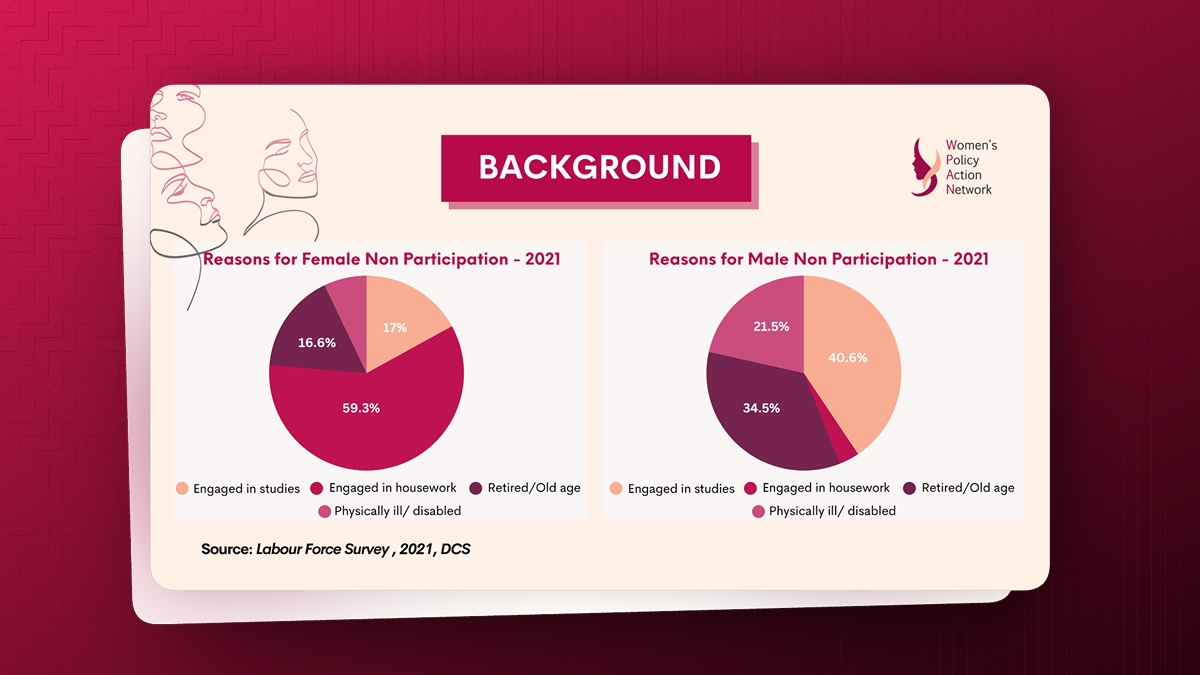
Data from the Labour Force Survey 2021 highlights differences between women and men in the reasons for non-participation.
| Reason for Non-Participation | Women | Men |
|---|---|---|
| Engaged in studies | 17% | 40.6% |
| Engaged in housework | 59.3% | — |
| Retired / Old age | 16.6% | 34.5% |
| Physically ill / disabled | — | 21.5% |
Source: Labour Force Survey, 2021, Department of Census and Statistics (DCS).
Focus Areas
- Child Care: Lack of affordability and access to frequent and quality child care.
- Elderly Care: Sri Lanka’s ageing population and the increasing demand for elderly care.
- Parental Leave: The absence of mandated paternal leave and the burden of maternity-leave costs on employers.
Child Care
Key Issues
- Accessibility
- Regulation and monitoring
Child Care in Sri Lanka
In 2021, Sri Lanka had approximately 1,902,000 children aged 0–5. The source material reports 474,406 students registered and 15,353 privately run preschools.
| Indicator | Figure |
|---|---|
| Children aged 0–5 in 2021 | 1,902,000 |
| Total number of students registered | 474,406 |
| Privately run preschools | 15,353 |
| Privately run centres | 80% |
Source: State Ministry of Women and Child Development, Preschools & Primary Education, School Infrastructure & Education Services (2021).
Policy Recommendations
- Regulate and monitor child-care centres.
Utilize local government mandates through by-laws to establish standardized and regularized day-care centres. - Incentivize the corporate sector to operate private day-care facilities.
Encourage public-private partnerships in providing care for children by utilizing existing infrastructure.
Elderly Care
Ageing Population
Sri Lanka is expected to face a nationally ageing population. The source material states that by 2050, Sri Lanka’s old-age dependency ratio will nearly double.
There is currently little infrastructure in place to address the growing needs associated with an ageing population.
Source: Asian Development Bank.
The Care Burden
The burden of taking care of elderly people will have to be borne by women. The source material uses findings from the Time Use Survey 2017 to highlight differences in the amount of time women and men spend on personal and household care activities.
Source: Time Use Survey (2017).
Existing Infrastructure
| Indicator | Figure |
|---|---|
| People above the age of 60 | 2.5 million |
| Elderly care centres in Sri Lanka | 225 |
| Privately run care centres | 220 |
Source: Institute for Health Policy. 2017. Survey of Elder Care Provider Institutions. Colombo.
Geographical Distribution
Over 50% of elders in care homes are located in the Western Province.
Source: Department of Census and Statistics.
Existing State Regulations
- Protection of the Rights of Elders Act (No. 9 of 2000)
- Protection of the Rights of Elders (Amendment) Act (No. 5 of 2011)
- National Elderly Health Policy of Sri Lanka, launched in February 2017
The implementation and effectiveness of these laws are rather limited.
Policy Recommendations
- The elderly-care sector should be regulated by the state.
- The state should increase funding for elderly-care centres.
- Elderly-care centres should be more accessible and affordable while maintaining quality.
Parental Leave
Current Situation
- There are discrepancies in legislation governing maternal benefits.
- Current maternity-leave benefits are entirely borne by the employer.
- There is no legislation recognizing or mandating paternal leave.
Estimated Maternity Leave Benefit Cost
What would happen if the state were to bear the cost of maternity-leave benefits?
| Expenditure / Benefit | Share of 2021 Tax Revenue | Amount |
|---|---|---|
| Estimated maternity-leave benefit cost | Approximately 0.5% | Rs. 5.9 billion |
| Samurdhi expenditure | 4.2% | Rs. 55 billion |
| Fertilizer subsidy | 1.6% | Rs. 21 billion |
Source: Verité Research.
Recommendations
Short Term
- Bring all maternal-leave benefits under one statutory instrument.
- Provide state-funded maternal-leave benefits.
Long Term
- Recognize paternal leave to destigmatize and eliminate gender roles.
Conclusion
Strengthening social infrastructure is presented as an important pathway towards gender equality and empowerment. The source material identifies child care, elderly care and parental leave as areas requiring improvements in accessibility, regulation, affordability, public support and legislative frameworks.
- Strengthen the regulation and monitoring of child-care centres.
- Expand child-care provision through corporate and public-private partnerships.
- Increase state regulation and funding for elderly care.
- Improve the accessibility, affordability and quality of elderly-care services.
- Bring maternal-leave benefits under a unified statutory framework.
- Consider state-funded maternal-leave benefits.
- Recognize paternal leave to help destigmatize and eliminate gender roles.
Sources
- Labour Force Survey, 2021 — Department of Census and Statistics (DCS).
- State Ministry of Women and Child Development, Preschools & Primary Education, School Infrastructure & Education Services (2021).
- Asian Development Bank.
- Time Use Survey (2017).
- Institute for Health Policy. 2017. Survey of Elder Care Provider Institutions. Colombo.
- Department of Census and Statistics.
- Protection of the Rights of Elders Act (No. 9 of 2000).
- Protection of the Rights of Elders (Amendment) Act (No. 5 of 2011).
- National Elderly Health Policy of Sri Lanka.
- Verité Research.
Acknowledgements
- Dr. Ramani Gunatilaka
- Prof. Dileni Gunewardena
- Lihini Fernando
- Ayomi Fernando
- Sewwandi Wijesekera
- Thanuja Jayawardena
- Verité Research
You may also be interested in
Research Publication
 Research Publication
WPAN Policy Brief
 Event
Event