 Advocata Studio
Breaking Barriers: The Future of Women in Sri Lanka’s Tourism Industry
Speakers:
- Dimithri Kuruppu — Managing Director, Jetwing Hotels (third-generation leader of the Jetwing group)
- Hiran Gunawardena — Executive Director, Jetwing (joined as a trainee receptionist in 1977, later became one of Sri Lanka’s first female general managers at a star-class hotel)
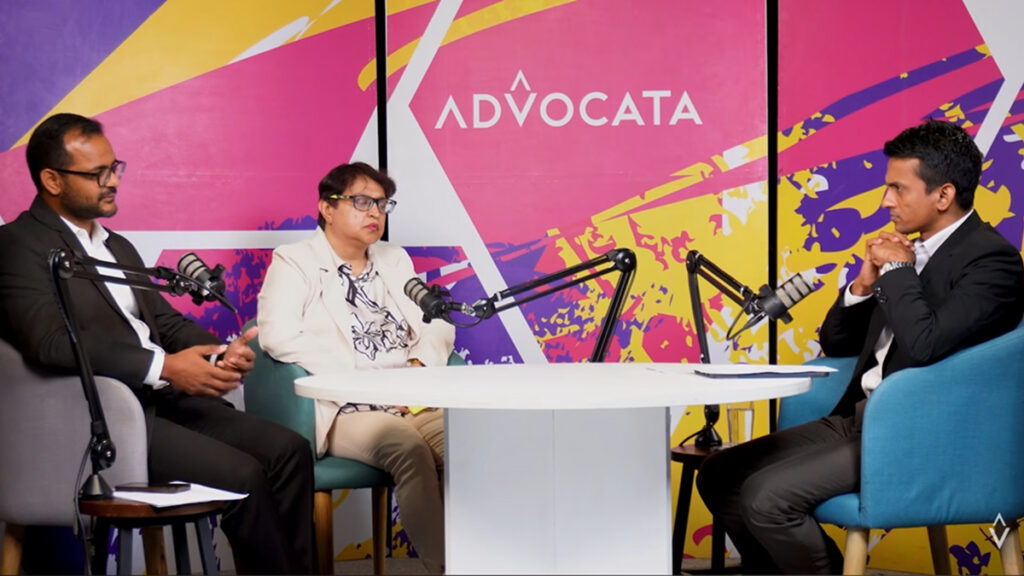
This episode of the Advocata podcast takes up a question that rarely gets the same attention as tourism’s dollar-earning potential: why women remain so underrepresented in the industry’s workforce. The conversation is framed against Sri Lanka’s broader challenge of low female labor force participation, and builds on an earlier Advocata discussion with Malik Fernando on the same theme. Joining the host are two guests from Jetwing Hotels — Hiran Gunawardena, whose career began as a trainee receptionist in 1977 and rose to executive director, and Dimithri Kuruppu, the third-generation managing director of the group founded by his grandfather.
The discussion opens with Hiran’s personal story, which doubles as a window into how much the industry has changed. She joined Jetwing Blue (then a six-room property) in an era when hospitality was not considered a respectable field for women, and had to rely on supportive, “broad-minded” parents — her father drove her to and from her shifts — to make the choice possible. She describes learning the business from the ground up in a pre-digital environment: manual billing, day sheets, and only two telephones at reception. Under Jetwing’s founder and later his son, the company invested heavily in staff training — sending employees for HR, finance, and marketing courses, and later computer training as email and switchboards arrived in the mid-1980s. Hiran credits this investment, along with a merit-based evaluation and promotion system, for her steady rise, eventually becoming general manager of some of Jetwing’s largest and most profitable properties for over a decade, and by her own account, one of the first female general managers of a star-class hotel in Sri Lanka in the early 2000s.
Dimithri reinforces that Jetwing’s culture has never deliberately engineered gender balance in management, but rather has treated merit and commitment as the deciding factors — pointing out that at one point the company had seven female general managers across its properties, including in Jaffna, where a manager from outside the region chose to relocate and adapt to the local culture. Hiran recounts one of the clearest tests of this merit-based ethos: her leadership during the 2004 tsunami, when she coordinated with fellow managers to relocate guests to a nearby school, arranged food and shelter, and kept staff operating under extreme uncertainty — despite family members questioning why she, as a woman, didn’t simply go home. She attributes her resolve partly to her Catholic faith and a sense of responsibility to both guests and staff that superseded concerns about the property itself.
The conversation then turns to structural and cultural barriers facing women in the sector today. Dimithri acknowledges a persistent stigma attached to hospitality work, particularly outside Colombo, and describes Jetwing’s Youth Development Program (running since 2006) as a deliberate response: recruiting young people regardless of prior qualifications, engaging local religious leaders and parents to demystify the industry, and running orientation sessions that let families see hotel operations firsthand. He notes that even in Jaffna, where the company was warned that conservative attitudes would deter female recruits, women turned out to be the largest group of applicants. A recurring theme, however, is that cultural pressure often resurfaces after marriage, with husbands discouraging wives from continuing to work — a pattern Dimithri says is more common in villages than cities, sometimes driven by financial pride rather than necessity. To address this, Jetwing runs a “Second Careers” program aimed at women in their 40s and 50s — often those who are widowed, whose children have grown, or who never had a first career — offering roles suited to their existing skills within walking distance of their homes.
Both speakers point to a paradox in the pipeline: hospitality and tourism management programs at local universities are reportedly dominated by female students, who often outperform their male peers academically, yet few are willing to start at entry-level positions after graduating, preferring office jobs or expecting to skip straight to senior roles. Hiran is candid on this point, arguing that theoretical study cannot substitute for hands-on experience and that new graduates — male or female — must be willing to start from the bottom, just as she did. Dimithri adds that Jetwing has begun using social media, including TikTok, to show the day-to-day realities of hotel work through employees’ own perspectives, specifically to help recruit and retain younger talent by setting realistic expectations from the outset.
On policy and industry-wide reform, Dimithri notes that female participation in Sri Lankan tourism hospitality sits at roughly 7–8%, far below the 40–50% seen in neighboring countries, and calls for better vocational education pathways, particularly for students not suited to traditional academic tracks, alongside continued efforts to shift parental and community perceptions. He also references the recent easing of restrictions on women working night shifts as a positive, if underused, development. Hiran’s closing message is more direct: she urges Sri Lankan women entering the industry to embrace early-career challenges without fear, and questions why women who work demanding hours in export processing zones hesitate to consider hospitality roles requiring similar commitment.
The episode closes with an invitation to viewers to follow related conversations in the series, including the earlier discussion with Malik Fernando, via Advocata’s YouTube channel and other social platforms.