Research Publication
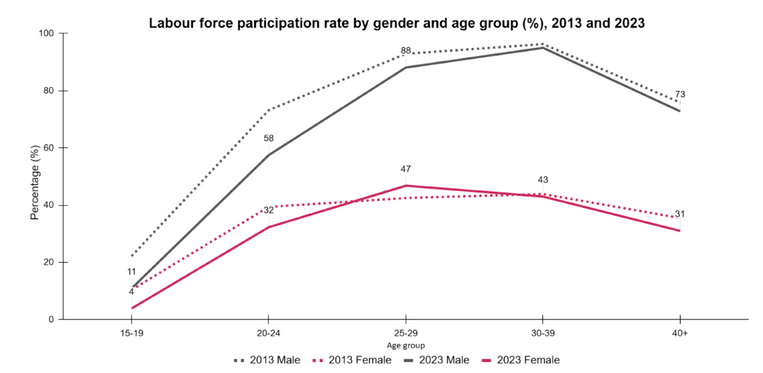
In 2023, Sri Lanka’s women’s participation in the labour force stood at 31.3%. Historically, female labour force participation has remained below 50%, running between 30-36% for the past few decades. This is in stark contrast to male labour force participation rates, which in 2023 stood at 68.6%.
Despite Sri Lanka’s progress in women’s health and education, these gains have not translated into higher labor force participation. Increasing women’s participation is essential for enhancing their financial and social status, driving economic growth, and reducing gender disparities in human capital. Additionally, with an aging population shrinking the labor force, higher female participation could help sustain GDP growth. Studies indicate that closing the gender gap in labor force participation over the next 50 years could boost income by 21%, while the World Bank’s South Asia Development Update 2024 suggests that increasing women’s participation to match men’s could raise GDP by up to 51% in the region.
Over the past decade, female labor force participation in Sri Lanka has seen modest improvements in younger age groups but remains significantly lower than male participation across all age brackets. The most notable increase is among women aged 15-24, suggesting that more young women are entering the workforce earlier than in 2013. However, participation peaks at 47% in the 25-29 age group before declining, reflecting various socioeconomic factors, such as societal norms, marital status, access to childcare and other support, level of economic development in different regions in the country, race, literacy in 3 English and more, that influences women’s ability to remain in the workforce
Source: Department of Census and Statistics
(1) Sri Lanka Selected Issues 2018. IMF Country Report No. 18/176, at: https://www.elibrary.imf.org/view/journals/002/2018/176/002.2018.issue-176-en.xml (2) South Asia Development Update 2024, World Bank, at: https://openknowledge.worldbank.org/server/api/core/bitstreams/6a04abae-03fa-4335-b12e-804528a3a048/content (3) Factors Affecting Women’s Labour Force Participation in Sri Lanka, ILO 2016, at: https://www.ilo.org/sites/default/files/wcmsp5/groups/public/@asia/@ro-bangkok/@ilocolombo/documents/publication/wcms_551675.pdf
In light of International Women’s Day 2025, this brief will provide an overview of five key challenges that affect Sri Lankan women’s ability to enter and remain in the workforce, along with widely accepted solutions to address these obstacles. Implementing policies that account for these challenges can help create a more equitable labor market, providing women with greater opportunities to realize their potential and contribute to economic growth.
Among the many factors influencing women’s labor supply—such as education levels, work-related skills, and labor demand—the ability to access and choose to engage in paid work outside the home plays a crucial role in determining female labor force participation.
The unequal distribution of caregiving responsibilities within households is a significant barrier to women’s access to work outside of the home. The gender gap in labor force participation is often tied to societal expectations and cultural norms which reinforce gender roles; women are still seen as the primary caregivers, while men are viewed as the breadwinners.
In fact, the 2023 Labour Force Survey revealed that approximately 6.4 million women are economically inactive, with over half (57.2%) citing housework as the primary reason for their inactivity. In accordance to the Time Use Survey conducted in 2017; women in comparison to men spend 3 hours and 12 minutes more time engaged in unpaid domestic activities and an additional 54 minutes of caregiving services for the family and household.
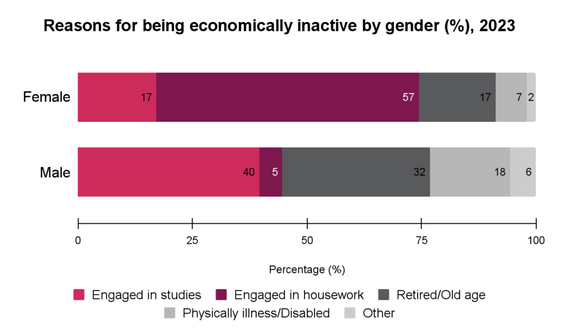
Source: Department of Census and Statistics
The unequal distribution of the care burden placed on women limits the willing women to engage in market activities leading them to 6 concentrate in informal, unpaid or household work. As noted in an ILO statistical brief, Sri Lanka has made some progress in reducing the number of women outside the labor force due to caregiving although substantial challenges persist, requiring further policy attention and support systems. 7 (4) Annual Labour Force Survey 2023, Department of Census and Statistics, at: https://www.statistics.gov.lk/Resource/en/LabourForce/Annual_Reports/LFS 2023.pdf (5) Time Use Survey, 2017, at: https://www.statistics.gov.lk/Resource/PressReleases/TUS_FinalReport_2017.pdf (6) ‘The Hidden Costs of Unpaid Caregiving’, S. Gammage. 2019, at: https://www.imf.org/-/media/Files/Publications/Fandd/Article/2019/March/gender-equality-and-costs-of-unpaidcaregiving-gammage.ashx (7) ‘The impact of care responsibilities on women’s labour force participation’, International Labour Organization Statistical Brief, at: https://www.ilo.org/sites/default/files/2024-10/GEDI-STAT%20brief_formatted_28.10.24_final.pdf Several factors influence the provision and receipt of care throughout life, underscoring the need for a more comprehensive recognition of the care economy. Moreover, caregiving activities take up significant time and limit their availability for paid employment or challenge the women to balance their paid work with the unpaid care work in their household.
Availability of child care facilities would enable them to reallocate their time spent from unpaid care activities at home to paid market work. Women could also take advantage of the work opportunities in the childcare industry to increase their labour force participation. The affordability of childcare services is a critical factor in women’s workforce participation. When 8 childcare services costs consume a significant portion of their earnings, women are more likely to forgo paid services and assume caregiving responsibilities at home. This decision is often driven by a cost-benefit analysis, where low wages and high childcare expenses make staying home the more viable option. Care work in Sri Lanka includes the provision of early childhood care and development as well as eldercare. In a study focused on working women and eldercare, women were identified as the primary caregivers who had to compromise their employment to look after the elderly.
The lack of adequate care services leaves millions of women and their families at a disadvantage. It is important to invest in the care economy and take steps to support it. Enhancing functioning care systems that recognize, reduce and redistribute unpaid care work, create more and better-paid jobs for care workers, and guarantee care workers’ representation are therefore critical to closing gender gaps.
Recommendations: Regulate and Monitor Child Day Care Facilities across all provinces, utilise local government mandates via bylaws to enact local legislation to set up standardised and regularised day care facilities. Establish professional care industry through public-private partnerships to include accredited qualifications to certify trained and qualified caregivers. Mandate paid and substantial parental leave for both men and women.
Another factor that hinders women’s desire to work outside home is the availability of safe public transportation. According to the World Bank’s South Asia Development Update report, inadequate safety during travel to and 10 from work significantly limits women’s mobility and labor force participation. The ILO also identifies poor access to and safety in transportation as a key obstacle to female workforce participation in developing countries, estimating that it reduces the likelihood of women joining the labor force by approximately 16.5%. 9 (8) Childcare Laws for Women’s Economic Empowerment, World Bank, at: https://documents1.worldbank.org/curated/en/099018006212310610/pdf/IDU-c2942538-3157-4ea9-bf02-573349106bf8.pdf (9) ‘Working Women and Eldercare. A Qualitative Perspective’, D Govil, H Sahoor. B. Chowdury. 2022, at: https://www.researchgate.net/publication/366909858_Working_Women_and_Eldercare_A_Qualitative_Perspective (10) South Asia Development Update 2024, World Bank, at: https://openknowledge.worldbank.org/server/api/core/bitstreams/6a04abae-03fa-4335-b12e-804528a3a048/content (11) ‘World Employment Social Outlook: Trends for Women’. International Labour Organisation. 2017, at: https://www.ilo.org/sites/default/files/wcmsp5/groups/public/%40dgreports/%40inst/documents/publication/wcms_55 7245.pdf Furthermore, a UNFPA report on the prevalence of sexual harassment in Sri Lankan public transport highlights that this remains a persistent issue, with many respondents reporting at least one incident of harassment on buses or trains in their lifetime. 12 Additionally, the importance of frequency and reliability of safe night-time public transportation was recommended to facilitate night work for women. Women’s mobility is 13 signifcantly restricted by the lack of safety in public transportation, which is a barrier that affects both their physical movement and their economic opportunities.
Recommendations: Implementation of women only transport services with designated seats or compartments on buses, trains or other public transportation. Enhancing legal and policy support for women’s safety by strengthening existing laws on gender-based violence and harassment in public spaces.
Sri Lanka’s labor laws impose significant restrictions on women’s ability to work at night, whereas no such limitations exist for men.
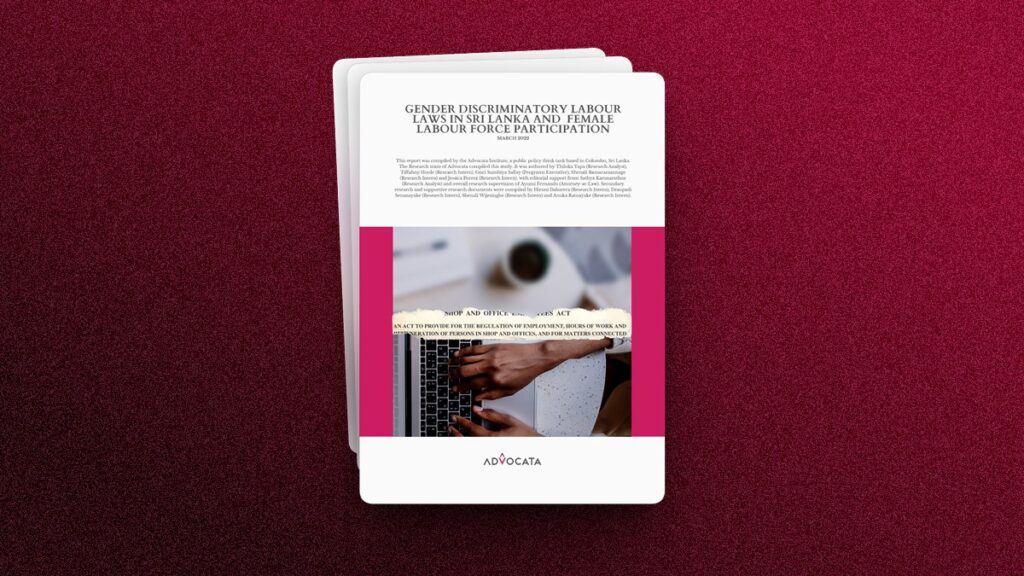
The Shop and Office Employees (Regulation of Employment & Remuneration) Act No. 19 of 1954, Factories Ordinance No. 45 of 1942, and Employment of Women, Young Persons, and Children Act No. 47 of 1956 all include provisions that limit night work for women across most sectors.
Under the Shop and Office Employees Act, women aged 18 and above can work in hotels and restaurants after 8 p.m., but not beyond 10 p.m., with exceptions for specific roles. However, since many establishments in the hospitality sector operate past midnight, these restrictions do not align with industry needs. The Factories Ordinance and Employment of Women, Young Persons, and Children Act permit night work for women in the manufacturing sector but limit it to a maximum of 10 days per month, again with exceptions for certain job roles. These restrictions create barriers for women seeking equal opportunities in industries that require nighttime operations. Restrictions on nighttime work can have implications on a woman’s ability to earn more, especially given that regulations (as per The Factories Ordinance and Employment of Women, Young Persons, and Children Act) require employers to pay employees 1.5 times more than their normal rates if they work night time shifts.
(12) ‘Does she travel safe?: Report on Sexual Harassment in Public Transportation in Sri Lanka’, United Nations Population Fund. 2018, at: https://srilanka.unfpa.org/sites/default/files/pub-pdf/Online_DoesSheTravelSafe_Report%2001032019-compressed_1.pdf (13) Facilitating Night Work for Women in Sri Lanka, IPS, at: https://www.ips.lk/wp-content/uploads/2020/11/Facilitating-Night-Work-for-Women-in-Sri-Lanka-ips_Policyinsights.pdf (14) In response to the limitations in existing labor laws, a draft Employment Act 2019 was presented to the National Labour Advisory Council (NLAC) in 2019. The Act aimed to unify Sri Lanka’s labor laws and address restrictions on overtime work for female employees, signaling a shift towards accepting overtime work for female employees. However, the Act remained in draft form and was never passed by Parliament. Despite this, notable progress has been made in expanding nighttime work provisions for women. (15) This section heavily draws from Advocata Institute’s 2022 publication ‘Gender Discriminatory Labour Laws in Sri Lanka and Female Labour Force Participation’, at: https://static1.squarespace.com/static/55697ab8e4b084f6ac0581ef/t/622620555b386e1d3b955569/1646665849826/Free dom+For+Her+Gender+Discriminatory+Labour+Laws+in+Sri+Lanka+and+Female+Labour+Force+Participation.pdf In addition, restrictions on overtime work permitted for women can also have implications on a woman’s ability to earn more. A study by the Institute of Policy Studies 16 in 2020 revealed how women in the nursing and retail industry saw overtime work as an opportunity to earn more money. However, the Shop and Office Employees Act imposes strict limits on women’s working hours. It permits a maximum of 9 hours per day, including meal breaks, within a 5-day workweek for women, with exceptions for those working in residential hotels, clubs, entertainment venues, or airport shops. Unlike men, who are allowed 9-hour workdays and up to 12 hours of overtime per week, women are not permitted to work beyond these limits.
Additionally, the Wages Boards Ordinance No. 27 of 1941 does not mandate overtime pay for women, further limiting their ability to earn more. In practice, many employers allow women to work overtime due to operational demands. However, without legal protections, this can leave women vulnerable to exploitation, with no guaranteed overtime pay or safeguards. The absence of legislative recognition for overtime work not only hinders women’s earning potential but also reinforces gender-based pay disparities, restricting their access to equal pay for work they are willing and able to do.
However, in May 2024, an amendment to the Shop and Office Employees Act introduced key reforms, allowing women (aged 18 and above) to work before 6 AM and after 6 PM in certain sectors, such as IT, BPO, and office roles supporting international businesses.
The amendment also mandates welfare measures for female employees working late hours, including security, transport, and resting facilities for those employed between 10 PM and 6 AM.
Recommendation: Introduce provisions for nighttime and overtime work for women in the Shop and Office Employees (Regulation of Employment and Remuneration) Act to cover all sectors, whilst instituting adequate safeguards for their security when working at night (e.g., access to safe transport to travel home). This should similarly apply to the Factories Ordinance and the Employment of Women, Young Persons and Children Act.
(16) ‘Women, work and Night shifts in Nursing Homes and Supermarkets’, (Colombo, Institute of Policy Studies Sri Lanka, 2020) (17) Shop and Office Employees (Regulation of Employment and Remuneration) (Amendment) Act, No. 28 of 2024, at: https://documents.gov.lk/view/acts/2024/5/28-2024_E.pdf
18 Given the need to balance caregiving activities and adhere to social norms that discourage women from working outside of the home, studies have shown that flexible work options, such as part-time work or work-from-home facilities have shown to help women balance work commitments with personal and family responsibilities. 19,20 However, Sri Lanka’s labor laws do not explicitly recognize part-time or flexible work, resulting in a lack of legal protections for both men and women seeking such employment. This absence of regulation creates uncertainty around access to and fair compensation for non-traditional work arrangements. Given that women disproportionately shoulder unpaid care work and household responsibilities, the availability of flexible and part-time job opportunities could play a crucial role in increasing their workforce participation and retention.
Employers in Sri Lanka face significant disincentives when hiring men or women under part-time or flexible contracts due to ambiguities in labor laws. One major issue is the lack of a clear definition for full-time employment.
Current labor laws do not specify the minimum working hours required to qualify as a full-time employee, meaning part-time workers are entitled to the same benefits as full-time employees, including paid leave, social security, and overtime payments. This makes part-time hiring less attractive to employers. Additionally, the Termination of Employment of Workmen Act (TEWA) of 1971 does not define the minimum working hours within the 180-day period required to qualify for compensation in cases of unfair termination. As a result, part-time employees working fewer hours still qualify for the same protection as full-time workers, further discouraging businesses from formally employing women through part-time contracts.
These challenges are particularly significant for women, as nearly half (49.5%) of 21 employed women in 2023 were in the informal sector, where work may be flexible but often lacks job security, fair wages, and legal protections. Without clear guidelines for part-time and flexible work, many women are left with unstable employment options that do not provide the necessary protections or benefits.
(18) This section heavily draws from Advocata Institute’s 2022 publication ‘Gender Discriminatory Labour Laws in Sri Lanka and Female Labour Force Participation’, at: https://static1.squarespace.com/static/55697ab8e4b084f6ac0581ef/t/622620555b386e1d3b955569/1646665849826/Free dom+For+Her+Gender+Discriminatory+Labour+Laws+in+Sri+Lanka+and+Female+Labour+Force+Participation.pdf (19) ‘Working women and tight rope walking: An agenda to reform workplace flexibility laws in Sri Lanka’ by N. Wanigasinghe. 2019, at: https://www.researchgate.net/publication/343683000_Working_women_and_tight_rope_walking_An_agenda_to_reform_ workplace_flexibility_laws_in_Sri_Lanka (20) ‘Silent and Discriminated: Part time employees in Sri Lanka and their legal rights’ by S. Kalahari. A. S. Adikaram. University of Colombo, at: https://www.academia.edu/40008358/SILENT_AND_DISCRIMINATED_PART_TIME_EMPLOYEES_IN_SRI_LANKA_and_THEI R_LEGAL_RIGHTS (21) Annual Labour Force Survey 2023, Department of Census and Statistics, at: https://www.statistics.gov.lk/Resource/en/LabourForce/Annual_Reports/LFS 2023.pdf Recommendation: Introduce provisions for part time and flexible work arrangements to existing labour laws, such as the Wages Board Ordinance, Shop and Office Employees (Regulation of Employment and Remuneration) Act, Employment of Women, Young Persons and Children Act, and the Factories Ordinance. Sri Lanka’s Ministry of Finance have stated a new employment law is in the works that would address these requirements. 22
Currently, The Maternity Benefits Ordinance No. 32 of 1939 (with amendments) and Shop and Office Employees (Regulation of Employment and Remuneration) Act, provides legal protection for women against dismissal due to pregnancy and safeguards both pregnant women and their fetuses from work that could be harmful. Under these laws, female workers are entitled to 84 working days of paid maternity leave at childbirth, regardless of their length of service. However, since there is no state subsidy for paid leave, the entire cost, including that of a replacement worker, is borne by the employer. 23 This creates disincentives among employers to hire women workers and promote them, which can affect women’s career progression. The effects of this on women of childbearing age (20-39 years) are very clear, given that unemployment among these women have been higher than that of similar-aged men.
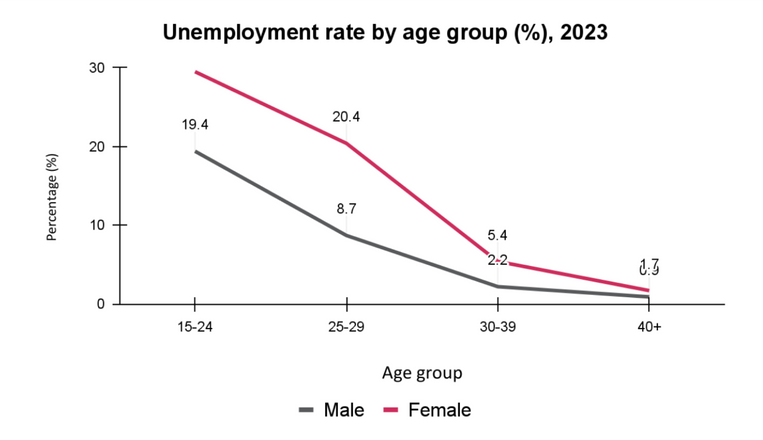
Source: Department of Census and Statistics
In addition, the maternity law in Sri Lanka does not ensure that women are guaranteed an equivalent position upon returning from maternity leave, nor do they provide provisions for flexible or part-time work arrangements after child-birth.
Introduce state-funded maternity leave benefits to reduce employer hesitancy in hiring women, particularly in the private sector. 24 (22) Ministry of Finance, Annual Report 2023, at: https://www.treasury.gov.lk/api/file/ad12f7fa-d2db-43d4-9daa-9270ee7b7cac (23) ‘State Duties: Women’s Participation in Sri Lanka’s Workforce and the UNGPs’, UNDP Sri Lanka, at: https://www.undp.org/sites/g/files/zskgke326/files/migration/lk/01UNDP_Asia_Issue_Brief_Stateduties_Women_participation.pdf (24) ‘State funding for maternity leave in Sri Lanka – a no-brainer.’ Verité Research 2024, at: https://www.veriteresearch.org/wp-content/uploads/2024/05/20230517_MLBInsight_D01.pdf