Public Lecture #1 – What’s wrong with Sri Lanka’s Economy? Public Lecture by Deshal de Mel

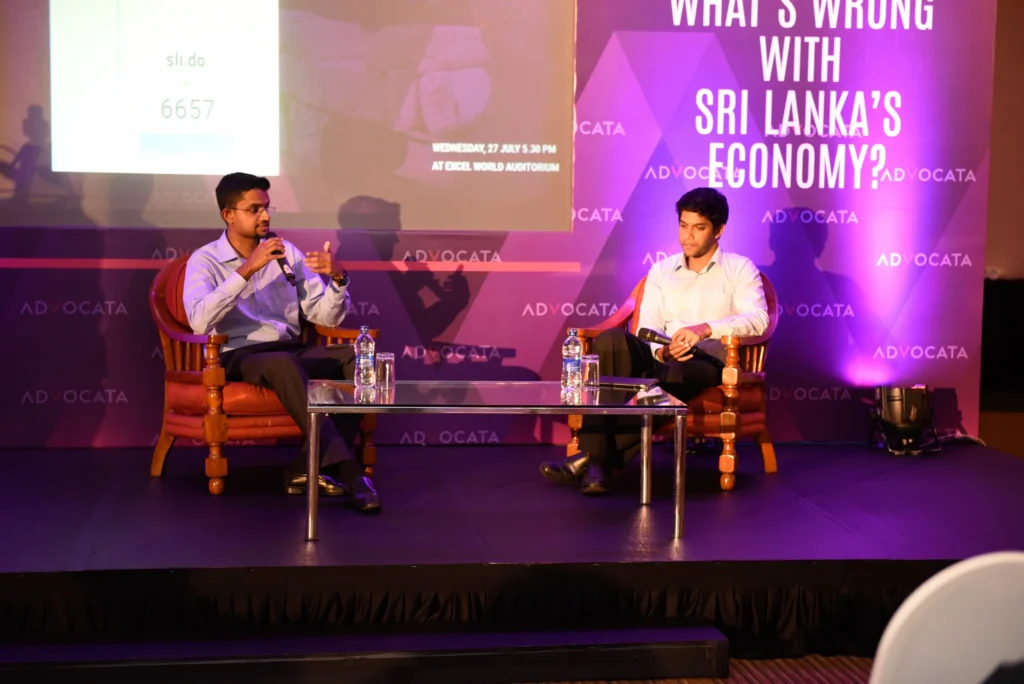
Delivered on 27 July 2016, this was Advocata Institute’s inaugural public lecture — the very first event in the “Fixing the Sri Lankan Economy” series that would define its early public programming — given by Deshal de Mel, then a senior economist at the Hayleys Group, to a crowd of more than 200 people. De Mel identified the biggest risk facing the Sri Lankan economy as its capacity to meet external debt repayments, explaining that the country had enjoyed easy access to cheap, long-term concessional finance until around 2005, after which its graduation to middle-income status cut off that access — leaving the government still carrying the spending habits and large public payroll built up during the cheap-financing era, now funded through continuous deficits and accumulating debt. He pointed to Sri Lanka’s agricultural sector as a specific symptom of deeper misallocation: absorbing roughly 30% of the labour force while generating only about 9% of GDP, propped up by protectionist policies aimed at “protecting” farmers that instead trapped resources and labour in low-value domestic production rather than freeing them to compete in higher-value global agricultural value chains. The main highlight was de Mel’s call for Sri Lanka to take a far more proactive approach to attracting export-oriented foreign direct investment, using its strategic geographic location to specifically target multinationals looking to relocate export operations — a theme that would recur across Advocata’s subsequent public lectures on trade and FDI. The lecture closed with an engaged Q&A moderated by economist Shiran Fernando, with de Mel later publishing additional written answers to unaddressed audience questions.
De Mel also argued that government borrowing crowds out private investment and that a large public sector absorbs scarce land and labour. He noted that the state employed about 17% of the labour force, with roughly 245 state enterprises employing a further 220,000 people. He supported state intervention where markets fail and where unequal opportunities create inequalities, but argued that large public spending had not secured adequate outcomes in areas such as science education.
His recommendations included rationalising government expenditure, reforming state enterprises, simplifying taxes and increasing reliance on direct taxation. He called for more private participation in education and gradual reductions in trade and domestic protection. A practical starting point, he suggested, was SOE reform, where public awareness of the costs was increasing. De Mel spoke in his private capacity as an economist.