Press Briefing: IMF & Urgency of State-Owned Enterprise Reforms

Overview
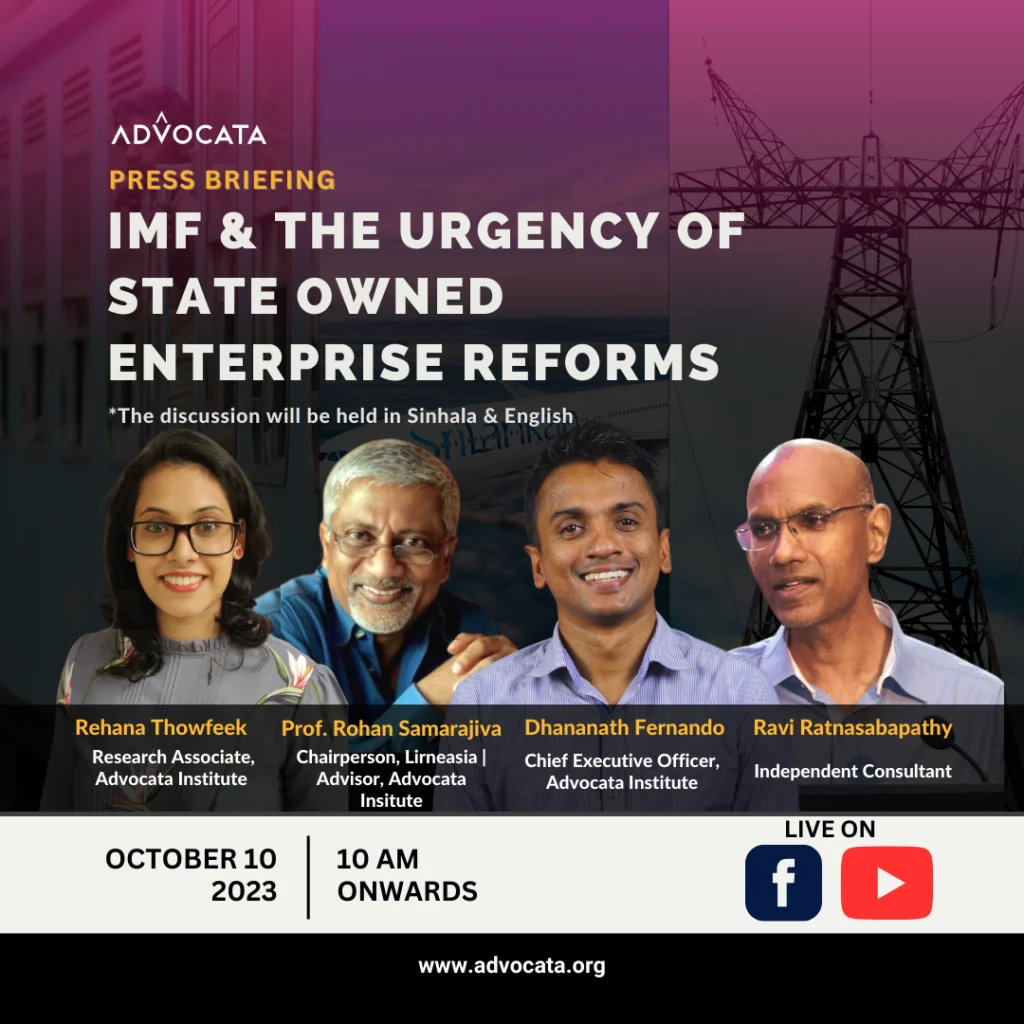
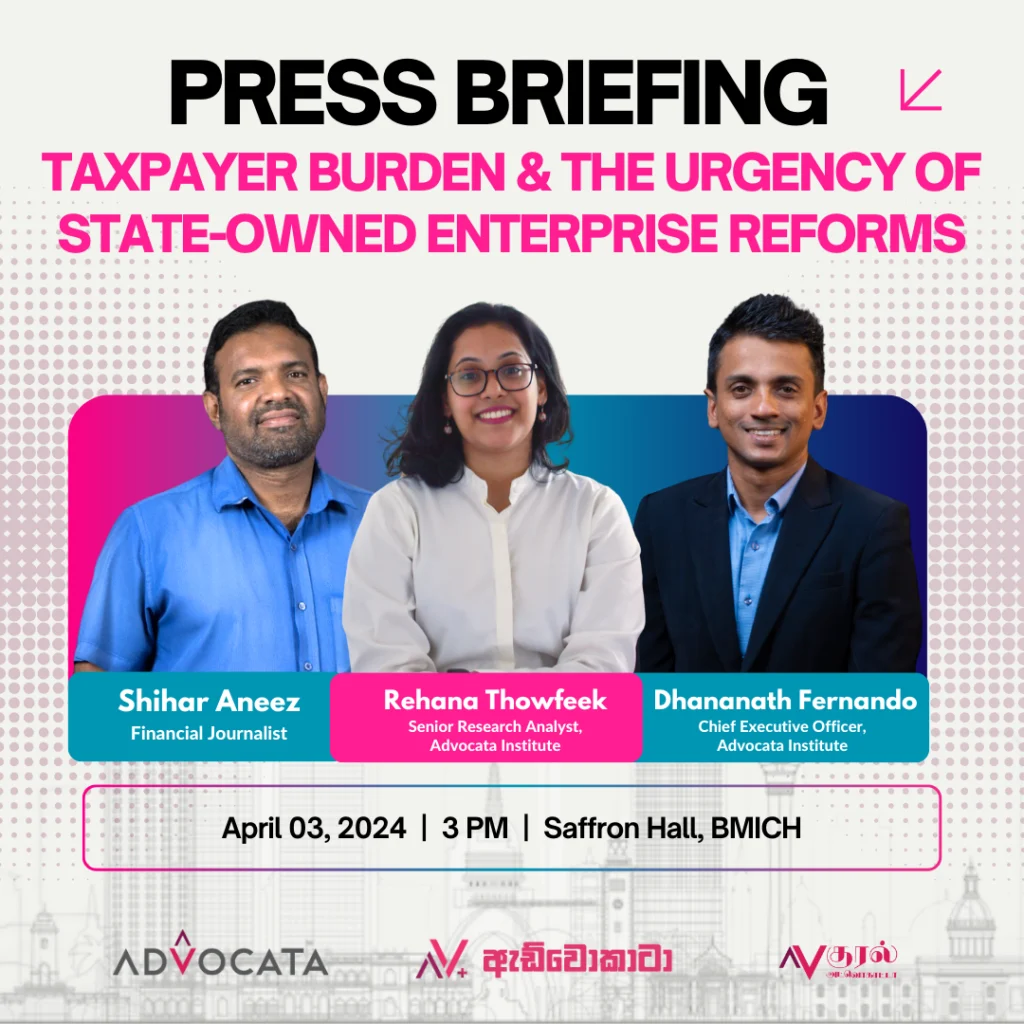
On 10 October, the Advocata Institute convened a press briefing dedicated to the reform of Sri Lanka’s State-Owned Enterprises (SOEs), framing the issue as one of national urgency amid the country’s ongoing economic and debt crisis. The briefing was explicitly designed as a public-awareness exercise, aimed not at policymakers alone but at journalists and the wider public, in order to build the informed pressure needed to sustain SOE reform on the national agenda. As the announcement framed it, Sri Lanka’s SOEs have long placed a significant burden on public finances while simultaneously acting as a major source of broader economic inefficiency — a combination that, in the context of an active debt crisis, elevated SOE reform from a technical policy concern to a matter of national importance.
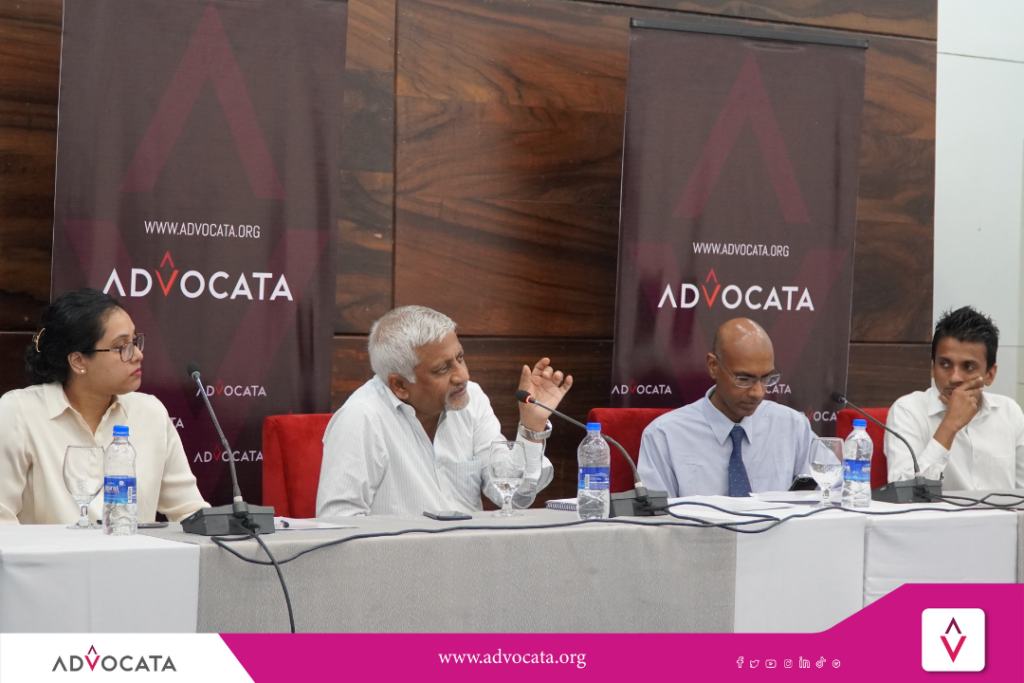
The format reflected that ambition: a ten-minute data-driven presentation by Research Associate Rehana Thowfeek, followed by statements from three of Advocata’s most senior voices on economic reform — Prof. Rohan Samarajiva, Dhananath Fernando, and independent consultant Ravi Ratnasabapathy — before opening the floor to questions from the assembled media.
The Scale of the Problem
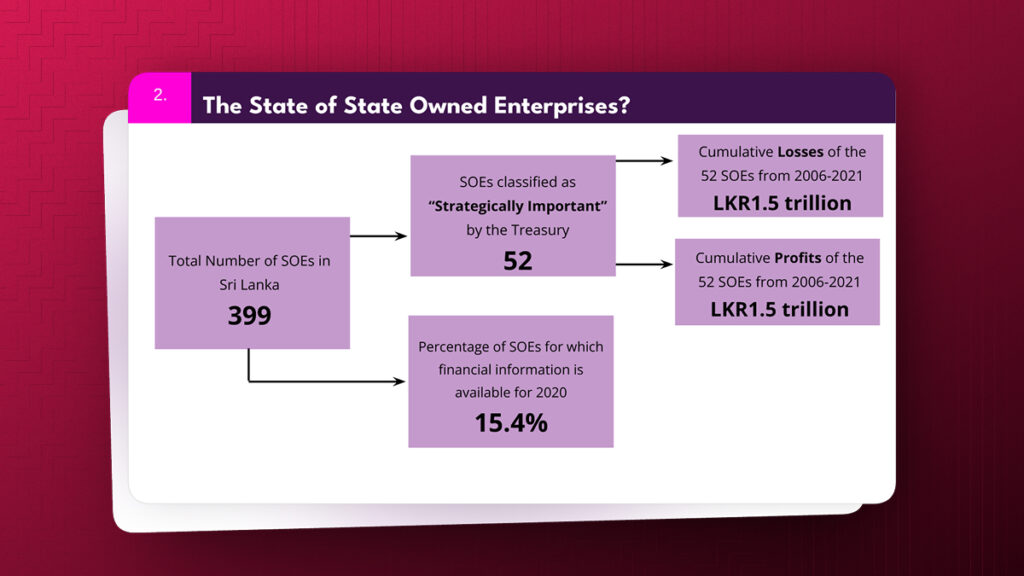
The briefing opened by establishing the sheer fiscal weight of Sri Lanka’s SOE sector. Speakers presented figures showing that state enterprises have accumulated losses totalling 1.8 trillion rupees, alongside accumulated debt of 1.5 trillion rupees — sums large enough, on their own, to represent a fundamental driver of the country’s fiscal deficit. This framing was central to the briefing’s core argument: that Sri Lanka’s macroeconomic instability cannot be fully separated from the performance of its state enterprises, since losses of this scale ultimately have to be absorbed somewhere in the public finances, whether through direct treasury transfers, contingent liabilities, or the kind of state-bank financing arrangements discussed later in the session. In a period when the government is simultaneously trying to restore fiscal credibility and renegotiate its external debt obligations, speakers argued that a loss-making SOE sector of this magnitude actively works against both objectives.

Performance and Governance: The Scorecard Findings
A central feature of the briefing was the presentation of Advocata’s scorecard methodology for assessing SOE performance — an attempt to move the discussion beyond anecdote and toward a systematic, comparable assessment of how individual enterprises are actually performing. The scorecard evaluated the 52 most significant SOEs in the country against both fiscal and governance criteria, offering a two-dimensional view of enterprise health: not just whether an entity is losing money, but whether it is also failing on the governance metrics — board composition, transparency, accountability structures — that typically explain why those losses occur and persist.
The results were stark. Thirteen of the 52 enterprises assessed were found to be failing on both fronts simultaneously — financially loss-making and governance-deficient — a group that included some of the country’s most economically consequential institutions: the Ceylon Electricity Board (CEB), the Ceylon Petroleum Corporation (CPC), and SriLankan Airlines. The inclusion of these particular entities was significant, as each sits at the centre of a critical economic sector — energy, fuel, and national aviation — meaning their dysfunction carries consequences well beyond their own balance sheets, feeding into everything from electricity pricing and fuel supply reliability to the country’s international connectivity and tourism sector.

Looking to International Models: Temasek
Having established the scale and nature of the problem, the briefing turned to potential solutions, with speakers pointing to Singapore’s Temasek model as a template worth serious consideration for Sri Lanka. Temasek’s approach — consolidating commercial state assets under a single, professionally managed holding company structure, operating at arm’s length from day-to-day political direction — was presented as a governance model that could address the core dysfunction identified in Advocata’s scorecard: the entanglement of commercial decision-making with political interference. The appeal of the Temasek model, as discussed, lies in its non-interventionist structure: state ownership is retained, and the public continues to benefit from the value of state assets, but management operates under commercial discipline and professional oversight rather than direct ministerial control — a structure credited with Temasek’s long track record of financial performance despite full state ownership.
Banking Sector Risk: The Danger of Circular Debt
One of the briefing’s most pointed warnings concerned the banking sector’s exposure to the SOE crisis, through what speakers termed “circular debt.” State-owned banks — specifically the Bank of Ceylon and People’s Bank — were identified as having become deeply entangled in financing loss-making SOEs, effectively channelling public deposits into enterprises that show no near-term prospect of repaying what they borrow. This dynamic was framed as a systemic risk rather than a sector-specific one: because these banks are themselves state-owned and systemically important to Sri Lanka’s financial system, their continued exposure to insolvent or near-insolvent SOEs creates a feedback loop in which the fiscal problems of the enterprise sector threaten to become a banking-sector stability problem as well. Speakers argued that this circularity — state banks lending to state enterprises that cannot repay, propped up by the implicit expectation of further state support — obscures the true scale of the country’s contingent liabilities and delays the reckoning that eventual reform will require.
Recommendations
The briefing closed with a set of concrete recommendations grounded in the diagnosis laid out over the preceding hour. Speakers advocated for listing state banks on the stock market as a mechanism to force greater transparency and accountability onto institutions that have historically operated with limited public disclosure — the logic being that public listing imposes reporting standards and market scrutiny that internal government oversight has failed to deliver. For the broader SOE sector, the recommendation was more direct: outright divestment or closure of enterprises found to be non-viable, rather than continued life-support through treasury transfers or captive bank financing. This was framed not as an ideological preference for privatisation in the abstract, but as a practical response to the scorecard’s findings — that a meaningful subset of Sri Lanka’s most significant SOEs are failing on every metric that matters, and that continuing to fund their losses diverts resources the country can no longer afford to spare.