Housing for All: The Role of Competition Policy in Construction

On 13th December 2023, the Advocata Institute hosted a conference at Lavender Hall, BMICH, on the theme of Housing for All: The Role of Competition Policy in Construction. The event examined a question that sits at the intersection of two everyday concerns for Sri Lankans — why housing keeps getting less affordable, and why the construction materials that go into a home keep getting more expensive.
The evening was structured around two discussion sessions. The first, Trade and Competition Policy: Impact on Affordable Housing in Sri Lanka, looked at how anti-competitive practices and protectionist trade policy have shaped the cost of housing at home. The second, Regional Housing Crisis: The Role of Competition in Construction Markets, widened the lens to compare Sri Lanka’s experience with the broader housing affordability crisis across South Asia. Dhananath Fernando, Chief Executive Officer of the Advocata Institute, opened the evening with a welcome address, and the sessions brought together economists, industry leaders, and policy researchers from Sri Lanka, Australia, Singapore, Bangladesh, and beyond. The event was held in partnership with the Templeton World Charity Foundation.
Why This Research Exists
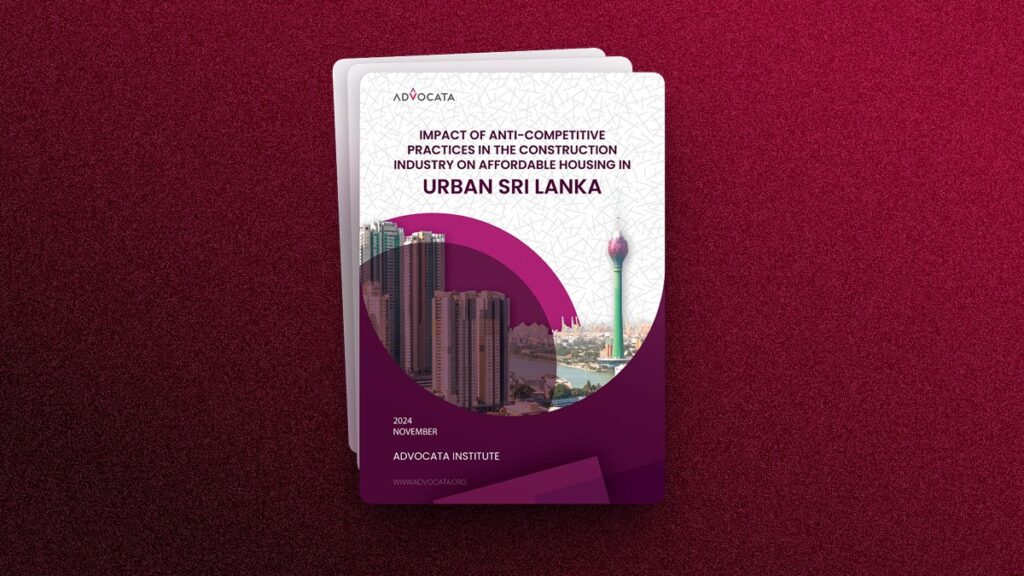
Housing is a fundamental human right, yet across Sri Lanka’s cities, owning even a modest home has moved further out of reach year after year. The research behind this conference set out to answer three questions: what kinds of anti-competitive practices exist within the construction industry, how do they affect the affordability of housing, and what policies could correct these market and policy failures.
The gap the research fills is a real one. Very little existing work had examined the structure of Sri Lanka’s construction input markets, how competition policy applies — or fails to apply — within them, or what the downstream impact on consumer welfare actually looks like. To close that gap, the research team combined a literature review with input market reviews, key informant interviews, and original quantitative analysis built around a Housing Affordability Index.
A Widening Gap Between Supply and Demand
The scale of the shortfall is stark. Sri Lanka’s housing gap — the difference between the number of housing units the population needs and the number that actually exist — grew by 218% over the decade to 2022. Colombo carries the heaviest burden of this shortfall, with excess demand estimated at 26,978 housing units.
That scarcity shows up in international comparisons too. On a price-to-income ratio for 2022, Colombo scores 39.71 — more expensive relative to income than Delhi (14.17), Dhaka (16.08), Karachi (16.98), Malé (13.65), Tokyo (12.9), London (15.8), and New York (9.86). Only Beijing, at 34.6, comes close to Colombo’s level of unaffordability, and Colombo still exceeds it.
Measuring Who Can Actually Afford a Home
To move beyond price indices alone, the research built a Housing Affordability Index (HAI), calculated as lifetime income for a given birth cohort divided by the price of housing. An index value at or below a threshold of 2.86 indicates a household can afford a home; above that threshold, it cannot.
Applying this to 30-year-olds across the income distribution produces a sobering result: only households above the 70th percentile of income can afford a modest 500 square foot house. Step up to a more livable 1,000 square foot house, and the bar rises further — only those above the 75th percentile can afford it. In other words, roughly a quarter to a third of the population, at best, is priced into even the smallest homes, while the majority is priced out entirely.
Why Materials Cost So Much: Oligopolies and Cross-Ownership
Part of the answer lies upstream, in the markets that supply construction materials. The research found that key input markets — cement, tile, and aluminium — are dominated by a small handful of players. Three firms control the cement market, split roughly 70% domestic manufacturers to 30% importers. Tiles are supplied entirely (100%) by just four domestic players, with no import share at all. Aluminium is similarly concentrated among four players, at an 80/20 domestic-to-import split.
Concentration alone isn’t the whole story — cross-ownership compounds it. The research traced ownership structures showing that a single entity owns 63.67% of Vallibel One and 51.01% of Hayleys PLC. Through Vallibel One, that entity controls a chain running through Royal Ceramics PLC into Lanka Ceramics, Lanka Walltiles, Lanka Tiles, Swisstek Ceylon, and Swisstek Aluminium — while through Hayleys PLC, it also controls Alumex PLC and Alco Industries. This is not simply a set of separate oligopolies sitting side by side in the tile and aluminium markets — it is substantially the same ownership interest sitting across both.
Trade Policy Tilts the Field Further
On top of this market concentration, trade policy adds another layer of protection that shields incumbents from competitive pressure. Total tariffs on tile imports reached 83% in 2021, with para-tariffs like CESS accounting for roughly half of all taxes levied on tiles. Cement importers face a CESS that local producers are simply exempted from.
Policy has also been unpredictable. Sweeping import bans introduced in April 2020 drove importers out of the market overnight, followed by a string of reversals and reinstatements, along with one-off carve-outs — such as allowing tile imports through the Board of Investment while leaving the general import regime unchanged.
Longer-standing protectionist measures compound the effect: the Industrial Protection Act of 1949, an informal policy limiting cement factories to one per port, the exclusion of tiles from tariff concessions under Sri Lanka’s free trade agreements with India and Pakistan, and non-tariff barriers built into Sri Lanka Standards Institution regulations.
The price impact of this combination has been severe. Between January 2021 and December 2022, cement prices rose more than 150%, tile prices rose 93–123%, and aluminium prices rose 118%.
A Law That Isn’t Being Used
Sri Lanka does have a legal framework meant to address anti-competitive conduct, currently the Consumer Affairs Authority Act No. 9 of 2003, which succeeded earlier legislation including the Fair Trading Commission Act, the Consumer Protection Act, and the Control of Prices Act. Under the current Act, the Consumer Affairs Authority handles investigation while the Consumer Affairs Council serves the adjudicative function.
In practice, the research found this framework is barely used for its intended purpose. Awareness that the law even covers abuse of dominance and anti-competitive practices is low. Enforcement has remained largely dormant on competition issues, focusing instead on price controls and general consumer welfare — a pattern the research attributes to a lack of institutional independence and resource constraints that make it difficult to hire the specialised expertise competition cases require. Compounding this, public awareness of the Authority’s procedures and scope remains limited, meaning even affected parties may not know a complaints avenue exists.
What the Research Recommends
- The recommendations that emerged track the three areas of failure identified: trade policy, competition policy, and institutional capacity.
- On trade, the research calls for a genuinely pro-competitive trade policy — gradually phasing out existing trade restrictions, avoiding the kind of ad hoc import controls that disrupted the market in 2020, and pursuing greater trade openness overall.
- On competition policy, it recommends amending the existing competition law, strengthening its enforcement, and investing in public education so both consumers and market participants understand what protections already exist.
- On the broader institutional environment, the recommendations extend further: addressing the institutional failures and regulatory gaps identified in the research, improving the availability of reliable market data, helping the construction industry achieve economies of scale and productivity gains, and reducing the cost of borrowing and access to finance for both builders and buyers.
Bringing the Conversation Together

The December conference gave these findings a public airing, with the first panel — moderated by Dr. Roshan Perera, Senior Research Fellow at Advocata — testing the trade and competition policy findings against the perspectives of Prof. Prema-chandra Athukorala of the Australian National University, Eng. Thilak Premalal of the National Construction Association of Sri Lanka, and Athula Amarasekara of Design Team 3, Singapore. The second panel, moderated by Rehana Thowfeek, Research Consultant at Advocata, placed Sri Lanka’s experience in regional context, drawing on Anu Anna Jo of the Centre for Public Policy Research, Dr. Joseph Wilson, Dr. Malathy Knight — Project Director for the wider regional study on anti-competitive practices and housing across South Asia — and Omar Raad Chowdhury of the South Asian Network on Economic Modeling.
Related resources
- Agenda Housing For All.pdf
- Unshackling Markets: The Case Against Import Controls and Price Controls in Sri Lanka
- Impact of Anti- Competitive Practices in the Construction Industry on Housing for the Urban Poor in India
- Impact of Anti-competitive Practices in the Construction Industry on Housing for the Urban Poor in Pakistan
- Impact of Anti-competitive Practices in the Construction Industry on Housing for the Urban Poor in Bangladesh