 Research Publication
Impact of Anti-competitive Practices in the Construction Industry on Housing for the Urban Poor in Bangladesh
8, December 2023
19 min read
Introduction
Bangladesh is a densely populated country; at present, around 38% of the population lives in urban areas, reflecting the rising proportion of the urban population (World Urbanization Prospects, 2018). It is estimated that by 2030, more than 40% of the population will live in urban areas. Some of the main drivers behind urban migration are rural poverty, river erosion, and natural disasters. The main destination of rural-urban migration is Dhaka, the country’s capital. While most migrants aim to relocate to Dhaka city in the hope of better opportunities and livelihood, they often end up residing in public places, slums, or abandoned buildings. Moreover, given the lack of provision for even a minimum standard of living, the city’s current conditions and infrastructure are not sufficient for working individuals let alone the poor (Shams et al., 2014).
The demand for housing in Dhaka city largely exceeds supply, and the issue of affordable housing has become even more pronounced with fast-increasing urbanization. While it is not expected that infrastructure development will match the rate of urban migration, the failure of the formal sector to provide adequate shelter for the urban population cannot be left out of the discussion (Synergy, 2019). The housing delivery system in Dhaka can be classified into formal and informal systems. The Housing and Settlements Directorate (HSD) and National Housing Authority (NHA) implement provisions for affordable housing for low and middle-income households.
A. Country Context
In 2020, the real estate sector in Bangladesh was estimated to be a market worth approximately USD 5,404.38 million, with an annual growth rate of 15-17% (Bangladesh Bureau of Statistics (BBS), 2020). The sector’s steady and strong growth can be largely attributed to increased demand for housing, government policy facilitations, and the availability of low-interest home loans. As the housing sector expanded, its contribution to the GDP has been significant, and in 2020-21, its sectoral share of GDP was 8.69% (BBS, 2020). However, in 2019-20, the sectoral share was higher at 10.47% and the decline thereafter may be due to the economic impacts of the COVID-19 pandemic.
Table 1: Some key numbers in the real estate sector of Bangladesh
| Description | Number |
|---|---|
| Ongoing Projects | 6,000 |
| Investment so far (BDT Crore) | 150,000 |
| Employment | 35,000,000 |
| Apartments delivered every year | 10,000 – 12,000 |
| Aligned Sectors | 230 |
Source: Adapted from Hague & Rahman (2021)
According to one estimate, there is an annual demand for 120,000 household units in Dhaka. However, only 25,000 household units are built annually (Bangladesh Investment Development Authority (BIDA), 2023). The huge gap between supply and demand indicates that consumers have limited options and are not in a position of leverage. The deficit in housing in urban areas was estimated to be 8.5 million units in 2021 (Table 2).
Table 2: Urban housing deficit (formal housing)
| Year | Housing deficit in urban areas (million) | Total urban population (million |
|---|---|---|
| 1991 | 0.95 | 20.87 |
| 2001 | 1.13 | 28.81 |
| 2011 | 4.6 | 43.43 |
| 2021 | 8.5 (estimated) | 60.00 |
Source: Adapted from Ahamed (2021)
Over the last two decades, the price of housing units or apartments in Dhaka has risen by fourto five-fold (Figure 1). The rise in price can be especially noted in locations that are perceived to have better facilities in terms of utilities, communication, and security.
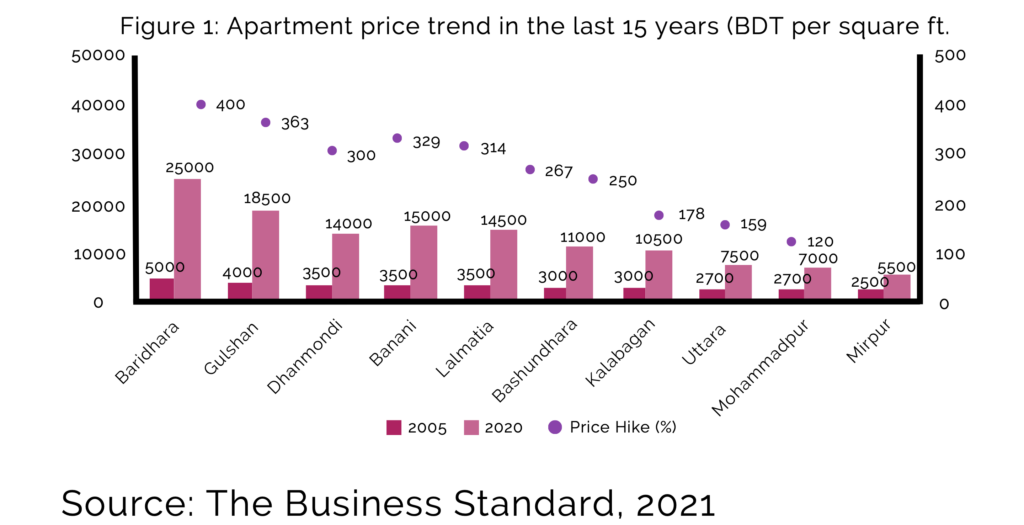
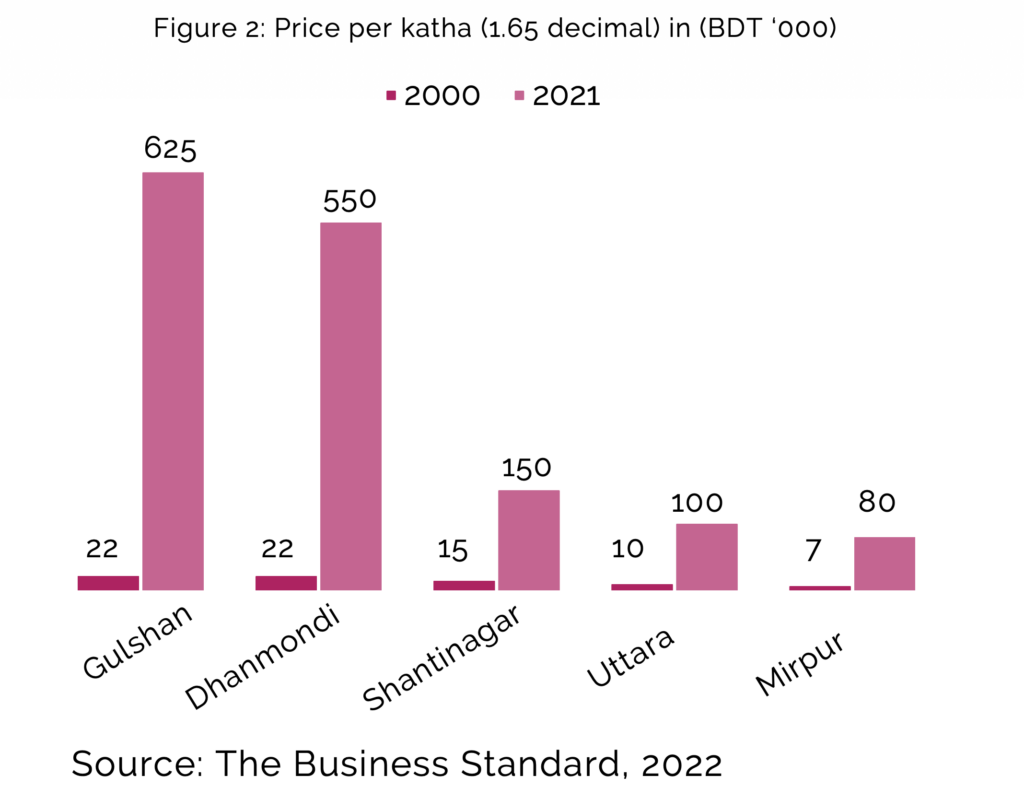
One of the key factors behind the rise in prices of apartments is the rising price of land. The increase in land prices can be attributed to the scarcity of land. Industry insiders have opined that over the last two decades, land prices in some areas have increased by 10-12 times (Figure 2).
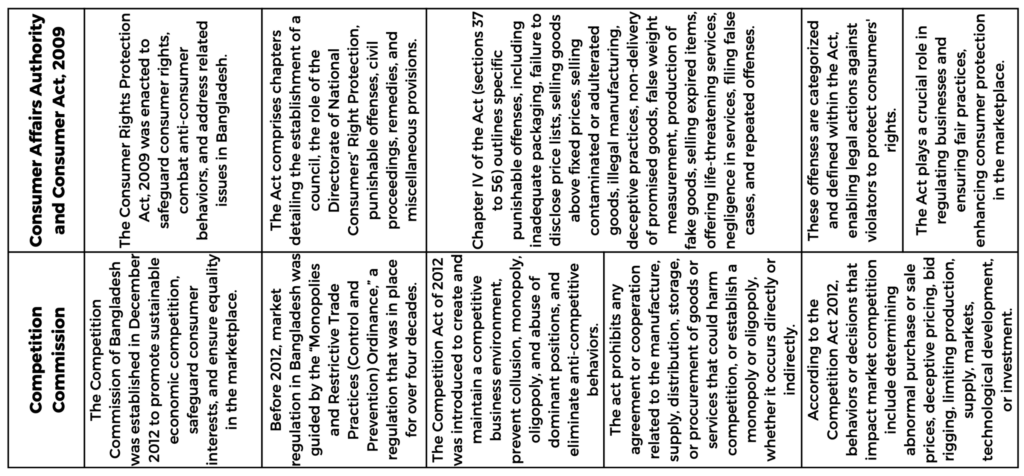
1. Legislation on Competition and Consumer Welfare
2. Housing for the Urban Poor: Policies and Legislative Framework
| National Housing Policy, 2016 | Eight Five-Year Plan (2020-2025) |
| The Slum and Squatter Settlement Scheme, part of the National Housing Policy, 2016, aims to improve living standards in Bangladesh’s slums and squatter settlements. | The eighth five-year plan aims to modernize the regulatory framework and computerize land records in Bangladesh, improving efficiency in recording, registering, and mapping home ownership and transactions for a smoother land market operation. |
| The policy emphasizes changing perspectives towards slum inhabitants and aligning with UN human settlement development policies for sustainable environments. | The plan emphasizes creating a level playing field, reforming land administration and regulations, and restructuring Bangladesh House Building Finance Corporation (BHBFC) to enhance the housing market and improve housing finance mechanisms. |
| Rehabilitation programs like Ghore Fera are proposed for slum communities, ensuring specific resettlement guidelines are created by local governments when replacing slums. | A major goal is to provide home loans through financial institutions to underprivileged, low- income, and impoverished individuals, with a focus on marginalized communities. |
| The policy suggests transforming and upgrading slumsincrementally to enhance infrastructure, with a focus on providing funding and decreasing losses through agreed resettlement guidelines. | The plan advocates for group tenure arrangements, where groups or local governments lease blocks, and specific quotas for poor and disabled individuals in publicly built plot allotments to ensure equal resource distribution. |
| Distressed women are prioritized for housing, and “Elder homes” are planned for older individuals without families in both urban and rural areas. Additionally, the policy aims to introduce extensive housing finance systems and strengthen existing and new investment organizations. | Special attention is given to community and non-profit land development initiatives, aligning with the objectives outlined in the National Housing Policy of 2016 and the Government of Bangladesh’s 2020 guidelines. |
3. Evolution of Trade Liberalization in Shaping Legislative Framework in Shaping Input Markets and Tariff Protection on Construction Materials
During the 1990s, there was a significant liberalization of imports through the elimination of import bans, quantitative restrictions, and import licensing. The simple average tariff rate for salt; sulfur; earths and stone; plastering materials, lime and cement [HS-25] was 62.99% in 1994. However, this rate decreased to 16.52% in 1998 and further to 11.27% in 2013. Similarly, the simple average tariff rate for iron and steel [HS-72] was 79.17% in 1994 and fell to 25.22% in 1998 and 9.23% in 2013. The rate for articles of iron or steel [HS-73] in 1994 was 85.08% and dropped to 35.65% in 1998 and was 20.97% in 2013 (Figure 3).
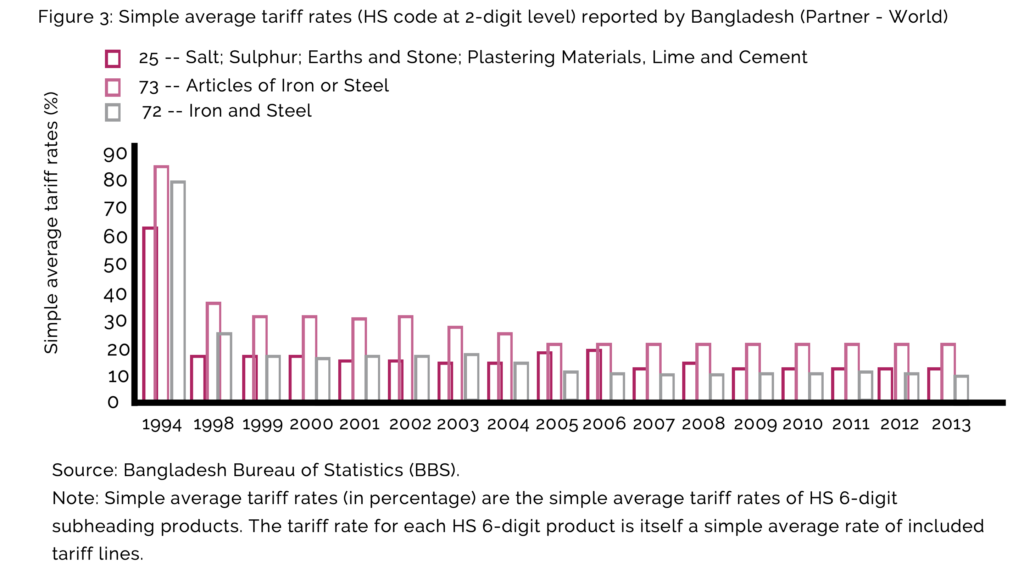
The index of building construction costs comprises three categories: construction materials, transport, and construction labor. The group and item weights were calculated using a 1998-99 analysis of building materials, transportation, and labor expenses, while Laspeyres’ method was used to calculate the Index (Table 3). The index indicates that over the last two decades, the cost of construction has increased by almost three times, with the highest increase in the cost of transport.
Table 3: Building Materials Price Index (BMPI)
| Year | General | Building Material s | Transport | Labor |
|---|---|---|---|---|
| 2008-09 | 214.06 | 201.58 | 488.29 | 221.46 |
| 2009-10 | 222.3 | 207.11 | 566.89 | 241.61 |
| 2010-11 | 256.6 | 230.46 | 843.83 | 282.59 |
| 2011-12 | 321.01 | 268.46 | 1468.7 | 378.69 |
| 2012-13 | 362.62 | 299.03 | 1639.04 | 439.67 |
| 2013-14 | 427.61 | 360.87 | 1737.52 | 512.85 |
| 2014-15 | 461.13 | 396.65 | 1720.25 | 538.33 |
| 2015-16 | 490.09 | 421.02 | 1776.3 | 569.2 |
| 2016-17 | 516.49 | 448.62 | 1840.93 | 586.48 |
| 2017-18 | 544.79 | 476.91 | 1909.77 | 609.13 |
| 2018-19 | 572.58 | 501.25 | 1981.59 | 643.88 |
| 2019-20 | 597.11 | 523.52 | 2044.74 | 671.8 |
| 2020-21 | 619.2 | 542.72 | 2097.85 | 700.28 |
Source: National Accounting Wing, Bangladesh Bureau of Statistics (BBS)
Table 4 illustrates how the prices indicated by the Price Index for building materials, in particular cement and iron and steel as imported commodities, have increased over time.
Table 4: Unit price index of selected imported commodities
| Year | Cement | Iron & Steel |
|---|---|---|
| M.T. (Unit) | M.T. (Unit) | |
| 2006-07 | 135.59 | 135.57 |
| 2007-08 | 141.75 | 146.54 |
| 2008-09 | 149.59 | 194.30 |
| 2009-10 | 161.00 | 208.29 |
| 2010-11 | 163.00 | 221.00 |
| 2011-12 | 215.66 | 294.76 |
| 2012-13 | 221.34 | 278.24 |
| 2013-14 | 212.65 | 249.11 |
| 2014-15 | 211.84 | 212.76 |
| 2015-16 | 189.17 | 157.48 |
| 2016-17 | 179.65 | 177.61 |
| 2017-18 | 24205.31 | 207.44 |
| 2018-19 | 19576.53 | 214.81 |
| 2019-20 | 18718.33 | 207.44 |
| 2020-21 | 18761.06 | 217.59 |
Data Source: Bangladesh Bureau of Statistics (BBS) Note: Base Year: 2002-03 = 100
The cost index statistics examined here demonstrate how expensive the import basket has become over time. Even though 1980s-era tariff reforms continued until the middle of the 1990s, they did not advance beyond this point (Raihan, 2018). From this point, the liberalization of Bangladesh’s tariffs trailed well behind those of many other economies (Raihan, 2018). Because of the high protective duties on material imports, local consumers suffer from sustained high domestic prices of cement and rods. The Bangladesh Steel Manufacturers Association (BSMA) has recently demanded the cutting of customs duty to approximately USD 4.66 per tonne, reducing advance income tax (AIT) to USD 0.93 from USD 4.55 per tonne and the withdrawal of 15% regulatory duty on the import of ferrous waste and scraps. Industry stakeholders also demand that AIT of 2% to 5% on import of raw materials should be cut to 0.50%. As such, at present, the overall import policy negatively affects the input market and consequently consumers.
B. Anti-Competitive Practices in Low-Cost Housing for the Urban Poor
1. Identifying Anti-Competitive Practices in the Real Estate and Construction Sector
The identification of anti-competitive practices within Bangladesh’s real estate and construction sector remains challenging due to the absence of substantiated evidence. Despite the appearance of a competitive market, the adherence of developers to fixed price ranges in specific areas implies potential implicit agreements. However, these indications lack concrete substantiation, hindering definitive conclusions.
2. Indicators of Anti-Competitive Practices in Input Markets
Certain sectors of the input markets exhibit clear signs of anti-competitive practices. Notably, syndicates or cartels operating in specific Dhaka areas wield significant influence over land prices, thereby impacting housing development costs. Public infrastructure projects, marred by corruption and insufficient competition, significantly inflate construction expenses. Additionally, malpractices allow select importers to manipulate market prices and product segments, further underscoring the prevalence of anti-competitive behaviors.
3. Lack of Monitoring in the Market
The absence of effective government monitoring exacerbates anti-competitive activities within the sector. Collusion, cartel formations, and implicit agreements among industry competitors remain undetected due to ineffective regulatory oversight. Consequently, major market players exploit this lack of scrutiny, potentially implicating corruption within regulatory bodies.
4. Lack of Accountability
A glaring issue within the sector pertains to the lack of accountability among real estate developers. Instances of unfulfilled promises, incomplete or non-existent housing units, and consumer deception are rampant. The complex and costly legal procedures deter consumers from seeking legal recourse. Consequently, this lack of accountability perpetuates housing inaccessibility, particularly for low-income households, deepening existing societal disparities.
5. Difficulty for New Entrants to Penetrate the Real Estate Market
Formidable barriers obstruct the entry of new participants into the real estate sector. Concentration within metropolitan areas, coupled with protracted bureaucratic processes, compel new entrants to resort to illegal practices. These barriers consolidate market control within the hands of a select few, underscoring the prevalence of anticompetitive practices.
6. Focus on High and Upper-Middle-Income Households
Real estate developers predominantly target high and upper-middle income households, driven by rapid returns on investment. Limited offerings for middle-income families exist, albeit priced at the higher end of the spectrum due to elevated land and construction costs. While developers are gradually shifting focus towards middle-income households, affordability remains a challenge. Consequently, this socioeconomic stratification leaves the urban poor without viable housing options, perpetuating societal disparities.
7. Limited Financing Options for the Urban Poor
The urban poor face challenges in securing housing financing, primarily due to restricted options. Financial institutions prioritize middle and uppermiddle income households for housing loans, imposing high collateral requirements and interest rates. This exclusionary approach leaves the urban poor without viable avenues for affordable housing finance, further exacerbating their housing predicament.
C. Case study
The study conducted a survey of 400 households in the Dhaka metropolitan area. Four major slums in Dhaka city were considered for the survey. Of the four slums, two from Dhaka North City Corporation, Banani and Mirpur, were selected. The remaining two, Shayampur and Dhalpur, were selected from Dhaka South City Corporation.
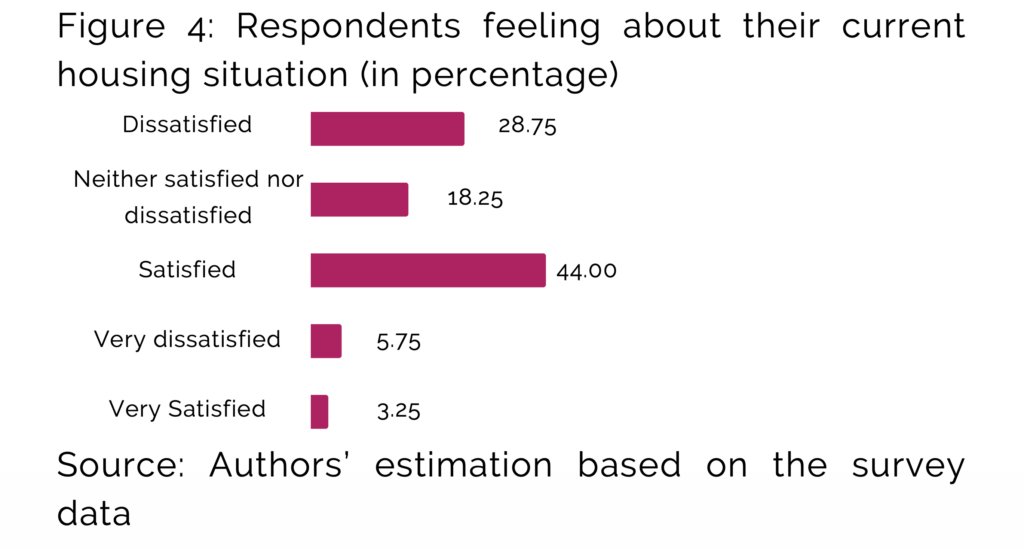
Almost half (47.25%) of respondents were satisfied with their current housing situation while 34.5% were not satisfied. 18.25% of respondents were neither satisfied nor dissatisfied with their housing situation (Figure 4).

Almost 99.5% of the respondents would like to go through an application and selection process if affordable housing units are available. Among them, 68.50% of the respondents want Pucca housing while 28.50% want Semi-pucca as their preferred housing (Figure 5).
The respondents were asked about the size of the house they expected. The average size of the expected housing was 584 square feet. On average, a household expects the number of bedrooms to be 2.5. The average expected number of washrooms per household was 1.3. The respondents expect better utility facilities such as sanitation, water supply, electricity supply, gas supply, waste management, etc., in their housing.
To understand the willingness to pay for a house, the respondents were asked, “How much are you willing to pay for the housing of your preference?” On average, each respondent wants to pay approximately USD 4600 for each housing for their preferred location in the urban setting. 99.75% of the respondents are willing to pay for housing on an installment basis. On a monthly basis installment, on average, each respondent wants to pay nearly USD 47 per month. 80% of the respondents said that if adequate assets were available, they would prefer to invest in housing.
The respondents were asked about their willingness to avail of any loan for housing. 85.3% of the respondents said that they were willing to avail of a loan for housing. On average, each respondent expects a loan amount of nearly USD 2900 per housing. On average, the respondents expect a preferred interest rate of around 4.1%. However, 87.8% of the respondents do not want to provide a mortgage for availing any loan. Notably, 43% of the respondents said that they would prefer microfinance over bank loans.
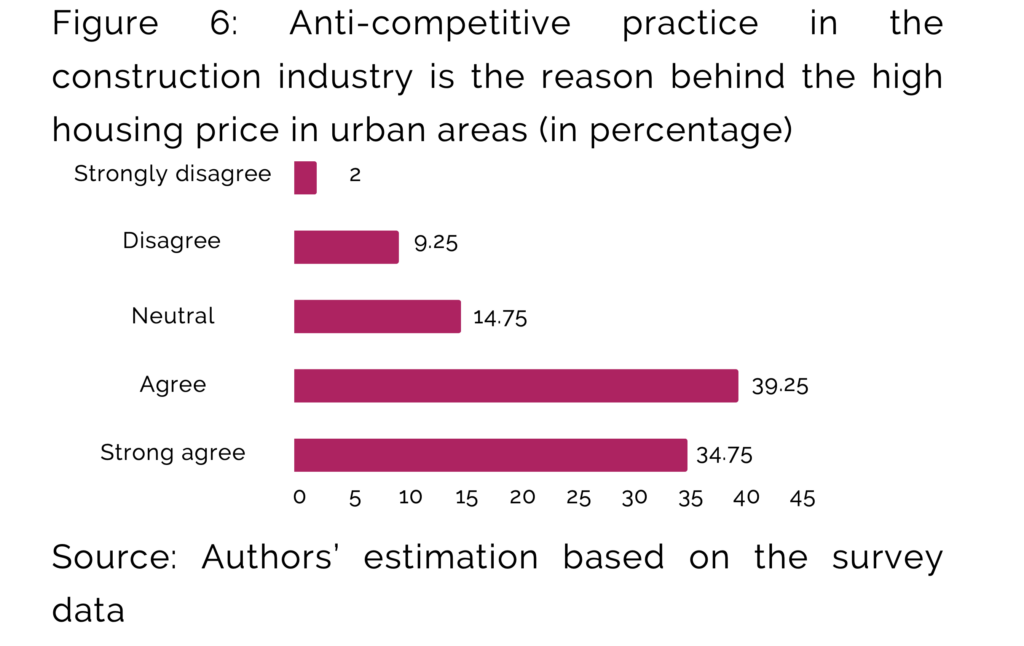
A great share of the respondents believes that anticompetitive practice in the construction industry is the reason behind the high housing price in urban areas. However, a small share of the respondents disagree with this perception (Figure 6).
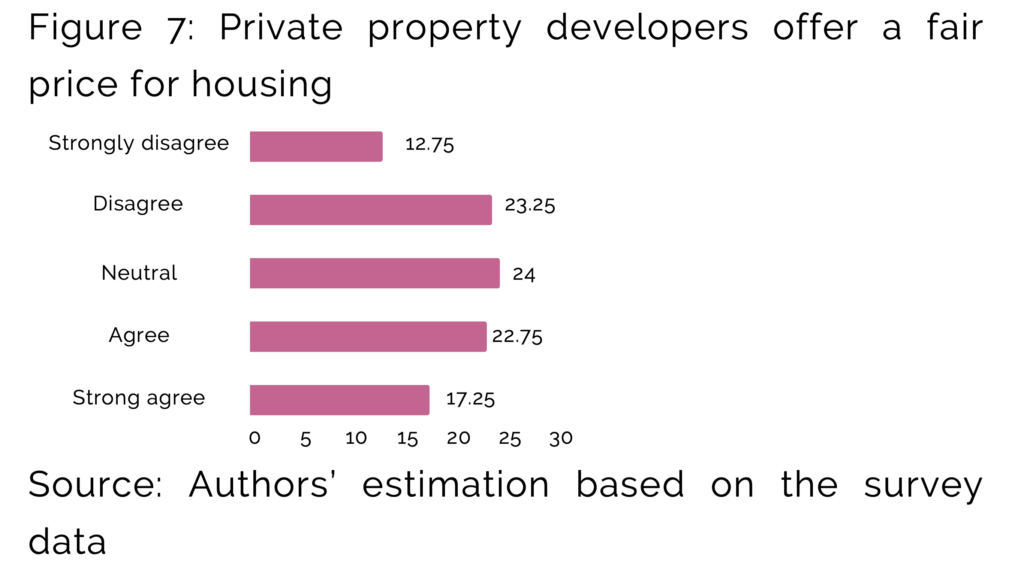
Almost one-fourth of respondents believe private property developers offer a fair price for housing. However, one-fourth of the respondents also disagree with this perception (Figure 7).
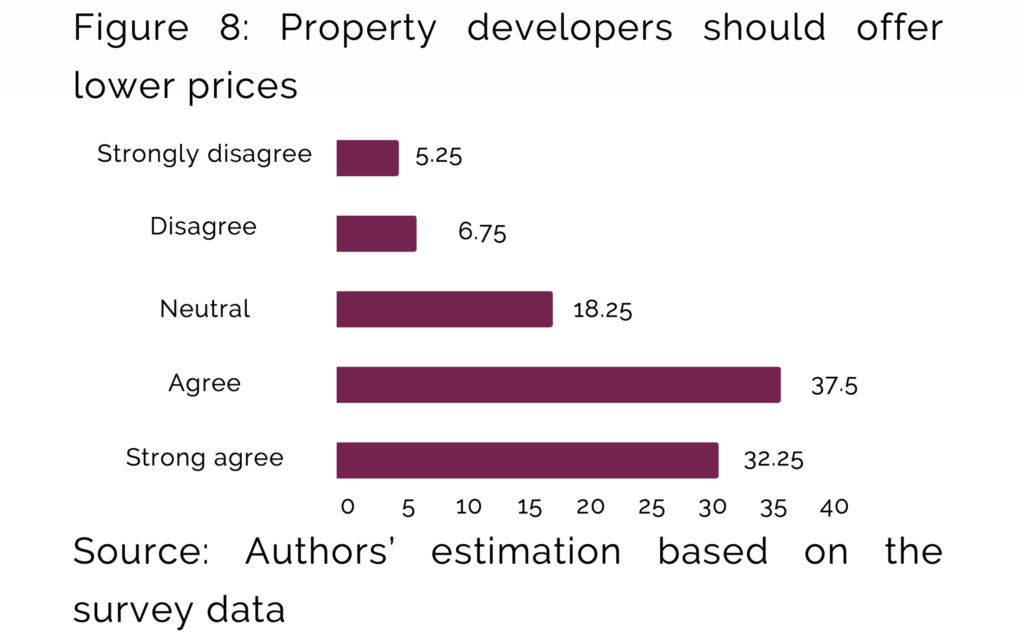
Almost 70% of the respondents believe that property developers should offer a lower price than the current prices while only 10% did not agree with this perception (Figure 8).
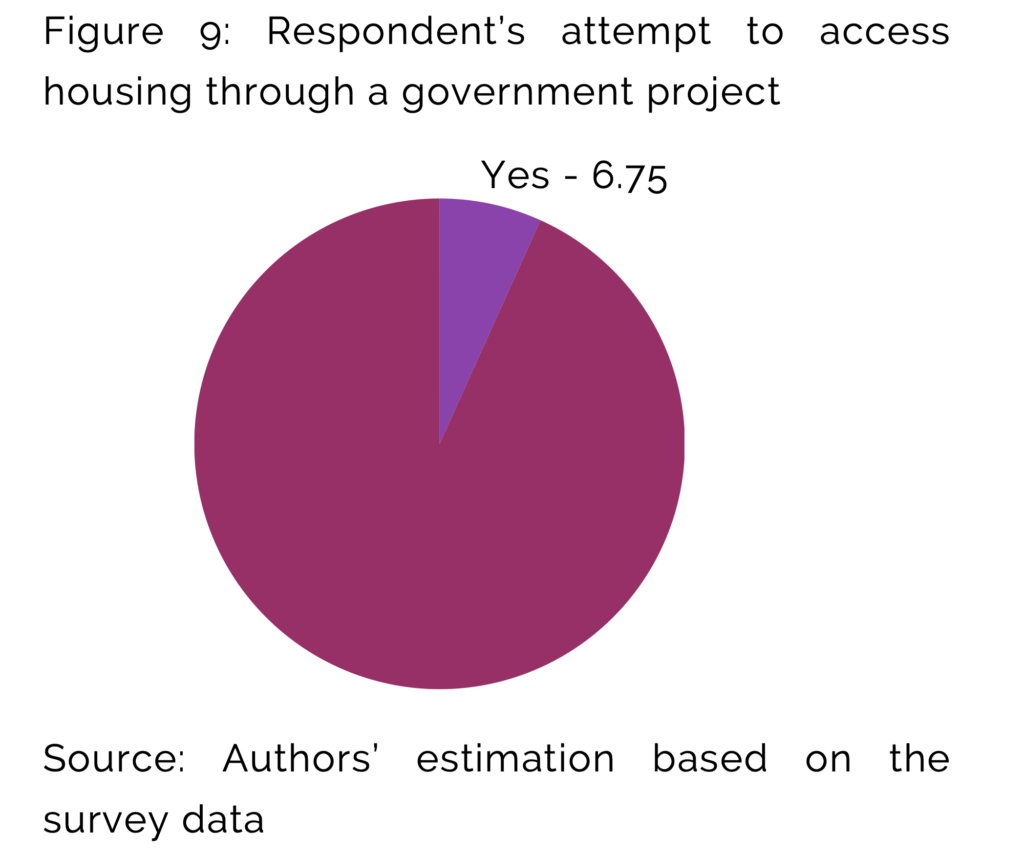
More than 90% of the respondents didn’t even attempt once to access housing through a government project. Those respondents who did not attempt to access the housing through a government project were asked the reasons behind it. The majority of respondents replied that they did not understand the process of applying. Some of the respondents replied that the allocation was not good enough to cover them (Figure 9).
C. Policy Recommendations to Improve Competitive Practices in the Provision of Low-Cost Urban Housing for the Poor
1. Market Monitoring Needs to be Intensified
There is no alternative to enhancing and intensifying market monitoring. Government agencies like the Competition Commission need to step up their monitoring efforts and strictly observe the existing laws. Market monitoring should primarily have two focuses: firstly, whether the market players are colluding, and secondly, whether the market players are engaged in malpractices. The Competition Commission needs to come forward in this regard.
2. Strengthening competition commission
The Bangladesh Competition Commission suffers from a lack of resources, insufficient capacity, coordination issues. There may be insufficient political will for the competition commission to function effectively. In addition, a structural issue persists, as there is no organogram for recruiting officials and support staff, and the available funds are reportedly limited. As a result, the Commission has been unable to fulfil its responsibilities adequately. In order to strengthen the competition commission, specialized personnel need to be recruited. Updating the scope of the laws and regulations with respect to anti-competitive practices requires amending definitions of cartel, contract, and collusion. The commissions capacity needs to be enhanced accordingly.
3. Ensuring accountability in the market
The government needs to work towards ensuring accountability in the real estate market. In many cases, customers are subject to fraudulent activities or breaches of agreements. Generally, the customers hesitate to pursue legal ways and often are left with no compensation.
4. The input market needs to be regulated
The construction input market suffers from a lack of regulation and certain parties take full advantage of this situation. In this regard, the government should work towards ensuring that there is no collusion among landowners. Also, firms that import construction materials like cement or steel also need to be brought under monitoring. In order to ensure that the volatility in the input market is minimum, there is no alternative to clearly defined regulations and implementation of those regulations.
5. Streamlining regulations
One of the major issues in the real estate market is the incongruencies among the existing regulatory frameworks. In order to improve efficiency and competitiveness, the government needs to streamline these processes. Reducing red tape in this regard is imperative. Also, there needs to be a thorough assessment of the regulations so that unnecessary regulations can be discarded.
6. Promoting public-private partnerships
Ensuring the urban poor’s access to housing is in many ways contingent upon implementing and accelerating public-private partnerships in the housing sector. Such partnerships can be greatly beneficial for both the public sector and the private sector.
7. Promoting fair pricing
The government should collaborate closely with private property developers to develop a transparent and equitable pricing framework for low-cost housing. Regulatory bodies should be responsible for monitoring and enforcing this framework to prevent instances of overpricing and ensure affordability for lowincome households.
8. Strengthening government housing projects
Government agencies responsible for housing should increase the allocation of housing units in government projects catering to low-income households. These agencies should simplify and streamline the application process for these projects, ensuring accessibility and comprehensibility for all segments of the urban poor population.
9. Ensuring easy access to financing
Financial regulatory bodies should collaborate with financial institutions to design specialized housing finance products for low-income households. These institutions should provide financial literacy programs to enhance the understanding of these options among urban poor communities, enabling easier access to housing finance.
10. Improving quality assurance
Government housing departments and regulatory bodies should implement stringent quality control standards for all housing projects. Independent bodies should conduct regular audits and inspections to ensure housing units meet the minimum quality and safety requirements.
11. Promoting consumer protection
The government should establish a dedicated consumer protection agency specifically addressing housing-related issues. This agency should advocate for residents, handling concerns related to housing quality, pricing, and contractual obligations.
12. Incentivizing affordable construction materials
The government should implement a strategic approach by providing incentives, subsidies, or tax benefits to manufacturers and suppliers engaged in producing and distributing affordable construction materials. This proactive measure will aim to stimulate and bolster the production of materials crucial for low-cost housing development.
13. Addressing infrastructure gaps
Government agencies responsible for infrastructure development should prioritize basic services such as water supply, sanitation, electricity, and waste management in urban slum areas, enhancing living conditions and overall attractiveness.
14. Market-based solutions
There are several market-based solutions that can be highly useful to ensure the urban poor’s access to housing:
- Affordable Housing Tax Credits: Affordable Housing Tax Credits involve offering tax incentives to private developers as an encouragement to construct and operate affordable housing units. These credits typically lower the developer’s tax liability, making it financially feasible for them to invest in projects that cater to the housing needs of low-income individuals and families.
- Inclusionary Zoning: Inclusionary Zoning is a regulatory strategy that requires developers to include a certain percentage of affordable housing units within their new residential projects. In exchange for adhering to this requirement, developers may receive certain zoning concessions, such as increased density or reduced parking requirements.
- Housing Vouchers: Housing Vouchers involve providing subsidies directly to lowincome households, allowing them to afford housing units produced by private developers in the open market. Recipients of housing vouchers pay a portion of their income towards rent, while the voucher covers the remaining cost, making marketrate housing more affordable for them.
- Microfinance Programs: Microfinance for housing extends microcredit or small loans to individuals from low-income backgrounds to facilitate their entry into the housing market. These loans help urban poor individuals build, purchase, or improve their homes.
- Mixed-Income Housing: Mixed-income housing entails private development projects that include a blend of market-rate and affordable housing units within the same complex. This approach creates diverse and inclusive communities by integrating households from various income groups.
- Rent Control: The government should implement policies that limit the increase in rent for certain properties to prevent excessive rent hikes, ensuring that housing remains affordable for low-income renters in areas with rising costs.
- Homesteading Programs: The government should offer vacant or underutilized public land to low-income families at minimal or no cost, allowing them to build their own homes. This self-help approach empowers families to become homeowners and invest in their communities.
- Housing Cooperatives: The government should also encourage the formation of housing cooperatives, where residents collectively own and manage a housing complex. This model reduces individual costs and fosters a strong sense of community.
- Social Housing Fund: This innovative approach involves the establishment of a dedicated fund aimed at promoting the construction and maintenance of housing units that cater specifically to low-income individuals and families. By leveraging both public and private sector resources, a Social Housing Fund can have a transformative impact on housing affordability.
- Integrating “Ashrayan-2” project into urban affordable housing initiatives: The “Ashrayan-2” project in Bangladesh is a government initiative aimed at providing housing and support to vulnerable and marginalized communities, particularly those who are homeless or living in extreme poverty. Integrating the Ashrayan2 project into urban affordable housing initiatives for the poor can create a comprehensive approach that addresses the specific needs of vulnerable populations in urban areas.
- Land Pooling Policy: A land pooling policy for urban affordable housing is a strategy that involves the collective contribution of land parcels from multiple landowners, which are then combined and developed into larger, planned housing projects.
References
- “Housing the Urban Poor in Urbanizing Dhaka: Challenges of Access to Land.” Synergy, April 16, 2019. https://utsynergyjournal.org/2019/04/15/housing-the-urban-poor-in-urbanizing-dhaka-challengesof-access-to-land/.
- “Real Estate Sector of Bangladesh: Covid 19 and Its Aftermath.” IDLC. Accessed May 31, 2023. https://idlc.com/mbr/article.php?id=389.
- BBS. “Bangladesh Bureau of Statistics, Statistical Yearbook Bangladesh 2021.” 2022. https://bbs.portal.gov.bd/sites/default/files/files/bbs.portal.gov.bd/page/b2db8758_8497_412c_a9 ec_6bb299f8b3ab/2022-06-15-10-493cf641425dd693f9e954de5ae9470775.pdf
- BIDA. “Construction Materials.”. 2019. https://bida.gov.bd/construction-material
- General Economic Division, Bangladesh Planning Commission, GoB. The 8th Five Year Plan: July 2020 – June 2025. 2020. http://www.plancomm.gov.bd/sites/default/files/files/plancomm.portal.gov.bd/files/68e32f08_13b8_4192_ab9b_abd5a0a62a33/2021-02-03-17-04-ec95e78e452a813808a483b3b22e14a1.pdf
- National Housing Authority.. National Housing Policy 2016. 2016. https://nha.portal.gov.bd/sites/default/files/files/nha.portal.gov.bd/law/76f125dc_8e5e_4095_b03d_7d9ac29f842d/National%20Housing%20Policy%202016_English%20Version.pdf
- Shams, S., M. Mahruf, C. Shohel, and A. Ahsan. “Housing Problems for Middle and Low Income People in Bangladesh: Challenges of Dhaka Megacity.” Environment and Urbanization Asia 5, no. 1 (2014): 175 – 84. https://doi.org/10.1177/0975425314521538.
- The Competition Act, 2012. (Act No. 23 of 2012). (Bangladesh).
- The Consumers’ Right Protection Act, 2009. Act No. 26 of 2009. (Bangladesh)
- World Urbanization Prospects 2018. Department of Economic and Social Affairs, UN, 2019. https://population.un.org/wup/Publications/Files/WUP2018-Highlights.pdf