Newsroom
MARCH 2022
Despite high levels of educational attainment,¹ low female labour force participation has been the case for Sri Lanka for over two decades with a rate oscillating between 30-37%. The total female unemployment rate was reported to be 8.5% in 2020 as opposed to a 4.0% of male unemployment rate.² Moreover, the second quarter of 2021 reported a female unemployment rate of 7.7% with a male unemployment rate of only 3.8%.³ Further, in both instances female unemployment rates recorded a higher number than male unemployment across all age groups.⁴
While there can be many factors that determine women’s participation in the labour force such as economic development, social norms, access to child care and other support activities,⁵ marital status, race, relation to the head of the household, literacy in English,⁶ etc, this report attempts to unpack the contribution of Sri Lanka’s labour laws that discourage the entry and retention of women in the labour force.
The analysis finds a lack of reference to part-time and flexible employment in the existing labour law, time restrictions on employing women at night, dearth of legal provisions for sexual harassment in employment and restrictions on overtime work for women as legal obstacles that discourage women from entering and remaining in the labour force.
To improve female labour force participation in Sri Lanka this brief recommends amending the Shop and Office Employees (Regulation of Employment & Remuneration) Act No.19 of 1954, Wages Boards Ordinance No. 27 of 1941, Gratuity Act No.12 of 1983, Industrial Disputes Act No.43 of 1950 (IDA), Factories Ordinance No. 45 of 1942 , Employment of Women, Young Persons and Children Act No.47 of 1956 to mitigate the impact of the identified discriminatory laws.
A mixed-method approach was deployed in this qualitative research report. The main sources this report relied on for analysis are:
a. Existing local and international literature on labour laws, genderdiscriminatory labour laws and their impact on women’s labour force participation.
b. Laws and policy frameworks and other official government documents.
c. A desk research-based survey of evidence on laws and policies adopted by other countries to encourage women’s labour force participation.
d. Key Informant Interviews (KIIs) with relevant government personnel and private sector personnel.
The 2022 World Bank, Women, Business and the Law index was used as a reference to identify the lack of legal best practices and discrimination that impacts female labour force participation. The study will:
a. Identify gender-discriminatory labour laws, legal provisions, or the lack thereof, in terms of part-time, overtime and work at night for women and sexual harassment in the workplace.
b. Provide reform recommendations to improve the legal and policy framework to encourage women to enter and remain in the labour force.
Sri Lanka’s labour force survey states that the female labour force participation rate (LFPR) was 32.0% in 2020.7 The second quarter of 2021 recorded 30.9% for the same.8 This is a significant decrease from the 33.4% reported in the first quarter of the same year.9 This could to be fully prepared for external shocks such as be attributed to COVID 19 deepening gender inequality in the labour market similar to global step towards safeguarding their economies trends. For example, a 2020 study by McKinsey when the legal environment encourages Global estimates that women’s jobs are 1.8 times more vulnerable to the crisis than men’s by stating that when societies become more jobs and women account for 54% of overall job equal, economies become more resilient. The losses despite making up only 39% of global employment.10
More positively, the biennial World Bank publication, Women, Business and the Law, which monitors how discriminatory laws prevent women from fully and equally contributing to their economies in 190 countries across the world, highlighted that despite adversities created by the pandemic many economies made gender equality a priority. For example, since October 2020, 23 economies around the world have recognized benefits and introduced legal reforms improving 39 laws increasing women’s economic empowerment.11 The 2021 Women, Business and the Law report emphasised that even though it is impossible to be fully prepared for external shocks such as a pandemic, governments take an important step towards safeguarding their economies when the legal environment encourages women’s work. The 2022 report confirms this by stating that when societies become more equal, economies become more resilient.12 The publication’s data reveal that legal reforms may precede improvements in women’s opportunities and outcomes. For instance, the report shows that in economies where women face less discrimination under the law, greater progress has been made in closing gender gaps. Most importantly, the report highlights that greater equality under the law is associated with more women participating in the labour force and fewer female workers in vulnerable employment.13 14
The graph below illustrates the positive relationship between equality of the law and increased female labour force participation.
FIGURE 1 | LEGAL GENDER EQUALITY AND FEMALE LABOUR FORCE PARTICIPATION
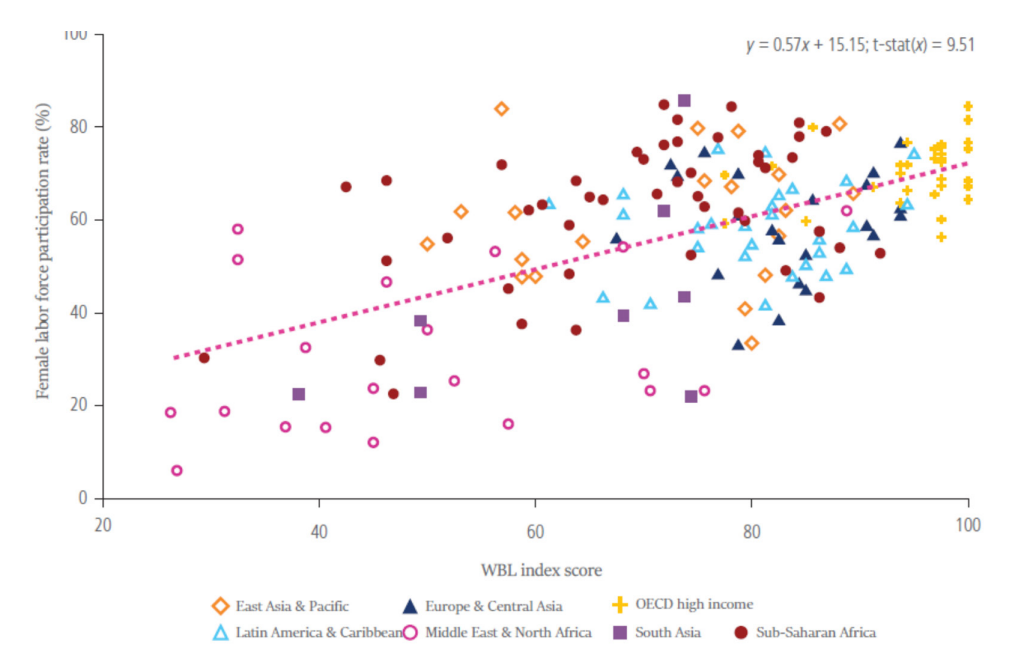
(Source: Women, Business and the Law 2021 (WBL) database; World Development Indicators (WDI) database, Global Gender Gap Index (WEF 2019.)
Drawing from this, while there are extensive studies of contributory factors to Sri Lanka’s low female labour force participation, this brief explores four legal constraints that are easier to tackle in terms of legal reforms in Sri Lanka.These reforms, which are entirely in the hands of the government, will contribute to making the labour market more conducive to women, encouraging their entry and retention in the labour force. This is important because, as identified by the World Bank, women’s economic empowerment reduces income inequality, increasing diversity and economic resilience, benefiting the wider economy of a country.15
Sri Lanka scored 65.6 on the World Bank’s Women, Business and the Law index. The index captures reforms that occurred between October 2, 2020, and October 1, 2021. Since its inception in 2009, the index collected data on laws and regulations that restrict women’s economic opportunities. In 2020, the project began examining this data through an index structured around a woman’s working life. This perspective aligns different areas of the law with the decisions women make as they begin, progress through, and end their careers.¹⁶
The study assigns 35 questions across eight indicators. Figure 2 below demonstrates the eight indicators.
FIGURE 2 | LAWS AFFECT WOMEN THROUGHOUT THEIR WORKING LIVES
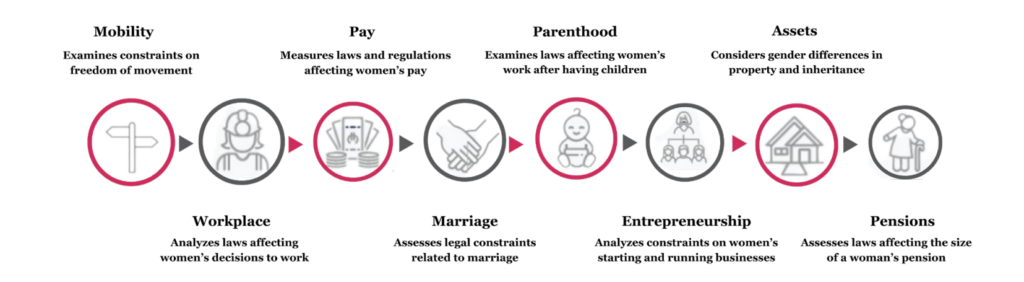
(Source: Women, Business and the Law 2022 (WBL),World Bank )
Overall scores are then calculated by taking the average of each indicator, with 100 representing the highest possible score. The final Women, Business and the Law index score is identified to present the share of good laws in each economy weighted by the indicators. Therefore, as stated by the World Bank, the index serves as an easily replicable way to gauge the regulatory environment for women as entrepreneurs and employees.
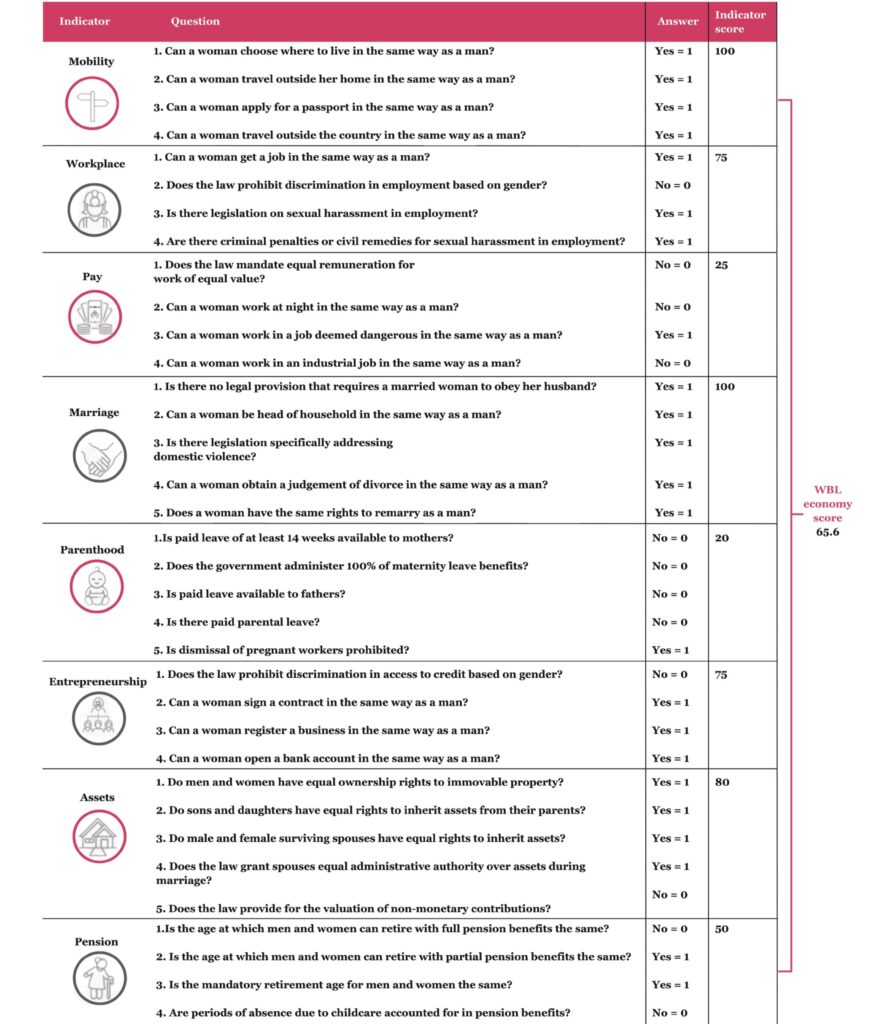
Under the workplace indicator, Sri Lanka has scored a total indicator score of 75. Of the four questions that have been taken into consideration under the workplace indicator sexual harassment is addressed by questions 3 and 4:
• Is there legislation on sexual harassment in employment?
• Are there criminal penalties or civil remedies for sexual harassment in employment?
In terms of legislation on sexual harassment in employment, no statute has been dedicated to addressing sexual harassment in the workplace in Sri Lanka. Moreover, statutes that cover the offence indirectly have been identified to be insufficient.
In terms of criminal penalties and civil remedies for sexual harassment in employment, sexual harassment is criminalised under Penal Code (Amendment) Act No.22 of 1995. However, there are no civil remedies for sexual harassment.
Under the pay indicator, Sri Lanka ranks low with an overall score of 25. Of the four questions considered under the indicator, two are as follows:
• Does the law mandate equal remuneration for work of equal value?
• Can a woman work at night in the same way as a man?
In terms of equal remuneration for work of equal value, there is no specific provision in the law that provides for equal pay for an equal role for men and women in Sri Lanka. However, Section 12 of the Sri Lankan Constitution states that all persons should be equal before the law, making both men and women eligible for equal pay for equal work. In light of this, it is worthy to note that Shop and Office Employees (Regulation of Employment & Remuneration) Act No. 19 of 1954 only permits a maximum of nine hours of work per day, including meal intervals, within a five-day working week for women, with an exception for those employed in residential hotels, clubs and other places of entertainment or in any shop situated at an airport. Hours in excess of this is not permitted under the Act. However, men above the age of 18 years are permitted to work a maximum of nine hours per day and twelve hours of overtime per week. This inhibits women’s opportunity for equal work and thereby restricts their access to equal pay for overtime work they may be willing and able to do.
Similarly, Sri Lanka’s labour laws have no reference to the concept of part-time work, thereby failing to legally secure both men and women’s equal access to and remuneration for part-time work.
In terms of a woman’s ability to work at night the same way as a man, the Shop and Office Employees (Regulation of Employment & Remuneration) Act No. 19 of 1954, The Factories Ordinance No. 45 of 1942 and the Employment of Women, Young Persons, and Children Act No. 47 of 1956 restricts women’s ability to work at night, in most sectors18 in Sri Lanka. No such restrictions are applicable to men.
The World Bank Women, Business and the Law indicator recognizes Section 10 under the Shop and Office Employees (Regulation of Employment and Remuneration) Act No. 19 of 1954 as a legal obstacle that prevents women from working the same night hours as men. However, through our research it was seen that The Factories Ordinance No. 45 of 1942 and the Employment of Women, Young Persons, and Children Act No. 47 of 1956 also include provisions that restrict women’s ability to work at night.
As the Women, Business and the Law indicators coincide with milestones a woman might experience or achieve in their lifetime, they are based on statistically significant associations with outcomes related to women’s economic empowerment such as women’s labour force participation rates.¹⁹ Therefore, the indicator measures explicit gender-based differences in the law. This report uses it as a reference to identify the lack of legal best practices and discrimination that negatively impacts female labour force participation to provide reform recommendations.
Presently, numerous statutes have been introduced to cover different aspects of employment in Sri Lanka.
The Shop and Office Employees (Regulation of Employment & Remuneration) Act No. 19 of 1954 regulates the terms and conditions of employment for employees engaged in a shop or office.20 The Wages Boards Ordinance No. 27 of 1941 regulates fundamental working conditions including working time, annual leave and wages,21 for particular trades.22 The Factories Ordinance No. 45 of 1942 provides for the safety and welfare of employees working in a factory.23 The Industrial Disputes Act No. 43 of 1950 (IDA) aims to regulate the relationship between the employer and employee by prescribing modes of settling disputes amongst them.24 The Employment of Women, Young Persons, and Children Act No. 47 of 1956 regulates work at night for women and children.25 The Payment of Gratuity Act No.12 of 1983 details the social security schemes accessible to workers.26 In response to some of the limitations identified in the aforementioned statutes, a draft ‘‘Employment Act 2019’’27 was presented to the National Labour Advisory Council (NLAC). The Act proposed to unify existing labour laws in Sri Lanka.
Sri Lanka’s labour laws have no reference to the concept of part-time work.28 According to 2019 World Bank data, the percentage of women who worked part-time in Sri Lanka (33.82%) was significantly higher than that of men (19.87%). 29 30 This indicates that a woman in Sri Lanka is almost twice more likely to engage in part-time work.
Research shows that women bear a bigger burden of unpaid care work. Therefore, part-time and flexible work can encourage them to enter and remain in the labour force. This overrepresentation of women in unpaid A 2017 survey by the Department of Census work calls for part-time and flexible work to and Statistics estimated that the female participation rate for unpaid domestic services for household and family members was 86.4% with unpaid caregiving services for household and family members amounting to 38.4% in 2016.31 Further, a 2017 Word Bank report found that from 2006 to 2015 the share of women with contributing-family-workerstatus, which is unpaid, rose from 72-78%. In other words, of all employed females in 2015, 18.8% were contributing-family-workers in comparison to 2.8% males that were engaged in unpaid work in the same year.32
This overrepresentation of women in unpaid work calls for part-time and flexible work to be included in the legal framework.
As the current labour laws fail to specifically recognize part-time work, employers are
restrained from employing part-time workers for several reasons.
The Wages Board Ordinance No. 27 of 1941,33 Shop and Office Employees (Regulation of Employment and Remuneration) Act No.19 of 1954,34 Employment of Women, Young Persons and Children Act No. 47 of 195635 and Factories Ordinance No. 45 of 194236 govern the working hours, rest intervals and holidays of workers.37 However, none of the statutes prescribe the minimum hours of work to be qualified as a fulltime employee.38 Therefore, even a part-time employee will be able to fall within the scope of a full-time employee.39 This would entitle parttime workers to the same number of holidays and rest hours.
Additionally, the Termination of Employment of Workmen (Special Provisions) Act No. 45 of 1971 entitles employees to compensation upon unfair termination of employment,40 provided that they have worked for 180 days within a year.41 As the Act fails to provide a minimum number of hours worked during those 180 days, a part-time worker would also fall under the scope of the Act.42 Thus, employers would be less inclined to hire part-time workers on the basis that they will be working for fewer hours for the same entitlements.43 For example, a 2016 International Labour Organisation (ILO) report revealed that 20% of senior managers of selected companies in Sri Lanka were not in favour of flexible working arrangements under the existing legal framework on the basis that such schemes would be more disadvantageous to the company.44
Another disadvantage of the lack of legal recognition of part-time work is identified under the Payment of Gratuity Act No. 12 of 1983.45 This Act calculates an employee’s social security46 based on their last drawn salary.47 Under this Act, part-time workers are entitled to the same social security as full-time workers, provided that they served an employer for an uninterrupted period of five years or more.48 This will be an additional factor that deters employers from hiring part-time workers.
The calculation of social security under the Payment of Gratuity Act No. 12 of 1983 has an impact on employees who wish to shift to part-time work arrangements. For instance, an employee working under the same employer for over five years wishing to shift to part-time work would be entitled to a smaller portion of social security as it is based on their salary as a part-time worker (last drawn salary), without any consideration of their salary as a full-time employee.
Based on the above, there are numerous barriers to secure part-time work in the formal sector in Sri Lanka. This causes women who prefer more flexible working arrangements to enter the informal sector as they are not formally governed under the labour laws aforementioned.49 For example, a survey conducted by the Department of Census and Statistics in 2020 revealed that 49.9% of the informal sector is made up of women.50 While casual51 and temporary forms of work in the informal sector ensure flexibility for women, it also exposes women to job and income insecurity, as it is characterised by low pay, little or no wage benefits and no labour law rights.52
This further disadvantages women as they are prevented from accessing formal financial services such as requesting loans from banks.53
Legislating part-time work proves to be an effective measure to increase female labour force participation by enabling women to balance unpaid care work responsibilities with paid employment.54
For instance, legislation of part-time work in Austria, Belgium and Germany contributed to an average 26% increase in women’s employment rates from 1992 to 2011.55 Further, government reforms introduced in the Netherlands, such as the right to work part-time by virtue of the Adjustment of Working Hours Act56 and provisions for flexible employment contracts through the Labour Market Act,57 led to an increase in the participation of young mothers in the labour force. In 2019, the maternal employment rate was 80.1% with 50% of maternal employment being part-time work compared to 30.1% full-time.58
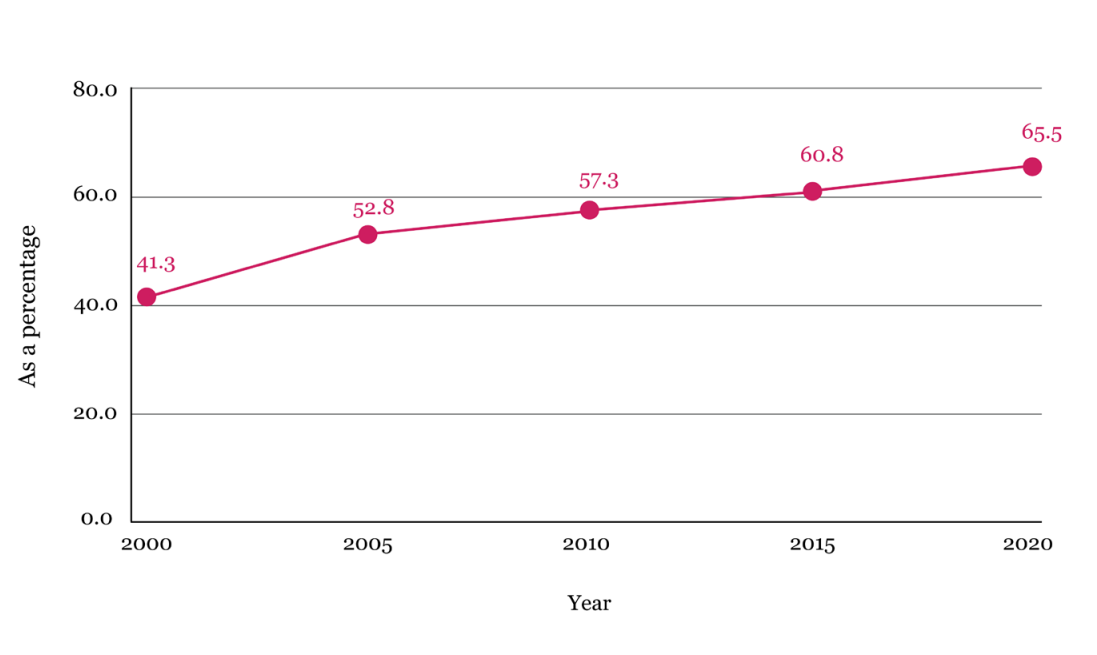
Austria, in particular, reports high part-time female employment rates recording 65.5% of total female employment in 2020.59 Laws such as the Working Time Act and the Temporary Employment Act, which equalised treatment of part-time and full-time employees, aided in the increase of part-time female employment in Austria. Moreover, reforms were made to the Working Time Act in 2007 to allowf urther protection to part-time workers by regulating the worker registration and payment process. Social protection was also extended to cover groups engaging in atypical forms60 of employment.61 These reforms have also contributed to the increase in part-time female employment rates. The law on working time also allows for the possibility of normal working time, which is 40 hours per week, to be distributed across the week as preferred. This, together with collective agreements,62 allow for flexible working time arrangements. The 2007 reforms have also ensured that part-timers are protected under all labour law requirements, insured, qualify for pension benefits and are entitled to severance pay.63
The graphs below depict the positive relationship between part-time female employment rate and female labour force participation in Austria from the years 2000 to 2020
FIGURE 3 | PART-TIME FEMALE EMPLOYMENT RATE IN AUSTRIA
Source: World Bank Data, 2022
FIGURE 4 | FEMALE LABOUR FORCE PARTICIPATION RATE IN AUSTRIA

Source: World Bank Data, 2022
The COVID 19 pandemic is also forcing the increase of flexible work globally due to safe-distancing measures and restrictions, highlighting the urgency to include part-time work in Sri Lanka’s legal framework.
Sri Lanka has ratified the Employment Policy Convention, 1964 (No. 122) despite the
ambiguity of part-time employment in the law.64 Article 1 of the Employment Policy Convention advocates for freedom in employment by stating that an employee should have freedom of choice and fullest opportunity to engage in work which they are suited for.65 As the ratified convention focuses on equal opportunity and freedom of
choice in work, part-time workers are entitled to protection by the law.66
The Shop and Office Employees (Regulation of Employment and Remuneration) Act No. 19 of 195471 only permits a maximum of 9 hours of work per day including meal intervals within a five-day working week for women.72 It does not permit any hours in excess of this. Men above the age of 18 years are permitted to work 9 hours per day and a maximum of 12 hours of overtime per week.73 However, an exception is provided for females employed in residential hotels, clubs and other places of entertainment or in any shop situated at an airport where they may be employed up to 10 p.m. under specific conditions.74 75
The Shop and Office Employees (Regulation of Employment and Remuneration) Act No. 19 of 195476 was enacted during the British rule in 1948 and intended to protect women. However, under modern working conditions the law dissuades employers from recruiting women, denying them opportunities for economic advancement.77
The Shop and Office Employees (Regulation of Employment and Remuneration) Act No. 19 of 195478 and the Wages Boards Ordinance No. 27 of 194179 does not permit any overtime for women. However, in practice, employees in a large number of firms work overtime. For example, the 2021 quarterly labour force survey shows that 49.8% of firms worked overtime.80 A 2020 study by the Institute of Policy Studies also revealed that 70.91% of employees in private hospitals worked overtime.81 Although this percentage is not segregated by gender, it highlights that the legislation does not accommodate modern business requirements.
There is an informal sentiment in some sectors such as IT and BPM, that the Department of Labour will not enforce the prohibition of overtime work. Therefore, a concept outside of the formal law, named administrative relaxation, is followed in these sectors with employers and employees coming into verbal or written agreements to engage in overtime work.82
Advocata’s efforts to confirm this from the Labour Department revealed that the concept of administrative relaxation is not officially recognised by them.
A key informant interview conducted by the Advocata Institute83 further found that there is no formal and uniform process by which administrative relaxation is practised. There have also been instances where companies have worked excessive hours of overtime, exceeding the permitted time limit.84 In other instances, there have been complaints where employees have worked overtime but did not receive overtime compensation.85 It is also unclear as to which sectors are entitled to administrative relaxation and therefore employees have little awareness of whether the sector they are engaged in is covered under this concept.
The draft ‘Employment Act 2019’ 86 was presented to the National Labour Advisory
Council (NLAC),87 proposing amendments88 to repeal the restriction on overtime work
for female employees under the Shops and Offices Employees (Regulation of Employment and Remuneration) Act No. 19 of 1954.89 The amendment permitted both male and female employees90 to work overtime during the five-day work week and be remunerated accordingly.91
This indicates that there has been acceptance towards change in the law and overtime
work hours. However, the Act was only taken up to the draft stage and was not passed by Parliament.92
In 2017, Nepal reversed their legal restrictions on overtime work for both male and female employees by enacting “Labour Act, 2074 (2017)”.93 This allowed female employees to work overtime up to a maximum of 24 hours per week,94 as opposed to 20 hours in the previous Act.95 It is worthy to note that female labour force participation has continued to increase since. Female labour force participation was at 79.4% in 2008, it increased up to 81.6% in 2015 and then to 82.5% in 2019.96 The amendments made on overtime laws could be a contributory factor to this increase.
FIGURE 5 | FEMALE LABOUR FORCE PARTICIPATION RATE IN NEPAL

Source: ILOSTAT database, 2022.
Sri Lanka is a signatory to the Discrimination (Employment and Occupation) Convention 1958 No. 111,97 which upholds the principle of non-discrimination in respect of employment and occupation based on sex.98 Despite being a signatory to this convention, overtime restrictions on female employees in Sri Lanka continue to exist.
The Shop and Office Employees (Regulation of Employment and Remuneration) Act No. 19 of 1954, the Factories Ordinance No. 45 of 1942 and the Employment of Women, Young Persons and Children Act No. 47 of 1956 restrict work at night for women in most sectors104 in Sri Lanka. No such restriction exists for men.105 Although these restrictions intend protection,106 they have inadvertently discriminated against women by restricting opportunities for employment. A 2016 ILO report revealed that a majority of employers in selected manufacturing, service and plantation sectors107 agreed thatthe existing laws on working at night are discriminatory.108
In light of this, this section discusses the restrictions placed on work at night for women employed in the IT/BPM sector, tourism industry (hotels and restaurants) and the manufacturing sector.
The Shop and Office Employees (Regulation of Employment and Remuneration) Act No.19 of 1954 permits women, who are 18 and above, to only work till 8 p.m.109 Exceptions are granted to women employed in selected industries.110 This exception does not include women employed in the IT and BPM sector.111 However, the nature of work in the sector requires employees to work outside the accepted 9-5 hours, as it functions in alignment with international time zones.
Currently, firms in the sector operate later hours by way of the concept of administrative relaxation, which is outside the formal law.112 However, as mentioned previously, the Department of Labour does not officially recognise this concept.
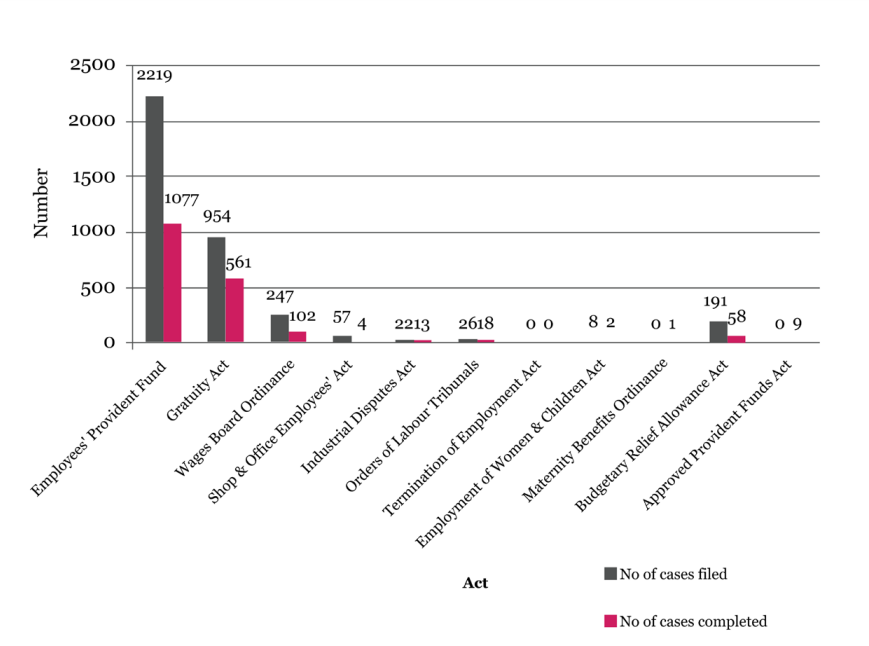
It is worthy to note that the 2020 Annual Performance Report of the Labour Department records only 57 cases filed and 4 cases completed under the Shop and Office Employees (Regulation of Employment and Remuneration) Act No.19 of 1954, which restricts women from working after 8 p.m., as opposed to 2219 cases filed and 1077 cases completed under the Employees’ Provident Fund Act No. 15 of 1958.113
FIGURE 6 | COURT CASES FILED BY ALL DISTRICT OFFICES AND CASES RESOLVED IN 2020
Source: Annual Performance Report – 2020, Department of Labour.
This legal ambiguity deters investment and expansion of the sector as labour laws are
recognised as a crucial factor for investors.114 Flexibility to the labour law, provided by way of unwritten administrative relaxations, discourage investors as informal arrangements lack certainty and transparency. For example, a survey conducted by the World Bank to identify several priorities for governments seeking to attract and retain international investment in the power sector, identified a clear and enforceable framework as a top priority for investors.115 66% of respondents indicated a legal framework, which clearly defines the rights and obligations of private investors, as one of the most important factors in decisions to invest in developing countries.116
Interviews conducted with the national chamber for the Sri Lankan IT/BPM industry, Sri Lanka Association for Software Services Companies (SLASSCOM), confirmed that the current practice in the sector is to work beyond 8 p.m. They expressed that the authorities have been supportive, emphasising the satisfactory working relationship between the parties. However, they recognized the need to remove restrictions to attract more investments to the industry.117
While the Shop and Office Employees (Regulation of Employment and Remuneration) Act No.19 of 1954 permits hotels and restaurants to employ women who are 18 and above to work after 8 p.m., it restricts them from working beyond 10 p.m.118 Exceptions are provided to selected job roles.119 However, as most hotelsand restaurants work till midnight or beyond, the actual requirement is to function beyond 10 p.m.
Women represented less than 10% of the tourism industry in 2018,120 despite the industry being identified to be a promising sector forincreasing women’s labour force participation in Sri Lanka.121 Estimates show that 25,000- 30,000 additional employees will be needed each year to deliver the projected increase of tourist arrivals by 2023.122 While limited flexible working options have been identified as a factor that contributes to low female engagement in the sector, removal of the restriction that limits women from working after 10 p.m. will enable better opportunities for women in the sector.
Working at night is allowed for women under the Factories Ordinance No. 45 of 1942 and the Employment of Women, Young Persons and Children Act No. 47 of 1956. However, it limits women working in the manufacturing sector¹²⁴ from engaging in night work for more than 10 days a month.¹²⁵ Exceptions are provided for certain job roles.¹²⁶
The restriction is contrary to the “right to have and determine choices”, an integral part of women’s empowerment, as declared by the United Nations.¹²⁷ It not only inhibits the ability of women to choose their preferred time to work, but also limits their capacity to earn more. For example, women engaged in night work are paid one and half times the normal payment in Sri Lanka.¹²⁸ A 2020 IPS study conducted amongst women working in supermarkets and nursing homes confirmed night work to be a mode of additional income.¹²⁹ Therefore, the ability to earn an extra income by choosing to engage in night work emphasises the need to remove restrictions that curtail choice.
While it is necessary for women to be permitted to work at night, access to safe transport should also be ensured. A 2020 IPS survey conducted amongst women working in the nursing sector and the supermarket sector revealed travel as a major concern associated with working at night.¹³⁰ Lack of buses available at night, harassment on the road and harassment from other travellers were stated as main challenges encountered by respondents from the nursing sector.¹³¹ The respondents from the supermarket sector were positive about travelling at night, as free transportation was provided by respective organisations, accompanied by a supervisor.¹³²
Despite restrictions on night work for women, Sri Lanka has ratified the Discrimination (Employment and Occupation) Convention, 1958 (No. 111), which upholds the basic ILO principle of non-discrimination in employment based on sex.¹³³ Similarly, these restrictions further violate fundamental principles of nondiscrimination and equality of opportunity and treatment under the Convention on the Elimination of All Forms of Discrimination Against Women, ratified by Sri Lanka in 1981.¹³⁴
The Bombay Shops and Establishment Act of 1948, which applied to the State of Maharashtra,¹³⁵ did not allow women to work after 9.30 p.m. until 2017.¹³⁶ In 2017, the State introduced the Maharashtra Shops and Establishments (Regulation of Employment and Conditions of Service) Act of 2017, allowing women to work from 9.30 p.m. to 7 a.m. in shops and establishments, provided that consent is obtained.¹³⁷ It also mandates the employer to provide protection from sexual harassment, safety and transportation from the establishment to the doorstep of the employee’s residence.¹³⁸
The Impact of Removal of Restrictions on Night Work for Women in Maharashtra
The Employment and Unemployment Survey of India (2015-2016) reported a female labour force participation of 33% in Maharashtra.¹³⁹ However, after the Act was enacted, the Periodic Labour Force Survey (PLFS) reported the female labour force participation, in the ages of 15 and above, to be 31.6% in 2018-2019¹⁴⁰ and 38.7% in 2019-2020.¹⁴¹
Based on 2014 data, 8.25% of women entrepreneur establishments were reported in Maharashtra.¹⁴² According to news reports, the reform is expected to boost these women-driven businesses with the removal of work at night restrictions.¹⁴³ Even though increased female labour force participation cannot be entirely credited to the night work reform, these reforms do help in creating an enabling environment for women to enter and retain in the labour force.¹⁴⁴
Kerala Shops and Commercial Establishments Act 1960 prohibited women from working before 6 a.m. or after 7 p.m.¹⁴⁵ In 2018, the Act was amended to allow women to be employed at night, between 9 p.m. and 6 a.m., provided that consent is obtained.¹⁴⁶ It also mandates the employer to provide adequate protection and transportation to females working at night.¹⁴⁷
Impact of Restrictions being Removed in Kerala in 2018
The Periodic Labour Force Survey (PLFS) reported a female labour force participation of 26.5% in 2017-2018 in Kerala.¹⁴⁸ After the amendment, the PLFS for 2019-2020 revealed a female labour force participation of 31.9% in the same category.¹⁴⁹
However, the Centre for Public Policy Research (CPPR) that pioneered the reform of removing night work restrictions in Kerala, confirmed that the increase in the labour force participation cannot be solely attributed to removal of work at night restrictions. Moreover, it is difficult to deduce if more women were employed in shops and commercial establishments due to the reform, as they are not considered a separate sample in the PLFS. Further, CPPR stated that the impact of COVID 19 may have resulted in the loss of the momentum of the reform.¹⁵⁰ Post-reform observations saw that many shops in Kerala started operating at night,while shops such as eateries were newly opened. Nevertheless, the CPPR expressed that it is difficult to say if women were necessarily employed in these shops.¹⁵¹
Legislative Reforms
Institutional Reforms
BOX ARTICLE 1.1 : ENSURING SAFETY OF WOMEN EMPLOYED AT NIGHT: A MARKET RESPONSE
According to a policy analysis by the Cato Institute, a market where firms compete for women’s labour allows women to increase their bargaining power. ¹⁵⁵ Women’s labour is important for firms in the IT/BPM sectors in Sri Lanka. A human resource GAP analysis report on the IT/BPM sectors in Sri Lanka states that female participation in the industry can increase both quantity and quality of inputs. Based on their primary research, it was acknowledged by corporate executives that women are relatively more sincere and dedicated in their work and possess better soft skills (language and communication), which lead to the enhancement of the industry’s competitiveness. This also means that women’s labour will provide competitive advantage to individual firms in the industry.¹⁵⁶
For women to be encouraged to work at night, their safety should be ensured. The Sri Lanka Association for Software Services Companies (SLASSCOM), the national chamber for the IT/BPM industry in Sri Lanka, speaking to Advocata, stated that a majority of firms in the industry already provide transportation for females working at night as a safety measure. Hence, for individual firms to retain and attract more women into the labour force and to ultimately remain competitive in the market, policies that ensure access to safe transportation for female employees working at night should be adopted as a market response.
Sexual harassment in the workplace is not addressed under the existing labour laws in Sri Lanka. While several statutes cover the offence indirectly, it has proven to be inadequate¹⁵⁷. A 2011 sample survey conducted by the Sri Lanka Medical Association revealed that out of 1,344 female Free Trade Zone workers, 57% faced sexual harassment.¹⁵⁸ Another sample survey, conducted by the same, revealed that out of 321 female industrial workers, 62.3% had experienced some form of unwanted sexual advance.¹⁵⁹ Furthermore, a questionnaire administered by the ILO in 2016 among 500 women, the majority of whom were unemployed, discovered that three-fifth of women would be willing to work if they were assured that they would not be vulnerable to sexual harassment in the workplace.¹⁶⁰ The ILO recognizes sexual harassment in the workplace to be a form of discrimination that causes women to move out of the workplace.¹⁶¹
Sexual harassment is criminalised under Section 345 of the Penal Code (Amendment) Act No.22 1995.¹⁶² It explains sexual harassment in the workplace to be words or actions used by a person in authority. ¹⁶³ The term ‘person in authority’ here is not limited to persons in power such as those in managerial positions, thereby enabling a co-worker to fall within the scope of the provision.¹⁶⁴
However, addressing sexual harassment in criminal law alone is ineffective. This is because the Penal Code requires victims to report cases of sexual harassment to the police in means of a complaint.¹⁶⁵ Additionally, complaints made under criminal law are potentially followed by lengthy court proceedings, requiring a higher burden of proof¹⁶⁶ in comparison to cases of civil law.¹⁶⁷
The Parliamentary Sectoral Oversight Committee on Legal Affairs (anti-corruption) & Media in 2017 estimated the average time taken to conclude a High Court Proceeding to be 10.2 years from the date of the crime.¹⁶⁸ This limits victims’ access to legal protection, causing sexual harassment cases to go under-reported.¹⁶⁹ This highlights the inadequacy of confining sexual harassment in the workplace to criminal procedures.¹⁷⁰
To circumvent the barriers to justice in criminal law, victims can resort to the Industrial Disputes Act No.43 1950 (IDA) under civil law. However, the scope of the Act is limited to the private sector.¹⁷¹ The Act provides swifter mechanisms to resolve work-related disputes which do not involve the police and court proceedings.¹⁷² Under this Act, work-related disputes can be expansively interpreted to include sexual harassment in the workplace, thereby allowing victims to seek justice.¹⁷³ However, it is worthy to note that a 2015 publication reports that no complaint of sexual harassment has ever been made through this Act.¹⁷⁴ Further, a key informant interview conducted by the Advocata Institute revealed that only 2-3 sexual harassment complaints have been made through the Act to the Labour Department between 2018-2019.Those complaints were directed to the police as the Labour Department was not equipped under the IDA to inquire into the matter.
With the aim of improving victims’ access to justice, the draft ‘Employment Act 2019’¹⁷⁵ put forth by the Ministry of Labour, addressed sexual harassment in the workplace.¹⁷⁶ The draft Act defined the offence as the use of physical, verbal and non-verbal conduct of sexual nature, which creates an intimidating, hostile and humiliating work environment on the basis of gender.¹⁷⁷ However, no further steps have been taken to approve the draft as valid law.
Workers in the public sector have several avenues of redress when experiencing sexual harassment in the workplace. The courts have attempted to combat sexual harassment in the public sector in limited circumstances. Pelaketiya v Gunasekera¹⁷⁸ ruled that sexual harassment within the public sector is a violation of the fundamental right to equality.¹⁷⁹ Republic of Sri Lanka v Abdul Rashak Kuthubdeen¹⁸⁰ criminalized the demand of sexual activity as a bribe in exchange for public service.¹⁸¹ Furthermore, the Ministry of Women and Child Affairs issued and executed an internal circular, enabling workers to file complaints when faced with sexual harassment.¹⁸² Thereafter, the Ministry of Women and Child Affairs submitted the circular to all other Ministries, with the direction to implement the complaint mechanism.¹⁸³
The Sexual Harassment of Women at Workplace (Prevention, Prohibition and Redressal) Act of 2013 is the law that protects women in workplaces from sexual harassment¹⁸⁴ in India.¹⁸⁵ The Act legally requires every employer to have an internal complaint committee, or committees, if they have multiple branches. A local committee is appointed by the Act at a district level, by way of conciliation.¹⁸⁶
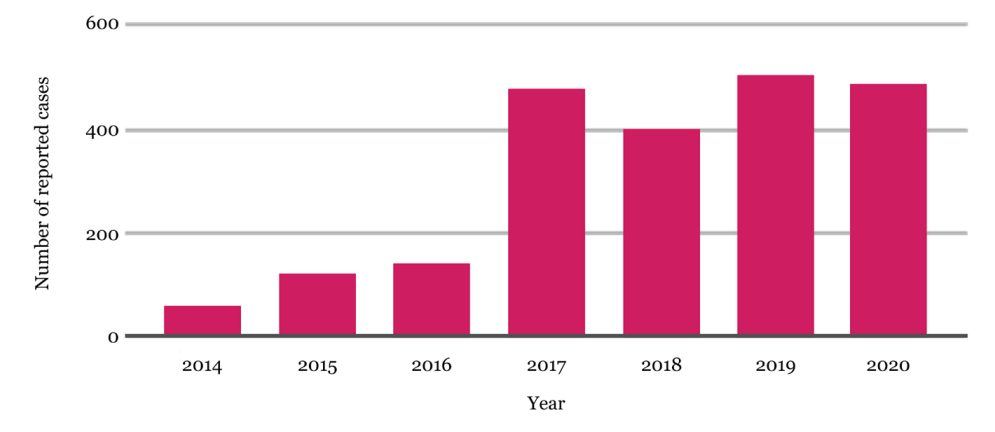
The Act was amended in May of 2016. This expanded the scope of the sexual harassment committees from merely being confined to handling complaints, to being proactive and taking the initiative to conduct prevention measures as well.¹⁸⁷ The second amendment was made in 2019 and organisations with more than 10 employees were instructed to register their internal committees through a web portal within 30 days from when the Act was issued.¹⁸⁸ After the implementation of the Act in 2013, within a year, the National Commission for Women reported a 35% increase in complaints from 249 to 336.¹⁸⁹ Numbers suggest that with the implementation of the law more women were encouraged to report cases of sexual harassment within the workplace.
FIGURE 7 | REPORTED CASES OF SEXUAL HARASSMENT IN THE WORKPLACE
Source: National Crime Records Bureau, Crime in India Reports
However, raising concern, a 2015 study by the Federation of Indian Chamber of Commerce and Industry (FICCI) found that 36% of Indian national companies and 25% of multinational companies situated in India had not constituted their internal complaints committees (ICCs).¹⁹⁰
The Indian Bar Association conducted a survey in 2017 where 6047 working women and men participated. This revealed that 65.2% of the companies did not follow the legal procedure that the Act requires and that only 33.3% of the women feel that their complaint was dealt with fairly. When asked if the women believed they had enough legal protection from sexual harassment, only 11.1% of the respondents were confident of the law. Most felt that the complaints process in their place of employment was not conducted in an organised manner.¹⁹¹
A 2018 study by the Martha Farrell Foundation found, through right to information queries, that out of 655 districts in the country, only 29% have formed the Local Committees (LCs) to address sexual harassment. 15% of districts have not formed the LC.¹⁹²
Through India’s experience it can be concluded that even though amendments to the law on sexual harrasement in the workplace encourages women to report cases of sexual harrasement, non-compliance with the law still disincentivises victims from reaping the full benefit of the legal reform. Therefore, a compliance mechanism seems necessary. Wider awareness on the victims’ legal rights is also proven to be essential. Additionally, there is a need to destigmatise sexual harassment in the workplace so that victims are freely able to access the legal protection available to them.
Despite an ineffective legal framework providing for sexual harassment in the workplace, Sri Lanka is a signatory to two relevant international conventions; the Convention on the Elimination of Discrimination against Women (CEDAW), which upholds the right to safe working conditions¹⁹³ and the International Covenant on Economic, Social and Cultural Rights (ICESCR), which recognizes the right to safe and healthy working conditions.¹⁹⁴ More recently, in 2021, the Cabinet granted approval to ratify the landmark ILO Convention on ‘Eliminating Violence and Harassment in the World of Work’.¹⁹⁵ In addition to courts and tribunals, the convention obligates its signatories to set up complaint mechanisms within the workplace to specifically address sexual harassment.¹⁹⁶
Legislative Reforms
Institutional Reforms
This report examines the role of gender discriminatory labour laws in Sri Lanka’s low female labour force participation. This study uses the World Bank’s Women, Business and the Law index as a reference to identify gender discriminatory laws in Sri Lanka that prevent women from fully and equally contributing to the economy. The report presents a case for concrete reforms to facilitate the entry and retention of women in the labour force. The study recognizes the significant relationship between women’s rights and economic wellbeing. A growing body of literature shows that women’s economic empowerment reduces income inequality, increasing economic resilience, benefiting the wider economy of a country. As concluded by the Women, Business and the Law report, when societies become more equal, economies become more resilient, highlighting that gender equality makes economic sense.
In this respect, the study identifies four legal constraints that are easier to tackle in terms of legal reforms in Sri Lanka:
These reforms will ensure that Sri Lanka’s legal and policy framework complies with legal best practices, improving female labour force participation and overall economic resilience in the country.
The research team would like to extend our sincere gratitude to Ms Ayomi Fernando (Attorney-at-Law), external consultant to the project. The report would have not been possible without her unwavering guidance and support. We are also deeply grateful for the academic insights of Dr Ramani Gunatilaka, Ms Shyamali Ranaraja (Attorney-at-Law) and Ms Nadunie Wanigasinghe (Attorney-at-Law). Moreover, we are thankful for industry insights shared by private and public sector personnel. Finally, we would like to thank Yasodhara Kariyawasam, Subashini Kaneshwaren and Tharushi Medawala for the design of the cover and layout of the report.’
This report was compiled by the Advocata Institute, a public policy think tank based in Colombo, Sri Lanka. The Research team of Advocata compiled this study. It was authored by Thiloka Yapa (Research Analyst), Tiffahny Hoole (Research Intern), Gnei Sumhiya Sallay (Programs Executive), Shenali Bamaramannage (Research Intern) and Jessica Peerez (Research Intern), with editorial support from Sathya Karunarathne (Research Analyst) and overall research supervision of Ayomi Fernando (Attorney-at-Law). Secondary research and supportive research documents were compiled by Hiruni Dabarera (Research Intern), Draupadi Senanayake (Research Intern), Shenali Wijesinghe (Research Intern) and Anuka Ratnayake (Research Intern).
(1) Government of Sri Lanka, Department of Census and Statistics, Table 03. Population (5 years and above) by educational attainment and age group and sex 2012, Census of Population and Housing, 2012, http://www.statistics.gov.lk/GenderStatistics/StaticalInformation/Education/ Population-5YearsAndAbove-ByEducationalAttainmentAndAgeGroupAndSex2012 (accessed October 18, 2021).
(2) Government of Sri Lanka, Department of Census and Statistics, Sri Lanka Labour Force Survey – 2020 (With Provincial and District level data), 2020, http://www.statistics.gov.lk/LabourForce/StaticalInformation/AnnualReports/2020 (accessed March 3, 2022).
(3) Government of Sri Lanka, Department of Census and Statistics, Sri Lanka Labour Force Statistics Quarterly Bulletin – 2nd Quarter 2021, Issue No. 91, 3, http://www.statistics.gov.lk/LabourForce/StaticalInformation/QuarterlyReports/2ndQuarter2021 (accessed March 3, 2022)
(4) Government of Sri Lanka, Department of Census and Statistics, Sri Lanka Labour Force Statistics Quarterly Bulletin – 2nd Quarter 2021, Issue No. 91, 3, http://www.statistics.gov.lk/LabourForce/StaticalInformation/QuarterlyReports/2ndQuarter2021 (accessed October 18, 2021).
(5) Factors Affecting Women’s Labour Force Participation Rate in Sri Lanka, (Colombo: International Labour Organization, 2016) https://www.ilo. org/wcmsp5/groups/public/—asia/—ro-bangkok/—ilo-colombo/documents/publication/wcms_551675.pdf (accessed October 18, 2021).
(6) L.U. Mallawarachchi and T.S.G. Peiris, “A study of the factors affecting female labour force participation in Sri Lanka”, Sri Lankan Journal of Business Economics, 9 (1), (2020): 60 https://mgt.sjp.ac.lk/bec/wp-content/uploads/2020/08/Sri-Lankan-Journal-of-Business-Economics-SLJBE-Vol.-09-1-2020-May-Article-04. pdf (accessed October 18, 2021).
(7)Government of Sri Lanka, Department of Census and Statistics, Sri Lanka Labour Force Survey Annual Report – 2020, http://www.statistics.gov. lk/LabourForce/StaticalInformation/AnnualReports/2020 (accessed March 4, 2022).
(8) Government of Sri Lanka, Department of Census and Statistics, Sri Lanka Labour Force Statistics Quarterly Bulletin – 2nd Quarter 2021, Issue No. 91, 3, http://www.statistics.gov.lk/LabourForce/StaticalInformation/QuarterlyReports/2ndQuarter2021 (accessed October 18, 2021).
(9) Government of Sri Lanka, Department of Census and Statistics, Annual Bulletin of Labour Force – 2002 (With Provincial Level Data), 2002, 1, http://www.statistics.gov.lk/LabourForce/StaticalInformation/AnnualReports/2002 (accessed October 6, 2021)
(10) Anu Madgavkar and others, COVID-19 and gender equality: Countering the regressive effects, (McKinsey Global Institute, 2020),2, https://www.mckinsey.com/~/media/McKinsey/Industries/Public%20and%20Social%20Sector/Our%20Insights/Future%20of%20Organizations/ COVID%2019%20and%20gender%20equality%20Countering%20the%20regressive%20effects/COVID-19-and-gender-equality-Counte ring-the-regressive-effects-vF.pdf (accessed October 10, 2021).
(11) Women, Business and the Law 2022, (Washington: The World Bank, 2022), https://openknowledge.worldbank.org/handle/10986/36945 (acces sed March 1, 2022).
(12) Women, Business and the Law 2022, (Washington: The World Bank, 2022), https://openknowledge.worldbank.org/handle/10986/36945 (acces sed March 1, 2022).
(13) Vulnerable employment refers to those workers who either are self-employed without any employees or are unpaid family workers. This is a noteworthy association: vulnerable employees are those who are least likely to have access to social protection and safety nets or to be able to save, leaving them exposed to economic shocks and at the greatest risk of poverty.
(14) Women, Business and the Law 2022, (Washington: The World Bank, 2022), https://openknowledge.worldbank.org/handle/10986/36945 (acces sed March 1, 2022).
(15) Women, Business and the Law 2021, (Washington: The World Bank, 2021), 5, https://www.worldbank.org/content/dam/sites/wbl/ documents/2021/02/WBL2021_ENG_v2.pdf (accessed October 10, 2021).
(16) Women, Business and the Law 2022, (Washington: The World Bank, 2022), https://openknowledge.worldbank.org/hand le/10986/36945 (accessed March 1, 2022).
(17) Women, Business and the Law 2022, (Washington: The World Bank, 2022), https://openknowledge.worldbank.org/handle/10986/36945 (accessed March 1, 2022).
(18) This term in this brief refers to work at night for women working in the IT/BPM sector, the hotels sector and the manufacturing sector.
(19) Women, Business and the Law 2022, (Washington: The World Bank, 2022), https://openknowledge.worldbank.org/handle/10986/36945 (accessed March 1, 2022).
(20) Shop and Office Employees (Regulation of Employment and Remuneration) Act No.19 of 1954.
(21) Sabrina Esufally, Vidya Nathaniel, Sanjit Dias and Gehan Gunatilleke, Sri Lanka: Domestic Workers. An Analysis of the Legal and Policy Framework, (Verite Research, 2015) https://www.veriteresearch.org/wp-content/uploads/2018/06/SriLanka-Domestic-Workers-Legal-Policy-Framework-No.-1.pdf, (accessed 8 November 2021).
(22) Wages Board Ordinance No. 27 of 1941.
(23) Factories Ordinance No. 45 of 1942.
(24) Industrial Disputes Act No. 43 of 1950.
(25) Employment of Women, Young Persons, and Children Act No. 47 of 1956.
(26) Payment of Gratuity Act No.12 of 1983.
(27) Draft ‘Employment Act 2019’.
(28) Nadunie Wanigasinghe, Working Women and Tight Rope Walking: An Agenda to Reform Workplace Flexibility Laws, (University of Colombo, 2019), http://docplayer.net/195865603-Working-women-and-tight-rope-walking-an-agenda-to-reform-workplace-flexibility-laws.html, (accessed 8 December 2021).
(29) “Part-time Employment, Female (% of Total Female Employment) – Sri Lanka”, The World Bank Group, February 8, 2022, htt ps://data.worldbank.org/indicator/SL.TLF.PART.FE.ZS?locations=LK (accessed 8 December, 2021).
(30) “Part-time Employment, Female (% of Total Female Employment) – Sri Lanka”, The World Bank Group, February 8, 2022, htt ps://data.worldbank.org/indicator/SL.TLF.PART.FE.ZS?locations=LK (accessed 8 December, 2021).
(31) Government of Sri Lanka, Department of Census and Statistics, Sri Lanka Time Use Survey – Final Report 2017, http://www. statistics.gov.lk/Resource/PressReleases/TUS_FinalReport_2017.pdf (accessed 8 December 2021).
(32) Jennifer L. Solotaroff and others, Getting to Work Unlocking Women’s Potential in Sri Lanka’s Labour Force, (Washington: The World Bank Group, 2017), https://documents1.worldbank.org/curated/en/281511510294264126/pdf/121117-PUB-PUBLIC-Get ting-to-Work-Unlocking-Womens-Potential-in-Sri-Lankas-Labor-Force-Overview-Ebook.pdf (accessed 8 December 2021).
(33) Wages Board Ordinance No. 27 of 1941, Section 24.
(34) Shop and Office Employees (Regulation of Employment and Remuneration) Act No.19 of 1954, Section 3.
(35) Employment of Women, Young Persons and Children Act No. 47 of 1956, Part IV, Section 21.
(36) Factories Ordinance No. 45 of 1942, Section 67 (1).
(37) Sanuja Kalhari and Arosha Adhikaram, Silent and Discriminated: Part Time Employees in Sri Lanka and their Legal Rights, (University of Colombo, 2016 https://www.academia.edu/40008358/SILENT_AND_DISCRIMINATED_PART_TIME_EMPLOYEES_IN_SRI_LANKA_and_THEIR_LEGAL_RIGHTS (accessed November 30, 2021).
(38) Nadunie Wanigasinghe, Working Women and Tight Rope Walking: An Agenda to Reform Workplace Flexibility Laws, (University of Colombo, 2019), http://docplayer.net/195865603-Working-women-and-tight-rope-walking-an-agenda-to-reform-workplace-flexibility-laws.html, (accessed 8 Decem ber 2021).
(39 Nadunie Wanigasinghe, Working Women and Tight Rope Walking: An Agenda to Reform Workplace Flexibility Laws, (University of Colombo, 2019), http://docplayer.net/195865603-Working-women-and-tight-rope-walking-an-agenda-to-reform-workplace-flexibility-laws.html, (accessed 8 Decem ber 2021).
(40) Termination without sufficient notice or without reasonable cause.
(41) Termination of Employment of Workmen Act (TEWA) (Special Provisions) Act No. 45 of 1971, Section 3 (1) (b).
(42) Factors Affecting Women’s Labour Force Participation Rate in Sri Lanka, (Colombo: International Labour Organization, 2016), https://www.ilo.org/ wcmsp5/groups/public/—asia/—ro-bangkok/—ilo-colombo/documents/publication/wcms_551675.pdf (accessed November 18, 2021).
(43) Factors Affecting Women’s Labour Force Participation Rate in Sri Lanka, (Colombo: International Labour Organization, 2016) https://www.ilo.org/ wcmsp5/groups/public/—asia/—ro-bangkok/—ilo-colombo/documents/publication/wcms_551675.pdf (accessed November 18, 2021).
(44) Factors Affecting Women’s Labour Force Participation Rate in Sri Lanka, (Colombo: International Labour Organization, 2016), 17, https://www.ilo. org/wcmsp5/groups/public/—asia/—ro-bangkok/—ilo-colombo/documents/publication/wcms_551675.pdf (accessed October 18, 2021).
(45) Payment of Gratuity Act No. 12 of 1983.
(46) Employees are entitled to a sum of money upon reaching retirement.
(47) Payment of Gratuity Act No. 12 of 1983, Section 06.
(48) Yashoravi Bakmiwewa, How to amend the Sri Lankan labour law to include flexible working arrangements?, (International Labour Organization, 2021), 5, https://www.ilo.org/wcmsp5/groups/public/—dgreports/—inst/documents/publication/wcms_776392.pdf, (accessed 30 November, 2021).
(45) Payment of Gratuity Act No. 12 of 1983.
(46) Employees are entitled to a sum of money upon reaching retirement.
(47) Payment of Gratuity Act No. 12 of 1983, Section 06.
(48) Yashoravi Bakmiwewa, How to amend the Sri Lankan labour law to include flexible working arrangements?, (International Labour Organization, 2021), 5, https://www.ilo.org/wcmsp5/groups/public/—dgreports/—inst/documents/publication/wcms_776392.pdf, (accessed 30 November, 2021).
(49) Nadunie Wanigasinghe, Working Women and Tight Rope Walking: An Agenda to Reform Workplace Flexibility Laws, (University of Colombo, 2019), http://docplayer.net/195865603-Working-women-and-tight-rope-walking-an-agenda-to-reform-workplace-flexibility-laws.html (accessed 30 Novem ber, 2021).
(50) Government of Sri Lanka, Department of Census and Statistics, Sri Lanka Labour Force Survey – 2020 (With Provincial and District level data), 2020, http://www.statistics.gov.lk/LabourForce/StaticalInformation/AnnualReports/2020 (accessed October 6, 2021).
(51) Workers who are called into the workplace as and when they are needed.
(52) Factors Affecting Women’s Labour Force Participation Rate in Sri Lanka, (Colombo: International Labour Organization, 2016), 17, https://www.ilo. org/wcmsp5/groups/public/—asia/—ro-bangkok/—ilo-colombo/documents/publication/wcms_551675.pdf (accessed October 18, 2021).
(53) Helani Galpaya, Suthaharan Perampalam, and Laleema Senanayake, Investigating the Potential for Micro-Work and Online-Freelancing in Sri Lanka, (Springer International Publishing, 2018), https://doi.org/10.1007/978-3-319-78420-5_14 (accessed 30 November, 2021).
(54) Olivier Thévenon, Drivers of Female Labour Force Participation in the OECD, (OECD, 2013) https://doi.org/10.1787/5k46cvrgnms6-en, (accessed 30 November, 2021).
(55) Paolo Barbieri, Giorgio Cutuli, Raffaele Guetto, and Stefani Scherer, “Part-Time Employment as a Way to Increase Women’s Employment: (Where) Does It Work?” International Journal of Comparative Sociology, 60, No. 4, 2019: 249–68, https://doi.org/10.1177/0020715219849463 (accessed 30 November, 2021).
(56) Flexible Working Act 2000, https://wetten.overheid.nl/BWBR0011173/2016-01-01 (accessed February 24, 2022).
(57) Balanced Labor Market Act 2019, https://wetten.overheid.nl/BWBR0042307/2021-01-01 (accessed February 24, 2022).
(58) OECD Family Database, (OECD, 2019), https://www.oecd.org/els/family/database.htm (accessed February 24, 2022).
(59) “Part Time Employment, Female (% of Total Female Employment) – Austria,” The World Bank, February 8, 2022, https://data.worldbank. org/indicator/SL.TLF.PART.FE.ZS?locations=AT (accessed March 3, 2022)
(60) As per the European Institute for Gender Equality, atypical employment is work arrangements that fall outside the realm of the standard employment relationship, understood as work that is full-time and of indefinite duration.
(61) Decent Work Country Profile Austria, (Geneva: International Labour Organization, 2009).
(62) As per Article 1 of the Collective Labour Agreement Act, collective labour agreement refers to the agreement entered into by one or more employers or one or more associations with full legal capacity of employers and one or more associations with full legal capacity of employees, whereby mainly or exclusively working conditions are regulated, to be taken into account in employment contracts.
(63) Tobias Hinterseer, “Part-time work: atypical? Precarious? Normal?”, European Journal of Futures Research, 1, No. 1 (2013): 1-8, https://link. springer.com/article/10.1007/s40309-013-0018-1 (accessed March 1, 2022).
(64) “C122 – Employment Policy Convention, 1964 (No. 122)”, International Labour Organization, https://www.ilo.org/dyn/normlex/en/f?p=NORMLEXPU B:12100:0::NO::P12100_INSTRUMENT_ID:312267 (accessed January 3, 2022).
(65) “C122 – Employment Policy Convention, 1964 (No. 122)”, International Labour Organization, https://www.ilo.org/dyn/normlex/en/f?p=NORMLEXPU B:12100:0::NO::P12100_INSTRUMENT_ID:312267 (accessed January 3, 2022).
(66) “C122 – Employment Policy Convention, 1964 (No. 122)”, International Labour Organization, Recommendation 7, https://www.ilo.org/dyn/normlex/ en/f?p=NORMLEXPUB:12100:0::NO::P12100_INSTRUMENT_ID:312267 (accessed January 3, 2022).
(67) Shop and Office Employees (Regulation of Employment and Remuneration) (SOE) Act No. 19 of 1954, Section 3 (1)(3)(a).
(68) Shop and Office Employees (Regulation of Employment and Remuneration) (SOE) Act No. 19 of 1954, Section 04, Subsection 6(1)(a).
(69) Wages Board Ordinance No. 27 of 1941, Section 28(1).
(70) Work compensated on an hourly basis
(71) Shop and Office Employees (Regulation of Employment and Remuneration) (SOE) Act No. 19 of 1954.
(72) Shop and Office Employees (Regulation of Employment and Remuneration) (SOE) Act No. 19 of 1954, Regulation 2(1). The following Regulation applies to all female employees working in Shops and Offices and male employees under the age of 18.
(73) On a five day work week.
(74) Subject to conditions under the Shop and Office Employees (Regulation of Employment and Remuneration) (Amendment) (No. 32 of 1984), Section 2A.
(75) Employment In Terms Of The Shop And Offices Employees’ Act Monograph No. 17 (Rajagiriya: The Employers’ Federation of Ceylon, 2016), 13.
(76) Shop and Office Employees (Regulation of Employment and Remuneration) (SOE) Act No. 19 of 1954.
(77) Factors Affecting Women’s Labour Force Participation Rate in Sri Lanka, (Colombo: International Labour Organization, 2016), 16, https://www. ilo.org/wcmsp5/groups/public/—asia/—ro-bangkok/—ilo-colombo/documents/publication/wcms_551675.pdf (accessed December 18, 2021).
(78) Shop and Office Employees (Regulation of Employment and Remuneration) (SOE) Act No. 19 of 1954.
(79) Wages Board Ordinance No. 27 of 1941, Section 24 (3).
(80) Sri Lanka Labour Force Statistics Quarterly Bulletin – 2nd Quarter 2021, Department of Census and Statistics, ISBN 978-624-5919-37-6, Issue No. 91 http://www.statistics.gov.lk/LabourForce/StaticalInformation/QuarterlyReports/2ndQuarter2021 (accessed February 10, 2022).
(81) Nisha A. and others, Women, Work and Night Shifts in Nursing Homes and Supermarkets, (Institute of Policy Studies of Sri Lanka, 2020).
(82) A key informant interview conducted by the Advocata Institute.
(83) A key informant interview conducted by the Advocata Institute.
(84) Employment In Terms Of The Shop And Offices Employees’ Act Monograph No. 17 (Rajagiriya: The Employers’ Federation of Ceylon, 2016),
(85) Employment In Terms Of The Shop And Offices Employees’ Act Monograph No. 17 (Rajagiriya: The Employers’ Federation of Ceylon, 2016),
(86) Draft ‘Employment Act 2019’.
(87) Draft ‘Employment Act 2019’.
(88) Draft ‘Employment Act 2019’, Section 35.
(89) Shop and Office Employees (Regulation of Employment and Remuneration) Act No. 19 of 1954, Regulation 2(1). The following Regulation applies to all female employees working in Shops and Offices and male employees under the age of 18.
(90) Draft ‘Employment Act 2019’, Section 12.
(91) Draft ‘Employment Act 2019’, Section 12.
(92) Sarah Hannan, “TUs push for withdrawal of proposed labour laws”, The Morning, September 8, 2019, https://www.themorning.lk/tus-pushfor-withdrawal-more-favourable-to-employer-and-manpower-agencies/ (accessed October 30, 2021).
(93) The Labour Act 2017 (2074).
(94) The Labour Act 2017 (2074), Section 30.
(95) Labour Act of Nepal (2048), Section 16.
(96) “Labour force participation rate, female (% of female population ages 15+) (modelled ILO estimate) – Nepal”, The World Bank Group, International Labour Organization, ILOSTAT database, June 15, 2021, https://data.worldbank.org/indicator/SL.TLF.CACT.FE.ZS?locations=NP (accessed December 7, 2021).
(97) Anatomy Of A Prohibition: ILO Standards In Relation To Night Work Of Women In Industry, Article 1(a) of the Convention, (Switzerland: Interna tional Labour Office Geneva, 2001), 40, https://www.ilo.org/public/english/standards/relm/ilc/ilc89/pdf/rep-iii-1b-c2.pdf (accessed September, 15,
(98) Anatomy Of A Prohibition: ILO Standards In Relation To Night Work Of Women In Industry, Article 1(a) of the Convention, (Switzerland: Interna tional Labour Office Geneva, 2001), 40, https://www.ilo.org/public/english/standards/relm/ilc/ilc89/pdf/rep-iii-1b-c2.pdf (accessed September, 15, 2021)
(99) Shop and Office Employees (Regulation of Employment and Remuneration) (SOE) Act No. 19 of 1954, Regulation 7.
(100) Employment of Women, Young Persons and Children No. 47 of 1956, Factories Ordinance No. 47 of 1956, and Shop and Office Employees (Regula tion of Employment and Remuneration) (Amendment) 1984, Section 2A and Section 67A
(101) Employment of Women, Young Persons and Children No. 47 of 1956, Factories Ordinance No. 47 of 1956, and Shop and Office Employees (Regula tion of Employment and Remuneration) (Amendment) 1984, Section 3 (2).
(102) Employment of Women, Young Persons and Children No. 47 of 1956, Factories Ordinance No. No. 45 of 1942, and Shop and Office Employees (Regulation of Employment and Remuneration) (Amendment) 1984, Section 2A and Section 67A.
(103) Employment of Women, Young Persons and Children No. 47 of 1956, Factories Ordinance No. No. 45 of 1942, and Shop and Office Employees (Regulation of Employment and Remuneration) (Amendment) 1984, Section 3 (2)
(104) This term in this brief refers to work at night for women working in the IT/BPM sector, the hotels sector and the manufacturing sector.
(105) No restrictions exist for men above 18 years of age.
(106) Sri Lanka: Small and Medium-Sized Enterprises Line of Credit Project (Financed by the Japan Fund for Poverty Reduction), (Asian Development Bank, April 2017), 6, https://www.adb.org/sites/default/files/project-documents/49273/49273-001-tacr-en_7.pdf (accessed May, 10, 2021).
(107) A. Wimalaweera, Covid 19 & BeyondThe impact on the Labour Market of Sri Lanka (Department of Labour, 2020), 6, http://www.labourdept.gov.lk/images/PDF_upload/ notices/survey%20report%202020.pdf (accessed January 5, 2022).
(108) Sub sectors in the manufacturing sector included enterprises in the apparel sector, food and beverage, boat building, hardware, furniture. The service sector included hospitality, retail services (clothing and supermarket), banks, insurance, Telecom/IT services, health services and construction. As per the report, those interviewed included both women and men (Pg 21). Factors Affecting Women’s Labour Force Participation Rate in Sri Lanka, (Colombo: International Labour Organization, 2016), 30, https://www.ilo.org/wcmsp5/groups/public/—asia/—ro-bangkok/—ilo-colombo/docu ments/publication/wcms_551675.pdf (accessed June 06, 2021).
(109) Factors Affecting Women’s Labour Force Participation Rate in Sri Lanka, (Colombo: International Labour Organization, 2016), 30, https://www.ilo. org/wcmsp5/groups/public/—asia/—ro-bangkok/—ilo-colombo/documents/publication/wcms_551675.pdf (accessed June 06, 2021).
(110) Shop and Office Employees (Regulation of Employment and Remuneration) (SOE) Act No. 19 of 1954, Section Section 10(2)(iii).
(111) Exceptions are only given where an employee who has reached 18 years of age be employed in a hotel or restaurant between 6 p.m. to 10 p.m. (Section 10(2)(b)(i)) and Any female who has attained the age of 18 years may be employed before 6. a.m. or after 6.p.m. in any office maintained by an airline at an airport on the work of a ground hostess, or in any residential hotel on the work of a receptionist, ladies cloak-room attendant, ladies linen room attendant or ladies lavatory attendant. (Regulation 3).
(112) Sri Lanka: Small and Medium-Sized Enterprises Line of Credit Project (Financed by the Japan Fund for Poverty Reduction), (Asian Development Bank, April 2017), 5 – 6, https://www.adb.org/sites/default/files/project-documents/49273/49273-001-tacr-en_7.pdf (accessed May, 10, 2021).
(113) Government of Sri Lanka, Department of Labour, Annual Performance Report – 2020, (2020), 28, http://www.labourdept.gov.lk/images/PDF_upload/statistics/ar2020_e.pdf (accessed March 3, 2022).
(114) “C122 – Employment Policy Convention, 1964 (No. 122)”, International Labour Organization, https://www.ilo.org/dyn/normlex/en/f?p=NORMLEXPUB:121 00:0::NO::P12100_INSTRUMENT_ID:312267 (accessed January 3, 2022).
(115) “C122 – Employment Policy Convention, 1964 (No. 122)”, International Labour Organization, Recommendation 7, https://www.ilo.org/dyn/normlex/en/f?p =NORMLEXPUB:12100:0::NO::P12100_INSTRUMENT_ID:312267 (accessed January 3, 2022).
(116) Shop & Office Employees (Regulation of Employment and Remuneration) (SOE) Act No. 19 of 1954, Section 3 (1)(3)(a).
(118) Shop and Office Employees (Regulation of Employment and Remuneration) (SOE) Act No. 19 of 1954, Section 10(2)(b)(i).
(119) Shop and Office Employees (Regulation of Employment and Remuneration) (SOE) Act No. 19 of 1954, Regulation 3; Any female who has attained age of 18 years may be employed before 6. a.m. or after 6.p.m. in any residential hotel on the work of a receptionist, ladies cloak-room attendant, ladies linen room attendant or ladies lavatory attendant.
(120) Sri Lanka Tourism and Hospitality Workforce Competitiveness Roadmap 2018-2023 A Private Sector Approach, (The Private Sector Tourism Skills Com mittee, 2018), 7, https://sltda.gov.lk/storage/common_media/29274e4cbb57d617b633f87fe9f998b7.pdf (accessed September, 6, 2021).
(121) Integrating Women’s Economic Empowerment And Equality Into Labor, Small And Medium Enterprise Development, And The Enabling Environment In Sri Lanka, (USAID, 2020), 10, https://banyanglobal.com/wp-content/uploads/2020/03/Integrating-WE3-Into-Labor-SME-Development-and-the-Enabling-Environment-in-SriLanka.pdf (accessed September, 8, 2021).
(122) Sri Lanka Tourism and Hospitality Workforce Competitiveness Roadmap 2018-2023 A Private Sector Approach, (The Private Sector Tourism Skills Committee, 2018), 5, https://sltda.gov.lk/storage/common_media/29274e4cbb57d617b633f87fe9f998b7.pdf (accessed September, 6, 2021).
(123) Government of Sri Lanka, Ministry of Tourism Development and Christian Religious Affairs, Sri Lanka Tourism Strategic Plan 2017-2020, (The World Bank Group, 2020), 96, https://storage.googleapis.com/sltda-cdn/tourism-strategic-plan-2017-to-2020.pdf (accessed September, 15, 2021).
(124) Most manufacturing entities would be included within the definition of an “industrial undertaking” in the Employment of Women, Young Persons and Children Act and the definition of a factory in the Factories Ordinance
(125) This is, provided that women consent to work at night, and that written approval of the Commissioner General of Labour has been obtained; Employ ment of Women, Young Persons and Children Act No. 47 of 1956. (EWYPCA), Section 2A(2)(g) and Factories Ordinance No. 45 of 1942, Section 67A(2)(g).
(126) As per Section 2B of the EWYPCA, this restriction does not apply to women holding responsible positions of a managerial or technical character, to women employed in health and welfare services who are not ordinarily engaged in manual work and to an industrial undertaking in which only members of the same family are employed; As per Section 74 of the Factories Ordinance No. 45 of 1942, this restriction does not apply to women holding responsible positions of management who are not ordinarily engaged in manual work.
(127) Louise Fox and Carolina Romero, In the Mind, the Household, or the Market? Concepts and Measurement of Women’s Economic Empowerment, (The World Bank, 2017), 3, https://documents1.worldbank.org/curated/en/436011496234827185/pdf/WPS8079.pdf (accessed September, 15, 2021).
(128) Factories Ordinance No. 45 of 1942, Section 67A(2)(d) and Employment of Women, Young Persons and Children No. 47 of 1956 (EWYPCA) Section 2A(2) (d).
(129) ‘Women, work and Night shifts in Nursing Homes and Supermarkets’, (Colombo, Institute of Policy Studies Sri Lanka, 2020), 20
(130) Nisha A. and others, Women, Work and Night Shifts in Nursing Homes and Supermarkets, (Institute of Policy Studies of Sri Lanka, 2020), 24.
(131) Nisha A. and others, Women, Work and Night Shifts in Nursing Homes and Supermarkets, (Institute of Policy Studies of Sri Lanka, 2020), 25.
(132) Nisha A. and others, Women, Work and Night Shifts in Nursing Homes and Supermarkets, (Institute of Policy Studies of Sri Lanka, 2020), 26.
(133) Anatomy Of A Prohibition: ILO Standards In Relation To Night Work Of Women In Industry, Article 1(a) of the Convention, (Switzerland: Interna tional Labour Office Geneva, 2001), 40, https://www.ilo.org/public/english/standards/relm/ilc/ilc89/pdf/rep-iii-1b-c2.pdf (accessed September, 15, 2021).
(134) George P. Politakis, “Night work of women in industry: Standards and sensibility”, International Labour Review, Vol. 140, No 4, (2001), https:// library.fes.de/libalt/journals/swetsfulltext/17160734.pdf (accessed October, 2, 2021).
(135) Bombay Shops and Establishment Act of 1948, Section 2.
(136) Bombay Shops and Establishment Act of 1948, Section 32.
(137) Maharashtra Shops and Establishments (Regulation of Employment and Conditions of Service) Act of 2017, Section 13(2)
(138) Maharashtra Shops and Establishments (Regulation of Employment and Conditions of Service) Act of 2017, Section 13(2).
(139) Government of India, Ministry Of Labour & Employment Labour Bureau Chandigarh, Report On Fifth Annual Employment – Unemployment Survey (2015-16), Volume I, 28, http://labourbureaunew.gov.in/usercontent/eus_5th_1.pdf (accessed March 2, 2022).
(140) Government of India, Ministry of Statistics and Programme Implementation, Annual Report Periodic Labour Force Survey (PLFS) (July 2018 – June 2019), India: National Statistical Office, 172, https://cse.azimpremjiuniversity.edu.in/wp-content/uploads/2019/06/Annual_Report_PLFS_2018_19_HL.pdf (accessed March 3, 2022).
(141) Government of India, Ministry of Statistics and Programme Implementation, Annual Report Periodic Labour Force Survey (PLFS) (July 2019 – June 2020), India: National Statistical Office, 181, https://www.mospi.gov.in/documents/213904/301563/Annual_Report_ PLFS_2019_20m1627036454797.pdf/18afb74a-3980-ab83-0431-1e84321f75af (accessed March 3, 2022).
(142) Government of India, Ministry of Statistics and Programme Implementation, All India Report of Sixth Economic Census, New Delhi: Central Statistics Office, 2016, iv, https://msme.gov.in/sites/default/files/All%20India%20Report%20of%20Sixth%20Economic%20Census.pdf (accessed March 3, 2022); Ms Katherine S Miles, An Analysis of Women Entrepreneurship in India Current Profile, Future Landscape and Recommendations for Policymakers and Imple menting Partners, (German Cooperation), 38, https://private-sector-development.com/pdf/publication/20190729_An%20Analysis%20of%20Women%20 entrepreneurship%20in%20India_full%20report.pdf (accessed March 3, 2022); “7th Economic Census”, Directorate of Economics and Statistics, https:// des.ap.gov.in/EcoCensus.do (accessed March 3, 2022).
(143) Anushree Sharma, “Maharashtra Government open to women working night shifts”, People Matters, December 21, 2017, https://www.peoplematters.in/ news/diversity/maharashtra-government-open-to-women-working-night-shifts-17118 (accessed March 3, 2022)
(144) Women, Business and the Law 2021, (Washington: The World Bank, 2021), 1, https://www.worldbank.org/content/dam/sites/wbl/documents/2021/02/ WBL2021_ENG_v2.pdf (accessed October 10, 2021).
(145) The Kerala Shops and Commercial Establishments Act 34 of 1960, Section 20.
(146) The Kerala Shops and Commercial Establishments Act 34 of 1960, Section 20.
(147) The Kerala Shops and Commercial Establishments (Amendment) Bill 2018; Sara John P and others, Draft of the Proposed Amendments to the Kerala Shops & Commercial Establishments Act, 1960, (Centre for Public Policy Research), 26, https://www.cppr.in/wp-content/uploads/2018/03/Model-Act-Draft.pdf (accessed October 5, 2021).
(148) This number is for the category of 15 years and above. Government of India, Ministry of Statistics and Programme Implementation, Annual Report Periodic Labour Force Survey (PLFS) (July 2017 – June 2018), India: National Statistical Office, 202, http://www.indiaenvironmentportal.org.in/files/file/Annual%20 Report,%20PLFS%202017.pdf (accessed March 3, 2022).
(149) Government of India, Ministry of Statistics and Programme Implementation, Annual Report Periodic Labour Force Survey (PLFS) (July 2019 – June 2020), India: National Statistical Office, 243, https://www.mospi.gov.in/documents/213904/301563/Annual_Report_PLFS_2019_20m1627036454797.pdf/18afb74a-3980-ab83-0431-1e84321f75af (ac cessed March 3, 2022).
(150) A key informant interview conducted by the Advocata Institute.
(151) A key informant interview conducted by the Advocata Institute.
(152) Employment of Women, Young Persons and Children (EWYPCA) Act No. 47 of 1956. , Section 2A(2)(a) and Factories Ordinance No. 45 of 1942, Section 67A(2)(a).
(153) Sara John P and others, Draft of the Proposed Amendments to the Kerala Shops & Commercial Establishments Act, 1960, (Kerala: Centre for Public Policy Research), 26, https://www.cppr.in/wp-content/uploads/2018/03/Model-Act-Draft.pdf (accessed October, 5, 2021).
(154) Sara John P and others, Draft of the Proposed Amendments to the Kerala Shops & Commercial Establishments Act, 1960, (Kerala: Centre for Public Policy Research), 26, https://www.cppr.in/wp-content/uploads/2018/03/Model-Act-Draft.pdf (accessed October, 5, 2021).
(155) Chelsea Follett, “How Markets Empower Women: Innovation and Market Participation Transform Women’s Lives for the Better”, Cato Institute, Policy Analysis No. 859, December 17, 2018, https://www.cato.org/policy-analysis/how-markets-empower-women-innovation-market-participation-transform-womenslives#introduction (accessed October, 5, 2021); Women’s labour is important for firms in the ICT/BPM sectors in Sri Lanka. According to a human resource GAP analysis report on the ICT/BPM sectors in Sri Lanka by the PWC (Commissioned by the ADB), female participation in the industry can increase both quantity and quality of inputs. Based on their primary research, most corporate executives have acknowledged that women are relatively more sincere & dedicated in their work, possess better soft skills (language & communication) and hence would enhance competitiveness of the industry.
(156) Sri Lanka: Small and Medium-Sized Enterprises Line of Credit Project (Financed by the Japan Fund for Poverty Reduction), (Asian Development Bank, April 2017), https://www.adb.org/sites/default/files/project-documents/49273/49273-001-tacr-en_7.pdf (accessed May, 10, 2021).
(157) Report of the Committee of Experts on the Application of Conventions and Recommendations, (International Labour Conference, 2009) https://www. ilo.org/public/libdoc/ilo/P/09661/09661(2009-98-1A).pdf (accessed February 3, 2022).
(158) Perera, J., Gunawardane N. and Jayasuriya V., Review of Research Evidence on Gender Based Violence (GBV) in Sri Lanka, Second Edition, (Sri Lanka Medical Association Colombo, 2011), https://www.researchgate.net/publication/256198565_Review_of_Research_Evidence_on_Gender_Based_Violen ce_GBV_in_Sri_Lanka (accessed February 3, 2022).
(159) Perera, J., Gunawardane N. and Jayasuriya V., Review of Research Evidence on Gender Based Violence (GBV) in Sri Lanka, Second Edition, (Sri Lanka Medical Association Colombo, 2011), https://www.researchgate.net/publication/256198565_Review_of_Research_Evidence_on_Gender_Based_Violen ce_GBV_in_Sri_Lanka (accessed February 3, 2022).
(160) Factors Affecting Women’s Labour Force Participation Rate in Sri Lanka, (Colombo: International Labour Organization, 2016) https://www.ilo.org/ wcmsp5/groups/public/—asia/—ro-bangkok/—ilo-colombo/documents/publication/wcms_551675.pdf (accessed September 12, 2021).
(161) Handbook addressing violence and harassment against women in the world of work, (UN Women, 2019), https://www.unwomen.org/sites/default/ files/Headquarters/Attachments/Sections/Library/Publications/2019/Addressing-violence-and-harassment-against-women-in-the-world-of-work-en. pdf (accessed November 30, 2021)
(162) Penal Code (Amendment) Act No.22 1995, Section 345. “Whoever, by assault or use of criminal force, sexually harasses another person, or by the use of words or actions, causes sexual annoyance or harass ment to such other person commits the offence of sexual harassment and shall on conviction be punished with imprisonment of either description for a term which may extend to five years or with fine or with both and may also be ordered to pay compensation of an amount determined by court to the person in respect of whom the offence was committed for the injuries caused to such person.”
(163) Penal Code (Amendment) Act No. 22 1995, Explanation 1.
(164) Women’s rights are human rights: A training guide, (United Nations Population Fund) https://srilanka.unfpa.org/sites/default/files/pub-pdf/Wo men%27s%20rights%20are%20human%20rights.compressed.pdf (accessed September 21, 2021).
(165) Naoko Otobe, Globalization, employment and gender in the open economy of Sri Lanka, (Geneva: International Labour Organization, 2013), https://www.ilo.org/wcmsp5/groups/public/—ed_emp/documents/publication/wcms_212721.pdf (accessed September 12, 2021).
(166) The obligation on the party to prove the allegations of the accusation in court proceedings.
(167) Report of the Committee of Experts on the Application of Conventions and Recommendations, (International Labour Conference, 2009) https://www. ilo.org/public/libdoc/ilo/P/09661/09661(2009-98-1A).pdf (accessed 12 September 2021).
(168) The Parliament of Sri Lanka, Sectoral Oversight committee on Legal Affairs (Anti Corruption) & Media, Recommendations Pertaining to the Expeditious and Efficient Administration of Criminal Justice, September, 2017, https://www.parliament.lk/uploads/comreports/1510738363068517.pdf (accessed February 9,
(169) Youth Labour Market Assessment, (Verite Research, 2018), https://www.veriteresearch.org/wp-content/uploads/2019/02/Youth-Labour-Market-Assess ment-26.12.2018.pdf (accessed December 14, 2021).
(170) Report of the Committee of Experts on the Application of Conventions and Recommendations, (International Labour Conference, 2009)
(171) Industrial Disputes Act No. 43 of 1950, Section 49.
(172) Including conciliation, a process by which a dispute is settled with the assistance of a third party and arbitration, a legally binding decision in response to the dispute outside court.
(173) Code of Conduct and Guidelines to Prevent and Address Sexual Harassment in the Workplace, (International Labour Organization and Employers Federation of Ceylon, 2013), https://www.ilo.org/wcmsp5/groups/public/—asia/—ro-bangkok/—ilo-colombo/documents/publication/wcms_525537.pdf (accessed September 7, 2021).
(174) Rodriguez and Wejnert, Enabling gender equality: future generations of the global world, (Emerald Group Publication, 2015), https://books.google.lk/books? id=1y7HsgEACAAJ&source=gbs_book_other_versions_r&redir_esc=y (accessed 12 September 2021).
(175) The Draft Employment Act 2019 unified all employment laws in Sri Lanka, with a special attempt to improve employment discrimination and access to remedy.
(176) Targeted Surveys on Application of Core Labour Standards Sri Lanka, (European Commission, August 2019).
(177) Draft ‘Employment Act 2019’, Section 07.
(178) SC/FR/No.76/2012.
(179) Government of Sri Lanka, The Constitution of the Democratic Socialist Republic of Sri Lanka, Article 12(1).
(180) B 839/93.
(181) Bribery Act No. 09 of 1980, Section 14.
(182) Government of Sri Lanka, Ministry of Women, Child’s Affairs and Social Security, The Performance Report of the Ministry of Women, Child Affairs and Social Security for the year 2019 has been prepared as per instructions in the Public Finance Circular No. 402 dated 12 September 2002, 47, https://www. parliament.lk/uploads/documents/paperspresented/performance-report-ministry-of-women-child-affairs-2019.pdf (accessed February 23, 2022).
(183) As discussed by a former employee under the Ministry of Women and Childs Affairs.
(184) This Act defines sexual harrasement as any uninvited and sexual act – physical, verbal, or nonverbal activity, such as physical contact, demand or desire for sexual favours, making sexually tinged comments, showing pornography, including “quid pro quo” harassment.
(185) Government of India, Ministry of Law and Justice, Act No. 14 of 2013.
(186) Mediation between the two parties.
(187) Government of India, Ministry of Law and Justice, NEW DELHI, MONDAY, MA Y 9, 2016/ V AISAKHA 19, 1938 (SAKA), May 2016, https://www.kelphr. com/pdf/amendment-on-posh-act.pdf (accessed March 3, 2022).
(188) Anshul Prakash and Abhisek Choudhury, “Maharashtra And Telangana: State Governments Mandate Registration Of Internal Committee Constituted Un der PoSH Act”, Mondaq, July 9, 2019, https://www.mondaq.com/india/discrimination-disability-sexual-harassment/823608/maharashtra-and-telanganastate-governments-mandate-registration-of-internal-committee-constituted-under-posh-act (accessed March 3, 2022).
(189) Manisha Chachra, “70% working women do not report workplace sexual harassment in India”, Business Standard, Indian Business Standard, March 4, 2017, https://www.business-standard.com/article/current-affairs/70-working-women-do-not-report-workplace-sexual-harassment-in-in dia-117030400227_1.html (accessed March 3, 2022).
(190) Fostering safe workplaces Sexual Harassment of Women at Workplace (Prevention, Prohibition and Redressal) Act, 2013, (Inida: Ernst & Young LLP, 2015) https://ficci.in/spdocument/20672/Fostering-safe.pdf (accessed March 3, 2022).
(191) Report GARIMA Sexual Harassment in the Workplace, (Prabhat Books, 2008), https://www.indianbarassociation.org/wp-content/uploads/2017/07/ Garima-1INBAs-Book.pdf (accessed March 3, 2022).
(192) ‘Who safeguards a woman’s right to a safe workplace? A STUDY OF LOCAL COMMITTEES ACROSS INDIA USING RTI DATA’, (2018), https://www. marthafarrellfoundation.org/uploads/pdf_files/1555302838_RTI%20Study%20PDF.pdf (accessed March 3, 2022).
(193) Convention on the Elimination of Discrimination against Women (CEDAW), Article 11 (f).
(194) International Covenant on Economic, Social and Cultural Rights (ICESCR), Article 7 (b).
(195) “SL to ratify landmark ILO convention on workplace harassment”, Daily Mirror, March 21, 2021, https://www.dailymirror.lk/print/business-news/SL-to-ratify-landmark-ILO-convention-on-workplace-harassment/273-208363 (accessed December 3, 2022).
(196) Convention on the Elimination of Discrimination against Women (CEDAW), Article 10.
(197) Legislative Reforms of labour laws in Sri Lanka is a time consuming affair, as it is accompanied with a spectrum of procedures and formalities.
(198) Kamalimi Wijayatilake and Faizun Zackariya, Sexual Harassment at Work. Plantation Sector, (Colombo: International Labour Organization, 2001).
(199) Industrial Disputes Act No. 43 1950, Section 48.
(200) Similar to the simultaneous revisions made to the four labour laws in Sri Lanka in respect of minimum age.
(201) Shop and Office Employees (Regulation of Employment and Remuneration) Act No.19 of 1954, Part I.
(202) Factories Ordinance No. 45 of 1942, Section 31(1).
(203) Shop and Office Employees (Regulation of Employment and Remuneration) Act No.19 of 1954, Section 68 (1).
(204) Factories Ordinance No. 45 of 1942, Part XV.
(205) Regulations can be enacted by way of Gazette Notification under Section 31(1) of the Employment of Women, Young Persons and Children’s Act No.47 of 1956
(206) Gazette of the Democratic Socialist Republic of Sri Lanka, 2010-08-20, No. 1667/41, 2010-08-17.
(207) Draft Employment Act 2019, Section 07.
(208) Wages Board Ordinance No.19 of 1945, Section 28(1).
(209) Employers belonging to that respective trade under the mandate of the Wages Board.
(210) Wages Board Ordinance No.19 of 1945.
(211) Wages Board Ordinance No.19 of 1945, Section 39.
(212) Code of Conduct and Guidelines to Prevent and Address Sexual Harassment in the Workplace, (International Labour Organization and Employers Federation of Ceylon, 2013), https://www.ilo.org/wcmsp5/groups/public/—asia/—ro-bangkok/—ilo-