 Advocata Conversation
Hasantha Uswatta on Advocata Conversations | Ep.14
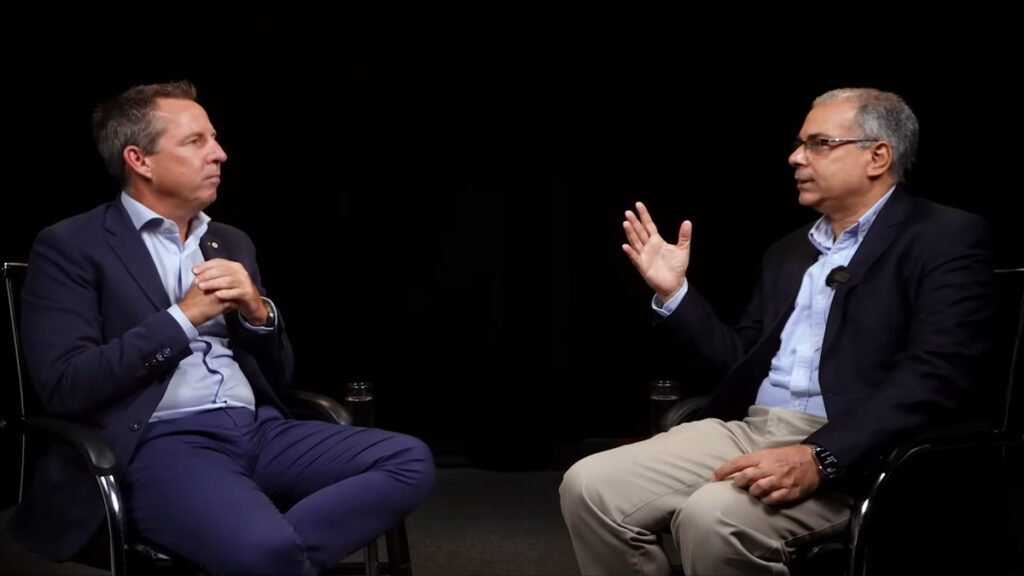
Sri Lanka’s next phase of economic recovery will depend not only on stabilising the economy, but also on finding credible ways to invest in the infrastructure required for long-term growth. Roads, electricity networks, ports, public transport, schools and other essential services demand substantial capital, technical expertise and effective management. Yet the Government’s capacity to finance and deliver these investments remains constrained. In this episode of Advocata Conversations, Murtaza Jafferjee speaks with infrastructure finance specialist Hasantha Uswatta about whether public–private partnerships can help bridge that gap—and what Sri Lanka must do to make them work.
Hasantha brings experience across global equities, institutional banking, capital markets and infrastructure investment. After beginning his career in Sri Lanka, he spent eight years in Australia, working with institutions including KPMG Australia and the Northern Australia Infrastructure Facility. His career placed him at the intersection of government, finance and long-term development, giving him first-hand experience of how infrastructure projects are structured, funded and regulated.
The conversation begins by examining what a public–private partnership, or PPP, actually is. A PPP is more than the Government hiring a private company to construct a project. It is a long-term arrangement in which public and private partners share responsibility for designing, financing, building, operating or maintaining an asset. Depending on the structure, the private partner may receive payments from the Government, charge users directly or combine several sources of revenue.
The purpose is not simply to move an asset from public ownership into private hands. A properly designed PPP brings together the strengths of both sectors. Government can define the public objective, establish the rules and manage risks that only the state can reasonably carry. The private sector can contribute capital, specialised knowledge, operational discipline and innovation. When these responsibilities are assigned carefully, the result can be better services, lower lifecycle costs and infrastructure that is maintained beyond the construction stage.
However, the discussion makes clear that PPPs are not an automatic solution. There is no such thing as transferring every risk to the private sector without a cost. Investors participate because they expect a reasonable return, while governments remain responsible for protecting the public interest. The central challenge is therefore to allocate each risk to the party best able to understand, control and absorb it.
A large infrastructure project may involve government agencies, banks, bondholders, institutional investors, construction companies, operators, suppliers and regulators. Each party enters through a different contract and accepts a different level of risk. The project’s success depends on whether these relationships are designed transparently and supported by realistic financial assumptions. If responsibilities are unclear, demand forecasts are exaggerated or political risks are ignored, even a promising project can become expensive and difficult to sustain.
Drawing from Australia’s experience, Hasantha explains how a mature infrastructure market can connect public needs with long-term private capital. Australia used approaches such as asset recycling, through which governments leased or transferred established infrastructure assets and redirected the proceeds towards new projects. Existing assets with stable operating histories were attractive to private investors, while governments used their stronger capacity to absorb the uncertainty associated with new, or greenfield, developments.
This distinction is important for Sri Lanka. Brownfield assets—those that are already built and operating—usually present fewer uncertainties and can often attract financing more easily. Greenfield projects carry greater construction, regulatory, social and demand risks. Governments may therefore have a legitimate role in helping early-stage projects become commercially viable. This does not necessarily mean providing grants or absorbing every loss. It can involve concessional financing, guarantees or carefully structured participation that encourages additional private investment.
Australia’s superannuation system also demonstrates how long-term domestic savings can support national development. Pension and retirement funds require stable, inflation-linked returns over several decades. Infrastructure can offer precisely that investment profile. Over time, Australia developed an ecosystem in which institutional savings helped finance public assets while generating returns for citizens. This alignment between long-term savings and long-term infrastructure became an important part of the country’s development model.
Sri Lanka also possesses significant domestic savings, but much of that capital is not directed towards productive, long-term investment. The challenge is not simply finding more money. It is creating credible projects, dependable institutions and financial structures capable of directing available capital towards economic growth. Better mobilisation of pension funds, insurers, banks and other institutional investors could expand the country’s financing options, provided that public funds are protected through strong governance and professional oversight.
The conversation does not ignore the failures and controversies associated with private participation. International experience shows that weak regulation can allow overpricing, excessive leverage, anti-competitive conduct and the abuse of monopoly power. Privatisation without competition or effective oversight can replace a public monopoly with a poorly regulated private one. That outcome neither protects consumers nor strengthens confidence in markets.
Strong regulation is therefore essential. A capable regulator must possess legitimacy, credibility and predictability. It must act independently, resist capture by political or commercial interests and understand the industries it oversees. It must also be able to update its approach as markets and technologies evolve. Transparent procurement, measurable performance standards, clear pricing rules and credible dispute-resolution systems are not secondary details; they are the foundations on which successful partnerships are built.
For Sri Lanka, this is especially significant because public trust in both government institutions and private enterprise has been weakened by corruption, opaque transactions and crony capitalism. Concerns about the sale or lease of “national assets” cannot simply be dismissed. They must be answered through open competition, public disclosure, independent valuation and regulatory institutions that demonstrate whose interests they serve.
At the same time, government ownership alone does not guarantee that an asset will be efficient, accessible or well managed. An asset may remain legally owned by the public while delivering poor services, accumulating losses or preventing investment elsewhere. The more useful question is not merely who owns an asset, but whether it delivers reliable and affordable value to the people.
The discussion ultimately presents PPPs as a practical instrument rather than an ideology. Some projects should remain fully public. Others may be suited to private ownership, long-term leases or shared arrangements. The correct model depends on the nature of the service, the risks involved, the strength of regulation and the outcome expected for citizens.
Hasantha’s decision to return to Sri Lanka also brings a personal dimension to the conversation. After building international expertise, he sees South Asia as one of the world’s most important emerging regions for infrastructure investment. The region has a growing population, expanding cities and an urgent need for better connectivity, energy and public services. At the same time, global investors are searching for credible long-term opportunities. Sri Lanka’s task is to build the institutional bridge between those two realities.
Economic stability has given the country breathing space, but stability alone will not create growth. Sri Lanka must develop investable projects, strengthen its regulatory institutions, mobilise domestic savings and attract responsible private capital. Doing so requires moving beyond slogans about either state control or privatisation and examining what produces the greatest public value.
This episode offers a clear introduction to that debate. It explains how infrastructure is financed, why risk allocation matters, how institutional capital can support development and why strong regulation must accompany private participation. Most importantly, it asks whether Sri Lanka is prepared to build the institutions required to turn capital into infrastructure—and infrastructure into greater opportunity and a better quality of life.