 Research Publication
Unlocking Urban Potential
5, August 2022
Summary
Nayana Mawilmada argues that Sri Lanka’s cities have been shaped by decades of low-density sprawl, fragmented land ownership, weak coordination and insufficient public-transport investment. Housing and population have moved towards the urban fringe while employment and essential services remain concentrated in city centres, producing long commutes, congestion, high transport costs, environmental damage and significant losses in productivity and quality of life.
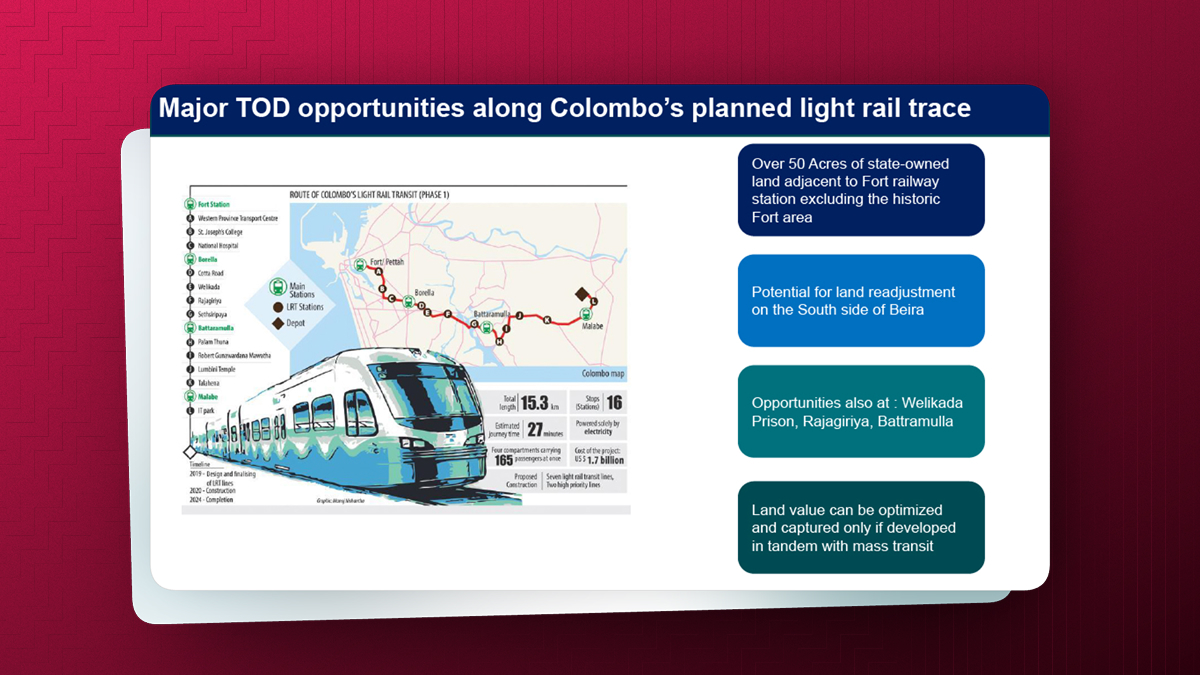
The presentation proposes four mutually reinforcing interventions: transition to a mass-transit network; stimulate transit-oriented development around stations; enable denser and more affordable multi-family housing; and create a transparent single window for releasing state land. Zoning reform, reduced parking mandates, better rail and bus integration, land-value capture and streamlined approvals could allow markets to deliver more efficient urban growth. Because cities evolve slowly, the agenda requires consistency across successive political cycles rather than isolated projects or short-term fixes.
Key Points
- Low-density sprawl and fragmented land make infrastructure expensive and urban development inefficient.
- People increasingly live on the urban fringe while jobs and services remain concentrated in city centres.
- Congestion and dependence on private vehicles reduce productivity, household time, female workforce participation and environmental quality.
- Mass transit and land-use reform must be planned together rather than treated as separate policy problems.
- Transit-oriented development can combine higher-density housing, state-land release and land-value capture around stations.
- Urban transformation requires a long-term programme that remains consistent across political cycles.