 Research Publication
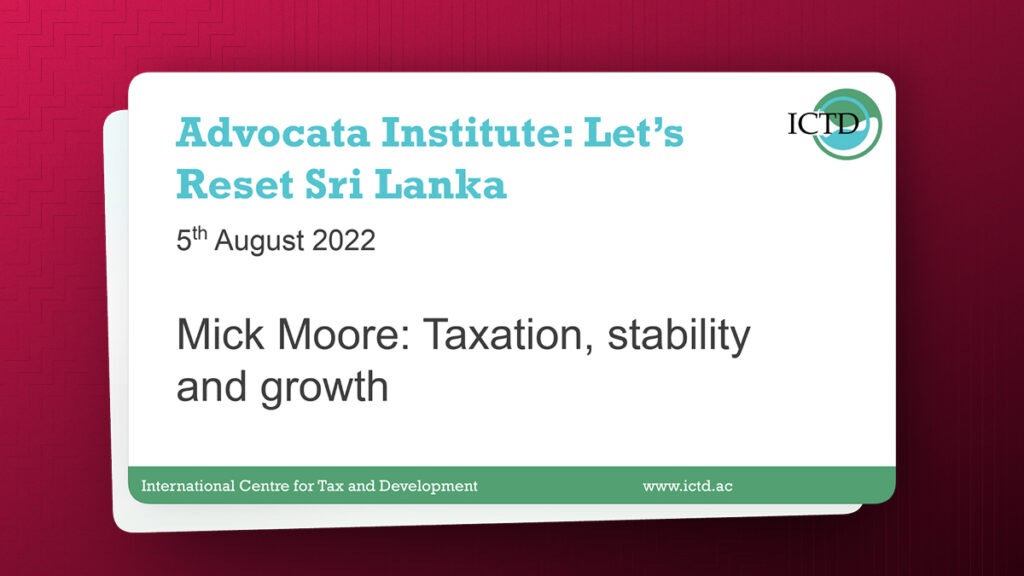
Taxation, Stability and Growth: Sri Lanka’s Revenue Challenge
5, August 2022
Summary
Dr Roshan Perera sets out the structural weaknesses of Sri Lanka’s tax system. Government revenue had fallen below recurrent expenditure, limiting investment in education, health, infrastructure and social protection while interest costs remained high. Despite rising income per person, tax revenue declined, and Sri Lanka recorded one of the world’s lowest tax-to-GDP ratios and one of Asia’s weakest levels of tax buoyancy.
The presentation identifies problems across VAT, personal income tax and corporate taxation. VAT collection was undermined by a high registration threshold, low efficiency and repeated rate changes. Personal income-tax thresholds removed many potential taxpayers from the system, while corporate revenue depended heavily on a small number of firms and sectors as extensive exemptions reduced effective rates elsewhere. Restoring stability requires a broader, more predictable and better-administered tax base that raises sufficient revenue while distributing obligations fairly.
Key Points
- Government revenue had fallen below recurrent expenditure, leaving inadequate room for essential public investment.
- Sri Lanka’s tax-to-GDP ratio and tax buoyancy were exceptionally low by international and regional standards.
- A high VAT threshold sharply reduced the number of registered taxpayers and narrowed the consumption-tax base.
- Repeated changes to VAT rates and weak collection efficiency reduced revenue performance.
- High personal income-tax thresholds removed many higher-income earners from the tax net.
- Corporate income-tax receipts were concentrated among a small number of firms while many sectors received exemptions or reduced rates.
- A stable and fair recovery requires broadening the base, improving administration and reducing arbitrary exemptions.
Tags