 Newsroom
A Comprehensive Policy Framework for the Gaming Industry of Sri Lanka
22, August 2024
175 min read
The gaming industry of Sri Lanka includes casinos, betting centers, and lotteries. The casino industry emerged in 1977 following the open economy policy. The government has reluctantly acknowledged casinos as part of economic development, but public perceptions of the industry’s integrity remains low due to the lack of proper regulation. The betting and lottery industries have operated for longer with varying degrees of oversight, with the lottery industry being exclusively state-operated. The report provides a SWOT analysis of the industry, highlighting strengths such as the legal status for inland casinos and a reliable patron base. However, the growth of the industry is stunted by lack of regulatory oversight and the limited focus so far on the integrated resort model.
Here is the link to the full report:
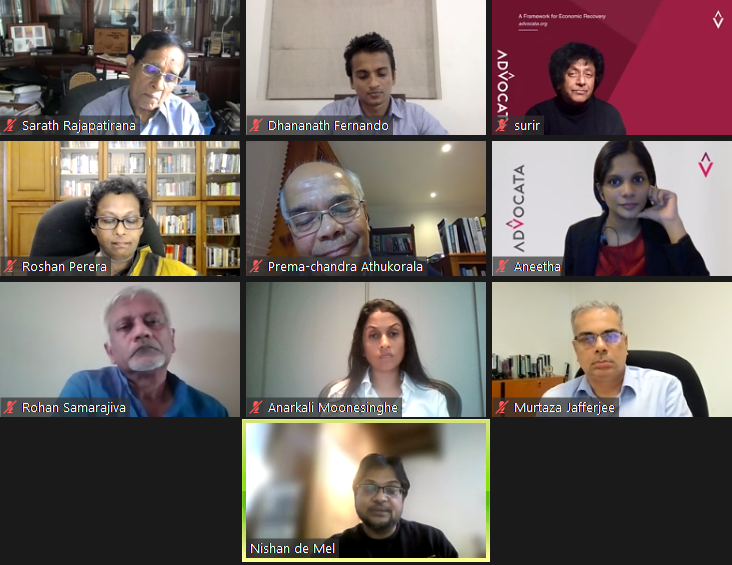
The author is sincerely grateful to Mr. Murtaza Jafferjee, Chairman of the Advocata Institute, for his guidance and support throughout the writing of this report.
The author also thanks the following individuals and, where applicable, their teams for serving as resource persons and/or for their constructive feedback on earlier iterations of the draft: Mr. Daniel Alphonsus, Mr. Krishan Balendra, Dr. Harsha de Silva, Mr. Anura Jayaratne, Ms. Hashini Jayasekara, Dr. Roshan Perera, Prof. Rohan Samarajiva, Mr. Revan Wickramasuriya, and Mr. Nalinaksha Wickremesinghe. Some others who were generous with their time and resources wish to stay anonymous.
Finally, many thanks to Mr. Dhananath Fernando, CEO of Advocata Institute, and the entire Advocata team, for their assistance and support throughout this project. Special thanks to Ms. Aisha Anver, Programs Executive at Advocata, for her meticulous proofreading of the draft.
1. Executive Summary
A. Summary of the Findings
The gaming industry of Sri Lanka primarily consists of casinos, betting centres, and lotteries. Outlawed during the British colonial era, the casino industry of Sri Lanka came into existence following the advent of the open economy in 1977. Despite a brief halt in the early 1990s due to political reasons, the industry continues to exist — although the character of the industry has undergone significant change since its early beginnings in the style of London’s gaming clubs. The casinos that are presently operational in the island mostly cater to an international patron base, excepting one which caters to a primarily local community of patrons.
Although the government of Sri Lanka has ascribed some legal status to casinos, particularly as part of the economic development programme following the conclusion of the civil conflict, in the eyes of much of the public, casinos remain quasi-formal economic operations. The lack of a proper licensing mechanism until recently and the continuing lack of a stringent regulatory mechanism for the casino industry are the primary contributing factors to this perception. The perceived lack of moral or legal integrity in how the industry operates has hindered the growth of the industry over the decades, limiting the revenues generated by the industry over time. However, the government has shown an active interest in addressing the regulatory shortcomings of the industry, particularly with the expected opening of a few integrated resort-style gaming venues in the near future.
The betting and the lottery industries of Sri Lanka have existed longer than the casino industry, with the former operating even under British rule and the latter coming into existence soon after independence from the British. While the range of sporting events on which bets can be placed has been restricted over time, the legitimacy of their operations have never come into question, as they have never faced the licensing issues encountered by the casino industry of Sri Lanka. However, the betting industry also operates without much regulatory oversight, unlike the betting industries of most other countries. The lottery industry, on the other hand, operates under full state endorsement, with no questions about the legitimacy of the industry’s operations, given that both existing lottery operators are state-owned enterprises.
This report begins with an introduction to the evolution of the casino, betting, and lottery industries of Sri Lanka, followed by a SWOT (strengths, weaknesses, opportunities, and threats) analysis of the industry today. The report identifies several key strengths of the Sri Lankan gaming industry. Firstly, Sri Lanka is one of the two South Asian countries to have ascribed legal status to inland casinos, the other being Nepal. Given the larger appeal of the Sri Lankan casinos to Indian gamblers, and the lack of casinos in mainland China and the Middle East, Sri Lanka’s casino industry boasts of a patron base comprising a blend of Indian, Chinese, and Middle Eastern consumers. Simultaneously, the increasingly open state policy on gambling, with the introduction of several new Acts and Gazettes enhancing the legal status of the industry in the last fifteen years alone, makes it stand out among its regional peers.
Despite these strengths, the casino industry of Sri Lanka is marred by the lack of a strong regulatory framework, unlike in other jurisdictions well known for their casino industries. A strong regulatory framework is important to attract both high-spending consumers and large international investors to any casino industry in the world. The stunted growth of the Sri Lankan casino industry over the decades is therefore attributable to the weak regulatory framework governing Sri Lanka’s casinos, which, if corrected, would help make the industry attractive to high-rolling players and large international investors. The weak regulatory system has additionally resulted in weak tax collection from the casinos, with policymakers and other interested parties sceptical of the government actually receiving the revenues it is due from the casino industry of Sri Lanka.
If these shortcomings of the industry could be corrected, there are many opportunities that await the gaming industry of Sri Lanka. Even in the presence of these weaknesses, international investors have demonstrated some interest in the local industry over the years, although none of these projects materialised largely due to regulatory barriers. However, with the proposed City of Dreams integrated resort project, and a few other new casinos reportedly in the pipeline, the government of Sri Lanka has a new opportunity to make amends for its past negligence. Furthermore, the rise in tourist arrivals from India and China, coupled with the government’s economic liberalisation programme since the economic collapse of 2022, has provided Sri Lanka with a prime opportunity to rethink the country’s approach to the gaming industry. The promotion of casual gambling among tourists—who would only partake in slot games and easily accessible table games, such as roulette, as a form of entertainment while on holiday—should not lead to concerns regarding the negative effects of compulsive gambling. In fact, given the high concentration of compulsive gamblers in the patron base of Sri Lanka’s existing casinos, an intentional shift towards casual gambling would help minimise the negative externalities associated with the industry today.
The window of opportunity to reset the industry, however, is running out fast; if the government of Sri Lanka fails to act quickly, there is a real possibility that other countries will take Sri Lanka’s place in the regional gaming market. The industry is facing increasing threats of competition from unlikely neighbours such as the United Arab Emirates and Thailand. The former, in particular, is set to open integrated resorts under world-renowned brand names in both Ras Al Khaimah and Abu Dhabi, which could substantially impact the demand for the gaming industry of Sri Lanka, especially from Indian patrons. While the lack of enthusiasm to change amongst Sri Lanka’s existing casino operators and the predominant public sentiment against gambling among the population are likely to be major hindrances in the process, if Sri Lanka does not adopt a more open approach to the casino industry fast enough, the country may soon lose this important industry to regional competition.
Based on these salient features of the industry identified in the SWOT analysis, four discussion papers follow, all of which make the case for an expanded, better regulated, and more equitable gaming industry in Sri Lanka, primarily relying on the growth of the island’s casino sector. As such, the four discussion papers make the moral, economic, fiscal, and equity-based cases for the country’s casino industry.
In Discussion Paper 1, the moral opposition to gambling within the country is identified as a contributor to the government’s historical reluctance to address policy concerns related to the casino industry, even while such opposition never impacted the betting and lottery industries. Given the negative effects associated with casino gambling, particularly its negative externalities which are well documented in the literature, the concerns of sceptics are justified. Yet, the nature of casino gambling is such that mere command-and-control regulations against operating casinos would not eliminate casino gambling within a jurisdiction. Risk loving human beings are naturally prone to gambling, which means that even if casinos are outlawed, instead of ceasing to operate altogether, the industry would merely move to the confines of the informal economy. Having experienced the ineffectiveness of casino bans in the past, Singapore has famously adopted a legalise-and-regulate approach to casinos, which allows the government to minimise the negative effects of casino gambling, while accommodating the human desire for gambling. The Sri Lankan government would do well to follow the footsteps of Singapore in this regard.
On the other hand, Discussion Paper 2 points out that, despite the negative effects innate to gambling, casinos have shown to entail substantial economic multiplier effects, which could facilitate broad economic growth. In addition to the direct contributions of gambling to the economy, casinos have also been shown to contribute to the growth of tourism and hotel industries, generate various employment opportunities, and facilitate retail sector growth. Given the proven appeal of Sri Lanka to international gamblers, if the casino industry of Sri Lanka is allowed to expand under stringent regulatory guidance, the industry may contribute to substantial gains to the Sri Lankan economy.
Discussion Paper 3 discusses the potential for substantial government revenue generation from the casino industry, under proper tax administration and regulatory oversight. Although Sri Lanka’s existing casinos are subject to a licence fee, an annual levy, a business income tax, a tax on gross gaming revenue, and a tax on winnings, there are concerns among both policymakers and the public regarding revenue collections. These concerns arise from both the cash-based nature of the industry and the fact that transactions with international patrons are generally made overseas, limiting the ability of the Inland Revenue Department to fully trace the revenues of the industry. On the other hand, it is also not clear that the existing tax rates for the industry are based on a scientific metric to optimise tax revenues from the gaming industry. If these barriers could be overcome, the government may be able to rely more substantially on the casino industry as a significant generator of government revenues.
Lastly, in Discussion Paper 4, the government’s present reliance on the lottery industry as a significant generator of government revenues is examined. There are legitimate equity concerns regarding redistributing incomes from the poorer segments of society, which make up the consumer base of lotteries, to similarly underserved segments of society, who benefit from the welfare programmes that are funded via the profits of the lottery industry. Given that lotteries are also games of chance similar to casinos and bookmaking, the lack of proper regulatory oversight on the lottery industry leads to further questions of fairness. Additionally, the two Lottery Boards, which are the sole existing operators of lotteries in Sri Lanka, suffer from the many efficiency concerns common to all state-owned enterprises of Sri Lanka, leading to questions about the effect on their profit margins. These equity-related concerns may be addressed through a more market-based approach to the operation of the lottery industry, as well as a shift in the government’s focus from the lottery industry towards the casino industry for the generation of crucial government revenues.
B. Summary of the Recommendations
This report makes the following recommendations for an expanded, better-regulated, and more equitable gaming industry of Sri Lanka, which would help the island capitalise on the economic benefits of the industry, while minimising its negative externalities.
- The establishment of a gaming regulatory authority which is entrusted with the power to regulate the casino, betting, and lottery sectors
- Introduction of a cap-and-trade system for a limited number of gaming licences to enhance the scale of the industry while maintaining competition
- Imposition of restrictions on the patronisation of casinos by Sri Lankan nationals, though entrance fees, betting limits, and income eligibility limits
- Imposition of strong regulations against problem gambling by both local and foreign patrons, through betting limits, visit limits, and awareness raising
- The inclusion of online gaming (online casinos, online betting, and online lotteries) under the regulations on physical gaming, with additional regulations on the registration of individuals as patrons of online gaming platforms
- The incorporation of economic incentives to the licensing and other regulatory frameworks on the gaming industry to encourage the operation of casinos in the form of integrated resorts, which are shown to have greater economic benefits
- The expansion of the market opportunities for integrated resorts through enhancements to labour, business registration, investment, and foreign exchange laws
- The simplification of the tax code on the gaming industry, and the imposition of a singular optimal tax on the gross gaming revenues
- The imposition of high taxes on the gaming industry given the potential for supernormal profits, stemming from constrained competition and the inelastic nature of demand for gambling
- The introduction of licensing fees for online gaming operators
- The establishment of a more stringent framework for the better monitoring of cash flows at casinos, so that the gross revenues are better tracked; this may be coupled with a strategy to phase out cash from the industry, as its cash-based nature is the primary barrier to foolproof tax administration
- The taxation of casinos based on their capacity until such time a foolproof mechanism to track gaming revenues is implemented
- The elimination of tax leakages from the industry in Special Economic Zones
- The prioritisation of progressive taxation, by replacing the government’s focus on the lottery industry as a key revenue generator for welfare programmes with a focus on revenue generation from the casino industry
- The restructuring of the state-operated lottery industry to minimise costs of operation, increase fairness, and optimise contributions to government revenue
2. Historical Evolution of the Gaming Industry of Sri Lanka
A ‘wager’ is a risk taken on something, such as a sum of money, based on the uncertain outcome of an event 1. To ‘gamble’ is to place a wager of such nature on an uncertain outcome, based purely on luck rather than knowledge or skill 2. On the other hand, ‘betting’ usually refers to a wager placed not on the basis of luck, but based on strategic research and prior knowledge 3. Building on these definitions, playing a casino game is generally considered an act of gambling, although some casino games such as blackjack and poker involve a degree of skill as well. On the other hand, wagering on horse-races or sports events is purely an act of betting.
‘Gaming’ generally refers to the engagement in an activity of gambling or betting that is sanctioned by the government; however, the term is sometimes used interchangeably with ‘gambling’ and ‘betting’, partly to avoid confusion with video games 4. By this definition, in Sri Lanka—where casinos, betting houses, and lotteries all operate via state-sanctioning—the larger gaming industry comprises the casino, betting, and lottery industries.
Wagering has played a role in human lives for as long as civilisations have existed, and even probably before then 5. In the ancient and mediaeval times, wagering generally took a social form, as demonstrated by archaeological evidence from the Mesopotamian civilisation, as well as ancient India, China, America, and Italy. The earliest evidence of mercantile wagering comes from the Renaissance period of Europe, particularly Italy and France, contemporaneously with the inception of probabilistic mathematics. By the 18th Century, mercantile wager had spread across the world, with common gaming houses opening in various localities globally, particularly in Europe and its colonies.
In Sri Lanka, laws pertaining to the gaming industry were first introduced by the British colonial government. The Lotteries Ordinance of 1844 established a licensing framework for lotteries, including lotteries related to horse-racing, and banned the promotion, issuance, and the purchase of unlicensed lotteries within the island 6. The Gaming Act of 1845, passed by the British parliament, outlawed common gaming houses where individuals played games for money 7. The Act also deemed wagers unrecoverable by law, in line with the Act’s intended purpose of discouraging wagering among the British public 8. The Gaming 1 Merriam-Webster (2024) 2 Woods and Butler (2020) 3 Litman (2021) 4 Connecticut Department of Consumer Protection (2021) 5 All statements in this paragraph are based on Schwartz (2006) 6 Government of Ceylon (1844) 7 Government of Britain (1845) 8 Government of Britain (1845) Ordinance of 1889, applicable to the colony of Ceylon, effectively extended these laws to Sri Lanka, by banning certain gaming activities and common gaming places 9.
Several other laws implemented during the British rule shaped the legal framework of gaming in Sri Lanka. An Ordinance introduced in 1930 established a mechanism to register racecourses and tax earnings from horse-race betting 10. This tax on horse-race betting marked the first time a tax specifically targeting the gaming industry was introduced in Sri Lanka. The ruling in Tarrant et al v. Marikkar in 1934 interpreted that the Roman-Dutch Law, which is applied to all lacunas in the Sri Lankan civil law except commercial law, does not recognise the enforceability of wagering contracts 11. The Cheetu Ordinance of 1935 additionally introduced a regulatory framework for cheetus, a common vehicle of savings among underprivileged locals at the time, which also incorporated an element of wager 12. Accordingly, towards the end of Sri Lanka’s colonial rule, a clear legal framework had been established covering the many forms of gaming present in the island at the time.
A. Historical Evolution of the Casino Industry of Sri Lanka
The clarity of the legal framework governing Sri Lanka’s gaming industry began to change in the decades following independence. Government Gazette No. 12824, issued in December 1961, banned the import of jackpot machines into Sri Lanka by citing the Gaming Ordinance of 1889 13. This gazette, however, did not stop the fledgling casino industry of Sri Lanka following the adoption of liberal economic policies in 1977 14. Although the central government pursued a policy of non-acknowledgement of casinos, the Colombo Municipal Council granted permission to Joe Sim, a casino operator of Singaporean origin, to open casinos at several venues—including the Galadari, Taj Samudra, and Galle Face Hotels. These casinos existed alongside several other casinos, all small in scale, that were operated by locals. These smaller establishments were not purely casinos; meant to resemble London-style social clubs, they also offered non-casino games such as rudjino.
9 Government of Ceylon (1889) 10 Government of Ceylon (1930) 11 Colombo District Court (1934) 12 Government of Ceylon (1934) 13 Government of Ceylon (1961) 14 The information on casinos between the period 1977 to 1991 come from conversations with descendents of casino owners during this time.
Casino Games, Junkets and VIP Players Roulette involves the spinning of a carousel and a white ball around it 15. The winner is
| Game | OddsofPayout | HouseEdge(Average ExpectedGrossProfitof theCasinofromEach Game) |
|---|---|---|
| AmericanRoulette | 37-1 | 5.40% |
| BritishRoulette | 36-1 | 2.78% |
| FrenchRoulette | 35-1 | 2.78% |
| Blackjack | 3-2 | 1% |
| Casino Stud Poker (Jackpot) | Depends on the hands that are dealt(ranges) | 2.5% |
In Baccarat Punto Banco, two hands–Punto and Banco–are dealt two (or sometimes three) cards each, and players bet on which hand will have the highest last digit of the sum totals of the cards. Players can also bet on Egalité–that the last digit of the sum totals will be equal.
Slot machines are also a popular gaming tool at casinos. They offer a variety of games to patrons that can be played by inserting money into the machines to purchase credits. Slot machines generally make up more than half of the gross revenues of a casino, as most patrons who are not serial gamblers prefer to try their luck on the less-intimidating slot machines.
Game Odds of Payout House Edge (Average Expected Gross Profit of the Casino from Each Game) American Roulette 37-1 5.40% British Roulette 36-1 2.78% French Roulette 35-1 2.78% Blackjack 3-2 1% Casino Stud Poker (Jackpot) Depends on the hands that are dealt (ranges 2.5% 15 All statements and data in this box article, unless otherwise stated, are based on The Good Gambling Guide (2020) from 1-1 to 250-1) 16 Baccarat, bet Punto 1-1 1.36% Baccarat, bet Banco 0.95-1 1.17% Baccarat, bet Egalité 8-1 14% Slot machines Varies by game Varies by game, usually higher than table games While the house edge percentages in the table above are based on the expected gross profit from each casino game by the house, the strategy used by players may increase or decrease the actual profits the house earns in games involving a degree of skill on the part of the players. On the other hand, the house itself may adjust the rules of the game to increase its edge, unless government regulations prohibit such modifications.
High-value players, also known as VIP players or premium players, are high-rollers at casinos who not only patronise casinos frequently, but place high wagers. In the casino gaming world, high-value players have almost a celebrity appeal based on the reputation that they have cultivated over many years as high-stakes rollers. Not only do high-value players contribute to a major share of casino revenues (two thirds of the total gaming revenue in Macau), but they also provide great marketing value to casinos that they are associated with 17. For this reason, high-value players are usually offered benefits such as better bonuses, exclusive gaming opportunities, cashback rewards, and higher betting limits by casino operators 18.
A junket is a special arrangement made between a ‘junket operator’ and several high-value players, that facilitates gaming at a particular casino 19. The role of the junket operator is to identify high-value players and facilitate their travel to particular casinos, in return for which, junket operators are paid a commission by casino operators 20. Junkets are particularly popular among high-value players in Macau, but can be found in any jurisdiction with a substantial gaming industry 21.
The Betting and Gaming Levy Act No. 40 of 1988 22 marked the first time in the history of independent Sri Lanka that the central government recognised the existence of the gaming industry and levied taxes on it 23. The Act introduced an annual levy on persons operating
| from1-1to250-1)16 | ||
|---|---|---|
| Baccarat,betPunto | 1-1 | 1.36% |
| Baccarat,betBanco | 0.95-1 | 1.17% |
| Baccarat,betEgalité | 8-1 | 14% |
| Slot machines | Varies by game | Varies by game, usually higher than table games |
Horse races within Sri Lanka and overseas constituted bookmaking 24. This Act followed Gazette No. 483/7 issued in December 1987, which rescinded the previous ban on the import of jackpot machines to the island, granted the importer obtains a special license from the Collector of Customs 25.
This new age for the gaming industry of Sri Lanka was however short-lived. In 1991, following a fallout between Joe Sim and then President Ranasinghe Premadasa, the Police Bureau of Special Operations conducted a raid of 12 casinos in Colombo, forcing their immediate closure 26. The ban on the importation and use of jackpot slot machines was reinstated 27. The relatively larger-scale casinos that are present today emerged in the two decades following the closure of these casinos. Beginning in 1993, casino operators have exploited a loophole in the Gaming Ordinance, which technically permits operators to circumvent the ‘promiscuous’ gaming provision by offering instant membership to patrons as they walk into casinos; the Gaming Ordinance only bans gaming houses with free access, and not ‘members only’ establishments that offer gaming services 28.
The Casino Business Regulation Act No. 17 of 2010, also known at the time as the Gaming (Special Provisions) Bill, was the first attempt by a Sri Lankan government to regulate the casino industry, while allowing them to operate 29. This Act allowed casinos to be set up within demarcated zones, and required that all such casinos obtain a licence to operate. However, a process to grant such licences was not established at the time, with no dedicated regulatory body being appointed for this purpose. Although several international investors, including the US-based FEE Group, Malaysia-based Genting Casino, India-based Delta Corp, and the Australia-based Crown Resorts group, demonstrated an active willingness to enter the Sri Lankan markets, none of these projects materialised 30.
In fact, no new casinos have yet opened up in Sri Lanka since the passage of the 2010 bill, although a few new projects are underway. Although the Crown group’s USD 350 million investment proposal for a 450-room resort with a casino was approved in 2014, an amendment to the Betting and Gaming Levy Act of 2015 banned the registration of new casinos within the island, forcing the project to a halt. Talks of new casinos have resurfaced in the last few years with the opening of the Colombo Port City and the Lotus Tower, and the commencement of the ‘City of Dreams’ integrated resort project, formerly known as the Cinnamon Life integrated resort. The City of Dreams integrated resort, which includes a casino, is a landlord-tenant partnership of John Keells Holdings PLC with the Hong Kong-based Melco Resorts & Entertainment Ltd.; while the integrated resort is expected to open to the public in October 2024, the casino will only open in July 2025 31. Bally’s, Bellagio, Casino 24 Interestingly, this Act did not identify establishments facilitating rudjino games as casinos, a distinction that is maintained by the Inland Revenue Department of Sri Lanka to date. 25 Government of Sri Lanka (1987) 26 Hoole (2001) 27 Hoole (2001) 28 South China Morning Post (1996) 29 Government of Sri Lanka (2010) 30 Kailash (2012); Doherty (2015); The Edge Malaysia (2010); Sunday Times (2012) 31 DailyFT (2024) Marina, and Stardust (now also called Casino Marina) remain the only registered casinos in the island with active tax files with the Inland Revenue Department (IRD), as confirmed by IRD sources. Whether these casinos possessed operating licences as required by the Casino Business Regulation Act was a longstanding question, which has seemingly been resolved since the authorisation of the Commissioner of the Inland Revenue Department to administer licences in 2022, as explained in more detail later in this section.
A Peek Inside Sri Lanka’s Casinos Sri Lanka’s four casinos–Bally’s, Bellagio, Casino Marina, and Stardust–are all located in the city of Colombo, each with a unique appeal to their target clientele 32. Bally’s and Bellagio are both under the ownership of the same group, whereas Casino Marina and Stardust are owned and operated by a separate group. Bally’s, Bellagio, and Casino Marina primarily cater to international clients, with most clients coming from India and China. Stardust, on the other hand, caters primarily to local gamblers. Regardless of their target audience, the average player at all of Sri Lanka’s existing casinos are marked by experience and skill; amateur and casual gamblers are a rare sight at Sri Lanka’s casinos.
Bally’s, Bellagio, and Casino Marina cater mostly to Indian gamblers, many of whom fly to Sri Lanka primarily for the purpose of gambling. The sales and marketing strategy of these casinos include regular events in Bangalore, Goa, and other Indian cities where high-rollers are generally found. Prospective patrons are able purchase packages—sometimes custom-tailored to their preferences—that start from INR 500,000 and go up to INR 10,000,000 or higher. Those purchasing packages above INR 1,500,000 for in house gambling in Sri Lanka generally have their flights reimbursed, as well as accommodation fully paid for on bed-and-breakfast basis at three, four, or five star hotels of the patrons’ choice, with complimentary lunch and dinner buffets available at the casino premises. Indian patrons—who reportedly make up an overwhelming majority of the patrons at these two casinos—are generally business persons, politicians, and sometimes even celebrities. Some Chinese tourists and residents, as well as Sri Lankans, also patronise these casinos, although walk-in memberships are no longer offered to Sri Lankan nationals at Bally’s and Bellagio. Sri Lankan nationals may still obtain membership on the precondition of a minimum spend or upon recommendation by existing local members– although local membership is presently highly discouraged. Casino Marina, on the other hand, not only offers Sri Lankan patrons instant VIP membership, but allow Sri Lankan patrons to redeem the value of the government-mandated LKR 15,000 entrance fee (more on this later) for gambling, in the form of three one-time play (OTP) chips worth LKR 5,000 each.
The reason that these casinos primarily target Indian patrons boils down to the fact that they have consistently delivered high profitability to these casinos. For reasons explained later in this report, both Indian and Chinese nationals demonstrate high propensity towards gambling, but Chinese gamblers are known to win their money and leave the casino, leaving little profits to casino operators. Indian gamblers, on the other hand, are said to approach casino gambling less tactically and more as a form of entertainment, resulting in higher profits to casino operators. Unlike Chinese gamblers, Indian gamblers also seek other forms of entertainment, such as dance performances and sexual pleasure—although, in the interest of preserving the integrity of their brand names, casinos 32 This section is based on visits to Sri Lankan casinos and conversations with those formerly employed in the industry. Efforts to reach current players of the industry for interviews had limited success.
do not involve themselves in the case of the latter. American and German gamblers also occasionally walk into these casinos, but the limited games and other amenities that local casinos offer (for instance, Sri Lankan casinos do not offer five card poker, and slot machines are a clear non-priority of Sri Lankan casino operators) mean they do not enthusiastically gamble, and more importantly, keep returning to the casinos.
In fact, the games offered at these casinos cater mainly to Indian and Chinese patrons. Given that most patrons of these casinos are high-rollers, table games are the most widely offered option, with there being around 140 tables at Bally’s, and less than 50 regular tables at Bellagio and Casino Marina. Table games are generally limited to regular poker, three card poker, Texas hold ‘em poker, baccarat, roulette, blackjack, jackpot, and andar bahar (an Indian casino game), unless a special request is made by a high-roller. The minimum allowed bet for these games generally ranges from LKR 1,000 to LKR 5,000, while the maximum allowed bet can be as high as LKR 5,000,000. Slot machines, generally patronised by casual and inexperienced gamblers, are more scarce in Sri Lanka’s casinos, with Bally’s having around 50 slot machines, Casino Marina having around half of that, and Bellagio having none. The minimum bet in a slot game can be as low as LKR 5 and may go up to several thousands, depending on the game and the preferences of the players.
The only casino in Sri Lanka that enthusiastically caters to Sri Lankan patrons, Stardust, is a unique operation in the gaming paradigm of Sri Lanka. Having now been rebranded as a separate and completely segregated section of Casino Marina, Stardust attracts a regular crowd of experienced Sri Lankan gamblers. Here too, Sri Lankan patrons are required to pay the LKR 15,000 entrance fee, which can be redeemed for three OTP chips of LKR 5,000 each. These Sri Lankans are high-rollers in the universe of Sri Lankan gambling, although they may not always spend as much as the international patrons of Sri Lanka’s other casinos. Local casino gamblers are visibly different in their approach to gambling than their international counterparts; while the high-rollers in other casinos do not treat their time at the casino as an opportunity for socialising, Stardust’s local patrons generally seem to know each other very well and enthusiastically converse with each other in the vernacular tongues.
Unlike the other casinos, the only table games generally offered at Stardust are baccarat and roulette, for which Sri Lankan gamblers seem to have a special affinity, in that order. Most players congregate in the first floor of the premises, where the lowest bet for baccarat starts at LKR 1,000. The upper floors, where the lowest bet for table games is much higher, are rarely frequented by the patrons even on a crowded night, while the demand for slot machines is even lower. Patrons at Stardust are also able to partake in sports betting, which is not offered at other local casinos.
A common phenomenon in all of Sri Lankan casinos, however, is the cash-based nature of the transactions that take place, with little traceability of the inflow and outflow of cash. The entrance fee for locals may be paid with a debit or credit card, for which a token is issued that can be exchanged for chips at the cashier. For any additional chips that customers purchase at tables, cash is the only accepted method of payment, with ATMs conveniently located inside the casinos. Patrons, however, do not generally receive a receipt for their purchase of chips or for their winnings. In the case of international patrons, with most payments already made overseas before the patrons arrive in Sri Lanka, the invoices are again not domestically traceable.
Presently, the Betting and Gaming Levy Act requires that all casinos open tax files with the Inland Revenue Department 33. Additionally, the Casino Business Regulation Act No. 17 of 2010 requires all casinos to obtain a licence to operate from the Ministry of Finance 34. The Casino Business Licensing Regulation No. 1 of 2022, pursuant to the Casino Business Regulation Act No. 17 of 2010, established a legal framework to issuing licences to operate casino gaming businesses 35. According to this Regulation, applications submitted to the Minister of Finance are to be considered based on the financial background and resources of the applicants, the financial viability of the (proposed) operations, and the potential benefits to the larger economy.
Extraordinary Gazette Notification No. 2295/10, which published the Casino Business Licensing Regulation No. 1 of 2022, appointed the Commissioner General of the Inland Revenue Department as the ‘authorised officer’ to administer licences to casino operators. Under this Regulation, a casino licence may be issued for a minimum of five years, and a maximum of 20 years. According to the Regulation, licences to approved operators may only be issued upon the upfront payment of the annual levy for the entirety of the period for which the licence is requested. To retain the licence, the operator is required to maintain a compliance officer who is tasked with ensuring the casino complies with all laws relevant to the operation of a gaming establishment in Sri Lanka. The licence holder is also required to ensure that solicitation for the purpose of prostitution or any other illegal activity, money-laundering, over-consumption of alcohol, illegal gaming activities, or any other illegal activity do not occur within the premises of the casino. Sri Lanka’s four existing casinos have obtained 5 year licences under this Regulation.
Since then, the licensing regulations have changed twice. A Government Notification issued on January 12, 2024 revised casino licence fees and casino licence renewal fees; under this revision, an integrated resort with a minimum investment of USD 250 million was subject to a licence fee of LKR 10 billion, whereas an integrated resort with a minimum investment of USD 500 million was subject to a casino licence fee of LKR 5 billion 36. These licences are valid for a period of 20 years 37. The revised casino licence fee for existing operators who had obtained their licences prior to January 1, 2023 is LKR 2 billion (allocated as LKR 500 million for the existing 5 year licence and LKR 1.5 billion for the following 15 years) 38. At the end of the 20 year period, the licence renewal fee is set at LKR 10 billion for all operators 39. Gazette No. 2369/42, published in February 2024, stipulated that to obtain a casino licence, a casino in an integrated resort with a minimum investment of USD 250 million, should have a minimum investment of USD 30 and a maximum investment of USD 100 million 40. Under the new law, a 33 Government of Sri Lanka (1988) 34 Government of Sri Lanka (2010) 35 Government of Sri Lanka (2022a) 36 Ada Derana (2024) 37 Ada Derana (2024) 38 Ada Derana (2024) 39 Ada Derana (2024) 40 EconomyNext (2024a) casino in an integrated resort with a minimum investment of USD 500 million should have a minimum investment of USD 100 million 41.
Despite these developments, Sri Lanka has yet to appoint a fully-fledged casino regulator, albeit the government’s admitted interest in doing so. In January 2023, the Cabinet approved a proposal by President Ranil Wickremesinghe, in his capacity as the Minister of Finance, to establish a gaming regulatory authority, which is intended to oversee tax collection, counter potential unlawful activity by casino establishments, and curb the negative externalities of gaming. It is, however, unclear as to whether this Cabinet decision has since been followed up with real action, although a gazette has reportedly been drafted on the appointment of a gaming regulatory body 42.
The Economics of Casinos Casinos, as explained above, offer a variety of table games and slot machines with varying odds of payout and house edges to their patrons. However, the house edge, which is the average expected earning of the casino from each bet, does not fully represent the returns of the casino industry, as there are various operational costs associated with running a casino. These costs vary based on the location, structure, and the business model of each casino; many casinos are set up as integrated resorts that offer non-gaming amenities to patrons, and thus, collect significant revenues from non-gaming services as well.
In major casino jurisdictions, revenues from gaming generally make up the majority share of the revenues of a casino establishment, even if the establishment is set up as an integrated resort. Research on casino revenues in the United States, where the integrated resort model is the norm, shows that 65 percent of the income of an integrated resort is made up of gaming revenues 43. The gaming revenues of a casino is dictated primarily by the composition of games that it offers. In the United States, for instance, slot machines are more popular than table games; while Vegas alone has around 150,000 slot machines, the total number of gaming tables in all of Nevada has been less than 2,500 in the last several years 44. In 2023, the total gross gaming revenue (GGR) — defined as the sum total of wagers minus the winnings paid out to patrons — from slot machines in the United States was USD 35.51 billion, compared to the GGR of only USD 10.31 billion from table games 45. On the other hand, the Asian gaming market, particularly in Macau, is dominated by table games. With merely 12,000 slot machines in operation in 2023, Macau’s gaming industry grossed a revenue of only USD 1.36 billion from slot machines, as opposed to a GGR of USD 21.39 billion from 6,000 gaming tables 46. In Sri Lanka, the proportion of gaming tables to slot machines indicates an even stronger skew of the GGR towards table games; Sri Lanka’s largest casino, Bally’s, has more than 100 gaming tables but only 50 slot machines 47. The data on the separate GGRs from table games and slot machines does not exist in the Sri Lankan context.
The operating costs of casinos, on the other hand, again depend on factors unique to the 41 EconomyNext (2024a) 42 Sirimanna (2024) 43 Henry Fund (2024) 44 Schwartz and Nickson (2024); Yakowicz (2022) 45 Velotta (2024) 46 GGRAsia (2024) 47 Cinnamon Hotels (2024) location, structure, and the business model of the gaming establishment. In integrated resorts, gaming activities generally yield a higher profit margin than non-gaming activities, as the operating costs for gaming activities tend to be lower 48. These operating costs are generally made up of rent, utilities, employee salaries, advertising and marketing, maintenance and upgrading, food and beverages (as complementary buffet-style spreads are the industry norm), and entertainment expenses 49. Additionally, gaming revenues are generally taxed based on the GGR (and sometimes alongside an add-on tax on the net profits); as such the tax policy of the jurisdiction in which the casino is located also plays a substantial role in the final net profit of a casino. The following table shows the market capitalisation, trailing twelve month P/E ratio (TTE P/E), and Return on Equity (ROE) of leading casino operators in the United States 50:
Operator # of Properties Sq. Ft. of Casinos # of Hotel Rooms Market Cap (USD Billion) TTE P/E ROE (%)
| Operator | #of Properties | Sq.Ft.of Casinos | #ofHotel Rooms | MarketCap (USD Billion) | TTE P/E | ROE (%) |
|---|---|---|---|---|---|---|
| Las Vegas Sands | 6 | 6,500,000 | 14,000 | 37.44 | 31.48 | 16.65 |
| MGM Resorts | 31 | 2,560,000 | 45,859 | 13.58 | 13.43 | 22.60 |
| Wynn Resorts | 9 | N/A | N/A | 11.14 | 15.37 | -1.98 |
| Caesars Entertainment | 58 | 3,669,800 | 48,800 | 8.70 | 11.05 | 16.91 |
| BoydGaming | 28 | 1,723,126 | 10,751 | 6.18 | 10.56 | 41.37 |
| RedRock Resorts | 15 | 1,356,000 | 2,821 | 6.17 | 20.37 | 210.37 |
| PENN Entertainment | 43 | 2,546,207 | 7,321 | 2.48 | 0.00 | -2.87 |
Traded company greatly enhances a company’s access to capital. The following table provides a summary of a few large casino operators in several key casino jurisdictions in Asia 51:
48 Henry Fund (2024) 49 For a comprehensive analysis of how much it costs to own a casino in the United States, including startup and construction costs, see PlayToday (2024) 50 Henry Fund (2024) 51 Market data as of July 2024.
Jurisdiction Operator Casino(s) Market Cap (in Billions) TTE P/E ROE (%) Singapore Las Vegas Sands Marina Sands Bay See table above.
Genting Singapore Ltd. Sentosa World Resort SGD 10.44 17.30 7.75 Macau Sands China Venetian Macao Resort HKD 24.60 6.65
| Jurisdiction | Operator | Casino(s) | Market Cap(in Billions) | TTE P/E | ROE (%) |
|---|---|---|---|---|---|
| Singapore | Las Vegas Sands | Marina Sands Bay | See table above. | ||
| Genting SingaporeLtd. | Sentosa World Resort | SGD10.44 | 17.30 | 7.75 | |
| Macau | Sands China | Venetian Macao Resort Hotel, Sands Macao | HKD 132.90 | 24.60 | 6.65 |
| Wynn Macau | Wynn Macau, Encoreat Wynn Macau | HKD4.26 | 27.16 | -4.40 | |
| Galaxy Entertainment | Galaxy Macau, Broadway Macau, Starworld Macau | HKD 150.89 | 22.10 | 8.17 | |
| MGM China | MGM Macau, MHM Cotai | HKD 47.35 | 18.01 | 8.74 | |
| Melco Resorts | Altira Macau, City of Dreams Macau | HKD2.90 | 0..00 | -3.73 | |
| SJM Holdings | Grand Lisboa Palace Resort, Grand Lisboa Hotel and Casino | HKD17.97 | 0.00 | -3.66 | |
| Philippines | PAGCOR | Casino Filipino (9 branches) | N/A (State-owned corporation) | ||
| Melco Resorts | City of Dreams Manila | HKD2.90 | 0..00 | -3.73 | |
| Universal Entertainment Corporation | Okada Manila | JPY 125.67 | 4.20 | 4.64 | |
| Cambodia | Nagacorp Ltd. | Naga World Integrated Resort | HKD17.34 | 12.50 | 6.66 |
B. Historical Evolution of the Betting Industry of Sri Lanka Sri Lanka was introduced to horse-racing, and the betting culture surrounding it, under British colonial rule. Horse-racing first became popular in Ceylon in the early 1820s, during the time of Governor Sir Edward Barnes, with horse-races being conducted on the Galle Face promenade, then known as the Colpetty Race Course 52. John Baker, brother of English explorer Samuel Baker, established the Nuwara Eliya Race Course in the 1840s 53. In 1892, the Colpetty Race Course was moved to Reid Avenue in Cinnamon Gardens, Colombo 54. Both the Colombo and Nuwara Eliya Race Courses were managed by the Colombo Turf Club. The thriving horse-racing industry of Ceylon came to a sudden halt when the then Sri Lanka Freedom Party (SLFP) government banned the importation of thoroughbreds in 1956 55.
Betting on horse-races remains a popular pastime in the island, as patrons bet on international horse races at betting centres located throughout the island. Today, there are over 600 registered betting centres, which maintain active tax files with the Inland Revenue Department 56. These betting centres operate under the two companies Sporting Times and Sporting Star, with the former belonging to the Senkadagala group of companies and the latter belonging to the Sumathi group of companies, both of which are run by prominent business families of Sri Lanka. The betting activities that take place in these establishments are however limited to telecasted horse-racing and other sports events. While betting on sporting events hosted within the island has been illegal for sometime, in 2019, the government passed a law banning bets on internationally hosted sporting events as well, although patrons can still be seen betting on cricket matches and other games at Sri Lanka’s many betting centres 57. Visits to these betting centres make clear that most of their patrons are regulars, with years of experience participating in betting, with most patrons belonging to the lower economic strata of society 58.
With the advent of the digital era, Sri Lankans have access to a wide variety of online betting platforms where they can bet on various events happening around the world. Both Sporting Times and Sporting Star, the two betting centre operators in Sri Lanka, offer their own online platforms for patrons to partake in betting activities online. Online bettors are also able to partake in betting on any global betting platform, as their websites are freely accessible from Sri Lanka, with no local law prohibiting Sri Lankans from joining such global betting platforms. The Economics of Bookmaking The various forms of betting available in many countries around the world makes the betting 52 Sunday Times (2018) 53 DailyFT (2016) 54 Sunday Times (2004) 55 The Morning (2021) 56 Inland Revenue Department (2023a) 57 Lavalette (2019) 58 These comments are based on visits to multiple betting centres within the municipal limits of Colombo. Neither company operating betting centres in Sri Lanka responded to our requests for interviews, made through both privately and publicly available channels.
Industry a diverse one. In the United States, betting primarily takes two forms: sports betting and non-sports betting. Sports betting generally consists of traditional sports betting, fantasy sports play, and e-sports betting; whereas non-sports betting consists of card games, track betting, dice games, and other various forms of betting 59. The size of the sports betting market in the United States amounted to USD 119.84 billion in 2023, with 9.1 percent of this amount retained as the ‘hold’ (industry jargon for gross revenue) by bookmakers 60. Most sports bets in the US are placed on the National Football League (NFL), with 61 percent of betters wagering on the sport; the National Basketball Association is a close second with 58 percent of betters wagering on the outcomes of its games 61. Other main sporting events in this respect include Major League Basketball, boxing, horse racing, National Hockey League, and stock car racing 62.
The two largest betting operators in the United States are DraftKings Inc. and Caesars Sportsbook, the latter of which is run by Caesars Entertainment, Inc. The market information for Caesars Entertainment, Inc. is aforementioned in the box article on the economics of casino gaming. DraftKings Inc., a company that exclusively offers sports betting on fantasy gaming services, presently has a market capitalisation of USD 20.8, more than twice that of Caesars Entertainment, and an ROE of -96.15 percent 63. As more than 80 percent of sports betting in the United States takes place online, the online betting platforms offered by these betting operators constitute the most important element of the services they offer 64. As such, the economics of betting in the United States and other parts of the world where online betting is popular is increasingly becoming a story of platform economics.
The economics of the betting industry, particularly in the case of Sri Lanka where the only legal form of bookmaking (technically at least) is betting on horse-races taking place overseas, are quite simple. To understand how the betting takes place, and how bookmakers make money, let us consider the example of a horse-race involving five horses 65. Each patron bets a specific amount on the horse that they believe would win the race. Assume that there are five patrons, and each of the five patrons bets LKR 100 on each of the five horses. The person who picks the winning horse would win the total bet amount, called the ‘handle’, which amounts to LKR 500, minus the commission of the bookmaker. Assuming the bookmaker claims a commission of 10 percent off each bet, the winning patron would receive LKR 450, which amounts to a profit of LKR 350 after deducting their own bet, and the bookmaker will make a GGR of LKR 50 from the race. In the event multiple patrons bet on the winning horse, the total bet amount is split evenly among the winning patrons.
The bookmaker’s net profits are determined by the operating costs of the betting centre, as well as the taxes that the bookmaker is obliged to pay on their GGR and gross profits. Similar to casinos, bookmakers incur operating costs such as rent, utilities, employee salaries, advertising and marketing, and maintenance and upgrading. Given that the costs of running a bookie are not as exorbitant as the costs of running a casino, bookmakers generally have higher profit margins, although the bets may be smaller than at a casino, leading to smaller absolute profits.
59 Gribbs and Kraus (2023) 60 Reynolds (2024) 61 TrafficGuard (2024) 62 TrafficGuard (2024) 63 Henry Fund (2024) 64 PBS News (2024) 65 For a more comprehensive explanation of the economics of bookmaking, see Gruen (1976) Historical Evolution of the Lottery Industry of Sri Lanka Since the lotteries ordinance of 1844 banned the administration of unlicensed lotteries, private actors have not been allowed to partake in the lottery industry as operators 66. As such, the government has maintained a monopoly in the lottery industry. The state monopoly in lotteries is not unique to Sri Lanka; in fact, in most countries with an active lottery industry, the government is predominantly involved in the administration of the lotteries, and appropriates most, if not all, profits in the industry.
In Sri Lanka, the state first entered the lottery industry with the Hospital Lottery, created under the Finance Act No. 4 of 1955 by E. A. Nugawela, the then Minister of Finance 67. In 1963, the National Lotteries Board was founded by Finance Act No. 11, under which the National Lottery was introduced the following year 68. As the demand for lotteries rose among the public, the need for a new lottery surfaced, and the National Resource lottery was debuted in 1969 as a result 69. The Development Lotteries Board was established in 1983 with an investment of LKR 2.2 million each by the President’s Fund and the Mahapola Trust Fund, with the intention of expanding the coffers of the President’s Fund 70. Over the years, the National Lotteries Board and the Development Lotteries Board have introduced various lotteries that have been embraced by the Sri Lankan public. The Mahapola Fund is also legally authorised to operate lotteries in the island, although the Fund is yet to successfully operate a lottery despite many failed attempts in the past 71.
As the first and national operator of government lotteries, the National Lotteries Board is legally entrusted with regulatory authority over the lottery industry of Sri Lanka. However, the Development Lotteries Board and the Mahapola Fund, the other two authorised lottery operators, are exempt from regulation by the National Lotteries Board, which limits the regulatory fiat of the National Lotteries Board to private lotteries. Conversations with the National Lotteries Board reveal that its regulatory activities are generally limited to ensuring that no privately conducted raffle imitates the format of a regular lottery ticket.
As of late, both the National Lotteries Board and the Development Lotteries Board have begun issuing ‘digital lotteries’, which refers to lotteries that can be purchased online, or through other digital means. Although the advent of the digital lotteries was meant to attract younger generations to lotteries, it is not clear whether digital lotteries have so far been effective at this goal; conversations with Lotteries Boards reveal that most consumers cotinue to be older, and that those under 30 years of age make up only a fraction of their consumer base 72.
66 Government of Ceylon (1844) 67 National Lotteries Board (2024a) 68 National Lotteries Board (2024a) 69 National Lotteries Board (2024a) 70 Development Lotteries Board (2024) 71 DailyFT (2022) The Economics of Lotteries
| The Economics of Lotteries The National Lotteries Board presently operates ten lotteries, whereas the Development Lotteries Board operates 9 lotteries. To illustrate how the lottery games in Sri Lanka works, this box article looks at the example of Mahajana Sampatha, a popular lottery operated by the National Lotteries Board, with daily draws on all seven days of the week and a cost of LKR 40 per ticket in June 2024. The draw of the Mahajana Sampatha lottery is made up of an English character and six numeric digits. To win the ‘super prize’ of the lottery, which stands at LKR 32,334,376.00 on June19, 2024, the lottery ticket of a player needs to match the English character and all six digits72. Other prizes are awarded based on the combination of digits and/or the English character that match the daily draw, as shown in the table below, along with the number of players who won each prize, and the total prize money paid out 73. Matching Prize (LKR) Winners Total Payout(LKR) Combination Character + 6 32,334,376 0 0 digits 6 digits 2,500,000 0 0 Last 5 digits 100,000 7 700,000 Last 4 digits 15,000 69 1,035,000 Last 3 digits 2,000 680 1,360,000 Last 2 digits 200 6,747 1,349,400 Last digit 40 66,940 2,677,600 First 5 digits 100,000 8 800,000 First 4 digits 2,000 71 142,000 First 3 digits 200 675 135,000 First 2 digits 80 6,604 528,320 First digit 40 60,979 2,439,160 Character 40 24,293 971,720 Total 167073 12,138,200 |
|---|
| Matching Combination | Prize(LKR) | Winners | TotalPayout(LKR) |
|---|---|---|---|
| Character + 6 digits | 32,334,376 | 0 | 0 |
| 6 digits | 2,500,000 | 0 | 0 |
| Last 5 digits | 100,000 | 7 | 700,000 |
| Last 4 digits | 15,000 | 69 | 1,035,000 |
| Last 3 digits | 2,000 | 680 | 1,360,000 |
| Last 2 digits | 200 | 6,747 | 1,349,400 |
| Last digit | 40 | 66,940 | 2,677,600 |
| First 5 digits | 100,000 | 8 | 800,000 |
| First 4 digits | 2,000 | 71 | 142,000 |
| First 3 digits | 200 | 675 | 135,000 |
| First 2 digits | 80 | 6,604 | 528,320 |
| First digit | 40 | 60,979 | 2,439,160 |
| Character | 40 | 24,293 | 971,720 |
| Total | 167073 | 12,138,200 |
As such, the returns in the lottery industry are a function of the number of tickets sold, the corresponding odds of payout, the operating costs, and taxes. In 2022, when the price of a lottery was LKR 20, the National Lotteries Board recorded a gross turnover of LKR 21,208,808,240 from its lottery sales 74. Upon the payment of indirect taxes (VAT and Social Security Contribution Levy), the National Lotteries Board recorded a net turnover of LKR 20,448,326,119 that year. The gross profits are calculable by deducting the cost of sales, which is made up of the payout to the dealers and agents who sell the tickets to customers, distribution costs, and other associated sales costs. Dealers act as the link between the Lotteries Board and the agent who sells the tickets to the customers through the street sellers; at the regular price of LKR 40 per lottery ticket today, which costs LKR 1 per ticket to print, the Lotteries Boards allocate around LKR 20 for prizes. The amount retained by the ticket seller varies based on the agreements they have with their agents; generally, a ticket seller retains around LKR 5 per ticket sold. Part of the remaining LKR 14 per ticket sold is spent on payments to dealers and agents, as well as administrative costs of the Lotteries Boards.
There are several other components that determine the net profit of the Lotteries Boards. In 2022, the National Lotteries Board received LKR 1,248,092,878 in other income, while incurring other expenses amounting to LKR 1,766,283,895, which left the National Lotteries Board with a profit before tax of LKR 1,390,636,900. Upon settling its income tax obligations, the National Lotteries Board reported a net profit of LKR 1,085,769,648 that year, through which contributions were made to the Consolidated Fund.
74 National Lotteries Board (2023) The odds of winning the super prize is based purely on mathematical probability, and the number of tickets that are printed by the National Lotteries Board. There are 26 characters in the English alphabet, and 10 possible digits; however the letter ‘I’ is excluded from the mix, due to its close resemblance to the digit ‘1’. As such, the total number of 25 × 10 6 = 25,000,000 can be printed with a unique combination of characters and numbers. If the National Lotteries Board does indeed print 25,000,000 tickets, the odds that a player wins the super prize is 1 25,000,000. However, the National Lotteries Board, in its attempt to reduce the possibility of a super prize win, does not print all 25,000,000 possible tickets. Assuming that the National Lotteries Board prints a share 1 � of the possible total of 25,000,000 tickets, the odds of a player winning the super prize reduces to 1 � × 1 25,000,000.
3. SWOT Analysis: Sri Lanka’s Gaming Industry in Context
The historical evolution of the gaming industry of Sri Lanka, particularly the casino industry, well explains the progression of the industry to what it is today. In order to make policy recommendations for its improvement, however, it is important not only to understand the industry within its historical context, but also to understand the position of the industry within the international context, particularly among its regional peers. The following SWOT analysis of strengths, weaknesses, opportunities, and threats of the gaming industry of Sri Lanka is an attempt to comprehensively place the industry within the regional context. The SWOT analysis makes it clear that while the local industry possesses great potential, its expansion is limited by longstanding challenges to the growth of the industry, allowing regional competitors to perhaps surpass the local industry in the near future, if corrective measures are not taken.
A. Strengths:
- Legal recognition of gambling
Although laws pertaining to Sri Lanka’s gaming industry are incomprehensive due to the nascent nature of the regulatory framework, Sri Lanka remains one of the few countries in the region to have granted legal status to casino establishments. In fact, Sri Lanka is one of the two countries in South Asia to have ascribed legal status to inland casinos, despite many concerns regarding the extent to which it has legitimised the operation of casinos within the island. The other South Asian country where casinos are legal, Nepal, has an industry of a smaller scale, with limited tourist appeal compared to Sri Lanka. With casinos remaining illegal in the Middle East and mainland China, Sri Lanka remains one of the few Asian countries to the west of Southeast Asia to have granted legal status to casinos.
Ascribing legal status to the casino industry is an important first step in bringing the industry out of the informal economy into the formal economy. Establishing a legal framework for the operation of the gaming industry—albeit weak, as discussed in more detail later—has somewhat facilitated the enforceability of the trust between gaming establishments and their patrons, which is a prerequisite for the prosperity of a gaming industry anywhere in the world. The theoretical foundations of the economics of trust predict that such legal environments attract both well meaning businesses and consumers to an industry, allowing for the expansion of the industry. The legitimacy that the industry has acquired as a result of the legal status ascribed to it is one of the most important strengths of the casino industry of Sri Lanka.
- Increasingly open state policy on gambling
The fact that the government of Sri Lanka has recently demonstrated increased levels of interest in the gaming industry, as a generator of economic growth and government revenues, is another strength of the industry, as it promises favourable policymaking going forward. The Casino Business Regulation Act No. 17 of 2010, the recent amendments to the Inland Revenue Act and the Betting and Gaming Levy Act concerning the gaming industry, and the Casino Business Licensing Regulation No. 1 of 2022 published under the Extraordinary Gazette Notification No. 2295/10 are examples of recent updates to the law that demonstrate the government’s increased interest in relying on the gaming industry as a source of economic growth and state revenues.
More new laws are seemingly on the way, in line with the state’s increased interest in the gaming industry. For instance, the Cabinet of Ministers have approved a proposal by the President of Sri Lanka to establish a gaming regulatory body, although the government has yet to put in place a comprehensive regulatory framework for the industry. These proposed changes to the law indicate the interest of the government in facilitating a conducive environment for the operation of casinos within the island, which is a marked change from the days of non-acknowledgement of the industry by Sri Lanka’s central government.
- Key regional player in the industry with a substantial consumer pool
Although not well-acknowledged within the island, Sri Lanka is a key regional player in the global casino industry, with a substantial base of patrons from a variety of regions in Asia. As aforementioned, given that Sri Lanka is the only country in South Asia to have ascribed legal status to the operation of inland casinos, Sri Lanka remains the only destination for patrons from the subcontinent to partake in gaming activities off the shadow economy. Sri Lanka also attracts a substantial patron base from the Middle East and mainland China, where patrons have substantial disposable wealth, but gaming remains illegal 75.
Given the substantial role that tourism plays in the Sri Lankan economy, the island’s casinos are able to easily attract patrons, and it is likely that this will remain an important strength of the local industry for years to come. The Maldives, the only other South Asian economy with a larger share of tourism than Sri Lanka, is a Muslim nation where gaming remains illegal primarily based on religious grounds, which means that Sri Lanka’s status as a key regional player in the global gaming industry is unlikely to be challenged by the archipelago nation anytime soon.
75 Menon (2022)
B. Weaknesses:
- The lack of a stringent regulatory framework
The lack of a comprehensive regulatory framework, however, remains the largest weakness of the gaming industry of Sri Lanka. While it has ascribed legal status to the industry, established a framework for the licensing of casinos, and has regularly levied taxes on the industry, the government of Sri Lanka has long evaded its responsibility to establish a regulatory body for the industry. For this reason, the industry has failed to reap the sum total of benefits of the legal status ascribed to it, and fully establish itself in the formal economy.
There are several disadvantages to the industry’s continued existence under lax regulation. Firstly, the lack of a regulatory mechanism makes it difficult to ensure that negative externalities of the industry, explained in more detail later, are accounted for in determining the optimal levels of supply of the industry. The lack of a regulatory mechanism also hampers the growth of the industry, as investors of good repute are hesitant of being associated with local gaming industries not in possession of the guarantee of integrity that a regulator is able to provide. Finally, in the absence of a regulatory mechanism, concerns arise regarding consumer rights, driving potential patrons away from the industry.
- Failure to Attract Large Investors
Another weakness of the industry is that, despite many decades of existence, it has continued on a stagnant trajectory, failing to grow beyond a few mid-sized players. The lack of a regulatory mechanism, as discussed above, is generally blamed for the inability of the industry to attract large investors. The multiple times large investors such as the US-based FEE Group, Malaysia-based Genting Casino, India-based Delta Corp, and the Australia-based Crown Resorts group expressed interest in entering Sri Lanka’s gaming industry, various political and bureaucratic obstacles prevented these plans from materialising.
The growth potential of the gaming industry of Sri Lanka necessarily depends on the type of investor it is able to attract, as the industry thrives on name recognition and reputation. As such, as an industry with a few mid-sized local players, the gaming industry of Sri Lanka fails to cater to the expectations of the high-end patrons in the global industry, which limits the potential of the industry to expand.
- Challenges to Tax Administration
Although the government of Sri Lanka has long levied taxes on the industry, the extent to which gaming establishments honour the tax code is not clear, given the lack of traceability of gaming revenues. It is almost as if the industry’s tax code has been set-up to incentivise avoidance; as discussed in further detail later in this report, establishments are required to self-report their revenues and profits for the purpose of income taxation. Given that the gaming industry of Sri Lanka is largely cash-based, and that the state entities tasked with industry oversight are resource constrained, tax administration has become a difficult task.
Even with the reported incomes, the government has failed to fully collect the tax revenue due to it. The Ministry of Finance estimates that a total of USD 7.4 million is due to the government in arrears from the island’s casino establishments 76. The continued inability of the government to establish a foolproof mechanism to collect the tax revenues due to it from the industry remains a weakness of the industry itself from a public economics standpoint.
C. Opportunities
- Increased Investor Interest
Despite the lack of a regulatory authority and the history of policy inconsistency on the gaming industry by the government of Sri Lanka, there seems to be increased interest among investors, which is a testament to the growth potential of the gaming industry of Sri Lanka. As discussed above, in the decade between 2010 and 2020 there were many international investors who seriously considered Sri Lanka as a potential destination of expansion. The interest by the US-based FEE Group, Malaysia-based Genting Casino, India-based Delta Corp, and the Australia-based Crown Resorts group in the casino industry of Sri Lanka is a promising sign for the industry, even while these plans did not materialise.
Since the disbanding of these projects, the possibility of many other potential investments in the gaming industry of Sri Lanka have surfaced, leading to renewed hope for the growth of the industry. Chief among these plans is the City of Dreams integrated resort, which, as aforementioned, will include a casino 77. The Port City of Colombo is also expected to include casino establishments in the future; conversations with officials reveal that the largest plot of land (16 hectares along the northwestern border) of the 269 hectare special economic zone has been marked out for an integrated resort that includes a casino, with expectations to sell this land for a minimum of USD 3,000 a square metre. However, officials themselves remain unclear about the future regulatory prospects for the industry, and state that the recent macroeconomic woes of the country has discouraged investors from giving serious consideration to such a project. On the other hand, an Indian investor is said to be involved with the plans to open up a casino at the Colombo Lotus Tower, although it is not yet clear when the casino would open its doors to the public 78. In fact, according to the State Minister of Finance Ranjith Siyambalapitiya, ten new operators have applied for casino licences, although approval has yet to be granted to these proposals 79.
76 Sirimanna (2024) 77 DailyFT (2024) 78 Sirimane (2023) 79 EconomyNext (2024b)
- Growth in Tourism
The recent growth of the tourism industry also provides a growth opportunity to the gaming industry of Sri Lanka. Given that the existing establishments primarily rely on international patrons, a thriving tourism industry is a precondition for the growth of the gaming industry, and as such, the resurgence of the tourism industry provides great hope for the growth of the gaming industry. The fact that Chinese and Indian tourists, who make up a substantial share of the international patrons of Sri Lanka’s gaming industry, have primarily been driving the resurgence of the tourism industry is particularly promising.
The rise of tourist towns along the southern and eastern coasts of Sri Lanka provides additional opportunities for the gaming industry to move away from its concentration in Colombo. As such, tourist centres such as Negombo, Galle, Mirissa, and Arugam Bay provide opportunities for investors to open new gaming establishments away from Colombo. The growth of tourism also provides an opportunity to experiment with ventures such as offshore gaming, which is how casinos are operated in the Indian state of Goa 80. Such diversification is important to attracting a larger patron base, which is a prerequisite for the growth of the industry into an operation of greater scale.
When It Comes to Casinos, Not All Tourism is Alike The casino industry of Sri Lanka is primarily sustained by Chinese and Indian patrons who come to Sri Lanka as regular tourists, or specifically for the purpose of gambling. Given Sri Lanka’s geographical and political proximity to these two nations, Sri Lanka is well positioned to expand its casino industry based off of its Chinese and Indian patron base alone.
The cultural propensity among the Chinese to gamble is well documented in prior research, with the Chinese community patronising casinos at a higher rate than other nationalities. Most research finds that Chinese men, particularly of lower socioeconomic status, are more likely to engage in gambling, as well as demonstrate symptoms of problem gambling 81. Many prior works attribute this higher risk taking behaviour among Chinese individuals to beliefs in superstition and luck 82. Among immigrant Chinese communities in other countries, added societal and psychological drivers stemming from barriers to assimilation have also been shown to increase the community’s propensity to gamble 83. Additionally, compared to other nationalities, the Chinese are less institutionally religious, which potentially means that the religious opposition that many communities have to gambling does not exist in their case 84.
Although less acknowledged in the literature, one may also draw a connection between superstition and the propensity to gamble among the Indian community as well. Unlike in Chinese culture, however, the belief in luck and superstition in Indian culture is necessarily linked to religion 85. These religious beliefs in good fortune translates to high propensity 80 Government of Goa, Daman, and Diu (1976) 81 Loo, Raylu, and Oei (2008) 82 Loo, Raylu, and Oei (2008) 83 Loo, Raylu, and Oei (2008) 84 Zhang, Brenner, and He (2022) 85 Madjov (2021) towards gambling among the Indian community, particularly on days which are considered auspicious. However, as detailed further on in this section, Hindu scripture is sceptical of gambling. As such, this perceived propensity towards gambling in Hindu culture is not borne out of direct religious teachings, but varied interpretations of the concepts of luck and fortune in Hindu society. In fact, it is well documented that gambling was part of Indian culture since the beginning of Indian civilisation more than 4000 years ago 86.
Accordingly, not every tourism-oriented economy necessarily claims a large gaming industry. Take for example the Dominican Republic, the most popular tourist destination in the Caribbean, where the gaming industry remains mostly small-scale, despite the lack of regulations discouraging casinos and the high prevalence of the integrated resort model. Conversations with officials from the Caribbean nation reveal there being 57 casinos currently in operation in the Dominican Republic, all following the integrated resort model as casino licences are only granted to hotels who wish to offer gambling opportunities to their patrons. Despite the high number of casinos in the country, the gross gaming revenue (GGR) of the industry in 2023 was a mere USD 131 million, compared to a GGR of USD 15.5 billion and USD 22.75 billion in Macau 87. Although gambling is an amenity offered by tourist hotels in the Dominican Republic, the tourism industry of the country is by no means centred around gambling.
A primary reason for the modest size of the Dominican Republic’s casino industry is the fact that more than half of its tourists are from North America, where gambling is not as culturally prominent as in Asia, except among a few ethnicities such as the Native American community. For those who partake in gambling, there are already easily accessible casinos in their home countries 88. Officials from the Dominican Republic disclose that even in casinos in the Republic, Chinese tourists make up a significant share of the players (alongside German, Spanish, and American tourists), although Chinese tourists constitute only a few thousand tourist arrivals to the Dominican Republic every year 89. According to officials, unlike in many jurisdictions known for gambling, the concept of ‘casino tourism’, in which tourists come in primarily for the purpose of gambling, is a rare occurrence in the Dominican Republic, except for sporadically organised junkets.
That the demographics of the tourists arriving in the Dominican Republic are not necessarily in favour of the nation’s gaming industry is further apparent upon deeper inspection of the GGR statistics from the Republic. According to officials, around 50 percent of the GGR in the Dominican Republic is attributable to slot machines, whereas the slot machine share of GGR was a mere 5.98 percent in Macau in 2023 90. The reason for this discrepancy is attributable to the type of player that each jurisdiction attracts; whereas most players patronising casinos in the Dominican Republic are regular tourists who only partake in gambling casually, Macau is known for its attraction of high-rollers. Prior research has shown that slot machine players are overwhelmingly inexperienced and amateur gamblers in general, the slot machine being a less intimidating proposition when compared to table games alongside more experienced players, with the added advantage of being able to place lower bets 91. The limited growth of the gaming industry of the Dominican Republic is therefore attributable to its tourist composition, which does not lend itself for substantial 86 Siu (2013) 87 Stutz (2024); Chu (2024) 88 Dominican Today (2023) 89 Tourism Analytics (2024) 90 GGRAsia (2024) 91 Chen, Shoemaker, and Zemke (2013) gaming revenues from tourists.
On the other hand, in countries such as Sri Lanka, where those from cultures with greater proclivity towards gambling make up a higher share of tourists, an expanding tourism industry would naturally result in higher demand for gambling. If strategically approached, a country with the tourist composition of Sri Lanka stands to grow its share of casino tourists, including high-rollers, which would translate to substantial gains for the gaming industry of Sri Lanka.
- Economic Liberalisation
Since the island declared bankruptcy in April 2022, the programme of economic liberalisation that the government of Sri Lanka has embarked on under the direction of the International Monetary Fund provides additional opportunities for the growth of the industry 92. Macroeconomic stability is crucial for the success of an industry of the likes of the gaming industry, which is susceptible to external shocks, given its reliance on tourism. Economic liberalisation is expected to put Sri Lanka on a path towards macroeconomic stabilisation, which would help shield the industry from future shocks, facilitating its prospective expansion.
D. Threats
- Increasing Competition from Unlikely Neighbors
Although Sri Lanka is a key regional player of the global gaming industry, a few of the island’s unlikely neighbors have demonstrated increased interest in setting up gaming industries of their own, which could prove to be a great threat to the future sustenance of the gaming industry of Sri Lanka. Although the two countries have until recently vehemently opposed gaming, both the United Arab Emirates and Thailand are on a rapid move towards the development of gaming industries of their own.
Although gaming is presently outlawed on religious grounds in the United Arab Emirates, many developments in the recent past point towards the overturning of these laws in the not-so-distant future. In September 2023, the United Arab Emirates established the General Commercial Gaming Regulatory Authority, which is entrusted with the responsibility of designing the frameworks for a national lottery and commercial gaming 93. Prior to the creation of this agency, in April 2022, the US-based Wynn Resorts groups announced plans for an integrated resort—including facilities for commercial gaming—in the emirate of Ras Al Khaimah 94. The emirate of Abu Dhabi is also reportedly forging ahead with plans to open several casinos, including in the Yas Island, well-known for leisure and entertainment 95. Moreover, in March 2024, Thailand, a regional competitor of Sri Lanka in the tourism industry, 92 International Monetary Fund (2024) 93 Gambrell (2023) 94 Salim (2024) 95 Zhao, Bartenstein, Fattah, and F leisher (2023) announced plans for a gaming-inclusive integrated resort, although gaming remains illegal in the Southeast Asian nation under the current laws 96.
If the plans of the United Arab Emirates and Thailand to venture into the gaming industry materialise while Sri Lanka remains uncommitted to fully embracing the industry, the local industry could soon find itself irrelevant in the regional gaming market. Both the United Arab Emirates and Thailand are well-positioned to claim a substantial share of the patron base of the gaming industry of Sri Lanka, which means that unless Sri Lanka steps up its game in the near future, the future of the local gaming industry could turn out to be grim.
- Inertia of Existing Players in the Industry
Although the local gaming industry stands to gain substantially from a fully legalised and well-regulated gaming industry, existing gaming establishments have been hesitant to lobby for such reform. In fact, the government’s slow pace of action with respect to industry reforms may well be interpreted as a form of protectionism of the existing players of the industry. Although the industry has stagnated with a few mid-sized establishments as a result, these existing establishments have been able to form an oligopoly in the industry, without the threat of the entrance of new players. The existing establishments are also presumably not too worried about the lack of a stringent regulatory framework for the industry, as the appointment of a regulator could necessitate substantial changes to their operations, which could seriously impact their returns. More importantly, opening up the industry to other competitors would invite competition from large-scale investors, which would make it extremely difficult for existing establishments to survive outside the integrated resort model. As such, the inertia of existing players to change remains a substantial obstacle to the growth of the industry.
- Public Sentiment
Concerns regarding the morality of gaming explains the stigma associated with the casino and betting industries worldwide. Whether these moral objections, particularly in the case of Sri Lanka, stem from religious beliefs is not clear, as no statistics on this question exist in the public domain. There is, however, reason to believe that religious beliefs at least partly constitute the moral opposition to casinos in Sri Lanka, given the scepticism of the major religions followed in Sri Lanka towards gaming.
Sri Lanka is a majority Buddhist country, with 70.1 percent of the population identifying as Buddhist 97. The Sigalovada Sutta, which is considered the layperson’s code of discipline in the Buddhist faith, discourages both the engagement in gambling and the association of 96 Sangwongwanich (2024) 97 Department of Census and Statistics (2014) Is the Opposition to Casinos Religious?
The three other major religions of Sri Lanka—Hinduism, Islam, and Christianity—also discourage gambling. The Rig Veda, one of the four sacred canonical texts of Hinduism, states that dice “are armed with goads and driving-hooks, deceiving and tormenting, causing grievous woe,” and encourages its readers to “[p]lay not with dice [but] cultivate thy corn land.” 99 The Holy Qur ’an, the sacred text of Islam, refers to gambling as “an abomination wrought by Satan” to “cause hostility and hatred” among human beings and “bar [humans] from the remembrance of God and from prayer.” 100 Although the Holy Bible, the sacred collection of Christian scripture, does not explicitly refer to gambling, gambling has been interpreted to go against biblical teachings on work ethic, avarice, and personal responsibility 101. As such, alongside the Buddhist majority, the adherents of Sri Lanka’s minority religions may also have religious objections to the state sanctioning of the gaming industry.
The negative public perception of the industry also remains an obstacle to the growth of the gaming industry of Sri Lanka. The negative externalities of gaming, discussed in more detail later, along with religious and ethical beliefs on the morality of gaming have led to a negative perception of the industry among the masses. While data on public sentiments on casinos does not exist, the demonstrations against the proposed investment by the Crown Resorts group in 2014 are a good example of the kind of public resistance that could be expected in the event of large-scale reforms to the gaming industry of Sri Lanka 102.
With this SWOT analysis in mind, the rest of this report consists of four discussion papers, making the case for a fully legalised and well-regulated gaming industry in Sri Lanka. Discussion Paper 1 makes the moral case for gaming reform, as incentive-based regulation has proven to be the most effective strategy to counter the negative externalities of gaming, as the industry is bound to survive unregulated in the shadow economy under prohibition. Discussion Paper 2 makes the growth case for gaming, as the economic multiplier effect of the gaming industry has historically shown to facilitate the growth of the overall economy through its spillover effects into other industries. Discussion Paper 3 makes the fiscal case for gaming, as the government stands to gain substantial revenues from the implementation of an optimal tax policy on the gaming industry. Discussion Paper 4 makes the redistributive case for gaming, as the gaming industry provides an avenue for equitable redistribution of wealth between different strata of the economy, unlike the regressive nature of the government’s present revenue generator of choice in the gambling industry: lotteries.
98 Kelly, Sawyer, and Yareham (2005) 99 Griffith (1896) 100 Rosenthal (2014) 101 Assemblies of God (2015) 102 Sunday Times (2013) anyone who engages in gambling 98. According to the Sigalovada Sutta, indulgence in gambling entails six evil consequences, which are: “winning breeds resentment; the loser mourns lost property; savings are lost; one’s word carries no weight in a public forum; friends and colleagues display their contempt; and one is not sought after for marriage, since a gambler cannot adequately support a family”. As such, it is reasonable to deduce that gambling is frowned upon in Buddhism.
Discussion Paper 1
The Moral Case for Gaming: Incentive-Based Regulation Over Blanket Bans Or Blind Eyes
The gaming industry, particularly casinos, remains illegal in many countries around the world 103. Gaming is considered taboo in many cultures, with some religions even prohibiting it outright, as explained earlier. From the viewpoint of economic theory, the negative externalities of gambling may justify these bans on gambling 104. A negative externality is a third-party effect of an economic activity that makes the high levels of supply of the economic activity less socially desirable. Pathological gambling by those addicted to gaming, the plethora of criminal activities that the gaming industry has traditionally been associated with, and the cultural influences of gambling are all reasonable deterrents to ascribing legal status to the casino industry in many countries 105. In addition to the negative externalities, there are also other negative effects of gambling, such as the personal cost to gamblers.
In economic theory, an externality is an effect of an economic activity on a third party that is neither the supplier nor the consumer. A negative externality is a negative effect on a third party. Smoking is a classic case of an economic activity with substantial negative externalities, because of the ill-effects of passive smoking on those around the smoker.
When a commodity entails negative externalities, the free market oversupplies it, necessitating government intervention. The oversupply occurs because the market forces of demand and supply do not take into account the social cost of the commodity, with which the commodity should be priced higher than it actually is. At the socially desirable equilibrium, the commodity should therefore be priced higher, and consumed less.
103 Thompson (2012) 104 Fiedler (2015) 105 Fiedler (2015) Negative Externalities, Explained Blanket bans on gambling, however, have proven ineffective at preventing the operation and patronisation of gaming establishments given the natural human proclivity towards high-risk and high-reward behaviours 106. This natural inclination, alongside the addictive nature of gambling, means that the gaming industry has inevitably entered the fold of the informal economy in countries where the industry has not been legally recognised 107. The inability of government entities to put a halt to gaming activities through blanket bans should not come as a surprise; there are many historical examples of the failure of blanket bans to be effective regulators of economic activities entailing negative externalities. The most prominent historical example may be the prohibition period in the United States in the early 20th Century, when the government banned the sale and consumption of alcohol. This alcohol ban, however, was ineffective at regulating alcohol consumption in the United States, giving rise to bootlegging and speakeasies—and ultimately, organised crime 108. The failure of price controls and quota systems in the recent history of Sri Lanka are more local examples of the ineffective nature of command-and-control policies in attaining the intended outcomes at a more general level 109.
The prohibition period further points to another dangerous aspect of command-and-control regulation regarding the ill-characteristics of the informal economy. Once alcohol 106 Betting and Gaming Council (2022) 107 Betting and Gaming Council (2022) 108 Thornton (1991) 109 Fernando (2021) As in the graph above, the negative externalities of gambling cause the social cost of gambling to be higher than the private cost to the supplier, leading the socially desirable level of supply of gambling to be lower than the market optimum. Government policy on gambling should therefore ideally aim to limit gambling to the socially desirable levels.
entered the fold of the informal economy, the government lost its ability to contain the negative externalities of alcohol consumption in the United States as the informal economy is beyond the reach of the regulatory fiat of the government 110. Furthermore, prohibition gave rise to mafia activities and organised crime, given the enhanced profit-generating opportunities that it brought to the law-flouting actors of the informal economy 111. Not only did it enrich economic actors that refused to play by the rules, but the government could not tax the profits made through the sale of alcohol in the informal economy, as they were beyond the reach of the state’s fiscal fiat. The same concerns apply to blanket bans on gaming. Given that gaming activities are very likely to continue even under a blanket ban, the government would not only lose the ability to regulate the industry to minimise the effects of negative externalities, but it would also lose the ability to tax the profits of gaming operators in the informal economy.
Regulation, on the other hand, is an alternative strategy that a government may pursue to address market failure—such as the negative externalities of the gaming industry—while still allowing the failed market to operate in a corrected state 112. Regulation primarily takes two forms: command-and-control, and incentive-based 113. Under command-and-control regulation, a government may allow an industry to exist, but impose stringent restrictions on how the industry operates and who participates in it. For instance, take the example of Sri Lanka’s alcohol industry. The government has stipulated, through command-and-control regulation, which types of alcohol are permitted to be manufactured, exported, and sold in Sri Lanka— a regulation under which arrack is allowed but moonshine is strictly prohibited 114. The government has imposed further command-and-control regulations on how to manufacture the permitted alcohol— for instance, when it comes to arrack, not only does a distillery need a licence from the government, but the distillery also needs to abide by a plethora of safety and other guidelines in the manufacturing process. On the other hand, when it comes to importing alcohol into Sri Lanka, a Permit of Importation is required under the Excise Ordinance. When it comes to the sale of alcohol, there are further command-and-control regulations on when alcohol may be sold (not on religious holidays), who can sell them (only those holding a valid liquor licence), at which times (only during the state-sanctioned operating hours for liquor stores, restaurants, and bars), and to whom (not to anyone below the age of 21 years). A fundamental flaw of command-and-control regulation of this nature, however, is that unless the state invests in a stringent monitoring mechanism to ensure that the regulations are adhered to by all parties concerned, frequent violations of such regulations may be the norm and not the exception.
Incentives-based regulation, on the other hand, takes a more economic approach to regulation by providing economic incentives to refrain from participating in the economic activity, so as to minimise violations 115. The alcohol industry is rife with various command- 110 Thornton (1991) 111 Thornton (1991) 112 For more details on the economics of regulation, see Baldwin, Cave, and Lodge (2010) 113 Baldwin, Cave, and Lodge (2010) 114 For a comprehensive enumeration of alcohol regulation in Sri Lanka, see Ministry of Health (2016) 115 Baldwin, Cave, and Lodge (2010) and-control regulations due to the ill-consequences of the overconsumption of alcohol on the human body and larger society. These ill-consequences are less prevalent in the case of ‘soft liquor’ with lower alcohol percentages, including wine and beer. The policy pursued by the Good-Governance Government to reduce taxes on soft liquor, thereby incentivising consumers to shift from hard liquor to soft liquor, was a form of incentive-based regulation aimed at minimising the negative externalities of alcohol consumption 116. This objective was also apparent in the policy to award soft liquor licences to all restaurants registered under the Sri Lanka Tourism Development Authority (SLTDA), although the policy was suspended based on a court order in October 2023 117.
From a theoretical perspective however, it is important to understand what exact purpose regulation serves, particularly in the context of the gaming industry. The Oxford Handbook of Regulation identifies four broad areas covered by regulation—economic regulation, social regulation, competition and merger laws, and the legal system—which are all applicable to the gaming industry as well 118. Under economic regulation are “the overtly economic issues affecting firm performance, industry structure, pricing, investment, output and so on,” which are very important questions to be answered by the regulators in the context of the gaming industry 119. To begin with, the regulator needs to answer the question of whether the industry is to be placed under the domain of the private or the public sector, or designed in the form of public-private partnerships. The regulator then needs to formulate a framework dictating the terms of the investments that can occur, which will ultimately decide the performance of gaming companies, their pricing, and output. Additionally, an important aspect of economic regulations is the tax laws applicable to the gaming industry, which is addressed in more detail in Discussion Paper 3 of this report.
In the context of the gaming industry, such economic regulation will necessarily be formulated based on the framework of social regulation pursued by the regulator, given the excessive prevalence of negative externalities in the gaming industry. The regulator would first determine its approach to countering the negative externalities of gaming—such as its psychological effect on human beings, association with crime and other illegal and unethical activities, and financial implications for the local communities—via social regulation, and then formulate economic regulation that aligns with the spirit of the social regulation.
The regulator will moreover formulate competition and merger laws applicable to the gaming industry to prevent the concentration of excessive market power in the hands of gaming operators in a manner that is detrimental to the objectives of economic and social regulation. Under these laws, the regulator will determine the appropriate levels of barriers to entry, mergers, and acquisitions so that the optimal level of competition is maintained in the industry, without allowing too much or too little competition among operators. These laws are not only necessary to protect consumer rights and operator rights against abusive 116 Kirinde (2017) 117 Daily News (2023) 118 Baldwin, Cave, and Lodge (2010) 119 Baldwin, Cave, and Lodge (2010) practices by operators with substantial market shares, and to weed out criminal activity such as money laundering among operators, but also to ensure that the configuration of the industry is sustainable from a business and strategy perspective as well.] Regulating the Odds: Consumer Rights Against Manipulation of Odds Although the manipulation of odds at casino establishments is not an area that has been prioritised by gaming regulatory authorities around the world, regulating odds is an important element of protecting consumer rights in the casino industry. As aforementioned, various casino games come with different house edges, which is the gross expected return to the casino from a round of the game. These house edges are based on the expected odds of payout assuming that the casinos do not meddle with the natural probabilities of a game; however, there is ample room for a casino to manipulate the odds of a game if it wishes to enhance its house edge.
To illustrate, let us take the example of European roulette. The player is able to pick a number ranging from 0 to 36, which gives odds of payout of 36-1. The payout generally is 35 times the bet, and the player would receive half their bet back if the winning number is 0 and the player chose a (losing) even number. This leaves the casino with an expected house edge of 2.78 percent. However, the casino may increase its edge by manipulating the odds in various ways. For instance, the casino may identify the numbers that players are more likely to choose, such as ‘7’, and numbers that players are less likely to choose, such as ‘9’, and manipulate the machine so that the wheel picks the latter more often than the former. The casino may also manipulate the machine to lower the probability that the wheel picks number ‘0’, so that it does not have to pay too many players half their bet values.
In roulette, a player is also able to bet on a colour (given that all numbers, except 0, are colour-coded in red and black), or whether the winning number is odd or even (excepting 0), or whether the number is low (1 to 18) or high (greater than 18); in these cases, the odds of payout are just below 50 percent, and a winning player receives an amount equal to their bet. If the casino, from its experience or based on research on the human mind, is able to discern whether players are less likely to pick a particular colour or group of numbers, the odds may easily be manipulated along these lines as well. When it comes to slot machines, the room for manipulation is even higher given that the players are generally inexperienced and have the option to choose from numerous games. Each slot game entails its unique odds of winning, and given that the slot machine As slot machines are computer-programmed, casinos may easily manipulate the odds of winning in favour of the house, enhancing their profit margins at the cost of consumer rights. In fact, casinos are generally able to request odds of their choice when slot machines are installed in their premises.
In general, such manipulation is possible with games involving machines, or decks of cards, if the casino manages to figure out a way of manipulating, to its advantage, the way that cards are dealt. Protection from such manipulation is an important aspect of consumer rights in the casino industry, given that players participate in casino games under the Lastly, the legal system within which casinos operate provides a backdrop to the legitimacy and the effectiveness of the regulations applicable to the gaming industry 120. The legal system should ideally provide for a means of ascribing legitimacy to gaming operations, based on a licensing system or another similar mechanism. Furthermore, the legal system should authorise a regulatory body with the power to oversee the operations of the industry, to ensure that the economic, social and other regulations applicable to the industry are actually followed. Furthermore, the legal system should ensure clarity regarding all direct and peripheral laws applicable to the gaming industry, and which bodies are entrusted with the enforcement of these laws in the context of the gaming industry. A well-established legal framework is an essential component of safeguarding the industry from negative externalities against itself, by maintaining the trust of both investors and consumers in the legitimacy of the operations of the industry.
With these different forms of regulation in mind, this paper now turns to a comparison of four economies in Asia–Singapore, Macau, the Philippines, and Cambodia–who have taken three mutually exclusive approaches to regulating their respective local gaming industries.
The Singapore Model: Ban, Give Up, and Regulate
The government of Singapore has historically been interested in eliminating all negative externalities that gambling has on its economy and the population. In the interest of achieving this goal, casinos were illegal in Singapore since it became an independent city-state in 1965. However, this blanket ban, which was in effect until 2005, was extremely ineffective at keeping gambling at bay inside the city-state. Upon realisation that the blanket ban did little to combat the negative externalities of gambling on the Singaporean public, the government decided to take a more market-based approach to the regulation of casinos 121.
The rationale behind the new policy of the Singapore government towards the gaming industry is simple; gambling is likely to occur even under a blanket ban, and as such, legalising the industry, and bringing it under a heavy regulatory framework, would do more 120 Baldwin, Cave, and Lodge (2010) 121 For a comprehensive understanding of the circumstances leading up to the legalisation of casinos in Singapore, see the parliamentary debate on the legalisation of casinos (Ministry of Trade and Industry Singapore, 2006) presumption of certain odds of winning. In jurisdictions with strong gaming regulatory authorities, where casino operators are also highly conscious of their reputation among players, one can expect a level of self-regulation on this topic among casino operators. However, in more nascent industries, where brand integrity concerning consumer rights is not a top priority for operators, it is important that the regulatory framework itself ensures that consumer rights are protected against the potential manipulation of odds by casino operators.
towards rooting out the negative externalities of gambling on the city-state’s population. The pragmatism-oriented compromise by the Singaporean government took the following form; a bill passed in 2006 facilitates the introduction of a limited number of integrated resorts, run by private operators approved by the government following an intense vetting process 122. Accordingly, in 2010, the two integrated resorts Marina Bay Sands and Resorts World Sentosa opened their doors to both local and international patrons 123.
These integrated resorts come under the Casino Regulatory Authority of Singapore, which is vested with the following regulatory powers 124: – Investigating the background, financial accounts, and the business relationships of the integrated resorts – Protecting the rights of patrons against odds of games that are rigged in favour of the house – Collecting licence fees from the integrated resorts As the gaming regulator, the Casino Regulatory Authority is also entrusted with the following responsibilities, which are intended to minimise the negative externalities of the gaming industry on the Singaporean population 125: – Licensing of casino operators and their employees upon rigorous background checks – Granting approval for investors holding stocks exceeding 5 percent, upon being duly informed by casino operators – Studying the rules of games at casino establishments to ensure that the games are not disproportionately skewed in favour of the house – Enforcing a robust anti-money laundering mechanism – Ensuring that all patrons of casinos are at least 21 years old – Enforcing the laws against casino marketing activities targeting locals – Issuing exclusion orders and visit limits to local patrons who are either financially at risk, or have visited casinos too frequently The following regulations are additionally in place to provide market-based disincentives for the patronisation of casinos by locals 126: – An entry levy of S$ 150 per day or S$ 3,000 per year collected from citizens and permanent residents of Singapore – Local patrons are encouraged to stipulate a loss limit as they enter the gaming premises and are required to leave the premises once the loss limit is reached – Junket operators are prohibited from extending credit to non-premium local players – No ATMs or other means of access to savings accounts inside the premises 122 Government of Singapore (2020) 123 Tani (2024) 124 Government of Singapore (2022) 125 Government of Singapore (2022) 126 Ministry of Social and Family Development (2022) With the changing landscape of the gaming industry, particularly given the industry’s increasing digitalisation, the government of Singapore has proactively taken steps to bring online gaming to the fold of this regulatory framework. With new laws passed in 2022, all rules applicable to in-person gaming establishments apply to online gaming platforms, including licensing requirements, age and financial restrictions on patrons, and advertising restrictions 127. Additionally, all patrons of online gaming platforms are required to obtain registration via a process that includes an in-person interview. All patrons are also required to set daily funding and expenditure limits before they engage in online gaming activities.
The Macau and Philippines Model: Embrace and Promote
Unlike in Singapore, whose approach to the gaming industry is defined by its interest in minimising the effects of negative externalities of the city-state’s population, Macau and the Philippines’ gaming policies are defined by their open embrace of the economic development and fiscal revenues that casinos bring. Macau, an autonomous region on the southern Chinese coast, is famous for its casino industry that rivals gaming establishments in the Western world. While the industry was introduced to the Macanese in 1844 by Portuguese colonists as a means of increasing government revenue, the present success of the industry is often attributed to its full endorsement by the Chinese government under the one country, two system policy 128.
The Chinese government’s market-based policy decisions aimed at expanding Macau’s casino industry helped propel the region into a world-class destination for gaming. The first policy decision taken by the Chinese government in this regard was to root out corruption within the industry and enhance competition. As such, in 2002, the monopoly over Macau’s casino industry was eliminated; by 2021, 41 entities are operated by six holders of concession agreements with the government that are granted in a public tender 129. These agreements, renewed every twenty years, stipulate that the operator is a joint stock company incorporated in Macau whose managing director is a resident of the city and owns 10 percent shares of the casino concessionaire 130. The new oligopolistic structure of the market facilitated the accommodation of the rising demand for casinos among the Chinese population 131.
Macau’s regulatory framework concerning casinos is mostly interested in curbing negative externalities that could impede the expansion of the gaming industry itself, as well as diversifying the industry with the adoption of the integrated resort model. The Macau Chief Executive, in consultation with the Gaming Inspection and Coordination Bureau of Macau, primarily conducts the following regulatory activities, that are meant to enhance the overall transparency of the industry, in order to broaden its appeal to potential patrons 132.
127 Government of Singapore (2020) 128 Simpson (2019); Sheng, Zhang, and Yin (2023). 129 Hamdi (2021) 130 U.S. Securities and Exchange Commission (2024) 131 Master (2013) 132 Wang and Ho (2022) – Enforcement of anti-money laundering regulations – Customer due diligence obligations – Enhanced monitoring of play by politically exposed persons – Identification and reporting of suspicious transactions – Ensuring that the establishments meet their record-keeping obligations In addition to these regulations, the Macau Chief Executive is also entrusted with enforcing the following laws 133: – Entry is limited to those above 21 years of age – Casino employees are banned from participating in games – Exclusion of patrons demonstrating problem gambling The regulatory framework concerning the casino industry of Macau is frequently updated, with the latest laws being passed in 2022. It comes as no surprise that these recent updates to the law were exclusively focused on eliminating national security threats, criminal activities, and money laundering—which could be detrimental to the future sustenance of the gaming industry—from the industry 134. The law also includes provisions mandating the diversification of casinos into establishments that offer more non-gaming activities to patrons, as the government of Macau has identified the integrated resort model as the most conducive towards the growth of the gaming industry 135.
In the Philippines, on the other hand, a substantial gaming industry existed even before the country’s colonisation by the Spanish in 1565, although the first casino was opened in the 1930s during the American colonial period by American expatriates 136. The illegal casino industry of the Philippines saw its heyday in the 1960s and the 1970s, as many small-scale casinos opened up in the Dewey Boulevard (now called Roxas Boulevard) neighbourhood of Manila 137. With the establishment of the Philippine Amusement Gaming Corporation (PAGCOR) in 1977 by the government of the Philippines as a fully state-owned corporation aimed at cracking down on illegal casinos, the country’s gaming industry saw massive transformation 138. PAGCOR was entrusted with a three-pronged mandate of regulating all games of chance (particularly casinos), raising funds for the government’s economic development efforts, and boosting the national tourism industry 139.
As demonstrated by the second and third mandates of PAGCOR, since its establishment, the government of the Philippines treated the casino industry as a crucial generator of economic growth and fiscal revenues. Since 1983, in addition to being the gaming regulator in the Philippines, PAGCOR was also authorised to operate casinos and other gaming establishments, and remains the largest casino operator in the Philippines to date 140.
133 Wang and Ho (2022) 134 Government of the Macau Special Administrative Region (2022) 135 Moura (2023) 136 Falguera (2008) 137 Sangil (2022) 138 Government of the Philippines (1977) 139 Commission on Audit (2012) 140 Falguera (2008) Alongside the 41 existing state-run casino establishments under PAGCOR, around 18 private investors currently operate in the Philippine market, mostly in the metro Manila area 141. With some world famous integrated resorts among them, the privately-owned casinos in the Phillippines have generated substantial revenues for the government of the Phillippines. To generate even more revenues for the government through enhanced private competition in the gaming industry, the government of the Philippines is presently considering the sale of PAGCOR-run casinos to the private sector 142.
Given the country’s outlook on casinos as a vehicle for economic growth and fiscal revenues, the regulatory framework on casinos is primarily meant to guarantee investor confidence in the integrity of the industry, and not necessarily to curb negative externalities of gaming. As such, as the primary casino regulatory body in the Philippines, PAGCOR, alongside the authorities regulating special economic zones within the Philippines where casinos are operated, implement the following regulations 143: – The licensing of land-based, offshore, and online casino establishments – Enforcement of anti-money laundering and terrorist financing regulations applicable to the casino industry – Screening employees of casinos for prior records of fraud or conflicts of interest with the government Additionally, PAGCOR enforces the Code of Practice for Responsible Gaming and additional Responsible Gaming Guidelines for online gaming platforms to prevent the overt materialisation of the negative externalities of gambling 144. These guidelines, however, pale in comparison to the strict regulations in Singapore, and are mostly focused on raising awareness on responsible gambling and consumer rights 145.
The Cambodia Model: Ignored Problems, Mixed Signals and Lax Regulations
Unlike Singapore, Macau, and the Philippines, which have clearly defined priorities in their approaches to the gaming industry, and have modelled their respective gaming industries to optimise the intended outcomes, Cambodia’s historical policy position on gaming can best be described as evasive. The recurring tendency of successive Cambodian governments to avoid taking strong policy decisions with respect to the industry, fearing pushback from both cultural critics and industry stakeholders, has led to the communication of mixed signals over the decades. Abrupt policy decisions taken to appease various interest groups that have no strategic basis have led to both legal and 141 Morales (2023); Shead (2017) 142 Morales (2023) 143 Quiogue (2023) 144 Quiogue (2023) 145 Quiogue (2023) financial complications in the present setup of Cambodia’s gaming industry, that have proven difficult to reverse 146.
The Law on Suppression of Gambling, passed in 1996, banned the general operation of casinos in Cambodia, with the exception of two licensed casinos Naga Floating and Holiday Club 147. However, due to poor enforcement of the law, unlicensed casinos continued to exist without any legal status. In 1999, the government blamed the unlicensed gaming industry for the burgeoning crime rate in Phnom Penh, Cambodia, and closed down more than a dozen unlicensed casinos. The two licensed casinos were given six months to relocate. While Holiday Club shut down its operations, NagaCorp sued the government and won. The Cambodian government was forced to sign a 70 year lease agreement with NagaCorp, which allowed NagaCorp to resume operations at a much larger scale as the only licensed casino operator in the country.
Despite its licensed status, NagaCorp has found it difficult to escape negative international perceptions of corruption, in part due to the unclear legal and financial framework concerning the larger gaming industry of the country. The lack of stringent regulatory oversight over the industry that reduces confidence among patrons and investors, the backroom deal-making with legislators which has proven essential for survival, and the establishment’s association with parties of unfavourable repute for the purpose of survival has gravely clouded the perception of NagaCorp as a gaming establishment. The weak laws against money laundering and the lack of independent audits of business activities have also left a blemish on the reputation of the casinos, despite its licensed status, which has taken a toll on the casino’s financial performance 148. Drawing from the lessons from these countries, the following section analyses the policy options available to the government of Sri Lanka in combating the negative externalities of gambling, and the predictable economic outcomes associated with each of these options.
1. A Blanket Ban on Gaming
Among those who are concerned about the negative externalities of the casino industry, the most popular proposals to combat these negative externalities necessarily include a blanket ban on the industry that would bring its operations to a complete halt. The reasoning here is seemingly simple: if casinos entail negative externalities, the banning of casinos will prevent those negative externalities from occuring in the first place. This view has been presented in the Parliament of Sri Lanka multiple times, including in the famous parliamentary debates on the legalisation of gambling in 1991 and 2013.
If a blanket ban on the casino industry proves to be effective, it would eliminate the need to spend public funds and other state resources on the regulation of the industry, or on the 146 For a more comprehensive account of the issues surrounding the legitimacy of casinos in Cambodia, see Zhu (2020) 147 All statements in this subsection, unless otherwise noted, are based on Yamada (2017) 148 Styllis (2016) attenuation of the ill-effects of the negative externalities. Given the religious and moral sentiments associated with the industry, a blanket ban could also prove to be a politically popular decision among some segments of the electorate, providing further incentive for such a policy approach. The widespread protests against the Sri Lankan government’s negotiations with casino mogul James Packer on the failed Crown Resorts project over a decade ago indicate that such a move could prove to be very popular among the masses.
Economic theory, however, suggests that command-and-control regulation in general, and blanket bans in particular, are ineffective tools of influencing human behaviour. Singapore’s failed experience with a blanket ban on the gaming industry shows that such policy action is difficult to implement even in a country with a strong state apparatus such as Singapore. As such, the likelihood of the Sri Lankan government being able to successfully implement a blanket ban on casinos is low, which lends regulation to be a more pragmatic approach.
2. Permit the Operation of Casinos Under a Regulator’s Purview
Given the historically witnessed ineffectiveness of blanket bans on gaming, another solution to the problem of negative externalities of gambling is to allow casinos to operate under strict regulations, which necessarily requires the creation of a regulatory body for the gambling industry that will keep the industry in check against the negative externalities of gambling.
With the Casino Business Regulation Act No. 17 of 2010 and Extraordinary Gazette Notification No. 2295/10, recent governments have laid the necessary first steps to establish a regulatory framework to accommodate casinos. While the Inland Revenue Department has for now been designated with casino regulatory powers, in the long run, this would not be a sustainable setup for several reasons. Firstly, the Inland Revenue Department is not an institution that is meant for regulation, but for revenue collection. The imposition of regulatory duties on this Department is only a distraction from its primary duties for which the Department exists. Secondly, casino regulation is a specialised topic that requires substantial expertise in the area, which the average bureaucrat at the Inland Revenue Department lacks. Therefore, it is essential that regulatory powers are vested within a body with specialised comprehension of gaming regulation. Furthermore, regulation should come under a body with substantial powers of enforcement, which the Inland Revenue Department does not possess.
Ideally, the regulatory body would consist of individuals with no ties to the gaming industry, and with a clean record of personal finances. As in other countries where this is practised, the ideal regulatory body would be entrusted with the enforcement of all gaming-related laws, the inspection and auditing of gaming establishments to ensure that they abide the laws, the penalisation of gaming establishments that fail to conform to the laws, and the advising of the government on policy decisions related to the gaming industry. The regulatory body may also enhance transparency in the industry by ensuring that the industry does not flout any laws against money laundering, protects consumer rights, and does not engage in other fraudulent activities that casinos are generally associated with.
For the regulatory body to be effective, it needs to be independent of government interference and political appointments.
3. Cap-and-trade licences
While the government may regulate the negative externalities of gambling through the establishment of a regulatory body, if it is still concerned about the persisting negative externalities of gambling, it may also further limit the number of casinos in operation through additional means. Singapore’s limitation of casinos to two integrated resorts, and online casinos to two exempted operators, is an example of how this is done in other countries. Sri Lanka may rely on a cap-and-trade method to auction a limited number of licences to potential operators, and regularly review the operators to make sure that negative externalities are minimised.
As limiting the number of casinos will limit the number of casino operators, the expected outcome is to reduce the sum total of negative externalities stemming from the industry. If this theory holds, a cap-and-trade mechanism could be a pragmatic compromise between pro-casino and anti-casino factions when allowing casinos to legally operate in the country. However, there is evidence that suggests that a cap-and-trade mechanism could have the opposite effects on the industry, by making casino operations more profitable than under unrestricted competition with no barriers to entry.
The Competition-Scale Tradeoff of the Casino Industry A cap-and-trade licensing system would contain the number of casinos within a jurisdiction to a level that is determined appropriate by policymakers. However, both economic theory and evidence from other countries suggest that limiting the number of authorised casinos to a predetermined number could help expand the casino industry, instead of limiting the aggregate volume of its operations.
Theoretically, the combination of economies of scale and the inelastic nature of the demand for casinos mean that casino operations are more likely to flourish under limited competition. The demand for casinos is relatively inelastic because it is an industry patronised by a set clientele, who, because of the addictive nature of gambling, would regularly partake in casino games, while the stigma associated with gambling keeps non-patrons strictly away from casino establishments 149. As such, regardless of the number of casinos in existence within a jurisdiction, the demand is relatively constant; consequently, the aggregate demand for gaming is then split up between the existing casinos, with a new casino unlikely to bring in non-patrons to the industry in substantial numbers. Accordingly, under free competition, as the number of casinos within a jurisdiction burgeons, the industry fails to reap the benefits of economies of scale. According to Michael Porter, a theorist of strategy and competition, when the market share of a firm in an industry no longer yields the industry substantial economies of scale, the market share of the firm is no longer optimal, leading for the need to reconfigure the 149 Research has found that the demand for gaming is both price and cross inelastic. For a summary of relevant prior works, see Nichols and Tosun (2013).
Market with greater barrier to entry 150.
Evidence from several casino jurisdictions indicate that this theoretical proposition may indeed be applicable to the real world. An analysis of casino operators in Las Vegas and Atlantic City, the two largest gaming cities in the United States, has shown that larger casinos enjoy economies of scale in areas such as sales, payroll, and administrative expenses, leading to greater financial viability in the long-term 151. The authors of the analysis also observe that there are even larger economies of scale to be realised through the acquisition and merger of existing casino operations, leading to a more sustainable configuration for the casino industry of the two cities 152. Along similar lines, researchers have observed that in Southeast and East Asian countries such as Singapore, Malaysia, South Korea, and Macau, where the gaming industry is made up of a few large firms, the national industries are larger compared to the national casino industries in Central and South Asia, where the market is generally saturated with many small-sized firms 153.
Brand prestige plays an important role in the casino market. For reasons already discussed, the trust factor that comes along with a brand of good reputation helps draw patrons to a casino. However, the preference for brand names among casino patrons is not merely limited to this trust factor. Research has found that patrons of casinos are also conscious of brand names for the social value and customer satisfaction benefits that they provide 154. Here, ‘social value’ refers to both social status and self-esteem that stems from it; patrons believe that gambling at a casino with a prestigious brand name could help elevate their social status and help them thus derive higher self-esteem. On the other hand, patrons also have a tendency to attribute higher consumer satisfaction to casinos with more prestigious brand names. All of these factors also have shown to increase a patron’s intentions to revisit casinos with prestigious brand names, compared to other casinos.
Whether this applies to the Sri Lankan casino industry would be well-evident once the City of Dreams casino opens to the public, as it will be the first casino in Sri Lanka run under a prestigious international brand name known for their reputable gambling services. The existing casinos of Sri Lanka, however, seem to have found their own balance in the market, with each catering to a specific range of patrons that are quite distinguishable from the other. For instance, Bally’s and Bellagio are the higher-end establishments in Sri Lanka today, with the former serving consumers who prefer a larger venue and the latter serving consumers who prefer a more intimate venue, and patronisation by locals being strongly discouraged. Casino Marina serves a less refined foreign consumer base, whereas Stardust caters to local patrons.
150 Porter (1985) 151 Gu (2013) 152 Gu (2013) 153 Siu (2013) 154 All references in this paragraph are based on Han, Lee, and Hwang (2018) The product differentiation by Sri Lanka’s casinos can be explained more theoretically using Phillip Kotler’s framework of Five Levels of Product Differentiation, explained in more detail in the table below 155. All casinos are similar in the first level, the core benefit that they provide, which is the opportunity to gamble. Excepting Stardust, which offers only a limited number of games that local patrons prefer, the other casinos are also mostly
| Kotler’s Five Levels of Product Differentiation | |
|---|---|
| Level1:Core Benefit | The basic benefit that consumers derive from the product |
| Level2:Basic Product | The basic characteristics that would allow the consumers to derive the core benefits |
| Level3:Expected Product | The attributes expected by the consumer whentheypurchasetheproduct |
| Level4:Augmented Product | Any attributes that exceeds the basic expectations of customers, which facilitates product differentiation among competitors |
| Level5:Potential Product | Possible innovations to take the product to the next level based on further value addition |
Level 2: Basic Product The basic characteristics that would allow the consumers to derive the core benefits Level 3: Expected Product The attributes expected by the consumer when they purchase the product Level 4: Augmented Product Any attributes that exceeds the basic expectations of customers, which facilitates product differentiation among competitors Level 5: Potential Product Possible innovations to take the product to the next level based on further value addition Source: Keller and Kotler (2005) from the product 155 All references in this paragraph are based on Keller and Kotler (2005)
4. Restrict Patronisation by Locals
Most concerns regarding the negative externalities of gaming arise out of the fear that it would contaminate the local culture with ‘sins’ from a religious perspective, and lead the local population towards problem gambling. These concerns do not exist at the same level when it comes to foreigners who patronise the casinos. This means that either completely or partly restricting the patronisation of casinos by locals could be an effective strategy to assuage fears of negative externalities.
As aforementioned, two of Sri Lanka’s existing casinos have already restricted access to local patrons. In the other casinos, local patronisation can be restricted through both command-and-control and market incentive-based mechanisms. A blanket ban on the entry of local patrons into casinos, imposing restrictions on the entry of locals based on their financial history, criminal history, and frequency of patronisation in the past, and prohibiting the marketing of casinos to locals are all command-and-control steps that the government may take to limit the exposure of locals to gambling. However, incentives done right are always more effective than bans, as argued earlier. Accordingly, the government may charge an entry levy for locals that is substantially higher than the entry levy for foreigners (if an entry levy is charged from foreigners at all), impose higher taxes on the gross gaming revenue of casinos generated from local patrons, and locate casinos away from residential areas and other areas where locals congregate.
However, the more that local patronisation of casinos is restricted, the more that black market gambling among locals could be encouraged, rendering such laws counterproductive. Given this possibility, it is important to recognise the optimal level of restrictions on the local population to minimise negative externalities, and craft regulations aimed towards achieving that optimal level.
5. Regulations Against Problem Gambling
Given the negative externalities associated with the addiction to gambling, commonly referred to as ‘problem gambling’ by regulators, the government may also take regulatory steps to prevent addiction, and curtail problem gamblers’ access to gambling. Singapore serves as a role model in this case, with the many regulations the state has imposed on the industry to contain problem gambling. If the casino industry is promoted mainly among tourists who engage in casual gaming while on holiday, these regulations will mostly need to focus on the local population exclusively, given that casual gamblers are unlikely to pick up a habit of gambling by partaking in slot games or simple table games on a brief tourist visit. However, given that the local industry currently depends on compulsive gamblers who visit Sri Lanka for the purpose of casino tourism, under the present status quo, regulations against problem gambling should also apply to foreign patrons of Sri Lankan casinos.
The Science Behind Gambling Addiction (Problem Gambling) The explanation for both gambling and gambling addiction in economic theory is quite simple. Individuals are either risk averse, risk neutral, or risk loving, based on how much risk they are willing to take on for a given amount of uncertain reward. Individuals who are risk loving would engage in activities such as gambling, which entails both high risk and high reward. On the other hand, the addiction to gambling is a result of the habit-forming nature of gambling. Once an individual partakes in gambling and begins to demonstrate a continuing preference for the activity (possibly after receiving a high payoff), their demand for the activity becomes inelastic, i.e. they would keep partaking in the activity at whatever personal cost.
What economic theory does not explain, however, is what about the human mind makes an individual either risk averse, risk neutral, or risk loving, and makes an individual form a habit of gambling. This is where psychology and neuroscience come in. Psychologists have identified three cognitive distortions in the way an individual thinks, when they decide to partake in gambling 156. The chief among these distortions is the ‘gambler’s fallacy’, which is a bias in the processing of random sequences, which makes one underestimate or overestimate the probability of an outcome based on a series of previous outcomes, as humans are psychologically trained to attribute patterns to occurrences around them, even in the presence of pure chance. The second is the ‘illusion of control’, where humans attribute an outcome based on pure chance to a degree of skill, and the third is the impact of ‘near miss’ outcomes where an event almost occurs giving individuals reason to believe that it is in fact likely to actually occur soon. Neuroscientists have attributed such cognitive distortions to dopamine and serotonin releases in the brain, which temporarily impair cognitive function in individuals who are otherwise rational and sensible.
The addiction to gambling, on the other hand, has several scientific explanations. Greater dopamine releases have been observed in pathological gamblers compared to non-pathological gamblers, which explains their greater levels of excitement about the activity and greater frequency of engagement in the activity. Pathological gamblers have also shown blunted neurological responses to other appetitive cues, such as erotic cures, compared to monetary cues, which shows that their propensity to act is activated more intensely by the prospect of monetary gains rather than by other factors which generally influence human behaviour.
Some steps that the government may take in this regard include limitations on casino promotions, tracking the frequency of patronisation by players and imposing limits on entry, requiring that each player sets a limit on maximum losses for the day before entry, requiring prominent displays of instructions on responsible gambling at casino premises, and banning ATMs at casino premises.
156 All statements in the remainder of this box article are based on Clark, Averbeck, Payer, Sescousse, Winstanley, and Xue (2013)
- Bringing the Online Gaming Industry Under Regulatory Fold
Right now, at least three casinos registered with the Inland Revenue Department operate online casino portals—where players can virtually join table games that are telecasted live from the casino—for those who want to gamble from the comfort of their homes. However, the current law on casinos makes no mention of these online gaming portals, leading to fundamental questions about their legality and their operability under the existing casino registrations 157. Given the increasing popularity of online gambling around the world, it is essential that these online gaming portals are brought under the fold of the law.
The government of Singapore, which passed new laws in 2014 and 2022 to bring online gambling under the casino regulator, again stands out as an example of how to approach the regulation of online gaming 158. Singapore’s new laws require that all online gaming portals obtain separate registrations, and that all players also be registered in person. Implementing a similar framework in Sri Lanka would allow the eventual gaming regulatory authority to more closely monitor the universe of online gaming in Sri Lanka, and weed out bad actors.
- Maximise Social Welfare Via Pigouvian and Sin Taxation
As explained above, because the social cost is higher than the private cost in commodities with negative externalities such as gambling, the government may impose taxes equivalent to the difference between social and private costs, to bring the private cost to the level of social cost. The market forces of demand and supply will then readjust to the socially desirable level of output, down from the market optimum at which gambling is oversupplied. In economic theory, this form of taxes, imposed solely for the purpose of driving down supply to contain negative externalities, are called Pigouvian taxes 159.
More recent modifications to the theory of Piguovian taxes approaches the topic from the point of view of optimal taxation. In conventional economic theory, optimal taxation is the adoption of a tax rate that optimises government revenues, given the existence of the Laffer Curve–where too low and too high rates of taxation result in lower revenue generation 160. The theory of sin taxation makes a slight adjustment to the calculation of the optimal tax rate by adding an additional constraint to minimise ‘sin’ activities in the economy, so as to maximise social welfare. To reduce the supply of gambling in the economy, the government may also pursue a policy of sin taxation, where tax rates are determined with the additional goal of minimising the supply of gambling in the economy 161.
157 Parliament of Sri Lanka (2024) 158 Government of Singapore (2014) 159 Tresch (2015) 160 Mankiw, Weinzierl, and Yagan (2009) 161 “ We show that imposing taxes on unhealthy items and returning the proceeds to consumers can generally improve total social surplus. Because such taxes counteract over-consumption by consumers with self-control problems while at the same time they naturally redistribute income to consumers with no self-control problems (who consume less), such taxes can even create Pareto improvements.” – O’Donoghue and Rabin (2006) How Industries Survive Despite High Sin Taxes Pigouvian and sin taxes, both aimed at reducing the demand for and supply of goods and services that entail negative externalities, are a popular choice of governments around the world. Not only are Pigouvian taxes expected to bring down the demand for and supply of socially undesirable goods and services to desirable levels, but they are also considered substantial generators of fiscal revenues for governments. In Sri Lanka, the Ceylon Tobacco Company, and the nation’s many alcohol distilleries—including the Distilleries Company of Sri Lanka and Rockland Distilleries, and Lion Brewery—are three examples of companies slapped with high sin taxes, including a 40 percent corporate tax and high rates of indirect taxation 162.
Despite these high sin taxes, these companies remain in business with high returns on investment (particularly the Ceylon Tobacco Company, with a return on investment of 212 percent 163 ). The question then is what allows these industries to record high returns in spite of the sin taxes meant to discourage their existence. One possible explanation is the monopolistic nature of these companies, which allows them to pass on the incidence of the taxes to the consumers. The fact that the commodities sold by these companies are of an addictive nature also contributes to this phenomenon, as habit-forming goods entail inelastic demand according to basic economic theory.
When it comes to the casino industry, all of these concerns applicable to the ineffectiveness of sin taxes in the tobacco and alcohol industries apply. Additionally, there may be other avenues available for gaming establishments to withstand the effect of high sin taxes. Casino establishments always have the option to adjust the ‘house edge’ in casino games to ensure that the returns to the house remain unaffected by high sin taxes. Given this possibility, optimal sin taxes on the casino industry should also be accompanied by stringent regulations on the odds of casino games, if the demand and supply effects of sin taxes are to be realised.
- Regulation of the betting industry
Similar to the casino industry, the betting industry may be regulated through both command-and-control and incentive-based measures to minimise both the private and social costs of betting on the local population. Restrictions on the number of betting centres, entrance fees, and income-based betting restrictions are some steps that the government may take in this regard. Additionally, regulating online betting platforms is of paramount importance; following the model of Singapore’s online gaming regulations, the government may implement a registration process for individuals before they partake in online betting, and bring the universe of online betting under the fold of the in-house betting regulations.
162 For the tax rates applicable to tobacco and alcohol industries, see Government of Sri Lanka (2022b) 163 As of June 11, 2024. Source: Financial Times (2024) profile of the Ceylon Tobacco Company PLC.
Discussion Paper 2
The Economic Case for Gaming: The Economic Multiplier Effect of Casinos
Despite the moral arguments against gaming and the consequent case for casino regulation, casinos have proven to have substantial economic multiplier effects 164. The casino industry is able to stimulate economic activity beyond merely the gaming-related economic activity it obviously facilitates. Allowing the gaming industry to operate in a well-regulated environment would allow Sri Lanka to reap the benefits of this economic multiplier effect of casinos, while keeping the associated negative externalities at bay.
The multiplier effect of casinos partly manifests in the form of an export multiplier, by facilitating the inflow of foreign exchange into the local economy 165. Given that casinos in Sri Lanka are currently primarily patronised by foreigners of mostly Indian and Chinese origin, if Sri Lanka is able to expand its casino ‘exports’, the economy will see higher inflow of much needed foreign exchange. The inflow of foreign exchange would not just be limited to the revenues from the casino industry in this case, as tourists visiting Sri Lanka for the purpose of gambling will also facilitate the expansion of the tourism industry, retail sales, and the food and beverage industries, leading to higher foreign exchange generation across the board. Furthermore, the establishment of integrated resorts, which the proposed City of Dreams casino is marketed as, will attract a different kind of tourism than to which Sri Lanka presently caters.
An integrated resort is a multifunctional hotel resort that provides both gaming and non-gaming services to its patrons. An integrated resort provides gaming facilities such as casinos, slot machines, and table games alongside the non-gaming facilities generally provided by a regular hotel, such as lodging, food and beverage, shopping, convention halls, entertainment shows, and theme parks 166. As such, integrated resorts serve as a one-stop shop for all of a traveller’s needs, and is a hotel resort model that is widely pursued in cities known for their flourishing gaming industries, such as Las Vegas, Singapore, Macau, and metropolitan Manila 167.
An integrated resort is a more financially viable endeavour compared to a regular hotel for a variety of reasons. Firstly, an integrated resort, by bringing together patrons with various purposes of travel under one roof, incentivises these patrons to participate in economic 164 Adam Rose and Associates (1998) 165 Metaxas and Folinas (2021) 166 Ahn and Back (2018) 167 Ahn and Back (2018)
Integrated Resort, Explained
Integrated resorts are also more financially sustainable because they provide an opportunity to compensate for the low returns associated with the regular hotel resort model with the high returns in the gaming industry. Given the universally low returns in the hotel industry, and the high returns in the gaming industry, integrated resorts help cross-subsidise losses related to food and board, making it a more financially sustainable model for hoteliers. For instance, in the Philippines, between 2016 and 2018, 89.53 percent of the total revenues of integrated resorts came from the gaming industry, whereas board, food, and beverages only brought in an average of 7.7 percent of the total revenues 168. As the revenues from gaming are also a result of the non-gaming facilities of the resort that function as additional pull-factors to attract patrons, integrated resorts offer the best business model to operate casinos in the 21st Century.
For these reasons, integrated resorts are also able to attract more tourists to a country. Data from Singapore, Macau, and Vietnam—three countries which opened up to integrated resorts in the 21st Century, shows that since the opening up of key integrated resorts, tourist arrivals saw marked increases. This is not to say that every new tourist arrival is attributable to the integrated resorts, but it is clear that the integrated resorts played a key role in encouraging more tourist arrivals to these countries.
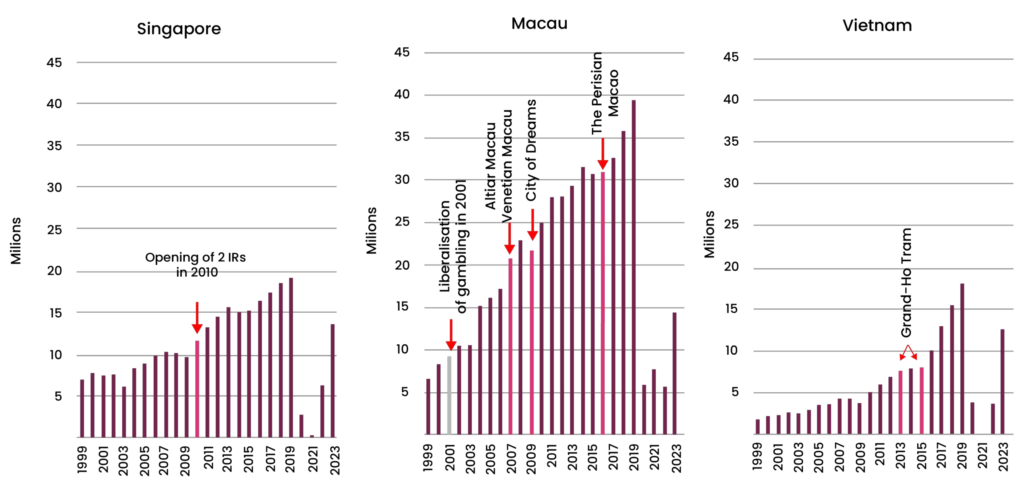
Source: Department of Statistics Singapore, Government of Macao Special Administrative Region Statistics and Census Service, and the World Bank Despite these benefits of the integrated resort model, Sri Lanka has yet to see an operational integrated resort within the island because, until recently, there was no mechanism to obtain licences for the opening of new casinos in Sri Lanka. With the recent advancements in the law in this respect, Sri Lanka may soon be seeing several new investments in integrated resorts. The City of Dreams project is one such integrated resort 168 Alegria, Fronteras, and Seacor (2019) activity that they did not originally plan for. For instance, a business traveller, on arriving at the integrated resort, may be enticed by the gaming facilities or the entertainment options on offer and participate in these activities, despite having no initial plans of doing so. Similarly, a patron who arrives at the integrated resort for gaming may also patronise the restaurants and retail stores at the resort. By thus incentivising patrons to spend on economic activities beyond their primary purpose of visit, an integrated resort is able to generate more revenues than a regular hotel or casino that exists in isolation.
However, the economic multiplier effect of casinos is not just limited to the deve lopment of export industries. By bringing in more investments and consumers to the local economies, the gaming industry generally helps expand the sales of local firms. The increased business profits from the higher sales volume may then be reinvested in the local economy, leading to higher levels of employment, capital gains, and tax revenues for local and national governments, although empirical evidence is mixed on the extent to which these multiplier effects materialise in a jurisdiction 169. The economic development spurred by casinos results in significant employment gains and the expansion of the retail sector where the casino is located, and could even have spillover effects on the labour market and economic activity in neighbouring regions, according to research conducted in the United States 170. The National Gambling Impact Study Commission of the United States, in its Final Report published in 1999, finds that since the advent of casinos, American cities where casinos are located have seen a marked growth in the hotel industry, enhanced revenue collections for local governments, increased construction, improved property values, lower unemployment numbers, and the employment of erstwhile minimum wage workers in jobs with better remuneration packages 171. In addition, the integrated resort model could lead to further expansion of economic activity by bringing in additional demand into the industry. The Hotel Investments Handbook segments the demand for gaming into four broad categories—local demand, tour and travel demand, leisure demand, and convention demand—last three of which are of particular relevance to the integrated resort model 172.
The Limitations of the Economic Multiplier Effect Given the trade-off between the negative externalities and the economic multiplier effects of the gaming industry, it is important that the industry is set-up in a way that maximises the economic multiplier effect while minimising negative externalities. Research on this topic finds that both the makeup of patrons and the neighbourhoods in which the gaming establishments are located play a crucial role in determining the extent to which the economy can enjoy the economic multiplier effect.
Given that the negative externalities of gambling are mostly felt by the local population, the makeup of the patrons is an important element of the economic multiplier effect. Research finds that if most patrons come from the local area, the likelihood of casinos having a 169 Walker (2013) 170 Economopoulos (2015) 171 National Gambling Impact Study Commission (1999) 172 Rushmore (2002) set to open its doors to the public in the near future. Given the dominance of Melco, the operator of City of Dreams, in the South East Asian market, the likelihood that the opening up of this integrated resort would substantially enhance tourist arrivals from the South East Asian region is high.
Furthermore, the benefits to the local population also depend on the ability of the neighbourhood to supply the goods, services, and workforce needed to run a successful gaming industry. If the casino is situated too far from human habitation, and the neighbourhood lacks the other goods and services that patrons need to conveniently enjoy their time at the gaming establishment, the likelihood of the region being able to reap the multiplier effect of the casino industry is low.
Computing the net economic multiplier effect of the casino industry in a locality is not an easy exercise. Research on Native American gaming establishments have found that studies of the net economic multiplier effect generally underestimate several implicit costs, leading to inflated numbers of the net multiplier effect 174. Most studies overestimate the share of non-local gamblers patronising casinos, which results in an overestimation of the inflows to the economy, and an underestimation of the social costs to the local population 175. Studies also underestimate the cannibalisation effect of casinos, which is the reduction of economic activities in other industries due to the reallocation of resources to the gaming industry 176. Particularly in the case where the share of the local population patronising casinos is underestimated, the cannibalisation effect may also be underestimated, leading to an inflated understanding of the net multiplier effect. Finally, due to the difficulty of attributing a monetary value to the social costs, most studies also tend to overlook some forms of negative externalities when calculating the total social cost of gambling, which leads to an underestimation of the overall implicit costs 177.
The task for Sri Lankan policymakers and stakeholders of the gaming industry of Sri Lanka is to rethink the set up of the island’s gaming industry, so that the benefits from the economic multiplier effect can be maximised. The following would allow Sri Lanka’s gaming industry to maximise the benefits from the multiplier effect by expanding the scale of the gaming industry and better integrating the industry with foreign investment opportunities and the tourism industry of Sri Lanka.
- Establish a Regulatory Frameworks that Attracts Large Investors
The scale and image of Sri Lanka’s gaming industry today is largely comparable to Cambodia’s mostly stagnant industry, as discussed in the case study in the earlier section. When taking a look at the historical evolutions of the gaming industries of the two countries, their similarities begin to make sense, as most issues are related to the lax regulatory 173 “[Casinos] have a negative impact on the community unless 50 percent of the gamblers come from out of state.” ~ William Thompson of the University of Nevada–Las Vegas, quoted in Parker (1997) 174 Gazel, Thompson, and Rickman (1995) 175 Gazel, Thompson, and Rickman (1995) 176 Gazel, Thompson, and Rickman (1995) 177 Gazel, Thompson, and Rickman (1995) negative effect on the local population is substantially higher 173. This finding makes sense as the economic multiplier effect only takes effect if the casinos attract patrons and investors who bring in business from outside.
environments of the two countries. The weak regulatory framework prevents Sri Lanka’s gaming industry from projecting an image of integrity to the international market, which is an important element of a flourishing casino industry given the industry’s penchant for stigmatisation—not just in Sri Lanka, but globally—based on allegations of money laundering, drug peddling, and prostitution, regardless of whether such allegations are true. While there is no evidence that the gaming industry of Sri Lanka is plagued by such associations, the inability of the industry to fully signal its integrity to the rest of the world in the absence of an independent gaming regulator discourages large investors from entering the local industry.
In the absence of a strong regulatory framework, Sri Lanka has ended up with a few small-and mid-sized casino establishments, the appeal of which is limited to a group of regional patrons that is in no way comparable to the patron base of the gaming industries of Macau, Las Vegas, and Singapore. If Sri Lanka is to reap the optimal benefits of the economic multiplier effect of the gaming industry, it is imperative that the scale of the local industry be expanded via the entrance of large investors (and possibly globally recognised casino brands) and patronisation by international superplayers. As such, establishing a strong regulatory framework that guarantees the integrity of the gaming industry of Sri Lanka as free from allegations of fraudulent and criminal activities is as important for maximising the economic multiplier effect as it is for minimising negative externalities.
- Develop Casino Establishments as Integrated Resorts
There are several benefits to the prioritisation of the integrated resorts model when making new investments in the gaming industry, which makes it the most effective model at activating the economic multiplier effect of the gaming industry. To begin with, integrated resorts activate the economic multiplier effect by attracting a large variety of patrons to the establishment, most of whom would be reluctant patrons of an establishment that only offers gaming activities. An integrated resort would attract tourists whose primary interest is not gaming, as well as business visitors, who would not otherwise consider visiting the establishment. Once they arrive at the establishment, it is likely that these unlikely patrons would end up participating in the gaming activities too. On the other hand, an integrated resort also incentivises gamblers to partake in other entertainment and lifestyle activities offered by the establishment, leading to higher economic activity than at a regular casino. Accordingly, the integrated resort model effectively guarantees that the gaming industry is able to reap the benefits of the economic multiplier effect.
Moreover, the integrated resort model is a more economically sustainable model than the type of resort that is largely prevalent in Sri Lanka. The margins in the food and beverages industry as well as the hotel industry are quite low all around the world. In 2017-before the Easter attacks, COVID-19 pandemic, and economic crisis impacted the tourism industry-a report by Fitch Ratings claimed that the margins in Sri Lanka’s hotel industry had shrunk to around 28 percent 178. The margins in the restaurant industry are arguably even lower. Although public data on this matter does not exist on Sri Lanka, data from other countries 178 EconomyNext (2017) show that the average profit margin in the restaurant industry is so low that even a 1 percent increase in the operating expenses of a restaurant could well translate to a negative cash flow for many restaurants 179. As such, the hotel resort model that is currently prevalent in Sri Lanka is not necessarily economically sustainable, if Sri Lanka is to rely on the tourism industry as a major player of the island’s economy.
While data on the financial performance of Sri Lankan casinos does not publicly exist, given the oligopolistic structure of the local industry and the inelastic nature of the demand for gaming, it is theoretically likely that the industry earns supernormal profits. An integrated resort, by bringing together the hospitality and gaming components, would lead to a more sustainable resort model for Sri Lanka’s tourism sector in the long run. The losses, or extremely low margins, in the hospitality industry may well be cross-subsidised by the high returns in the gaming industry, while also ensuring that the sector caters to all varieties of potential tourists that Sri Lanka could attract.
- Expanding Market Opportunities for the Gaming Industry
To reap the optimal benefits of the economic multiplier effect of the gaming industry, it is essential that the market conditions affecting the industry are conducive towards its growth. However, presently, many uncertainties in the market, resulting from government inaction, have led to the creation of an environment that foils what it ideally ought to be.
The snail’s pace of the government in enforcing the licensing provisions of the Casino Business Regulation Act No. 17 of 2010 has strengthened the oligopolistic setup of existing casinos. Given the limited growth potential of these casinos, and the lack of new entrants into the market, the growth of the gaming industry has stagnated in recent years. Liberalising the gaming market by allowing new entrants into the market and facilitating their licensing is therefore an important precursor of expanding the gaming industry of Sri Lanka.
The ease of doing business in Sri Lanka also needs to improve, if the country is to extract the maximum benefits of the economic multiplier effects of the gaming industry. There is a great need for labour market reform in Sri Lanka, for instance, to allow for the hiring of unskilled labour as full-time, part-time, or contract workers. The government took a significant step towards labour market reform last year, when the Cabinet approved an amendment to the Shop and Office Employees (Regulation of Employment and Remuneration) Act to lift certain restrictions on women’s ability to be employed in night shifts 180. However, there are questions as to whether the proposed amendment goes far enough to correct the labour market conditions for the expansion of the gaming industry, as only women employed in “information technology companies, knowledge outsourcing, 179 Mun and Jang (2018) 180 Government of Sri Lanka (2024) business process outsourcing (BPO), and offices performing accounts, administration and technical activities for foreign businesses” will be allowed to work night shifts under it 181.
Furthermore, the concerns related to the ease of doing business in Sri Lanka are not just limited to the labour market, and it is important that the government reviews all relevant laws to create a conducive environment to extract the optimal economic multiplier effects of the gaming industry of Sri Lanka 182. The existing foreign exchange laws, for instance, discourage the transfer of revenues earned by casinos through invoicing in other countries to the Sri Lankan banking system, which limits the multiplier effects of casinos in the Sri Lankan context. Liberalising foreign exchange laws would therefore be one crucial incentive towards ensuring that the Sri Lankan economy benefits from the casinos that operate within the Sri Lankan jurisdiction.
181 Government of Sri Lanka (2024) 182 World Bank Group (2020)
Discussion Paper 3
The Fiscal Case for Gaming: Expanding Government Revenues
| Macau | Singapore | Cambodia |
|---|---|---|
| Special gaming tax of35% Additional gaming taxes: To Macau Foundation:1.6- 2% City development, tourism promotion and social security:2.4-3% | Entrance levy on locals (Revenue:$1billion) Gross gaming revenue: Good sand services tax:7% Corporate income tax:17% GGR from premium players: 5% GGRfromothers:15% | Flat tax on the Gross Gaming Revenue: 4%f or VIP players and 7% for masscus to merson integrated resorts 7%for all customers at isolated casinos Corporatetaxrate:20% |
Integral part of the city-state’s economy, the approach to taxation is based on maximising state revenues. This is in contrast to Singapore, where gaming taxes are not a means of fiscal policy but one of combating negative externalities, which is reflected in the tax code through the many Pigouvian taxes. On the other hand, the taxes applicable to the gaming industry of Cambodia reflect the country’s evasive approach to the gaming industry. For one, the taxes applicable to casinos are very low in Cambodia compared to other countries in the region with an extant gaming industry. Moreover, even these low taxes do not seem to be necessarily purpose-driven; it is not clear that they necessarily optimise government revenue or help combat negative externalities arising from the gaming industry.
Macau Singapore Cambodia Special gaming tax of 35% Additional gaming taxes: To Macau Foundation: 1.6 – 2% City development, tourism promotion and social security: 2.4 – 3% Entrance levy on locals (Revenue: $ 1 billion) Gross gaming revenue: Goods and services tax: 7% Corporate income tax: 17% GGR from premium players: 5% GGR from others: 15% Flat tax on the Gross Gaming Revenue: 4% for VIP players and 7% for mass customers on integrated resorts 7% for all customers at isolated casinos Corporate tax rate: 20% 183 Inside Asian Gaming (2024) Annual licence fees: Fixed: MOP 30 million Variable: MOP 300,000 per VIP table, MOP 150,000 per non-VIP table, MOP 1,000 per slot machine Starting March 2022: A progressive tax with a maximum rate of 22% Annual licence fee since 2022: S$ 22.8 million to operate one casino S$ 38 million to operate both casinos Effective tax rate: ~39% of GGR 184 Effective tax rate: ~20% of GGR Effective tax rate: ~5.5% of GGR before 2019, ~19% since 2019 The Philippines is not directly comparable to these three casino jurisdictions as the casino industry of the Philippines is primarily dominated by casinos run by the state-owned PAGCOR, as described in an earlier section. The government of the Philippines mandates that PAGCOR allocates 50 percent of its net revenue–which stood at PHP 79.37 billion in 2023–to the government 185. Privately-run casinos are levied a corporate income tax of 30 percent, as well as an annual licensing fee equivalent to 35 percent of gross gaming revenues, although many tax incentives are also available to private investors running integrated resorts 186.
With the tax rates applicable to the gaming industries of other regional players in mind, this section now turns to a discussion of the historical evolution of the tax policy on the gaming industry of Sri Lanka.
Historical Evolution and the Present Context of Sri Lanka’s Gaming Taxes
The gaming industry has been a longstanding generator of revenues for the Sri Lankan government, even during the British colonial period. The Government of Ceylon first began earning fiscal revenues from the gaming industry with the introduction of the Betting
| Annual licence fees: Fixed: MOP 30 million Variable: MOP300,000 per VIP table, MOP150,000 per non-VIP table, MOP1,000per slot machine | Starting March 2022: A progressive tax with a maximum rate of 22% Annual licence fee since 2022: S$22.8 million to operate one casino S$38milliontooperate both casinos | |
|---|---|---|
| Effectivetaxrate:~39%of GGR184 | Effectivetaxrate:~20%of GGR | Effectivetaxrate:~5.5%of GGRbefore2019,~19%since 2019 |
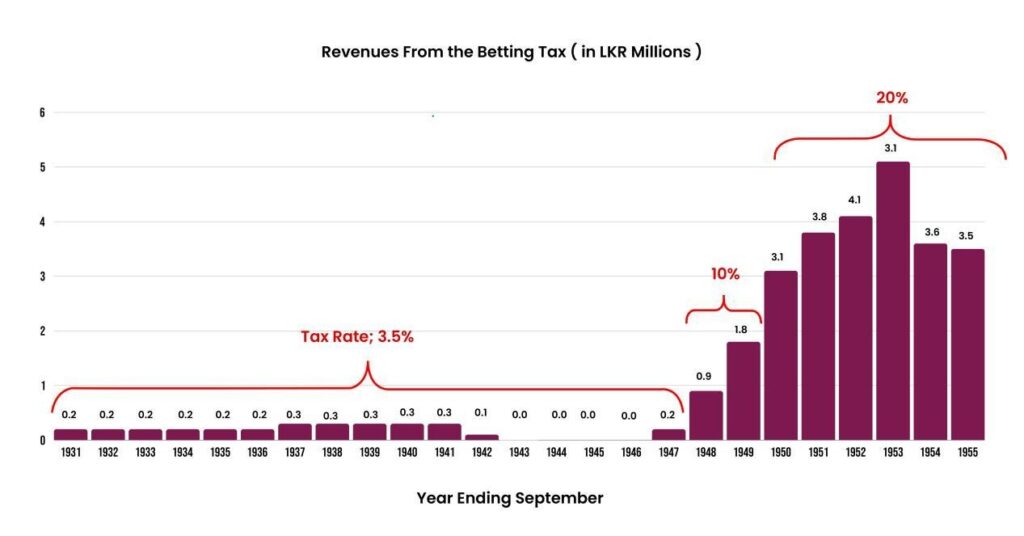
Source: Ceylon Sessional Papers (1955)
188 In addition to the betting industry, the government of Ceylon also received substantial revenues from the lottery industry, before private lotteries were outlawed. The licensed private lotteries operating under the Lotteries Ordinance No. 6 of 1944 were levied a 20 percent tax on their gross proceeds by the Lotteries Amendment Act No. 2 of 1954, under which, the government of Ceylon received a revenue of LKR 1,661,275.65 during the year ending September 30, 1954, and an estimated revenue of LKR 4,386,533.00 during the year ending September 30, 1955 189.
Moving onto the more recent times, since the first introduction of the Betting and Gaming Levy Act in 1988, the government of Sri Lanka has accumulated non-negligible revenues for state coffers through the taxation of casinos and other gaming establishments. The Betting and Gaming Levy Act No. 40 of 1988 imposed an annual levy of LKR 1 million on the operation of a business of gaming, which was raised to LKR 25 million in 2001. The Act was amended in 2002 to lower the levy on businesses that only facilitate the playing of rudjino to LKR 500,000. In 2005, the levy for all gaming establishments, including rudjinos, was revised to LKR 50 million, and in 2013, the levy was increased to LKR 100 million. In 2015, the levy was again increased to LKR 200 million. The most recent amendment to the Act in 2023 revised the levy to LKR 500 million. In 2015, the government also imposed a one-time tax of LKR 1 billion each on the casino establishments, termed the ‘Casino Industry Levy’. Imposed by the Finance Act No. 10 of 2015, this one-time levy was part of a package of popular one-time tax, meant to temporarily raise government revenue.
The 2013 amendment to the Betting and Gaming Levy Act introduced a 5 percent ‘gross collection levy’ on the gross gaming revenues of casino establishments, which was increased to 10 percent in the 2015 amendment to the Act. The 2023 amendment to the Act again increased the gross collection levy to 15 percent of the monthly gross gaming 188 Government of Ceylon (1955) 189 Government of Ceylon (1955) revenue, unless the monthly gross gaming revenue is below LKR 1 million. The gross collection levy exempts casinos from the value added tax, nation building tax, and the social contribution levy that other business establishments generally come under. The amendment, certified in August 2023, also reduces the ‘casino entrance levy’ by half to USD 50 for non-local patrons, from the USD 100 imposed in the 2015 amendment when the entrance levy was first introduced, although it was never collected in reality, until February 2023 190. The entrance levy, which was previously also applicable to foreign patrons in theory, is no longer applicable to foreign patrons.
In addition to these levies, the profits from gaming are also taxed under corporate income tax provisions. The 2014 budget imposed a 40 percent tax on the profits from gaming, which was reduced to 30 percent in 2016, but raised to 40 percent again by the Inland Revenue Act No. 24 of 2017. The Act further recognised participation in gambling as an act of investment, and stipulates that winnings from gaming be treated as investment income. The Act accordingly introduced a 14 percent withholding tax on winnings from gambling, which was however abolished by the Inland Revenue Act No.19 of 2021. The government plans to increase the corporate income tax on gaming establishments to 45 percent by 2025, in line with the government’s commitment to the increasing fiscal revenues under the IMF programme 191.
In 1988, the original Betting and Gaming Levy Act imposed an annual levy of LKR 100,000 on betting centres, which was increased to LKR 1 million in 2000. In 2002, the annual levy was revised to LKR 30,000 for betting centres with live telecast facilities, and LKR 10,000 for betting centres without live telecast facilities. In 2005, the annual levy was increased to LKR 1 million for betting centres that operated through an agent, LKR 250,000 for agentless betting centres with live telecast facilities, and LKR 25,000 for agentless betting centres without live telecast facilities. In 2006, these levies were revised to LKR 1 million, LKR 300,000, and LKR 50,000, while in 2013, they were again revised to LKR 2 million, LKR 300,000, and LKR 25,000 respectively. From 2015 onwards, the respective levies were LKR 4 million, LKR 600,000 and LKR 55,000. With the latest amendment to the Betting and Gaming Levy Act in 2023, betting centres with agents are now annually levied LKR 5 million, while agentless betting centres with live telecast facilities are levied LKR 1 million, and agentless betting centres without live telecast facilities are levied LKR 75,000.
Betting centres are also levied a gross collection levy of 15 percent on the gross revenue, similar to casinos, with no obligation to pay value added and nation building taxes (VAT and NBT), or social contribution levies. Winnings from bets and lotteries are taxed as investment income under the Inland Revenue Act, similar to winnings from playing casino games. Accordingly, all winnings from bets and lotteries are presently taxed at 40 percent.
The following table shows the number of taxpaying casinos and betting centres in Sri Lanka between 2009 and 2022, and the revenues collected from these taxpayers in each year 190 Inland Revenue Department (2023b) 191 International Monetary Fund (2024) under the Betting and Gaming Levy Act. Do note that these figures also include the income taxes collected from gaming establishments and the income taxes collected from winnings from gaming activities.
Year Tax Revenue (LKR) Number of taxpayers 2009 268,516,695 4 casinos, 869 bookmakers 2010 294,841,046 4 casinos, 933 bookmakers 2011 286,881,858 4 casinos, 988 bookmakers 2012 289,175,098 4 casinos, 1051 bookmakers 2013 591,870,451 5 casinos, 1067 bookmakers 2014 815,175,141 5 casinos, 1067 bookmakers 2015 831,922,843 5 casinos, 622 bookmakers 2016 1,884,498,652 5 casinos, 563 bookmakers 2017 1,929,034,608 5 casinos, 605 bookmakers 2018 2,469,578,624 4 casinos, 633 bookmakers 2019 2,435,982,807 4 casinos, 631 bookmakers 2020 1,428,071,291 4 casinos, 633 bookmakers
| Year | Tax Revenue (LKR) | Number of tax payers |
|---|---|---|
| 2009 | 268,516,695 | 4 casinos, 869 bookmakers |
| 2010 | 294,841,046 | 4 casinos, 933 bookmakers |
| 2011 | 286,881,858 | 4 casinos,988 bookmakers |
| 2012 | 289,175,098 | 4 casinos, 1051 bookmakers |
| 2013 | 591,870,451 | 5 casinos, 1067 bookmakers |
| 2014 | 815,175,141 | 5 casinos, 1067 bookmakers |
| 2015 | 831,922,843 | 5 casinos, 622 bookmakers |
| 2016 | 1,884,498,652 | 5 casinos, 563 bookmakers |
| 2017 | 1,929,034,608 | 5 casinos, 605 bookmakers |
| 2018 | 2,469,578,624 | 4 casinos, 633 bookmakers |
| 2019 | 2,435,982,807 | 4 casinos, 631 bookmakers |
| 2020 | 1,428,071,291 | 4 casinos, 633 bookmakers |
| 2021 | 1,939,352,796 | 4 casinos, 656 bookmakers |
| 2022 | 5,244,762,337 | 4 casinos, 620 bookmakers |
Department does not have the capacity, both in terms of personnel and financial resources, to conduct audits of the casino establishments, despite their seemingly best efforts to ensure that the industry upholds its tax obligations. By September 2023, some industry players, allegedly, had yet to fully pay the one-time casino industry tax imposed in 2015 192.
Sri Lanka’s Gaming Taxes: Interpreting the Government’s Priorities in the Past The historical tax rates on the gaming industry of Sri Lanka, and the actual tax revenues collected from the operators until the end of 2022, suggest a lack of policy direction on the part of successive previous governments. As the case study of the casino tax rates in other countries demonstrate, a government may take one of two approaches to the taxation of the industry: one which minimises negative externalities to the economy (with Pigouvian taxes), or one which prioritises government revenue generation. In the case of Sri Lanka, until the end of 2022, neither seemed to be the case.
For instance, the casino tax rates in Sri Lanka until 2022 were not of a Pigouvian nature unlike in Singapore, demonstrating the lack of an authentic interest on the part of the government in curbing the negative externalities of gaming. The only tax on the books applied to the casino industry which is perceivable as Pigouvian in nature was the casino entrance levy; however, given that the levy was never actually collected, it does not seem that the government was really interested in curbing the negative externalities of gaming on the local population. Moreover, even in the hypothetical case where the tax was collected, it would not have served a Pigouvian function given that the levy was applicable to both local and foreign patrons. As such, the levy would have provided both local and foreign patrons the same disincentive from patronising casinos, and would have done little to reduce the local share of patrons at Sri Lanka’s casinos.
Until 2022, successive governments also did not seem to make an earnest effort to maximise government revenue via the optimal taxation of casinos. Firstly, by setting the annual levy to a flat amount which was only revised sporadically with no apparent scientific basis, the government failed to maximise its revenues from the annual levy. In contrast, an annual levy that is a percentage of the revenues of casino establishments would have ensured that the government was able to extract a more consistent share of the incomes of the casinos in the form of taxes, and would have eliminated the need to keep revising the tax over the years. Furthermore, the gross collection levy, first set at 5 percent and later increased to 10 percent, is substantially below the tax rate on gross gaming revenues in other countries, as the case studies above of Singapore and Macau suggest. The one-off casino industry levy, on the other hand, fails to make sense given its non-recurring nature, and can only be perceived as a populist policy measure intended to please the casino-sceptic public.
Since 2022, however, several key changes have been made to the tax code on the casino industry of Sri Lanka, which are seemingly an honest effort on the part of the government to maximise state revenues from the industry, while curbing its negative externalities. For instance, the 2023 amendment to the Betting and Gaming Levy Act reintroduced the casino 192 Sri Lanka Mirror (2023) entrance levy to the tax code. While the entrance levy has been reduced from USD 100 to USD 50, it is now only applicable to local patrons which means that now, there are unique disincentives on the patronisation of casinos by the local population, which will help shield local communities from the negative externalities of the industry. A statement by Ranjith Siyambalapitiya, State Minister of Finance, confirms this intention; the State Minister referred to the entrance levy as an attempt by the government to lower the local share of casino patrons from 40 percent to 10 percent or less 193.
The increase in the gross collection levy, on the other hand, despite falling short of the optimal rates pursued by other countries, is a move in the right direction of increasing state revenues from the casino industry. While it is unclear if the new 15 percent gross collection levy on gross gaming revenues, along with the 40 percent corporate income tax on the profits of casino establishments, will help Sri Lanka achieve an effective tax rate of around 40 percent on gross gaming revenue as is the case in Macau, the revised tax rates are undoubtedly a step in the direction of bringing Sri Lanka’s tax code closer to the optimal rates.
Despite improvements to the casino tax code in the last year, the tax code remains rife with a variety of issues that prevent the government from maximising its revenues from the industry. To begin with, the haphazard revisions to the casino tax code over the years has left Sri Lanka’s casino industry with a complicated tax code, which makes it administratively prohibitive for the Inland Revenue Department to properly enforce the tax code on the casino establishments in operation. This point also relates to a larger concern with respect to the administration of gaming taxes in Sri Lanka, as to whether the Inland Revenue Department possesses the necessary capacity and technical expertise to effectively enforce the tax code. The following are a few proposals to address these concerns, which would help maximise the revenues that the state generates from the casino industry of Sri Lanka.
- Simplification of the Tax Code on Casinos
As aforementioned, the tax code applicable to the casino industry of Sri Lanka is too complicated to ensure its efficient administration. Presently, the casinos are levied an annual fee, which is equivalent to the licensing fees levied on casinos in other countries, although Sri Lankan casinos do not technically hold an annually renewed licence. In addition to this licensing fee, casinos also pay a 15 percent levy on the gross gaming revenue, and a 40 percent business income tax on their profits. Casino establishments are also responsible for the payment of the 14 percent withholding tax on all winnings from casinos, as well as the entrance levy of USD 50 on local patrons. Two casinos have also yet to fully settle the one-time casino industry levy of LKR 1 billion imposed on them in 2015. The proliferation of the various types of taxes applicable to the industry makes the administration of the tax code on casinos complicated, leading to the inefficient enforcement of the tax code that is presently observed.
193 EconomyNext (2023) In line with the tax codes of other jurisdictions that have successfully optimised state revenues from the casino industry, it is advisable that the government of Sri Lanka take immediate steps to simplify the casino tax code. For instance, the two separate taxes on the gross gaming revenue and the profits of casino establishments could be replaced with a higher tax rate on the gross gaming revenues with no separate tax on profits. In fact, both Macau and Singapore, which have a higher effective tax rate on their respective gaming revenues, tax the gross gaming revenues; unlike Cambodia, where the tax code is based on profits. A higher tax rate on the gross gaming revenue of around 40 percent–which is similar to the aggregate tax rate on the gross gaming revenue in Macau–would allow the government of Sri Lanka to generate higher state revenues from the casino industry than the existing tax code.
Such simplification of the tax code would also make it easier for the Inland Revenue Department to enforce it, by removing a layer of complexity from the existing tax code on the industry. The higher efficiency resulting from it would go a long way in ensuring that the tax obligations of the casino establishments are actually met, and that the government expenses incurred in the collection of taxes from the casino industry are kept to a minimum.
- Licensing Fees on Online Gaming Portals
The online casino portals currently operated under the brand names of the existing physical casino establishments are not presently subjected to an annual levy. If one is to consider online casino portals as an entity separate from the physical casino establishments, one may reasonably interpret this phenomenon as a loophole in the tax code that allows casino operators to open new casino businesses without being subjected to the annual levy. The failure of the government to integrate online casino portals into the casino tax code therefore incentivises tax avoidance by casino operators, ridding the government of hundreds of millions of potential extra revenues from the casino industry.
Given the lack of public data on the revenues of online gaming portals of Sri Lanka, it is difficult to assess whether the existing annual levies on physical casino establishments are appropriate for online gaming portals as well. In fact, it is not clear as to whether the Inland Revenue Department itself has access to this information, which would assist in the crafting of a more appropriate tax code for the online gaming portals of Sri Lanka that would better suit those businesses. However, it is undeniable that on the principles of equity in the tax code concerning the casino industry alone, online gaming portals should be obliged to pay an annual levy similar to the physical casino establishments, and be assessed a tax on the gross gaming revenue that allows the government to maximise its tax revenues from the online casino portals separately.
- Better Monitoring of Cash Flows at Casino Establishments
Regular audits of casino establishments are an important first step in ensuring that the
| Location | MonthlyTax(inRD$)PerTable/Machine194 | |||
|---|---|---|---|---|
| First 15 Tables | Second 20 Tables | Additional Tables | SlotMachines | |
| Santo Domingo | 20,000 | 23,000 | 26,000 | 4,000 |
| Santiago de los Caballeros, Puerto Plata, La Altagracia, and LaRomana | 13,000 | 16,500 | 18,000 | 3,500 |
Instead of taxing casinos based on their gross revenues or profits, the government may tax casinos based on the total capacity of the casino operations. In 2006, Law No. 29-06 of the Dominican Republic imposed an income tax on casinos that is calculated based on the region in which the casino is located, and the number of tables and slot machines in operation, so that the taxes paid by the casinos are a function of their total capacity to earn revenues. According to this law, casinos in the Dominican Republic are required to pay the following taxes, based on the locality and the number of tables and slot machines in operation:
First 15 Tables Second 20 Tables Additional Tables Slot Machines Santo Domingo 20,000 23,000 26,000 4,000 Santiago de los Caballeros, Puerto Plata, La Altagracia, and La Romana 13,000 16,500 18,000 3,500 194 Government of the Dominican Republic (2006) Location Monthly Tax (in RD$) Per Table/Machine 194 A similar tax law on Sri Lanka’s casinos would not only simplify the tax collection process, but will eliminate the room for tax evasion and avoidance, either based on accounting sophistry or under-reporting of cash revenues. Sri Lankan authorities may also track withdrawals from the ATMs located inside Sri Lanka’s casinos as an approximation of the gambling transactions taking place. As such, until the government of Sri Lanka is able to design a foolproof mechanism to trace earnings by casinos, a capacity-or withdrawal-based tax policy would be an efficient alternative for collecting the tax revenues from the casino industry.
- Scaling-Up of the Industry
With the present set-up of the casino industry of Sri Lanka, even if the government prioritises the optimisation of state revenues from the industry, there is a hard ceiling on the revenues that the government can potentially earn from the industry. This hard ceiling is set by the fact that the ambiguous nature of the legal standing and the integrity of the industry at present has not allowed the existing casino establishments to grow beyond their current scale by attracting investments from larger industry players. As long as the industry remains in this mid-scale, there is limited gross gaming revenue and profits generated by the casino establishments, leading to limited tax revenues for the government.
The casino industry, by nature, leans towards oligopolistic competition; research shows that the economies of scale available to large-scale casinos means that the free market outcome in a casino jurisdiction generally tends to consolidate market power among a few casinos 195. From the point of view of regulation as well, it may be preferable to limit the number of casino establishments to a few larger players than many smaller players, as the regulatory framework can be more efficiently enforced in the former setting. In Sri Lanka too, if the free market is allowed to dominate, there is no reason to believe that the market will deviate from the industry norm of an oligopolistic setup. In this context, it is in the interest of the government’s revenue-raising objectives to facilitate the expansion of the scale of casino establishments, so more tax revenues can be generated from the limited casinos in San Pedro de Macorís, Andrés, Boca Chica, and within other less developed provinces 10,000 12,000 14,000 3,000
| San Pedro de Macorís, Andrés, BocaChica,and within other less developed provinces | 10,000 | 12,000 | 14,000 | 3,000 |
|---|
Furthermore, facilitating free-market activity in the industry is also paramount to ensuring that the local industry catches the interest of prospective investors who can assist in scaling-up its size.
- Shifting the Tax Incidence to Tourists for More Efficient Taxation
Research shows that the incidence of a tax, which can be defined as whether the casino establishment or the patrons end up bearing the burden of a tax, is an important element of the efficiency of casino taxation, particularly in a tourism economy such as Sri Lanka 196. When a tax is imposed on the casino industry, if the industry is able to raise the prices of its gambling products to pass the burden of the tax onto the patrons, then the incidence of the tax falls on the patrons. The total welfare of a tourism economy is maximised, according to research, if the incidence of casino taxation falls fully on the tourist population 197. Such taxation would allow for the maximisation of state tax revenues as well the welfare of casino establishments in the presence of the tax, while fully passing on the welfare losses of the tax to the non-local patrons.
Accordingly, if the government of Sri Lanka is to pursue an optimal taxation policy on the casino industry, it is important that the incidence of the tax falls squarely on tourists-which the government may achieve using a multitude of tools. Taking steps to lower the local share of patrons at casino establishments via command-and-control laws that discourage locals from entering casinos, or the provision of market incentives against local patronisation, such as licensing fees, could help in this regard.
Furthermore, market segmentation may be used as a tool to increase the share of tax incidence on foreign patrons 198. If the government incentivises casino establishments to segment their operations into mass market and VIP categories, it is reasonable to assume that the foreign-to-local patron ratio of the VIP segment will be substantially greater than the foreign-to-local patron ratio of the mass market segment. If differential taxes are then applied to the mass market and VIP segments, the government may be able to devise a tax policy that places a bulk of the tax incidence on international patrons, thereby increasing the overall welfare derived by the local economy.
- Avoid Gaming Tax Leakages at Special Economic Zones
As aforementioned, the Port City master plan incorporates provisions for an integrated resort on the special economic zone, which would include a casino. Conversations with officials reveal that the expectation is to have the integrated resort, and its gaming operations, designated as a ‘Business of Strategic Importance’, under which, the Colombo Port City Economic Commission Act No. 11 of 2021 allows for the granting of exemptions to tax 196 Gu (2014) 197 Gu (2014) 198 Gu (2014) obligations under the Inland Revenue Act, No 24 of 2017, the Betting and Gaming Levy Act, No 40 of 1988, and the Casino Business (Regulation) Act, No 17 of 2010 for up to 25 years.
Such tax holidays could lead to the loss of crucial revenues for the government from the industry, and make it no longer optimal to allow for the operation of the gaming industry, considering the many negative externalities that the industry entails. According to the Advocata Institute, under such provisions, “the Port City may prove to be a leakage point of taxes for the State”, as “life as a businessperson could be very different depending on which side of the Chaithya Road your business is situated.” 199 Such differential tax laws could have dynamic effects by eliminating the existing tax revenues from the gaming industry for the government, in the case in which the casinos operating on mainland Sri Lanka decide to shift their operations to the Port City as well, to avoid their substantial tax obligations to the government. As such, to capture the maximum fiscal revenues from the gaming sector, it is important that laws are recrafted to eliminate such opportunities for leakages.
199 Advocata Institute (2021)
| Year | Gross Sales Income (LKR) | |
|---|---|---|
| National Lotteries Board | Development Lotteries Board | |
| 2022 | 21,208,808,240 | 19,071,456,751 |
| 2021 | 17,292,066,080 | 15,364,398,498 |
| 2020 | 18,041,145,000 | 15,033,029,360 |
| 2019 | 22,079,260,575 | 17,065,414,012 |
| 2018 | 20,438,643,440 | 15,854,856,246 |
| 2017 | 16,747,180,220 | 13,981,500,306 |
| 2016 | 20,170,417,750 | 11,874,659,603 |
| 2015 | 17,394,463,681 | 12,271,477,490 |
| 2014 | 15,153,133,820 | 9,728,586,929 |
| 2013 | 14,537,362,545 | 9,941,375,151 |
| 2012 | 12,004,268,616 | 8,624,166,662 |
| 2011 | 10,092,330,623 | 6,884,267,246 |
| 2010 | 8,862,869,826 | 5,667,809,000 |
| 2009 | 8,580,538,712 | 5,220,418,000 |
2021 17,292,066,080 15,364,398,498 2020 18,041,145,000 15,033,029,360 2019 22,079,260,575 17,065,414,012 2018 20,438,643,440 15,854,856,246 2017 16,747,180,220 13,981,500,306 2016 20,170,417,750 11,874,659,603 2015 17,394,463,681 12,271,477,490 2014 15,153,133,820 9,728,586,929 2013 14,537,362,545 9,941,375,151 2012 12,004,268,616 8,624,166,662 2011 10,092,330,623 6,884,267,246 2010 8,862,869,826 5,667,809,000 2009 8,580,538,712 5,220,418,000 2008 6,832,519,239 4,498,179,000 2007 6,079,850,149 3,947,214,000
| Year | National Lotteries Board Contributions to the Consolidated Fund(LKR) | Development Lotteries Board Contributions to the President’sFund(LKR) |
|---|---|---|
| 2022 | 2,609,494,086 | 2,894,896,000 |
| 2021 | 2,162,030,441 | 2,305,868,900 |
| 2020 | 2,205,079,779 | 2,296,720,000 |
| 2019 | 2,637,962,164 | 2,191,000,000 |
| 2018 | 2,426,947,888 | 1,968,000,000 |
| 2017 | 2,016,986,336 | 346,541,000 |
| 2016 | 2,445,594,544 | 1,836,020,000 |
| 2015 | 2,130,953,970 | 1,628,053,000 |
| 2014 | 1,888,455,133 | 1,834,814,000 |
| 2013 | 1,753,135,197 | 2,007,375,000 |
| 2012 | 1,574,149,137 | 1,648,471,000 |
| 2011 | 1,345,046,907 | 1,354,089,880 |
2021 2,162,030,441 2,305,868,900 2020 2,205,079,779 2,296,720,000 2019 2,637,962,164 2,191,000,000 2018 2,426,947,888 1,968,000,000 2017 2,016,986,336 346,541,000 2016 2,445,594,544 1,836,020,000
| 2008 | 6,832,519,239 | 4,498,179,000 |
|---|---|---|
| 2007 | 6,079,850,149 | 3,947,214,000 |
| 2006 | 6,460,015,752 | 3,761,749,000 |
| 2005 | 6,166,897,652 | 4,102,829,000 |
| 2004 | 6,489,740,091 | 3,729,539,000 |
| 2003 | 7,181,894,656 | 2,995,514,000 |
| 2002 | 4,965,365,543 | 2,266,820,000 |
These figures demonstrate the outsized role played by lotteries in generating revenues for the government from the gaming industry. The government’s heavy reliance on the sale of lotteries to generate revenues for the national healthcare and education sectors is however not an equitable strategy. In fact, the state’s overreliance on the lottery industry has led to a scenario where the government collects revenues from the economically most vulnerable populations to redistribute it to those of the same or higher economic background.
It is well-documented in existing literature that, globally, lotteries are an ‘inferior good’, meaning that the demand for lotteries generally goes down in response to an increase in the income of the consumer base 200. Accordingly, it is the poorest households which generally spend the most on lottery ticket purchases; which is the case for Sri Lanka as well, based on conversations with those involved in the lottery industry of Sri Lanka. Although comprehensive data on the consumer demographics of the Sri Lankan lotteries market does not exist, the main objectives of those who purchase lotteries include purchasing land, building houses, purchasing motor vehicles, and settling loans, which indicate that the consumer base is generally lower income 201. It is important to note, however, that while the Development Lotteries Board fully agrees with this characterisation of their consumer base as low income earners, the National Lotteries Board does not necessarily agree. According to the National Lotteries Board, the high share of lottery tickets sold in urban centres on working days is evidence that the average lottery buyer is economically better off than conventionally thought. During conversations, the National Lotteries Board also pointed to the number of prizes that are not claimed by winning buyers as evidence that a significant number of lottery buyers purchase lotteries out of sympathy for lottery sellers, and not necessarily because they are interested in winning prizes. Despite these claims, it is highly likely that most regular lottery buyers are still low income earners.
The consumer base of casinos, on the other hand, cannot be more different. A majority of those who patronise Sri Lanka’s casinos are tourists, mainly from India, China, and the Middle East 202. The local patrons, unsurprisingly, represent the wealthiest stratas of Sri Lankan society, according to those familiar with the industry. In fact, with the casino entrance levy of USD 50 in effect as of 2023, it is reasonable to assume that the average income of the local patrons of Sri Lankans now is even higher than before. Given the obvious difference in the consumer base of the lottery and casino industries of Sri Lanka, the government’s heavy reliance on the former to fund social welfare programs is not only regressive in nature, but also does not make economic sense. Any government programmes aimed at uplifting the quality of life of the poor, such as the President’s Fund, the Mahapola scholarship programme, or any other welfare scheme funded through revenues earned from the lottery industry of Sri Lanka, would only make economic sense if serving a real redistributional purpose by transferring money from those with more to those with less. The lottery industry serves no such redistributive purpose because it collects revenues from the poorest strata of society, and redirects it back to the same. In fact, given the inadequate means testing criteria and irregularities in the administration of government 200 Blalock, Just, and Simon (2007) 201 Auditor General’s Department (2019a) 202 Menon (2022) welfare programmes in Sri Lanka, the disbursement of welfare to segments of society less deprived than those who need welfare the most is a common phenomenon 203. Considering this reality, it is not an overstatement to postulate that Sri Lanka’s state-run lotteries collect revenues from the least well off segments of the Sri Lankan population, to redistribute it to those somewhat better off.
The regressive nature of the tax policy that is adopted when governments operate lotteries as a means of revenue generation as opposed to optimising state revenues from the casino industry, the form of gambling favoured by the economically prosperous segments of society, is well-documented in the literature 204. Although lotteries are not technically a tax, theoretically, lotteries function as an ‘implicit tax’ on the population, one that is regressive in nature given that the incidence of the implicit tax—or in other words, the burden of bearing the brunt of the tax—falls on the poorer strata of society 205. Lotteries thus violate the fairness and equity principles of a good tax system, in addition to being an ineffective tool of redistribution.
State-operated lotteries are not only a regressive form of state revenue generation, but are also an extremely inefficient fiscal policy tool. Lotteries are extremely expensive to operate, which means that only a fraction of the money collected as sales revenue from the lotteries end up being retained by the government as state revenues. The following figure demonstrates the percentage of sales revenues of the National Lotteries Board and the Development Lotteries Board that were contributed to the Consolidated and the President’s Funds respectively.
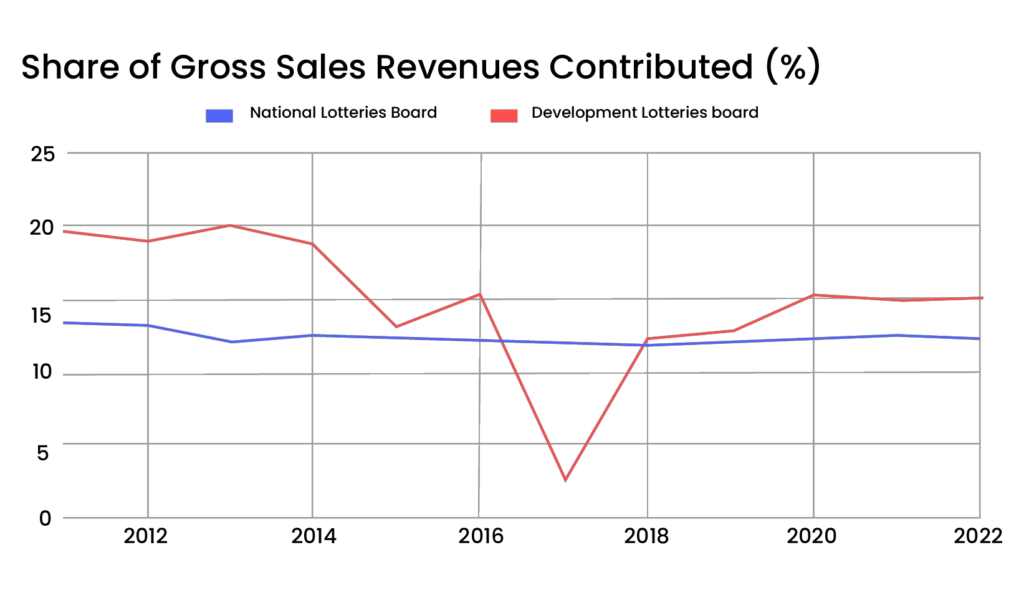
Source: Annual Reports of the Lotteries Boards
203 Sebastian, Shivakumaran, Silwal, Newhouse, Walker, and Yoshida (2018) 204 Clotfelter (2005) 205 Clotfelter (2005) The high expenses of the Lotteries Board are mostly a function of operating costs and prize payouts. In addition to a large number of oversights in the handling of financial resources, the Auditor General’s reports on the Lotteries Boards sometimes point to substantial occurrences of irregularities that rise to the level of financial mismanagement or fraud 206, which have also caught the attention of the Committee on Public Enterprises (CoPE) of the Parliament of Sri Lanka 207. As such, the high operating costs of the Lotteries Boards are attributable to the natural inefficiencies associated with any state-owned enterprise with no profit incentive. A primary barrier to lowering the operating costs of the Lotteries Boards is the fact that managements do not have the ability to make quick, business-minded decisions on their own; given that the Lotteries Boards fall under the authority of the Ministry of Finance, every decision requires approval from the respective Boards of Directors and the Ministry of Finance, leading to substantial delays in decision-making. Given that the Lotteries Boards are also required to abide by various government procurement regulations and other circulars, the Lotteries Boards claim that it is near-impossible to take the most cost effective route when making decisions on the printing, sale, and distribution of tickets. Bloated and unmotivated workforces, limited attention to marketing, and the lack of a profit motive are other hindrances to higher profitability at the Lotteries Boards.
Conversations with industry experts also revealed that the high operating costs have prevented the Lotteries Boards from making any profits at all in the past, which has not been the case since the adoption of digital algorithms in the printing of lotteries. Before the adoption of digitalised algorithms, the Lotteries Boards used to print all possible permutations of draws, which gave consumers a high chance of winning. The adoption of digitalised algorithms has allowed the Lotteries Boards to limit the number of lottery tickets printed and thereby control the consumers’ chance of winning. While the technological advancements adopted by the Lotteries Boards have enhanced the profitability of their operations, it is likely that the rights of consumers are violated in the process, depending on how one interprets consumer rights in the context of lotteries; this, however, is beyond the scope of this paper. Conversations with those familiar with the industry also revealed that the Lotteries Boards has made great strides on cutting down on the number of fraudulent claims via counterfeit lottery tickets by introducing a QR code system to authenticate tickets. The crackdown on counterfeit lotteries has also contributed to enhancing the profitability of the Lotteries Boards in recent years.
Despite these important strides made by the Lotteries Boards in the recent past, the fact remains that the operations of the Boards are both inefficient and regressive as a tool of fiscal policy. The following are a series of proposals aimed at redesigning the approach of the state towards the larger gaming industry, in order to minimise the inefficiency and regressivity that arises from its present reliance on lotteries as a generator of fiscal revenues, over other forms of gaming.
206 Auditor General’s Department (2019b) 207 Ada Derana (2022)
1. Privatization of the Lotteries Board
There is no reason based on economic theory as to why the Lotteries Boards should remain in state ownership. In fact, as the aforementioned inefficiencies in the management of the Lotteries Boards suggest, the state ownership of the Lotteries Boards has brought about those inefficiencies, inevitably associated with state ownership, to the lottery industry of Sri Lanka. In this context, the government should give serious consideration to the privatization of the Lotteries Board.
The full privatization of the Lotteries Boards, however, may prove to be difficult for several reasons. Firstly, given that no country currently has a fully privatised national lottery system, there is no tried-and-true foolproof model for the privatisation of the Lotteries Boards that the government of Sri Lanka may pursue. Furthermore, given the extant reliance of the state on the Lotteries Board as a tool of fiscal policy, the sudden privatisation of the Lotteries Boards may rid the state of crucial fiscal revenues in the short run.
The partial privatisation of the Lotteries Board may be a more appealing choice in this context. A model for partial privatisation already exists in the form of the National Lottery of the United Kingdom, which was franchised to a private operator in 1994 but continues to contribute one share of its revenues to the British government, and another share to charitable causes as stipulated by the British Parliament. If the management of the Lotteries Boards of Sri Lanka is privatised under a similar model, the added profit motive would likely increase the contributions to the Consolidated and President’s Funds by increasing sales revenues and decreasing administrative costs. The government may earn additional revenues under this system by awarding the franchise rights through a bidding process, with the licence renewed periodically.
Even if partial privatisation of the Lotteries Boards is not achieved, bringing the Lotteries Boards under the Companies Act No. 7 of 2007 would eliminate some hindrances to higher profitability at the Lotteries Boards. In fact, conversations with the National Lotteries Board reveal that as part of the economic liberalisation effort of the government after the onset of the economic crisis in 2022, a cabinet proposal was made to bring the Lotteries Boards, alongside several other SOEs under the Ministry of Finance, under a single division of the Ministry, where they would be administered as companies under the Companies Act. The National Lotteries Board claims that such a move would minimise the inefficiencies generated by procurement guidelines, other government circulars, and delays in decision-making due to redtape. Yet, it is important to note that even as entities under the Companies Act, the Lotteries Board would still retain most other inefficiencies stemming from state ownership.
2. Expanding the Consumer Base of Lotteries to Include the Economically Better Off
Regardless of whether the Lotteries Boards are privatised, there are steps that can be taken to reduce the regressive nature of the lottery industry from a redistributionary standpoint. The Lotteries Boards may aggressively pursue a rebranding strategy to increase its appeal to the segments of society that are economically better off than its present consumer base. In fact, conversations with industry professionals reveal that some action has already been taken with this aim in mind, although these steps have failed to help the Lotteries Boards make inroads among economically better off segments. For instance, a few years ago, the National Lotteries Board introduced an SMS lottery that was meant to appeal to a newer generation of technologically savvy consumers. Despite the failure of this venture, the Lotteries Boards may keep experimenting with other strategies to diversify its consumer base, in order to attenuate the economically regressive nature of their operations.
To successfully diversify its consumer base, however, the Lotteries Boards need to devise a clear-eyed marketing strategy that aggressively appeals to more privileged segments of society than the existing consumer base of lotteries. In devising such marketing strategies, the Lotteries Boards need to be aware of several economic realities that would help better target their attempts at consumer diversification. Firstly, the traditional model of lotteries seen so far in Sri Lanka has limited appeal to more prosperous segments of society-–a likely cause for the failure of the SMS lottery by the National Lotteries Board. As such, the Lotteries Boards need to conduct extensive research on what exactly would enhance the appeal of lotteries to more privielged segments of society, and what forms of advertising would enable the Lotteries Boards to tap into such potential, if any. Furthermore, the Lotteries Boards also need to supplement its current sales strategy of reliance on lottery agents and salespersons with more modern forms of sale, to meet prospective consumers of more privileged means where they are.
3. Merger of the Lotteries Boards and Reduction in the Number of Lotteries
The lottery industry of Sri Lanka, much like the casino industry, operates under inelastic demand conditions. As such, regardless of the number of Lotteries Boards in existence, and the number of different lotteries being operated at any given times, the number of consumers who purchase lotteries remains generally fixed. As such, the existence of two state-run Lotteries Boards at present does not make much economic sense, and one could argue that it only contributes to the high operational costs of the industry. The many lotteries currently operated by each Lotteries Board have also failed to substantially broaden the consumer pool for lotteries, and as such, have only balkanised the fixed aggregate demand for lotteries among the consumers, while further adding to the operational costs.
The restructuring of the Lotteries Boards, whereby the two Lotteries Boards are merged into one, and the number of lotteries in operation are substantially reduced, could thus help lower operating costs of the industry. Cost savings from the restructuring of the Lotteries Boards would allow the industry to enhance its contributions to the government, which would do real justice to the implicit tax on the public that is the lottery industry. However, before a merger of such nature takes place, it is important that the competition effects of having two Lotteries Boards are studied in detail; in the event that the ‘friendly’ competition between the two Lotteries Boards is proven to bring in more revenues than a merger would cut costs, a merger of the two Lotteries Boards would not be economically justified.
4. Bringing the Lottery Industry Under the Gaming Regulator
The urgent need for a casino regulator has been repeatedly emphasised in the sections above. Given the technical similarities between casinos and lotteries, it is only reasonable that the lottery industry is also brought under the purview of the same proposed regulatory authority. The National Lotteries Board, the existing regulator of Sri Lanka’s lottery industry is not fit for this purpose; as an operator of lotteries itself, the National Lotteries Board has a duelling mandate to both operate lotteries and regulate how they are operated, which leads to concerns about clear conflicts of interest. Furthermore, given that the Development Lotteries Boards and the Mahapola Fund have been legally exempted from the regulatory authority of the National Lotteries Board, the National Lotteries Board is limited in its ability to provide tangible regulatory services to the industry.
There are multiple factors that warrant the proper oversight of the lottery industry of a country by an independent regulatory authority, regardless of whether the lottery industry is operated publicly or privately. Lotteries also entail the same negative externalities as casinos, which means that the supply of lotteries may need to be adjusted to the socially optimal level through regulatory control. The same concerns of consumer rights related to the casino industry are also applicable to the lottery industry, given the industry’s ability to manipulate the odds of winning through the number of lotteries printed, and other mechanisms. Hence, a regulatory body is also necessary to ensure that the rights of lottery consumers, who generally represent the most economically underprivileged strata of society, are protected. Lastly, a regulatory body would also be able to ensure that the lottery industry is not associated with money laundering and other criminal or unethical activities, which the industry may be prone to given the nature of wager.
5. Redirect State Focus Towards Revenue Generation from the Casino Industry
Even if the proposals above are implemented, the reality remains that the overreliance of the state on the lottery industry as a tool of fiscal policy is substantially less progressive than the counterfactual case, where the government looks to the casino industry for revenue generation. Therefore, in order to make the gaming tax code truly progressive, the government needs to gradually move away from the lottery industry towards the casino industry for the generation of fiscal revenues.
The proposals stipulated in the previous sections will allow the government to achieve this goal, alongside efforts to make lotteries more appealing to economically better off consumers. Given the potential high scale of operations of a fully formalised casino industry when compared to the lottery industry, there is greater government revenue to be generated through the former than the latter. Progressive economic reforms aimed at promoting economic growth through the casino industry, while controlling its negative externalities, would help this fiscal potential of the gaming industry to materialise in the Sri Lankan context.
6. Conduct Research on the Economic Effects of Addiction to Lotteries
While the Lotteries Boards claim that there is no evidence of addiction among individuals to the lottery industry, neither the Lotteries Boards, nor any other public or private entity, have actually conducted any research on this matter. It is highly likely that, although most buyers of lottery tickets are not addicted to lotteries, there remain some individuals whose lottery buying patterns have a substantial negative effect on their quality of life. In fact, conversations with the National Lotteries Board reveal some such instances in the past where lotteries contributed to the generation of negative externalities, including when men in rural areas were found to have been habitually engaged in betting on the last two digits of the Mahajana Sampatha.
Only a comprehensive study of the economic effects of the lottery industry of Sri Lanka would be able to discern whether the economic benefits of lotteries, including the many welfare programmes they fund and the prize monies that are paid out to winners, truly outweigh the negative externalities of lotteries. As such, the government (or any interested private entities) should take immediate steps to study this matter in more detail, so that the real contribution, or the lack thereof, of this exclusively state-operated industry on the Sri Lankan public can fully be understood.
References
Ada Derana (2022). “COPE Reveals Irregularities Committed at Development Lotteries Board.” Ada Derana, https://www.adaderana.lk/news.php?nid=81146.
Ada Derana (2024). “Sri Lanka increases casino licence fee and renewal fee.” Ada Derana, https://www.adaderana.lk/news/96388/sri-lanka-increases-casino-license-fee-and-renewal-fee.
Adam Rose and Associates (1998). “The Regional Economic Impacts of Casino Gambling: Assessment of the Literature and Establishment of a Research Agenda.” National Gambling Impact Study Commission.
Advocata Institute (2021). “The Port City We Need.” Advocata Institute, https://www.advocata.org/commentary-archives/2021/04/23/the-port-city-we-need-lx8w5.
Ahn, Jiseon and Ki-Joon Back (2018). “Integrated resort: A review of research and directions for future study.” International Journal of Hospitality Management, 69, 94-101.
Alegria, Justin Philip R., Lianne Carmelli B. Fronteras, and Kayla C. Seacor (2019). “Profile and Taxation of the Integrated Resort Industry in the Philippines.” NTRC Tax Research Journal, 31(3), 23-40.
Assemblies of God (2015). “A Biblical Perspective on Gambling: Position Paper.” Assemblies of God.
Auditor General’s Department (2019a). “Development Lotteries Board – 2019.” Auditor General’s Department.
Auditor General’s Department (2019b). “Special Audit Report on the Structural Functionality and Consumer Benefits of the Development Lotteries Board.” Auditor General’s Department.
Baldwin, Robert, Martin Cave, and Martin Lodge (2010). The Oxford Handbook of Regulation, Oxford University Press.
Betting and Gaming Council (2022). “New Research Reveals Shocking Size of Black Market Gambling Across Europe.” Betting and Gaming Council, https://bettingandgamingcouncil.com/news/new-research-reveals
Blalock, Garrick, David R. Just, and Daniel H. Simon (2007). American Journal of Economics and Sociology, 66(3), 545-570.
Chan, Viviana (2024). “PAGCOR’s decision to lower licensing fees enhances competitiveness of IGLs, says COO of Winn Tech.” Asian Gaming Brief.
Chen, Sandy C., Stowe Shoemaker, Diana Marie V. Zemke (2013). “Segmenting Slot Machine Players: A Factor Cluster Analysis.” International Journal of Contemporary Hospitality Management, 25(1), 23-48.
Chu, Christopher (2024). “Macau Bounces Back As Casinos Adapt to Two ‘New Normals.’” FinanceAsia, https://www.financeasia.com/article/macau-bounces-back-as-casinos-adapt-to-two-new-normals/494290.
Cinnamon Hotels (2024). “Adventure: Bally’s Casino.” Cinnamon Hotels, https://www.cinnamonhotels.com/experiences/ballys-casino.
Clark, Luke, Bruno Averbeck, Doris Payer, Guillaume Sescousse, Catharine A. Winstanley, and Gui Xue (2013). “Pathological Choice: The Neuroscience of Gambling and Gambling Addiction.” Journal of Neuroscience, 33(45), 17617-17623.
Clotfelter, C. T. (2005). “Gambling Taxes.” Theory and Practice of Excise Taxation: Smoking, Drinking, Gambling, Polluting, and Driving. Edited by Sijbren Cnossen, Oxford University Press, 84-119.
Colombo District Court (1934). Tarrant et al v. Marikkar, Ceylon Government Press.
Commission on Audit (2012). “Philippine Amusement and Gaming Corporation Annual Audit Report for CY 2012: Executive Summary.” Commission on Audit.
Connecticut Department of Consumer Protection (2021). “What is the Difference Between Gambling and Gaming?” Government of the State of Connecticut, https://portal.ct.gov/gaming/knowledge-base/articles/gambling-vs-gaming#:~:text=Gaming%20is%20when%20you%20participate,which%20remains%20a%20cri minal%20activity.
DailyFT (2016). “Horse Racing at the Highest Level.” DailyFT, https://www.ft.lk/Sports/horse-racing-at-the-highest-level/23-535738.
DailyFT (2022). “Mahapola to Launch New Online Lottery; Calls for EOIs.” DailyFT, https://www.ft.lk/front-page/Mahapola-to-launch-new-online-lottery-calls-for-EOIs/44-729983.
DailyFT (2024). “JKH Cracks Jackpot with Melco.” DailyFT, https://www.ft.lk/top-story/JKH-cracks-jackpot-with-Melco/26-761217.
Daily News (2023). “Issuing Soft Liquor Licenses for Tourist Hotels, Restaurants Suspended.” Daily News, https://www.dailynews.lk/2023/10/18/admin-catagories/breaking-news/176825/issuing-soft-liquor-licenses-for-tourist-hotels-restaurants-suspended/.
Department of Census and Statistics (2014). Census of Population and Housing 2012 Key Findings, Department of Census and Statistics.
Development Lotteries Board (2024). “About Us.” Development Lotteries Board, https://www.dlb.lk/aboutus/en.
Doherty, Ben (2015). “James Packer’s crown loses gloss as he’s dealt out of the casino game in Sri Lanka.” The Guardian, https://www.theguardian.com/business/2015/feb/02/james-packers-crown-loses-gloss-as-hes-dealt-out-of-the-casino-game-in-sri-lanka.
Dominican Today (2023). “Dominican Republic Reports Record 8.5 Million Tourists in 2022.” Dominican Today, https://dominicantoday.com/dr/economy/2023/01/14/dominican-republic-reports-record- 8-5-million-tourists-in-2022/.
Economopoulos, Andrew J. (2015). “Examining the Impact of Casinos on Economic Development: A Spatial Analysis of the Counties in the Mid-Atlantic Region.” Business and Economics Faculty Publications, 19.
EconomyNext (2017). “Sri Lankan Hotels/ Profit Margins Getting Squeezed: Fitch.” EconomyNext, https://economynext.com/sri-lankan-hotels-profit-margins-getting-squeezed-fitch-8584/.
EconomyNext (2023). “Sri Lanka Wants to Bring Local Casino Players from 40 Pct to Almost Nothing With Tax: Minister.” EconomyNext, https://economynext.com/sri-lanka-wants-to-bring-local-casino-players-from-40-pct-to-almost-nothing-with-tax-minister-127818/.
EconomyNext (2024a). “Sri Lanka New Casino Licences to Require Minimum Investments.” EconomyNext, https://economynext.com/sri-lanka-new-casino-licenses-to-require-minimum-investments-151719/#.
EconomyNext (2024b). “Sri Lanka gets 10 applications for casinos: Minister.” EconomyNext, https://economynext.com/sri-lanka-gets-10-applications-for-casinos-minister-146879/.
Gambling Regulatory Authority (2020). “Casino Stud Poker (RWS): Game Rules.” Gambling Regulatory Authority of Singapore.
Falguera, Norris Z. (2008). “Philippines’ Casino Operations as a Viable Source of Revenue.” Journal of Industry and Information Science, 4(2), 79-95.
Fernando, Dhananath (2021). “When Price Controls Get Out of Control.” The Morning, https://www.themorning.lk/articles/165194.
Fiedler, Ingo (2015). “A Behavioural and Health Economic Analysis of Gambling.” Presentation for ARJEL and ODJ, University of Hamburg Institute of Law and Economics Division of Gambling.
Finkelstein, The Hon. Ray (2021). Royal Commission into the Casino Operator and Licence: The Report, Victorian Government Printer.
Gambrell, Jon (2023). “UAE creates federal authority for ‘commercial gaming’ as casino giants flock to Gulf Arab nation.” Associated Press, https://apnews.com/article/united-arab-emirates-gaming-gambling-casinos-f4a4a49505a15115b96ba70374ca1aaa.
Gao, Jason, David Fong, and Xiaoming Liu (2011). “Mathematical Analyses of Casino Rebate Systems for VIP Gambling.” International Gambling Studies, 11(1), 93-106.
Gazel, Ricardo, William M. Thompson, and Dan Rickman (1995). “The Economic Impacts of Native American Gambling in Wisconsin.” Gaming Research and Review Journal, 2(2), 43-62.
GGRAsia (2024). Yield Per Macau Slot Machine in 2023 Above 2019 Levels.” GGRAsia, https://www.ggrasia.com/yield-per-macau-slot-machine-in-2023-above-2019-levels/.
Government of Britain (1845). Gaming Act, His Majesty’s Stationery Office.
Government of Ceylon (1844). Lotteries Ordinance, Ceylon Government Press.
Government of Ceylon (1889). Gaming Ordinance, Ceylon Government Press.
Government of Ceylon (1930). Betting on Horse-Racing Ordinance, Ceylon Government Press.
Government of Ceylon (1934). Cheetu Ordinance, Ceylon Government Press.
Government of Ceylon (1955). Sessional Paper XVII: Report of the Taxation Commission, Ceylon Government Press.
Government of Ceylon (1961). Ceylon Government Gazette, No. 12,824, Ceylon Government Press.
Government of Goa, Daman, and Diu (1976). The Goa, Daman and Diu Public Gambling Act, 1976, Department of Printing and Stationery.
Government of Singapore (2014). Remote Gambling Act No. 34 of 2014, Government of Singapore.
Government of Singapore (2020). Casino Control Act 2006: 2020 Revised Edition, The Law Revision Commission.
Government of Singapore (2022). Gambling Regulatory Authority of Singapore Act No. 14 of 2022, Government of Singapore.
Government of Sri Lanka (1987). Gazette No. 483/7, Department of Government Printing.
Government of Sri Lanka (1988). Betting and Gaming Levy Act No. 40 of 1988, Department of Government Printing.
Government of Sri Lanka (2010). Casino Business Regulation Act No. 17 of 2010, Department of Government Printing.
Government of Sri Lanka (2022a). Extraordinary Gazette Notification No. 2295/10, Department of Government Printing.
Government of Sri Lanka (2022b). “Inland Revenue (Amendment) Act, No. 45 of 2022.” Department of Government Printing.
Government of Sri Lanka (2024). Shop and Office Employees (Regulation of Employment and Remuneration) (Amendement) Act No. 28 of 2024, Department of Government Printing.
Government of the Dominican Republic (2006). Law No. 29-06, Government of the Dominican Republic.
Government of the Macau Special Administrative Region (2022). Macau Administrative Regulation No. 54/2022, The Printing Bureau.
Government of the Philippines (1977). “Presidential Decree No. 1067-A.” Government of the Philippines.
Gribbs, Joshua B. and Shane W. Kraus (2023). “The Relative Risks of Different Forms of Sports Betting in a US Sample: A Brief Report.” Comprehensive Psychiatry, 127, 1-5.
Griffith, T. H. (1896). “Hymn XXXIV Dice, Etc.” Hymns of the Rig Veda, E. J. Laearus and Co.
Gruen, Arthur (1976). “An Inquiry Into the Economics of Race-Track Gambling.” Journal of Political Economy, 84(1), 169-178.
Gu, Xinhua (2014). “Tax incidence and price discrimination: An application of theories to gambling markets.” China Economic Review, 28, 135-151.
Gu, Zheng (2001). “Economies of Scale in the Gaming Industry: An Analysis of Casino Operations on the Las Vegas Strip and in Atlantic City.” The Journal of Hospitality Financial Management, 9(1), 1-15.
Gu, Zheng (2013). “Economies of Scale in the Gaming Industry: An Analysis of Casino Operations on the Las Vegas Strip and in Atlantic City.” Journal of Hospitality Financial Management, 1, 1-15.
Hamdi, Raini (2021). “Casinos made Macau one of the wealthiest places in the world — but they also brought heightened inequality and crime. Now, China is cracking down.” Business Insider, https://www.businessinsider.com/macau-gambling-beijing-cracks-down-future-in-question-casinos-2021-11.
Han, Heesup, JungHoon Lee, and Jinsoo Hwang (2018). “A Study of Brand Prestige in the Casino Industry.” Tourism and Hospitality Research, 18(1), 96-106.
Henry Fund (2024). “Casinos and Gaming.” Henry Fund of the University of Iowa Henry B. Tippie College of Business.
Hoole, Rajan (2001). Sri Lanka: The Arrogance of Power –- Myths, Decadence and Murder, University Teachers for Human Rights (Jaffna)
Inland Revenue Department (2023). Annual Performance Report 2022, Inland Revenue Department.
Inland Revenue Department (2023b). “Notice to Casino Operators: Implementation of Casino Entrance Levy.” Inland Revenue Department.
Inside Asian Gaming (2024). “Macau Government Reaps Gaming Tax of US$ 8.1 Billion in 2023.” Inside Asian Gaming, https://www.asgam.com/index.php/2024/03/03/macau-government-reaps-gaming-tax-of-us8-1-billion-in-2023/.
International Monetary Fund (2024). IMF Country Report No. 24/161: Sri Lanka, International Monetary Fund.
Kailash, Babar (2012). “Delta Corp buys 11 acre in Sri Lanka, to develop 4-5 star hotel.” The Economic Times, https://economictimes.indiatimes.com/industry/services/hotels-/-restaurants/delta-corp-buys-11-acre-in-sri-lanka-to-develop-4-5-star-hotel/articleshow/14031243.cms?from=mdr.
Keller, Kevin Lane and Phillip Kotler (2005). Marketing Management, Pearson.
Kelly, John, Sue Sawyer, and Victoria Yareham (2005). “Sigalovada Sutta: The Buddha’s Advice to Sigalaka.” Access to Insight: Readings in Theravada Buddhism, https://www.accesstoinsight.org/tipitaka/dn/dn.31.0.ksw0.html.
Kirinde, Chandani (2017). “Finance Minister Urged to Go Soft on Hard Liquor.” Sunday Times, https://www.sundaytimes.lk/171112/news/finance-minister-urged-to-go-soft-on-local-hard-liquor-268150.html.
Lavalette, Tristan (2019). “Sri Lanka Acts Tough Against Corruption After Turbulent Period in Cricket.” Forbes, https://www.forbes.com/sites/tristanlavalette/2019/11/13/sri-lanka-acts-tough-against-corruption-after-turbulent-period-in-cricket/.
Leyco, Chino S. (2024). “Government revenue share from Pagcor income soars: Reached P7.02 billion from January to February.” Manila Bulletin, https://mb.com.ph/2024/4/9/government-revenue-share-from-pagcor-income-soars#:~:text=Reached%20P7.,billion%20from%20January%20to%20February&text=The%20 government%20recorded%20a%20rise,to%20the%20pandemic%2Dinduced%20lockdowns.
Litman, Paul (2021). “Gambling vs. Betting: What is Really the Difference?” Jerusalem Post, https://www.jpost.com/special-content/article-689791.
Loo, Jasmine M. Y., Namrata Raylu, and Tian Po S. Oei (2008). “Gambling Among the Chinese: A Comprehensive Review.” Clinical Psychology Review, 28, 1152-1166.
Madjov, Svilen (2021). “Luck and Abundance in Indian Culture.” ENV Media, https://env.media/luck-and-abundance-in-indian-culture/.
Mankiw, N. Gregory, Matthew Weinzierl, and Danny Yagan (2009). “Optimal Taxation in Theory and Practice.” Journal of Economic Perspectives, 23(4), 147-174.
Master, Farah (2013). “Macau’s Casinos Bet on China’s Rising Middle Class.” Reuters, https://www.reuters.com/article/us-macau-casinos/macau-casinos-bet-on-chinas-rising-middle-class-idUSBRE97706L20130808/.
Menon, Vandana (2022). “Drink, gamble, plan the exit: How Sri Lankan elites in Colombo are handling economic crisis.” ThePrint, https://theprint.in/feature/drink-gamble-plan-the-exit-how-sri-lankan-elites-in-colombo-are-handling-economic-crisis/908218/.
Merriam-Webster (2024). “Wager.” Merriam-Webster.com, https://www.merriam-webster.com/dictionary/wager.
Metaxas, Theodore and Sotiris Folinas (2021). “Gambling Tourism and Economic Development: Some Lessons from Macao.” Journal of Economics, Finance and Management Studies, 4(3), 156-165.
Ministry of Health (2016). National Policy on Alcohol Control, Ministry of Health, Nutrition and Indigenous Medicine – Sri Lanka.
Ministry of Social and Family Development (2022). “Strengthening Social Safeguards for Gambling.” Ministry of Social and Family Development, https://www.msf.gov.sg/media-room/article/strengthening-social-safeguards-for-gambling#A.
Ministry of Trade and Industry Singapore (2006). “Ministerial Speeches and Comments for Integrated Resorts.” Ministry of Trade and Industry Singapore, https://www.mti.gov.sg/Resources/feature-articles/2006/Ministerial-Speeches-and-Comments-for-Integrated-Resorts.
Morales, Neil Jerome (2023). “Philippines Gaming Regulator Weighs Sale of Casinos for $1.47 Bln.” Reuters, https://www.reuters.com/markets/deals/philippines-gaming-regulator-weighs-sale-casinos-147-bln-2023-03- 21/#:~:text=MANILA%2C%20March%2021%20(Reuters),agency’s%20chief%20said%20on%2 0Tuesday.
Moura, Nelson (2023). “Macau gov’t expecting gaming operators to do “heavy lifting” of diversification efforts: consultant.” Asian Gaming Brief, https://agbrief.com/intel/deep-dive/21/08/2023/macau-govt-expecting-gaming-operators-to-do-heavy-lifting-of-diversification-efforts-consultant/.
Mun, Sung Gyun and SooCheong Jang (2018). “Restaurant Operating Expenses and Their Effect of Profitability Enhancement.” International Journal of Hospitality Management, 71, pp. 68-76.
National Gambling Impact Study Commission (1999). National Gambling Impact Study Commission Final Report, United States Government Publishing Office.
National Lotteries Board (2024a). “History.” National Lotteries Board, https://www.nlb.lk/about/history.
National Lotteries Board (2024b). “Mahajana Sampatha.” National Lotteries Board, https://www.nlb.lk/English/results/mahajana-sampatha/5531.
National Lotteries Board (2023). Annual Report 2022, National Lotteries Board.
Nichols, Mark W. and Mehmeth S. Tosun (2013). “The Elasticity of Casino Gambling.” The Oxford Handbook of the Economics of Gambling, Edited by Leighton Vaughan-Williams and Donald S. Siegel, Oxford University Press.
O’Donoghue, Ted and Matthew Rabin (2006). “Optimal Sin Taxes.” Journal of Public Economics, 90(10- 11), 1825-1849.
Parker, Ray (1997). “Gambling Is Professor’s Work,” Las Vegas Review Journal, 12A.
Parliament of Sri Lanka (2024). “Take immediate measures to look into regulating Online Casinos – CoPF Chair to write to the Minister of Finance on the matter.” Parliament of Sri Lanka, https://www.parliament.lk/news-en/view/4092.
PBS News (2024). “Super Bowl Bets Placed Online Surged This Year, Verification Company Says.” PBS News, https://www.pbs.org/newshour/economy/super-bowl-bets-placed-online-surged-this-year-verification-company-says#:~:text=The%20data%20records%20the%20number,done%20online%20in%20the%20U.S.
PlayToday (2024). “How Much Does It Cost to Own a Land-Based Casino.” PlayToday, https://playtoday.co/blog/guides/how-much-does-it-cost-to-own-a-land-based-casino/.
Porter, Michael (1985). Competitive Advantage: Creating and Sustaining Superior Performance, The Free Press.
Quiogue, Marie Antonette (2023). “Gaming Law 2023: Philippines.” Chambers and Partners, https://practiceguides.chambers.com/practice-guides/gaming-law- 2023/philippines#:~:text=Since%20July%202023%2C%20PAGCOR%20has,service%20provid ers%20and%20affiliated%20entities.
Reynolds, Mike (2024). “American Gaming Association: Legal Sports Betting Hits Record Revenue in 2023.” S&P Global, https://www.spglobal.com/marketintelligence/en/news-insights/latest-news-headlines/american-gaming-association-legal-sports-betting-hits-record-revenue-in-2023- 80522087.
Rosenthal, Franz (2014). “Gambling in Islam.” Man Versus Society in Medieval Islam, Edited by Dimitri Gutas, Brill, 338-516.
Rotherick, Seamus (2023). “VIP and Loyalty Programs: Maximising Casino Bonus Benefits.” The Golf Business, https://www.thegolfbusiness.co.uk/2023/11/vip-and-loyalty-programs-maximising-casino-bonus-benefits/.
Rushmore, Stephen (2002). Hotel Investments Handbook, HVS International.
Salim, Sahim (2024). “UAE: RAK gaming resort to open in early 2027; casino operator Wynn releases new photos.” Khaleej Times, https://www.khaleejtimes.com/uae/uaes-first-gaming-resort-to-open-in-early-2027-wynn-resorts-releases-new-photos.
Sangil, Max (2022). “Sangil: Gambling Casinos, Then and Now.” SunStar, https://www.sunstar.com.ph/pampanga/opinion/sangil-gambling-casinos-then-and-now.
Sangwongwanich, Pathom (2024). “Thailand plans bill to legalize casinos, spokesman says.” The Japan Times, https://www.japantimes.co.jp/news/2024/06/05/asia-pacific/thailand-bill-legalize-casinos/.
Schwartz, David G. (2006). Roll the Bones: The History of Gambling, Gotham Books.
Schwartz, David G. and Courtney Nickson (2024). “Las Vegas Strip Statewide Table Game Mix: The Evolution of Casino Games, 1985-2023.” UNLV Center for Gaming Research
Sebastian, Ashwini, Shivapragasam Shivakumaran, Ani Rudra Silwal, David Newhouse, Thomas Walker, and Nobuo Yoshida (2018). “A Proxy Means Test for Sri Lanka.” World Bank.
Shead, Bob (2017). “Gaming Industry in the Philippines Part I – Casinos.” ASEAN Briefing, https://www.aseanbriefing.com/news/gaming-industry-philippines-part-casinos/#:~:text=There%20are%20about%2018%20privately,Widus%20Resort%20and%20Mi dori%20Casino.
Sheng, Edmund Li, Anning Zhang, and Yechang Yin (2023). “A city profile of Macau—The rise and fall of a casino city.” Cities, 140, 1-13.
Simpson, Tim (2019). “From Casino Wars to Casino Capitalism: Sovereignty and Gaming in Macau.” University of Las Vegas Center for Gaming Research Occasional Paper Series No. 46.
Sirimane, Shirajiv (2023). “Lotus Tower to Open Casino in March.” Sunday Observer, https://www.sundayobserver.lk/2023/12/10/business/11570/lotus-tower-to-open-casino-in-march/.
Sirimanna, Bandula (2024). “Casino Regulatory Authority in the Cards with the Increase in Gambling.” Sunday Times, https://www.sundaytimes.lk/240114/business-times/casino-regulatory-authority-on-the-cards-with-the-increase-in-gambling- 544919.html#:~:text=According%20to%20recent%20estimates%20of,Siyambalapitiya%20discl osed.
Siu, Ricardo Chi Sen (2013). “The Economics of Asian Casino Gaming and Gambling.” The Oxford Handbook of the Economics of Gambling, Edited by Leighton Vaughan-Williams and Donald S. Siegel, Oxford University Press, 55-83.
Sri Lanka Mirror (2023). “Anuradha and Ravi Avoid Paying Taxes.” Sri Lanka Mirror, https://srilankamirror.com/news/anuradha-ravi-avoid-paying-casino-taxes/.
South China Morning Post (1996). “Dice Roll Again as Casinos Exploit a Legal Loophole.” SCMP.com, https://www.scmp.com/article/173178/dice-roll-again-casinos-exploit-legal-loophole.
Stutz, Howard (2024). “Nevada Casinos Again Shatter Revenue Record, Brings in 15.5B in 2023.” The Nevada Independent, https://thenevadaindependent.com/article/nevada-casinos-again-shatter-revenue-record-bring-in-15-5b-in- 2023#:~:text=For%20the%20third%20straight%20year,4.6%20 percent%20 increase%20 over%202022
Styllis, George (2016). “Nagaworld draws ‘poor man VIPs’ to Cambodian casinos.” Nikkei Asia, https://asia.nikkei.com/Business/Nagaworld-draws-poor-man-VIPs-to-Cambodian-casinos.
Sunday Times (2004). “The Early Buildings Down Galle Face Centre Road.” Sunday Times, https://www.sundaytimes.lk/040926/funday/2.html.
Sunday Times (2012). “Government to impose heavy taxes on casinos.” Sunday Times, https://www.sundaytimes.lk/120415/BusinessTimes/bt07.html.
Sunday Times (2013). “Religious leaders denounce moves to set up more casinos.” Sunday Times, https://www.sundaytimes.lk/131020/news/religious-leaders-denounce-moves-to-set-up-more-casinos-66414.html.
Sunday Times (2018). “Galle Face Green.” Sunday Times, https://www.sundaytimes.lk/180204/funday-times/galle-face-green-279401.html.
Tani, Mayuko (2024). “Singapore Begins Second Phase of Casino Development.” Nikkei Asia, https://asia.nikkei.com/Business/Travel-Leisure/Singapore-begins-second-phase-of-casino-resort-development#:~:text=Under%20Lee’s%20leadership%2C%20the%20tiny,and%20Industry%20 said%20in%202019.
The Edge Malaysia (2010). “Corporate: Genting group gets nod for Vietnam venture, eyes Sri Lanka.” The Edge Malaysia, https://theedgemalaysia.com/article/corporate-genting-group-gets-nod-vietnam-venture-eyes-sri-lanka.
The Good Gambling Guide (2020). “Casino Games.” TheGoodGamblingGuide.co.uk, http://www.thegoodgamblingguide.co.uk/casino/casinogames.htm.
The Morning (2021). “Our weekly sports photo analysis Out of Focus: Colombo Racecourse, best in the East in 1907.” The Morning, https://www.themorning.lk/articles/141263.
Thompson, Willian N. (2012). “Why They Say “No” (Casi-”No”):Countries That Reject Legalised Casino Gambling.” UNLV Gaming Law Journal, 2(195), 195-230.
Thornton, Mark (1991). “Alcohol Prohibition Was a Failure.” Cato Institute Policy Analysis No. 157.
Tourism Analytics (2024). “Dominican Republic.” Tourism Analytics, https://tourismanalytics.com/dominicanrepublic-statistics.html.
TrafficGuard (2024). “The State of US Sports Betting.” TrafficGuard, https://www.trafficguard.ai/blog/the-state-of-us-sports-betting#:~:text=The%20Most%20Bet%20on%20Sports%20in%20the%20US&text=The%20NB A%20follows%20closely%20behind,%25.
Tresch, Richard W. (2015). “Production Externalities.” Public Finance: A Normative Theory (Third Edition), Academic Press, 109-122.
Turton, Shaun (2020). “Cambodia aims to woo resorts with new casino law.” Nikkei Asia, https://asia.nikkei.com/Business/Travel-Leisure/Cambodia-aims-to-woo-resorts-with-new-casino-law#:~:text=PHNOM%20PENH%20%2D%2D%20Cambodia%20will,and%20help%20attract% 20greater%20investment.
U.S. Securities and Exchange Commission (2024). “Concession Contract for the Operation of Games of Chance or Other Games in Casinos in the Macau Special Administrative Region.” U.S. Securities and Exchange Commission, https://www.sec.gov/Archives/edgar/data/1174922/000091205702032887/a2085104zex- 10_24.htm.
Velotta, Richard N. (2024). “‘Future is Brighter than Ever’: Strip Leads US in Gaming Revenue Again.” Las Vegas Review-Journal, https://www.reviewjournal.com/business/casinos-gaming/future-is-brighter-than-ever-strip-leads-us-in-gaming-revenue-again-3003812/.
Walker, Douglas M. (2013). “Overview of the Economic and Social Impacts of Gambling in the United States.” The Oxford Handbook of the Economics of Gambling, Edited by Leighton Vaughan- Williams and Donald S. Siegel, Oxford University Press, 108-125.
Wang, Changbin and Hong-Wai Ho (2022). “Unveiling Macau Gaming Inspectors: Functions, Conditions, and Operations.” UNLV Gaming Research and Review Journal, 26(3), 31-43.
Woods, Ronald B. and Nalani Butler (2020). Social Issues in Sport, Human Kinetics
World Bank Group (2020). Doing Business 2020: Economy Profile – Sri Lanka. World Bank Group.
Yakowicz, Will (2022). “Slot machines bring in billions, so why are so many casinos removing them?” Forbes, https://www.forbes.com/sites/willyakowicz/2022/06/03/slot-machines-bring-in-billions-so-why-are-so-many-casinos-removing-them/?sh=df88a6f6ead7.
Yamada, Teri Shaffer (2017). “Phnom Penh’s NagaWorld Resort and Casino.” Pacific Affairs, 90(4), 743-765.
Zhang, Chan, Philip S. Brenner, and Lirui He (2022). “Measuring Religious Non-Affiliation in China: A Comparison of Major National Surveys in China.” International Journal of Public Opinion Research, 34(1).
Zhao, Shirley, Ben Bartenstein, Zainab Fattah, and Lisa Fleisher (2023). “Dubai Puts Casino Plans on Backburner as Abu Dhabi Pushes Ahead.” Bloomberg, https://www.bloomberg.com/news/articles/2023-11-02/dubai-puts-casino-plans-on-backburner-as-abu-dhabi-pushes-ahead.
Zhu, Michael (2020). “Cambodia Conundrum.” Global Gaming Business Magazine, https://ggbmagazine.com/article/cambodia-conundrum/.