Newsroom
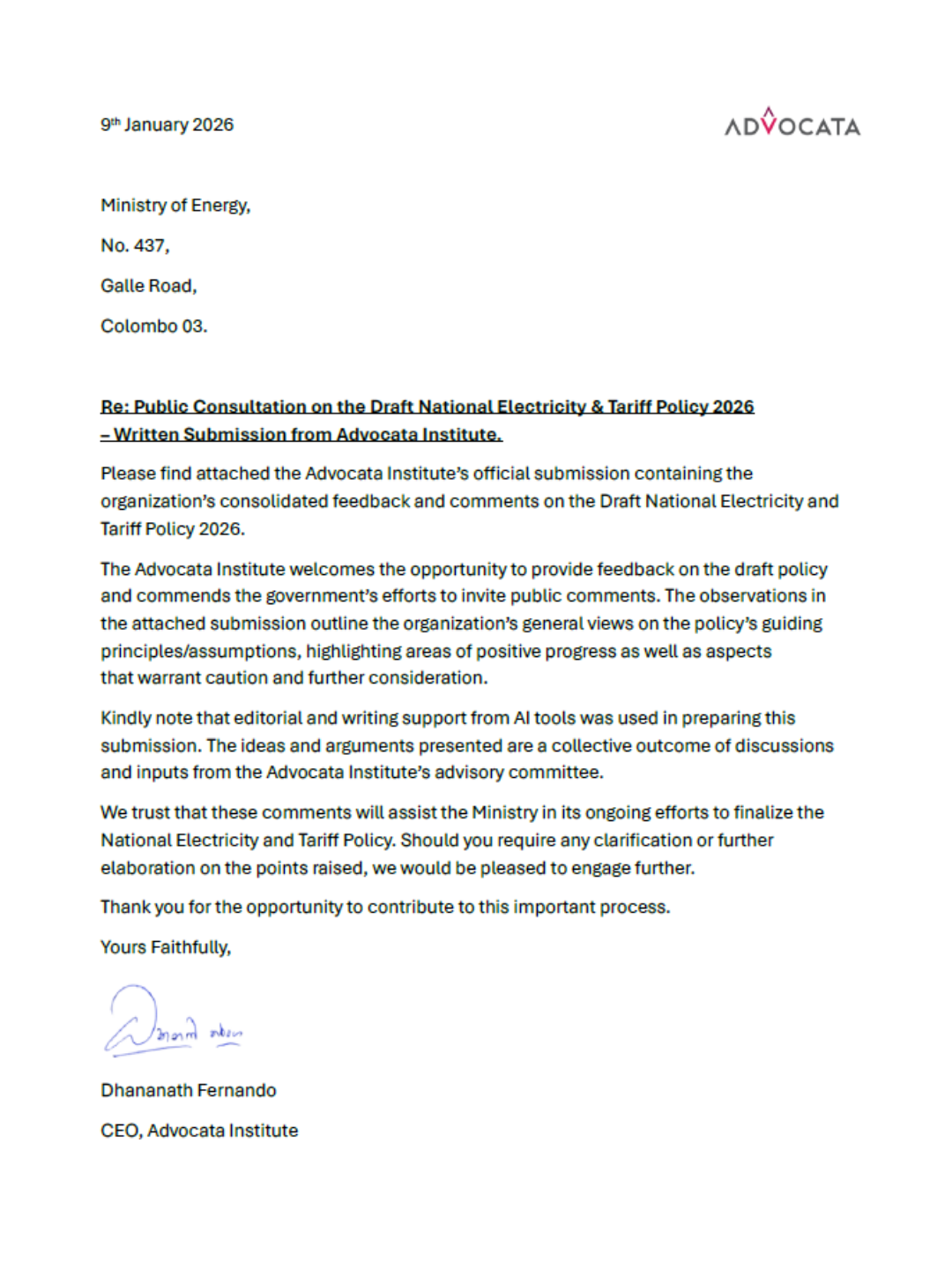
Submission from Advocata Institute. Please find attached the Advocata Institute’s official submission containing the organization’s consolidated feedback and comments on the Draft National Electricity and Tariff Policy 2026.
The Advocata Institute welcomes the opportunity to provide feedback on the draft policy and commends the government’s efforts to invite public comments. The observations in the attached submission outline the organization’s general views on the policy’s guiding principles/assumptions, highlighting areas of positive progress as well as aspects that warrant caution and further consideration.
Kindly note that editorial and writing support from AI tools was used in preparing this submission. The ideas and arguments presented are a collective outcome of discussions and inputs from the Advocata Institute’s advisory committee.
We trust that these comments will assist the Ministry in its ongoing efforts to finalize the National Electricity and Tariff Policy. Should you require any clarification or further elaboration on the points raised, we would be pleased to engage further. Thank you for the opportunity to contribute to this important process.
Yours Faithfully,
Dhananath Fernando CEO,
Advocata Institute
Pertaining to Policy Statements:
| Policy Statement | Comments |
| Policy Statement 5: Long Term Financial Sustainability of Power Sector Entities | While efficiency gains can appropriately be shared between the entity and its customers, allocating them directly to employees is not advisable. Decisions on employee compensation are a matter of corporate governance and should remain at the discretion of the entity, which operates as an independent economic actor with its own capital. Directing efficiency gains to staff risks undermining the logic of the firm, and does not contribute to the long-term financial sustainability of the entity. Any gain-sharing framework should therefore focus on strengthening the entity’s capital base and benefiting end-use customers, rather than prescribing the internal compensation structure. |
| Concurrent policy statement II: Share of renewable energy-based electricity generation shall be enhanced | While renewable energy can be sustainable, it is not inherently lower cost or fully dispatchable, as grid stability and storage solutions require significant additional investment. By contrast, conventional energy sources already have stored energy in their fuel. To ensure reliability, renewable energy requires investment in storage and grid stabilization, which increases costs. The policy should clearly state the objective of promoting renewable energy—whether for sustainability, cost, or energy security—rather than conflating multiple goals within the same section. |
Pertaining to Results Delivery Framework:
| Results Delivery Framework | Comments |
| 1.(a) | The lifeline tariff assumes that low electricity consumption reflects low household income, which is not necessarily the case. Using electricity consumption as a proxy risks mistargeting subsidies. We recommend instead providing targeted support to low-income households through programs such as Aswesuma, allowing cash transfers to reach those who need them without relying on electricity usage as a proxy. |
| 1.(b) | We commend this, and urge its prompt implementation. |
| 2.(a)(ii) | While promoting economic activity is an important objective, this provision falls outside the core mandate of the electricity sector, and we recommend removing this. |
| 2.(e) | We commend this, and urge its prompt implementation. |
| 3.(c) | Similar to our comments for 1.(a) |
| Concurrent policy IV | Include clauses related to data protection and sharing as well as protecting cyber security in the results delivery framework. |
| Concurrent policy VI | Results delivery framework for concurrent policy VI is welcome and commendable. |
Pertaining to Policy Statements:
| Policy Statement No. | Comments |
| 7 | Electricity is a non-storable commodity whose economically relevant unit is instantaneous delivery, making it inherently a spot product, as large-scale storage is costly and physical supply cannot easily be smoothed over time. Attempting to smooth prices artificially, for example through the balance sheet of the CEB, undermines the purpose of sending efficient price signals to consumers. While it may be premature to expose all end-users to spot prices, bulk supply consumers, which account for 48% of total connections excluding LECO as of 2024, can be transitioned to spot pricing. This allows them to adjust consumption based on actual system conditions, while indirectly providing some smoothing for retail consumers without distorting price signals. |
| 8 | Legacy policy costs, which were historically designed, should be socialized rather than incorporated into electricity tariffs. Including them in tariff calculations risks distorting prices at the margin and misallocating resources. A more efficient approach is to treat these costs on the government’s balance sheet and recover them through the broader tax system, for example, by including electricity under VAT. This not only ensures that tariffs reflect the true cost of supply but also broadens the VAT base and provides a sustainable mechanism to finance legacy obligations. Keeping electricity outside VAT also distorts relative energy prices, since other energy sources such as petrol and diesel are subject to VAT while electricity is not. As the green transition shifts energy consumption increasingly towards electrification, taxing electricity becomes even more important to protect and broaden the tax base, particularly as consumption of heavily taxed fossil fuels is expected to decline. |
| 9 | We commend Strategy 9, which aims to benchmark end-user tariffs against those in comparable economies in South and Southeast Asia, as this provides a useful reference for ensuring competitiveness and efficiency in pricing. |
Pertaining to Strategies, Actions and Timeframe:
| Strategies, Actions and Timeframe | Comments |
| 1.1.4 and 2.3.12 | Could you clarify the basis for assuming a 2% return on legacy assets? This figure appears unusually low, and it would be helpful to understand the methodology or assumptions behind it. |
| 1.4.2 | Concerned, because you might end up increasing the tariff. |
| 1.4.5 | Advocata commends this approach |
| 1.4.6 | We commend this approach; however, we note with concern that it will not apply to past contracts, which could create opportunities for unjust enrichment. |
| 2.2.3 | As the NSO will be incorporated under the Companies Act, it should at a minimum comply with the statutory requirement to file audited accounts within 6 months of the financial year-end. However, most financial regulators require regulated entities to submit audited accounts within 4 months. We therefore recommend aligning the NSO with this best practice by requiring it to submit its audited financial statements to the regulator within 4 months, and to make them publicly available on its website, in order to strengthen transparency and accountability. |
| 2.3.10 and 2.6.11 | Using the Consumer Price Index (CPI) as an indexation factor for operations and maintenance costs is inappropriate, as CPI is heavily influenced by food and other consumer items that are not relevant to utility cost structures. A Producer Price Index (PPI), particularly for manufacturing, would provide a more accurate and relevant measure of cost movements for O&M expenses. |
| 2.3.14 | Licensees should give audited accounts within 4 months and not 9 months. |
| 3.2.2 | Price-based competition is a fundamental feature of open access. Restricting entities from offering lower prices would effectively prevent others from purchasing competitively, undermining the purpose of open access and reducing market efficiency. Any policy that limits such competition risks nullifying the benefits intended from allowing multiple suppliers. |
| 4.2 | Advocata commends this overall strategy. |
| 4.2.3 | We commend this, however there is no need to wait until 2030 to implement simplified and improved end-user tariffs; these reforms |
| 4.2.5 | This approach is also commendable, particularly for introducing an analytical method to determine time-of-use energy tariffs for end-use bulk customers and for energy transfers from transmission to distribution. |
| 4.2.8 | We commend this, however there is contradiction/ambiguity in this statement, especially when compared with what is stated in strategy 1.4.6. These two provisions appear inconsistent. One suggests that new prosumers from 2026 will continue under net metering or net accounting, but on time-of-use tariffs, while the other states that all new rooftop solar agreements from 2026 onwards must be on a Net Plus basis. Both cannot apply at the same time to the same group of customers, and the policy needs to clearly state which settlement mechanism will apply to new connections. |
| 5.1.4 | This approach is commendable; however, there is no need to wait until 2030 to implement it. The reforms can and should be brought forward to deliver benefits sooner. Timeline should be 2028. |
| 5.1.6 | We recommend moving away from the use of lifeline tariffs as a targeting mechanism, as low electricity consumption does not reliably correspond to low household income or household size. The current approach results in cross-subsidisation within the tariff structure, rather than transparent and well-targeted support. A more efficient and equitable approach would be to provide direct cash transfers to low-income households through schemes such as Aswesuma, funded through the budget, instead of embedding social assistance within electricity prices. |
| 5.2 | There is no strong justification for socializing the cost of street lighting through the distribution licensees. These costs should instead be borne and managed by the relevant municipal councils, which are generally responsible for public lighting services. Consistent with the principle of subsidiarity, public functions should be exercised at the lowest level of authority capable of delivering them effectively, with higher-level intervention justified only where scale, spillovers, or systemic risk require it. Accordingly, there is no clear need to establish a separate entity for street lighting, as these functions can be effectively handled by municipal councils within their existing mandates. |
| 7.2 | We recommend that bulk supply consumers, who represent 48% of total consumers (13,719 accounts as of 2024, according to the Ceylon Electricity Board), be exposed to spot prices, so that price signals better reflect actual system conditions and costs. |
High level points on the National Electricity Policy -15 December 2025 for discussion2
1The contributor is a Sri Lankan national who works in an energy regulator in a developed western economy.
2The author does not have Sri Lanka specific industry knowledge, and these points are based on general knowledge of electricity regulatory frameworks.
3Page 2.
4Policy Statement description, p.4.
5The least cost generation plan and long-term power system development plans may include these standards.
6However, unserved energy caused reliability shall be minimised. No specific value mentioned, providing electrical services at optimum cost to the national economy, 3(d), p.6.
7Concurrent Policies, 1.
82(e), p.4.
9Policy Statement 5, p.5.
10III. Strengthening good governance, p.7.
11Ibid.
National tariff policy
Table 1 Strategies actions and timeframes
| Ref | Commentary |
| 1.1.2 | Appears to be cost of service. That is, whatever spent, however inefficient and bloated will be passed on to customers. There must be some recognition of the fact that regulated entities should not pass on risk to customers that the businesses are better placed to manage. But I recognise that this clause is only for EGL which is the CEB successor and therefore must recover debt as per some IMF clause. |
| 1.1.4 | Above competitive neutrality point. Acknowledge that 2.3.12 suggests a future review |
| 1.1.8 | Generally, in a capacity market like SL the capacity payments encompass providing ancillary service as part of the available capacity. But recognise with the transition of generation from spinning wheels/turbines to solar PV, additional contracts may be needed to ensure ancillary services when spinning wheels/turbines are not running. Suggest getting it stated that the NSO is required to set out a guideline on how ancillary service will be contracted and procured competitively. This allows for new technologies to compete. Ex. Batteries, synchronised condensers, grid forming converters other future technologies. I believe this important and good for efficient least cost outcomes. |
| 1.3.4 | Should fixed and variable cost be explained more, or reference to an accounting standard. I think it might be better to ask the NSO to put out a guideline on this. Policy may possibly allude to capacity costs and variable costs. |
| 1.3.5 | Good recognition that the bidder is best placed to manage risks. Must add: Where the GOSL is providing risks management support, then it must be made public before bids are called and made available to all bidders subject to commona conditions. |
| 1.4.2 | Important to note investment certainty and the future tariff changes may have a chilling effect on investment. Must make clear that no ex-post adjustments be made. |
| 1.4.3 | System wide costs such as distribution system strength requirements, potential lower revenue resulting in those that can’t afford solar PV paying more so that DN can recover its |
| costs, equity issues must be considered. Consider some fixed charges for those with PV?? Vexed issue globally. | |
| 1.4.5 | This is dangerous. It may look nice to fix a cap based on last PPA but that assumes that the sun shines 24/7. If LCOE for wind is higher but available largely from 5-10pm this rule becomes nonsensical. This MUST be studied carefully!! |
| 1.4.6 | Again, needs to be studied more. Terminology differs across the world. If ‘nett plus’ means paying for every kwh produced as against paying for only the ‘nett’ which produced less consumed, then this is a big cost impost and a wealth transfer from those that cannot afford PV to those who can afford. Look at other options to solve measurement problem. Do a cost benefit analysis and decide what’s the least cost. |
| 1.4.7 | If VPP (virtual power plant- digital aggregator??) development is the intention, then this capped price (via 1.4.5) approach will not work. Any investor that participates in a pilot has to price risk of failure etc. In developed world most pilots are subsidised by the governments and the knowledge garnered from pilot socialised. Rethink!! |
| 1.4.8 | Ex post taking of money if investment is already made? |
| 1.4.9 | Is this practical. I guess battery will only have charge via PV and discharge via grid. Appears impractical, should get this clarified. |
| 1.5.2 | What is a resource cost? |
| 1.6.1 | NO! There must be some sort of ring-fencing so that bad behaviour etc should not be paid for by consumers. Be more specific of what type of costs? |
| 1.6.2 | NO! Should not be a blanket clause. Something like, where it is shown that a reasonably prudent owner could not get insurance for the event and /or consequential damage of the event. Not paying insurance premiums increases profits and passes risks to consumers who have no expertise to manage those risks. |
| 2.1.5 | Lots of words but key words are missing …despatch at lowest marginal cost to satisfy demand whilst maintaining system security, in SL context might have to add free hydropower first as per (assume) hydro plan with reservoir control authorities. Thermal generators should be despatched based on their contracted/bid variable costs as they get capacity payments via the PUCSL tariff payments. |
| 2.2.1 | Is this efficient? Should we have some locational price signalling? Complicated area whole world is grappling with nodal pricing, locational pricing etc but some locational signalling should be included |
| 2.2.3 | MUST publish and annual despatch engine audit. I assume PUCSL checks the lowest marginal cost despatch |
| 2.3.2 | Does not make sense? If asset is completed why file as per long-term development plan when you have actual costs? |
| 2.3.4 | Generally accounting depreciation and regulatory depreciation are different. Statutory accounts are driven by profit maximisation whereas reg depreciation tries to ensure depreciation matches economic life very closely so that inter-generational equity is maintained for consumers. |
| 2.3.5 | This requires a guideline or a document setting out the basis of how financiability stress is evaluated and the basis of accelerated depreciation. |
| 2.3.6 | What does capital remuneration for replacement assets even mean? |
| 2.3.8 | Looking forward to seeing this guideline on a benchmark efficient cost of debt |
| 2.3.9 | Is insurance premium a fixed cost? Does it get added to the asset value and therefore earn a return on it?? Why is there an insurance fund? Does the TN self-insure and the PUCSL approves the fund as per prudential requirements? Does a TN have the skills and knowledge of actuary work. So given there is a fund, I assume that any shortfall on self-insured assets are not passed on to consumers if there is an insurance event. |
| 2.3.11 | Hmm! So the regulator manages the capex of the business line by line. What is the incentive for the TN put an efficient capex proposal and get it done on time? |