The Role of trade in economic recovery in Sri Lanka
As Sri Lanka faced growing economic challenges in 2021, questions surrounding the country’s approach to international trade became increasingly important. With the economy under pressure and the need for sustainable sources of foreign exchange becoming more urgent, the role of trade in supporting economic recovery was a critical issue for policymakers.
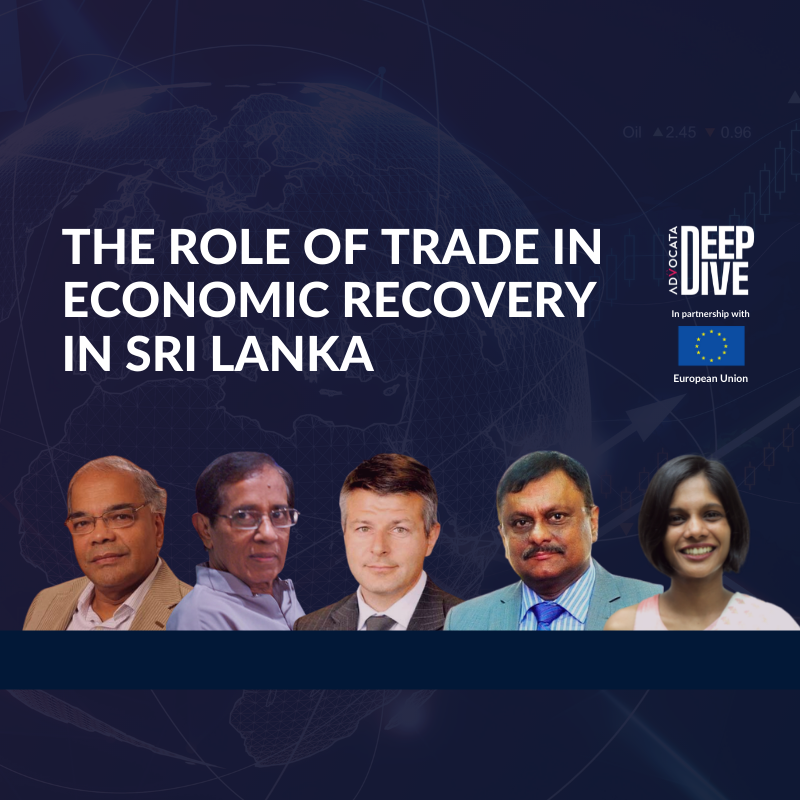
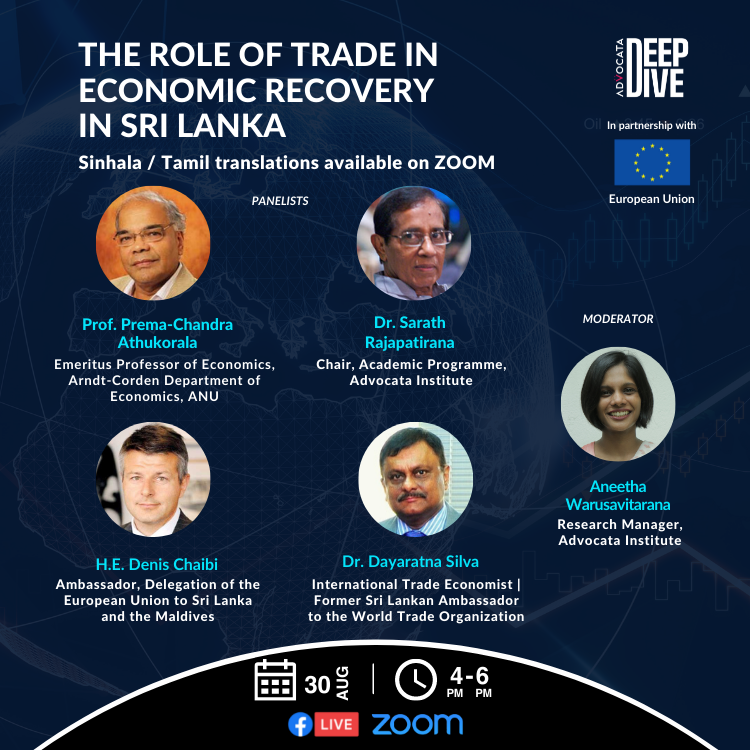
Against this backdrop, the Advocata Institute hosted the second episode of its Deep Dive discussion series on 30 August 2021, focusing on “The Role of Trade in Economic Recovery in Sri Lanka.” The online discussion brought together economists, trade experts and a representative of the European Union to examine Sri Lanka’s trade policies and the role that greater integration with the global economy could play in the country’s recovery.
The discussion featured Prof. Prema-Chandra Athukorala, Emeritus Professor of Economics at the Arndt-Corden Department of Economics at the Australian National University; Dr. Sarath Rajapatirana, Chair of the Academic Programme at the Advocata Institute; H.E. Denis Chaibi, Ambassador of the Delegation of the European Union to Sri Lanka and the Maldives; and Dr. Dayaratna Silva, International Trade Economist and former Sri Lankan Ambassador to the World Trade Organization. The discussion was moderated by Aneetha Warusavitarana, Research Manager at Advocata Institute.
Understanding international trade
The discussion was preceded by a primer by Dr. Sarath Rajapatirana titled “International Trade: From Theory to Policy: Sri Lanka in Perspective.” The primer provided an introduction to the principles of international trade and examined Sri Lanka’s experience from both a theoretical and policy perspective.
Beginning the discussion with this primer was intended to provide the broader context necessary to understand Sri Lanka’s trade policies. International trade is not simply about the buying and selling of goods across borders. It can influence a country’s access to markets, investment, technology, productivity and foreign exchange, making trade policy an important component of wider economic policy.
For a small open economy such as Sri Lanka, the ability to participate effectively in international markets is particularly important. Access to international markets allows domestic firms to reach consumers beyond the country’s relatively small domestic market, while imports provide access to goods, services, technology and inputs that may not be produced competitively within the country.
Trade and economic recovery
One of the central questions explored during the Deep Dive was how trade could contribute to Sri Lanka’s economic recovery.
A country’s ability to generate foreign exchange through exports is an important consideration when facing external economic pressures. Export earnings can provide the foreign currency needed to pay for imports, service external obligations and support economic activity.
At the same time, trade policy can influence the incentives facing businesses. Policies that make it easier for firms to access imported inputs, technology and international markets can affect their ability to compete and expand.
The discussion therefore considered the broader relationship between trade policy and economic growth. Rather than viewing trade in isolation, the event placed it within the wider question of how Sri Lanka could establish an economic framework capable of supporting recovery and long-term growth.
Sri Lanka’s approach to trade policy
Sri Lanka has historically maintained a relatively protectionist approach towards parts of its economy, using tariffs and other trade restrictions to protect domestic industries.
While protection can sometimes be used to support particular industries, trade restrictions can also affect the wider economy. Higher barriers to imports can increase the cost of inputs for domestic producers, reduce competition and limit consumers’ access to goods.
The discussion provided an opportunity to consider these trade-offs and examine whether Sri Lanka’s existing approach was enabling businesses to become more competitive in international markets.
For an economy seeking stronger export growth, the relationship between import policy and exports is particularly important. Exporting firms frequently rely on imported machinery, raw materials, intermediate goods and other inputs. Consequently, barriers affecting imports can also have implications for the competitiveness of exporters.
This makes trade policy an important part of the broader business environment.
Connecting Sri Lankan businesses with global markets
Greater participation in international trade can provide domestic businesses with opportunities to access larger markets.
The domestic market alone may not provide sufficient scale for businesses to grow, particularly in sectors where firms can achieve greater efficiency by producing for international consumers. Export markets can provide opportunities for firms to expand production, develop new products and improve their competitiveness.
International integration can also expose domestic firms to greater competition. While this can create challenges for less competitive businesses, competition can encourage firms to improve productivity, adopt new technologies and innovate.
The discussion therefore considered trade not merely as a mechanism for increasing exports, but as part of a broader process of economic transformation.
The importance of international economic relationships
The participation of H.E. Denis Chaibi brought an international perspective to the discussion, particularly regarding Sri Lanka’s relationship with the European Union.
The European Union represents an important trading partner for Sri Lanka and is a significant destination for Sri Lankan exports. Engagement with international partners can therefore play an important role in expanding market access and strengthening Sri Lanka’s participation in global trade.
Sri Lanka’s trade relationships extend beyond individual agreements or markets. They form part of a broader network of economic relationships that can influence investment, exports, standards and access to international markets.
Maintaining and strengthening these relationships is therefore an important consideration for any long-term trade strategy.
Learning from international experience
The participation of Prof. Prema-Chandra Athukorala and Dr. Dayaratna Silva also brought significant expertise in international trade and Sri Lanka’s engagement with the global trading system.
Their experience provided an opportunity to consider Sri Lanka’s trade policies within the context of developments in the international economy.
Countries that have successfully integrated into global value chains have often used international trade as a means of expanding manufacturing and services, attracting investment and increasing productivity. Understanding these experiences can help inform discussions about the reforms Sri Lanka may need to strengthen its own participation in international markets.
For Sri Lanka, this raises an important policy question: how can the country move from relying on a relatively narrow export base towards a more diversified and competitive export economy?
Trade policy as part of wider economic reform
The event also highlighted that trade policy cannot be considered independently from other economic policies.
The competitiveness of exporters depends on a range of factors, including taxation, infrastructure, access to finance, labour regulations, logistics, investment policy and the overall regulatory environment.
Reducing barriers to trade can therefore be an important component of reform, but it needs to be accompanied by improvements in the broader business environment.
For Sri Lanka to increase its participation in global markets, businesses need to be able to compete on the basis of productivity, innovation and efficiency. This requires an economic environment in which firms have the incentives and freedom to invest, expand and respond to international demand.
Looking towards recovery and growth
The “The Role of Trade in Economic Recovery in Sri Lanka” discussion formed part of Advocata Institute’s broader efforts to encourage informed public debate on economic policy.
By bringing together academic expertise, international perspectives and practical experience in international trade, the event created a platform for examining how Sri Lanka could make greater use of trade as part of its economic recovery.
The discussion was particularly relevant given the economic pressures facing the country at the time. It encouraged participants and viewers to consider not only how Sri Lanka could increase exports, but also how its broader trade policy could contribute to productivity, competitiveness and sustainable economic growth.
Ultimately, the role of trade in Sri Lanka’s economic recovery extends beyond increasing the value of goods and services sold overseas. It involves determining how the country engages with the global economy, how domestic businesses compete internationally and how economic policy can create an environment that encourages investment, innovation and productivity.
The Deep Dive discussion provided an opportunity to explore these questions and consider what a more outward-oriented and competitive Sri Lankan economy could look like.
The event was part of Advocata Institute’s Deep Dive series, which seeks to provide accessible and informed discussions on important public policy issues affecting Sri Lanka.