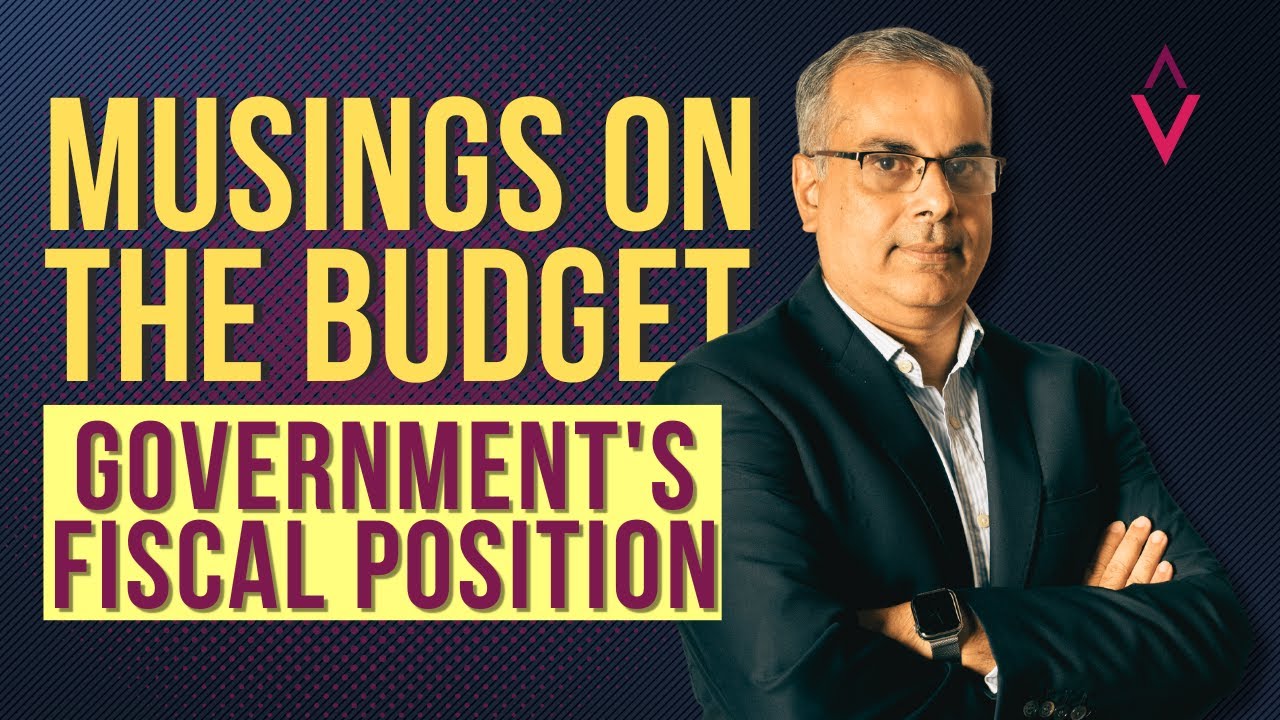
Musings on the budget, unsolicited advice on fiscal policy: Insider Perspectives with Murtaza Jafferjee
Date: 19 December 2024 Time: 5:30 PM Format: Online webinar (Zoom) Speaker: Mr Murtaza Jafferjee, CFA — Chair, Advocata Institute
Every December, as Sri Lanka’s national budget takes shape, the same questions resurface: why does the country keep running into balance-of-payments trouble, who really pays for tax policy decisions, and what will it take to break the cycle of recurring fiscal crises? In this webinar, Murtaza Jafferjee, Chair of the Advocata Institute, walks through the data and the economics behind these questions, cutting through the noise around Sri Lanka’s fiscal choices to offer a grounded, evidence-based reading of where the country stands heading into 2025.
Rather than simply reacting to the year’s budget announcements, the session builds a complete analytical picture from the ground up — starting with basic macroeconomic accounting and ending with a hard look at Sri Lanka’s debt trajectory. Along the way, it challenges a number of assumptions that dominate public discussion of the economy: that white elephants alone explain the crisis, that exporting more is a sufficient fix, that tax incentives are what draws investment, and that subsidies are the best way to protect the vulnerable.
The presentation draws heavily on data from the Department of Census and Statistics, the Central Bank of Sri Lanka, the IMF, and Advocata’s own research, giving the audience a rigorous, numbers-first grounding for what are often treated as purely political debates.
Starting from first principles
The presentation opens by revisiting the three standard ways of measuring GDP — the income, expenditure, and production approaches — before showing how Sri Lanka’s output is actually distributed across agriculture, industry, and services. From there, Jafferjee derives the identities that connect national savings, investment, the fiscal balance, and the current account, laying the analytical groundwork for everything that follows. This is the often-overlooked “twin deficits” framework: the idea that a country’s balance-of-payments position is inseparable from what is happening inside its government budget and its private sector’s saving and spending behaviour.
Why Sri Lanka keeps hitting balance-of-payments trouble
With that framework established, the session turns to the central diagnosis: Sri Lanka’s repeated balance-of-payments crises are not the result of bad luck or external shocks alone, but of sustained excess “absorption” — spending, both consumption and investment, beyond what the economy can sustainably finance. Three forces are identified as driving this: persistently loose fiscal policy, with large primary deficits compounded by a heavy interest burden; loose monetary policy, in which fiscal pressures pushed real interest rates into negative territory; and the misallocation of resources caused by administered prices and poorly targeted subsidies.
Importantly, the presentation pushes back on the popular narrative that blames the crisis solely on a handful of high-profile government infrastructure projects. Yes, projects like the Hambantota Harbour, Mattala International Airport, the Lotus Tower, and the lesser-known Oluvil Harbour (funded by a Danish loan and left commercially unviable due to environmental issues) are examined as textbook “white elephants.” But the data shows that the bulk of the country’s excess investment actually came from the private sector — households and firms — much of it encouraged by generous tax incentives that disproportionately benefited wealthier segments of society. Credit growth, the presentation shows, fuelled both consumption and investment across sectors from construction to consumer durables, and this private-sector overreach deserves just as much scrutiny as public megaprojects.
Is exporting more the answer?
A recurring prescription for Sri Lanka’s external woes is “export more.” The session tests this idea against Turkey’s experience — a country often cited for its export-led growth and diversified trade basket — before examining Sri Lanka’s own trade and current account trends. The comparison sets up a more nuanced conclusion: export growth alone cannot resolve a balance-of-payments problem rooted in domestic spending patterns and macroeconomic policy choices.
Tax policy: who really pays
A substantial portion of the presentation is devoted to unpacking Sri Lanka’s tax system. It shows that government revenue as a share of GDP has been catching up to regional peers such as Bangladesh, Vietnam, and the Philippines, but from a very low starting point, and increasingly on the back of indirect, consumption-based taxes rather than income taxes — a structural shift with real implications for who bears the tax burden.
Vehicle taxation is highlighted as a case study in policy gone wrong: a system that mixes quantity-based and ad valorem (luxury and VAT) taxes in a way that creates significant market distortions and opens the door to corruption, illustrating a broader point that administrative problems cannot be solved through tax policy alone. The session also walks through recent changes to personal income tax bands and the tax-free threshold, mapping them against actual household income and expenditure data across deciles to show who gains and who doesn’t.
On tax incentives, the presentation examines Sri Lanka’s long-running practice of granting extensive exemptions — under instruments like the Strategic Development Projects Act and the Colombo Port City framework — with holidays running as long as 25 years and covering VAT, income tax, and other levies. Drawing on investor survey data, it questions whether such incentives are actually the deciding factor in investment decisions, noting that political and economic stability, market access, and labour availability consistently rank as more important to investors than incentive packages.
The equity question in sectoral taxation
The webinar also takes a close look at “sin taxes” on cigarettes and alcohol, showing how these are dominated by excise duties and fall disproportionately on lower-income households as a share of their non-food spending — a clear equity concern even as these categories continue to generate rising tax revenue for the government, despite falling consumption volumes.
Subsidies versus cash transfers
Turning to government spending, the presentation reviews how subsidies are structured across fertilizer, electricity, water, and kerosene, including the tiered pricing schemes used for utilities. It makes the case that direct cash transfer programmes, such as Samurdhi, are a more efficient and better-targeted way to support low-income households than blanket price subsidies — though Samurdhi’s share of total government spending has fluctuated well below the levels needed to meaningfully close welfare gaps.
The debt reckoning
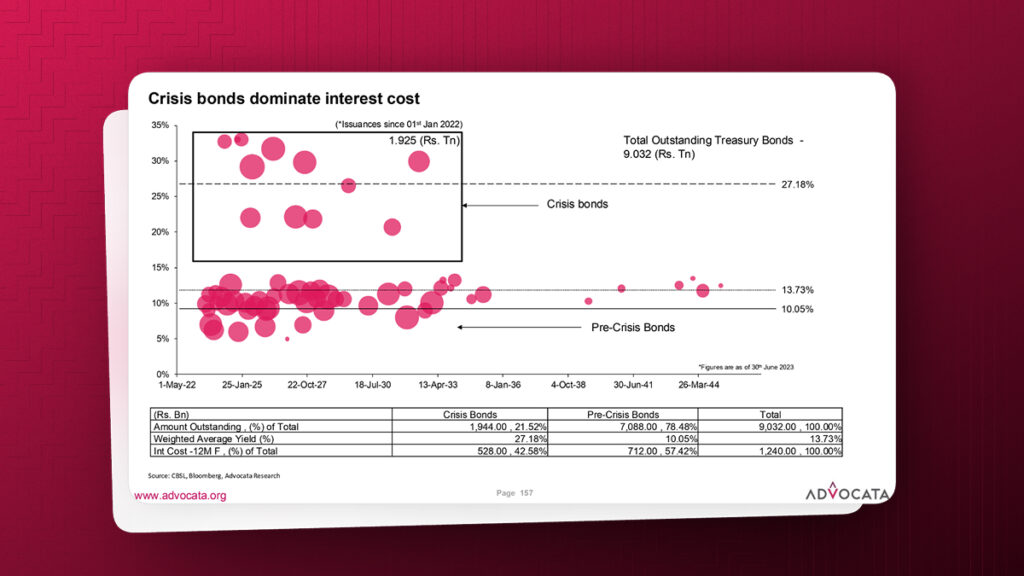
The session closes on its most sobering material: Sri Lanka’s debt dynamics. In 2023, interest payments alone consumed over 90% of total tax revenue — a figure that frames just how constrained the government’s fiscal room truly is. The presentation breaks down exactly what has driven the country’s debt-to-GDP ratio over time, separating out the effects of real interest rates, economic growth, exchange rate movements, and primary balances, and situates Sri Lanka’s position against IMF debt-sustainability stress tests. It also highlights how “crisis bonds” — debt issued since January 2022 at sharply elevated yields — now account for a disproportionate share of the country’s total interest cost.
The presentation ends on a note that is cautious but not without hope: Sri Lanka is at a critical juncture, and if the right policy choices are made now, there is a genuine chance to break the pattern of recurring crises that has defined the past several decades.
For anyone trying to make sense of Sri Lanka’s economic trajectory beyond the headlines — policymakers, business leaders, investors, students, and engaged citizens alike — this session offers a rare combination of technical rigour and plain-spoken clarity, making a complex and often politicised subject genuinely accessible.
About the Speaker
Murtaza Jafferjee, CFA Chair, Advocata Institute
Murtaza Jafferjee is an investment professional with over 25 years of experience in Sri Lanka’s capital markets. He is the CEO of JB Securities Ltd and has served as Chairperson of the Advocata Institute since 2020, having been a founding member of the Institute when it was established in 2016.
Over the course of his career, Jafferjee has held several senior governance roles, including as an elected director of the Colombo Stock Exchange and as a director of Nations Trust Bank and Serendib Hotels PLC. He is a past president of the CFA Society of Sri Lanka, the local member society of the CFA Institute, where he also previously served as Advocacy Chair, working to promote good ethical practice in the industry.
He holds a Bachelor’s degree in Mechanical Engineering and Computer Science from the University of New South Wales, Australia, and a Master’s degree in Financial Economics from the University of Colombo. He is a Chartered Financial Analyst (CFA).
At Advocata, Jafferjee has been a consistent voice for evidence-based public policy, advocating for competitive, well-regulated markets and greater economic freedom as the path to sustainable growth for Sri Lanka.