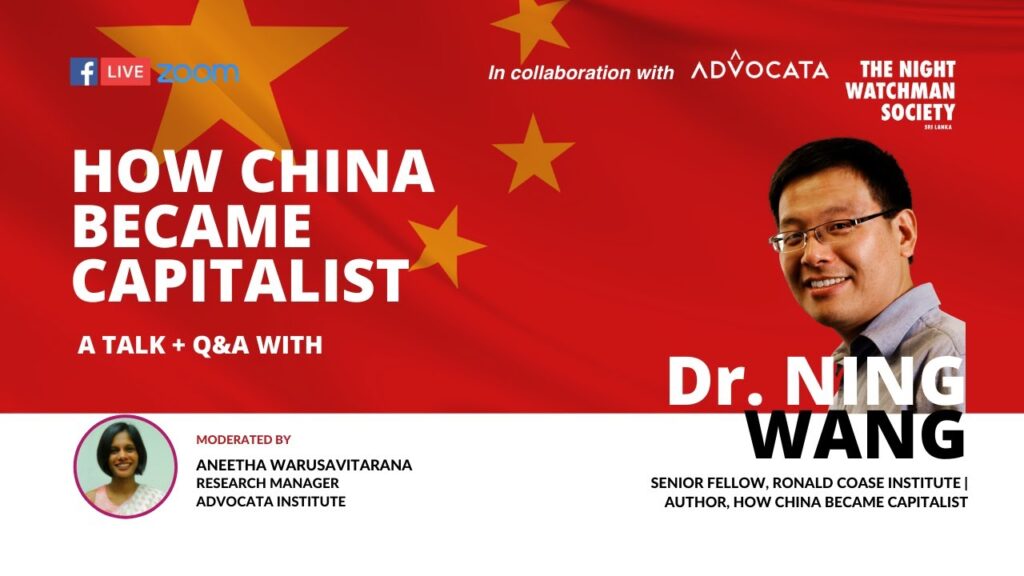
How China Became Capitalist: A talk + Q&A with Dr. Ning Wang
Overview
Advocata held a virtual talk and Q&A, hosted by The Night Watchman Society in collaboration with the Advocata Institute. The session explores China’s market transformation from Maoist policies to state-led capitalism, highlighting key insights from Dr Ning Wang’s co-authored book, How China Became Capitalist.
Event Information
- Title: How China Became Capitalist: A talk + Q&A with Dr Ning Wang
- Host Organisations: The Night Watchman Society & Advocata Institute
- Date & Time: Thursday, August 12 at 6:30 PM onward
- Featured Speaker: Dr Ning Wang (Senior Fellow at the Ronald Coase Institute; Editor-in-Chief of Man and the Economy: Journal of the Coase Society; co-author of How China Became Capitalist)
- Moderator: Anita Varus (Advocata Institute)
Key Presentation Highlights
Dr Ning Wang explained that China’s transition to a market economy was not the product of a top-down master plan designed by Beijing or international advisers, but rather an unintended consequence of ordinary citizens striving to improve their daily lives. Following Chairman Mao’s death in 1976, China was plunged into severe econo mic hardship and political uncertainty. Recognising that two decades of radical socialist experiments had failed to feed the population while neighbouring East Asian economies were rapidly modernising, Chinese leadership realised fundamental changes were necessary.
To revive the economy, Beijing embraced a pragmatic approach famously captured by Deng Xiaoping’s “cat theory,” which prioritised practical economic results over ideological purity. Instead of sweeping state directives, the primary catalysts for change were bottom-up “marginal revolutions”, grassroots initiatives driven by local communities. A prime example was rural reform: when impoverished farmers secretly implemented “private farming” through the Household Responsibility System, its productivity drastically outperformed state-mandated collective farming. Recognising its clear superiority, the central government eventually endorsed the practice as national policy, fundamentally shifting the agricultural landscape.
Over the following decades, China’s economy effectively grew out of socialism as dynamic private enterprises consistently outcompeted state-owned firms. Today, the private sector is responsible for generating over 90% of all new urban jobs in the country. However, while China has successfully created open and fiercely competitive markets for goods, services, and labour, Dr Wang noted a critical structural limitation: the absence of an open “market for ideas”. Because media outlets and higher education institutions remain under strict state control, the intellectual freedom necessary for organic creation and critical inquiry remains heavily restricted.
Key Discussion & Q&A Themes
During the interactive discussion, Dr Wang addressed the dual nature of China’s political system and state capacity. China’s centralised, one-party structure allows for remarkable speed and efficiency when executing massive infrastructure developments once a political commitment is made. However, this efficiency comes at a cost, as the system lacks democratic feedback channels to balance public priorities and fails to provide the total intellectual autonomy required for top-tier, cutting-edge innovation. China built its impressive state capacity over decades by prioritising baseline literacy, training vast numbers of engineers, welcoming foreign direct investment to absorb technical and managerial expertise, and sending delegations and students across the globe to learn modern market operations.
Addressing international developments, Dr Wang highlighted the global impact of the Belt and Road Initiative (BRI). The BRI offers developing nations an alternative source of credit to finance essential infrastructure projects, such as ports, railways, and highways. Unlike traditional international financial institutions, which typically attach strict macroeconomic austerity demands or structural reform preconditions to their loans, China’s global lending model provides capital without intervening directly in host nations’ domestic policy management.