Advocata Roundtable discussion: The Role of Tax Administration in Enhancing Tax Revenue
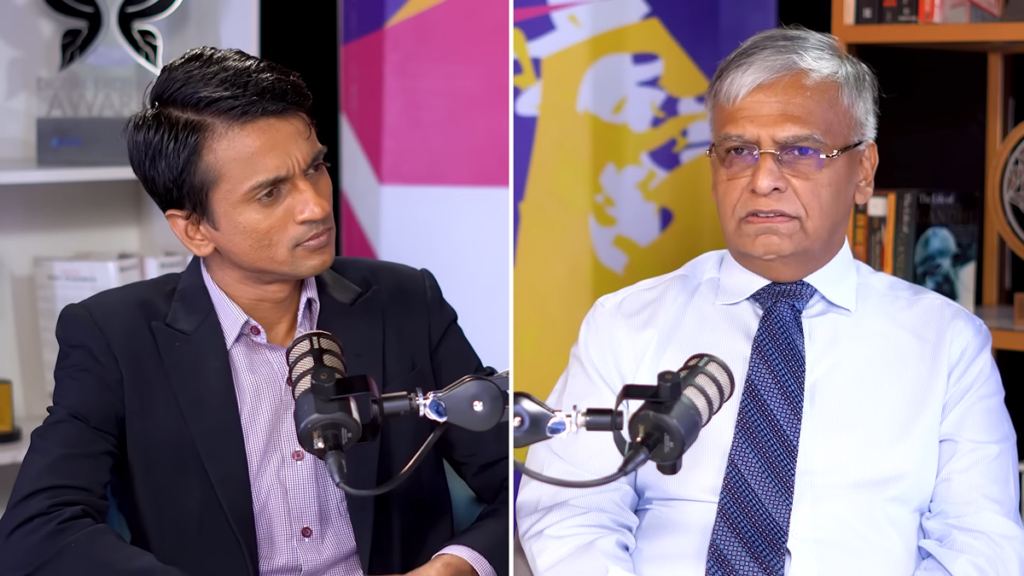
Host: Advocata Institute Panelists: Ranjith Hapuarachchi (Commissioner General of Inland Revenue) and Suresh Perera (Principal, Tax & Regulatory, KPMG Sri Lanka)
Moderator: Dr. Roshan Perera (Senior Research Fellow, Advocata Institute)
Overview
The Advocata Institute convened a roundtable discussion on “The Role of Tax Administration in Enhancing Tax Revenue,” bringing together Sri Lanka’s most senior tax official, Ranjith Hapuarachchi, Commissioner General of Inland Revenue, with Suresh Perera, Principal for Tax & Regulatory at KPMG Sri Lanka, in a conversation moderated by Dr. Roshan Perera of the Advocata Institute. The session was streamed live on Zoom, and its smaller, roundtable format allowed for a more granular, practitioner-level conversation than a typical public panel — pairing the regulator’s perspective with that of a leading tax advisory practitioner working directly with taxpayers navigating the system.
The discussion arrived at a moment when revenue mobilisation sits at the centre of Sri Lanka’s economic recovery. With the country’s IMF-supported reform programme resting heavily on rebuilding a historically narrow tax base, the roundtable moved past the usual debate over tax rates to focus on a less-discussed but equally consequential question: whether Sri Lanka’s tax administration — the institutions, processes and systems that actually collect revenue — is capable of delivering on the country’s fiscal targets, however well-designed the underlying policy might be.
Key Discussion Points
Policy Inconsistency as an Administrative Burden
Early in the discussion, the panel turned to a theme that would recur throughout: the corrosive effect of frequent, ad-hoc changes to tax policy and legislation. Both panelists agreed that constant revision — often introduced with little advance notice — makes consistent administration extremely difficult and creates lasting uncertainty for taxpayers and the consultants who advise them. This instability was framed not merely as an inconvenience but as a structural obstacle to revenue collection in its own right, since taxpayers and businesses find it harder to plan, comply and invest under a system that keeps changing the rules.
VAT’s Structural Underperformance
Suresh Perera offered a detailed diagnosis of why Value Added Tax — in principle one of the most efficient and broad-based instruments available to the government — has consistently underperformed in Sri Lanka. He pointed to two compounding design flaws: an unusually high volume of exemptions, numbering over 130, which narrows the effective VAT base far below its statutory scope; and the persistence of what he described as a “hybrid” system, in which turnover continues to be taxed alongside genuine value addition. Together, these features distort the tax’s intended design and significantly dilute its revenue-generating potential relative to what a cleaner, broader-based VAT could deliver.
Toward a National Tax Council
Both experts converged on the need for a consistent, medium-to-long-term tax strategy — one insulated from the short-term political cycle that has historically driven Sri Lanka’s frequent tax changes. The panel’s central institutional recommendation was the establishment of a National Tax Council: an independent, expert-led body designed to depoliticise tax policymaking and provide continuity across changes in government. The rationale offered was straightforward — tax policy that is redesigned with every new administration undermines both the credibility of the system and the administrative capacity built up to enforce it, and a standing, technically-led body could provide the stability needed to sustain reform over time.
Tax Culture and the Social Contract
The discussion also addressed the less technical, more behavioural dimension of tax administration: the relationship of trust — or its absence — between the state and the taxpayer. Panelists framed revenue collection as fundamentally a two-way exchange, arguing that voluntary compliance rises when citizens can see tangible benefits and quality public services resulting from their contributions. This “social contract” framing positioned tax culture not as a fixed trait of the population but as something the state itself has a direct role in shaping, through the visible and credible use of the revenue it collects.
Administrative Coordination and Technology
Finally, the panel turned to the practical machinery of collection and enforcement. They advocated for closer coordination between Sri Lanka’s three main revenue-collecting agencies — Inland Revenue, Customs, and Excise — which currently operate with limited integration between their respective data and processes. A central recommendation here was the implementation of a unique taxpayer identification number, linked consistently across government databases, to close the monitoring and enforcement gaps that allow non-compliance to persist undetected across different arms of the revenue administration.