අපේ ඉරණම තීරණය කරන අය වැය – The Budget That Determines Our Fate
Overview
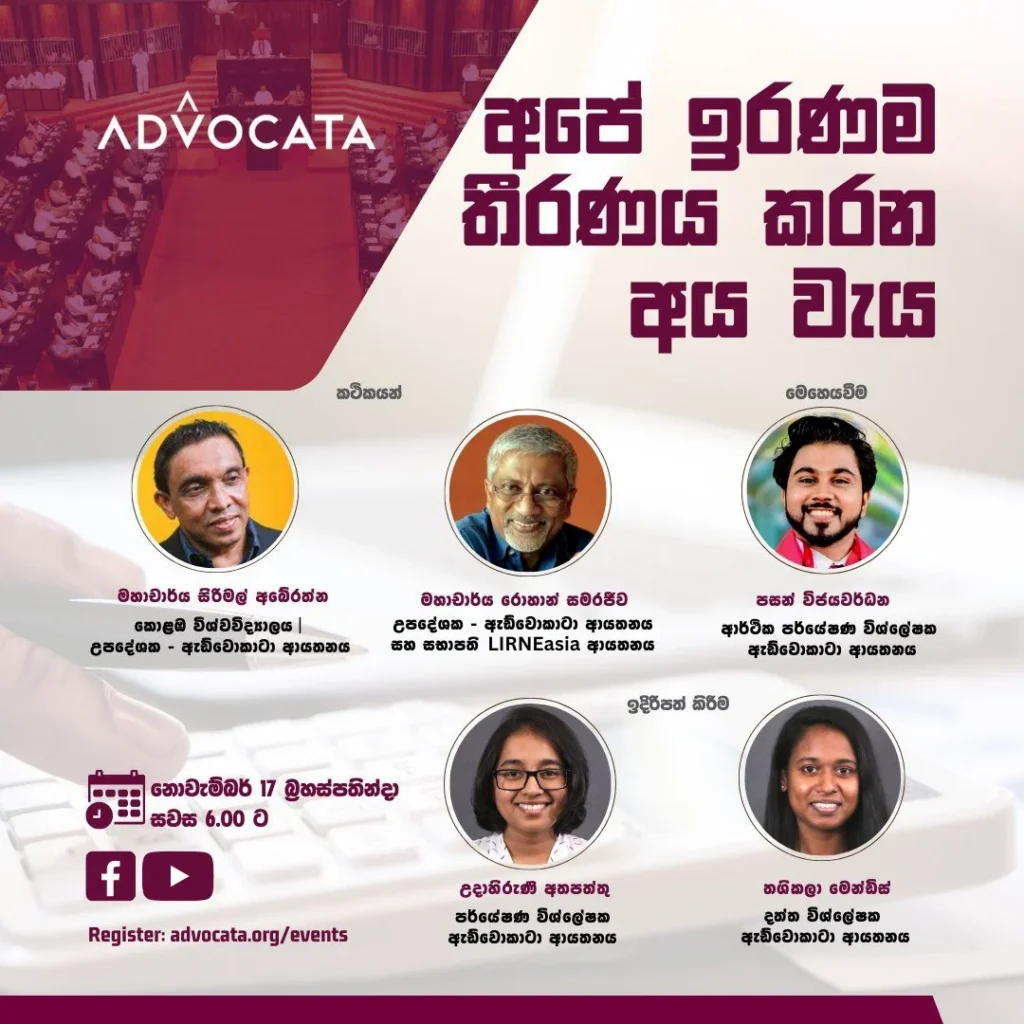
On 17 November 2022, the Advocata Institute hosted “The Budget That Determines Our Fate” (අපේ ඉරණම තීරණය කරන අය වැය), an online post-budget discussion examining Sri Lanka’s 2023 National Budget in the immediate aftermath of the country’s worst economic crisis since independence. The discussion was conducted in Sinhala to reach a broad domestic audience and was livestreamed on Advocata’s Facebook and YouTube channels, reflecting the organisation’s continued push to make budget analysis accessible beyond the usual audience of economists and policymakers.
The session was framed around a set of questions with immediate relevance to households and businesses navigating the crisis: how the government intended to reduce the budget deficit, what tax and expenditure reforms the 2023 Budget would introduce, and — critically — how fiscal policy would respond to the rising socio-economic toll of the crisis, including deepening poverty and malnutrition.
Format
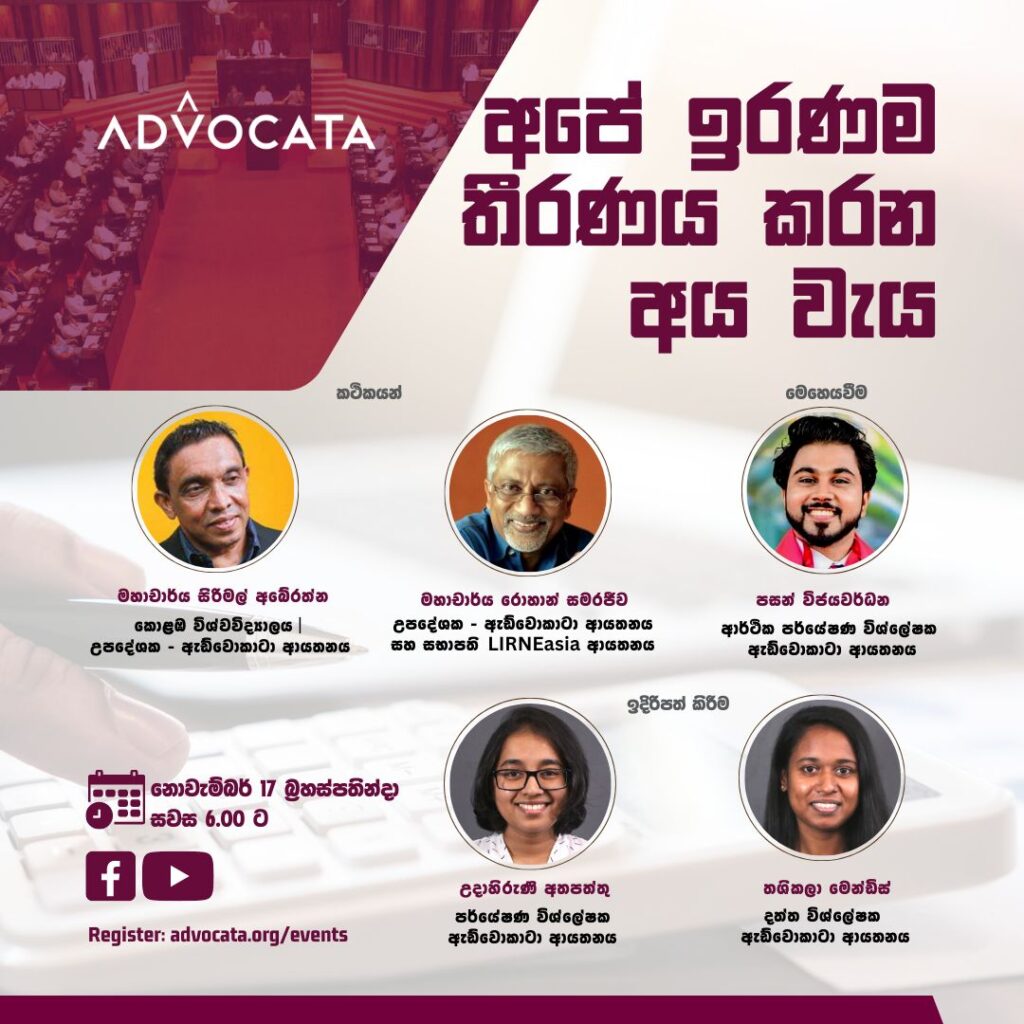
The event combined short technical presentations with an expert panel discussion, a format Advocata has used consistently across its budget-analysis programming to ground high-level policy debate in the underlying data.
Udahiruni Atapattu and Thashikala Mendis, Research and Data Analysts at Advocata respectively, opened the session with presentations on government expenditure and revenue trends. These presentations were intended to set the empirical baseline for the discussion that followed — situating the 2023 Budget’s specific tax and spending proposals within the broader trajectory of Sri Lanka’s public finances, at a time when the government was under significant pressure to close a wide fiscal gap while negotiating an IMF-supported reform programme.
Panel Discussion
The panel discussion that followed brought together two of Sri Lanka’s most prominent economic commentators: Prof. Sirimal Abeyratne of the University of Colombo, and Prof. Rohan Samarajiva, Founding Chair of LIRNEasia and an Advocata advisor, in conversation with moderator Pasan Wijayawardhana.
The discussion centred on the core fiscal questions the crisis had made unavoidable. On the revenue side, panelists examined the tax reforms contained in the budget — part of a broader push to widen Sri Lanka’s historically narrow tax base and rebuild government revenue after years of erosion, a theme central to the fiscal consolidation path required under the IMF programme. On the expenditure side, the discussion turned to where and how the government proposed to cut spending, and the trade-offs involved in pursuing deficit reduction without further destabilising an economy already under severe strain.
A significant portion of the conversation addressed the human cost of the crisis directly: how the budget’s fiscal commitments squared with the country’s worsening socio-economic indicators, including rising poverty rates and growing concerns over malnutrition, particularly among vulnerable households hit hardest by inflation and currency depreciation. Panelists weighed the extent to which the budget’s welfare and social protection allocations were adequate to the scale of need, against the competing imperative of fiscal discipline demanded by the broader stabilisation effort.
Throughout, the panel’s analysis returned to a central tension that has defined Sri Lanka’s post-crisis policy debate: the need to restore macroeconomic stability and rebuild fiscal credibility, set against the risk that overly rapid consolidation — through taxation, spending cuts, or both — could deepen hardship for households already struggling with the effects of the crisis. Panelists stressed that the choices made in the 2023 Budget would have consequences well beyond the immediate fiscal year, shaping the pace and shape of the country’s recovery for years to come — a framing reflected in the event’s title.
Significance
The discussion took place at a pivotal moment for Sri Lanka’s economic reform trajectory, with the 2023 Budget representing one of the first major fiscal statements of the post-crisis period and a key test of the government’s commitment to the structural reforms underpinning its engagement with the IMF. By pairing rigorous, data-driven presentations with expert commentary — delivered in Sinhala and distributed via free livestream — Advocata sought to broaden public understanding of the budget’s implications beyond specialist and English-language policy circles, at a time when the budget’s outcomes stood to affect nearly every Sri Lankan household.